Get in Touch with Xiamen Huandao Packaging Technology Co., Ltd.

Paper Bags with Handles: 5 Systems, Tests & Failures

A paper bag with handles is a load-carrying assembly, not a piece of paper with a cord added to it. The grip, anchor, patch or eyelet, top fold, body paper, side seam, bottom, packed product and carrying conditions determine the finished product. GSM indicates the mass of the paper in grams per square meter. It doesn’t indicate the maximum load the assembled bag can carry.
This guide shows how to compare 5 handle systems, write a packed-product brief, choose evidence that answers the right question, review environmental wording and keep an approved sample tied to production. Clients who have defined their use case may proceed from this technical document to custom paper bags with handles for a defined product and order. That product page has configuration and pricing; this page is about engineering and verification.
A stock shop may categorize brown paper bags with handles, kraft paper gift bags, party favor bags, wedding gift bags and birthday merchandise under one search term. Those search terms help a shopper locate a pack or bulk gift bag, but they don’t identify the attachment, test scope or safe use. A retail buyer needs a different record.
A catalog may classify a similar format as kraft paper bags with handles, paper gift bags with handles or gift bags with paper handles. The specification needs to name the anchor. Brown paper gift bags, kraft gift bags and kraft brown paper may overlap in appearance but have different constructions.
Kraft brown paper gift bags require a revision-specific record. The phrase doesn’t tell us what was tested.
A medium retail bag requires the same evidence. The craft lies in converting a visible design into a controlled construction that a shop team can repeat.
Buyer rule: Approve the construction you tested, within the conditions you noted, for the product you actually pack. Treat every subsequent step beyond that scope as a new question; do not deem it an automatic pass.
Why Paper Bag Handles Fail When GSM Looks Adequate
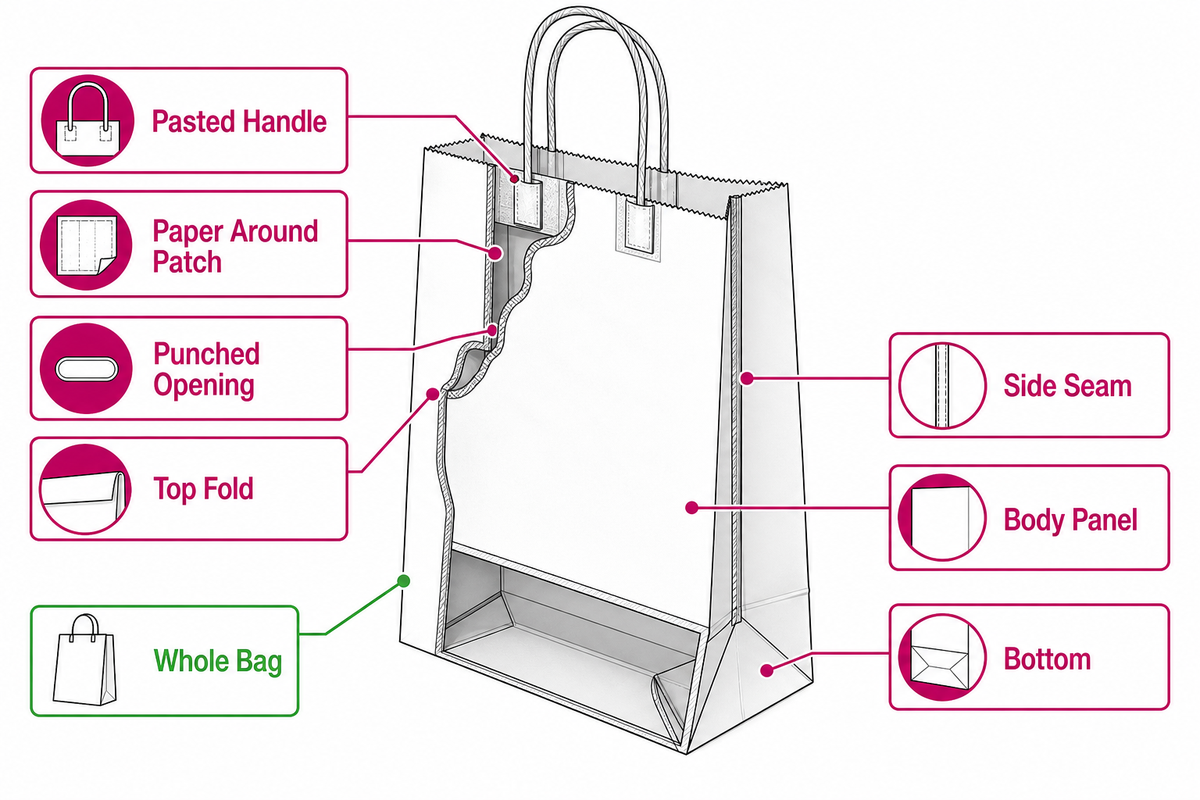
GSM is a material identity field, not a finished bag capacity certificate. A higher basis weight can change paper behavior, but that doesn’t mean a patch is long enough, an eyelet cuts the sheet, a top fold separates, or a hard corner starts a tear. A bag can still fail at its least forgiving interface.
A paper-property reference separates grammage, tensile strength and tear resistance. It describes grammage in g/m², cites TAPPI T 410 and ISO 536, and gives one laboratory conditioning example of 23 °C ± 1 °C at 50% ± 2% relative humidity. These are material-test concepts. They do not become a load rating for a finished carrier.
The public EN 13590 catalog abstract covers general characteristics and test methods for flexible carrier bags used to carry retail goods, including volume and carrying-capacity determination. The useful lesson is scope: Material data and assembled-bag performance answer different questions.
Three buyer complaints expose the shortcut quickly: “The bag looked heavy, but the patch peeled.” “The sample carried the product, but a damp shipment deformed.” “The handle stayed intact, but the bottom opened.” Reading GSM alone doesn’t solve any of these.
A sturdy appearance isn’t a test result.
Large paper bags don’t become durable through scale or label. Durability still depends on the load path and approved use.
| Failed zone | Visible signal | Possible mechanism | Evidence to inspect | Do not infer |
|---|---|---|---|---|
| Pasted handle | Handle lifts cleanly | Bond or surface mismatch | Adhesive/process record, fibre left on patch | Handle material is weak |
| Paper around patch | Crescent or edge tear | Stress concentration or short reinforcement | Patch dimensions, grain direction, tear path | More GSM alone will fix it |
| Punched opening | Hole becomes oval | Local bearing stress or low clearance | Hole position, eyelet, reinforcement, top-fold geometry | Rope diameter is the only cause |
| Top fold | Fold opens in layers | Adhesive, crease or laminate interface | Fold width, bonding process, sectioned sample | The handle passed |
| Side seam | Peel starts near the top | Seam width, adhesive or load eccentricity | Seam overlap, cure record, packed arrangement | Bottom construction is sound |
| Bottom | Flap opens or paper splits | Base load, fold geometry or hard corner | Bottom pattern, base board, product footprint | The handle rating covers the bottom |
| Body panel | Vertical tear grows from a corner | Point load or abrasion | Product orientation, insert, clearance, movement | Paper was defective |
| Whole bag | Progressive sag after damp handling | Moisture and time | Humidity, condensation, carry duration, recovery | A dry test predicts wet handling |
How much weight can a paper bag with handles hold?
There’s no true universal number. The answer belongs to a particular construction, packed contents, method, conditions, sample count and acceptance rule. A published industry standard may define a category, but it can’t become the rating of your white paper gift bags or brown kraft paper bags with a modified handle.
Paper Bag Handle Types: The 5-Handle System Matrix
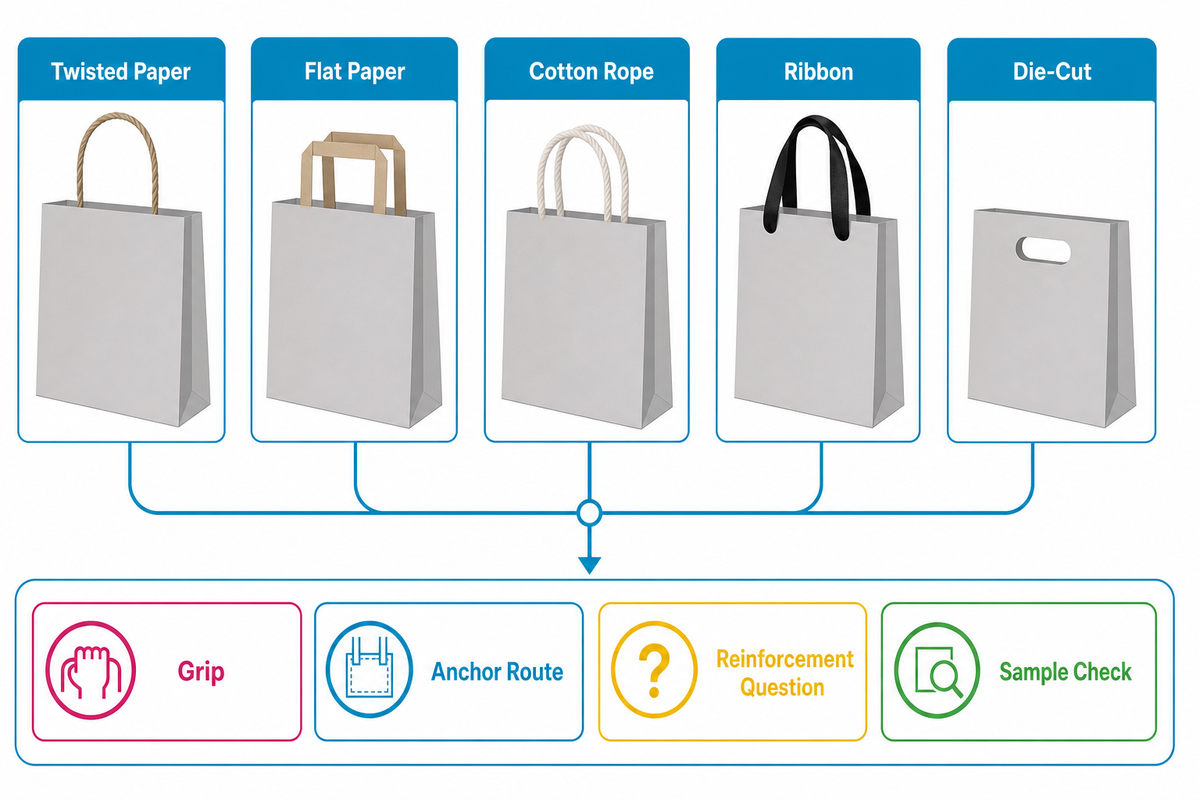
The name of a handle identifies a grip style; it doesn’t certify the anchor system around it. Twisted paper, flat paper, cotton rope, ribbon and die-cut grips, among others, can all transmit a tensile load to paper, but they differ in how they feel and look. Consider the complete path from hand to bottom.
| System row | Grip | Anchor route | Reinforcement question | Moisture/separation question | Sample check |
|---|---|---|---|---|---|
| Twisted paper, internal patch | Round paper cord | Ends pasted under top fold or patch | Patch length and surrounding tear path | Wet cord and bond response | Inspect fibre transfer after pull |
| Twisted paper, folded-end patch | Round paper cord | Folded ends spread within a patch | End spacing and fold consistency | Patch lift after damp exposure | Section 3 samples at both anchors |
| Flat paper, surface patch | Flat paper strip | Wide pasted contact | Contact area and edge peel | Layer split or curl | Measure bond area, not just handle width |
| Flat paper, top-fold capture | Flat handles | Ends retained within folded rim | Fold depth and adhesive coverage | Fold opening after cycles | Cut a cross-section through the rim |
| Cotton rope, knotted | Soft round rope | Through holes, knots inside | Hole-to-edge distance and backing patch | Rope moisture transfer, knot seating | Check hole growth and knot movement |
| Cotton rope, tipped | Soft round rope | Tips retained behind paper or board | Tip bearing area and local crease | Tip/paper separation | Record tip material and geometry |
| Ribbon, knotted | Soft flat textile | Through holes with knots | Hole reinforcement and ribbon twist | Dye transfer or fraying | Cycle with the ribbon orientation recorded |
| Ribbon, eyeleted | Soft flat textile | Through metal or polymer eyelets | Eyelet flange and paper compression | Mixed-material separation | Inspect pull-through and component record |
| Die-cut, plain opening | Paper opening | Load enters cut edge directly | Corner radius and top reinforcement | Wet-edge tear growth | Check every cut corner after cycles |
| Die-cut, reinforced opening | Paper opening | Opening backed by folded or added layer | Backing registration and bond | Layer separation | Compare cut alignment on 5 samples |
The matrix rejects a “strongest handle” winner since the methodology alters the outcome. A premium ribbon on a weak opening may be less reliable than a modest twisted paper handle with a well-matched patch. A recyclable kraft body doesn’t solve the whole-bag claim when the system also contains eyelets, textile handles, coating or a clear window.
A colorful handle may be an intelligent brand choice, but color doesn’t alter the evidence fields in the matrix.
For a side-by-side construction view, use Huandao’s paper bag handle-option comparison after the load case is defined.
How to Turn a Packed Product into a Handle Specification
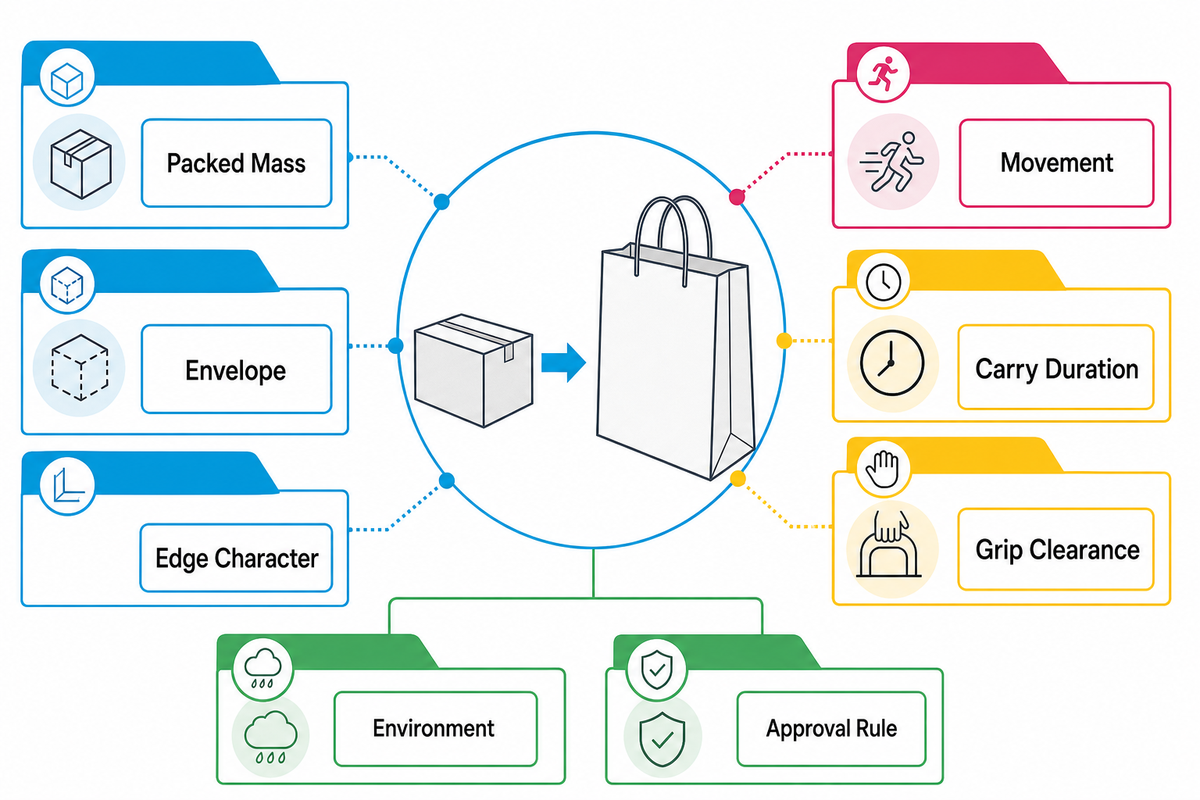
Substitute a guessed load rating with a measured load case. Begin with a packed product. Choose a bag and test brief. A thick cosmetic set and a soft folded article of clothing can have the same mass but behave in a totally different manner with respect to contact, base fit, movement, and grip.
| Field | What to record | Why it changes the decision |
|---|---|---|
| Packed mass | Net packed mass, not an empty-bag estimate | Defines one part of the load case |
| Item count | 1 rigid set, 4 boxes, 12 small units, or other | Changes movement and point contact |
| Envelope | Width × depth × height in mm | Controls panel and base fit |
| Base footprint | Actual contact shape and clearance | Reveals bottom loading and tipping risk |
| Edge character | Soft, rounded, rigid, pointed or abrasive | Changes tear initiation |
| Movement | Fixed, cushioned, loose or shifting | Changes dynamic peaks |
| Carry duration | Short handoff, 15 min walk, 60 min travel | Adds time under load |
| Cycles | Lift, walk, set down and re-lift sequence | Separates static hold from repeated handling |
| Grip clearance | Handle drop and usable hand opening in mm | Affects access, tilt and user comfort |
| Environment | Dry indoor, humid, refrigerated or condensing | Defines the test condition boundary |
| Interior pack | Tissue, insert, tray or base board | Can redistribute contact |
| Approval rule | Sample count, stop criteria and allowed damage | Turns a demonstration into a decision |
An object of 3 kg in a rigid boxed set may create a sharp corner against a side seam. For the same 3 kg mass, a rigid boxed cosmetic set may put a hard corner near a side seam, while a folded garment spreads contact but can shift and tip if the handle drop is too short. The brief should show both packing arrangement and potential movement. It shouldn’t interpret “3 kg passed once” as an open-ended capacity statement.
A bakery and a small business may pack very different products in bags with similar outside dimensions. Each should record its own edges, moisture exposure, interior pack and carry pattern.
The buyer can discuss paper bags with handles configured for a specific packed product after completing the worksheet. For print, size and broader sourcing questions outside this test-focused guide, see the broader paper shopping bag buying guide.
Wholesale buyers, when personalizing a bag, should freeze the artwork and structural changes separately, as an aesthetic change doesn’t require the same level of approval as a load-path change.
Huandao’s handle-to-load brief can be used as a follow-on record once the packed use case is defined.
Finished-Bag Tests vs Paper Tests: The Bag Evidence Stack
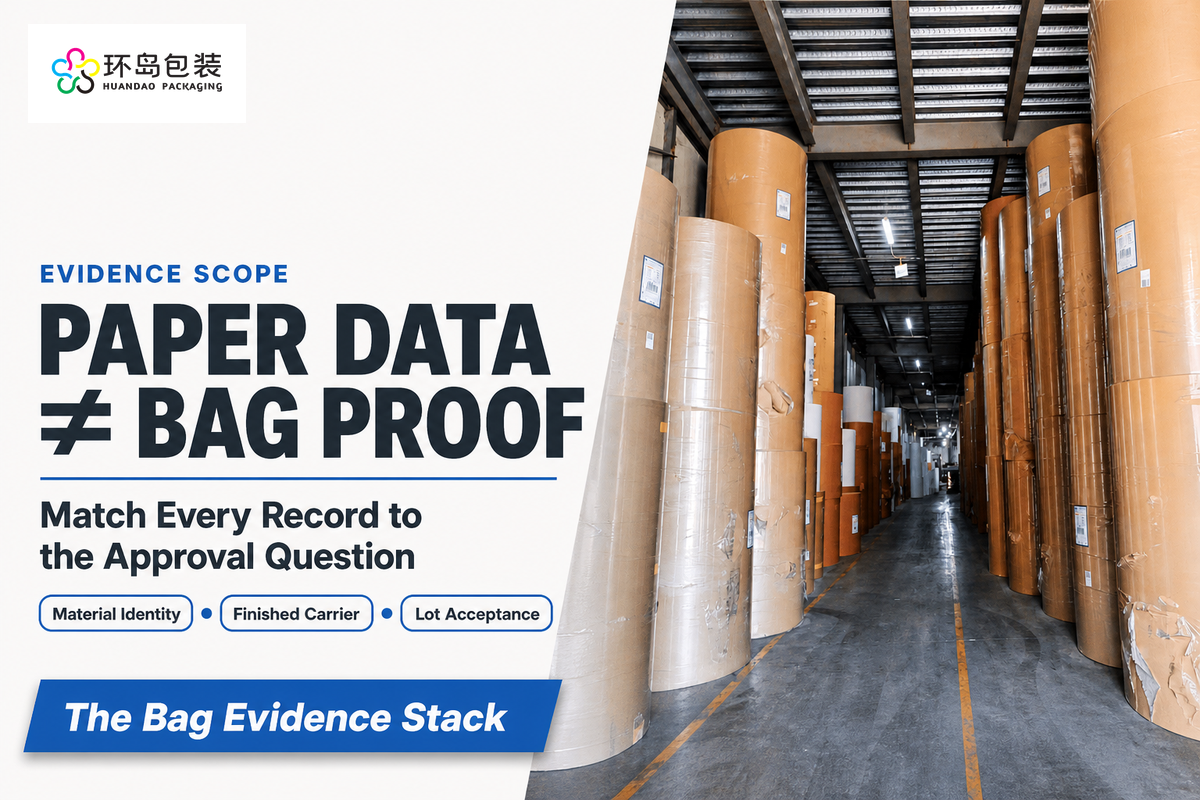
An evidence file is useful only when its scope matches the approval question. A basis-weight test identifies a paper. An ink-rub test addresses a printed surface under stated method. A finished carrier test examines a bag under defined and tested conditions. A retained sample confirms identity; a lot-sampling plan addresses delivery representativeness. No substitute layer addresses all the others.
Coverage for ISO 187:2022 is limited to standard atmospheric testing for paper, board, pulps and samples, and to monitoring test environments and sample conditioning. That scope is useful because temperature, relative humidity and conditioning status belong beside the test result. It still does not validate a finished bag in every store, warehouse or delivery condition.
NIST defines lot-acceptance sampling as drawing a random sample from a lot and making an accept/reject decision under a stated plan, rather than estimating the quality level of the entire lot. In buyer terms: sample identity, traceability and statistical representativeness are separate fields.
| Evidence | Question answered | Question not answered | Identity required | Buyer decision |
|---|---|---|---|---|
| Paper basis weight | Mass per unit area | Finished capacity | Grade, lot, method, g/m² | Confirm material identity |
| Paper tear result | Recorded tear behaviour | Patch or seam performance | Direction, conditioning, sample | Compare material within scope |
| Paper tensile result | Strip rupture force under method | Bag load path | Machine/cross direction, method | Check material consistency |
| Moisture or conditioning record | State before test | All field humidity | Temperature, RH, duration | Judge result comparability |
| Ink-rub result | Printed-surface resistance | Handle strength | Ink, finish, method, job | Approve surface within scope |
| Adhesive/process record | What bond process was used | Capacity without test | Adhesive/process revision, time | Trace attachment process |
| Handle attachment test | Local assembly response | Bottom or side seam | Handle, patch, paper, sample | Approve attachment question |
| Finished-carrier test | Whole construction under stated method | Changed construction or use | Revision, pack, conditions | Approve exact scope |
| Approved retained sample | What the buyer saw and signed | Lot representativeness | Sample ID, date, revision | Lock visual/physical identity |
| Construction record | Which parts and dimensions were released | Whether execution matched | Revision and change history | Control permitted change |
| Production job record | Which job ran which revision | Every unit’s performance | Job, line, dates, material lots | Trace delivery to process |
| Lot-acceptance record | How sampled units drove accept/reject | Unlimited quality inference | Lot definition, randomisation, n, rule | Judge delivery under the plan |
Huandao states its in-house lab issues ECT/burst, ink-rub and basis-weight reports based on the customer’s production job. For a paper bag order, the useful check is not “does the factory have a lab?” Ask for the report ID, purchase/job reference, tested sample, method, conditions, result and construction revision. ECT may be applicable to some components of corrugated and shouldn’t be considered a general handle-bag test.
Recyclability Claims: The Component Claim Map
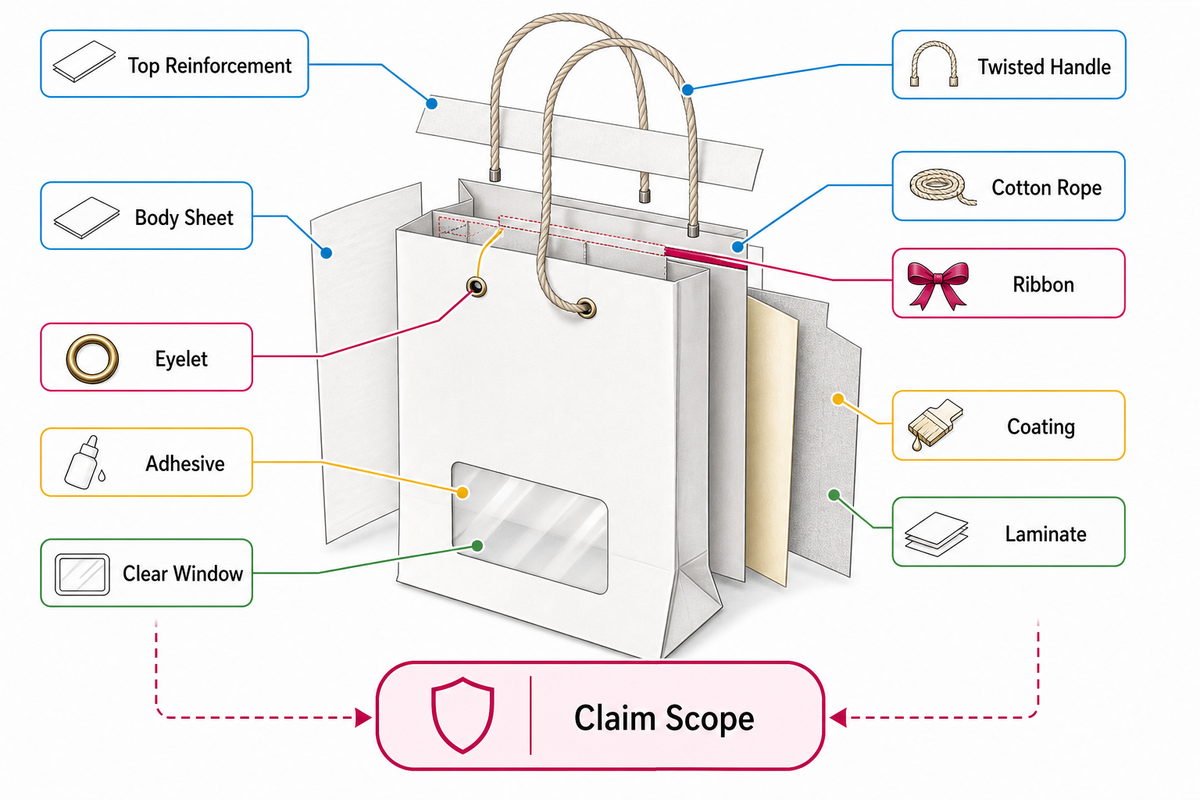
A paper body alone doesn’t verify a recyclability claim for the entire bag. Handle, patch, eyelets, adhesives, coating, lamination and window may impact the claim. Collection and processing may vary for different destinations. Define the components; then ask a claims reviewer what wording is supported by the evidence.
The U.S. Federal Trade Commission’s Green Guides distinguish a product, its packaging and a component when evaluating environmental claims. They distinguish between recyclable claims and recycled-content claims, and advocate qualifying claims to avoid consumer confusion or misleading representation. “recycled kraft paper” defines content when supported; it doesn’t imply that an assembled bag can be recycled in all communities.
The FSC chain of custody addresses the route of forest-based material through the supply chain and the controls associated with an FSC claim. It’s neither a load test nor a determination of local recycling. A company certificate also does not mean every gift bag, retail bag or merchandise bag it sells is FSC certified.
| Component | Material/function | Separation question | Evidence owner | Destination-system question | Wording status |
|---|---|---|---|---|---|
| Body sheet | Kraft paper or other paper grade | Base material | Paper supplier | Accepted paper grade? | Pending material and system proof |
| Top reinforcement | Paper or board strip | Same fibre family? | Converter | Accepted with body? | Record construction |
| Twisted handle | Paper cord and adhesive | Fixed or removable? | Handle/adhesive suppliers | Accepted as assembled? | Qualify if needed |
| Cotton rope | Textile grip | Can users remove it? | Handle supplier | Textile tolerated in paper stream? | Do not generalise |
| Ribbon | Textile or polymer | Knot, eyelet or pasted end? | Handle supplier | Local separation route? | Component caveat likely |
| Eyelet | Metal or polymer ring | Practical removal? | Converter | Screened or rejected? | Name the component |
| Adhesive | Bonding layer | Dispersible in process? | Adhesive supplier | Mill/process criteria? | Need technical evidence |
| Coating | Surface protection | Continuous film or light coat? | Coating supplier | Accepted at local facility? | Avoid blanket claim |
| Laminate | Film bonded to paper | Can layers separate? | Film/converter | Multi-layer handling available? | Strong qualification |
| Clear window | Film aperture | Removable without tools? | Window supplier | Windowed paper accepted? | State scope |
Terms such as eco-friendly, compostable, recyclable, reusable and recycled kraft should never be stacked as decoration. Each communicates a different proposition. Record who owns the evidence, the market, the date and the exact product or component covered.
From Approved Sample to Production: The Construction Lock Record
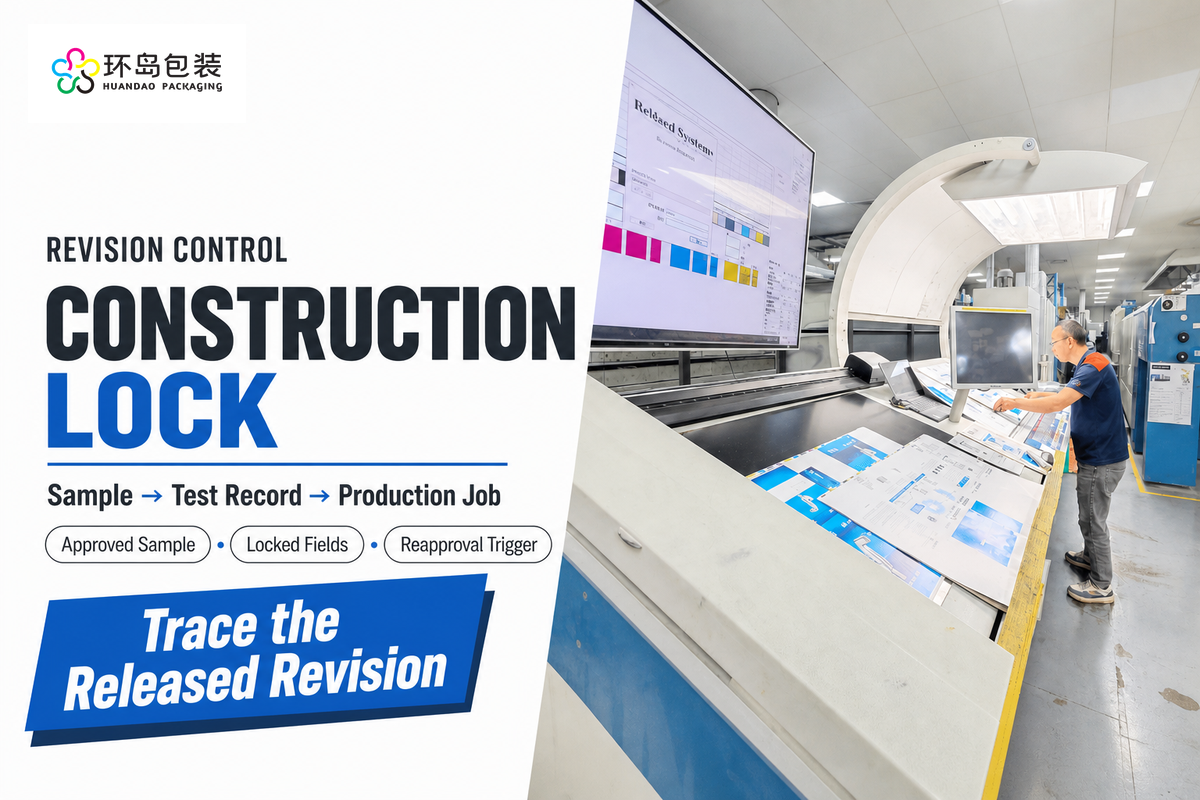
A signed sample is useful only if its construction, test results and product revision are fully documented and traceable. Traceability tells you which records are related. It, however, doesn’t prove that a small sample represents every unit in the lot that’s being traced.
ISO 10007:2017 gives general guidance for configuration management across a product or service lifecycle. The Construction Lock Record below is an original buyer method for handled paper bags, not an ISO form and not an ISO-certified template. The standard specifies a control principle, while the order record specifies paper bag fields.
| Locked field | Example record | Reapproval trigger |
|---|---|---|
| Approved sample | Sample ID, date, physical retained unit | Sample lost or replacement made |
| Bag dimensions | Width × gusset × height in mm, tolerances | Any dimension or tolerance change |
| Body paper | Grade, colour, g/m², supplier/lot | Grade, source or basis-weight change |
| Handle | Material, width/diameter, drop, colour | Any grip or geometry change |
| Anchor | Patch/eyelet/end style and location | Position, material or method change |
| Top fold | Depth, layers, crease and bond | Fold or adhesive process change |
| Seam and bottom | Overlap, folds, adhesive/process reference | Pattern or process change |
| Artwork/finish | Artwork revision, ink, coating, laminate | New finish or coverage |
| Test record | Method, pack, conditions, sample n, result | Use case or construction change |
| Lot plan | Lot definition, random sample, accept/reject rule | Lot structure or risk changes |
| Production link | Job ID, date, line/process and material lots | Split job or rework |
| Release status | Approver, exceptions, date and signed revision | Any unapproved deviation |
Huandao reports real-time scanning of each process step into an MES kanban, with ERP and intelligent scheduling behind it. That system name becomes relevant when the buyer can trace from the purchase order to the approved revision, tested sample, production job and material lots. A dashboard screenshot without that trail means little.
What Is Changing in 2026: Evidence Before Eco Claims
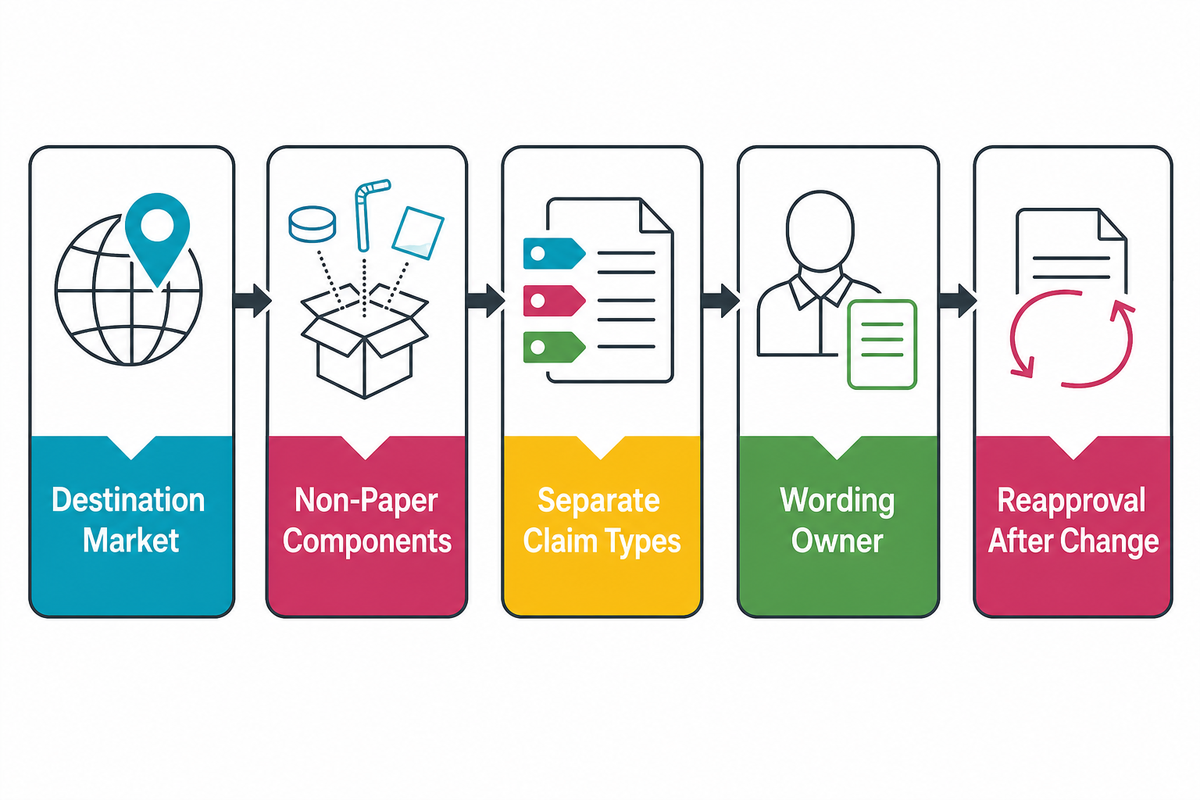
In 2026, procurement teams should freeze component evidence before approving environmental copy. The current policy pages show a hodgepodge of effective rules, later effective dates, proposals, and consultations. The safe editorial habit is to record jurisdiction, covered product/store, effective date and evidence owner, next to the wording.
California offers a good real-world example. According to CalRecycle, as of January 1, 2026, grocery and retail settings may offer recycled paper carryout bags under conditions such as a $0.10 minimum charge, acceptance for recycling in qualifying curbside programs, and printed manufacturer, country, and post-consumer content. A separate minimum of 50% post-consumer recycled material is required as of January 1, 2028. These dates apply only to the defined California contexts, not to every paper gift bag or every paper sale in the United States.
Evidence and claims are pushed to the front of the review process by policy activity in Europe as well. A proposal or draft policy shouldn’t be described as a rule that’s in effect. For any market, reopen the review when the handle, eyelet, coating, laminate, adhesive or window changes.
- Date the evidence and name the destination market.
- List every non-paper component and its supplier.
- Separate recyclable, recycled-content, certified-sourcing and compostable propositions.
- Assign a person who can approve the exact wording.
- Trigger reapproval after a construction or material change.
A 10-Signal Failure Matrix for Paper Bags with Handles
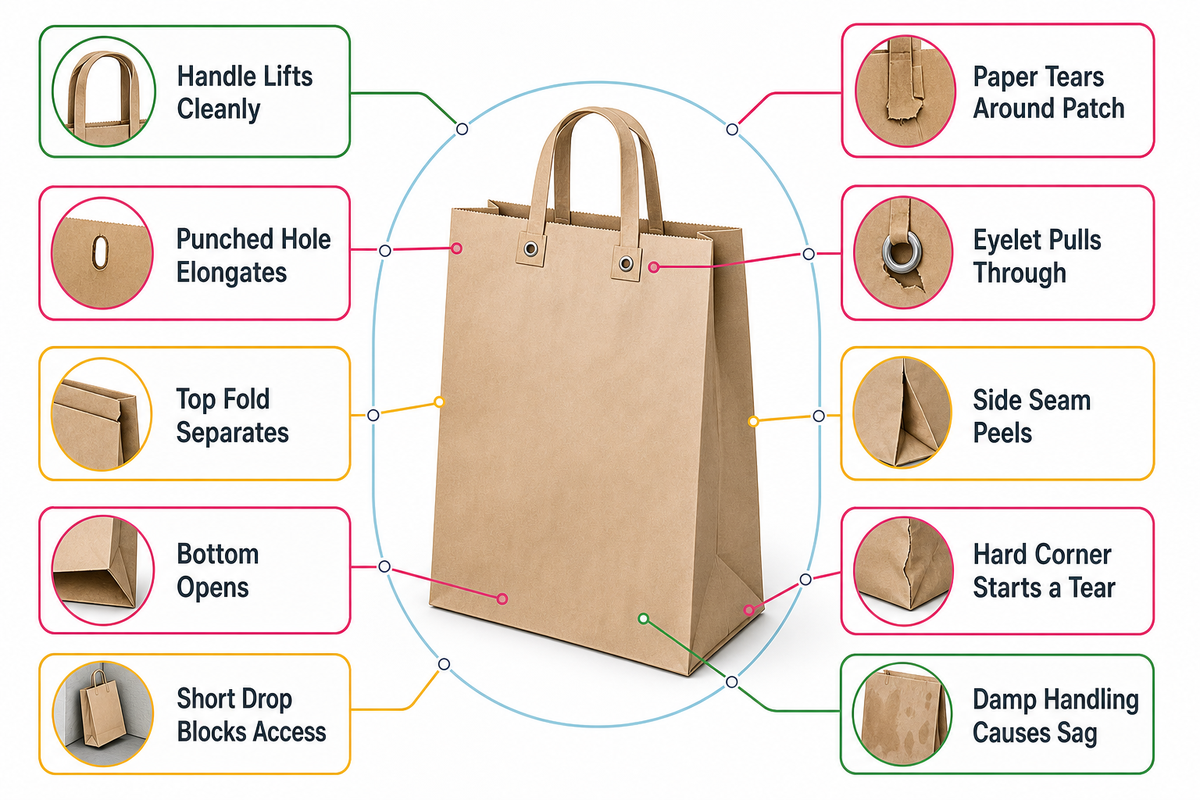
The first observable damage is an indication of an investigation route, not a remote diagnosis. Keep the bag that was handled, the packed configuration, and a record of how it was handled. A cell phone photo of the damaged configuration, without the product position, revision and conditions, may show where damage occurred, but not why it happened.
| Signal | Possible mechanism | Evidence to inspect | Corrective lever | New sample? |
|---|---|---|---|---|
| Pasted handle lifts cleanly | Bond/surface mismatch | Patch, adhesive, surface, fibre transfer | Bond process or contact area | Yes |
| Paper tears around patch | Local stress concentration | Tear shape, patch edge, grain, load position | Patch geometry or paper property | Yes |
| Punched hole elongates | Bearing stress | Hole-to-edge distance, reinforcement, cycles | Opening/anchor geometry | Yes |
| Eyelet pulls through | Flange or paper compression issue | Eyelet dimensions, setting, backing | Eyelet and reinforcement | Yes |
| Top fold separates | Crease/bond/finish interface | Fold section, adhesive coverage, coating | Fold or process | Yes |
| Side seam peels | Bond or uneven load | Seam overlap, packed orientation, cure | Seam/process/pack | Yes |
| Bottom opens | Fold, bond or base load | Bottom pattern, footprint, base board | Bottom construction | Yes |
| Hard corner starts a tear | Point contact or movement | Product corner, clearance, insert | Pack orientation or protector | Usually |
| Short drop blocks access or tips bag | Grip geometry mismatch | Hand clearance, centre of mass, bag height | Handle drop/position | Yes |
| Damp handling causes progressive sag | Moisture/time interaction | RH, condensation, duration, recovery | Material, coating, pack or use limit | Yes, under target conditions |
“Heavy duty paper bags with handles” is a search phrase, not a test result. Ask what failed, on which revision, with what content, after how many cycles and under what conditions. Then match the evidence to the lever rather than changing multiple variables. The EN 13590 public catalog abstract likewise treats carrying capacity as a finished flexible-carrier test question, so this matrix is a routing aid rather than a universal capacity rating.
How to Verify Supplier Evidence on Your Own Job
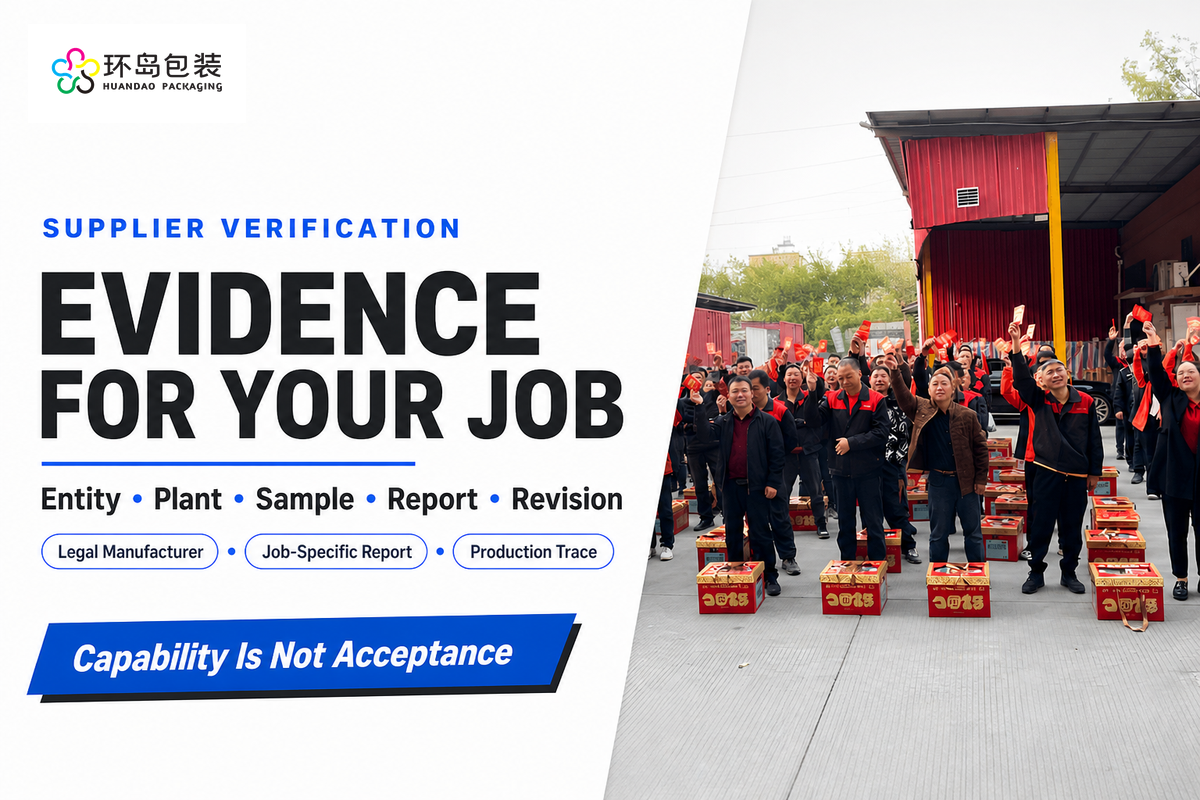
A factory claim becomes useful when it can be tied to the legal entity, plant, order, sample, report, production lot and approved revision. The checks below don’t certify Huandao or any other supplier. They provide a baseline for requirements a buyer may have.
Xiamen Huandao Packaging Technology Co., Ltd. states that it was founded on 30 June 2003 in Xiamen with RMB 20 million registered capital. It lists its own plant at No. 587 Tongfu Road, Tong’an District, Xiamen with 133 staff and states it’s the color printing plant of Huan Yin Packaging Group. The company reports group revenue over RMB 200 million, recognition as a National High-Tech Enterprise and the President Unit of the Xiamen Printing Industry Association. These reports are by the company and not independent confirmation in this article.
The company reports in-house pre-press, sheetfed offset printing, UV coating, lamination, die-cutting and folder-gluing. It says an in-line corrugator supplies single E-flute and single B-flute board just in time, while A, C, F, BC and other profiles use sourced board. Group companies supply inner trays, inserts and outer shipping cartons along with the printed pack in a consolidated shipment. While consolidated shipping may simplify logistics and reduce costs, it doesn’t prove performance.
| Statement | Buyer check | Order link | Boundary |
|---|---|---|---|
| Legal manufacturer | Business name, address, invoice and bank beneficiary | PO and contract | Trading relationship does not prove plant scope |
| Own plant | Live or dated plant evidence, process route, production address | Job traveller | Facility presence does not prove this job ran there |
| In-house process | Process list and actual job steps | MES/job timestamps | Capability does not prove use on every order |
| Laboratory report | Report ID, method, conditions, sample and result | Job and construction revision | One report does not cover changed versions |
| FSC claim | Certificate validity, site and product scope in public search | Correct claim on sales document | Not all products of a certified company are certified |
| Approved sample | Physical ID, signed revision and retained unit | Release record | Identity is not lot representativeness |
| Production lot | Lot definition, random sampling, n and acceptance rule | Lot-acceptance record | Sample result has stated confidence/scope |
| Change control | Who approved material, handle, adhesive or artwork change | Revision history | Unapproved substitution reopens approval |
| Group supply | Which legal entity makes each tray, insert, box or bag | Packing list and shipment | Shared freight is not shared certification |
Paper Bags with Handles FAQs
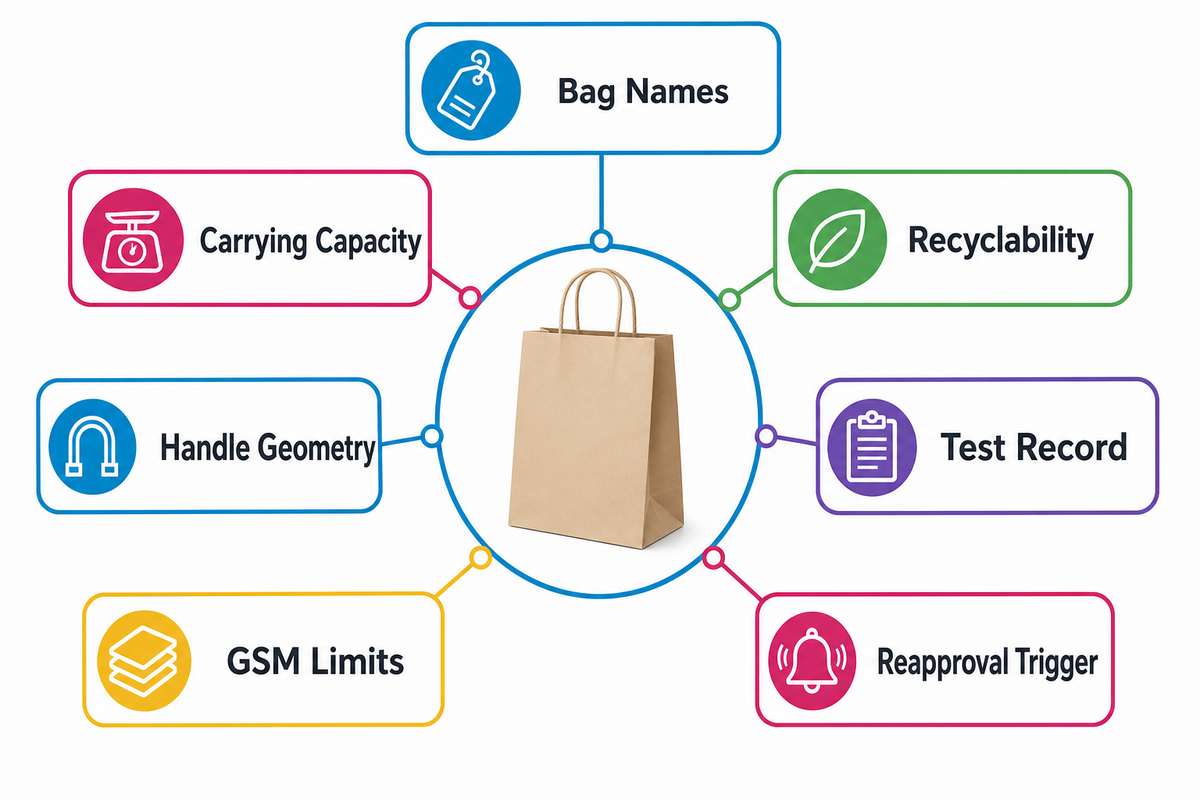
The questions below cover naming, capacity, recycling scope, handle geometry, test records, GSM and reapproval. For environmental-claim questions, the FTC Green Guides distinguish product, package and component scope and call for qualification when an unqualified claim could mislead.
What are paper bags with handles called? They are often called paper shopping bags, carrier bags, merchandise bags, paper gift bags or paper tote bags.
The label changes by market and use. Brown bags may also be described as kraft bags, while a boutique may say retail bags. None of those names identifies the handle anchor, reinforcement, verified capacity or environmental claim scope, so a procurement specification still needs the construction fields and a revision identifier.
How much weight can a paper bag with handles hold? No single safe figure applies to every handled paper bag.
Approve the exact bag with actual or representative contents under a recorded method. State the construction revision, packed mass and shape, sample count, conditioning, lift/set-down sequence, duration, stop criteria and allowed damage. Record who witnessed the test and where the retained sample is stored. Don’t convert one supplier test, a GSM value or a marketing phrase into a universal capacity.
Are paper bags with handles recyclable? The answer depends on the complete construction and the destination recycling system.
Review the body paper, handle, patch, eyelet, adhesive, coating, laminate and window. Ask whether components remain fixed, can be separated in normal use and are accepted by the relevant collection and processing route. Keep recycled-content, recyclable, compostable and certified-sourcing statements separate, and date the market-specific review for the place where the bag will be sold.
Do flat paper handles and twisted paper handles fail in the same way? Either can fail at the handle, attachment or surrounding paper, but their geometry differs.
A flat handle spreads force through a wider strip, while a twisted handle concentrates it through cord ends and their patch. Compare actual anchor area, top fold, adhesive process, paper tear path and sample result instead of assuming the grip shape decides the outcome.
What should a finished-bag test record include? It should identify the exact sample, construction, contents, method, conditions and decision rule.
Record sample and revision IDs; bag dimensions; paper, handle, patch, adhesive and finish; packed product and orientation; temperature, relative humidity and conditioning; static or cyclic sequence; duration; sample count; stop criteria; observations; result; tester; date; and retained-sample location. If the test informs lot acceptance, add the lot definition, random-sampling method and accept/reject rule. A report without these links may be genuine yet unusable for the buying decision.
Does a higher GSM always make a handled paper bag stronger? No. GSM describes mass per area, while a finished bag also depends on paper properties and assembly.
Tear behaviour, fibre direction, moisture, patch geometry, hole position, top fold, adhesive, side seam, bottom and packed-product contact all matter. A heavier sheet can still fail at a weak joint, so test the complete revision rather than buying by GSM alone.
When should a handle change trigger a new sample? Re-sample whenever the change could alter load transfer, user grip, packing, claims or production control.
That includes handle material, width or diameter, drop, colour treatment, end form, knot, tip, patch, eyelet, punched-hole position, backing layer, top-fold depth, adhesive, application process or supplier. A changed coating or laminate can also affect bonding. Update the Construction Lock Record, run the relevant tests again, retain the new sample and retire the old approval. If only artwork changes, review print and finish evidence; if coverage or curing can affect a bond area, include attachment testing too. Reopen the component claim review when a paper handle becomes textile, an eyelet is added, or a film window changes, because the environmental wording may need a different scope. A new handle drop may also alter access, tipping and the carry cycle even when every material stays the same.
References & Sources
- US Federal Trade Commission, Green Guides environmental marketing claim scope and qualification.
- US EPA, Paper and Paper Products Procurement Guidelines – Context of Procurement of Recovered Paper.
- EN 13590 public catalog abstract – Flexible-carrier performance and carrying-capacity methods.
- PaperonWeb, Properties of Paper – Terms related to the properties of materials.
- CEPI Eurokraft and EUROSAC, 2023 Industry Guidelines for High Quality Paper Carrier Bags – An industry benchmark, not a rating against all paper bags.
- FSC, Chain of Custody and FSC Public Certificate Search Guidance – Traceability of certified material and site checks.
- ISO 10007:2017 general configuration-management guidance; it does not publish the Construction Lock Record in this article.
- ISO 187:2022 conditioning and test-atmosphere scope for paper, board and pulps.
- NIST, Lot Acceptance Sampling – Sample to lot decision rules, not a method of paper bag testing.
- CalRecycle, Bag Requirements at Grocery and Retail Stores – 2026 and 2028 California-specific requirements.
- European Commission, Green Claims – Current policy context; Applicability and legal status requires country-specific assessment.
Technical and regulatory sources are cited for their stated scope. Company facts are attributed to Huandao. This guide isn’t a universal load rating, certification decision or legal opinion.
HUANDAO PACKAGING INSIGHTS
About Huandao Packaging Insights
Huandao Packaging manufactures folding cartons, litho-laminated printed boxes and rigid gift boxes, and also supplies paper bags, retail displays and protective inserts.
Our guides help buyers compare packaging options and prepare a clearer brief before requesting a quote.
Packaging families
Board, print and finish
Artwork, dieline and sample review
Delivery planning
PROJECT DISCUSSION
Talk with the Huandao Team
- Company
- Xiamen Huandao Packaging Technology Co., Ltd.
- Quote input
- Dimensions, filled weight, quantity, artwork or dieline, finish and destination.
- Review scope
- Box, insert and delivery requirements.
- Next step
- Bring the available details to a packaging conversation.