Get in Touch with Xiamen Huandao Packaging Technology Co., Ltd.

Quick Specs
- Construction: liners bonded to a fluted paper medium; single-wall and double-wall are different layer arrangements.
- Print routes: direct flexo, offset litho-lamination or direct digital inkjet.
- Strength, colour and abrasion: separate properties requiring appropriate samples and test records.
Printed corrugated boxes are cartons with graphics printed on a paper-based structure. Choosing the right printed box to carry a logo is the easy part. Deciding the right print route, liner, structure and finish to replicate the artwork while accounting for the way a product will be packed, handled and shipped is the more difficult part.
In specifying custom printed corrugated boxes, one typically starts with a product description and its journey, then the printing options. A shipping box and retail product packaging, though similar graphics, may require different structures, samples and evidence of approval. The product box may be the exposed delivery pack or be shipped in a separate case.
Printed corrugated boxes use linerboard and a fluted medium for structure, with graphics applied directly or on a laminated printed sheet. Choose the print route around artwork and versions, then assess the finished box for its distribution conditions.
Key points
- A flute letter describes geometry, not a universal product-weight limit.
- Digitally made flexo plates and direct digital inkjet are different technologies.
- A blank sample establishes different things from a production-printed sample.
- The lowest price per ordered box can exceed the cost of an alternative when unused versions become obsolete.
What are printed corrugated boxes made from?
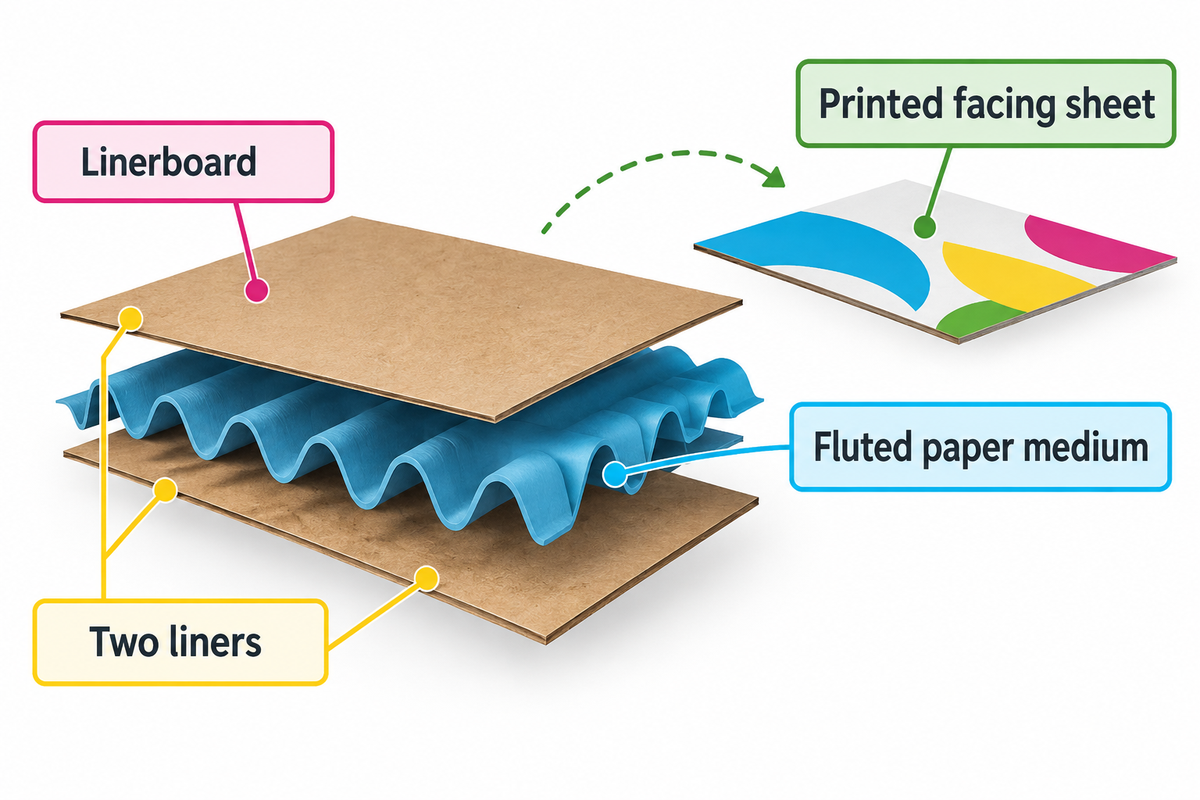
Printed corrugated boxes are made from linerboard bonded to a fluted paper medium. A single-wall board has two liners around one medium; double-wall adds another medium and liner. The print surface may be the outer liner or a top sheet that’s laminated to the structure.
Kraft in brown or white-top coated, or uncoated papers, give different surfaces to start with. Brown paper may give a different result based on the hue; a white surface gives a more neutral base. Recycled material describes the content of the fibers, and the construction and grade of paper describe the performance of the finished product. Neither a brown nor white surface gives a universal strength rating.
Which paper is used in corrugated boxes?
Containerboard provides the liners and the fluting medium, with kraftliner, testliner and other grades selected for their roles. The European Federation of corrugated Board Manufacturers’ production description distinguishes these papers from the assembled board. Packaging of the type litho-laminated also carries a printed facing sheet, therefore the specification must identify both the structural board and the facing sheet.
A carton made of corrugated cardboard differs from a solid-paperboard carton even when both carry full-colour print. For a small retail item that already travels in a protective outer case, folding carton packaging may provide the presentation layer without adding a corrugated medium. A rigid gift box is another construction for presentation and repeated opening. For an exposed delivery box, the structural role is different.
How do flexo, litho laminated and digital printing differ?
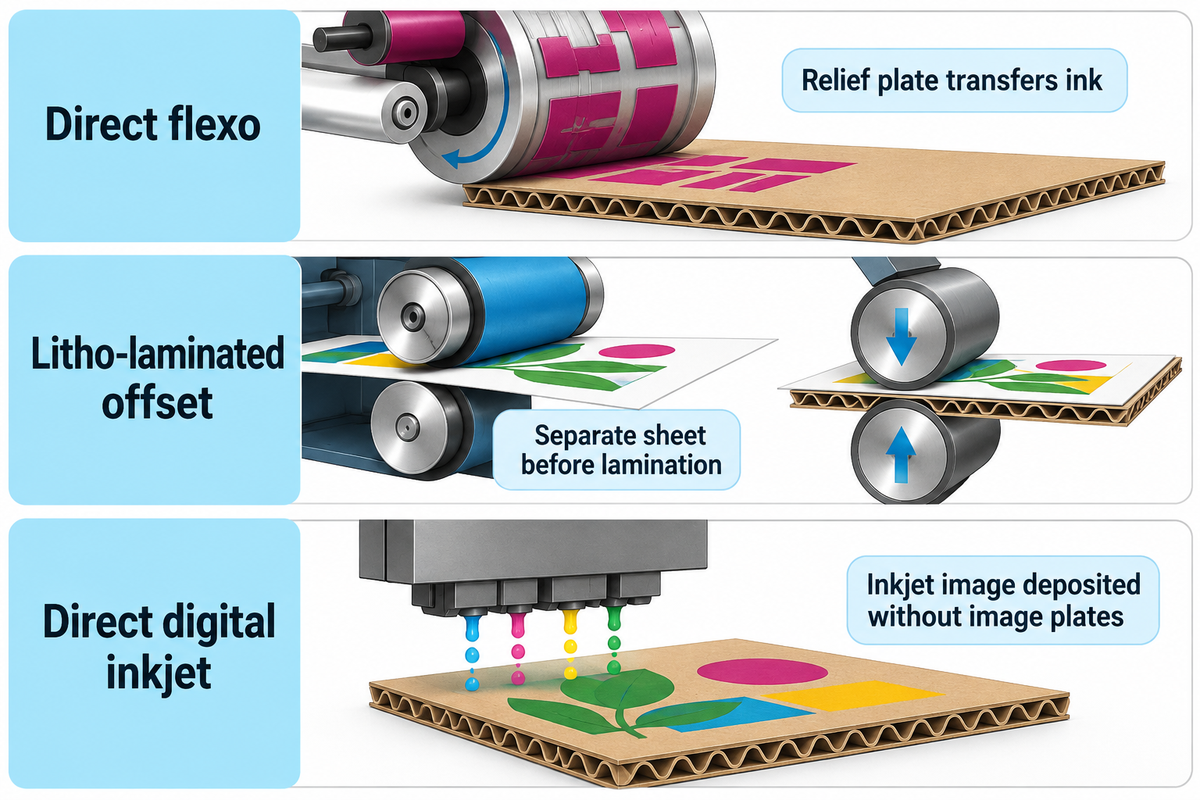
Flexo, litho-lamination, and direct digital inkjet are three techniques available for printing cartons. Choose among them based on the artwork, substrate, artwork versions, and the order of converting processes. There’s no hard and fast rule that one of the processes will always ensure superior quality.
Direct flexography may print boxes in one step along with other converting processes. Sheetfed offset lithography is done prior to the bonding of the printed face. Digital inkjet removes the image-plate step. However, it still requires compatible board, color control and other downstream processes. BOBST’s corrugated production overview segregates flexo and litho-lamination processes.
Print Route Elimination Table
| Decision | Direct flexo | Litho-laminated offset | Direct digital inkjet |
|---|---|---|---|
| Image transfer | Relief plate transfers ink | Offset image printed on facing sheet | Inkjet image deposited without image plates |
| Printed substrate | Corrugated liner in post-print | Separate sheet before lamination | Board compatible with the inkjet system |
| Artwork changes | A changed image can need new plates | Revised offset preparation and sheets | Revised files and production control |
| Fine graphics | Evaluate the actual plate, board and press | Evaluate printed sheet and laminated result | Evaluate actual ink, board and print mode |
| Large solid areas | Examine striping and coverage | Examine colour and laminated surface | Examine coverage and surface appearance |
| Several versions | Include version-specific setup | Include version-specific printed sheets | Compare file changes and conversion batches |
| Inside printing | Check the available face sequence | Define inside facing separately | Check face access and workflow |
| Coatings and glue | Check ink, coating and bond areas | Check print finish and lamination bond | Check ink/coating/converting compatibility |
| Decisive sample | Production-representative printed board | Finished laminated and converted sample | Sample from the proposed board and system |
High-quality printing denotes the result, not the process, of a given print job. High-Graphics Flexo is due evaluation against offset and digital; digitally imaged flexo plates remain flexo plates. Print equipment specialists interviewed by Packaging Digest in 2020 allude to the need for digital output to include adapting coating, die-cutting and folder-gluing.
What kind of printer can print on cardboard?
Industrial flexo, offset and digital systems can satisfy different cardboard workflows. Offset usually prints the facing sheet for litho-lamination; a direct-to-board digital inkjet system can print the corrugated substrate itself. A desk-top proof printer can show a layout; its feed, ink and paper paths differ from those used in production packaging.
Think of a launch, printed with a single design, and repeat orders with multiple language versions. The first job makes the printed surface and color reference central. The second, adds version control, changeover and leftover inventory. Purchasing wants one volume price; marketing needs the right language mix; production needs a workable batch plan. The buyer can achieve custom packaging through a conventional or digital route; however, comparing the total quantity printed while ignoring the quantity per version, hides a major cost element. Breaking the requirement into smaller, usable demand and comparing the work needed to fulfill the mix is what should be done.
How should you compare flute profiles and board strength?
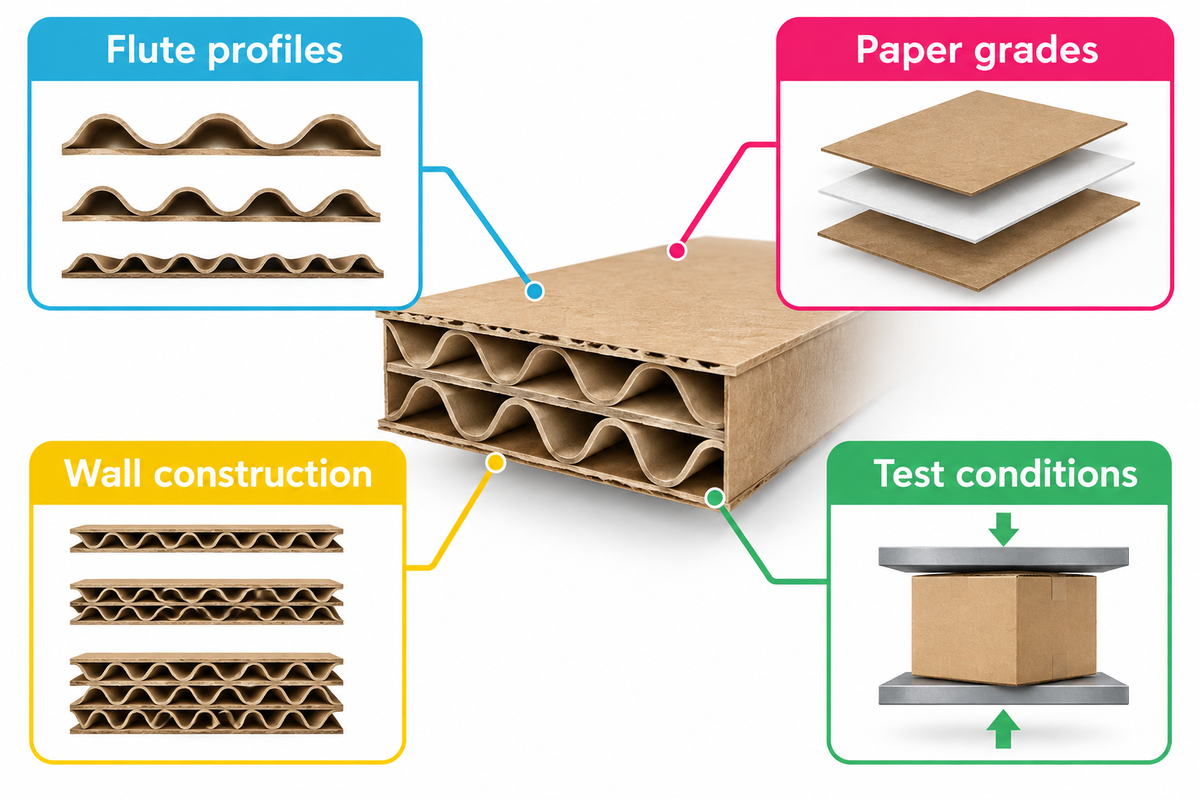
Compare flute profiles as structural geometry, then compare paper grades, wall construction and relevant test results. Fine flutes offer a compact print-facing structure; larger profiles can serve different cushioning and compression needs. Final protection of the load is determined by the complete box, the product restraint, the stacking pattern and the exposure to moisture. Thus, the flute factor alone can’t determine the payload of the box.
The Fibre Box Association’s corrugated-board guide states that there’s a lot of variation in flute designations. FEFCO’s indicative heights below exclude the facings.
| Profile | Indicative height | Use of this number |
|---|---|---|
| A | 4.8 mm | Describe the flute profile |
| B | 2.4 mm | Describe the flute profile |
| C | 3.6 mm | Describe the flute profile |
| E | 1.2 mm | Describe the flute profile |
| F, G, N grouped | 0.5–0.8 mm | Grouped reference, not one F-flute caliper |
“Corrugated board boxes are far from standardised.”
Edge crush testing is done to determine how much compression the edge of the board can take. Burst testing, on the other hand, applies a load across the face of the board. Mecmesin has a good explanation of ECT and burst testing. A filled-box compression or distribution test is again a different type of test to address a different type of assembly. Sturdy corrugated cardboard requires a suitable load path and a suitable board.
For example, a retail box inside a shipper can focus on presentation while the outer case can focus on distribution. Remove the shipper and the retail box can focus on a different task. A 2023 numerical study by Cornaggia and colleagues also shows why climate belongs in structural analysis; its calculated board responses are not a universal humidity deduction for every carton.
E-flute at approximately 1.2 mm and B-flute at 2.4 mm describe different medium profiles prior to adding facings. A specification for custom corrugated boxes should specify the assembled construction and test conditions separately. Substituting a flute name for those details leaves both the print surface and the protection requirement underspecified.
How does the application change the box design?
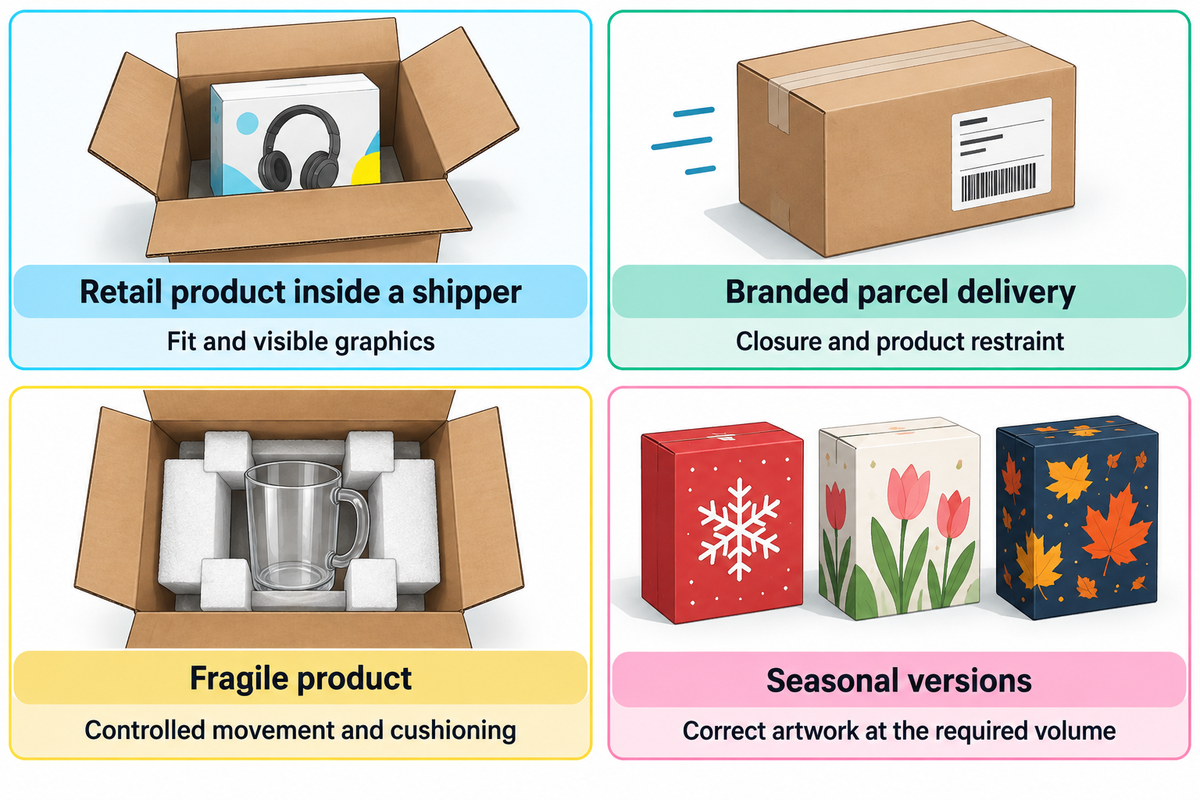
Priorities for the structure and handling of a box are determined by the application. Graphics are determined by the application. A box for shelf display needs visibility, a box for delivery needs closure, and a box for heavy industrial shipping needs load assessment. Best results for custom shipping boxes are achieved with a complete description of the packed product and journey.
Application-to-design matrix
| Application | Design priority | Useful comparison |
|---|---|---|
| Retail product inside a shipper | Fit and visible graphics | Printed corrugated versus solid paperboard |
| Branded parcel delivery | Closure and product restraint | Exposed printed face versus protective overbox |
| Repeated business shipments | Identification and repeatability | Simple graphics versus full-colour coverage |
| Shelf-ready display | Opening and replenishment | Display geometry versus transport geometry |
| Fragile product | Controlled movement and cushioning | Outer box plus fitted protective inserts |
| Bulky items | Load path and handling access | One-piece case versus engineered multi-part pack |
| Moisture-prone route | Board and surface performance | Conditioned packed sample and proposed finish |
| Seasonal versions | Correct artwork at the required volume | Separate version quantities and obsolescence |
| Food-related use | Food-contact arrangement | Protected inner pack versus relevant contact application |
An e-commerce mailer box can support an unboxing experience without printing every panel. The inside lid may carry instructions while the outside retains handling information. A fitted insert can protect your items by controlling movement; extra ink coverage can’t do that work. Our corrugated mailer boxes page covers that format’s supply options.
Imagine an individual accessory shipped in a presentation box rather than in a retail replenishment case. The designer wants a smooth, uninterrupted look. The fulfilment team needs a reliable closure. And the quality team needs product restraint. All of the above may be solved more easily with an insert and an outer shipping carton than with a thicker printed retail box. The packing trial should include the accessory, its insert, closure and shipping carton in their final positions. Changing only the board leaves movement inside the pack unresolved. The best way to evaluate a design is to compare it to other designs. In this case, comparing the various complete designs allows teams to focus more on the functionality of the design rather than the thickness of the packaging. This is a design scenario, not a customer test.
For materials that may come into contact with food, ink migration through the substrate and set-off in a stack require additional consideration. The EU’s Packaging Good Manufacturing Practice rules, Annex A cover those aspects for food contact applications in the EU. On its own, external printing doesn’t determine a package’s food contact suitability.
What must the artwork tell the printer?
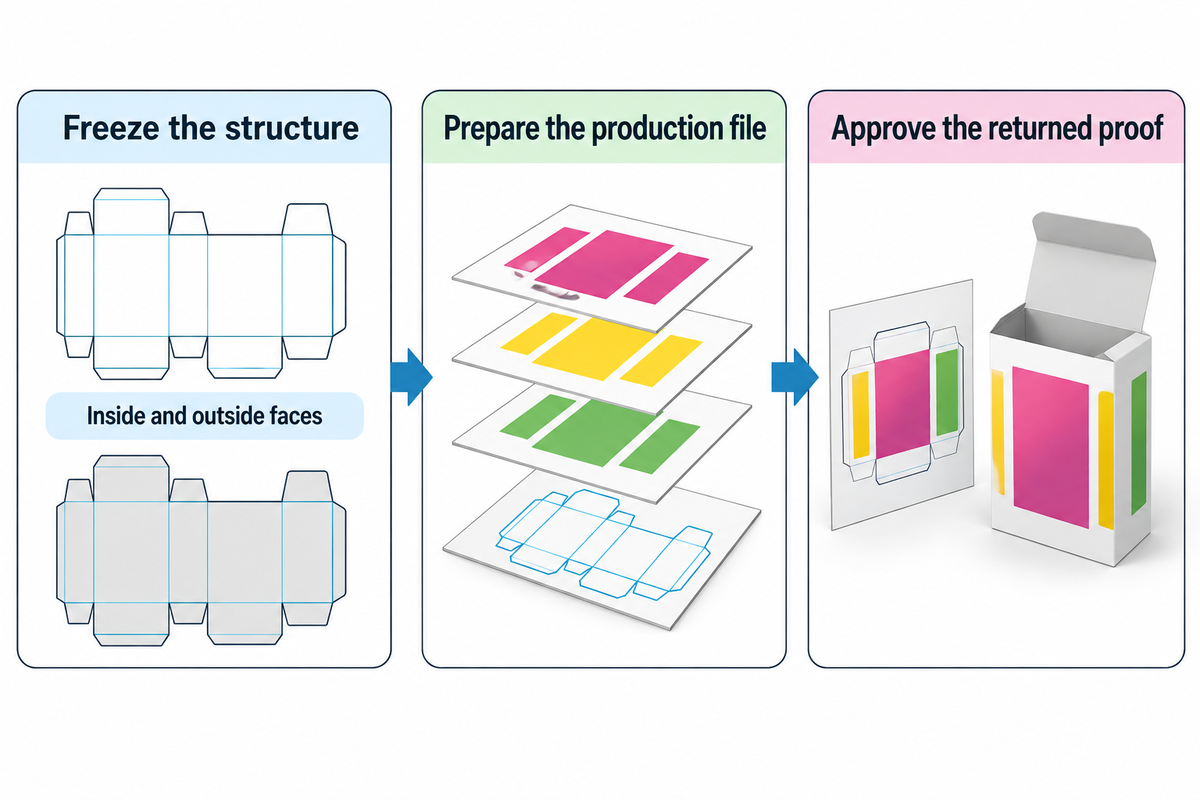
A production artwork file should define the box size, orientation, faces and colors, and other finishing details. The areas of a box that won’t be printed, or finished, need to be addressed in the production art file, too. The printer’s approved dieline template then connects the flat art to the assembled custom box, including panels that are turned in or become hidden.
ISO 19593-1:2026 describes PDF processing-step data for packaging and labels, including cutting, folding, glueing and printed finishing information. Practical file preparation still follows the receiving printer’s workflow. An online design tool is useful for arranging graphics, while print readiness also involves fonts, image resources, colour separations and the correct structural revision.
Can I upload a print-ready file of my corrugated box?
Yes. A print-ready file is suitable when it matches the printer’s accepted format and the approved structural drawing. Artwork placed on an old dieline may position a logo above a fold, cover instructions beneath a cover, or coat a glue area.
Barcodes need an identified symbol, substrate and scanning environment. GS1 New Zealand’s ITF-14 guidance, for example, distinguishes direct corrugated printing from labels and hand scanning from automated scanning. A successful phone scan is useful feedback, but production verification should match the intended application.
- Freeze the structure — use the approved drawing and identify the inside and outside faces.
- Prepare the production file — keep graphics and finishing information in their designated layers or processing groups.
- Approve the returned proof — check the version and panel orientation before plates or production files are released.
Die-cut conversion supports shaped openings and closures, but a digital preview doesn’t create packaging that’s physically correct on its own. For custom die-cut boxes, structural cuts and creases belong in the product specification before artwork approval.
Which sample answers which approval question?
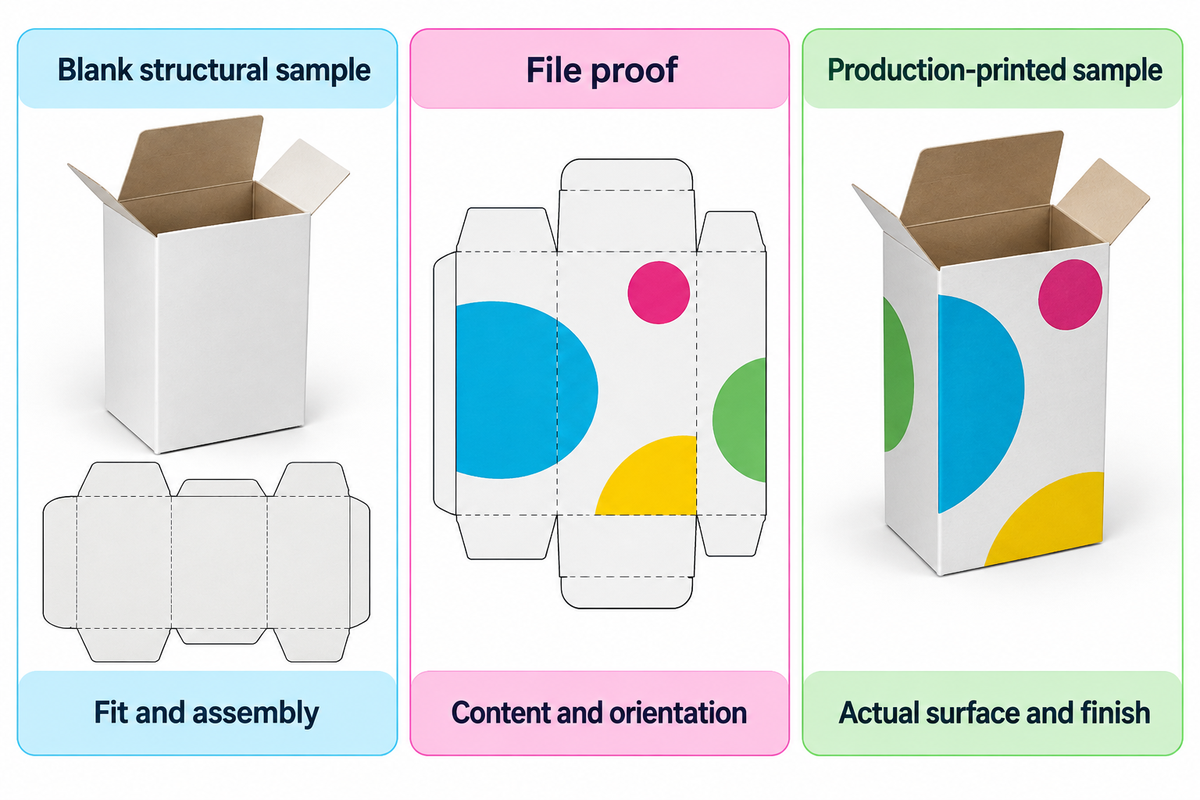
Use a blank structural sample for fit and assembly, a file proof for content and orientation, and a production-representative printed sample for the actual surface and finish. A printed sample of the final piece should be requested to verify the actual surface and finish. A sample is only approved once the question it’s answering has been verified. One print mock-up can’t fully verify the final product against the requirements.
Blank structural sample
- Check product fit and insert position.
- Observe assembly and closure.
- Record board and drawing revision.
Production-printed sample
- Check print on the specified surface.
- Evaluate the chosen finish and abrasion.
- Relate converted-box checks to production.
White and brown substrates can alter the appearance of the same color. X-Rite discusses this in its example of substrate and brand-color. Keep the reference substrate and finish with the approved sample. Commercial names such as standard white or premium white require a defined paper grade and surface treatment.
Printing and conversion can also alter structural behavior. A 1990 Rochester Institute of Technology thesis abstract reports that in its flexographic printing trials, print factors altered compression in its regular-slotted-container study. For a structure-sensitive order, retain a representative printed and converted sample, along with a blank prototype. The historical study doesn’t supply a universal strength-loss percentage for today’s boxes.
Suppose a buyer approves a kraft mock-up for fit and a white-paper proof for graphics. Both approvals can be correct, and yet neither represents the final brown printed face. Matching the final substrate, printing process and finish resolves that mismatch before debating whether the color is “close enough.”
Which coatings and finishes suit the handling conditions?
Consider finishes around the exposed areas: friction, folding, glue-lines and the recovery pathway. A varnish can provide a slight sheen; a laminate adds another layer. Spot UV, foil stamping and emboss effects serve visual or tactile purposes; test moisture and abrasion performance separately, for example with a dry or wet TAPPI T 830 ink-rub test.
Different design problems arise for a glossy retail face and a heavily rubbed transit face of a custom printed corrugated packaging. The finish interacts with the ink, folds and adhesive areas. A finish that’s adequate for showcasing your brand becomes a production constraint if it constrains the recovery of the construction.
The American Forest & Paper Association and Fibre Box Association published an updated voluntary standard for coated or treated corrugated in 2025. Its protocols evaluate repulpability and recyclability in the old-corrugated-containers stream. Therefore, a general “eco-friendly” description is of little use in developing a design construct.
Claims about recycled fibre content and recyclable finish box are two different statements. In the United States, Federal Trade Commission Green Guides, section 260.12, also address collection access where an item is sold and the package as a whole. The guidance defines a substantial majority as at least 60 percent for unqualified claims. This is a US marketing condition and not a global paper box testing condition.
A package made from recycled paper isn’t automatically acceptable for all collection systems. A fully customizable surface still possesses manufacturing and recovery constraints. Durable corrugated cardboard, coating performance and disposal wording, belong in the same design discussion and shouldn’t be resolved by the word “paper.”
Why do printed corrugated boxes scuff, stripe or warp?
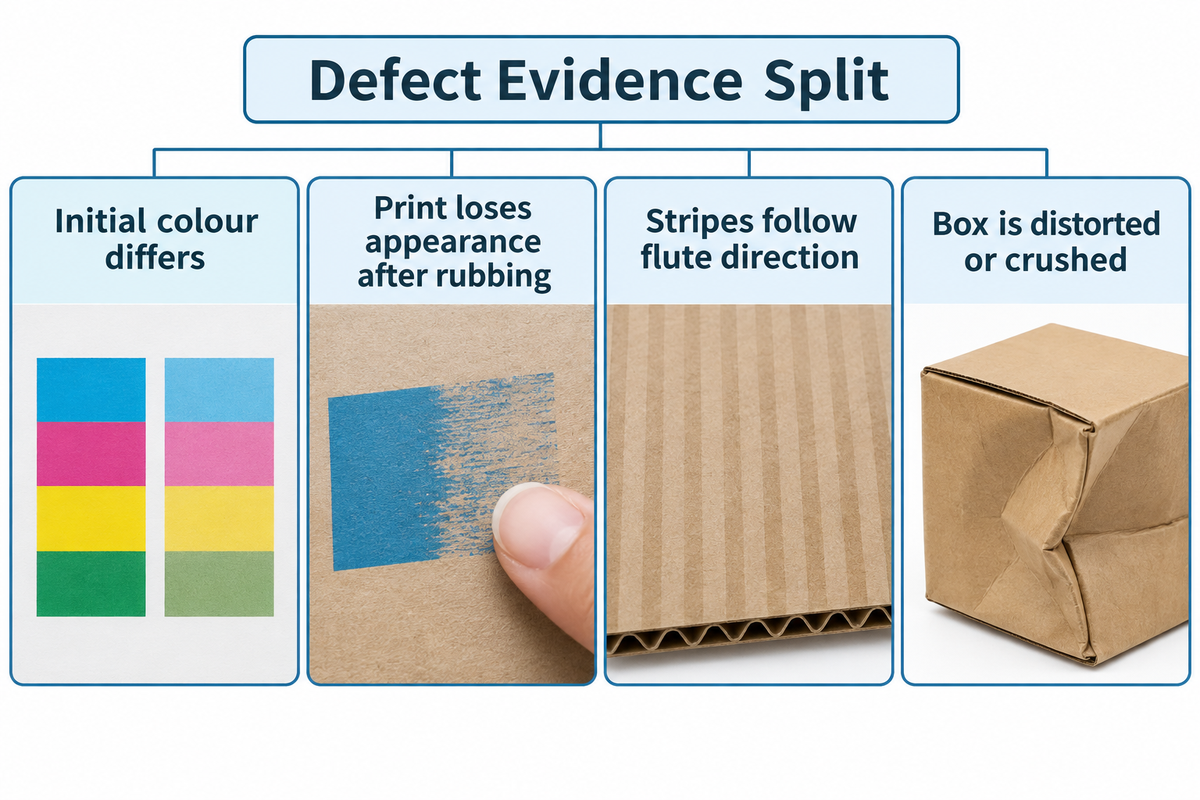
Scuffing, printed striping, and board distortion should be investigated as separate concerns. Scuffing concerns the printed surface under contact; striping can follow the flute pattern; physical ripples or warp concern board topography or shape. Begin with the approved reference and/or production sample, and focus on the property in question, rather than diagnosing failure based on weak ink.
In a Flexographic Technical Association technical article, Dan Fry of MacDermid, explains the difference in print density between the peaks and valleys of a corrugated board. This discussion is relevant to flexographic print transfer and plate geometry. This is a separate consideration from direct digital inkjet printing.
“This print density differential gives the appearance of corduroy striping running along the flutes of the board.”
Discussing physical washboarding, Billerud describes liner ripples following fluting with adhesive shrinkage as one of the phenomena. A printed stripe may be apparent without establishing the same physical cause. Side lighting and other unprinted areas, as well as retained board samples, help to separate appearance from surface texture.
Defect Evidence Split
| Observation | Compare | Useful record |
|---|---|---|
| Initial colour differs | Approved reference on matching substrate and finish | Artwork version, substrate and colour approval |
| Print loses appearance after rubbing | Finished print under agreed abrasion conditions | Rub method, exposure and acceptance criteria |
| Stripes follow flute direction | Printed density and physical surface separately | Board, print setup and retained production samples |
| Box is distorted or crushed | Board identity, conversion and packed load path | Relevant board or finished-pack test and conditioning |
ASTM D5264-98(2019) describes comparative abrasion testing of printed materials under laboratory conditions. The current TAPPI publisher listing, TAPPI/ANSI T 830 om-24, covers ink-rub evaluation including dry and wet modes. Agreement on the mode and acceptance criteria makes a report usable; a method number alone is not a shipment-durability guarantee.
What really changes the cost per usable box?
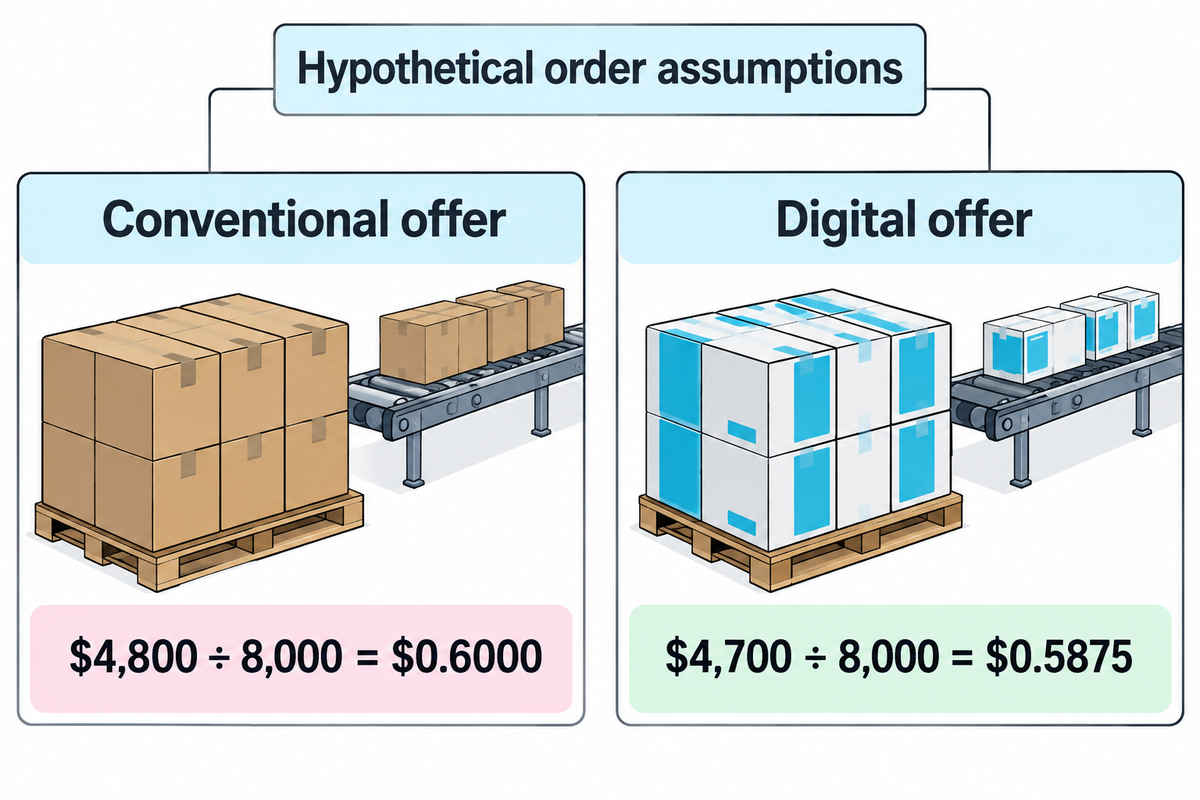
The cost per usable box means the specified order costs, divided by the quantity that can serve the planned demand. Set-up, versioning of the art work, freight and obsolete stock change the answer even if the unit price of the print job appears low. Consider equivalent protection, finish, printed sides, and scope of delivery when selecting a cost-effective route.
Good-Box Order Economics
Assumed inputs: a campaign needs 8,000 usable boxes. A conventional offer requires ordering 10,000 boxes at $0.40 each, with $600 setup and $200 freight. A digital offer supplies 8,000 boxes at $0.55 each, with $100 setup and $200 freight. The conventional offer’s remaining 2,000 boxes become unusable for this campaign because the artwork expires. These are hypothetical order assumptions.
| Item | Conventional offer | Digital offer |
|---|---|---|
| Ordered quantity | 10,000 boxes | 8,000 boxes |
| Print subtotal | 10,000 × $0.40 = $4,000 | 8,000 × $0.55 = $4,400 |
| Setup | $600 | $100 |
| Freight | $200 | $200 |
| Order total | $4,800 | $4,700 |
| Usable campaign quantity | 8,000 boxes | 8,000 boxes |
| Cost per usable box | $4,800 ÷ 8,000 = $0.6000 | $4,700 ÷ 8,000 = $0.5875 |
The lower printed-unit cost case loses here because the buyer pays for expired inventory and more setup costs. If all 10,000 conventional boxes remain useful, the same $4,800 order spreads over 10,000 boxes, or $0.48 each. That beats the digital offer’s $0.5875, so version life, demand and the actual quotations decide which route wins. For an equipment example, EFI describes versioned graphics on its Nozomi 14000 LED system.
For shipping purposes, freight should be part of the comparison of order costs: expedited shipping can outweigh a print-price saving. Shipping products, individually rather than on a replenishment pallet, changes the distribution task. Custom printed boxes, with extra inside printing, premium quality, and/or additional versions should also be part of the comparison.
What production evidence should you retain?
The approved drawing, artwork version, substrate and finish specification, representative samples and job-linked test reports should be retained. Each of these should identify what was tested and the production step involved. For teams packaging products across several production runs, these records distinguish a change in artwork, material and a processing issue without restarting the design process.
Huandao has sheet-fed offset litho printing, coating, laminating, die-cutting, and folder-gluing all under one roof. Our corrugator supplies both single E-flute and single B-flute board. Other profiles (i.e. A, C, F, and BC) board are sourced elsewhere. The lab reports on ECT/burst, ink rub test, and basis weight checks for the customer’s job are done in process. Process steps are scanned into MES, with ERP systems used to plan the scheduling of the job.
For the production brief, confirm the board construction and test conditions, print-facing substrate, quantity per artwork version, inside and outside print, finish and glue areas, intended barcode environment, sample purpose and freight scope. Also provide the required recovery wording or food contact arrangement if relevant. Providing the information in this manner will consolidate the approval questions.
Huandao’s protective packaging solutions can combine the printed box with inner trays, inserts and outer cartons in a single shipment. Our printed corrugated box solutions page handles the manufacturing and quotation side of the business. The technical records should be in line with the specified job and construction.
What is changing in corrugated printing?
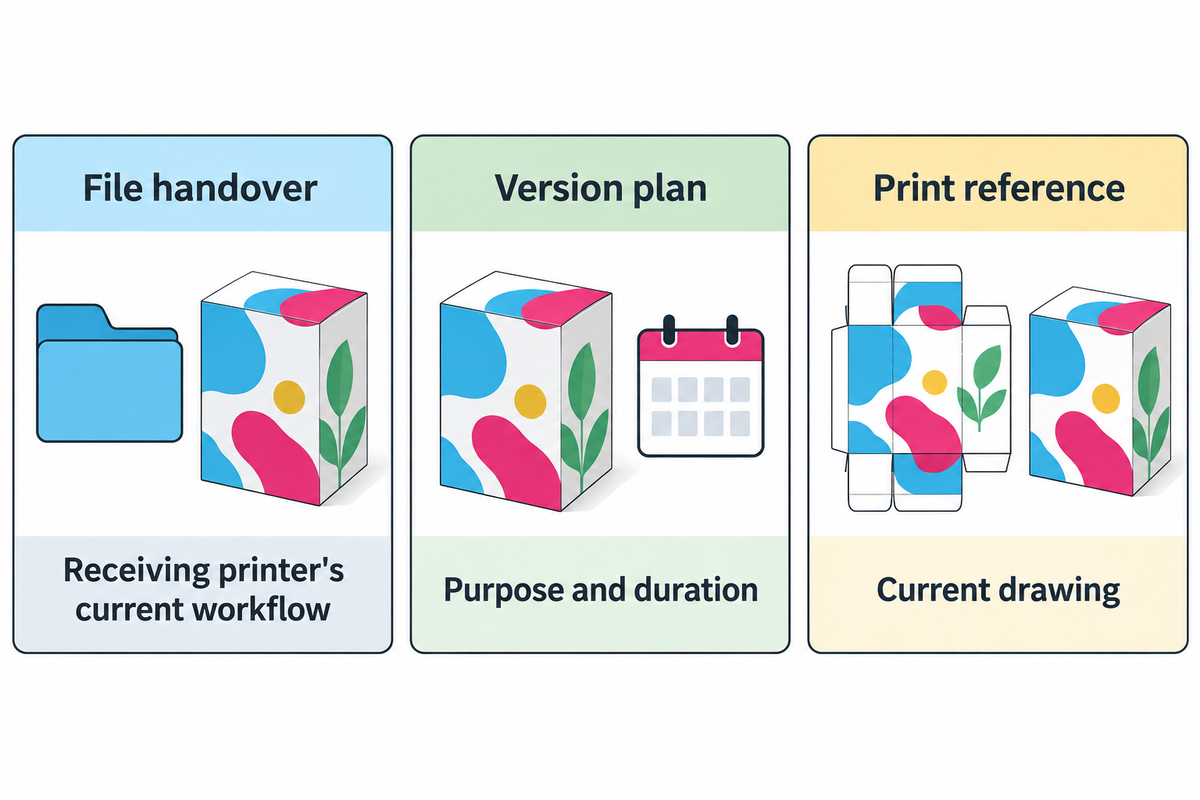
Attention should be paid to artwork versioning and the manner in which production files are handed over, when planning repeat orders of printed boxes. A new print system can change how efficiently versions are handled, while a revised file standard can improve how finishing information travels with graphics. Those can impact the buyer’s workflow.
ISO published the second edition of ISO 19593-1 in October 2026, replacing the withdrawn 2018 edition. Its public abstract includes packaging processing-step information such as primer and printing plate making. For a new project, the useful action is to align the file handover with the receiving printer’s current workflow, especially where white ink, varnish or finishing information sits outside the visible artwork.
EFI talks in its literature about Nozomi 14000 LED inkjet system a ‘plate-free, versioned, direct-to-board’ process. This is an example of a vendor’s technology and not a reference to Huandao’s machinery. Buyers of packaging still need to review the finished result and assess conversion and order economics for the alternative route.
Smithers’ November 2025 forecast shows digital corrugated printing as worth $8.2 billion in 2030. The figure is a forecast for that segment, not measured 2026 sales or the size of all corrugated packaging. It shows it’s worth monitoring the capacity of digital printing and not to treat forecasts of digital printing as a purchasing directive.
Seasonal work should separate reusable artwork from campaign specific versions before deciding on the order split. A customizable box creates value when its changing graphics meet demand, not when stock is stranded after the promotion. The 2025 coated-corrugated recovery update also means finishing selection is made at the whole construction level. A practical next order should have a current drawing along with a print reference and a version plan stating its purpose and duration.
Printed corrugated boxes FAQs
What is the difference between cardboard and corrugated boxes?
Corrugated boxes contain a fluted medium between liner layers; “cardboard” is a broader everyday term.
Solid paperboard packaging has no fluted layer. Corrugated cardboard shipping boxes use the combined structure for their particular protection and handling task. When comparing packaging boxes, specify the actual layer arrangement rather than relying on either everyday name. A folding carton inside a shipping case and an exposed corrugated retail box have different jobs, even if their artwork looks similar.
Can corrugated boxes be printed on both sides?
Corrugated boxes can have inside and outside printing when the selected construction and production route support both faces.
Panel orientation matters because the flat artwork changes position when the box is assembled. Identify the opening view, hidden overlaps and glue areas on the drawing. Extra faces also add production work and approval questions. For a mailer, one useful inside message can serve the customer better than treating every available panel as a surface that must be printed.
Are printed corrugated boxes recyclable?
Printed corrugated boxes can be recyclable when the complete construction suits the relevant recovery system; in the US, AF&PA puts the 2025 cardboard recycling rate at 70% – 75%.
Ink, coatings, laminates, attachments and contamination can change the handling of the finished pack. A claim about recycled content describes the input material, while a claim about recyclability describes what can happen after use. For coated or treated board, relevant repulpability and recycling evaluation is useful alongside the collection arrangements in the market where the package will be discarded.
What is the minimum order quantity for printed corrugated boxes?
Minimum order quantity shifts with the print route: one published supplier table lists 100 shipping boxes for digital or post-print flexo printing and 5,000 in most cases for in-line printing.
Separate total volume from quantity per artwork version. Several designs sharing a structural drawing can still require separate printing preparation, sheets or production planning. Use the manufacturing page for Huandao’s current quotation conditions.
Can I see a sample before production?
Pre-production samples are useful when their purpose and relationship to the production route are defined.
A blank sample can establish fit, folds and product restraint. A printed mock-up can communicate appearance, while a production-representative sample addresses the actual paper, ink and finish. Keep the approved reference with its drawing and artwork revision. If a sample uses a different print system or board, record the difference so that its approval is used for the question it actually answers, rather than extending it to unrelated properties.
How long does production take?
One online box printer quotes 5 business days for sample orders and 10-15 business days for printing larger orders, counted from artwork approval.
A changed file or finish can alter that schedule. Compare the promised dispatch date and freight arrangement, rather than treating a printing-only turnaround as the delivered lead time.
Do printed corrugated boxes protect products during shipping?
A correctly designed corrugated pack can protect your products when its structure and restraint suit the distribution conditions.
Corrugated shipping boxes are made to work as part of a complete pack. Corrugated shipping boxes may need inserts, cushioning or an outer case for a particular item. Brand visibility and high-quality graphics serve communication; a box still needs to be sturdy enough for its load path. Evaluate the proposed packed assembly for the journey rather than assuming premium printing provides additional shipping protection.
Key takeaway
Choose printed corrugated boxes by matching the print route to the artwork, the structure to the journey and the approval sample to the property being checked. Compare costs over usable demand, with artwork versions and unused inventory included.
Bring the structure and artwork together
For a production discussion, prepare the product dimensions, packed weight, distribution route, drawing and artwork versions. Huandao’s team can connect the printed box with the related protective packaging and shipment plan.
Technical comparisons use the sources below and the specifically attributed supplier webpages linked in the text. The cost example employs assumed inputs. Huandao production descriptions come from company information; no customer test or case values, or customer results are provided.
References & Sources
- Corrugated board production European Federation of Corrugated Board Manufacturers.
- New Digital Printing Technologies Boost Packaging Benefits Kate Bertrand Connolly, Packaging Digest, 2020; named supplier interviews.
- What is Corrugated? Fibre Box Association.
- Influence of humidity and temperature on mechanical properties of corrugated board, Numerical investigation Cornaggia, Gajewski, Knitter-Piątkowska and Garbowski, BioResources, 2023.
- Regulation (EC) No 2023/2006, consolidated 16 March 2025, Annex A European Union; food-contact scope.
- ISO 19593-1:2026, processing steps for packaging and labels International Organization for Standardization; public abstract.
- ITF-14 Barcode Specifications GS1 New Zealand, version 2.0, 28 November 2024.
- The Effect of flexographic printing on the compression strength of corrugated shipping containers Michael Reese Eyre and Nancy Kaczor, Rochester Institute of Technology, 1990; thesis abstract.
- Industry Publishes Updated Voluntary Standard for Recycling Cardboard American Forest & Paper Association and Fibre Box Association, 29 May 2025.
- 16 CFR 260.12, Recyclable claims Federal Trade Commission Green Guides; United States.
- Reducing Fluting Issues While Handling Increased Graphic Requirements Dan Fry, Flexographic Technical Association; supplier-authored technical article.
- ASTM D5264-98(2019), abrasion resistance of printed materials ASTM International; public scope.
- TAPPI/ANSI T 830 om-24, ink rub test of container board and corrugated board TAPPI; public scope.