Get in Touch with Xiamen Huandao Packaging Technology Co., Ltd.

Custom Paper Shopping Bag Guide: From Product Fit to PO

Buyer specification guide
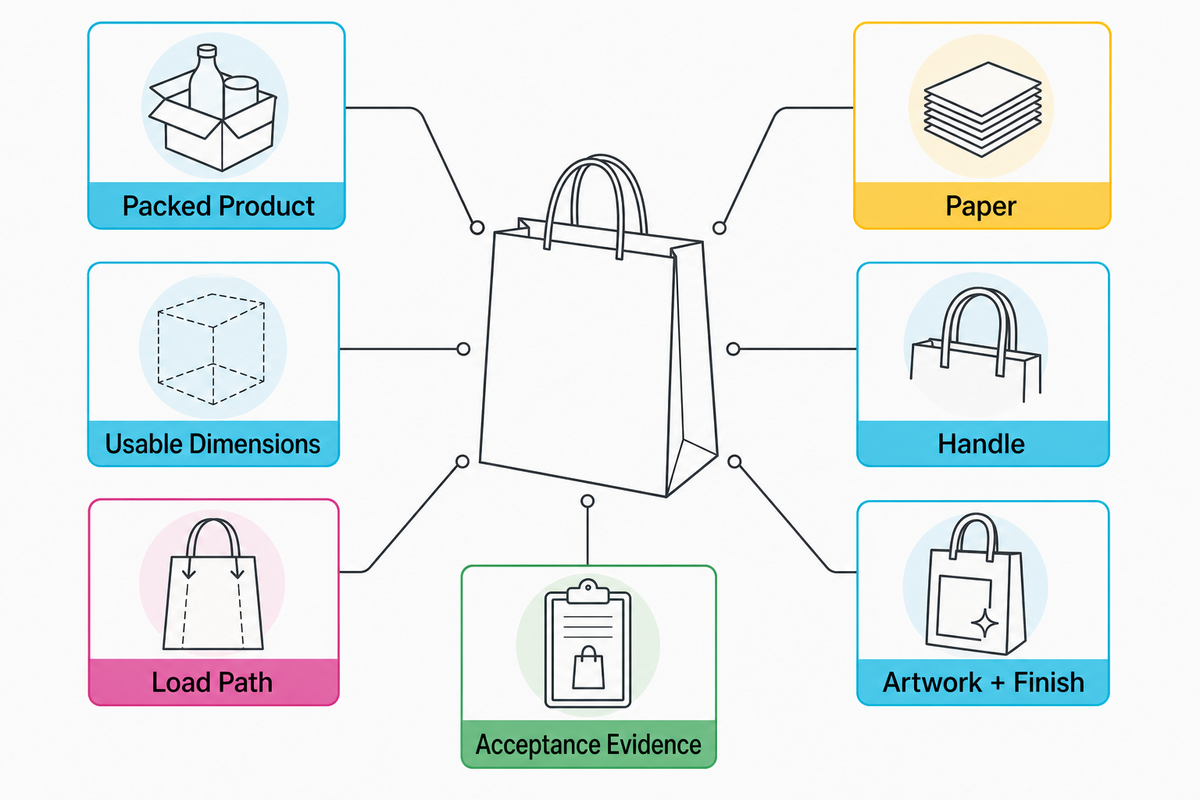
Custom paper shopping bags are finished carry systems specified around the packed product and carrying route, rather than by paper weight or a visual reference alone. This guide turns that decision into seven controllable inputs: product, usable dimensions, load path, paper, handle, artwork/finish and acceptance evidence. If you already have those inputs, you can move to configuring paper shopping bags and getting quotes; this article stays focused on the brief first.
Direct answer: A paper shopping bag is a finished system. The suitability of the system depends on the packed contents, usable dimensions, folds, bottom, top reinforcement, handle attachment, conversion, and the evidence you agree to inspect. GSM is useful specification information, but it isn’t a universal safe-load rating.
The same specification method can apply to retail, gift, event, and promotional orders. Specification still governs each order. Each use case warrants a measurable brief. A giveaway bag may be temporary, but the packed product, load, and carrying route still matter. Branded artwork needs one controlled revision against the agreed dieline.
Start with the Packed Product, Not the Bag Style
Answer: Begin with the item as it will be carried. That includes maximum packed dimensions and weight, orientation, inserts, carrying time, retail handoff, and exposure to moisture and/or abrasion. That record prevents a visually attractive bag from becoming the first unresolved engineering decision after artwork has been approved.
The 7-Point Bag Brief
Definition: A one-page record that locks product, dimensions, load path, paper, handle, artwork/finish, and acceptance evidence prior to quoting.
- For packed product, record item, inserts, tissue, closures and maximum weight in kg/g.
- For usable dimensions, state width x depth/gusset x body height, measurement posture and inside/outside.
- For load path, state which panels work with which bottom/top/collar and handle attachment.
- Paper: State candidate paper family, basis weight (if any), finish and evidence needed.
- Handle: State type, clearance, attachment, reinforcement, balance and intended carry route.
- Artwork and finish: state boundaries and limits: print panels, finishes, colors, handle zones, folds and gussets.
- Acceptance evidence: state sample level, loaded-use check, lot rule and what records are needed for release.
| Use case | What to record | Decision risk |
|---|---|---|
| Apparel | Folded or boxed posture, tissue and garment protection | Body height may be driven by presentation, not weight |
| Cosmetics | Rigid cartons, maximum protrusion, set count and upright orientation | Gusset clearance and stable balance |
| Boxed gifts | Box corners, ribbon height and one-hand carry route | Top clearance and panel scuffing |
| Events | Multiple inserts, distribution time and weather exposure | Variable contents and repeated handling |
| Grocery-style carry | Actual packed mix, moisture exposure and carry distance | Finished-bag test must use the intended load |
“Boutique” is a cue for experience and appearance, not a load class. For example, a single boxed item requires a different brief than a general shopping bag for a purchase of multiple, varied items. Freeze that difference before approving a style reference.
For retail stores, state what the retailer will pack and how long the carry lasts. Items such as paper grocery bags or takeout may introduce moisture or mixed content. Catalog breadth may be described as a wide range. However, that term shouldn’t replace a packed product record.
What Makes a Paper Shopping Bag Carry Safely?
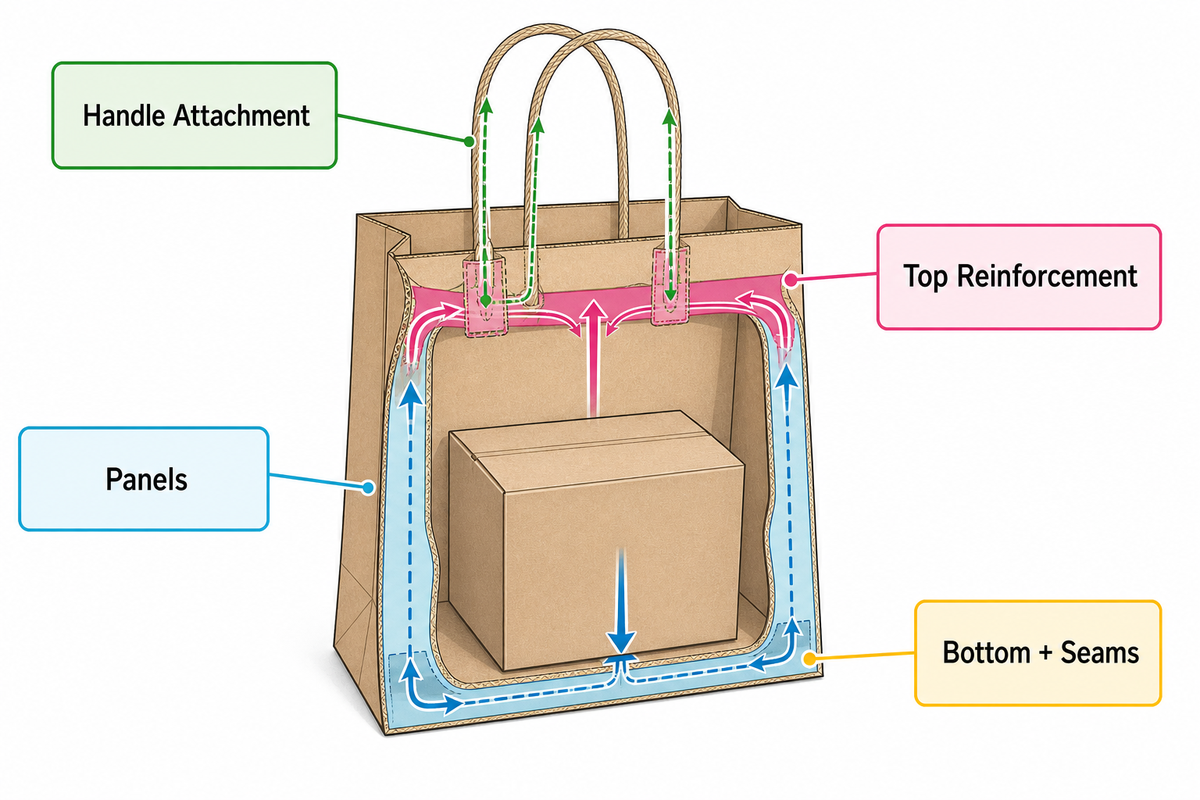
Answer: A finished bag carries through four connected zones: panels, bottom and seams, top reinforcement, and handle attachment. Review them as a load path under the intended packed contents. A paper grade or handle name alone cannot predict an order-specific carrying result because construction, glue, reinforcement, dimensions, and conversion also matter.
The 4-Part Load-Path Check
Definition: A finished-bag inspection that follows force from the contents through panels, bottom, top reinforcement, and handles.
| Zone | Controllable input | Verification point | Record | Stop condition |
|---|---|---|---|---|
| Front and back panels | Paper family, sheet condition, folds | Loaded carry and abrasion observation | Sample ID and load description | Panel tears or excessive deformation |
| Side gussets | Fold accuracy and packed orientation | Open, fill, carry, unload cycle | Photo or inspection note | Crease split or blocked opening |
| Bottom and seams | Bottom construction, adhesive, reinforcement | Inspect under intended packed contents | Test setup and result | Opening, separation, or unstable base |
| Top/collar | Turn-top or reinforcement design | Check around handle anchors | Approved drawing reference | Tearing or distortion at the top |
| Handle attachment | Handle type, patch, knot or glue route | Lift, walk, set-down sequence | Attachment observation | Pull-through or detachment |
| Balance | Product placement and handle position | One-hand carry with intended load | Carrier feedback | Unstable or uncomfortable carry |
| Print/finish zone | Ink, coating, fold position | Rub and crease review where relevant | Proof/sample sign-off | Unacceptable rub, crack, or transfer |
| Repeat cycle | Defined carrying sequence | Repeat only if the use case requires it | Agreed cycle count | Failure before agreed acceptance point |
| Release | Approved method and criteria | Confirm all records are present | Release signature or digital record | Any missing or failed requirement |
“The approved object is the finished bag under its intended use, not a guessed conversion from GSM to kilograms.”
buyer-spec method used in this guide
How much weight can custom paper bags carry?
Direct answer: There’s no responsible universal weight number for custom paper bags. The answer must come from a documented finished-bag test using the intended contents, bag size, construction, handle attachment, and carrying sequence. A converted GSM figure doesn’t guarantee a carrying promise.
The paper bag platform discusses quality targets in the context of its own programme; that isn’t a rating for every bag design. Put the actual load in the brief and agree how it will be packed and handled. Preserve the sample, observation record and other relevant records with the purchase order file. For a more detailed setup record, use this handle-to-load brief.
How to Size a Paper Shopping Bag from the Packed Product
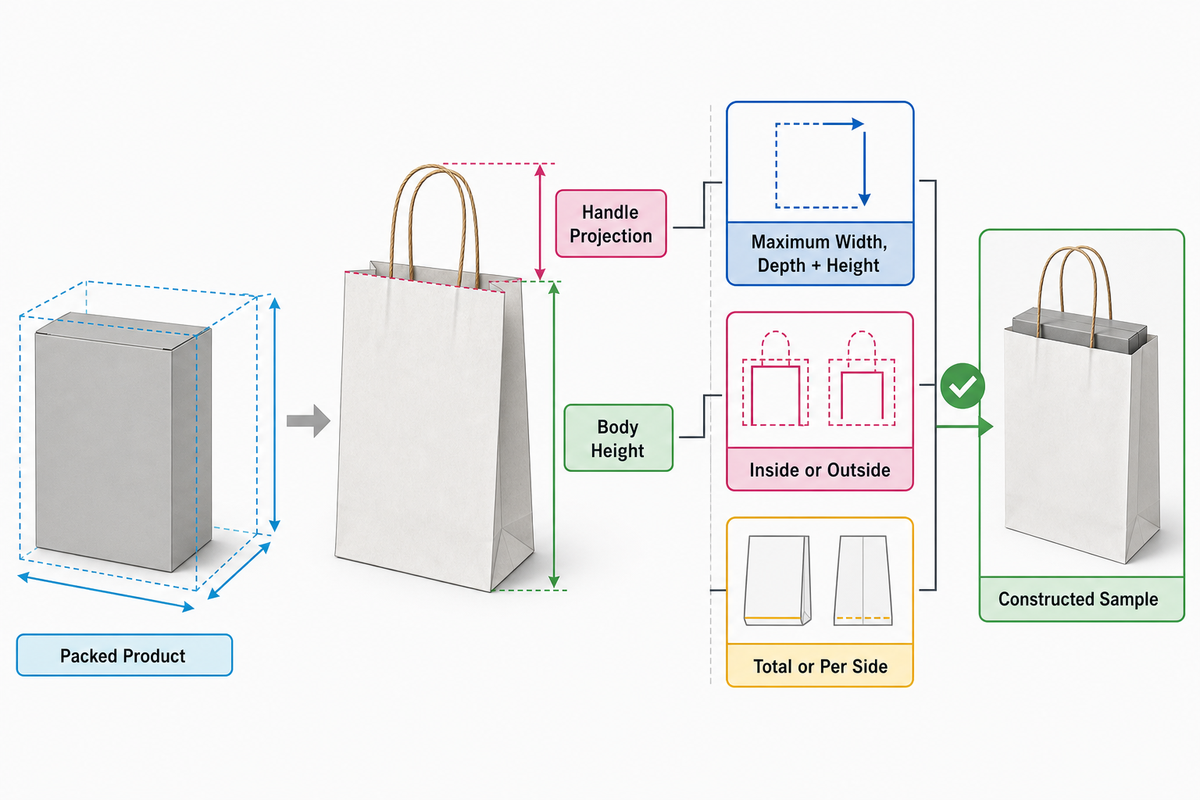
Size the bag from the packed product’s maximum width, depth, and height after defining its front and measurement posture. Indicate if the stated dimensions are internal or external, and if any allowance is total or per side. Then check if it fits on the physical sample constructed.
GS1 Sweden’s measurement guidance is useful for the discipline: identify the front, measure maximum dimensions including protrusions, and state the posture. It does not outline a universal shopping bag clearance allowance. ISO 6591-1:2026 addresses dimension measurement for empty paper sacks, but its public scope does not set a retail shopping-bag formula.
Worked starting brief: a packed product measuring 180 × 80 × 220 mm, plus a 20 mm total allowance in each dimension, produces a starting brief of 200 × 100 × 240 mm. This is Huandao’s company-provided starting convention, not a universal allowance or production approval. Verify construction-dependent fit, product removal, and body-height clearance on the sample.
The paper bag size planner can help organize dimensions, but the signed drawing still requires a measurement convention.
Does the height measurement include the handles?
Direct answer: Normally, body height and handle projection are recorded separately. A buyer needs the body height to assess bag fit and handle projection to assess clearance for carrying, storage and display. The convention must be shown on the approved drawing, NOT with a verbal shortcut.
Instead of noting the total visible height, it would be better to state “240 mm body height; handle projection measured separately.” Treating total visible height as a single measurement would lead to a bag that seems tall enough to provide body clearance in a photo, but after handle attachment and top fold, it may not provide sufficient body clearance.
Kraft vs Coated Art vs Specialty Paper: A Decision Matrix
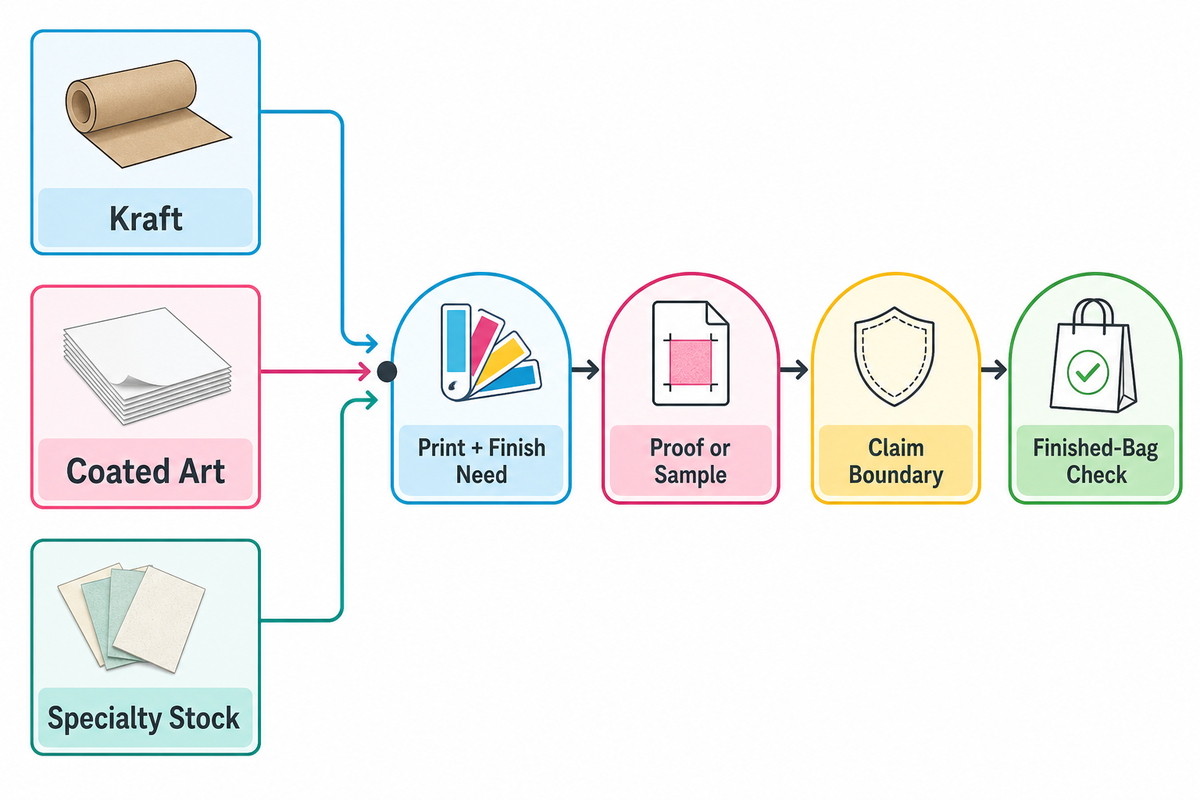
Answer: Paper selection should be based on the finished job’s requirements, NOT a “stronger” or “premium” paper. A blanket statement of “recyclable paper” is NOT sufficient. The final product should be assessed. Kraft, coated art, and specialty stocks each require a sample and a finished-bag check for the actual product and finish combination.
| Paper family | Starting specification cue | Useful when | Proof/test to request | Claim boundary |
|---|---|---|---|---|
| Kraft | Company-provided starting range: 120–200 gsm | A natural paper appearance or selected retail use | Physical constructed sample and intended-load check | Do not infer recycled content, recyclability, or certification from “kraft” |
| Coated art | Company-provided starting range: 157–250 gsm | Color, surface, or finish decisions needing a print proof | Color/finish proof, fold and rub review where relevant | Coating and full construction change claim review |
| Specialty stock | Project-specific; no general range stated here | Tactile or premium presentation with defined requirements | Representative construction and finish sample | Ask for order-specific material and claim evidence |
Basis weight is one input. It doesn’t replace inspection of formation, bag dimensions, seams, bottom construction, reinforcement, or handles. Compare the paper options against the intended job with a paper material comparison.
White paper, brown paper, and white kraft describe appearance; they aren’t evidence labels. Brown kraft paper, recycled brown, and recycled brown kraft should be supported by a defined grade. Kraft bags and brown paper bags require the same finished-bag checks. White paper bags should be supported by the same evidence.
Custom kraft paper bags and recycled kraft paper bags may contain recycled materials. The supplier needs to provide the actual basis for the claim. Check if the sheet is made from recycled fiber and whether the claim covers post-consumer input. A sustainable or reusable result can’t be assumed; intended reuse depends on construction and usage. If the choice is limited to white or brown, request the grade, coating and finish. A recycled paper description doesn’t confirm recyclability in the target market.
What is the best paper bag material to use?
The best material is the one that meets the packed load, the desired print and finish, handling exposure and balance, and the documentation requirements in the finished sample. Kraft may suit one brief and coated art another; neither name settles carrying performance, recycling access, certification scope, or food-contact suitability.
For any environmental wording, inspect the complete construction: paper, coating, inks, adhesives, handles, and reinforcement. A carrier for packaged goods isn’t automatically food-contact packaging. Keep those scope decisions separate.
How to Choose a Handle and Approve the Finished Sample
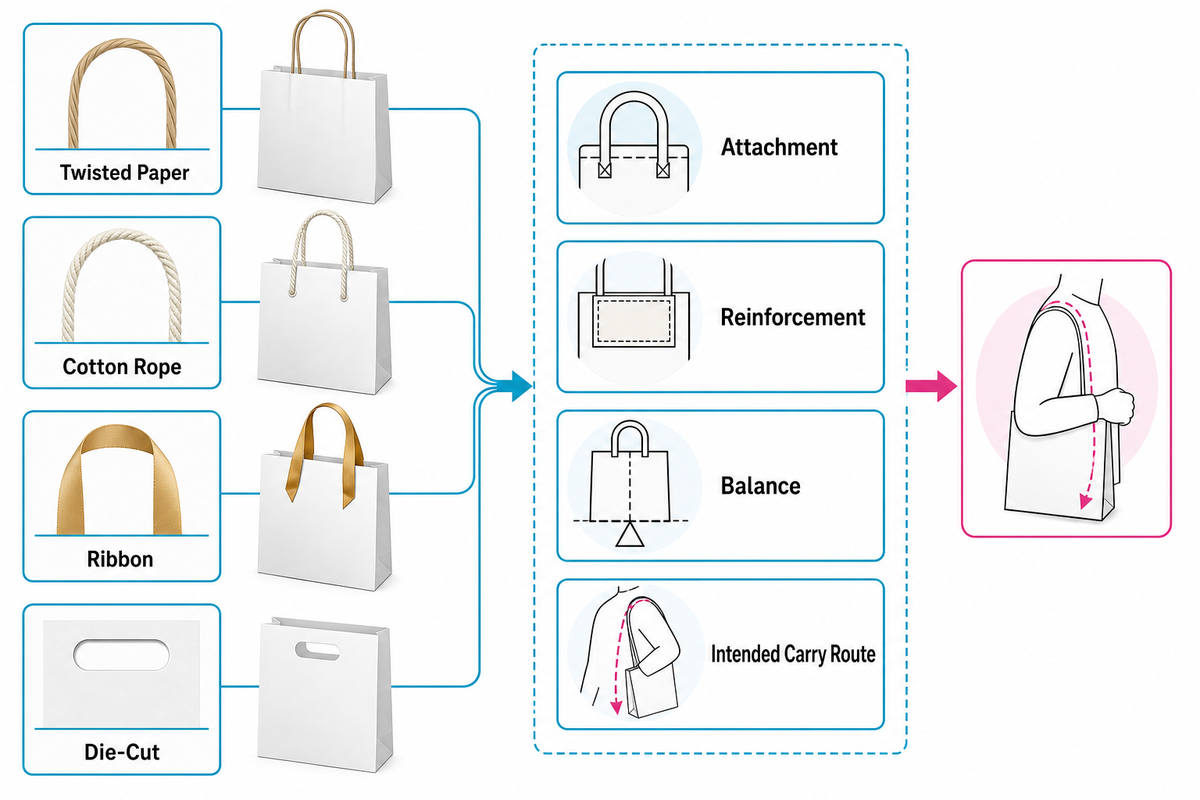
Answer: Choose a handle after the packed product, carrying route, hand clearance, balance and attachment design are decided. Twisted paper, cotton rope, ribbon and die-cuts are the options to evaluate; performance classes aren’t pre-approved. Approval must also consider the handle and surrounding paper in the finished sample.
| Handle family | Brief it for | Inspect on sample | Stop if |
|---|---|---|---|
| Twisted paper | Paper-led presentation and defined carry route | Grip, attachment, top reinforcement, balance | Tear, pull-through, blocked access, or unstable carry appears |
| Cotton rope | Specified tactile feel and hand clearance | Hole/anchor area, clearance, knot or attachment condition | Detachment, discomfort, or collar damage appears |
| Ribbon | Gift presentation with defined closure and carry needs | Finish interaction, hand clearance, attachment and balance | Ribbon interferes with access or carry becomes unstable |
| Die-cut | Integrated handle profile and product access | Cut edge, hand opening, top area, panel deformation | Sharp/blocked access, tearing, or discomfort appears |
Catalog groups labeled bags with handles or paper bags with handles don’t define attachment strength. Avoid handle and fold stress zones in an edge-to-edge graphic. High-end presentation requires measurable acceptance criteria.
Retail-bag anatomy includes separate risk zones around the turn top, handle attachment, gussets, and bottom. An attractive empty sample isn’t sufficient for bag approval. The sample construction must be reviewed with the bag filled and carried. Capture the exact sample ID and test setup. See paper bag handle options to see an example of the options you’ll face.
How Printing, Artwork, and Finishes Change the Approval Path
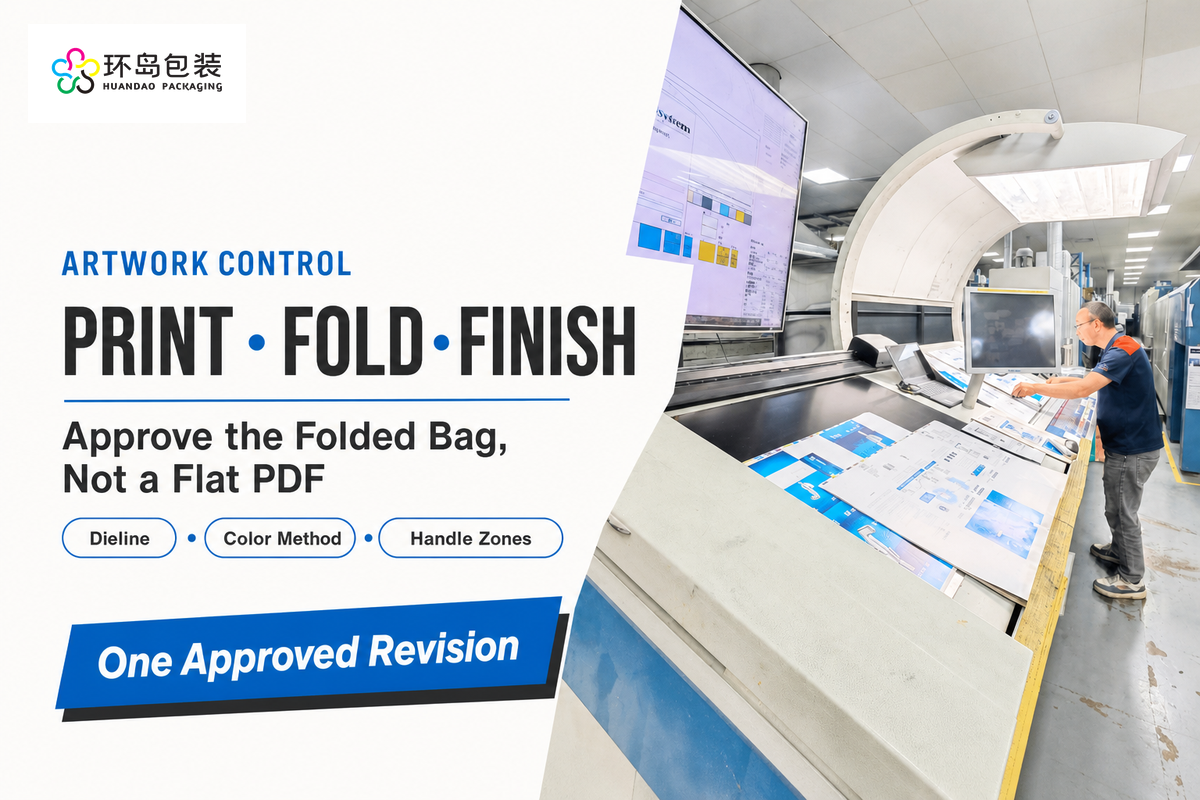
Answer: Artwork approval must control the bag as a folded object, not as a flat PDF. Address logos, color method, folds, gussets, handle zones and finish boundaries on the dieline; then select a proof that answers remaining color, placement and surface risk before production.
Mark the primary front panel, reverse panel, side gussets, bottom, turn top, and handle zone. A logo may be technically printable on a panel but still become distorted, obscured, or interrupted by a fold or attachment. Ask which decisions a digital proof can answer and which require a physical, constructed sample.
Huandao states some projects can use CMYK plus up to two Pantone spot colors and six printing units with an inline coater. That is a disclosed capability boundary. It does not mean that every order uses those methods or finishes. Confirm the actual quote and approved proof route.
When you customize the imprint with a company name or logo, bind that logo or artwork to one approved revision, retain the approved files and color references, and record printer confirmation before production.
When a portal asks to upload a logo or design, record the revision and treat any sticker as a separate component. Vibrant color and intricate designs require a representative proof, not a screen-only approval. A search for logo paper requires resolution to a paper grade and printing method.
- State the color role: process color, named spot color, or approved alternative.
- Mark artwork that crosses folds, gussets, handle attachments, seams, or finish transitions.
- Name the finish and what check is required for its appearance, rub, crease, or handling.
- Save the approved dieline, proof revision, and sample ID with the order record.
Where can I print my logo on the paper bag?
Usually, logos are safe on clear front or back panel areas away from folds, gussets, handles, seams, and finish boundaries. The exact printable zone depends on the approved dieline, bag construction, and artwork scale; show it on the final drawing rather than assuming it from a flat mockup.
When a brand mark must be placed on a fold or carry zone, make this an explicit proof request and check it on the physical construction. This is especially critical if the finish changes the surface appearance of the bag, or if the bag is repeatedly handled at retail.
The 3-Sample Approval Ladder: What Each Sample Must Prove
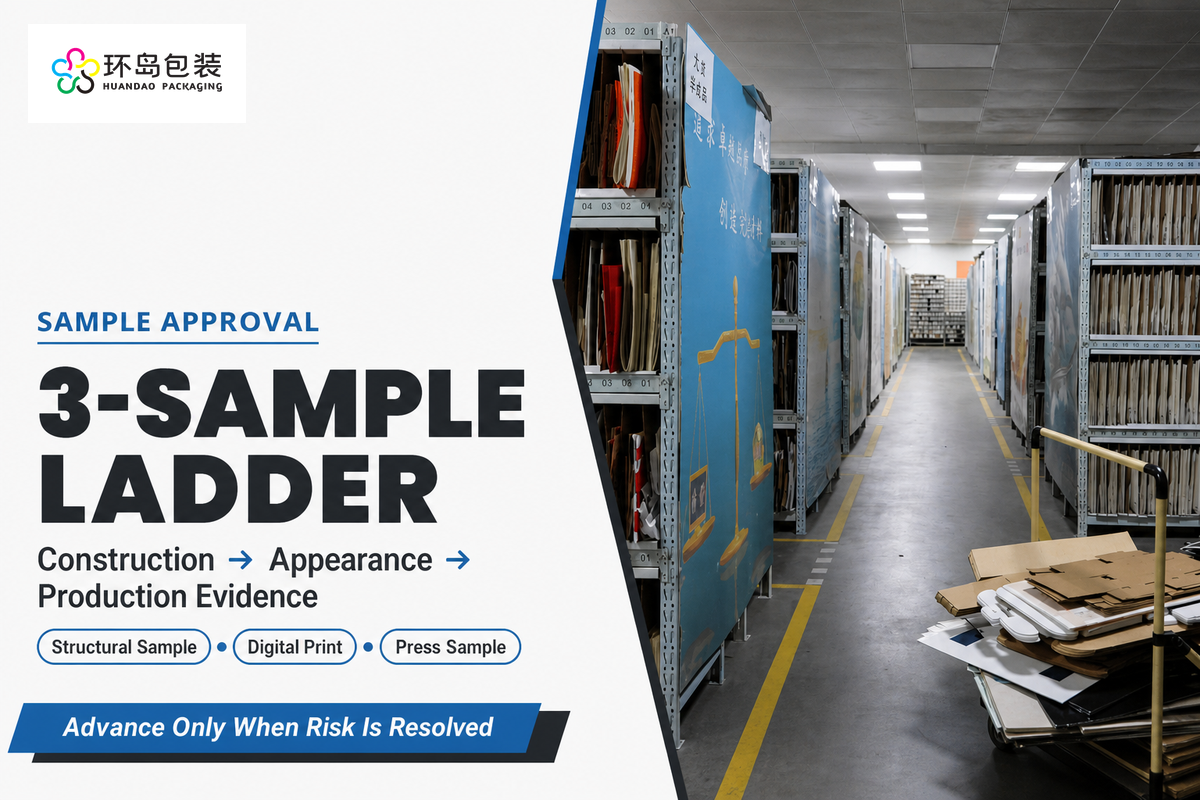
Use the least costly sample to validate the current uncertainty and only advance when the next uncertainty requires a more representative sample. A structural sample, a digitally printed appearance sample, and a production-representative press sample answer different questions. By themselves, they don’t prove a shipment lot conforms.
The 3-Sample Approval Ladder
Definition: A staged approval process separating construction, printed appearance and production-representative samples, prior to releasing a purchase order.
| Level | Can prove | Cannot prove | Buyer record and stop condition |
|---|---|---|---|
| 1. Structural sample | Fit, opening, basic construction, handle route, intended-load observation | Production color, final finish, repeatability | Record packed contents; stop if fit or load-path failure remains |
| 2. Digital-printed sample | Artwork placement and preliminary visual direction | Production ink, press behavior, final production consistency | Record artwork revision; stop if folds, zones, or finish risks are unresolved |
| 3. Production-representative press sample | Agreed production-like print, paper, finish, and construction evidence | Shipment-lot conformity without a separate lot rule | Record sample ID and criteria; stop if required job-specific evidence is absent |
Separate production-lot acceptance: after the design/sample ladder, agree a random selection method and accept/reject rule for the production lot. NIST describes lot-acceptance sampling as an accept/reject decision for the immediate lot, not an estimate of general lot quality. The sample size and threshold are order-specific; don’t borrow a generic number from this guide.
When appropriate, include job specific ink-rub, basis-weight or other agreed records. Stop production release if the required sample level has not answered the unresolved risk, or if the lot rule is missing.
The 12-Field RFQ and Usable-Cost Checklist
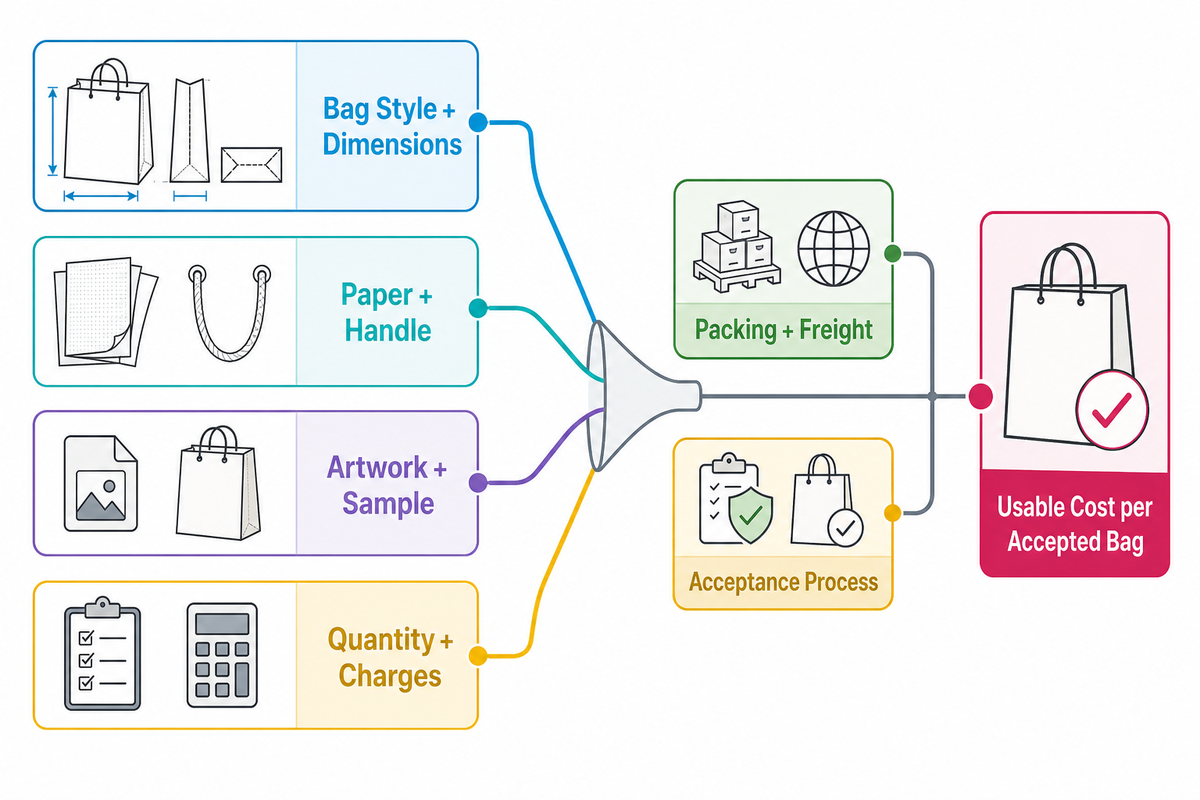
Answer: Quotes are comparable only after the same locked specification and commercial terms are shared with suppliers. Normalize quantity by size and style, sample scope, setup, packing, freight basis, delivery basis, deviations, and the buyer’s own unusable-share assumption before treating a quoted unit price as a procurement decision.
The 12-Field RFQ and Usable-Cost Checklist
Definition: A list to help a buyer identify differences that are usually hidden before comparing prices of usable output.
| # | Field to lock before price comparison |
|---|---|
| 1 | Bag style and construction |
| 2 | Usable width × depth/gusset × body height convention |
| 3 | Paper family, finish, and confirmed specification |
| 4 | Handle type, attachment, and reinforcement |
| 5 | Artwork revision, color method, and print locations |
| 6 | Quantity per size and style |
| 7 | Sample type, cost, and approval scope |
| 8 | Tooling, plates, setup, or other stated one-time charges |
| 9 | Inner-pack and master-carton packing |
| 10 | Freight basis, destination, and delivery terms |
| 11 | Lead-time assumptions and declared deviations |
| 12 | Buyer-entered unusable share and acceptance/claim process |
A simple comparison is: usable cost per accepted bag = total landed order cost / accepted usable bags (a buyer-side comparison, not a promise). To make assumptions visible, use the paper bag Quote Comparison Calculator and the Cost per usable bag calculator.
Consider “variety of sizes” as a catalog label; the packaging solution should give quantities for different sizes separately. The phrase paper bags at wholesale prices doesn’t normalize paper, setup, freight, and acceptance; wholesale comparison begins with the same twelve fields.
What is the minimum order quantity for custom-printed paper bags?
Direct answer: Minimum order quantity is supplier-, size-, style-, print-, and process-specific. Huandao’s company-provided starting MOQ is 1,000 pieces per size/style, with smaller projects reviewed case by case. That isn’t a market-wide rule and should be requested in the same RFQ that defines sample, setup, packing, and freight assumptions.
A lower threshold can change the construction, print route, setup economics, or available sample path. Compare the total defined order, not just the quantity figure.
How to Verify a Paper Bag Manufacturer Before Production
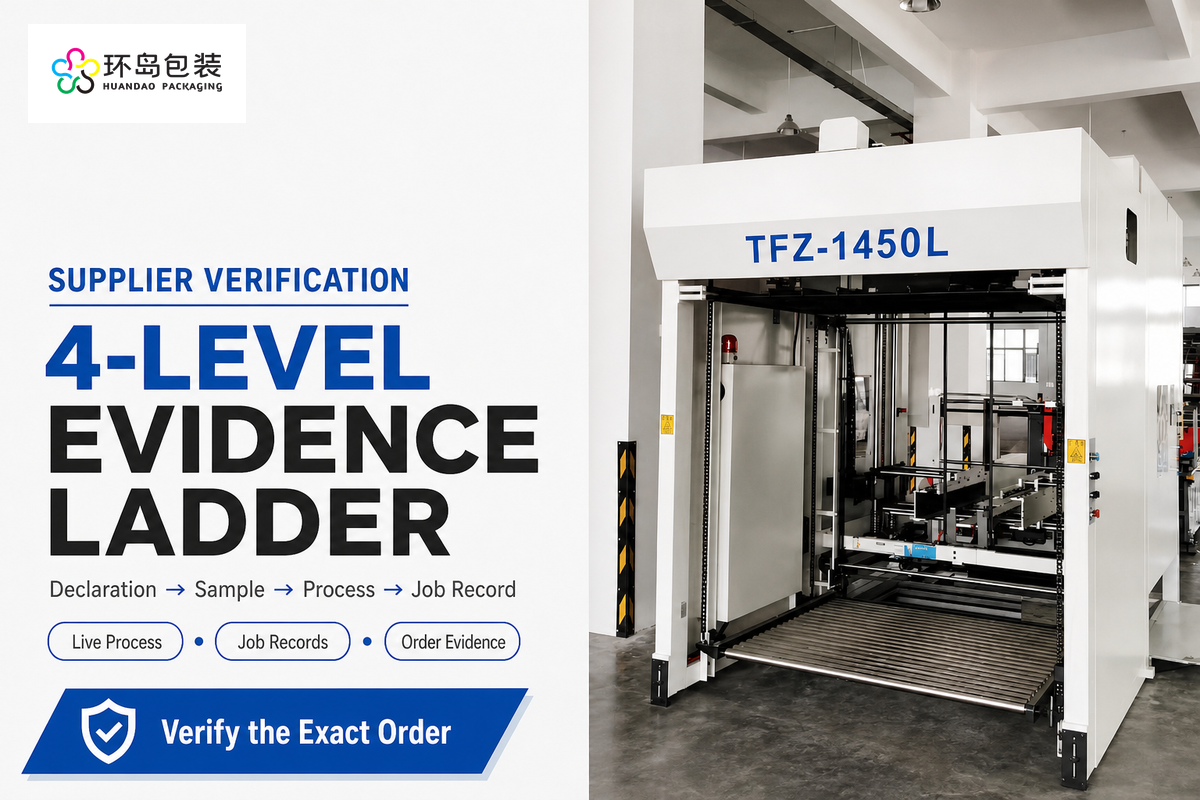
Answer: Supplier verification becomes more credible as it moves from a declaration to a sample, then to live-process evidence, and finally to job- and shipment-specific records. A factory image, certificate, or capability list can be useful context, but it does not establish acceptance of the buyer’s exact order without an approved specification and relevant records.
The 4-Level Manufacturer Evidence Ladder
Definition: A process that provides physical evidence and order-specific acceptance records to verify a supplier’s capability.
- Declaration: Supplier capability statement, process description, and relevant quality-system information.
- Sample: a physical bag that demonstrates defined dimensions, construction, handling, and appearance questions.
- Live-process evidence: evidence tied to the relevant converting, printing, finishing, or inspection route.
- Job/shipment record: inspection and acceptance evidence, approved specification, sample reference, and lot shipment rule.
ISO 9001 is a quality-management-system baseline for planned and controlled operations; it is not proof that a particular bag meets an order’s fit, load-path, print, or claim requirements. If an FSC claim is requested, verify certificate validity and product-category scope, then request sales documents identifying the certified product, claim, and supplier certificate code.
Statements referring to Huandao’s plant, in-house processes, laboratory, MES/ERP, or consolidated packaging are company statements unless proven otherwise. The company says its laboratory can issue job-specific ECT/burst, ink-rub, and basis-weight reports where those tests apply. Readers can review the Huandao production facility context; however, they should request evidence related to the order in question.
What Is Changing in Paper Bag Procurement?
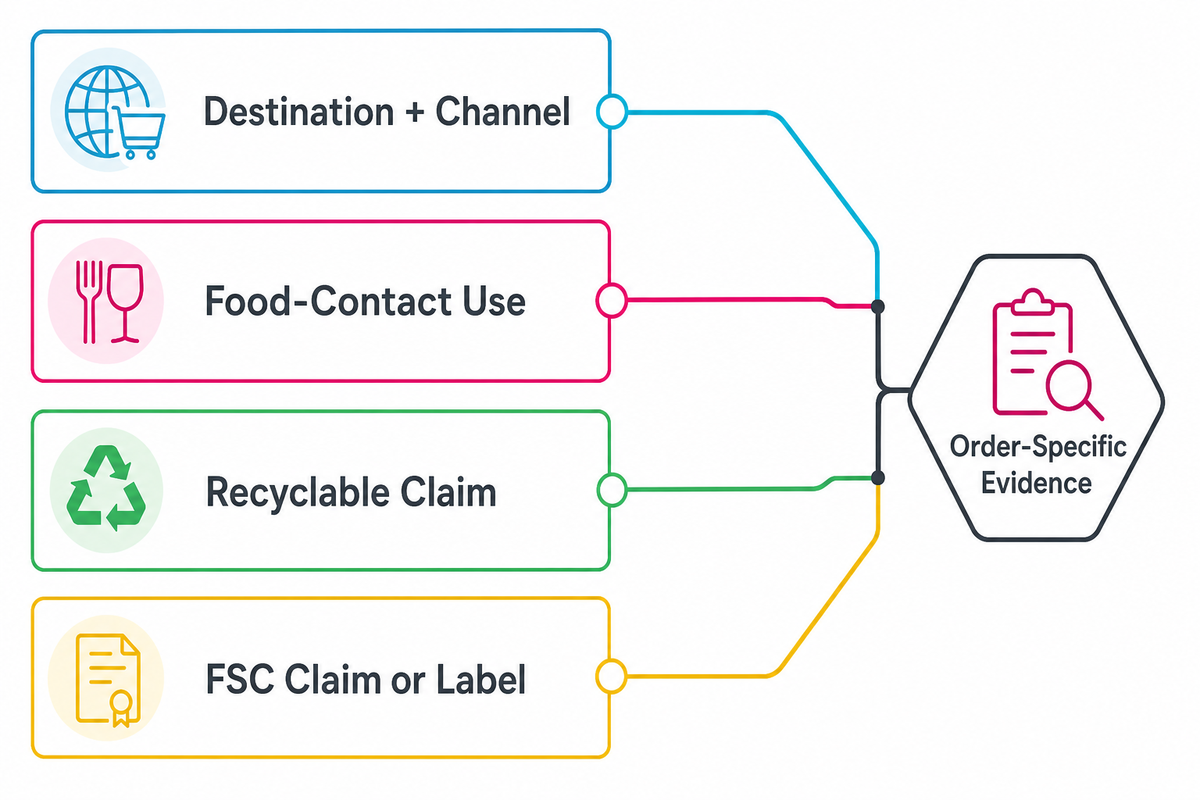
Answer: Procurement is becoming more evidence-sensitive due to differences in destination markets, sales channels, intended uses, finished construction, and claim wording. Start with the end in mind: where and how will the bag be used? Once the location and use case have been determined, request construction disclosure and order-specific evidence for environmental, material, or food contact statements as necessary.
| Question | Evidence boundary | Buyer action |
|---|---|---|
| Destination and channel | California rules for covered stores changed from 1 January 2026; the postconsumer-content threshold rises to 50% in 2028. | Check applicability and required markings for the actual sale channel. |
| Food-contact use | EU PPWR measures applying from 12 August 2026 include PFAS restrictions for food-contact packaging. | First decide whether the bag itself is food-contact packaging; carrying packaged food is not the same claim. |
| Recyclable claim | FTC guidance says qualification may be needed when suitable facilities are unavailable to at least 60% of relevant consumers or communities. | Review finished construction and destination-market access. |
| FSC claim or label | FSC’s revised trademark standard was published 1 January 2026, effective 1 July 2026, with transition through 1 January 2029. | Verify scope, approved artwork/claim route, and job documents before release. |
As upstream context only, AF&PA reported U.S. packaging papers and specialty packaging shipments 7% higher in March 2026 than March 2025, and 3% higher for the first three months. That doesn’t prove similar growth for custom shopping bags.
Custom Paper Bag FAQs
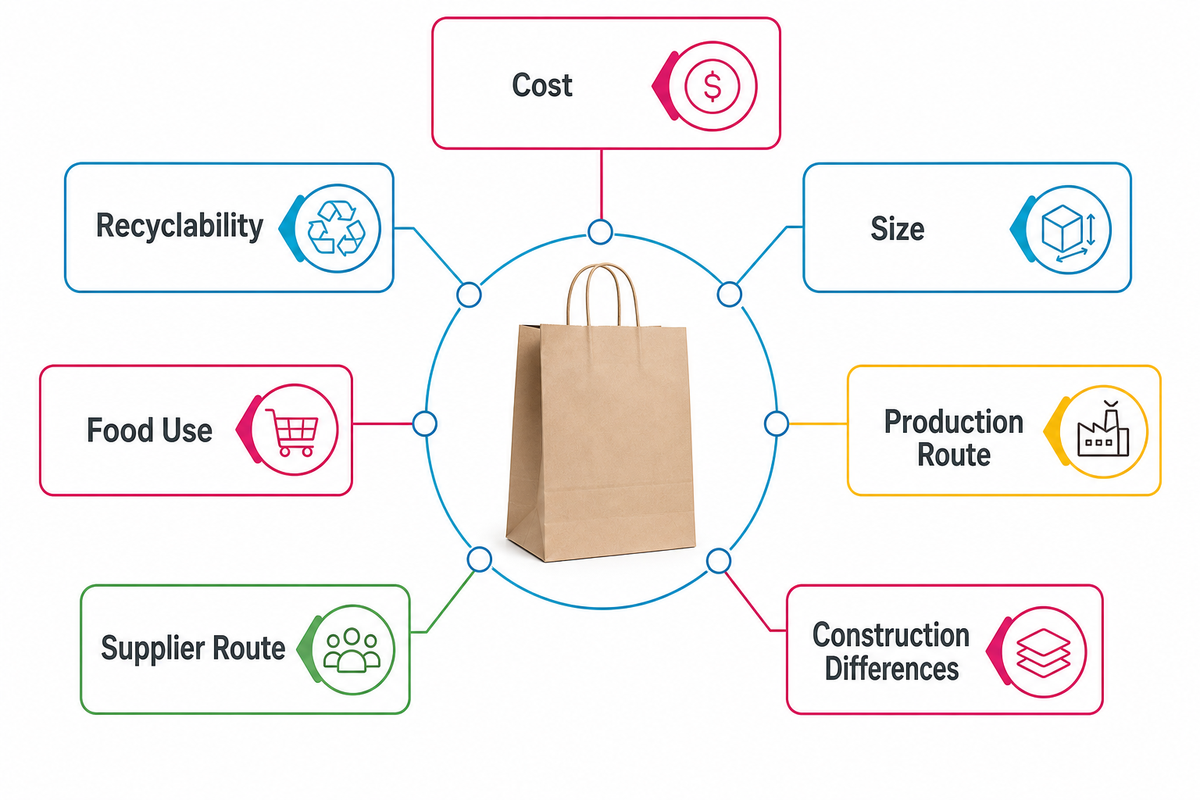
Answer: Brief answers may serve as initial scoping to the next procurement question, but they shouldn’t take the place of a product brief, physical sample, quote normalization or order-specific evidence. These answers deliberately separate supplier-specific information from universal rules and keep material, environmental, certification, and food-contact claims distinct.
How much do custom paper bags cost?
Cost depends on size, construction, paper, handle, colors, finish, quantity, samples, setup, packing, freight basis, and usable output. Compare the same twelve RFQ fields and a defined landed-cost basis before judging a unit price for the same destination and delivery basis. This guide makes no commercial price claim because those inputs vary by order.
Are paper bags recyclable?
Some finished paper-bag constructions may be recyclable in some markets, but the paper family alone doesn’t decide it. Coatings, inks, adhesives, handles, reinforcement, and local collection/processing access matter for that exact finished construction. FTC guidance calls for qualification when suitable facilities aren’t available to at least 60% of relevant consumers or communities.
What sizes do standard kraft paper bags come in?
There is no single standard size that proves fit. Start with the packed product’s maximum width, depth, and height, define the measurement convention and allowance, and validate the constructed sample. A “standard” stock size can still fail when an insert, box corner, or required body clearance changes the usable dimensions.
Can I use these paper bags for food purchases?
Carrying packaged food is different from food-contact packaging. If the bag or its components will contact food, identify the actual intended use and destination-market requirements before making any compliance statement. Don’t infer food-contact suitability from paper appearance or a general supplier description.
How are paper bags made?
The production route can include paper selection, printing, cutting, folding, side and bottom conversion, handle attachment, finishing, packing, and inspection. The exact route depends on the construction. For a buyer, the useful question is which part of that route controls the risks in the approved bag: print placement, gusset folds, bottom/seam integrity, top reinforcement, handles, or final lot acceptance.
Where can I buy custom paper bags?
First complete the brief in this guide, then use a supplier’s configuration and quotation route with the same dimensions, construction, sample scope, and acceptance requirements. The separate commercial solution page handles configuration and quotation.
Are all paper bags the same?
No. Two bags can look similar while differing in usable dimensions, paper, folds, bottom construction, reinforcement, handle attachment, print/finish, packing, and the evidence supplied with the order. The most reliable comparison isn’t a photograph or a GSM number: it’s a locked brief, a representative sample, a loaded-use check, and an agreed production-lot acceptance rule.
Turn the Brief into a Quote-Ready Specification
Once the seven inputs are complete, use the commercial page to create a configuration and quote request. Make sure you keep the packed-product records, samples, and acceptance evidence with the request, so the quote is based on the bag you’ll approve.
How This Guide Was Prepared
This is an informational procurement guide, not a universal performance standard or product certificate. Company capabilities, material ranges, and MOQ references are marked as company-provided. Other scoped claims are linked to reviewed authority or trade sources. The exact-term result set reviewed contained five commercial product/category pages and no articles (5/5, or 100% commercial), so this guide owns the educational buying task while the existing page owns configuration and quotation. Final assessment of suitability will always depend on destination, use, and finished construction, as well as order-specific evidence.
Related Articles
References & Sources
- GS1 Sweden: measurement of packages and products
- ISO 6591-1:2026, paper sacks, dimensions and measurement method
- The Paper Bag: For High Quality
- Packaging Strategies: The anatomy of retail shopping bags
- PaperIndex: material specifications and retail use
- PaperIndex: finished-construction sustainability questions
- NIST: acceptance sampling concepts
- ISO 9001 quality-management systems
- FSC UK: choosing FSC-certified products
- CalRecycle: bag requirements
- European Commission: packaging rules applying in 2026
- FTC: environmental claims summary
- FSC: revised trademark standard announcement
- AF&PA: March 2026 packaging papers report
HUANDAO PACKAGING INSIGHTS
About Huandao Packaging Insights
Huandao Packaging manufactures folding cartons, litho-laminated printed boxes and rigid gift boxes, and also supplies paper bags, retail displays and protective inserts.
Our guides help buyers compare packaging options and prepare a clearer brief before requesting a quote.
Packaging families
Board, print and finish
Artwork, dieline and sample review
Delivery planning
PROJECT DISCUSSION
Talk with the Huandao Team
- Company
- Xiamen Huandao Packaging Technology Co., Ltd.
- Quote input
- Dimensions, filled weight, quantity, artwork or dieline, finish and destination.
- Review scope
- Box, insert and delivery requirements.
- Next step
- Bring the available details to a packaging conversation.