Get in Touch with Xiamen Huandao Packaging Technology Co., Ltd.

PDQ packaging at a glance
- Purpose: present packaged products for shoppers.
- Supply options: flat, assembled empty, or pre-filled.
- Key distinction: making the tray and loading the products are separate jobs.
- Transport protection: specify the complete loaded shipping unit.
PDQ Display Boxes can come as flat blanks or as displays holding products ready for sale. For these custom boxes, the difference determines who folds the tray, fits the inserts, checks the assortment, and protects the shipment. Agree it before you compare prices or arrange for the retail launch.
Updated October 2026
PDQ Display Boxes are retail trays or display packs designed for quick placement of products on sale. PDQ commonly means Pretty Darn Quick. The tray may arrive flat, assembled empty or pre-filled; the order must identify which work is included.
Before you order
- A pre-assembled display can still arrive empty.
- Count the products by item as well as by total tray quantity.
- Approve the loaded transport configuration separately from the exposed display.
- Give the store opening instructions that match the actual delivered pack.
What Are PDQ Display Boxes and How Do They Work?
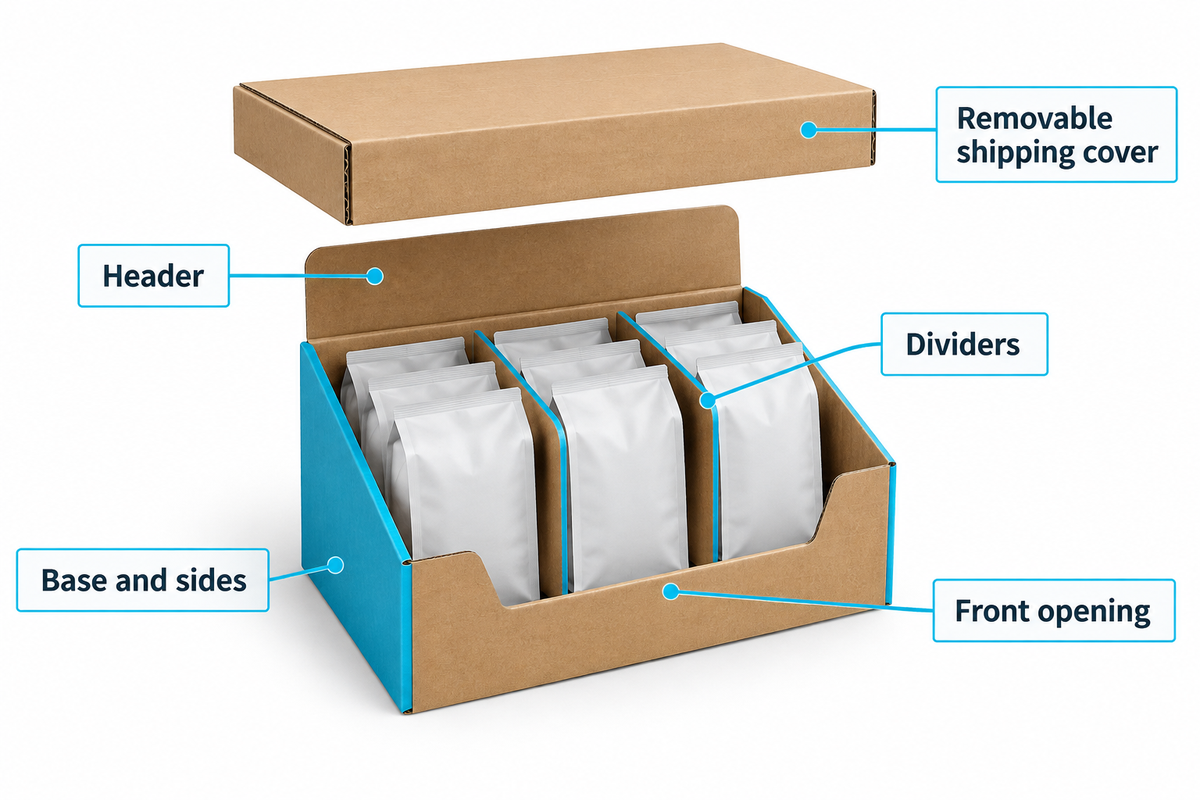
PDQ display boxes present products in a format that staff can quickly put into service in retail stores. PDQ display trays may be placed on a counter, shelf, or a larger merchandising unit. The front opening of the unit gives shoppers access to the product. The base, sides and dividers keep the products in the intended arrangement. Shipping covers or outer cartons can be removed before sale by a staff member.
A PDQ box can be viewed as packaging with a second job. Unlike individual product boxes, the tray groups saleable packs for display. During preparation, trays organize the packs. Once in the store, the tray serves as a product display. An eye-catching header may contain the message above the packs; a low front lip can help to hold the packs without concealing their labels.
This overlaps with retail-ready packaging. FEFCO’s Shelf-Ready packaging guidance integrates identification, opening, shelf positioning, shopping and disposal. Quick unpacking is part of a larger process. A tray that opens neatly but makes the product difficult to remove still needs a different packaging solution.
The word “quick” doesn’t specify an opening time, load rating, or approval by a retailer. This is determined by the product and the retail program.
PDQ Displays, POP Displays and Counter Display Boxes
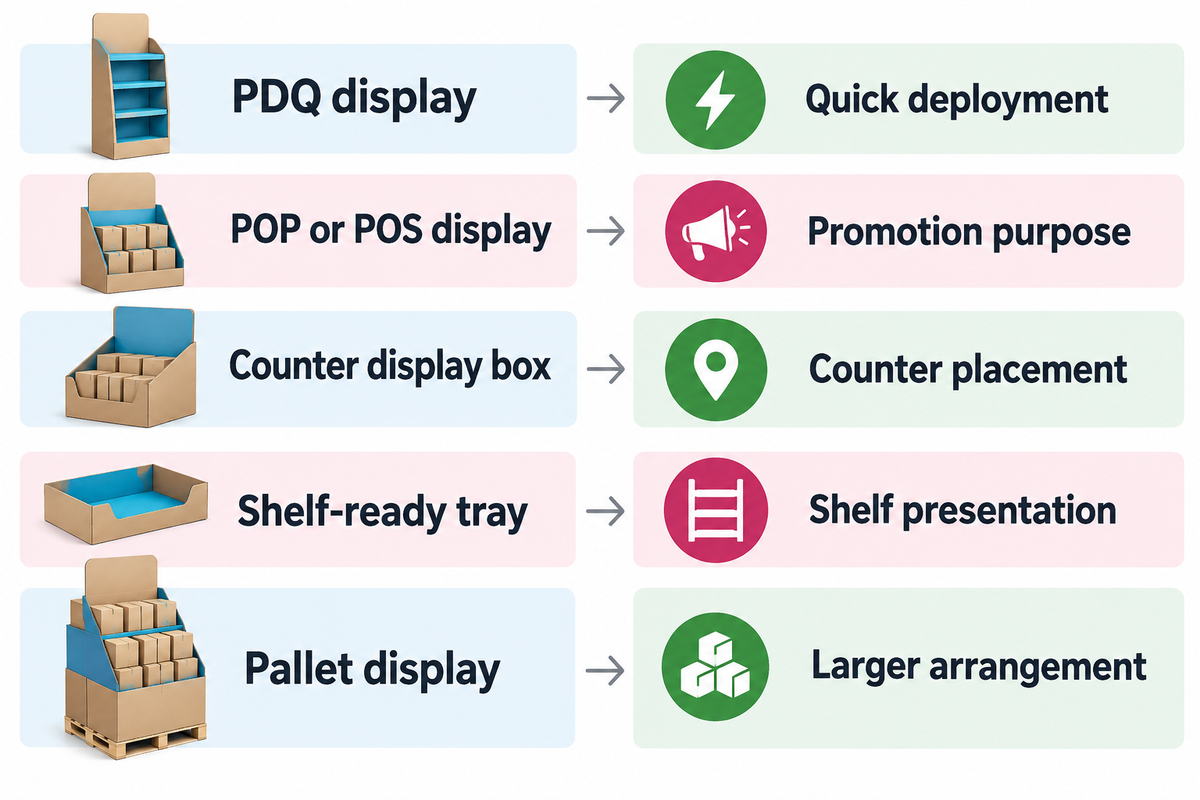
PDQ, POP and counter display labels represent different features of display packaging. PDQ focuses on how fast products are readied for sale. A point-of-purchase (POP) display defines a merchandising purpose; a counter display defines the location of a POP display. One custom display can represent each of the three descriptions, and the name alone is a poor indicator of what’s in the shipment.
What are the different types of display boxes?
Different display boxes include counter trays, shelf displays, stepped trays, hanging packs, and larger floor or pallet displays. Use the assigned fixture, product shape and needed restraints to determine the appropriate display footprint. A checkout counter or service desk can accommodate countertop displays, while an endcap can offer a different display location. Placement doesn’t indicate whether products arrive preloaded.
| Label | What it describes | What still needs defining |
|---|---|---|
| PDQ display | Quick retail deployment | Supply state and opening sequence |
| POP or POS display | Point-of-purchase or point-of-sale promotion | Location, structure and products |
| Counter display box | Counter placement | Footprint, orientation and capacity |
| Shelf-ready tray | Products presented on a shelf | Shipping cover and shelf fit |
| Pallet display | A larger merchandising arrangement | Pallet footprint and handling route |
GS1 US packaging-level definitions also differentiate a display shipper from a consumer unit or case. Use the same meaning for phrases like “one display” throughout the supply chain by being consistent with the language on ordering and receiving documents.
Choose a PDQ Tray Structure Around the Product
For cardboard PDQ structures, start with the actual saleable pack, its loaded weight, and the space available for the display. Each material or component, whether corrugated cardboard, solid paperboard or an insert, solves a different problem. The goal for the tray is to allow sufficient access for shoppers to remove the products while holding on to the products during the planned handling. Empty appearance doesn’t help answer this.
Which products work best in PDQ displays?
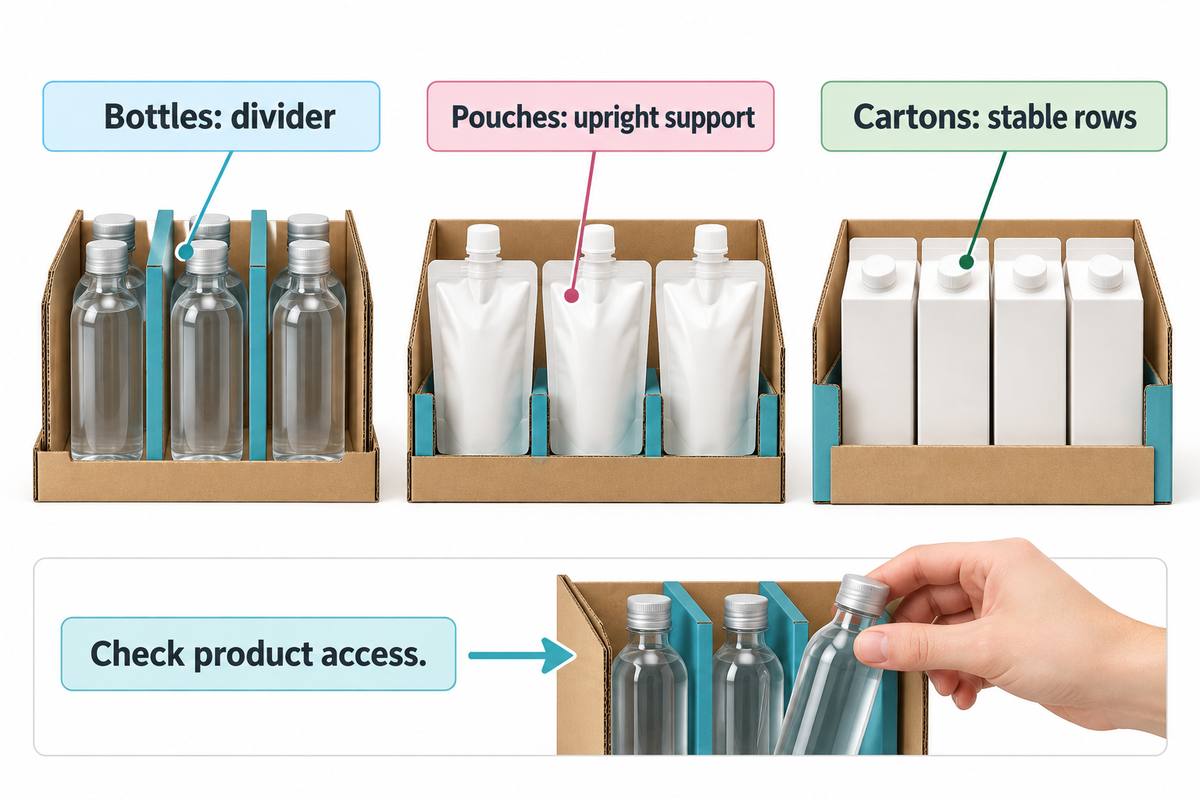
PDQ displays may be used to present small packaged items. Regular cartons can usually be relied upon to create stable rows. A thin bottle may require a divider, and a flexible pouch may need some support to keep the label facing the shopper.
A promotional display for a bottled condiment may illustrate these concepts. If the shoulder of a bottle touches another before its base is properly in the tray, a change in the printed art won’t address the fit. Load real bottles into a structural sample and see if the insert openings, lifting clearance and product visibility are correct. For a pouch, see if the pack stays upright in the desired orientation.
Huandao’s cardboard counter display box options show board and sample routes. The custom counter display range includes stepped trays, dividers and printing and finishing choices. Tie the choices to a physical reason: a die-cut opening reveals the pack; a header identifies the brand; an insert controls its position.
Approved packaging design should be followed, and customization should be requested for the intended board surface, e.g. brown kraft or a printed board liner. Decorative effects, lamination or an embossed finish may change the look of the sample. Loaded samples should be used to test the fit of the display and the product. A reminder to test the appearance of the product and its removal and replacement from the display can be found in FEFCO’s shopper-access criteria.
Flat, Assembled or Pre-Filled: What Will You Receive?
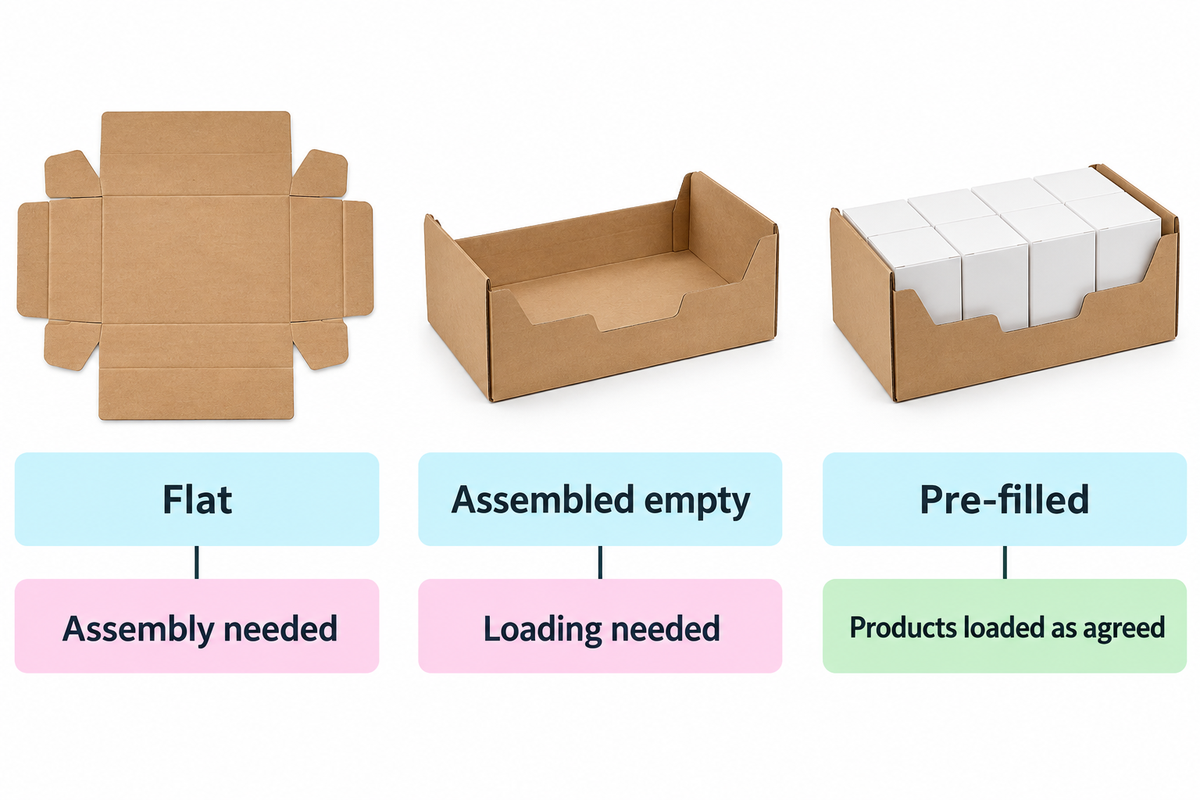
Flat displays come ready to be assembled. Assembled-empty displays have their structure made but are still waiting to have products added. Pre-filled displays have products loaded per agreement. Accessories may arrive fitted or separately packed. A supplier’s “ready” state isn’t always the same as the retail “ready” state. Therefore it’s important to specify the details at the handoff of the goods.
PDQ Handoff Responsibility Grid
The PDQ Handoff Responsibility Grid tracks the tray at the converter’s delivery point, after products are loaded, and when it’s exposed for sale.
| Stage | Possible condition | Work to assign | Handoff record |
|---|---|---|---|
| Converter delivery | Flat blanks or assembled-empty PDQ trays | Fold, lock or glue; fit loose inserts | Component list and assembly reference |
| Loaded shipping unit | Products arranged in the tray, with agreed protection | Check assortment; close and label the pack | Approved loaded sample, item quantities and shipping configuration |
| Exposed retail display | Protective material removed; header in position | Open, position and release for sale | Opening instructions and fixture assignment |
A flat-pack delivery leaves assembly with the next operation, which could be your own packing team or co-packer. An assembled-empty tray transfers the work upstream, still leaving loading to be done. If custom PDQ trays are supplied pre-filled, agree on who supplies the products, who checks them and if the protection is provided.
Published installations provide examples illustrating why making this distinction is important. A Packaging World article on Number1 identifies operations as erection, loading, closure, and pallet stacking. A different 2026 report on Icy Hot packaging identifies shelf displays as assembled in store. Those describe different deployment options, not alternative definitions of PDQ.
How Products Are Packed into a PDQ Display
Product loading begins with agreed-upon assortments and finished-pack references. Loading involves assembling the tray, installing required restraints, loading saleable packs in the prescribed orientation, and checking item counts and identification before closing the transport pack. “Filling” refers to placing prepackaged product in a display, not to dispensing product into a consumer container.
Pack-Out Task Split
For product packing, the Pack-Out Task Split assigns a decision maker and defines an output that the subsequent task can check.
This table outlines tasks, activities, and responsibilities (i.e. roles) for a given job function. The roles describe functions: within a single business, multiple roles may be fulfilled. An in-house packing team still needs the same handoff information.
| Task | Typical owner to name | Output for the next operation |
|---|---|---|
| Release tray and insert design | Brand and converter | Approved structural reference and component revision |
| Supply packaging parts | Converter | Counted blanks, inserts, headers and specified outer cartons |
| Supply saleable products | Brand | Correct items and quantities for the packing order |
| Form the empty tray | Converter or packing team | Tray assembled to the agreed reference |
| Load the assortment | Brand or co-packer | Item-by-item count and orientation check |
| Identify the shipping unit | Brand and packing team | Agreed consumer, case and display identification |
| Protect and close | Packing team | Complete loaded transport configuration |
| Receive and route | Distribution team | Quantity received, condition and destination record |
| Open and position | Store team | Exposed display matching the setup reference |
GS1 US distinguishes eaches, mixed cases, and display shippers. Indicate the level being counted. A delivery of 240 trays isn’t the same as a delivery of 240 consumer packs, even if both document shipments use the term “units.”
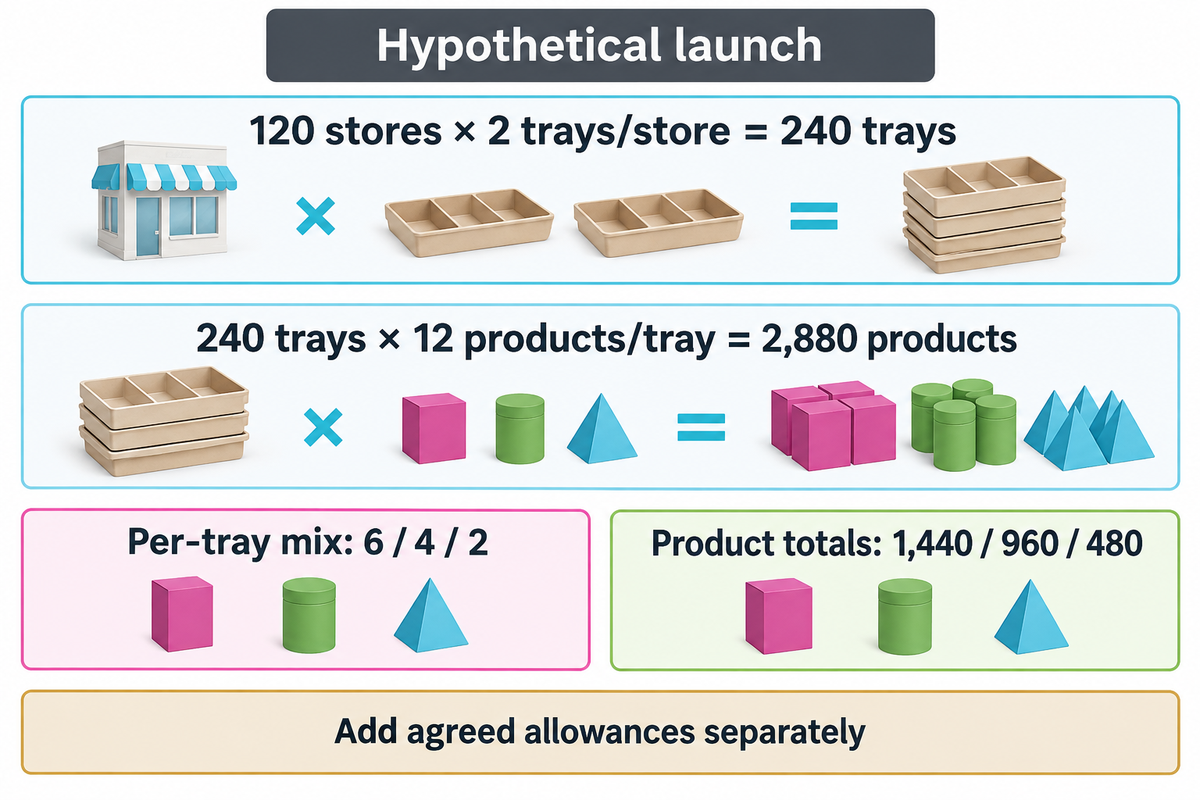
For a hypothetical launch to 120 stores, with 2 trays per store and 12 products per tray, the order needs 240 trays and 2,880 products. If each tray contains an assortment of 6, 4 and 2 products, the totals would be 1,440, 960 and 480 respectively. Their total is 2,880. The totals don’t account for spares and losses and any agreed-upon allowances should be added separately.
The right number of products in the wrong mix is a problem that total count can hide. Keep one approved packed reference with the job and record changes to the assortment before starting the next batch.
Protect the Display Between Pack-Out and Store Arrival
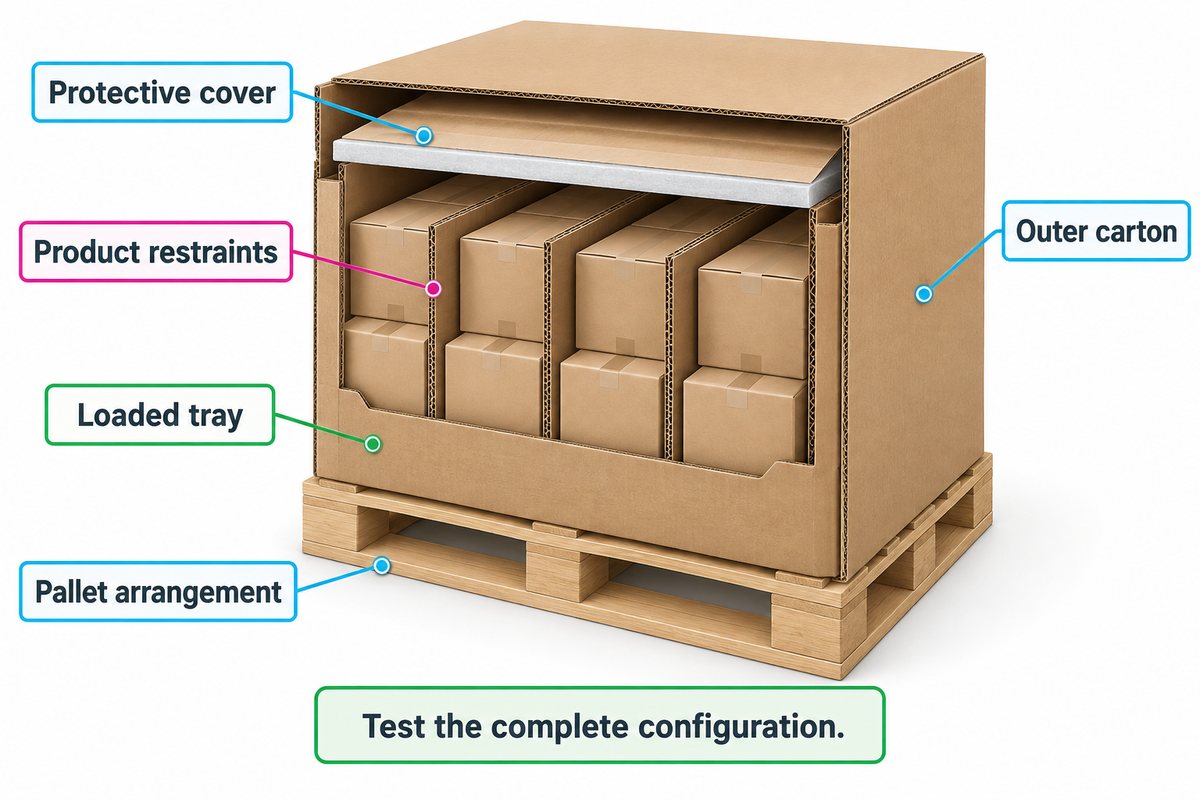
The transport package is the loaded tray and all of its restraints, cover and outer carton and any pallet arrangement used on the route. Evaluate the complete configuration. A display designed to expose products on a shelf may need additional protection.
For instance, a tray containing cosmetics sent via parcel delivery has a different distribution experience than trays conveyed via pallet to a distribution center. Describe the intended distribution to the packaging team and test provider. ASTM D4169 addresses shipping-unit performance against distribution factors and also indicates consideration of D7386 for single-parcel packages. Choose the test procedure that represents the actual distribution of the parcel or pallet arrangement.
ISTA’s test-procedure overview breaks down screening, partial simulation, general simulation and other test procedures. Thus, the claim “ISTA tested” should be accompanied by the procedure, edition, tested configuration and result. A board-strength value, in isolation, doesn’t define a distribution test.
Do
- Include the real product load in the reference pack.
- Protect loose headers and exposed surfaces.
- Record the route and handling configuration.
Don’t
- Substitute an empty sample for the loaded pack.
- Remove a shipping cover without reviewing its function.
- Carry a test result across an unreviewed design change.
Review changes after approval, too. ISTA’s retesting guidance also mentions the changes to the product, packaging or process that may affect performance. A heavier or different bottle or insert, or a changed distribution route, requires checking the validation.
If a separate outer is required, Huandao’s printed corrugated shipping boxes provide a similar packaging route. The client needs to describe the tray’s loaded dimensions and the needed protection when coordinating the tray and outer carton.
Compare the Cost of Empty Boxes and Filled Displays
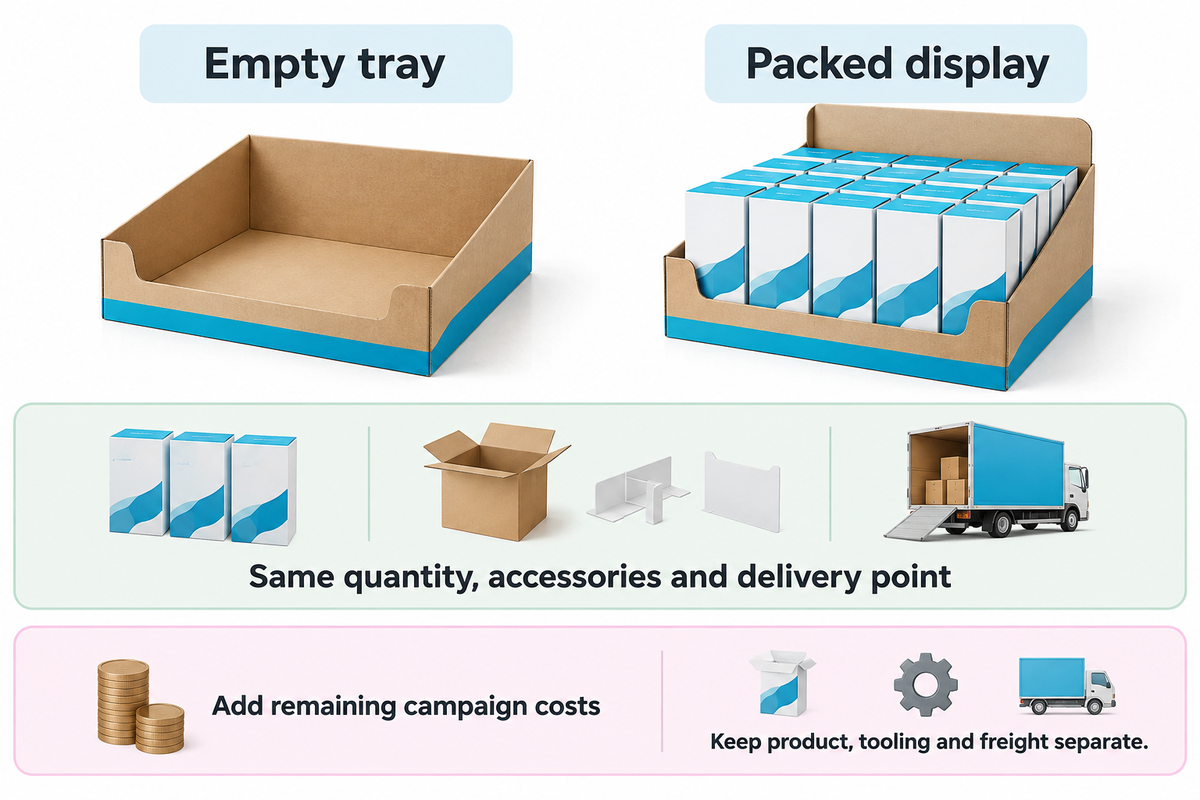
Compare costs at the same delivery stage. An empty PDQ tray quotation and a packed-display quotation describe different work. Identify the packaging boxes and inserts, assembly, product loading, inspection, protection and freight and then define what work is yet to be done by your team. The cheaper packaging line may leave a large packing job for another area of the supply chain.
“Traditionally, in kitting, the contract packager has only charged for assembly service.”
The report discusses how component purchasing changes impact the commercial arrangement. For a current PDQ order, find out if the packer is provided the components or if the packer is responsible for procuring the components within its own price. Otherwise, the same tray or insert may be reflected in the two costs.
For this example launch, multiply the tray quantity by the sum of the quoted empty-tray price and the quoted assembly and loading charge per tray. Prices depend on the nature, assortment and work included; request job specific quotes. Keep product cost, tooling, freight, storage, tax and waste separate.
A 2008 MIT study of retail-ready packaging noted that an increase in costs to consumer-product manufacturers may be connected to retailer benefits. The study provides no recent PDQ price benchmarks.
Purchasing can provide the actual quotes. The packing manager then assesses if the quoted work can be performed prior to dispatch. Finance compares the same quantities, accessories and delivery point on both offers, then adds the other campaign costs.
Who Makes Custom PDQ Display Boxes?
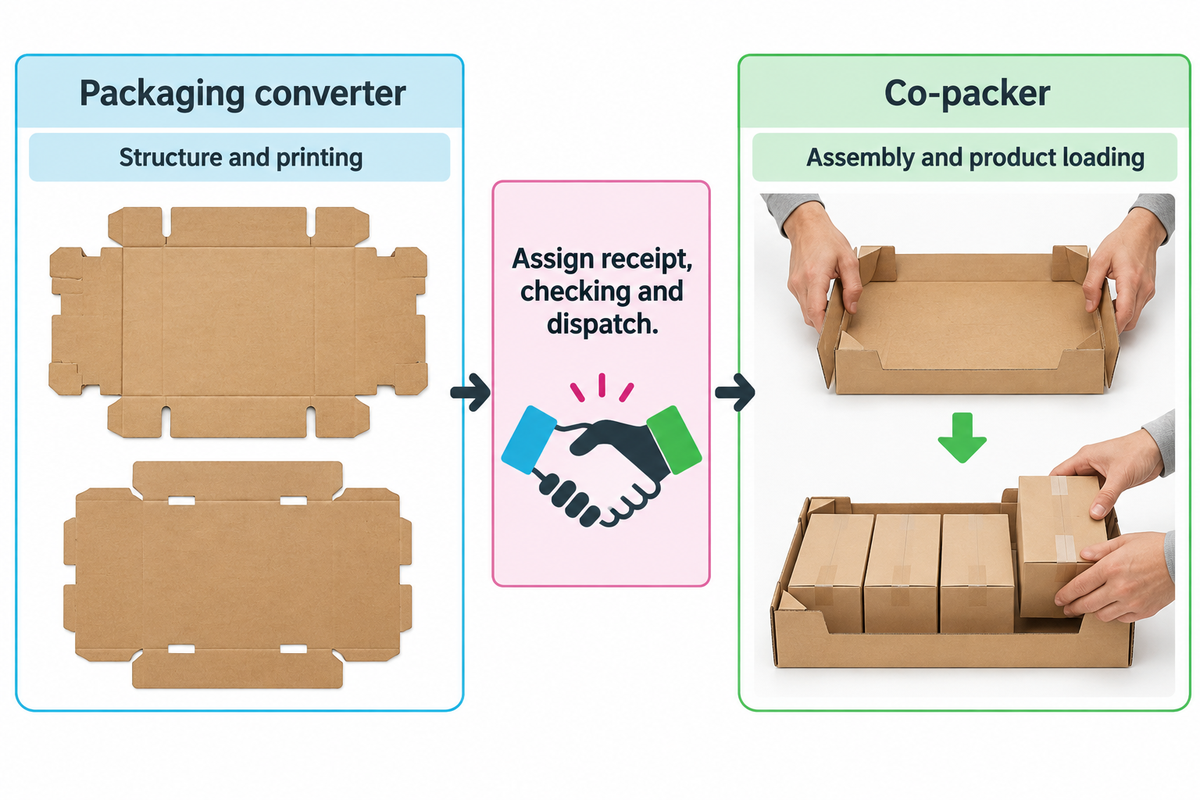
Packaging converters make PDQ display boxes by structuring, printing the board and converting it into the desired components. A co-packer can assemble these components and load the products. Some suppliers can offer both services; however, the order should name the party responsible for each of these services including product receipt, checking and dispatch.
At Huandao, our custom PDQ display boxes service covers structure, print, sample routes, and coordination of packaging components. For custom PDQ boxes, use that product page to discuss the tray and its associated inserts or shipping cartons. Product loading should be agreed separately with the party handling your saleable stock.
This is also the case for food. In custom packaging, a retail tray holding cartons of sealed food is a different packaging job from a retail tray touching unpackaged food. For the consumer carton of food, see our folding carton options. Decide which carton you’re buying, and then discuss materials and printing.
Prepare a PDQ Display for Its Retail Launch
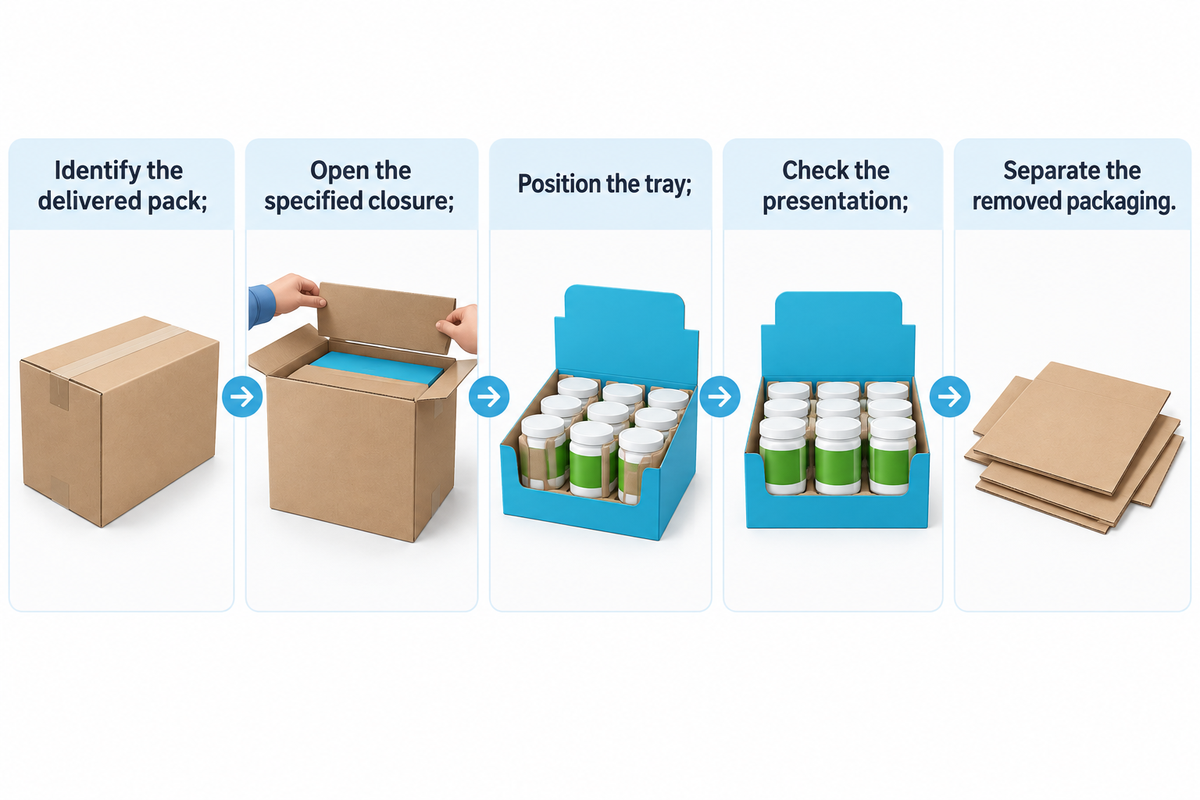
Setup instructions should be developed for the delivered unit, including its actual covers, inserts and headers. Practice the instructions with a staff member who hasn’t assembled the display before. To use the display quickly, the exercise should reveal which components stay with the product and which components are removed. The exercise should also show what the finished display looks like.
FEFCO’s retail-ready packaging criteria connect opening and shelf placement with shopping and disposal. This gives the trial a clear endpoint: an easily accessible display and a defined path for removed packaging.
- Identify the delivered pack. Match its destination, assortment and condition to the job reference.
- Open the specified closure. Follow the marked opening sequence while protecting products and printed display faces.
- Position the tray. Fit any separately packed header and place the display on its assigned fixture.
- Check the presentation. Face the product labels toward shoppers, keep the grip area clear and remove loose transit material.
- Separate the removed packaging. Follow the store’s collection rules for cardboard and other components.
A useful setup sheet shows the delivered pack next to the completed display. Identify any part that’s like waste but needs to stay, like a product-support insert. If the opening trial tears a visible panel or leaves staff searching for the header, modify the pack or instructions before releasing the launch quantity.
PDQ Display Boxes: Frequently Asked Questions
What does PDQ mean for Walmart?
Meaning and retailer requirements
In retail packaging, PDQ commonly means Pretty Darn Quick and describes a display intended for fast setup. For large retailers such as Walmart or Costco, use the requirements of the specific retail program. A supplier must work from the requirements for the specific retailer, product and program, including the assigned location, handling method and any required testing or identification.
What types of packaging materials are used in PDQ displays?
Board and structural choices
Corrugated cardboard is a common choice because a tray may need to hold products during transport and display. Paperboard can suit lighter applications. Material selection also depends on geometry, product weight, exposure and service life. A loaded sample shows how the chosen material and structure work together under the intended product load.
Is PDQ packaging recyclable?
Construction and collection rules
Many paper-based PDQ trays can enter a cardboard recycling stream, but acceptance depends on their construction and the receiving system. The U.S. Environmental Protection Agency’s cardboard guidance recommends flattening boxes and checking local collection rules. Separate removable plastic parts as required. Coatings, lamination and contamination can affect the appropriate recovery route; avoid an unconditional eco-friendly claim.
Can PDQ boxes include product windows or inserts?
Windows, dividers and fit
Yes. Windows can expose the product, while inserts or dividers keep individual packs in their intended positions. Check that the insert fits the real product and leaves the required grip area accessible. Confirm whether it arrives fitted or loose.
How durable are PDQ boxes for in-store use?
Load, location and handling
There’s no universal service life for a PDQ box. A short promotion on a dry indoor shelf places different demands on the tray than frequent handling in a busy checkout area. Product weight, unsupported spans, joints, moisture exposure and handling all affect performance. Inspect the complete loaded sample on the intended fixture and agree the display period and replacement conditions with the retailer. If the same tray travels with the products, shipping damage may also affect its appearance and usability at the store. Evaluate that packed configuration separately. Base replacement decisions on the loaded tray: damaged joints, a sagging base or unstable products call for removal from service.
What is the minimum order quantity and lead time for PDQ display orders?
Order-specific quantities and timing
Request the quantity and production schedule for the actual structure, artwork versions and supply state. Include sample approval, packaging manufacture, product loading and transport in the launch plan. Schedule tray manufacture and product loading as separate operations, with a handoff date between them.
Discuss Your PDQ Packaging with Huandao
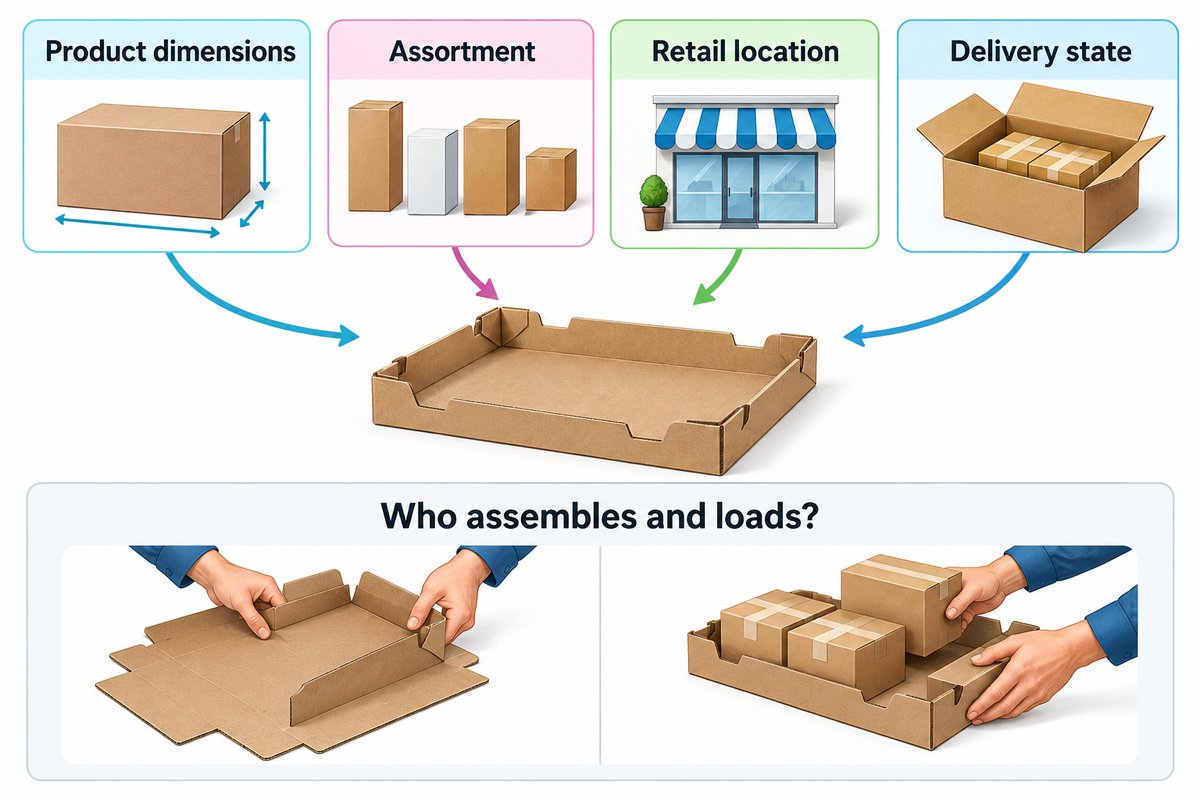
Send the product dimensions, assortment, retail location and preferred delivery state. Tell us which team will assemble the trays and load the products so we can discuss the packaging components around that handoff.
This guide uses packaging standards guidance, published industry examples, and product information from Huandao. The example of the quantity calculation is just for illustration; for the cost calculation, use current price quotations. An order is placed based on an agreed individual job specification and the retailer requirements.
References & Sources
- Shelf-ready packaging — European Federation of Corrugated Board Manufacturers (FEFCO).
- Packaging level definitions — GS1 US.
- Robots assemble, pack and stack grocery retail displays — Anne Marie Mohan, Packaging World, 2016.
- How Icy Hot uses scratch-and-sniff packaging innovation — Matt Reynolds, Packaging World, 2026.
- ASTM D4169-23e1: shipping containers and systems — ASTM International, public scope.
- Test procedures — International Safe Transit Association.
- When should a packaged product be retested? — International Safe Transit Association.
- Kitting moves beyond hidden-market status — Jean Thilmany, Packaging World, 2007.
- An assessment of the value of retail ready packaging — Kathleen Anne Jackson and Ling Bai Burke, Massachusetts Institute of Technology, 2008.
- How do I recycle common recyclables? — U.S. Environmental Protection Agency.