Get in Touch with Xiamen Huandao Packaging Technology Co., Ltd.

Custom Corrugated Packaging: A Practical Box Design Guide

It can be expensive to deliver a beautiful box. Leave too much space around a small product and freight rises; squeeze the fit and an accessory can press against the retail surface. The useful starting point for Custom Corrugated Packaging is the product’s journey, before the artwork.
This guide explains seven decisions: size, packaging system, board, print, approval, cost and manufacturing responsibility. Use it to define what your product packaging must do. Once that’s clear, the custom corrugated packaging portion of Huandao’s custom corrugated packaging solutions covers the rest.
Start with the delivery route. Write down whether the saleable box travels alone through a parcel network, inside another shipping carton, or in a palletized load. Those are different design assignments, even when the product and logo stay identical.
What is custom corrugated packaging?
Custom corrugated packaging is a product-specific pack made with fluted paper bonded to liners. Customization can change its dimensions, structure, board construction, print, fitments, and surface. A specification connects the choices to the packed product and its journey rather than describing a box by its external appearance.
The Fibre Box Association distinguishes single-face, single-wall, double-wall and triple-wall board. Corrugated cardboard gets its structure from that combination of liners and fluting. Folding cartons use a different construction. A printed, paperboard carton may require a separate outer shipper. Our folding carton guide explains that format.
Both formats are often referred to as cardboard boxes. Procurement needs a more precise description: box style, finished inner dimensions, board spec, and intended use. Custom packaging boxes can look similar in photos while using different materials and load paths.
Product boxes that sit on a shelf and corrugated shipping boxes that travel alone have different packaging needs. A customizable structure helps to assign work to the correct layer. When evaluating a range of packaging, classify each box type based on its job and then evaluate decorative options.
For a retail launch, determine if scuffs on the saleable product box constitute damage. If they do, the shipping design has to keep the display surface and the product intact. Ordering a heavier outer carton won’t help address abrasion between two tightly packed printed surfaces.
How do you size the box around the product?
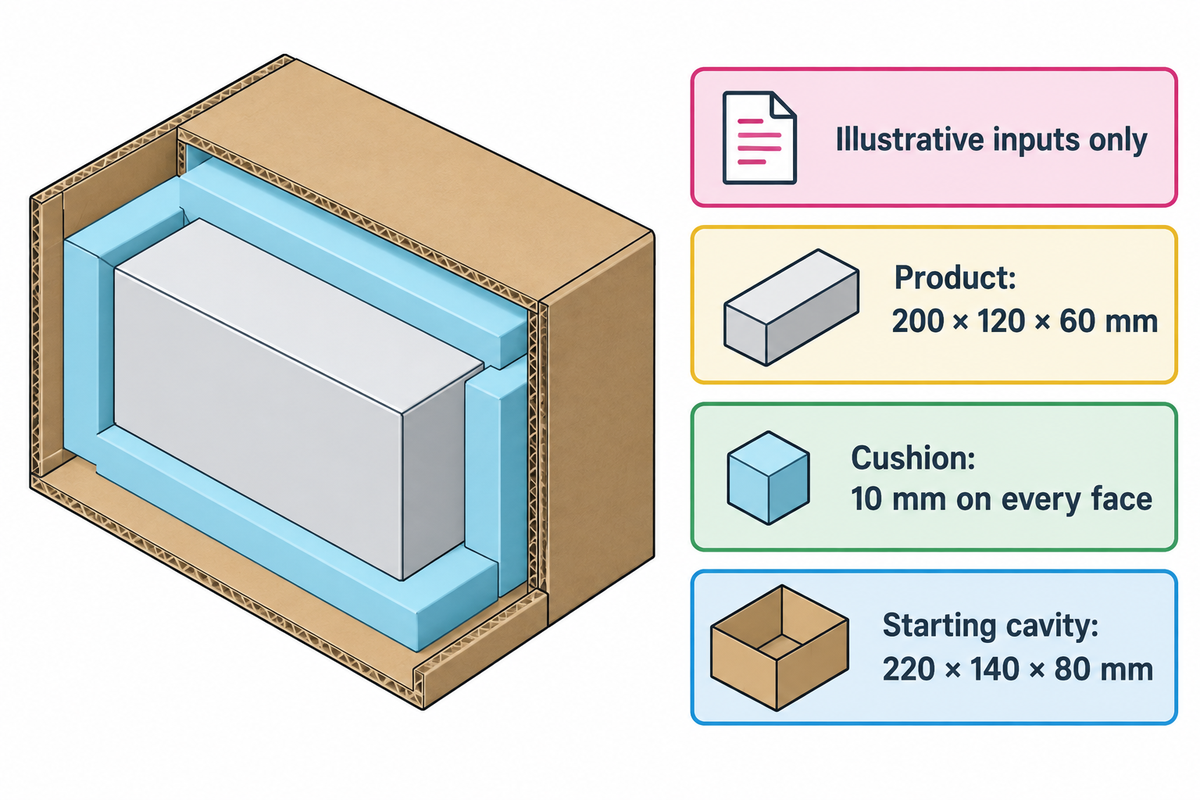
Size the interior for the complete, packed arrangement (product, accessories, restraints, and cushioning). Then measure the assembled exterior for logistics. The first measurement controls fit; the second affects handling, pallet layout and carrier billing. Specifying a product’s bare dimensions is only the beginning of a custom box.
What Size Corrugated Box Do I Need for Shipping?
The inside size is the packed product’s occupied space plus the allowances required by its approved protection design. Specify the intended orientation and include fitments. Record the dimension order and units on the drawing. Measure the closed and filled exterior. There’s no single clearance that accommodates all products, cushioning and delivery routes.
Suppose an illustrative product measures 200 × 120 × 60 mm. A designer allows 10 mm of cushioning on every face. The resulting starting cavity is 220 × 140 × 80 mm, before assembly tolerances or other features are resolved. These are assumed drawing inputs, not a recommended cushion thickness or a shipment-ready specification.
Cushion selection is made prior to finalizing the carton size. Matthew Daum’s packaging research abstract connects cushion thickness to overall pack dimension and logistics costs. For a fragile product, choose protection using its sensitivity and the expected distribution stresses; shrinking a proven cushion to hit a freight target reverses the design process.
Build a blank custom sample with the actual accessories. Check loading direction, finger access, and if an operator can close it without forcing a panel. An efficient looking partition may actually slow down every packing cycle. Huandao’s die-cut construction options help turn a packed design into a structural piece.
If purchasing wants one size for several products, compare the additional void and packing material for each SKU. A single shared size for multiple products may reduce the variety in the stock and increase the volume shipped. Record both consequences before approving the common design.
Boxes are made around a defined orientation, so photograph the approved loading arrangement with the drawing. For a custom design, mark where a connector or fragile edge must avoid contact. This gives the converter a clearer instruction than asking for less corrugated material without identifying the occupied space.
Which packaging system fits the delivery route?
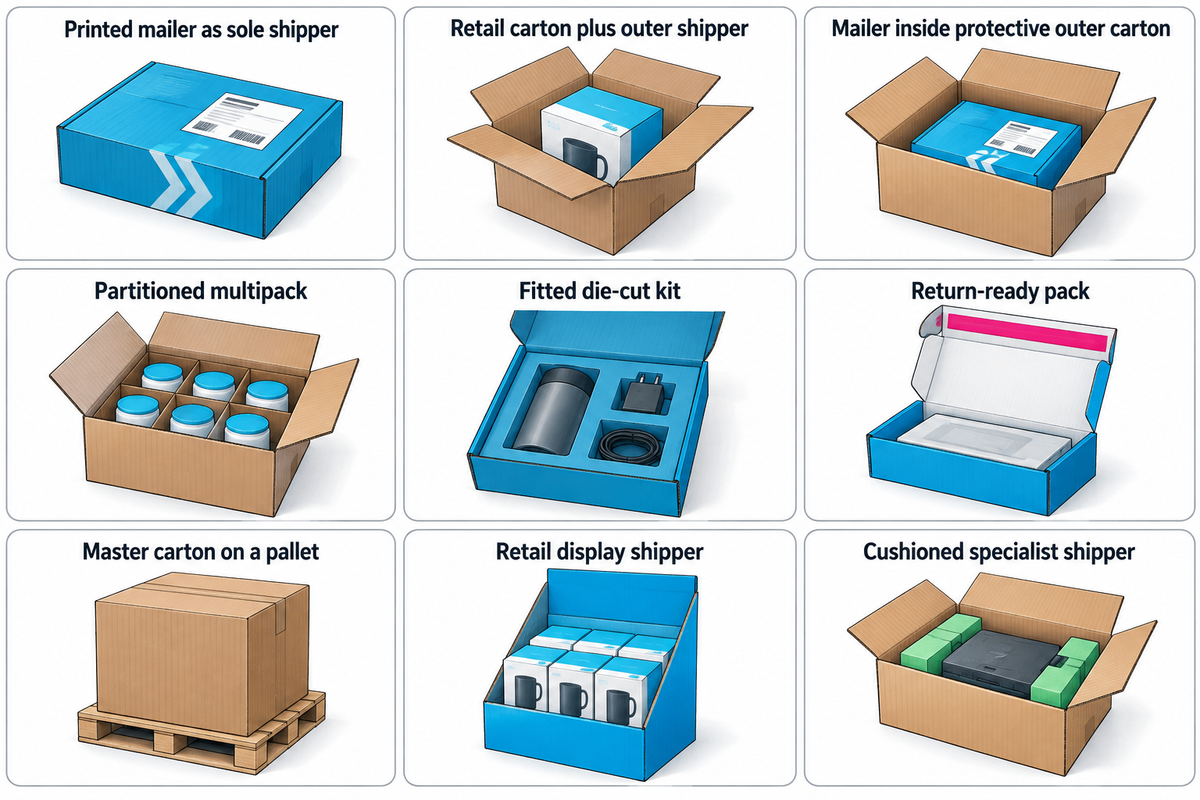
Choose the packaging system by deciding which layer does each job: retail presentation, product restraint, impact cushioning and transport protection. Impact protection and transport protection can be combined in a printed mailer. Retail cartons inside a shipping carton separate those roles. The right boundary depends on the levels of protection required and the nature of the damage your customer will accept.
How Do Corrugated Boxes Protect Your Products?
Corrugated boxes protect your products through the combined behavior of the board, folded structure, fitments and closure. The outer shell takes handling loads; internal supports control movement and, where designed for it, cushion impacts. True protection assessment is done with actual contents. An empty box test answers only part of that question.
ISTA’s design guidance recognizes the importance of the packaged product and distinguishes early screening from performance prediction. Use the Pack-System Boundary Map below to assign responsibilities before choosing a style.
| System type | Typical route or use | Decision to resolve before approval |
|---|---|---|
| Printed mailer as sole shipper | Direct-to-consumer parcel | Label placement, opening security and acceptable exterior scuffing |
| Retail carton plus outer shipper | Saleable unit inside parcel carton | Restraint between layers and retail-surface abrasion |
| Mailer inside protective outer carton | Presentation-sensitive delivery | Whether the extra layer earns its material and freight cost |
| Partitioned multipack | Several units in one delivery | Item-to-item contact, loading sequence and divider stability |
| Fitted die-cut kit | Product with accessories | Retention of small components and removal access |
| Return-ready pack | Outbound and customer return | Second closure, instructions and protection after reopening |
| Master carton on a pallet | Warehouse-to-retail distribution | Stack support, overhang and handling throughout the route |
| Retail display shipper | Transit followed by shelf display | Transport integrity before display openings are removed |
| Cushioned specialist shipper | Shock-sensitive contents | Product fragility, cushion design and complete-pack testing |
Custom mailer boxes suit projects where the opening is important, but corrugated mailer boxes also need a closure and a label surface appropriate to the route. Subscription boxes add another constraint: each assortment must conform to an approved arrangement. A structure proven with one month’s contents may need review when the next assortment changes.
Custom roll end front tuck boxes need the closing sequence reviewed with the filled contents. Folding the lid should keep your products in the intended position rather than push an accessory into a display face. When you use custom fitments, inspect the assembled pack, because an attractive flat dieline cannot show every contact point.
When a buyer asks to remove the outer carton, maintain the retail-damage criterion during comparison. Otherwise, a cheaper system can appear successful simply because the definition of an acceptable delivery became less demanding. For specific structures and opening mechanics of mailers, see our printed-mailer design guide.
How should you choose board and flute construction?
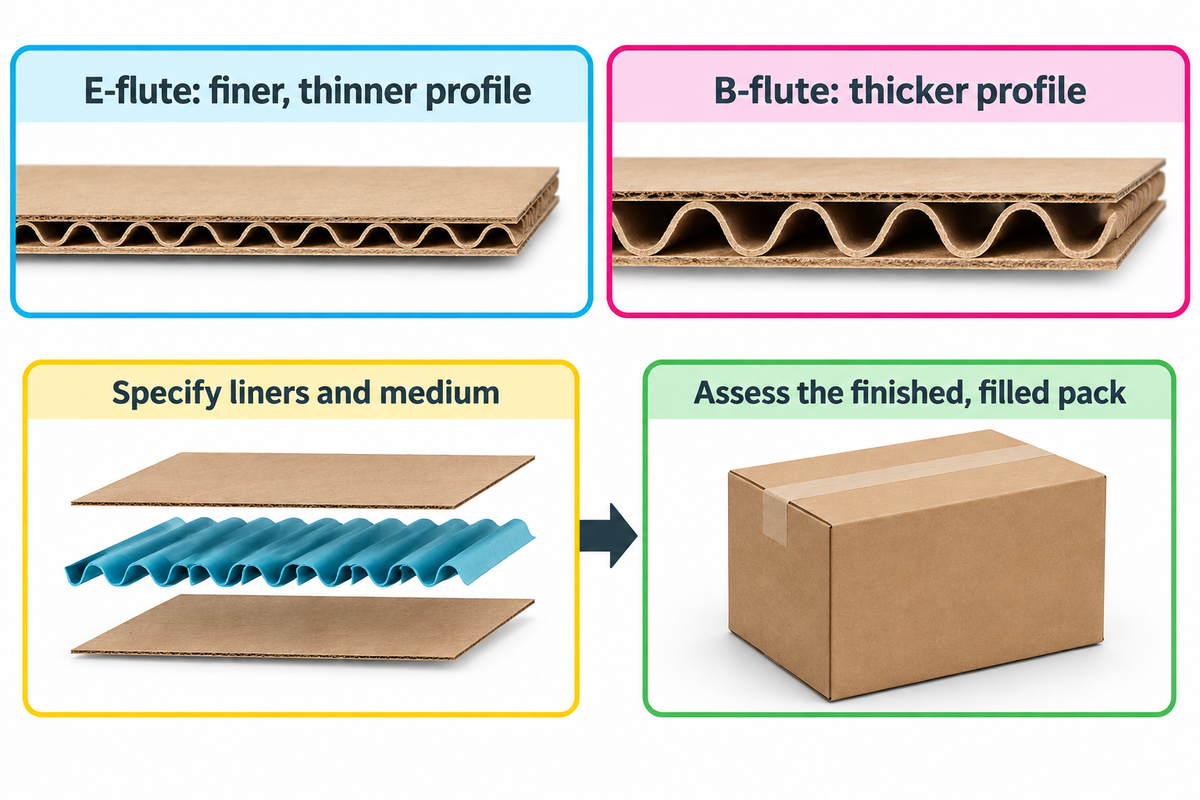
Choose board based on the strength required, environmental exposure and means of manufacture. Flute construction helps describe the material; liner and medium specifications also matter. Compare samples made to the proposed specification, then assess the finished, filled pack. A flute name or edge-crush test alone is an incomplete specification.
What’s the Difference Between E-Flute and B-Flute Corrugated Boxes?
Generally, E-flute provides a finer, thinner profile, while B-flute provides a thicker profile. Consider folded fit, surface appearance, and protective structures, keeping liners and medium grades in view. Neither letter provides a universal load limit, and flute profiles may vary from one producer to another.
The FEFCO code offers a common way of naming shared structures. State the code or drawing revision with the material in question. For single-wall corrugated boxes, a change of paper combination can matter even when the profile and outward dimensions remain the same. Double-wall alternatives require their own material and converting review.
FEFCO’s test-method list includes basis weight, bursting strength, edgewise crush and package compression. Determine which property an order’s report measures. ECT addresses edgewise board behavior; burst addresses a different failure mode. A report should identify the job and tested construction, so it remains traceable to what you are buying.
Other geometry details should also be addressed. One study on pallet configurations indicated that support geometry changed compression performance of the boxes studied. Another crease position study also indicated that structural details affected the performance of the samples tested. These results favor checking the actual design over assuming thicker corrugated stock will solve every handling problem.
For stored stacks, include time under load in the brief. The public scope of ASTM D7030 concerns deflection over time under constant compression on empty containers. This is not the case for a short compression peak. Agree the duration and conditions of storage prior to purchasing a grade solely based on an instantaneous test value.
When you customize corrugated packaging boxes, keep the approved paper combination on the drawing or order specification. Approval of repeat corrugated packaging boxes warrants review of material substitution, even when the printer is able to reproduce the exact artwork. Leaving the artwork file to define the specification removes a structural reference for procurement.
How do print and finish choices affect the pack?
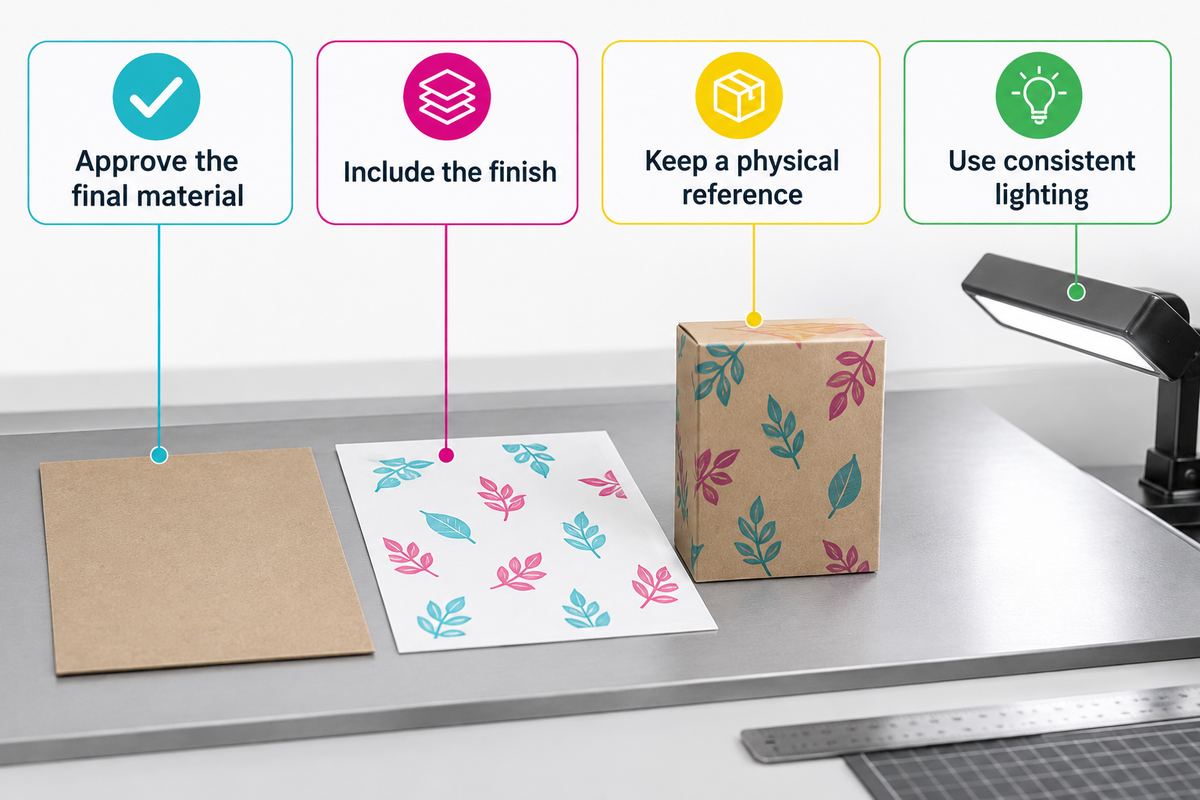
The paper and finishing used in print affect the color and surface. Approve the final surface of a brown kraft corrugated and a white printed liner, which are different starting materials. Define expectations for critical color and scuff on the final material and finish. A glossy digital mock-up is useful for placement, but a physical reference gives production a clearer target.
Can Corrugated Boxes Be Printed with Full Color?
Full-colour custom printed corrugated boxes can use a suitable direct-print process or a printed sheet laminated to corrugated board. Choose the route with the converter against artwork, quantity and surface requirements. For color approval, agree on a reference and compare it with a sample on the specified board and finish, under consistent lighting conditions.
“Make sure the color standard is on the same stock as your print sample.”
For custom printed boxes, place the logo and branding away from folds, labels or closures that will cover them. Quality printing should preserve the information a customer needs after packing. If high quality printing is important for shelf presentation, define the physical approval reference instead of relying on that phrase in a quotation.
Personalized corrugated boxes can reinforce brand identity through repeatable color and graphic placement. For corrugated boxes, approve the interior and the exterior if both are printed. To get custom printed corrugated boxes ready for approval, supply the final artwork on the converter’s current dieline; a change to that structure can alter placement.
Keep the artwork and structure revisions together in the same record. Sometimes, moving a crease after color approval can move a graphic to a folded edge. Huandao’s litho-laminated box options cover that production route; our guide to printing methods and surface-defect checks handles the print-specific questions.
What should you approve before production?
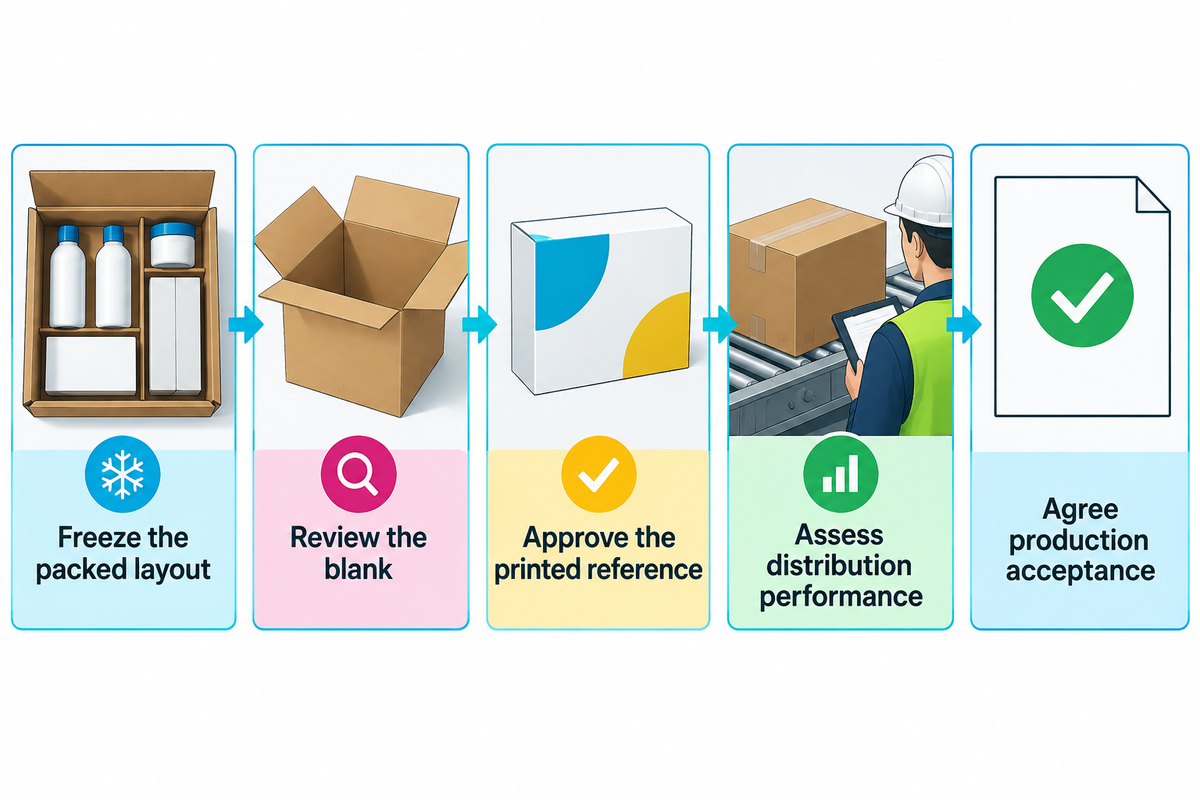
Approve fit, appearance and distribution performance with the samples relevant to each case. A blank structural sample checks folding and loading. Printed samples check artwork and the agreed surface. A filled-pack assessment checks the product-plus-package arrangement. Maintain these approvals associated with one written revision prior to production.
A practical approval sequence is:
- Freeze the packed layout. Include accessories, orientation, closure and the definition of unacceptable damage.
- Review the blank. Assemble it, load it and inspect contact points. Check access for both the packing operator and customer.
- Approve the printed reference. Identify stock, finish, artwork revision and critical information.
- Assess distribution performance. Select an appropriate protocol with the responsible test provider and representative filled samples.
- Agree production acceptance. Record inspection characteristics, sampling responsibilities and how a nonconforming lot is handled.
If a converter offers a free sample, determine whether it’s a sample of your proposed construction or a stock example. Stock samples help compare surfaces and folding; custom corrugated packaging boxes need their own fit review. Record which approval each sample is intended to support.
Lot acceptance and design validation address different questions. NIST describes acceptance sampling as a method to make a decision regarding the disposition of a lot. Passing a production inspection shouldn’t be confused with design validation. Design validation should be performed to assess the delivery performance of a newly designed package. However, an approved design requires consistent production.
When a purchaser wants to reuse an old approval, determine what changed first. ISTA’s retesting guidance addresses changes to product, packaging and process. A different fitment, board source or filled arrangement can change the pack being assessed, even if the artwork on the outside of the pack is the same.
What does custom corrugated packaging really cost?
The total cost for a delivered order comprises pack material, packing labor, freight and anticipated loss due to pack failure. Keep tooling and setup cost visible, when comparing quantities. Wholesale pricing alone leaves out costs that can reverse the decision, particularly when an extra protective layer changes shipped volume or the time required at the packing bench.
FedEx outlines dimensional-weight billing using external package dimensions and applicable rules. Confirm the carrier, service, units and current terms before calculating freight. Our carrier volume-weight comparison touches on this aspect of the brief.
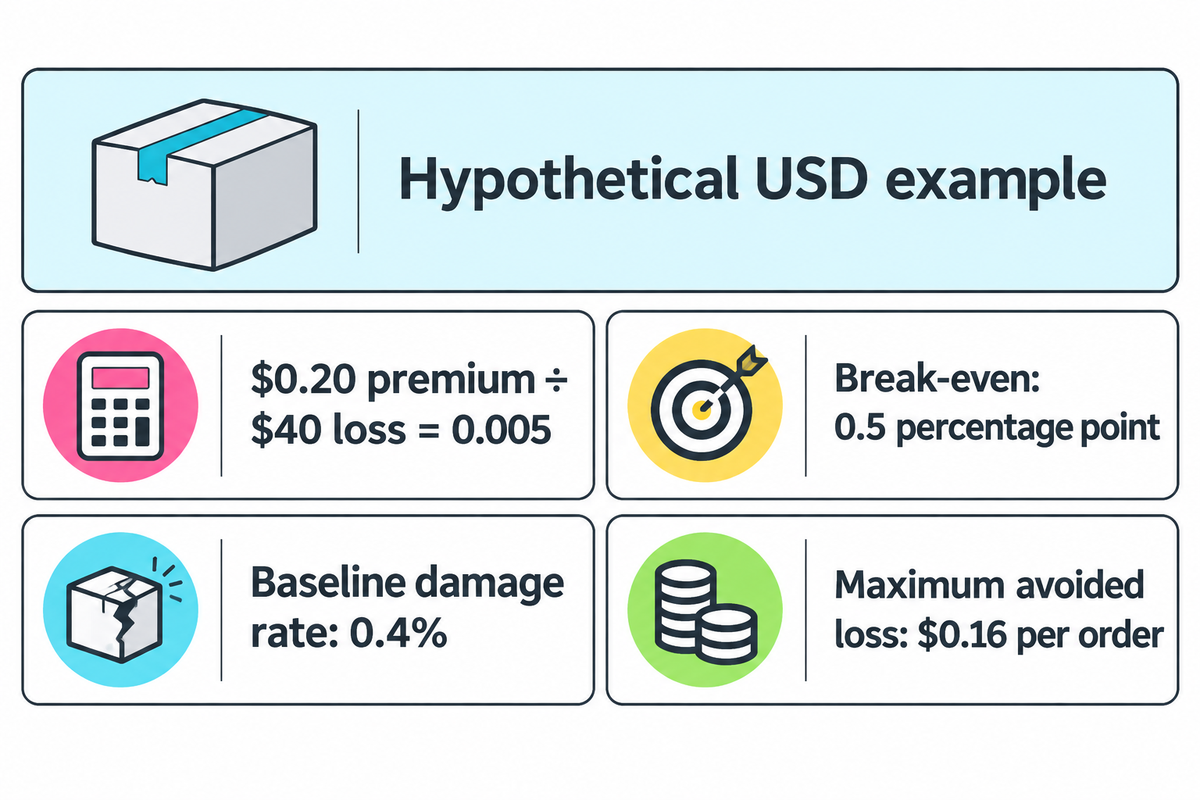
The worked example for the delivery-cost break-even illustrates damage trade-off. We assume USD costs per order, identical products, and an incremental loss of $40 per damaged delivery. For this worked example, every value is hypothetical; assume System A is a single printed shipper and System B adds protection.
| Cost or scenario | System A | System B or comparison |
|---|---|---|
| Assumed pack materials | $1.20 | $1.45 |
| Assumed packing labor | $0.40 | $0.35 |
| Assumed freight | $3.20 | $3.20 |
| Pre-loss delivery subtotal | $4.80 | $5.00 |
| Additional pre-loss cost | Reference | $0.20 |
| Assumed incremental loss per damaged delivery | $40 | $40 |
| If damage probability falls 0.4 percentage point | $0.16 avoided loss | $0.04 net extra cost |
| If damage probability falls 0.5 percentage point | $0.20 avoided loss | $0.00 net difference |
| If damage probability falls 0.6 percentage point | $0.24 avoided loss | $0.04 net saving |
The break-even reduction is the $0.20 premium ÷ $40 loss = 0.005, or 0.5 percentage point. This is an absolute change in probability. A hypothetical reduction from 1.0% to 0.5% meets it; a relative reduction of 0.5% doesn’t mean the same thing.
At an assumed damage rate of 0.4%, eliminating all damaged deliveries saves at most $0.16 per order. Damage avoidance alone can’t recuperate the break-even premium. For systems with different loss severity, compare each probability multiplied by the loss amount.
For assumptions made in this example, use your fulfillment order records. Include replacements and recoveries; don’t double-count losses. Huandao’s order cost comparison tool aids evaluation. For wholesale corrugated boxes, compare the same packed specification and delivery terms at each quoted quantity before you order in bulk.
Boxes offer a visible unit price; packing work and losses often sit in different budgets. Bring them together when comparing boxes for shipping. Ask your suppliers to give their best custom packaging quote at the same quantity and against the same approved revision and then add the packing and delivery costs that your business bears.
How do you choose a manufacturing partner?
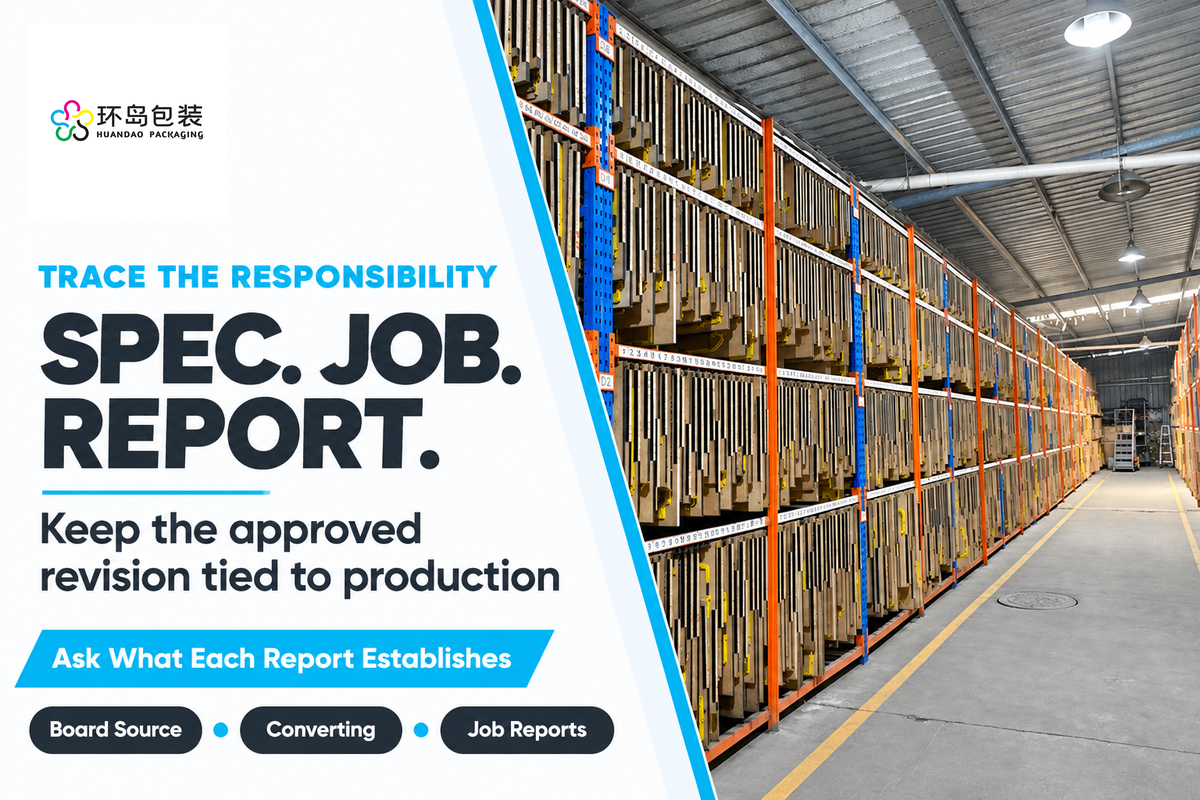
When splitting responsibility, look for a partner whose process responsibility aligns with your specs. You should also identify who supplies the board, prints, converts, tests and assembles the order. Traceability of responsibility gives a path of accountability to resolve an issue without guesswork. A list of customization options is less helpful.
At Huandao, pre-press, sheetfed offset printing, UV coating, lamination, die-cutting and folder-gluing run in-house. Our corrugator supplies single E-flute and single B-flute board; A, C, F, BC and other profiles use sourced board. This distinction gives you the opportunity to discuss material and sourcing for the job.
We provide job-specific ECT/burst, ink-rub and basis-weight reports from our lab. Request the agreed tests to ID your production and construction. Process steps are scanned into MES tracking, with ERP and Production Scheduling behind the operation. These help link the approved spec to the manufactured order. Ask what each report establishes: NIST’s acceptance-sampling guidance concerns the disposition of a production lot, while ISTA’s design guidance concerns the packaged product. Keep those responsibilities explicit when reviewing a supplier’s testing offer.
If you need custom packaging solutions that combine the printed box with trays, inserts and outer cartons, Huandao’s place within Huan Yin Packaging Group allows those components to be supplied together and consolidated into one shipment. See how shared freight and actual packing plan impact the price.
For a wholesale packaging purchase, check how repeat orders retain the material and artwork revisions. Custom shipping boxes should be reordered against that specification not against a photograph. Before agreeing to the lowest price for wholesale boxes, check if the same conditions apply for tooling, sample work, testing and delivery.
Suppliers may offer custom assembly as well as printed components. If assembled boxes are available, compare their shipped volume and receiving requirements against flat-packed supply. Box packaging that is quicker to load can still consume more warehouse or freight space; define where assembly belongs in your own operation. Decide in what part of the operation assembly will occur.
What changes when you reduce material?
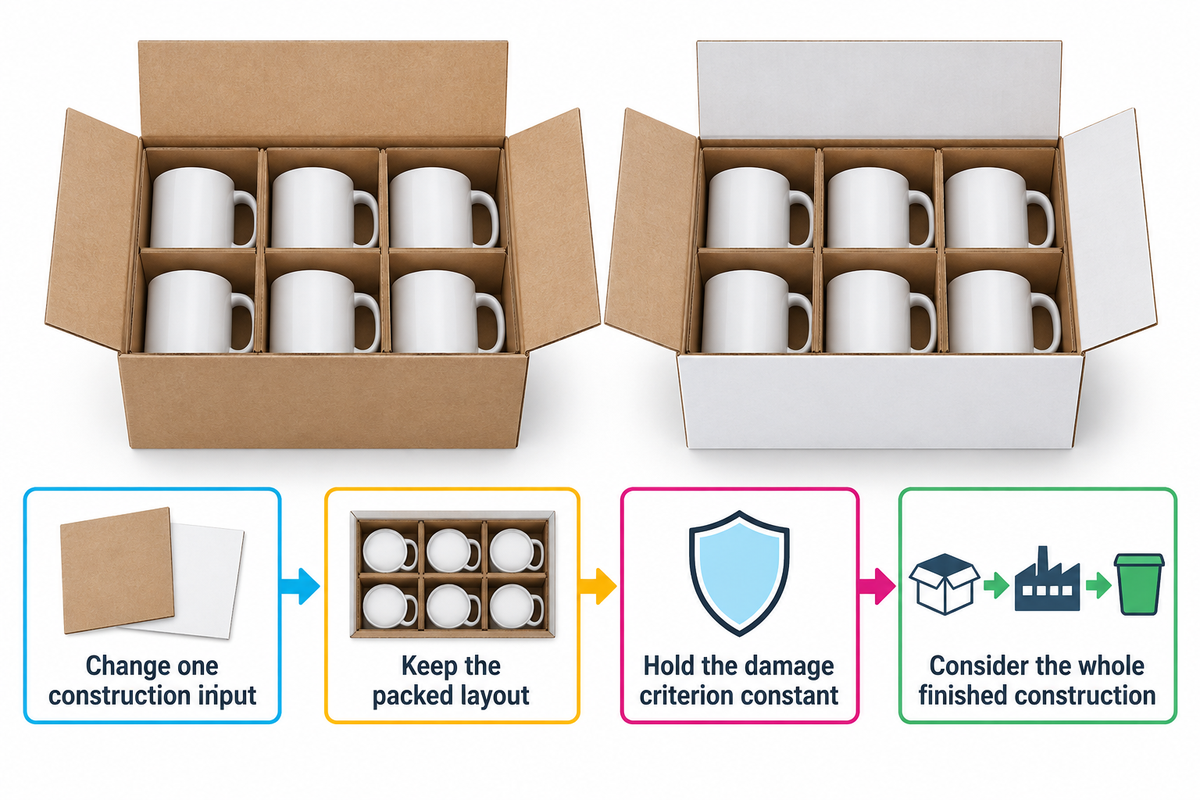
Material reduction changes the physical construction and can affect packing work, freight and damage exposure. Be sure to revisit the whole pack and to reassess product protection for the entire intended route of exposure. Record the changes to material and the performance requirements to remain satisfied.
The 2025 recyclability-design guidance from FEFCO focuses on design for recyclability. The whole finished construction, including coatings and adhesives, as well as other non-paper components, should be considered together with the local collection and processing. Recyclable board components are just one aspect of that consideration.
For the first reduction trial, agree to a single change and the approved packed layout. Hold the damage criterion constant to ensure the comparison is meaningful. If a buyer’s packaging requirements include a protected retail surface, retain that requirement when evaluating an uncoated or lighter alternative.
When discussing the product with the manufacturing team, define the product, journey and packing problem you wish to improve. Whether less void is the priority or easier loading and/or a better retail presentation is desired, the change can be designed to satisfy the requirement. Discuss your pack design with Huandao before altering the artwork to ensure the improvement is satisfactory.
Frequently Asked Questions
Can I order custom boxes with no minimum?
Huandao’s standard MOQ is 1,000 pieces per size and style; smaller runs are quoted case by case. Note that minimums are dependent upon the production route. If you need a smaller quantity, compare the quoted specification and setup charges instead of assuming that a short run would use the same process or result in the same unit price.
How long does it take to get custom corrugated boxes?
Delivery timing is quoted for the approved specification and destination, including the required design and sampling work. A production lead time starts from a defined event, such as artwork and sample approval, rather than your first inquiry. Confirm board sourcing and finishes alongside production and shipping terms. Revisions after approval can lengthen production times.
Can I get corrugated boxes with custom die-cuts?
Yes. Die-cutting can create shapes, openings, handles and closure features, but a cut changes structure as well as appearance. Show how the box will be filled, transported and shipped. Confirm the sample, tool ownership and repeat-order terms before approving a new die, especially when an opening interrupts a load-bearing panel.
Can I design my own custom box?
Yes. Use the converter’s approved dieline and leave layers for cut, crease, glue and art distinct. Identify inside and outside faces. Use a screen mock-up to review placement, then assemble a physical sample to check folded fit. Discuss custom shapes before finalizing.
Are corrugated boxes eco-friendly?
Corrugated boxes can support a recycling-focused design when the complete construction suits the local recovery route. Consider board quantity, coatings, adhesives, windows and inserts, alongside product damage. Just because a product contains a paper component, it doesn’t mean the assembled product is recyclable. Evidence of actual construction is required. Relying on phrases such as eco-friendly corrugated or environmentally friendly needs a defined basis. Material reduction should be such that the necessary protection isn’t compromised.
Can you order corrugated boxes with interior dividers?
Yes. A divider can separate items or position accessories, while cushioning addresses impact sensitivity. Elaborate on the filled layout and loading direction. Check contact points and movement in the assembled pack; partitions alone do not establish adequate protection for fragile items.
How do you order custom corrugated boxes?
Send the dimensions and packed weight of the product, the quantity by size and style, expected delivery route and the status of your artwork. Explain the nature of unacceptable damage, including cosmetic damage to the retail box. Agree on the box, insert, board, finish and closure. Approve the samples and the written order specification. Before you order in bulk, confirm which tooling, testing, packing, delivery and repeat-order costs are included. Keep the revision to align procurement and factory with fulfillment.
References & Sources
- Fibre Box Association: What Is Corrugated? Board construction and flute terminology.
- Common Corrugated packaging Constructions Examples of corrugated box constructions according to FEFCO.
- FEFCO: Material and Package Tests Material and package tests according to FEFCO recommendations.
- ISTA: Getting Started with Design packaged-product testing and design considerations.
- ISTA: Retesting – Evaluating product, package and process changes.
- Kim et al.: Effects of Pallet Overhang on Corrugated Box Compression Strength – Research under the study’s tested support configurations.
- Mrowczynski et al., Materials (2021) – Research on shifted flap creases and compression strength.
- Daum, Journal of Applied Packaging Research (2014) – Cushion curves abstract, package dimensions and cost.
- ASTM D7030-04 (2022) public scope for short-term constant-load container assessment.
- NIST: What Is Acceptance Sampling? General lot-acceptance principles.
- FEFCO: 2025 Recyclability Guidelines Update industry design guidelines.
HUANDAO PACKAGING INSIGHTS
About Huandao Packaging Insights
Huandao Packaging manufactures folding cartons, litho-laminated printed boxes and rigid gift boxes, and also supplies paper bags, retail displays and protective inserts.
Our guides help buyers compare packaging options and prepare a clearer brief before requesting a quote.
Packaging families
Board, print and finish
Artwork, dieline and sample review
Delivery planning
PROJECT DISCUSSION
Talk with the Huandao Team
- Company
- Xiamen Huandao Packaging Technology Co., Ltd.
- Quote input
- Dimensions, filled weight, quantity, artwork or dieline, finish and destination.
- Review scope
- Box, insert and delivery requirements.
- Next step
- Bring the available details to a packaging conversation.