Get in Touch with Xiamen Huandao Packaging Technology Co., Ltd.

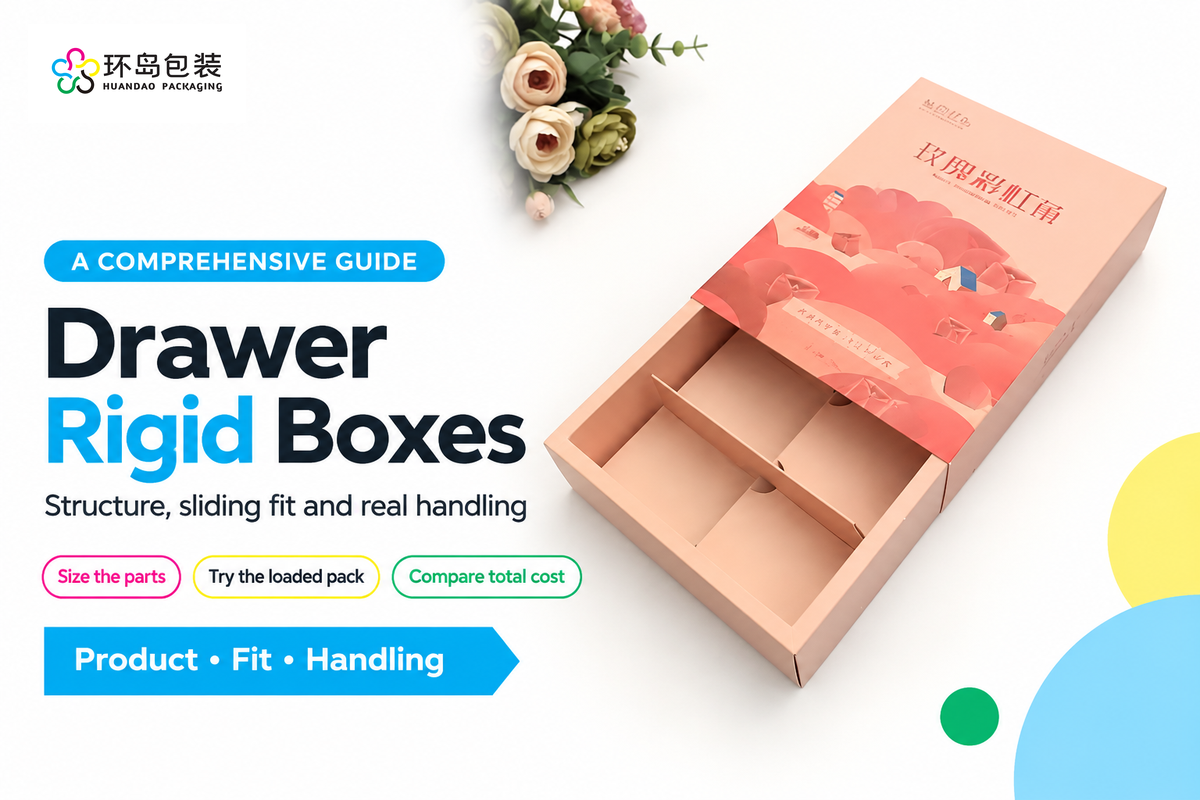
Quick specifications to define
- Structure: wrapped rigid sleeve, sliding tray and optional insert.
- Dimensions: usable cavity, finished tray outside and sleeve inside.
- Opening: pull direction, grip and available display space.
- Approval: finished loaded movement, appearance and shipment configuration.
Drawer Rigid Boxes are presentation boxes with an inner tray that slides out of an outer sleeve. Figuring out the structure along with the product removal pathway and sizing the final components guides the design. A bind after loading shouldn’t be remedied with an expensive or thicker board.
Drawer Rigid Boxes combine a sliding tray with a stiff outer sleeve. A useful design preserves product space, opens within the available display area and moves properly with the insert and product fitted.
At a glance
- Rigid appearance and flat-shipping construction are separate choices; some knockdown formats fold flat.
- Sliding gaps come from finished mating dimensions, including wrap and local buildups.
- Compare empty, insert-fitted and loaded trays before changing the sleeve.
- Compare configured costs and packed shipment volume, alongside the quoted box price.
How Drawer Rigid Boxes Work
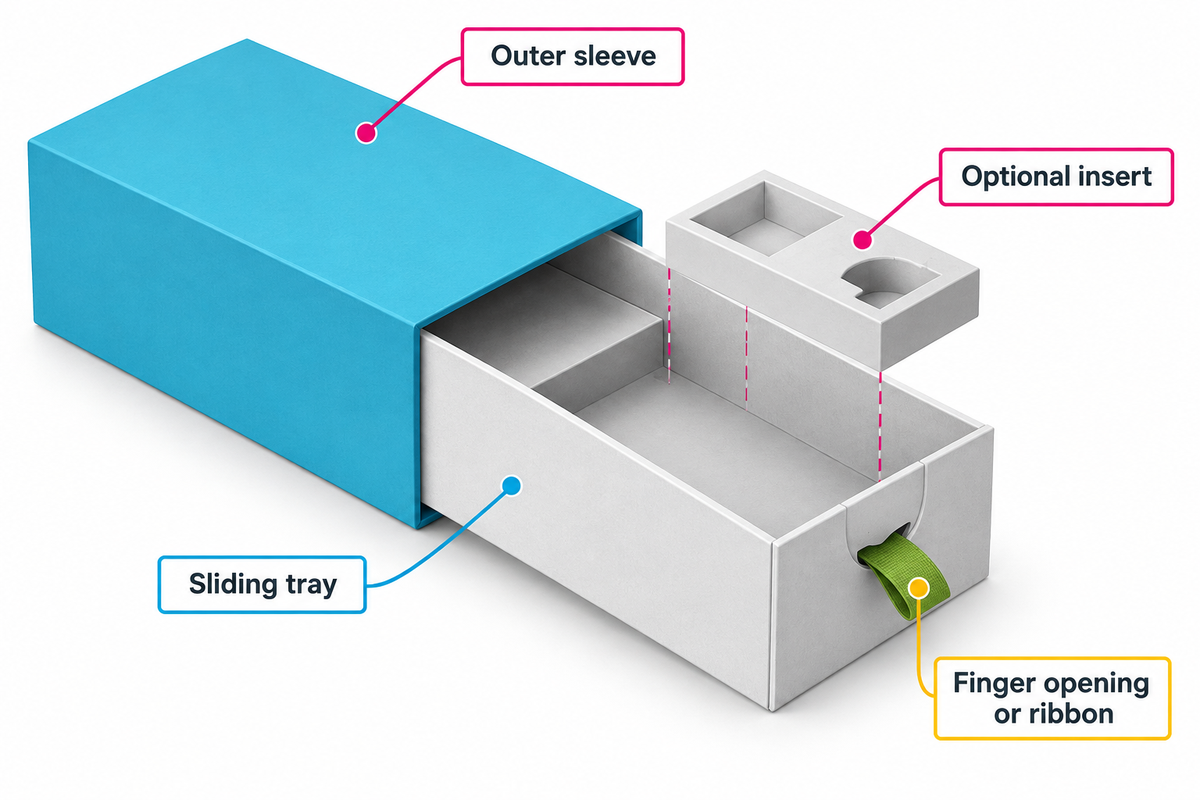
Conventional drawer box packaging has two principal pieces: a sleeve that surrounds the tray and a base that slides through its opening. Wrapped board maintains its shape prior to filling. An insert supports the product in the tray and a finger opening or a ribbon gives the user a grip.
“The combination of a slipcase and additional base (drawer) that slides into it”
The sleeve in drawer packaging is a short tube that surrounds the tray. An open-ended sleeve allows movement through either end unless the design adds retention. A closed end of the sleeve limits through movement. The drawing should address product orientation and how the package is handled if the box is standing upright.
For a gift set displayed on its long edge, place the loaded sample in that display position before choosing the pull location. A smooth horizontal demonstration on a desk answers a different question from handling an upright display box. The principle for a decorative sleeve is to provide a separate shipping arrangement when the distribution route exposes it to impacts or rubbing.
A knockdown box folds flat. Conventional assembled rigid box packaging uses different erection details, as described by PPC. These boxes are made for different shipping and preparation arrangements. Our rigid gift-box structures show the various structural families.
Which Board, Wrap and Insert Suit a Drawer Box?
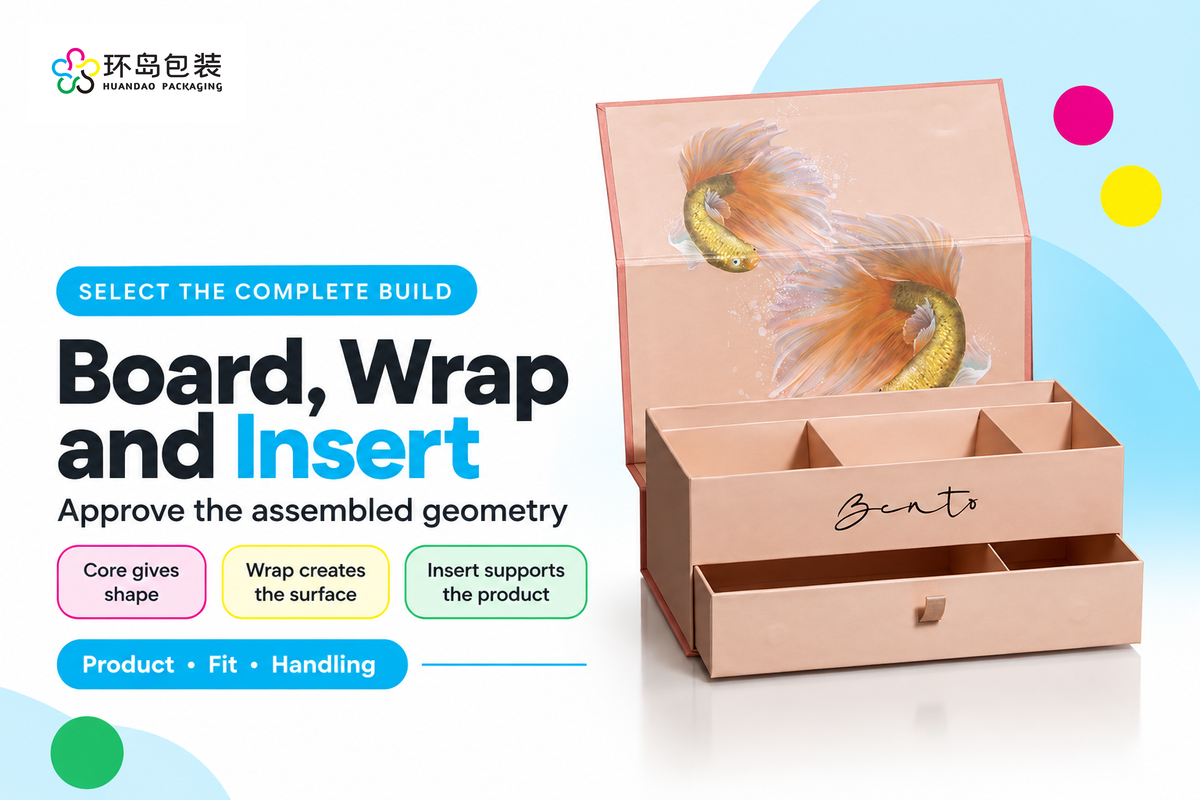
A custom rigid box typically requires core board for shape, wrap for print and touch, and an insert for product support. These layers are integrated. A thick rigid board can affect the finished tray size, and an oversized insert can push out the walls of the tray and affect its interaction with the sleeve.
How thick should rigid drawer-box board be?
Start with a core of 1.5-3 mm chipboard to construct a Huandao standard build, and select the build based on the product weight and the size of the box. The finished sample must include the wrap and insert since both change the assembled geometry.
Board caliper measures thickness; grammage measures mass per area, thus gsm alone can’t determine finished thickness. As described in the PPC construction overview, rigid packaging uses a stiff board with an overwrap. Thin folding cartons and wrapped cardboard drawer boxes look similar but have different constructions.
For a bottle set, product support may consist of a paperboard divider or a shaped foam or molded-pulp insert that provides a different contact arrangement. With a proud insert that meets the sleeve roof, product support must take the form of a low profile or a different tray arrangement.
Paper boxes made with kraft paper must be assessed for a defined board grade and finish. Kraft boxes may also contain coatings, adhesive and separable nonpaper components. For sustainable packaging decisions, consider material combinations in the context of national recycling systems using Cepi’s paper-based packaging guidance. Local collection rules apply to the completed packaging material.
Size the Cavity, Tray and Sleeve Separately
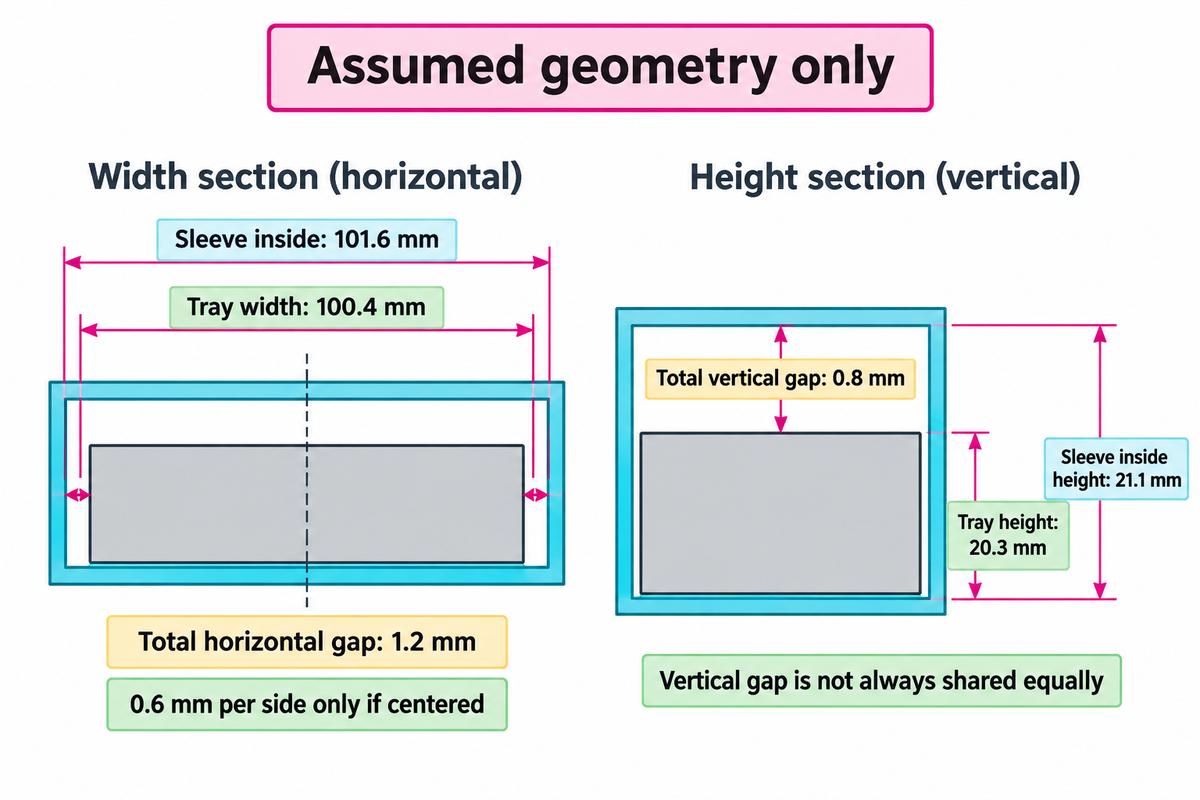
Size drawer-style rigid boxes from the product outward: usable cavity, completed tray outside, then sleeve inside. Mark the direction of travel before comparing width and height. Wrap turn-ins, lining, adhesive seams and wall shape affect the mating surfaces, so a single nominal box dimension leaves important interfaces undefined.
Example: a packaging designer records a finished tray width of 100.4 mm and height of 20.3 mm. The sleeve opening measures 101.6 mm inside width and 21.1 mm inside height. Subtraction gives 1.2 mm total horizontal gap and 0.8 mm total vertical gap. If the parts are centered symmetrically, the geometric half-gaps are 0.6 mm and 0.4 mm. A tray resting on the sleeve floor doesn’t share its vertical gap equally above and below. These assumed dimensions explain the drawing calculation; they aren’t a fit specification. The designer still needs to locate a raised seam and observe the completed loaded tray.
Do
- Label cavity, tray outside and sleeve inside separately.
- Show finished wrap and lining on the section drawing.
- Record the loaded tray and its direction of travel.
Don’t
- Use product dimensions as finished box dimensions.
- Treat a total gap as a per-side allowance.
- Apply one clearance to every material combination.
Condition containers and packaging components using ASTM D4332-22 for meaningful comparisons. Record humidity, sample atmosphere and exposure history alongside dimensions. Avoid comparing a recently unpacked tray with one stored in another room.
Find What Makes a Drawer Stick or Drop
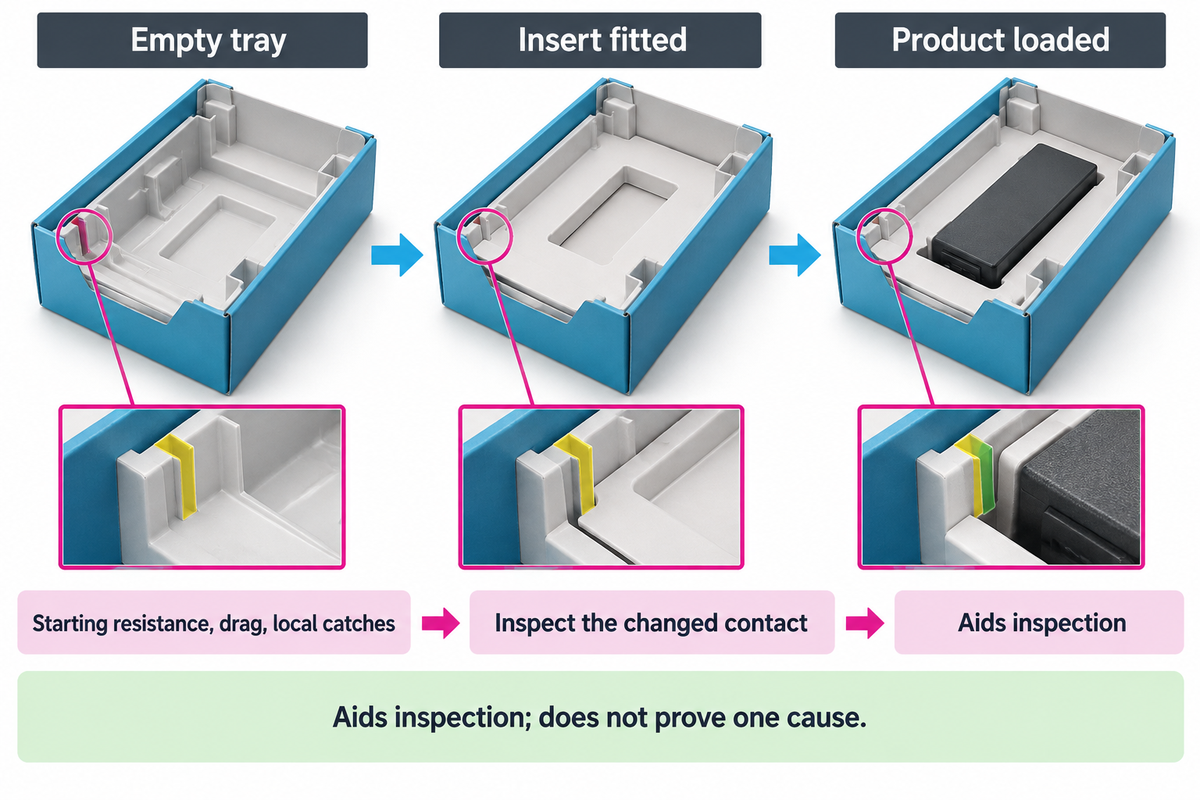
Observe whether movements change when the product is loaded. Make sure the sleeve, orientation, and handling are the same for each analysis. This sequence directs the next inspection toward contact marks, raised seams or wall distortion; a change in resistance alone cannot identify a unique cause.
3-State Slide Diagnosis
For drawer mechanism problems, record whether the tray resists the first pull, drags throughout travel or catches at one location as you slide rigid components through their stroke. Use samples with similar opening history. If first opening is important to the customer, leave a set of samples untouched.
- Move the empty tray. Observe starting resistance, drag and localized catches in the finished sleeve.
- Fit the insert. Inspect any changed wall shape, height or contact point before adding the product.
- Load the product. Repeat in the intended handling position and inspect product movement and retention.
Paper-surface friction can change with humidity and repeated use. Kawashima and colleagues’ 2008 paper-friction study observed humidity effects and small reductions in friction with repeated contact. Record opening history when comparing the pull force of wrapped, glued boxes.
| Observed symptom | Inspect first | Next action |
|---|---|---|
| Empty tray catches at the entrance | Opening squareness and corner buildup | Mark the contact location before altering size. |
| Drag runs through the whole stroke | Mating surfaces and finished dimensions | Separate surface rubbing from geometric interference. |
| Catch repeats at one location | Wrap join, glue ridge or lining edge | Inspect that local feature with the tray removed. |
| Insert alone changes movement | Insert height and wall pressure | Compare the tray profile before and after fitting. |
| Only the loaded tray binds | Product contact and tray deformation | Observe the load path and unsupported spans. |
| Tray moves out when tilted | Opening direction and retention design | Evaluate the intended orientation and handling. |
| First pull differs from later pulls | Surface condition and opening history | Keep first-opening observations separate. |
| Samples change after storage | Atmosphere, exposure and visible distortion | Compare conditioned samples with matching history. |
| Ribbon is difficult to grip | Exposed grip and adjacent product | Observe intended users opening the loaded pack. |
An example is a cosmetics kit whose empty tray glides smoothly, but whose insert-fitted tray rubs near the front. Loading the bottles adds a catch at that spot. Increasing the sleeve size could leave the rest of the stroke too loose. The packaging technician removes the insert and inspects the front wall, then compares its profile with the insert fitted. A raised insert edge or a wall pushed outward gives a specific feature to change. If neither appears, the technician examines surface marks and sample history instead of blaming the insert automatically. The procurement lead keeps the original sample and the changed component, for comparison.
Drawer, Magnetic or Lift-Off Boxes: Which Opening Works Best?
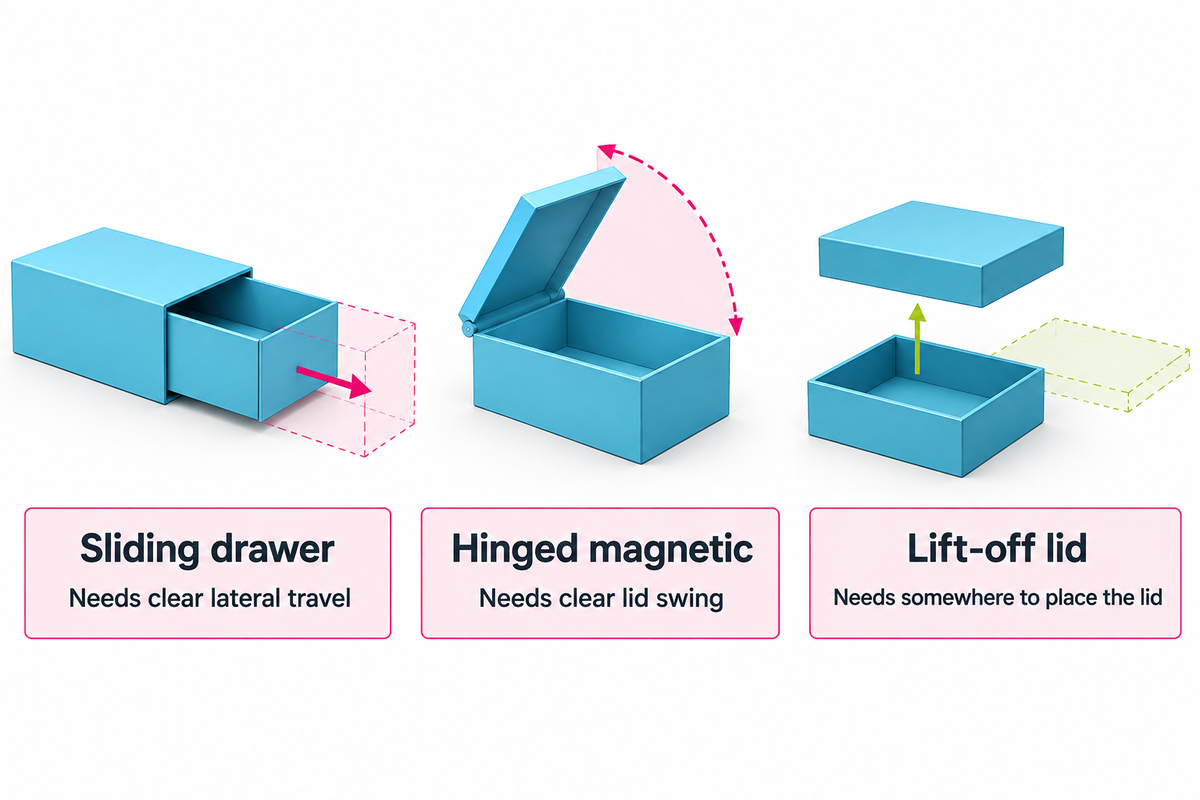
A drawer works best when lateral access and a controlled reveal fit the display; a hinged magnetic format suits a lid that can stay attached, and a lift-off design suits products lifted vertically from a shallow base. Product removal, lid storage and packing determine which opening motion suits the available space.
A luxury drawer presentation on a beauty counter may prefer horizontal access, if a display shelf is just above the pack. That packaging option loses its advantage if a display rail blocks the tray front. A magnetic lid needs an opening envelope, and a lift-off lid needs a place to rest, while product is being handled.
| Format | Useful when | Change format when |
|---|---|---|
| Sliding drawer | Lateral access and controlled reveal fit the display. | Full travel would extend into an aisle or obstruction. |
| Hinged magnetic | The lid can remain attached during access. | The lid swing blocks the user or surrounding display. |
| Lift-off lid | The product lifts vertically from a shallow base. | The detached lid is awkward to manage. |
Magnetic closure gift boxes are an alternative opening choice, rather than a general strength upgrade. For upward removal, compare our lift-off-lid construction. Tuck boxes may suit a lighter folding structure; mailer boxes address a different packing role. Luxury rigid boxes still need an outer distribution design suited to the route.
Which Opening and Insert Suit the Product?
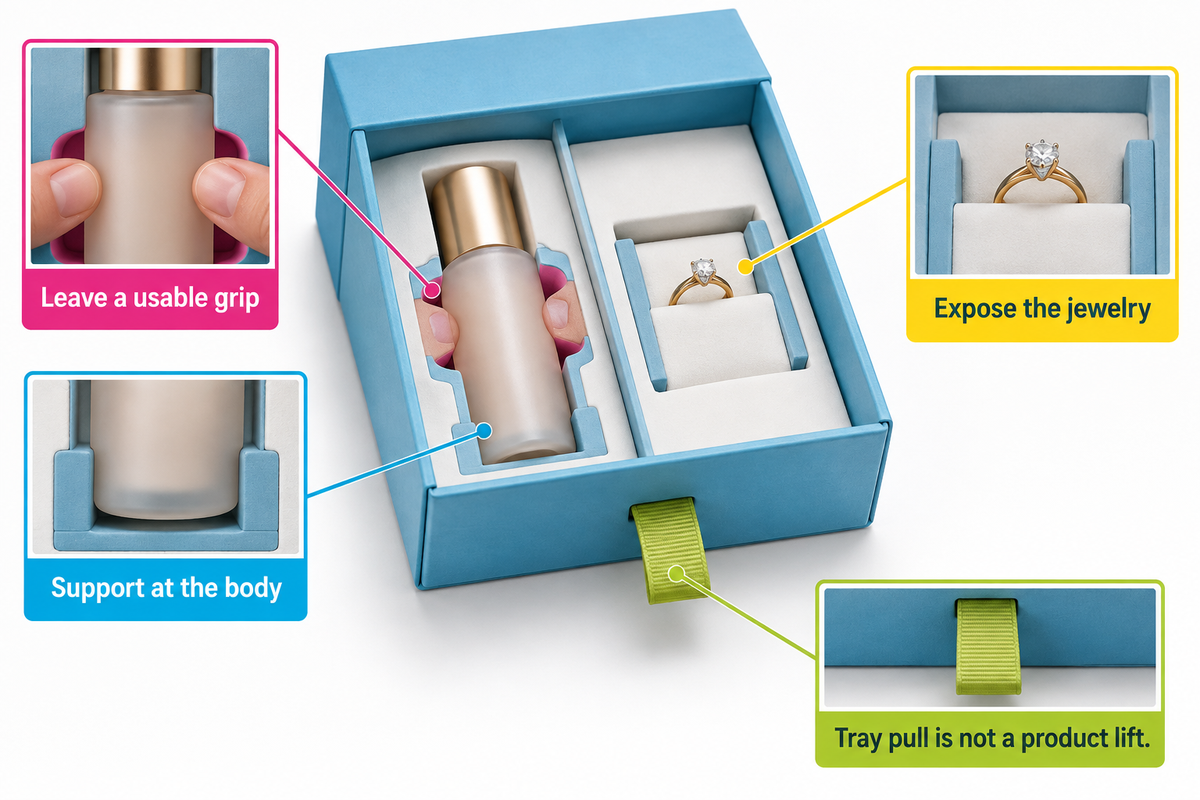
The packaging should support the products where they can take contact, and leave a clear path for removal where the user can grip them. A ribbon can open the tray, but doesn’t necessarily lift the product out. The insert should be designed to match the product arrangement; then observe how the intended user interacts with the completed drawer gift boxes.
Review opening location, opening method, grip and opening instructions alongside product fit. Include user evaluation, covered by the BSI summary of ISO 17480 accessible packaging design: a larger visible pull may help one user while another still struggles to stabilize the sleeve.
| Product type | Support to develop | Removal detail |
|---|---|---|
| Necklace or pendant | Dedicated jewelry pad and restrained chain | Expose the jewelry without pulling on the chain. |
| Ring or earrings | Product-specific slot or pad | Leave finger access beside the piece. |
| Glass cosmetic bottle | Body support with separated neighbors | Grip the body without relying on the cap. |
| Cosmetic tube set | Divided cavities with a consistent orientation | Expose a grip above the support. |
| Candle vessel | Base support matched to the vessel | Allow an upward grip around the body. |
| Chocolate assortment | Suitable direct-contact tray inside the presentation pack | Separate food-contact needs from the decorative outer. |
| Small electronic accessory | Support around the body and loose accessories | Keep ports and cables clear of the gripping path. |
| Stationery set | Shallow compartments or a paper platform | Leave a thumb space under flat items. |
| Multi-item promotional kit | Separate compartments for differing heights | Remove each item without tipping its neighbors. |
Different layouts may be needed for boxes for jewelry and display boxes, even with similar outer dimensions. Secure packaging needs support at intended body contact points, as well as a workable removal path. For retail packaging, a presentation dummy should include the item shapes and contact surfaces that the final insert will encounter.
Which Printing and Finishes Suit Real Handling?
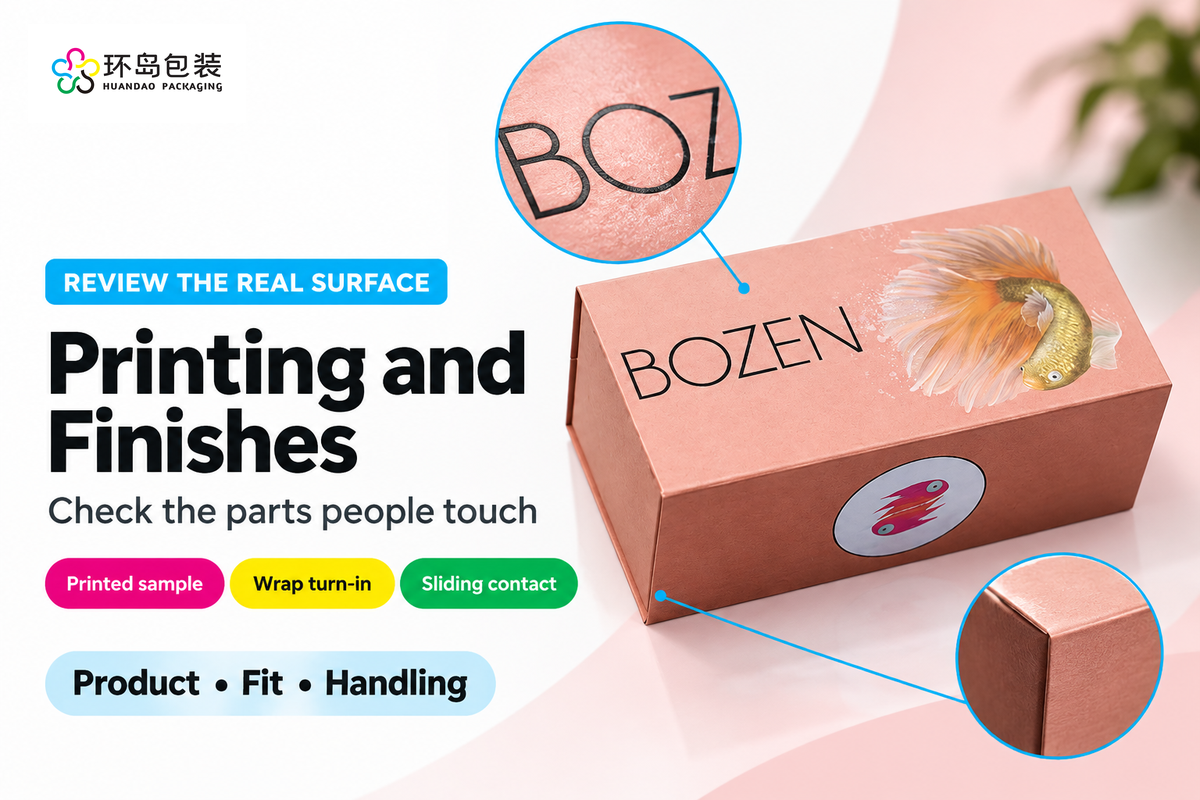
Choose printing and finishes based on what people touch, the shelf lighting and what rubs together when a package is opened. Custom printed wraps can capture color and artwork. Lamination and coating can alter the final effect and be combined with foil stamping. Review your chosen combination on an actual sample instead of judging touch from a screen.
Should I choose soft-touch lamination for a retail drawer box?
Choose soft-touch lamination when its tactile surface suits the displayed product better than gloss or matte, then confirm it on a rubbed sample. Contact areas and dark regions printed on the sample should be rubbed before a final approval for the production run.
For a dark premium packaging design, the customer touches the sleeve front and ribbon area repeatedly; put those regions on the printed sample, together with fine foil detail and any textured wrap. Premium custom printing means the artwork should be placed against those areas. A foil logo crossing a wrap turn-in on custom luxury boxes needs a different position from one on a flat surface.
Use ASTM D5264 for comparative abrasion testing to assess the impact of different inks, coatings and laminates; record the rubbing medium and chosen acceptance appearance with the result. The printed drawer front and sliding contact area may need different checks because they encounter different handling.
Co-ordinate tactile choices across the entire gift packaging, following the presentation principle in Sheri Koetting’s packaging-design discussion. Place finishes to achieve that presentation instead of filling up empty spaces.
Understand Box Cost, Packing Labor and Freight
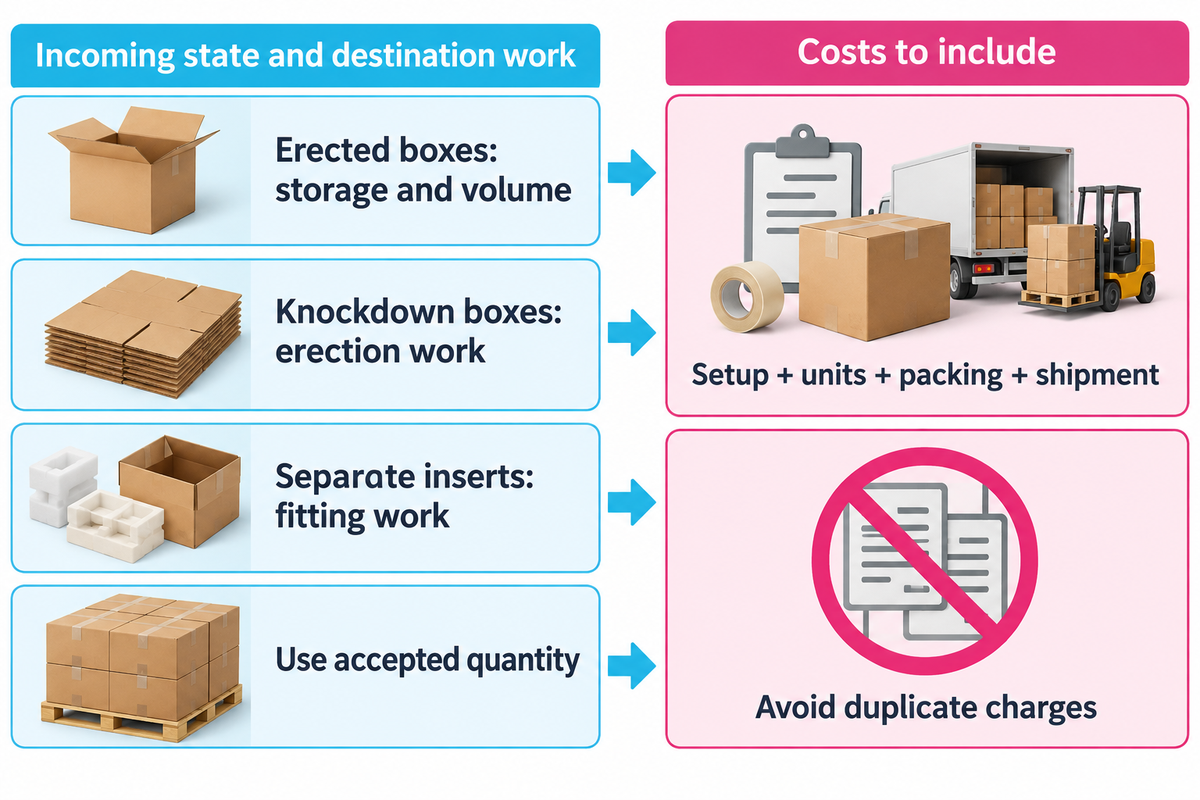
Ask for a quote based on the same box specifications and material. Separate fixed setup costs from repeat unit costs, and include destination packing costs. A wholesale price for empty packaging boxes and a delivered price for filled-ready sets describe different purchases, even when both suppliers show the same quantity.
A buyer of drawer boxes at wholesale prices must have a common configuration and a quote which includes materials. Add box and insert costs, and setup costs. Then, add any separately billed packing and shipment costs and divide by the accepted quantity. Don’t charge the same scrap or assembly work twice. Order quantities, artwork versions and custom sizes can each change the quotation basis.
| Purchase choice | Constraint that moves | Owner and comparison input |
|---|---|---|
| Boxes arrive erected | Empty storage and shipment volume | Logistics: packed carton dimensions and count |
| Boxes arrive knocked down | Destination erection and handling | Packing supervisor: observed preparation time and available staff |
| Inserts arrive separately | Fitting work at the packing bench | Operations: complete loading sequence and accepted appearance |
| Quotation uses ordered quantity only | Cost of rejected or reworked pieces | Finance and quality: accepted-quantity denominator without duplicate scrap charges |
Example: assume an outer carton measures 20 × 12 × 10 in and weighs 8 lb. Using FedEx’s published US dimensional-weight guidance, its volume is 2,400 in³ and 2,400 ÷ 139 = 17.27 lb before service billing-rounding. The dimensional figure exceeds the actual weight. This compares weight bases, not freight rates; the carrier’s service and account terms determine the billed shipment.
Are rigid drawer boxes shipped pre-assembled?
Traditionally, rigid drawer boxes are shipped as assembled, pre-formed units. A change in design to a knockdown may alter the assembly state, but it also adds erection work at the delivery site. Leave the assembly state in the quote to allow the customer to evaluate the same unit for freight volume, preparation time, and completed appearance.
Choose assembled or collapsible rigid packaging around destination packing capacity before comparing small unit-price differences. Assembled custom packaging boxes occupy storage space on arrival; collapsible boxes add preparation work. Finance may combine the configured freight quote with packing cost calculated from the time it takes a full workbench cycle to pack the product and the loaded labor rate.
Our collapsible rigid boxes provide a separate construction option to compare. Before you order custom rigid drawer boxes or a folding alternative, record packed carton count and dimensions with the box order. Buying boxes in bulk changes the game on how much storage and preparation work reaches the destination at one time.
From Sample to Production: Decide What to Approve
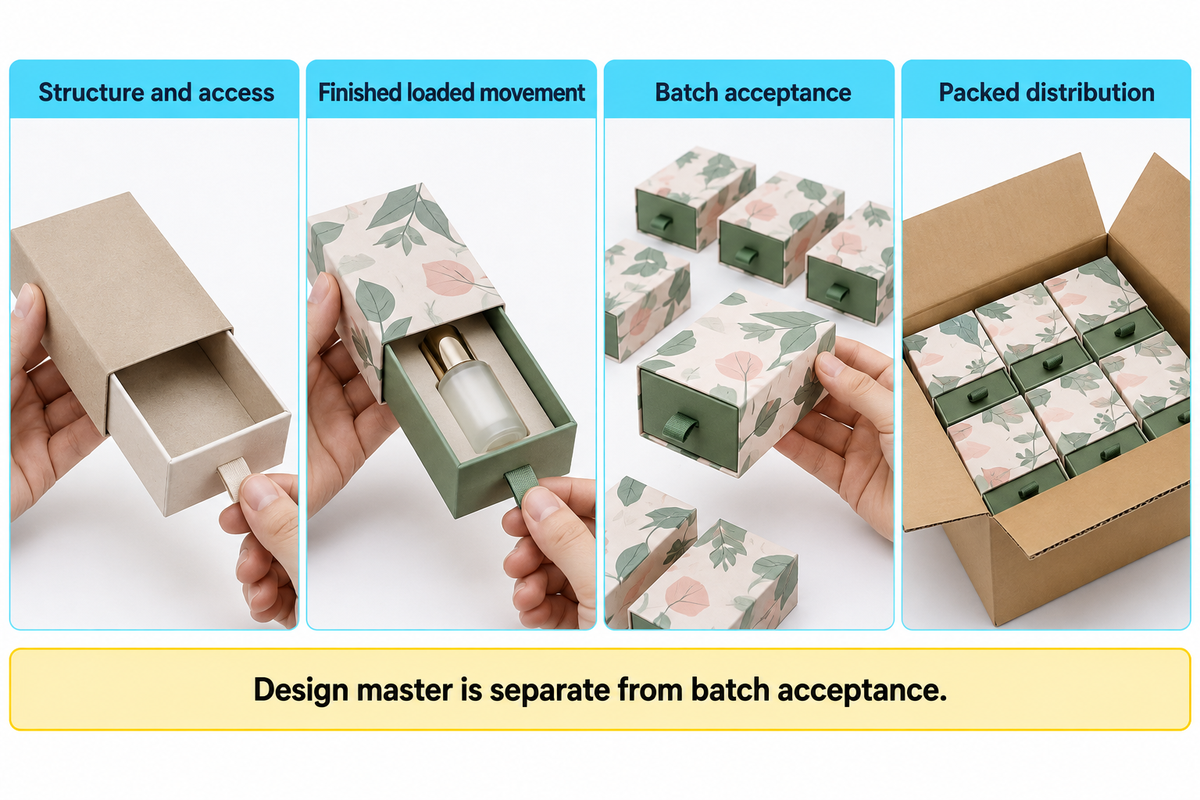
Approve structure, printed surface and loaded movement as separate decisions and define production acceptance and transport evaluation. A structural sample determines the shape and access. A completed loaded sample adds the chosen wrap and insert. Production samples may be inspected to evaluate the supplied batch, while shipment samples are checked against the packed distribution arrangements.
Keep approved design master and batch acceptance separate. Random samples support a lot’s accept or reject decision, as described in the NIST acceptance sampling explanation. Loaded containers and inner packing can be evaluated for free-fall effects using ASTM D5276. The outer shipping carton, as well as supports, shall be included in the shipping configuration, beyond the presentation carton.
At Huandao, we make these boxes as part of our printed paper packaging production in our own Xiamen plant. Pre-press, sheetfed offset printing, UV coating, lamination, die-cutting and folder-gluing run in-house. We can coordinate inner trays, custom inserts and outer shipping cartons, through the Huan Yin Packaging Group. Our job-level ECT, burst, ink rub, and basis weight reports relate to the production run in question.
To create custom rigid drawer boxes, give the packaging company the product arrangement, contact restrictions, removal directions, and the distribution route. These packaging requirements belong beside the finished drawing before placing a rigid drawer box order. Packaging experts reviewing the fit need both the empty and the loaded sample, in addition to the agreed appearance and sample checks, and the production inspection plan. A change to the insert or wrap after approval reopens the fit and handling decisions affected by the change.
For custom packaging needs, Huandao’s custom drawer rigid boxes page covers available configuration and quotation details. Keep the product, insert and ship requirements, in the same brief when discussing the packaging solution.
Frequently Asked Questions
Can rigid drawer boxes include inserts?
Rigid drawer boxes can include paperboard, molded-pulp or foam inserts matched to the product layout.
Choose contact points around the item body, then leave a usable grip for removal. The insert should sit inside the completed tray without pushing its walls outward or touching the sleeve roof. For a multi-item set, review the tallest item and the empty spaces between neighboring products as part of the loaded package.
Can I customize both the sleeve and drawer of the box?
Both the outer sleeve and inner tray can carry custom artwork and selected finishes.
Place the design on a drawing that shows the closed pack and the opened reveal. Keep small lettering away from wrap joins, pull openings and areas hidden by the sleeve. To customize these boxes without disrupting movement, review any surface change where the two parts touch, together with the printed sample and insert.
Are rigid drawer boxes strong enough for heavy products?
They can be, when the structure and support layout are designed for the product’s weight rather than relying on the drawer format alone.
The product mass, supported span and way the box is lifted all affect the loaded design. A thick board around an unsupported base can still leave the wrong load path. Start with the item arrangement and support points, then evaluate the finished loaded package and its outer shipping configuration for the intended handling route.
What is the minimum order quantity for custom drawer boxes?
Huandao’s stated standard minimum order quantity is 1,000 pieces per size and style; smaller runs are quoted case by case.
Different sizes or artwork versions may require separate production setups. Include the quantity for each version in the brief, together with the insert and finish. Supplier minimums are individual offers, so compare the same scope when reviewing custom drawer boxes.
Will foil stamping crack on a rigid drawer box?
Foil can lose its appearance or adhesion when the paper, foil and geometry are poorly matched.
Keep critical fine detail on a suitable flat region where possible. A design extending across a wrap turn-in exposes the finish to different forming and rubbing conditions. Review the chosen artwork on the production paper with the planned foil and any underlying print or lamination. Handle the sample through its opening motion and inspect the edges of the stamped detail. Surface appearance, adhesion and sliding behavior need their own observations; a digital preview only shows the intended design.
Are drawer style boxes better than regular rigid boxes?
Drawer style boxes are one rigid-box format, suited to products that benefit from sliding access.
Choose them when the display leaves room for tray travel and the product can be removed comfortably. A hinged or lift-off format may suit another setting. The right packaging follows access, protection and packing requirements rather than a general luxury ranking.
Where is your packaging produced?
We manufacture at our own Huandao facility in Tong’an District, Xiamen, Fujian, China.
The plant is at No. 587 Tongfu Road and has 133 staff. Huandao was founded in 2003 and is the color-printing plant of Huan Yin Packaging Group. Our operations cover printed paper packaging, including folding cartons, litho-laminated boxes and rigid gift boxes. The group can coordinate protective inserts and outer shipping cartons with the printed box, so related packaging components can be consolidated into one shipment. The production brief defines which components and job reports accompany your order.
Develop a drawer box around your product
Send the product dimensions, arrangement and opening direction with your planned quantity. Huandao can discuss the board, printed wrap, insert and outer-carton scope together, then develop the sample around those requirements. Include the destination packing arrangement so the quotation covers the work your team expects to receive.
Our perspective on sliding fit
Huandao makes printed paper packaging, so this guide connects the cavity drawing with the finished tray, sleeve and insert. The worked dimensions and carton example use stated assumptions. The three-state comparison is our proposed observation sequence; paper-friction research supplies a caution about surface history. Written by XCX for Huandao, with public construction and test-method references listed below.
References & Sources
- Paperboard Packaging Council: Rigid Box Industry Terminology.
- Paperboard Packaging Council: Paperboard Packaging Construction.
- Cepi: Paper-Based Packaging Recyclability Guidelines.
- ASTM D4332-22: Conditioning Containers, Packages and Components, public summary.
- Kawashima, Sato and Yamauchi: Paper Friction and Relative Humidity, 2008.
- BSI: BS EN ISO 17480, Accessible Packaging and Ease of Opening, public summary.
- ASTM D5264: Abrasion Resistance of Printed Materials, public summary.
- Sheri Koetting: Materials, Shapes and Imagery in Luxury Packaging, Packaging Strategies, 2017.
- NIST: What Is Acceptance Sampling?
- ASTM D5276-19(2023): Drop Testing Loaded Containers, public summary.