Get in Touch with Xiamen Huandao Packaging Technology Co., Ltd.

Custom Candle Rigid Boxes: From Jar Fit to Finished Pack

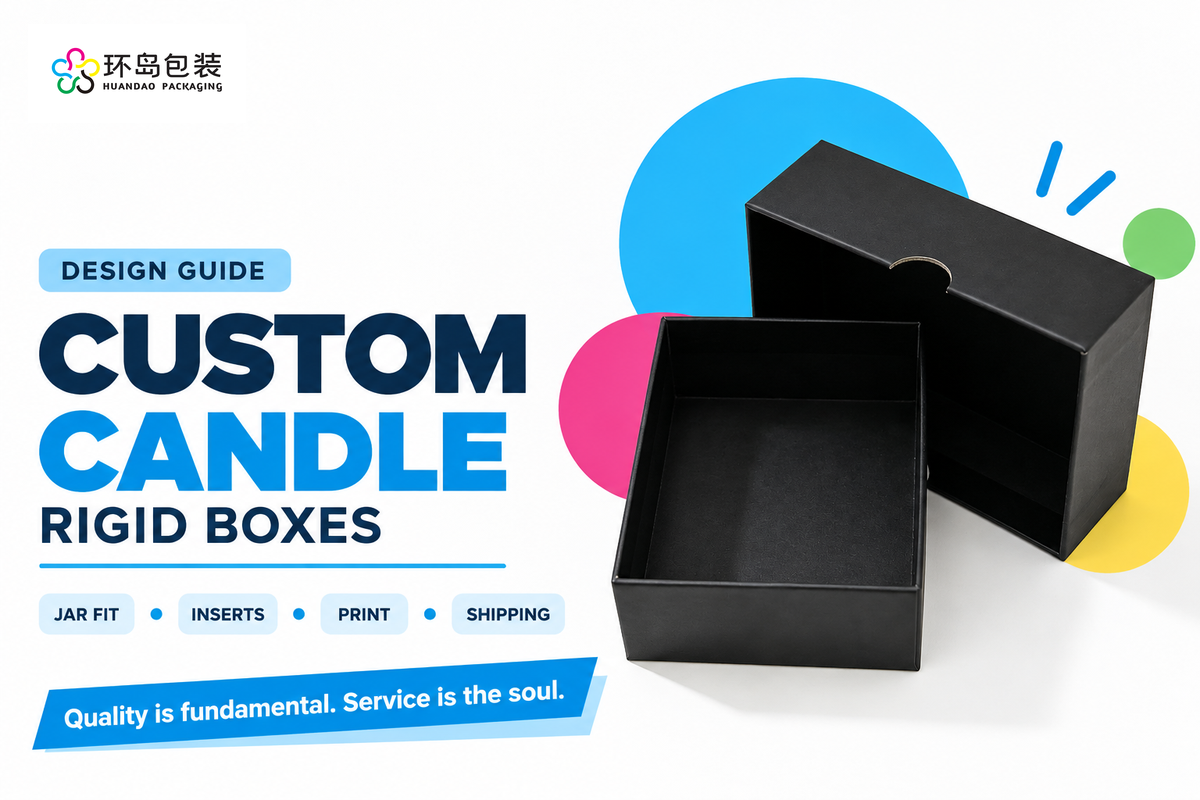
Custom Candle Rigid Boxes are paper-wrapped board boxes sized around a finished candle and its insert. Choose the opening, jar support, print finish and shipping arrangement together, with presentation and transit protection designed around the complete packed product.
A candle can appear settled in its box, but that doesn’t always mean it’s easy to lift out. A projecting lid can catch an insert. A dark wrap can show handling marks before it reaches the shelf. There are different design problems, and a heavier shell does not address all of them.
This guide addresses seven decisions: construction, finished-jar fit, insert support, printing, complete-pack cost, distribution and approval. It is for candle brands developing a retail unit, a gift set or packaging for e-commerce, with a practical brief to carry into sampling.
What Makes a Candle Box Rigid?
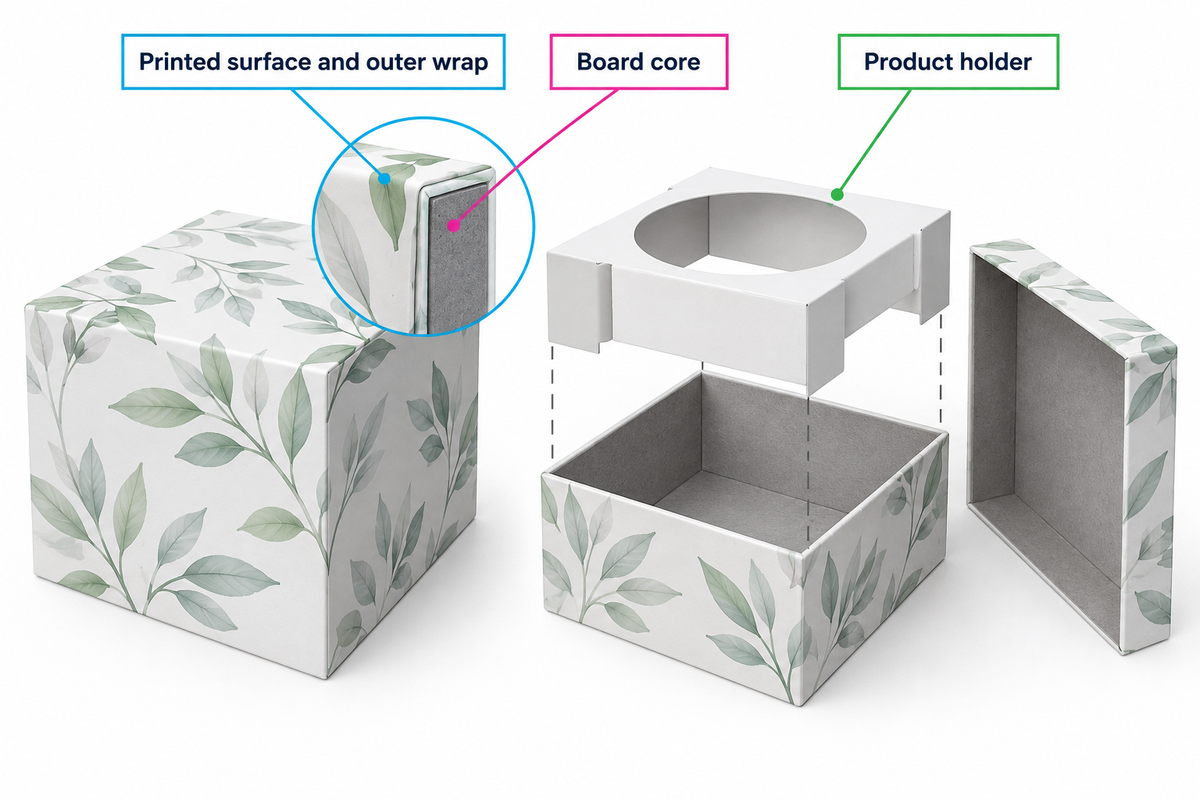
A rigid candle box uses a structural board core with a printed surface and a separate outer wrap, rather than relying on folded carton stock. The core, printed surface and product holder each do a different job. Read candle packaging boxes by those layers, before comparing appearance, weight or a supplier’s description of premium packaging.
The Paperboard Packaging Council’s rigid-box terminology distinguishes set-up boxes from folding cartons and corrugated shipping containers. It also describes knockdown versions that fold flat. “Rigid” therefore tells you about a construction family; it does not tell you everything about how the empty pack arrives.
Quick specification brief
- Core: board grade and caliper, recorded separately from wrap-paper weight.
- Fit: finished jar, lid, label and filled mass.
- Holder: material, contact areas and removal feature.
- Dimensions: identify internal and external measurements on the drawing.
- Delivery: erected or flat, with the packing configuration specified.
For a handmade candle sold locally, a printed folding carton may meet the presentation need with less assembly volume. Gift boxes become useful when luxury candle packaging calls for a more substantial opening or a more developed interior. Compare rigid gift box structures at the construction level before finalizing the decision on decoration.
Compare Two-Piece, Drawer and Magnetic Styles
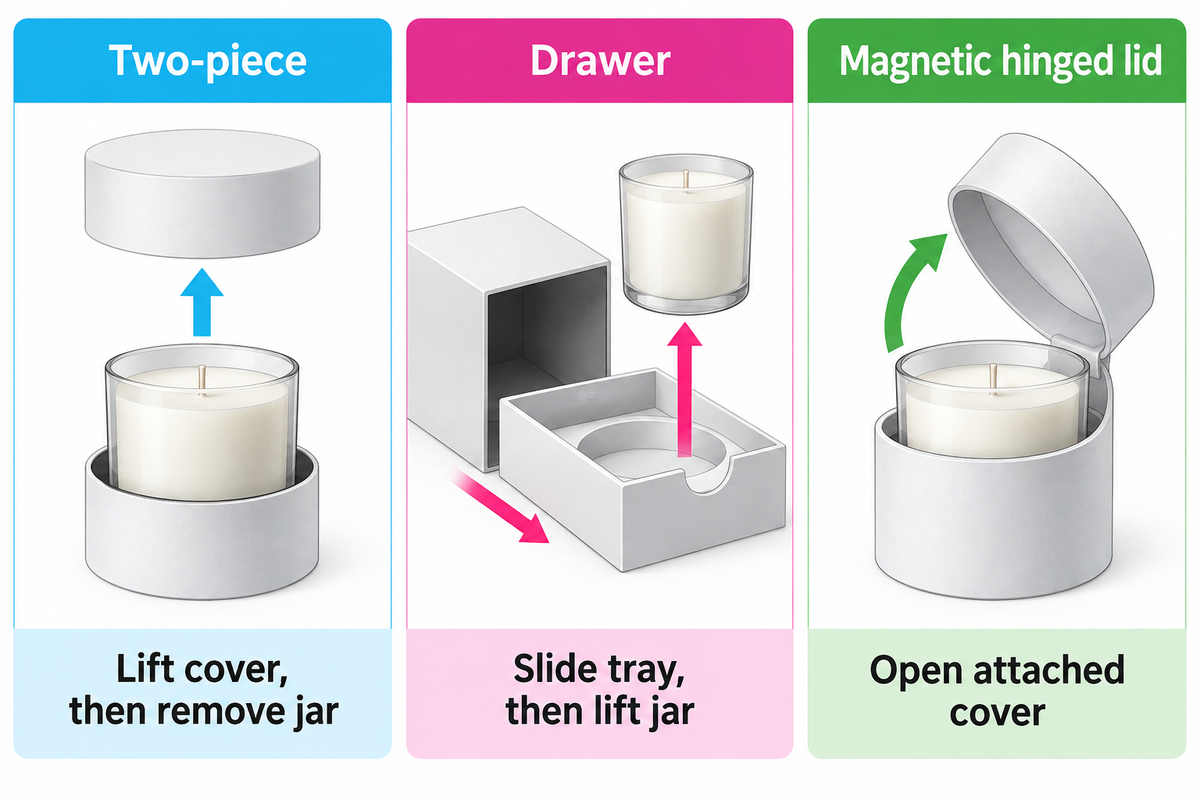
Two-piece, drawer and magnetic constructions change how people open, hold and close the pack. Match the opening to the jar’s weight, lid profile and removal path, then specify whether the shell is delivered assembled or as a collapsible construction. Look at the loaded packaging for the actual distribution path.
Unique packaging gains extra points for features that allow the consumer to reach, view or handle the product. Compare premium packaging solutions by those actions before adding a decorative mechanism that makes removal harder.
A lid that lifts off gives access to the interior. A sliding tray moves the product out before it is lifted. A hinged lid keeps the cover attached and can be used to present an interior message in a candle gift box. Use these motions to decide which sample to develop.
| Style | Opening action | Useful when | Sample check |
|---|---|---|---|
| Two-piece | Lift cover, then remove jar | An uncomplicated vertical reveal suits the product | Cover release and finger access around the jar |
| Drawer | Slide tray, then lift jar | The tray should stage the reveal | Tray support during opening and access past the sleeve |
| Magnetic hinged lid | Open attached cover | Inside graphics or repeated closure have a purpose | Lid swing, closure alignment and jar removal |
The 2014 Packaging Digest interview about Bäks describes an initially flat box that uses embedded magnets. That historical example shows why “magnetic” and “collapsible” are separate attributes; it does not supply a freight-saving percentage for this project.
Advantages to seek
- Accessible loading and removal.
- A deliberate view of the product.
- A closure that suits repeat handling.
Limitations to check
- A tight cover can make opening awkward.
- A sliding tray needs support when extended.
- An attached lid needs space to swing.
Review the actual drawer rigid box construction or magnetic closure construction once the motion is decided. If empty storage is the concern, assess a collapsible rigid box as its own assembly decision.
Size the Box Around the Finished Jar
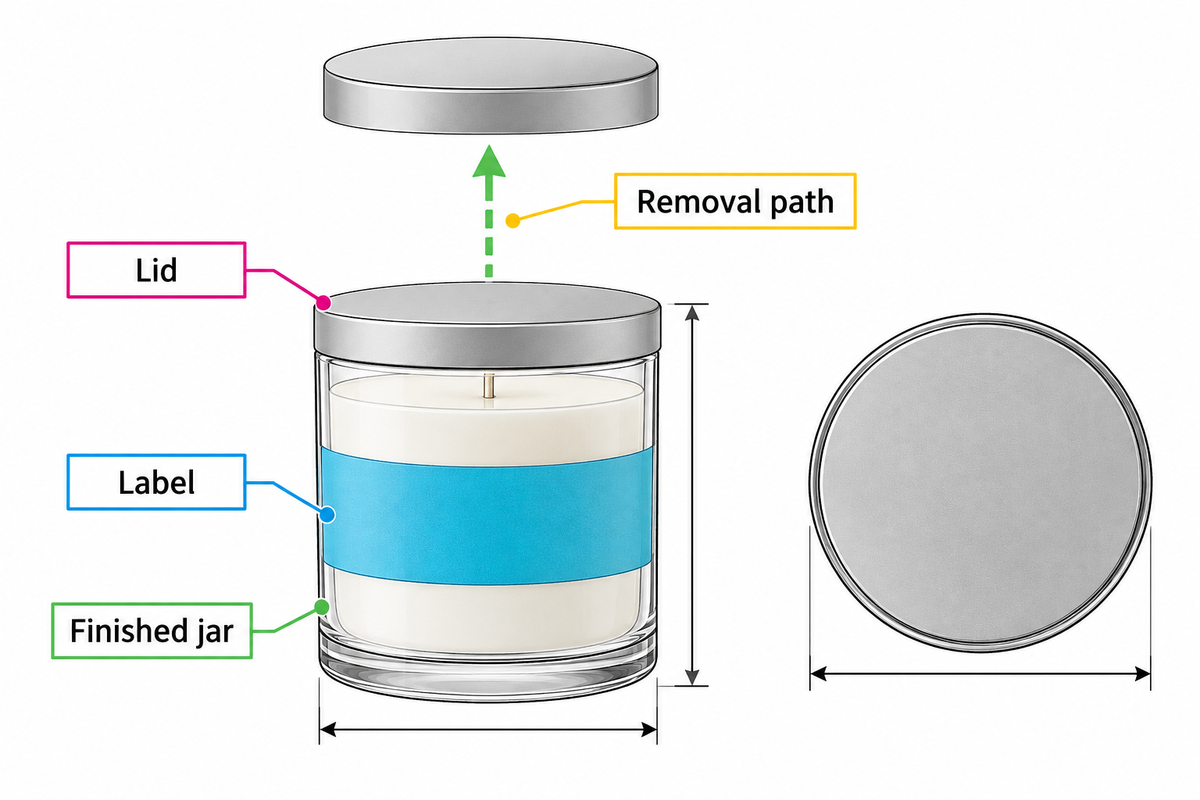
Candle box packaging begins with the finished candle jar’s maximum envelope. Measure the body, projecting lid, label and closed height of the finished jar before designing the insert. Then distinguish the insert cavity, the insert’s outside size and the box’s internal dimensions. When specifying custom candle boxes that fit, nominal candle ounces will not substitute for those dimensions.
How do I select the right size for my custom rigid candle box?
Start with a physical example of the finished candle and its production lid and labels. Show the closed height and the widest point. Indicate where the insert will touch the jar and how the jar will be removed. Size the holder first and the surrounding box second. Use a structural sample to approve the combination.
Use a Jar Envelope Map: front and top views showing the maximum outline, where the jar will be supported and in what direction it will be removed. For a tapered vessel, the widest point can be above the holding band. For a lid that overhangs the glass, a cavity based only on the body can catch the lid on removal.
| Published property | CandleScience black straight-sided tumbler | Use in the brief |
|---|---|---|
| Wax weight to fill line | 8.50 oz | Contents reference, not external size |
| Volume to overflow | 11.90 fl oz | A different property from wax mass |
| Nominal top outside diameter | 3.20 in; stated allowance ±0.06 in | Check actual body variation |
| Nominal height | 3.39 in; stated allowance ±0.08 in | Add the selected lid’s actual effect |
Those published tolerances place the upper top outside diameter at 3.20 + 0.06 = 3.26 in and the upper vessel height at 3.39 + 0.08 = 3.47 in. Those calculated limits do not account for a projecting lid and label. Those calculated limits do not account for a chosen insert allowance. They are not recommended box dimensions.
The same supplier excludes pine wooden lids from one of its retail-box options but accepts other lid types. This is a good warning against treating a jar name as a complete fit specification. In this case, the lid is a separate component from the jar. The use of a representative sample of the actual product, as discussed in ISTA’s representative-sample guidance, shows the importance of evaluating the product and its package combination.
Choose Candle Boxes with Inserts That Support the Jar
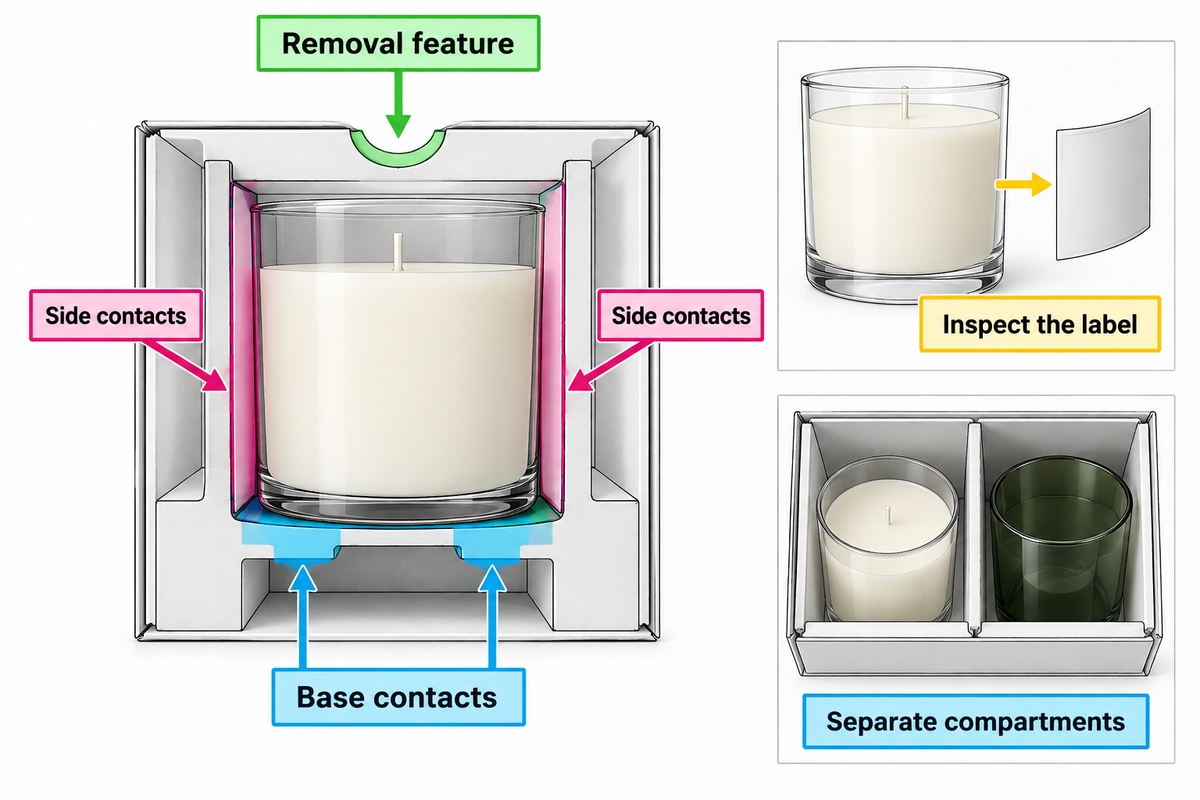
Candle boxes with inserts need to hold the intended contact areas while leaving a path for removal. A closely fitting cutout can still press on a label and trap a lid. Choose the packaging material and support geometry together, using the filled vessel rather than an empty look-alike.
For rigid candle packaging, a folded paperboard platform can locate a jar without covering the side completely. Corrugated supports can create separate compartments for sets. Other shapes and surfaces of contact are offered by molded fiber and foam. However, the material name alone does not show how the insert behaves under the packed load.
The Paperboard Packaging Council describes insert platforms and removal lifts as different features. Apply that distinction to the candle: one feature supports it; another lets the user remove it without pulling at the label or lifting by a loose lid.
Consider a candle-and-diffuser gift set. If the two products share the same open space, they can contact each other, even if the shell feels firm. A divided holder gives each product a defined position. The trial then needs to show whether the heavier jar distorts its support and whether the diffuser can be removed without disturbing the candle.
Do
- Mark intended base and side contacts on the drawing.
- Load and remove the finished product.
- Inspect the label after repeated handling.
Don’t
- Use the lid as an assumed load-bearing handle.
- Hide an inaccessible jar beneath a decorative collar.
- Leave neighboring glass products free to touch.
Candle dust covers, a care card and a ribbon can change the loading sequence. They should be included in the sample of the custom packaging, before the holder is approved, and not added later.
Design Printed Candle Boxes for Handling and Display
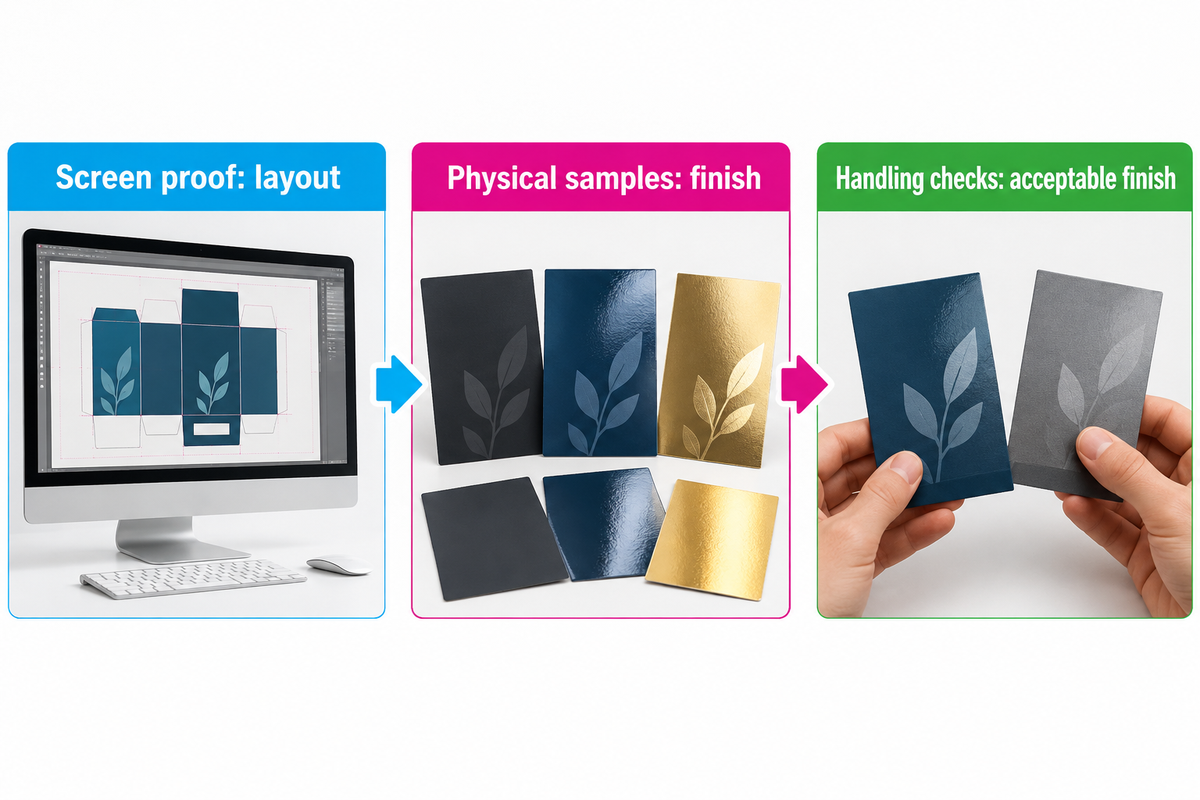
Printed candle boxes have to be approved in the selected wrap and have a surface suited to the expected contact. Start with the candle labels, scent names and shelf presentation, then choose the finish. A screen proof can indicate layout, but not texture, foil relief or resistance to scuffing.
What is the best finish for premium candle packaging?
The goal is an acceptable finish based on the look desired for the material in question; the finish remains acceptable after the relevant handling checks. Physical samples should be used to compare matte, gloss, soft-touch, foil, embossing, etc. when selecting the best candle box finish for your design. Care should be taken with dark surfaces and with fine metallic details.
For a branded candle with several scents, keep the naming hierarchy consistent and make the variable area easy to distinguish. It is acceptable to have some similarity in designs for different custom printed candle boxes. A custom design should be easily legible for the least and most contrasting color combinations. It should be legible for the smallest scent name across the actual range.
ASTM D5264-98 (2019) describes a comparative laboratory method of abrasion for printed materials. Its public scope includes labels, cartons and inserts with graphics on flat substrates. Use it to define a surface comparison with the supplier, including the material combination and acceptance reference; do not turn the standard number into an unsupported universal rub-cycle requirement.
Product information warrants a separate layout check. The public abstract of ASTM F2058-07(2021), Candle Fire Safety Labeling, addresses warning visibility on the unit of sale. The closed retail pack should be checked, and the jar should not be the only item checked. The candle guidance from the US Consumer Product Safety Commission identifies this among voluntary industry consensus standards. The product owner should supply approved information for the destination market.
With in-house pre-press, sheetfed offset printing, UV coating, lamination, die-cutting and folder-gluing, our Huandao process integrates print, finish and artwork. For more on print methods for another type of board construction, check out our guide to printed corrugated boxes.
Compare the Cost of the Complete Candle Pack
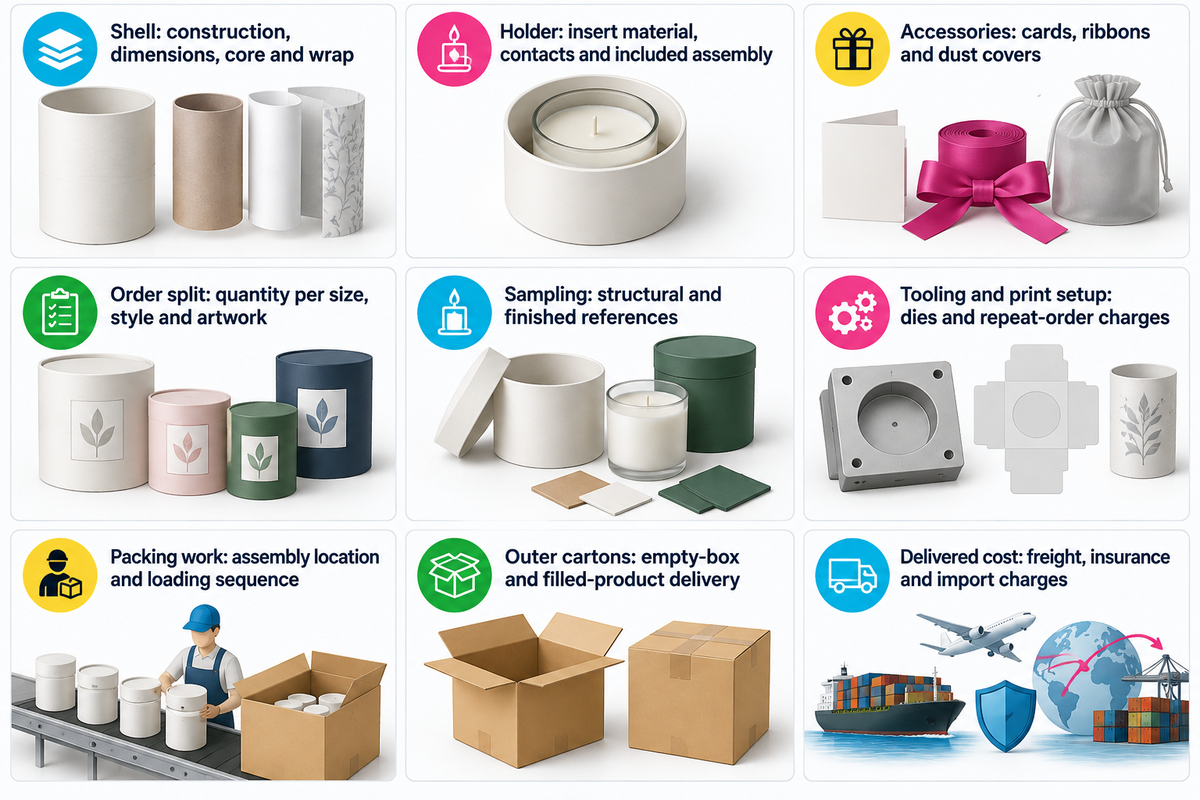
Total cost of the package depends on what’s included in the quote, how the package is put together, and how quantities are split. When assessing a unit price, compare identical boxes, holders, and artwork for the same destination. A cheaper empty shell may mean you’ll have to source components yourself.
When getting quotes for custom candle boxes at wholesale, get both suppliers to price the same approved specification. A price for stock gift packaging is different from one for custom rigid candle boxes; wholesale prices need a matching scope.
| Cost category | Record for each quotation | Decision affected |
|---|---|---|
| Shell | Construction, dimensions, core and wrap | Match the physical product |
| Holder | Insert material, contacts and included assembly | Compare complete product support |
| Accessories | Cards, ribbons and dust covers | Identify separate purchases |
| Order split | Quantity per size, style and artwork | Allocate setup to the actual versions |
| Sampling | Structural and finished references included | Budget the approval route |
| Tooling and print setup | Dies, print versions and repeat-order charges | Separate launch and repeat costs |
| Packing work | Assembly location and loading sequence | Account for work at your facility |
| Outer cartons | Empty-box delivery and filled-product shipping packs | Keep the two delivery objects distinct |
| Delivered cost | Freight, insurance and applicable import charges | Compare the same arrival destination |
The landed cost guide from the US International Trade Administration includes product price, insurance, freight, tariffs, taxes and other fees. The article from the Paperboard Packaging Council also distinguishes preassembled rigid packaging from flat folding cartons, making empty-pack volume a relevant input.
The best packaging choice for a growing candle business with little time available for assembly may be an assembled design. A repeat program with ample labor and limited empty storage may assess a flat design differently. Who does each operation? Compare the cost of using the custom box with the cost of buying it. Include luxury candle boxes in that operational comparison rather than treating appearance as the only input.
Plan Candle Shipping Boxes as a System
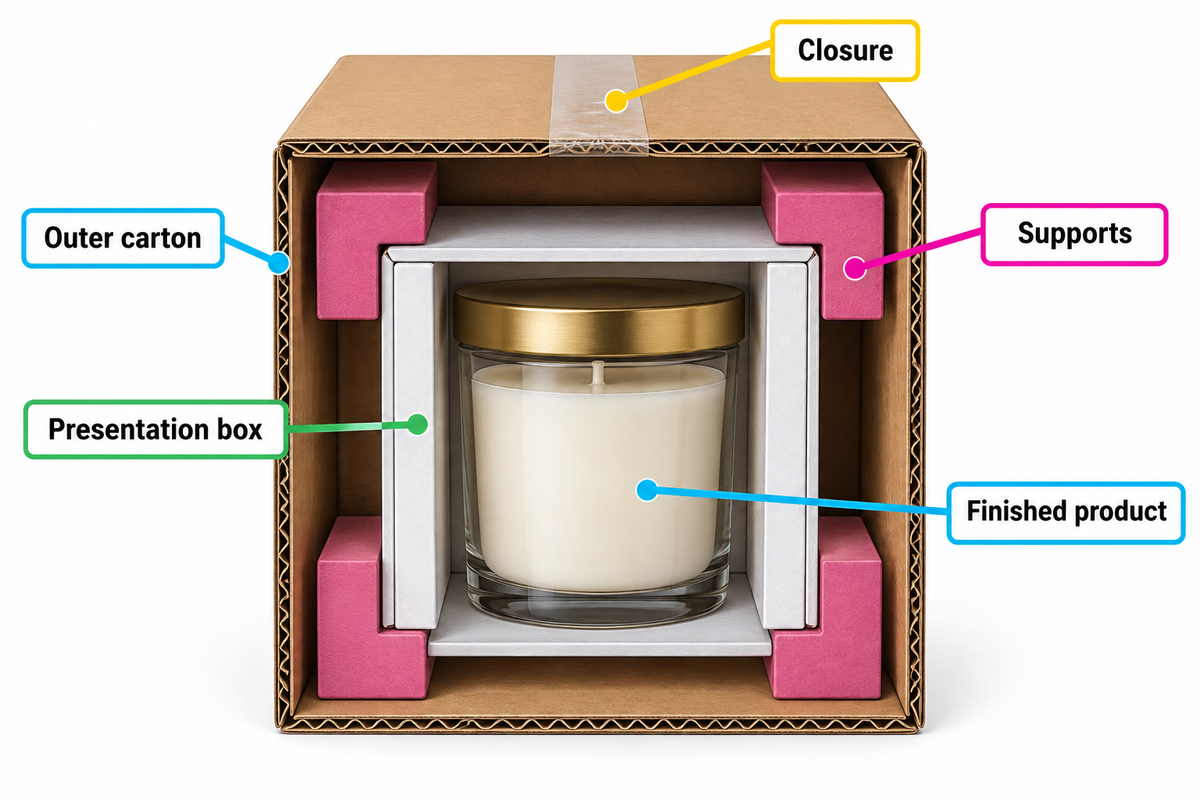
Candle shipping boxes should be designed around the complete parcel: finished product, presentation box, supports, outer carton and closure. The retail box may remain part of that system. The retail box, however, does not represent the performance of the complete parcel. Define the routes and the actual order configurations before choosing protective packaging.
Will rigid candle boxes protect my product during shipping and display?
Partly: the rigid shell encloses and presents the candle, but shipping performance comes from the entire loaded pack. The jar, holder, outer carton, cushioning and closure need to work in harmony to support shipping performance for the intended route. Judge shipping performance on that complete configuration, not on a premium finish or magnetic lid.
ISTA’s design guidance links distribution hazards and product vulnerabilities and states that parcel orientation is not assured. Retail packaging shipped in a divided wholesale case is a different configuration from the same unit sent solo to a home.
For a seasonal set, single-jar orders and mixed gift orders need to be mapped separately. A larger shipping carton does not automatically secure a smaller assortment. Check where each item is held, what separates glass surfaces and what keeps the presentation box from rubbing against the surrounding materials.
Compare the intended corrugated mailer construction with the retail unit already inside it. Bulk packaging for incoming empty boxes and product packaging for outgoing packed orders need their own packing drawings.
Check Fit, Finish and the Complete Packed Product
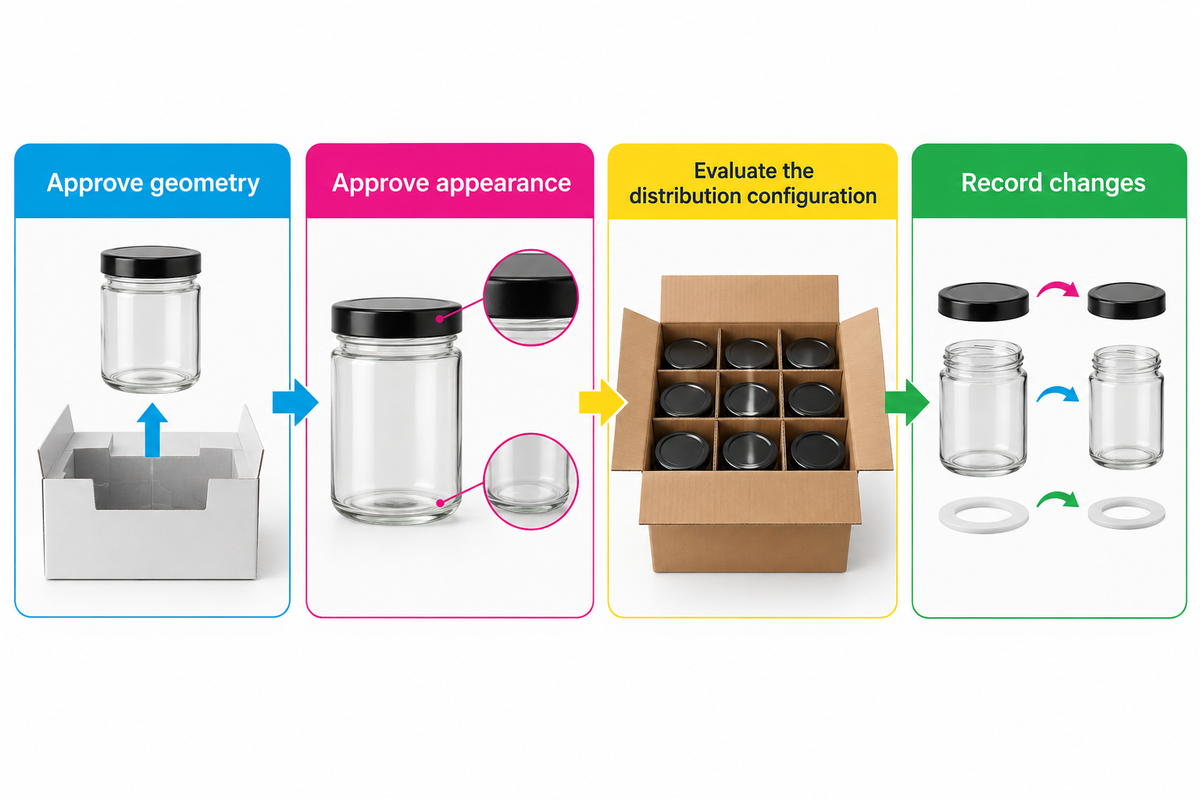
Approve geometry, appearance and distribution performance separately, as they address different needs. Finished samples can illustrate appearance, while representative loaded samples support distribution evaluation. Keep the reason for the checks, approved configuration and other relevant details, in the order record.
“Both products and packages should be as close as possible to actual production items.”
- Approve geometry. Load the jar, close the pack, open it and remove the product; inspect the lid, label and holder contacts.
- Approve appearance. Compare the actual wrap, print, foil, coating and visible product information with the agreed reference.
- Evaluate the distribution configuration. Use representative filled products and the intended complete packaging arrangement with an appropriate test plan.
- Record changes. Identify any different jar, lid, insert, material or assembly process before repeating the order.
Engineering note: define the conditions before comparing samples.
ASTM D4332-22 explains why temperature and relative humidity affect meaningful, reproducible measurements of packaging materials, especially cellulosic materials. Record the agreed conditioning and fit tolerance with the sample; the standard does not supply a universal jar-to-insert clearance.
Don’t open a certification test package to check the jar mid-sequence. ISTA’s guidance distinguishes investigation with intermediate inspections from a complete certification test; a gentle movement check at the packing bench is useful for development but is not a substitute for the selected procedure.
For reorders, ISTA’s retest guidance addresses product, package and process changes that can affect performance. A replacement lid or insert stock deserves a recorded assessment even when the outside artwork stays unchanged.
Turn the Decisions into a Candle Packaging Brief
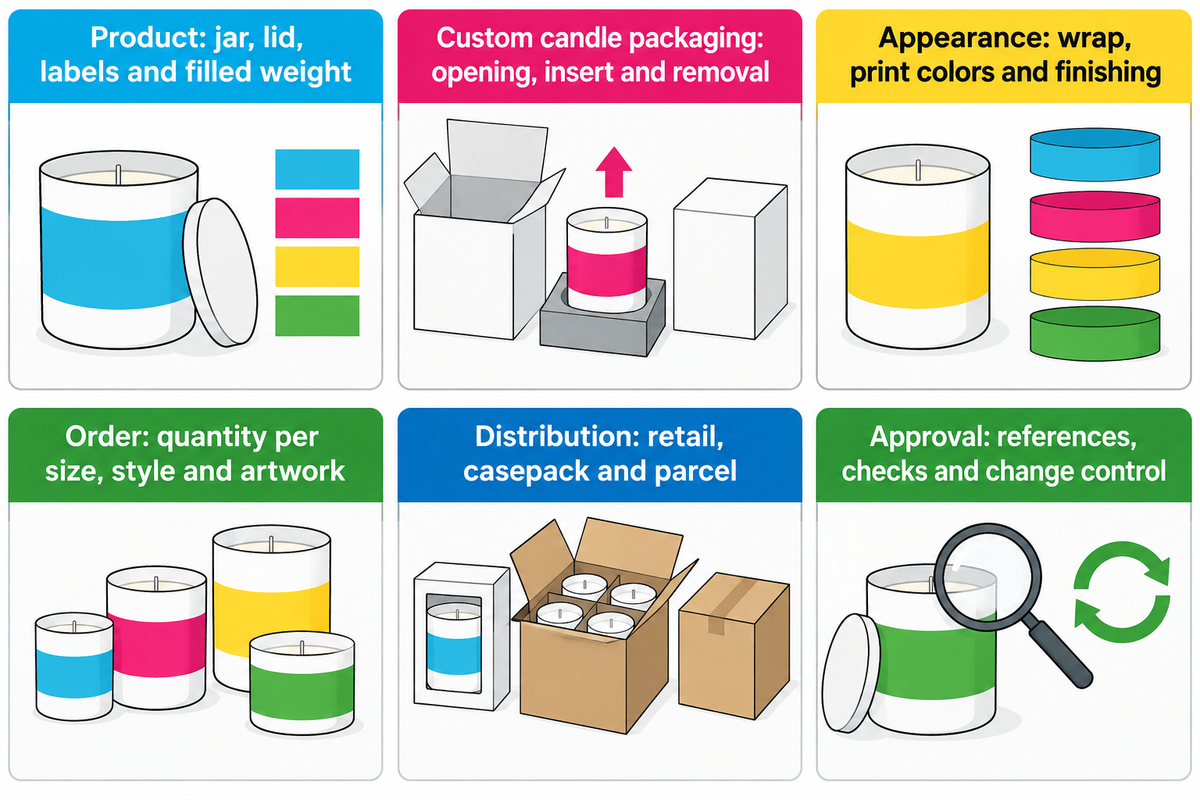
A useful brief gives a supplier the information required to propose a packaging solution without guessing. Include the finished candle product, sales channel, component list, quantity split and approval route. Keep required delivery dates separate from production estimates, and name the person responsible for approving product information and artwork.
- Product: jar drawing or samples, selected lid, labels and filled weight.
- Custom candle packaging: opening style, empty-pack configuration, insert contacts and removal feature.
- Appearance: wrap, print colors, finishing and approved candle box design.
- Order: quantity per size, style and artwork; included packaging products and accessories.
- Distribution: retail unit, casepack and parcel arrangements, with destination and arrival deadline.
- Approval: structural and finished references, agreed checks, product information and change control.
Our own Huandao plant in Xiamen has 133 staff. Within Huan Yin Packaging Group, inner trays, inserts, and outer shipping cartons can be coordinated with the printed box and consolidated into one shipment. A shared shipment is something we can quote, rather than a promised freight saving for every order.
For orders destined to the EU, the European Commission has set 12 August 2026 as the application date for the Packaging and Packaging Waste Regulation. Identify the applicable requirements for the destination before fixing the specification; that date does not make every later provision a present requirement for every candle pack.
With those inputs assembled, compare our Custom candle rigid box options against your final product, based on your opening preference and your distribution plan.
Frequently Asked Questions
Can I order a sample of my custom rigid candle box before full production?
Yes; agree on the structural and finished samples needed for your specification.
Start with the finished jar, its selected lid and the production label. A structural sample should let you check loading, closure, removal and contact with the holder. Then approve the chosen wrap, printing and finish on an appropriate physical reference. A digital proof answers artwork questions; it cannot demonstrate the assembled fit or replace evaluation of the complete shipping configuration.
What is the minimum order quantity for custom candle boxes?
Huandao’s standard is 1,000 pieces per size and style; other suppliers set their own minimums.
Huandao’s current candle rigid box solution states a standard minimum of 1,000 pieces per size and style, with smaller runs quoted case by case. Confirm how multiple artwork versions are counted before comparing a total across quotations. Ask whether the quoted minimum applies to the shell alone or includes the fitted insert and other custom packaging boxes needed for the order.
Do bulk orders reduce the cost of candle boxes?
Usually yes per box, as long as the specification stays the same.
Setup and tooling can be allocated across more units, but material, finishing, inserts, packing work and freight still contribute to the complete pack. Compare the same construction and version split rather than assuming every larger combined order is equivalent. For a wholesale candle program, record repeat-order charges separately from launch costs so the next quotation can be compared on the same basis.
Can I add my logo and branding to the candle boxes?
Yes; place the approved branding on the supplier’s confirmed dieline.
Keep artwork away from folds and cut edges, and approve the actual wrap and finish. Premium custom candle boxes still need readable scent names and product information; foil or embossing should support that hierarchy.
Are custom candle boxes eco-friendly and recyclable?
Partly: the paper-covered board shell can go into paper recycling where boxboard is accepted, as it is in Palm Beach County’s yellow recycling bin; other components may need separate handling.
A paper-covered board shell, plastic film, magnets, ribbons and an insert may need different handling. Specify the actual components and how they separate before making a disposal claim. Check that local collection accepts the finished mixed-material pack, not only that the board is recycled. For sustainable packaging goals, compare removable paper supports and fewer attachments, then check local collection guidance. Make the claim about the verified configuration, rather than assuming all cardboard boxes for candles have the same end-of-life route.
How long does it take to receive custom candle boxes?
As a reference, one rigid-box maker publishes as little as 5–7 days for sampling and 20–25 days of bulk production after sample approval, plus about 20–30 days by sea or 7–10 days by air.
Ask for dates for your specification, rather than borrowing a generic lead time. Keep artwork approval, sample approval and warehouse arrival separate. New inserts or changed finishes can add development work before production begins.
Can I reorder the same custom box design later with consistency?
Use the approved specification and physical references, and identify any component changes.
Keep the dieline, material specification, artwork version and signed samples with the order record. Confirm that the jar, lid, labels and insert remain the same, since a visually similar vessel can need another fit check. Record replacement papers, coatings or packing arrangements before repeating production. When a change could affect performance, decide whether fit or distribution evaluation needs to be repeated. This gives candle makers a clearer basis for consistency than a previous order number and a photograph alone.
Build the sample around your finished candle
Bring the jar, lid, artwork versions and intended sales channel to the discussion. Huandao can review the construction, insert and outer-pack requirements together, so the sample answers your actual packaging needs. Start with the finished product and the approval questions, then compare the proposed pack against that brief.
References & Sources
- Rigid Box Industry Terminology — Paperboard Packaging Council.
- Boxing champ — Mark Spaulding, Packaging Digest, 2014.
- Getting Started with Design & Testing — International Safe Transit Association.
- ASTM D5264-98(2019): Abrasion Resistance of Printed Materials — ASTM International, public scope and significance.
- ASTM F2058-07(2021): Candle Fire Safety Labeling — ASTM International, public abstract.
- Candles Business Guidance — US Consumer Product Safety Commission.
- Determine Total Export Price — US International Trade Administration.
- Loyalty, Luxury and Limited Editions: The Resilient Rigid Box — Paperboard Packaging Council, Packaging Strategies, 2014.
- ASTM D4332-22: Conditioning Containers, Packages, or Packaging Components for Testing — ASTM International, public scope and significance.
- When should a packaged-product be retested? — International Safe Transit Association.
- Packaging waste: regulation status and application date — European Commission.
HUANDAO PACKAGING INSIGHTS
About Huandao Packaging Insights
Huandao Packaging manufactures folding cartons, litho-laminated printed boxes and rigid gift boxes, and also supplies paper bags, retail displays and protective inserts.
Our guides help buyers compare packaging options and prepare a clearer brief before requesting a quote.
Packaging families
Board, print and finish
Artwork, dieline and sample review
Delivery planning
PROJECT DISCUSSION
Talk with the Huandao Team
- Company
- Xiamen Huandao Packaging Technology Co., Ltd.
- Quote input
- Dimensions, filled weight, quantity, artwork or dieline, finish and destination.
- Review scope
- Box, insert and delivery requirements.
- Next step
- Bring the available details to a packaging conversation.