Get in Touch with Xiamen Huandao Packaging Technology Co., Ltd.

Custom Printed Mailer Boxes: A Practical Buyer Guide

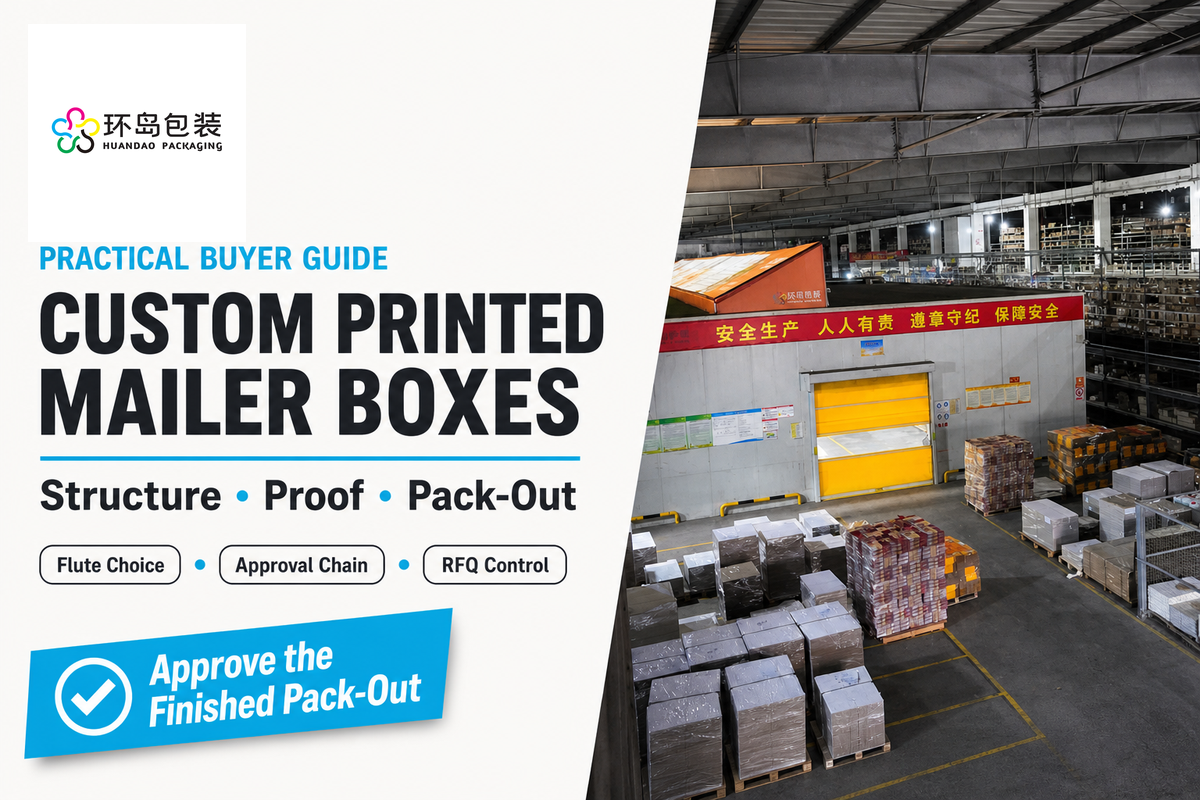
Specification and approval guide
Custom printed mailer boxes are a specialized form of die-cut corrugated packs. The board, flute, dimensions, closure, graphics, finish and internal restraint must all function as a unified system. Logos, flute names and board strength values don’t prove that a filled pack will survive its intended distribution path. The mailer pack should be treated as a finished pack-out, not as a decorated shell.
Direct Answer: approve actual construction and artwork, test a production-like filled pack, and bind the drawing, proof, sample and results to the same job revision before mass production. The Flute-Finish Risk Grid, the 6-Surface mailer Control Map and the 5-Gate Mailer Approval Chain, below, transform this rule into a buyer-ready process.
Use this guide whether you’re specifying e-commerce packaging, a subscription box, a retail gift box, or a product launch kit. Buyers requesting a bid to order custom mailer boxes should consult this guide first. This is NOT a mailing boxes Directory or a supposition that all corrugated boxes exhibit the same characteristics.
This guide provides an understanding of what’s decided, what remains undecided and what evidence must be presented following the full order for each decision made for e-commerce mailer boxes, including mailer boxes for your e-commerce operation. The same is true for custom packaging developed for retail or subscription use.
What Custom Printed Mailer Boxes Are, and What They Do Not Prove
Answer:
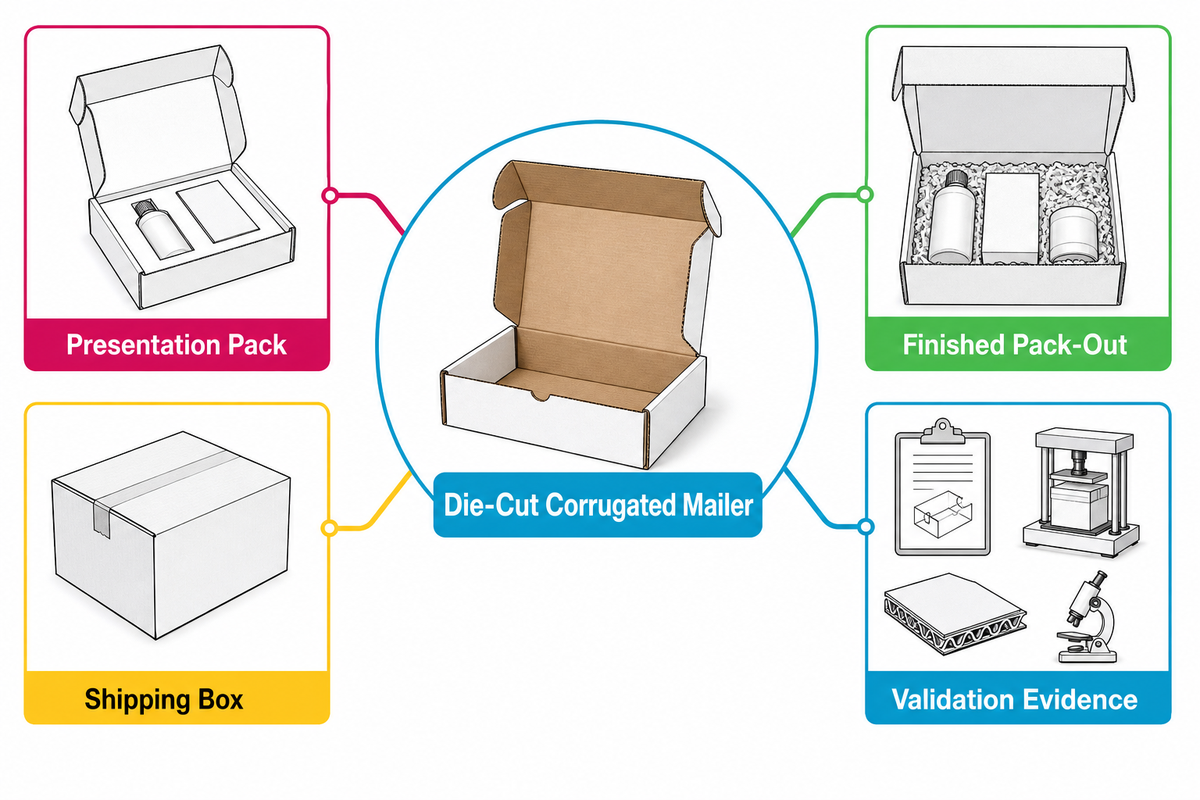
A mailer box is usually a die-cut and creased corrugated box that folds into a self-closing pack. The style name is not a shipping-performance grade. Direct-shipping suitability depends on the corrugated cardboard combination, finished box size, product fit, closure, inserts, handling route and validation evidence.
What is a mailer box?
A mailer is a die-cut cardboard box that usually opens with a hinged lid and closes with tabs or locks. It can act as branded packaging, a presentation pack or a shipping box. The intended role must be declared because a presentation mailer placed inside an outer carton faces different hazards from one sent through a parcel network by itself.
Folding cartons belong to a different family of styles. Use the custom printed folding carton guide to compare their specification path, or review Huandao’s folding-carton production option if that’s deemed more appropriate by the buyer. Moving to the corrugated format, buyers interested in custom printed mailer box manufacturing options can review the evidence required prior to that commercial handoff.
10-Use-Case Mailer Type Matrix
| Use case | Likely pack role | Main failure risk | Validation need |
|---|---|---|---|
| Clothing | Direct mailer or inner presentation pack | Excess space, moisture or corner collapse | Filled fit, closure and route check |
| Cosmetics | Mailer plus fitted insert | Movement, scuffing and component contact | Product orientation and insert sample |
| Books | Compact direct-ship pack | Edge impact and panel bowing | Loaded drop and compression sequence |
| Electronics | Mailer, restraint and sometimes outer carton | Shock, abrasion and accessory movement | Representative complete pack-out |
| Subscription kits | Branded recurring pack | Changing contents invalidate the fit | Worst-case SKU configuration |
| Glass or ceramics | Protected inner pack or qualified direct shipper | Breakage from impact and voids | Product-specific cushioning and transit test |
| Food-contact item | Secondary pack unless suitability is documented | Incorrect material or claim scope | Construction and intended-contact review |
| Heavy parts | Often a reinforced pack or outer shipper | Lock release, puncture and bottom failure | Load-path and handling validation |
| Damp route | Route-dependent system | Loss of board performance or print rub | Conditioning and route-specific review |
| Multi-component kit | Mailer with zoned insert | Part collision and packing error | Assembly trial and component count |
A custom box may look suitable in a 3D design or online design tool while leaving the route, closure and internal load unresolved. The correct box styles are those that match the use case and can be supported by the agreed evidence.
Don’t combine the responsibilities of mailer and shipping boxes when the boxes are used at different stages of distribution. Ask for a sample mailer box to check fit and review the look of your custom graphics before calling the style approved. The sample is a mailer box to check against the drawing, not a substitute for the drawing.
Can a Mailer Box Ship Without an Outer Carton?
A supplier weight limit, flute name or edge-crush result is not a universal approval. ISTA treats its procedures as tests of identified packaged products, not empty blanks.
ISTA describes 3A as a general simulation for individual packaged-products moving through a parcel system at up to 150 lb / 70 kg.
Worked Example – Launch Kit Alpha: This illustrative example measures 210 × 140 × 55 mm and weighs 650 g. Those invented values are used only to show how the same pack record moves through structural, board and pack-out decisions; they are not Huandao limits or recommendations.
Are mailer boxes safe to ship?
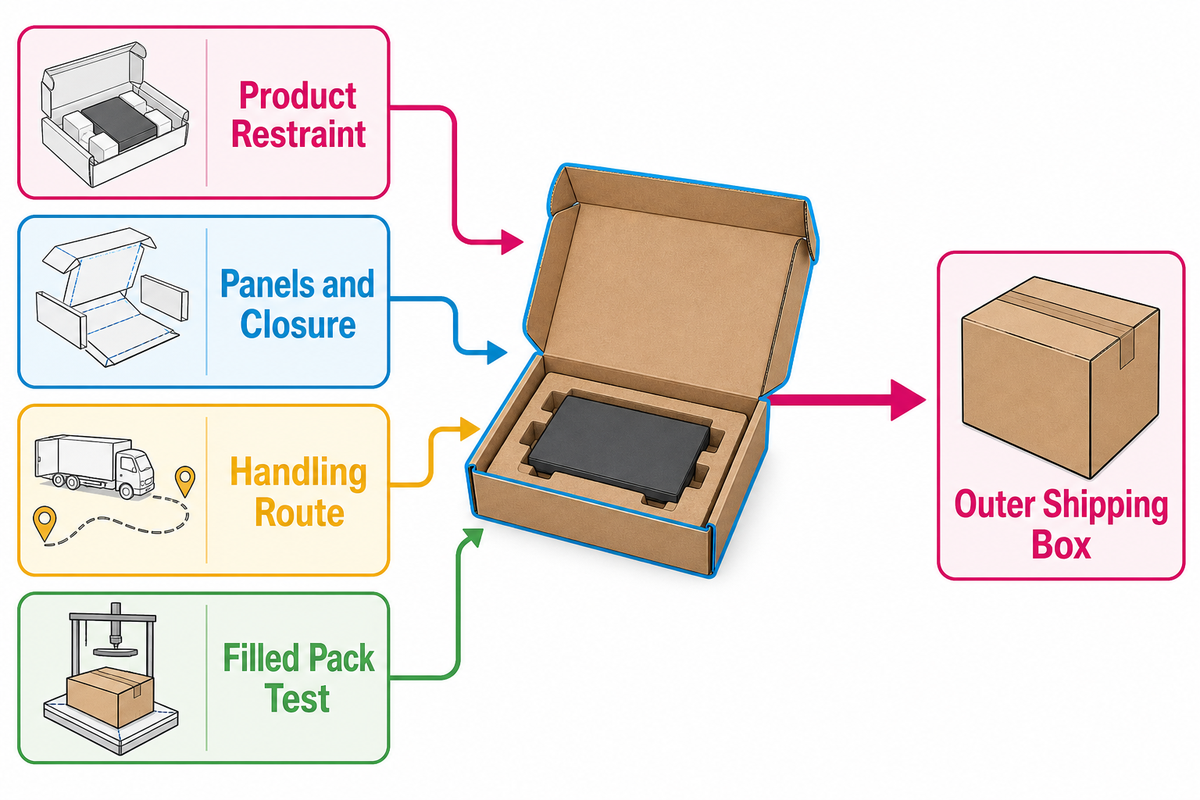
Yes, when the product is restrained, the panels and closure suit the packed load, and the test matches the route. They aren’t automatically safe just because mailer boxes are made of corrugated fiberboard. Whether you’re shipping apparel or fragile electronics, examine the same six decisions:
- Fragility: identify what damage means for the actual product.
- Packed mass: note the total packed weight and how that weight is distributed.
- Panel span: note broad, unsupported areas and cut-outs and weak orientations.
- Closure: check locks, tabs, tape or other controls to prevent tampering and/or opening.
- Restraint: confirm an insert or wrap prevents damaging movement.
- Route: validate the final pack under the relevant handling sequence.
| Direct-ship signal | Add an outer shipping box when… |
|---|---|
| Product is stable in its approved orientation | Loose parts can strike one another or the walls |
| Locks remain closed in representative handling | A tab can release, snag or expose the product |
| Panels retain shape under the defined load | Large spans bow, buckle or crush in the tested setup |
| Graphics tolerate expected contact | Scuffing or moisture would make the presentation unacceptable |
| The filled pack passes the selected route check | The route changes or a critical component changes after the test |
| Label and closure areas remain usable | Seals, labels or barcodes cross unstable folds or openings |
Note all post test changes. A new product weight, insert, adhesive, lock, board combination or box dimension can change the load path. Confirm how boxes are packed for the test and how they’re closed. The evidence applies to the tested configuration, not automatically to smaller boxes, a revised product configuration, or future revisions.
E-Flute vs B-Flute: Match the Board to the Risk
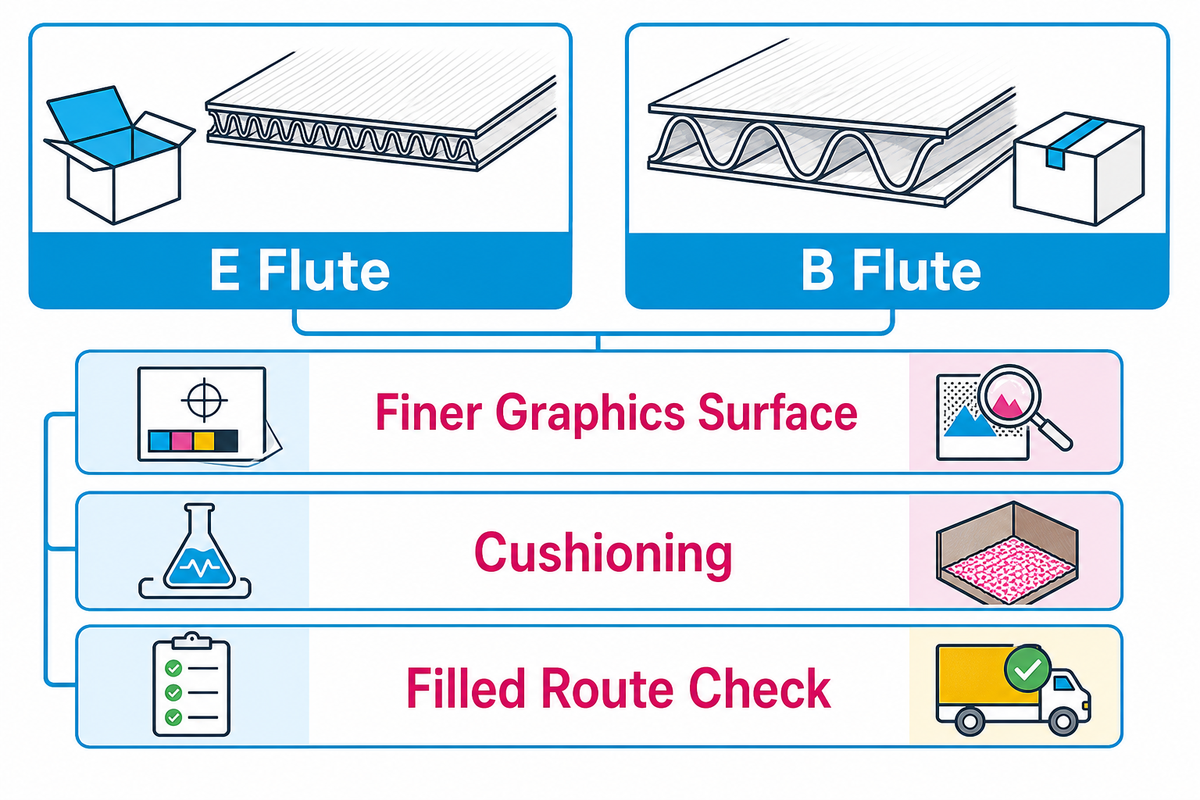
Answer: Incorporation of E flute largely occurs where compactness and finer graphics surface are of importance; incorporation of B flute occurs where more depth of flute and cushioning is of benefit. Neither is a sole strength grade. Liner and Medium combination, dimensions, score quality, humidity, finish, product load and geometry are a few factors which affect the final result.
A supplier reference places E flute at approximately 1–1.5 mm and about 90 flutes per foot, with B flute around 3 mm and 47 flutes per foot. These are nominal profile references, not drawing tolerances or pass/fail limits. The Fibre Box Association likewise treats flute profiles as families with different tendencies rather than a universal ranking.
Flute-Finish Risk Grid
| Product / route | Starting profile | Graphics / finish | Insert cue | Risk to check | Release evidence |
|---|---|---|---|---|---|
| Folded apparel, short parcel route | E candidate | High-detail exterior print | Usually low restraint | Corner and closure deformation | Filled handling sample |
| Cosmetic set | E or B candidate | Fine colour and coating | Zoned tray likely | Part contact and finish rub | Pack-out plus rub review |
| Single hardback book | B candidate | Moderate coverage | Edge pad if needed | Edge impact and lid bow | Route-representative test |
| Small electronics kit | B candidate | Exterior brand panel | Required for accessories | Shock and movement | Complete packed test |
| Subscription samples | E candidate | Inside and outside print | Content-dependent | SKU variation | Worst-case kit sample |
| Glass bottle | B or engineered alternative | Print secondary to protection | Cushioning essential | Breakage and neck impact | Product-specific validation |
| Dense metal component | B or double-wall study | Limited finish | Load-spreading insert | Puncture and lock release | Loaded handling sequence |
| Damp distribution route | Construction-specific | Coating must be reviewed | Product-dependent | Moisture and delamination | Conditioned sample |
| Retail gift presentation | E candidate | Fine graphics and tactile finish | Presentation tray | Crease cracking and scuffing | Finished appearance sample |
| Multi-unit case pack | System-specific | Outer brand priority varies | Shared divider or tray | Case compression and count | Mailer-plus-case test |
Huandao states that its in-line corrugator supplies single E-flute and single B-flute board just in time with zero stock, while A, C, F, BC and other profiles are made from sourced board. This describes a production route, not proof that E or B flute fits a given package.
Example 1: an apparel subscription box with custom dimensions may start with E flute because print quality and compactness are of importance. It may move to B flute if the packed sample shows excessive panel deflection. Example 2: A coated cosmetic mailer may retain E flute but add a tray since thicker board may not solve component-to-component contact. Decisions are based on failure mode and not on the grade stated on the package.
Launch Kit Alpha: the illustrative comparison records an E-flute sample at 1.4 mm nominal profile and a B-flute alternative at 3.0 mm. The buyer would release neither value by itself; fit, closure, print and the filled route check decide which sample survives.
Choose the Print Process Before You Approve the Artwork
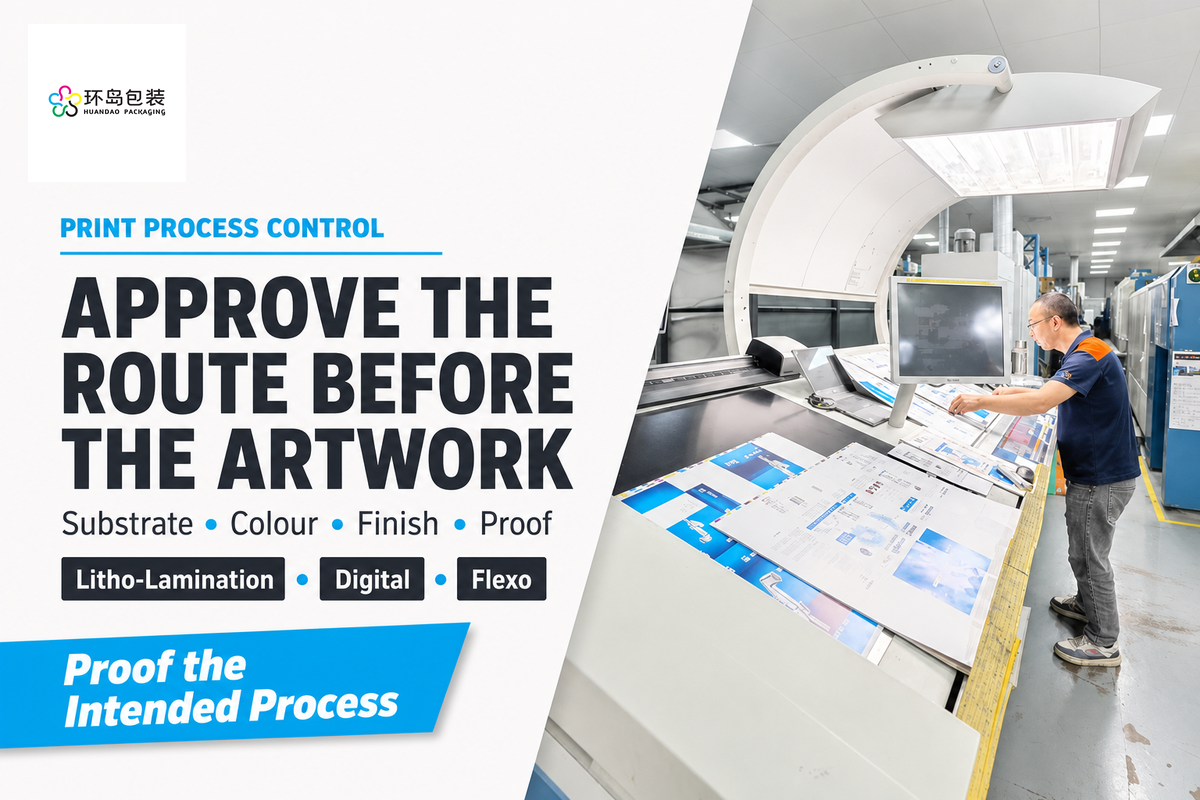
Answer: Decide on offset litho-lamination, direct digital printing or direct flexographic printing based on the number of times repeated per artwork, version count, color target, surface area, substrate, finish, proof requirement and expected changes. There’s no order size at which one option always becomes cheaper.
| Process | Setup behaviour | Useful fit | Control points | Proof question |
|---|---|---|---|---|
| Litho-lamination | Printed sheet is produced, finished and laminated to corrugated board | Detailed graphics, defined finishes and repeat runs | Sheet colour, lamination, register, crease and surface rub | Does the proof represent paper, coating and final converting? |
| Direct digital | Lower plate exposure and flexible versioning | Multiple artworks, changes or shorter repeated quantities | Substrate interaction, colour consistency, banding and finish compatibility | Is the sample from the intended device and board? |
| Direct flexo | Plate and ink setup support efficient repeated graphics | Simpler artwork and production volumes that justify setup | Plate, anilox, ink, substrate and registration | Which colour and detail limits apply to this artwork? |
Huandao reports in-house pre-press, sheet-fed offset printing, UV coating, lamination, and die-cutting and folder-gluing. That process chain can support printed boxes via an offset and litho-laminated route; it can’t set a universal crossover point against digital or flexo work.
Can I print on both the inside and outside of a mailer box?
Yes, if the chosen construction and supplier support it. Inside-the-box graphics can lead to contact, registration, score and rub issues; Outside-the-box graphics can lead to handling and placement issues of labels on the outside of the box. Put both print surfaces in the quote, artwork layers and proof scope, instead of assuming that one print specification covers both.
To create custom graphics without losing control, one should set the production route before the final design process. Teams can create a custom colour target, but they should not customize a proof requirement away when boxes are printed on a different substrate or device.
A print-process decision is complete only when the artwork count, colour target, substrate, finish and proof route are named together.
Build the 6-Surface Mailer Control Map
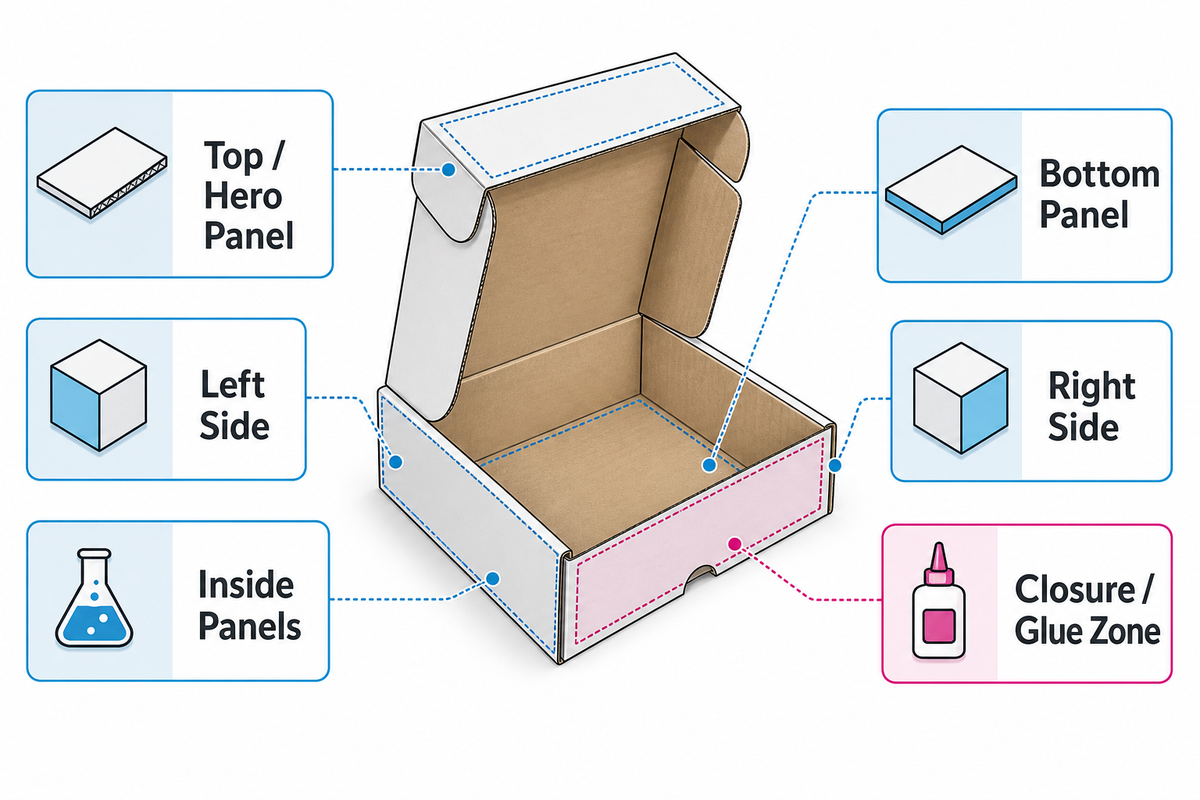
Answer: Control the top, bottom, two sides, inside and closure or glue areas as a single file set. A custom design that appears correct on a flat screen can rotate across a side panel, cross a score, hide a QR code or put coating in a lock. The dieline, 3D design and a physical sample answer different questions.
6-Surface Mailer Control Map
| Control | What to mark | What to inspect |
|---|---|---|
| Top / hero panel | Logo, message, orientation and label exclusion zone | Reading direction after assembly |
| Bottom panel | Required marks, seam and abrasion exposure | Contact rub and legibility |
| Left side | Artwork direction, score and tab intersections | Rotation and crease cracking |
| Right side | Barcode or QR code quiet area | Scan condition on the formed box |
| Inside panels | Message, ink coverage and product contact | Rub, transfer and fold visibility |
| Closure / glue zone | Locks, tabs, tape, glue and finish exclusions | Assembly and repeated opening |
| Bleed and safe area | Supplier-specific bleed and trim boundaries | No critical item enters a cut or score risk |
| Colour reference | Process build, named spot colour or approved target | Proof and production reference match |
| Finish mask | UV, film, varnish or uncoated areas | Registration, appearance and fold behaviour |
| Revision block | Dieline ID, artwork ID, date and approver | Every deliverable carries the same revision |
A hypothetical orientation error is simple: a logo placed upright on a flat side panel may appear upside down after that panel folds inward. Rotate the digital model and assemble a blank and mark the front before approving. An online design studio can preview appearance but it shouldn’t override the controlled custom dieline. A published corrugated-and-laminated-cardboard assembly record gives design context for how geometry, slots and inserted components interact; it is not proof that a particular mailer will pass distribution.
When designing your custom artwork, make the box design serve the formed structure. Once the boxes turned from flat blanks into physical samples are available, review panel direction and finish boundaries again rather than trusting the flat view.
What file formats do mailer-box suppliers accept?
Requirements are supplier-specific. A common production handoff includes a print-ready vector file from Adobe Illustrator, outlined or supplied fonts, images at requested resolution, a finish mask, and supplier’s latest dieline. Ask the pre-press team to verify accepted versions, colour settings and linked files before the order was placed.
Use the 5-Gate Mailer Approval Chain
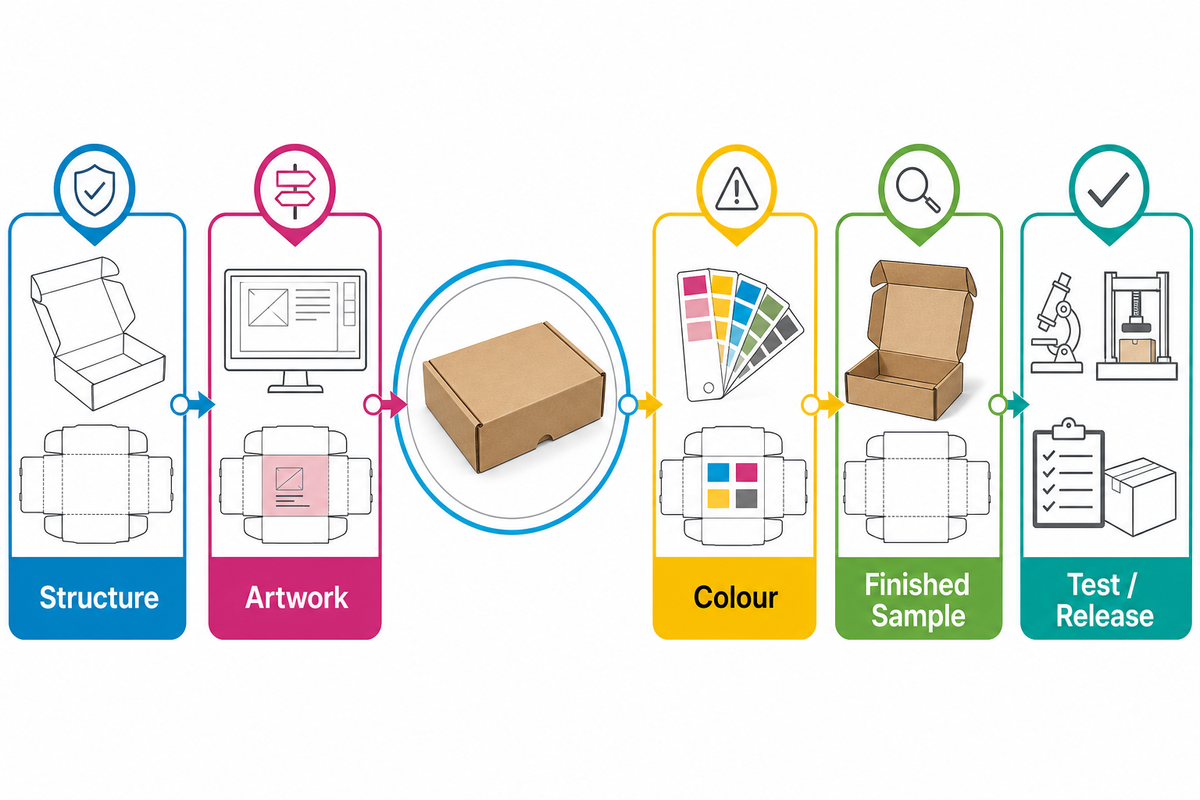
Answer: Release production only after the structure, artwork, colour target, finish sample and validation evidence all refer to the same controlled revision. One attractive custom printed sample doesn’t prove the other four. A blank proves fit differently from a digital proof. A finish sample proves appearance differently from a packed-route test.
5-Gate Mailer Approval Chain
| Gate | Deliverable / owner | It proves | It does not prove | Reject condition | Retained record |
|---|---|---|---|---|---|
| 1. Structure | Cut blank; packaging engineer | Dimensions, folds, lock and product fit | Production colour or route survival | Interference, poor fit or unstable closure | Drawing and blank ID |
| 2. Artwork | Pre-flighted file; brand and pre-press | Panel mapping, content and print readiness | Final colour or finish behaviour | Wrong dieline, missing asset or unsafe placement | Artwork revision and pre-flight report |
| 3. Colour | Agreed proof; brand owner | Defined colour target under stated conditions | Final assembly or transit performance | Unapproved deviation or ambiguous reference | Signed proof and target |
| 4. Finished sample | Representative sample; supplier and buyer | Look, fit, conversion and assembly together | Every lot or distribution route | Scuff, crack, delamination, poor lock or mismatch | Sealed sample and photos |
| 5. Test / release | Pack-out and report; quality owner | Result for the identified configuration and method | Unrecorded future changes | Missing identity, failed criterion or changed construction | Method, results and release authorization |
Can I order a sample before a bulk order?
Typically, but what sort? Blank samples verify structure; digital proofs verify content; printed mailer samples verify appearance; production-representative samples verify conversion; and a packed test verifies distribution performance. A sample box should specify one approval reason. If you can order a single sample of your custom box, say which gate it addresses prior to placing the full order.
Where boxes came from a pilot process, retain that pilot identity. When boxes arrived with defects, separate possible transit damage from print or converting defects. Don’t assume boxes are perfect because one display sample passed a visual check.
Make Every Test Report Traceable to the Production Run
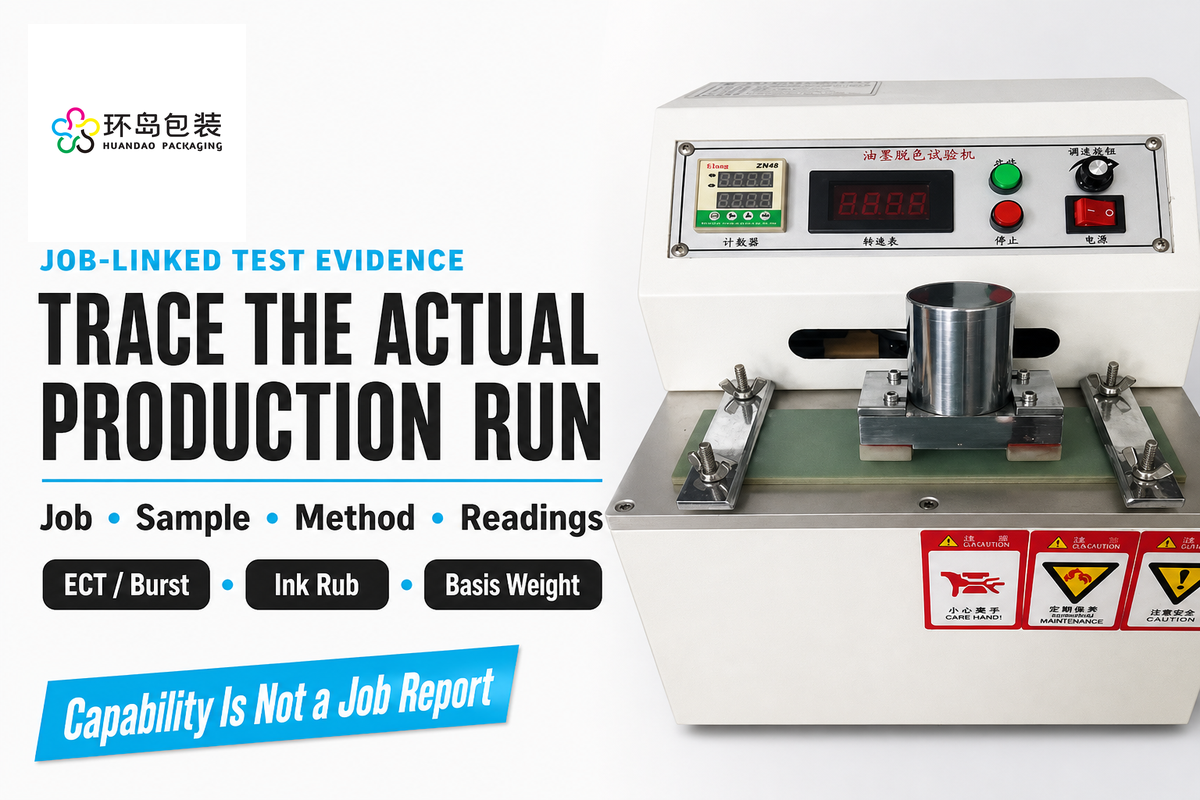
Answer: An ideal report would include the purchase order or job, production date, lot of material, identity of sample (if any), method, readings, acceptance rule, disposition, and shipment. A general laboratory certificate does little more than confirm capability. It doesn’t show that boxes, if any, were taken from the finished goods and tested, or that samples passed the tests.
TAPPI separates edge-crush, burst, basis-weight and ink-rub into different methods. Each method addresses a different question. ECT and burst shouldn’t be used interchangeably for strength labels, and neither proves finished-pack transit validation.
Production-Run Traceability Checklist
- Buyer purchase order and supplier job number.
- Approved dieline, artwork and construction revision.
- Production date, line or machine and responsible operation.
- Board, liner, medium, ink and finish lot identity where controlled.
- Sample location, quantity and sampling time.
- Test method, procedure revision and conditioning details.
- Individual readings, summary and unit of measure.
- Acceptance criterion, decision rule and pass/fail result.
- Nonconformance, rework or concession record.
- Finished quantity, case or pallet identity and shipment link.
| Record | What it can establish | What it cannot establish alone |
|---|---|---|
| Edge-crush test | Edgewise compression response of the identified board specimen under the named method | Finished-box compression or parcel survival |
| Burst test | Resistance of the identified board specimen to rupture under the named method | Stacking, closure security or cushioning |
| Ink-rub test | Print abrasion behaviour under stated pressure, strokes and conditions | Moisture resistance or total route performance |
| Basis weight | Mass per unit area for the identified material sample | Converted box performance or fibre composition |
| Packaged-product test | Response of the identified complete pack-out to the named sequence | Untested routes or later construction changes |
According to Huandao, its in-house laboratory does ECT or burst, ink-rub, and basis weight tests on customer’s production runs. It also says that every process step is scanned into MES and reported in real time with integrated, intelligent scheduling and ERP. These are capability statements by Huandao and not third-party lab accreditation. Ask for the actual job-linked report and MES identity.
NIST’s traceability guidance makes the evidence boundary useful: a measurement result is linked through documented references and applies to the identified item and time unless stated otherwise. A generic certificate can’t be stretched into proof for every order.
Engineer Inserts, Product Fit and the Outer Carton as One Pack-Out
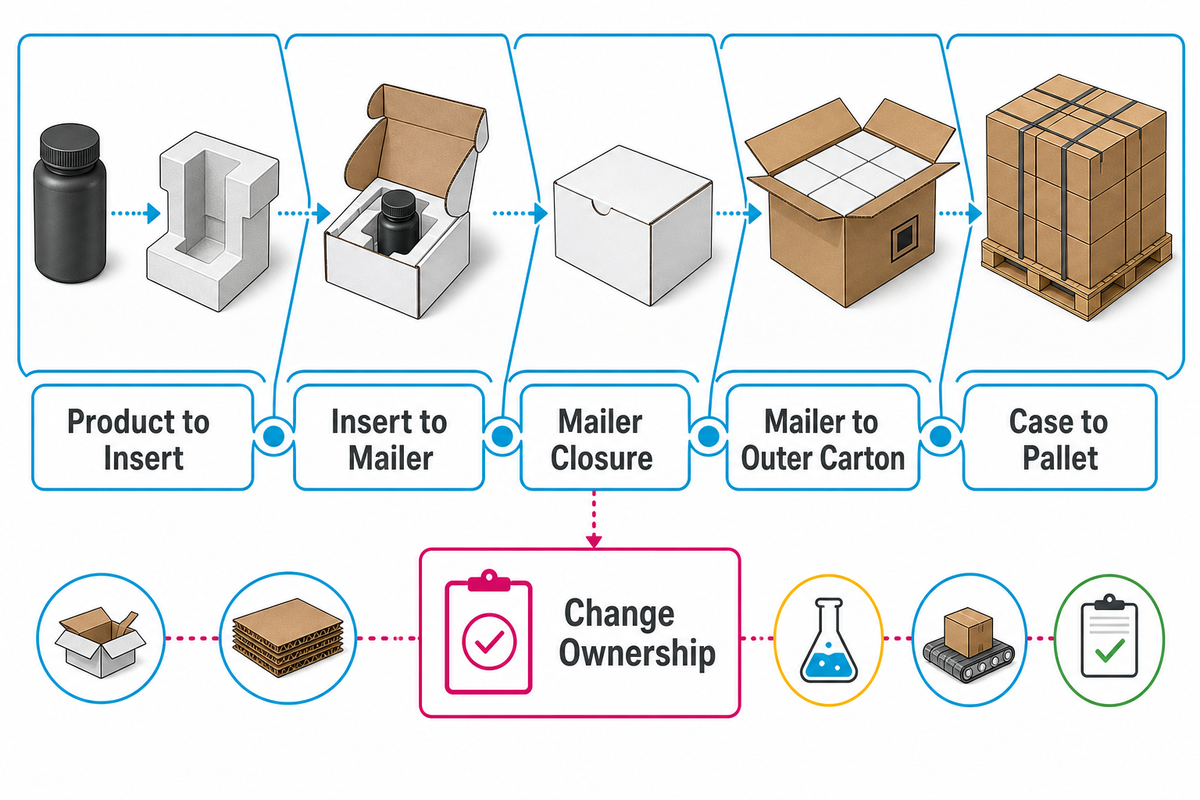
Answer: Design the mailer and insert, along with any outer cartons, from a one dimensional master. Lock product orientation, restraint, assembly owner, case count and change ownership. Own case quantities. Separate box orders often collide at the final stage of packing, as each assumes a different internal or external dimension.
| Interface | Field to lock | Failure if omitted | Evidence |
|---|---|---|---|
| Product to insert | Orientation, clearance and retention points | Movement, abrasion or hard loading | Physical pack-out sample |
| Insert to mailer | Finished internal dimensions and insertion direction | Bow, rattle or assembly delay | Approved dimensional drawing |
| Mailer closure | Opening force, tab path and product clearance | Lock release or product contact | Assembly trial |
| Mailer to outer carton | Outside dimensions, count and orientation | Crushed corners or unused void | Case-pack drawing |
| Case to pallet | Case count, pattern and overhang rule | Unstable load or compression mismatch | Pallet plan |
| Change ownership | Who updates every dependent drawing | One component changes while the others remain stale | Revision register |
According to the company brief, as part of Huan Yin Packaging Group, Huandao can supply the printed mailer with inner trays, inserts and outer shipping cartons and consolidate them into one shipment with shared freight. This could simplify interface ownership. Huandao doesn’t guarantee lower shipping costs; dimensions, case quantity, delivery basis, route and freight terms require further assessment.
As an example, with a cosmetics kit, the insert has to hold each bottle, the mailer has to close without the caps being pressed, and the master carton has to hold the agreed count without corner crush. A polished unboxing experience starts with those interfaces, not with graphics alone. The same assembly record illustrates corrugated panels and inserted laminated-cardboard pieces as one geometric system; it remains design context, not route-performance evidence.
Launch Kit Alpha: the illustrative record carries forward a target finished internal size of 222 × 152 × 65 mm, an insert clearance check at 6 mm, a 12-unit case pack measuring 480 × 330 × 290 mm, and a hypothetical gross case mass of 9.6 kg. These are formatting examples only; a supplier must calculate and validate the real pack.
Normalize the Quote Around One Finished Pack-Out
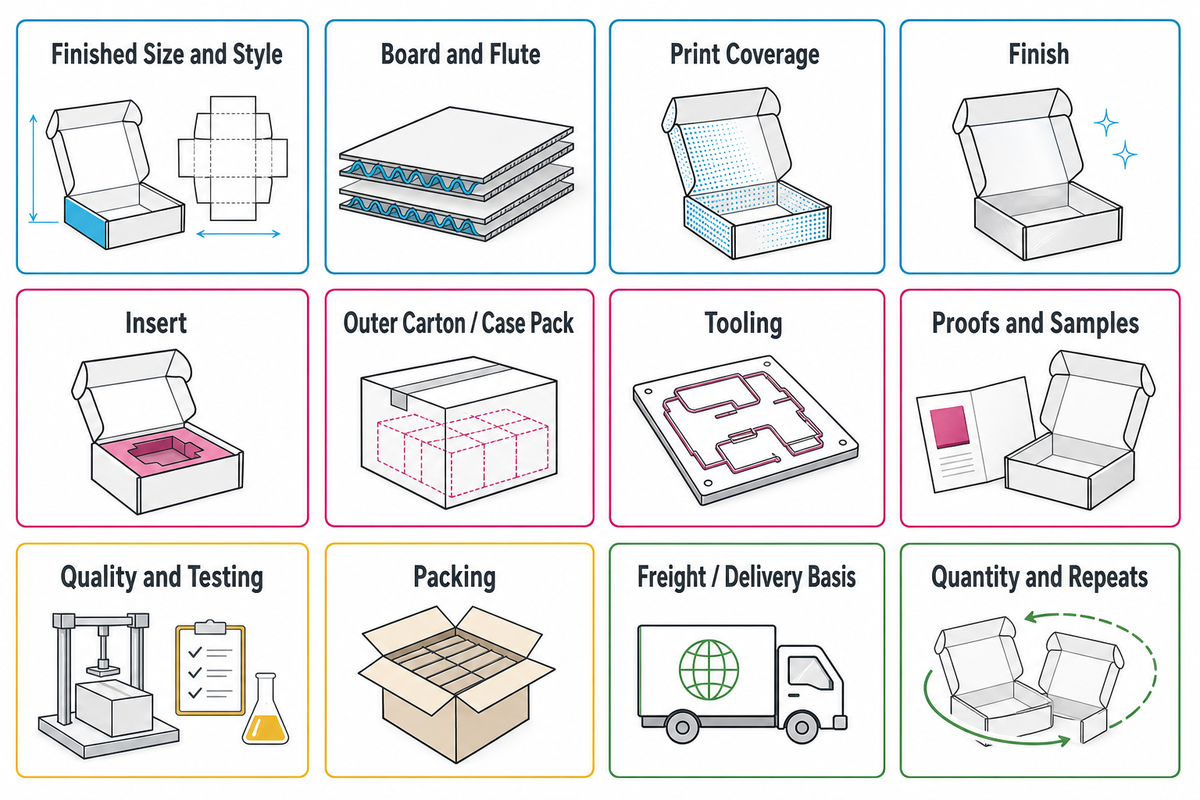
Answer: Compare quotations only after every supplier prices the same finished construction, proof scope, pack-out, quality evidence, packaging method, and freight terms. A low price per box is not comparable when tooling, inserts, samples, master cartons, delivery terms or acceptable quantity deviations differ. The NC State BioResources review of edge-compression testing methods is one reason the quality line should name the method and tested configuration rather than use a generic strength label.
12-Line Mailer Quote Normalizer
| Line | RFQ field | Comparable answer | Deviation to expose |
|---|---|---|---|
| 1 | Finished size and style | Internal dimensions, outside dimensions and dieline ID | Different convention or substitute style |
| 2 | Board and flute | Liner, medium, profile and approved alternative rule | Unnamed board substitution |
| 3 | Print coverage | Inside/outside panels, colours and artwork count | Logo-only versus full coverage |
| 4 | Finish | Coating, lamination, mask and surface | Finish excluded or changed |
| 5 | Insert | Material, cavities, fit and assembly responsibility | Insert priced separately |
| 6 | Outer carton / case pack | Case style, count, dimensions and packing orientation | No master carton or different count |
| 7 | Tooling | Die, plate and reusable-tool ownership | One-time charge omitted |
| 8 | Proofs and samples | Blank, colour proof, finished sample and packed test | Screen proof substituted for physical proof |
| 9 | Quality and testing | Methods, sampling, criteria and report deliverables | Generic certificate only |
| 10 | Packing | Flat or erected, bundle count, labels and palletization | Labour shifted to buyer |
| 11 | Freight / delivery basis | Named delivery term, destination, packaged quantity and exclusions | Freight estimate not on the same basis |
| 12 | Quantity and repeats | Order quantities, acceptable variance, repeat assumptions and validity | Minimum quantity or overrun differs |
RFQ copy block: “Quote the mailer, insert and case pack revisions shown. State one-time charges, proof level, quality records, packed quantity, acceptable delivery variance, delivery basis and every proposed deviation. Don’t substitute construction without written approval.”
Once this brief is complete, compare supplier answers against the same 12 lines.
Put all boxes and packaging components on the same comparison sheet. If alternative boxes are available, identify them as deviations instead of blending them into the base quotation.
Low minimums, an instant order online flow or a design tool can be convenient, but each option still requires an approved construction. Record the order details before every order, particularly if box dimensions, artwork count or shipping costs change.
Audit the Manufacturer Through Records, Not Machine Lists
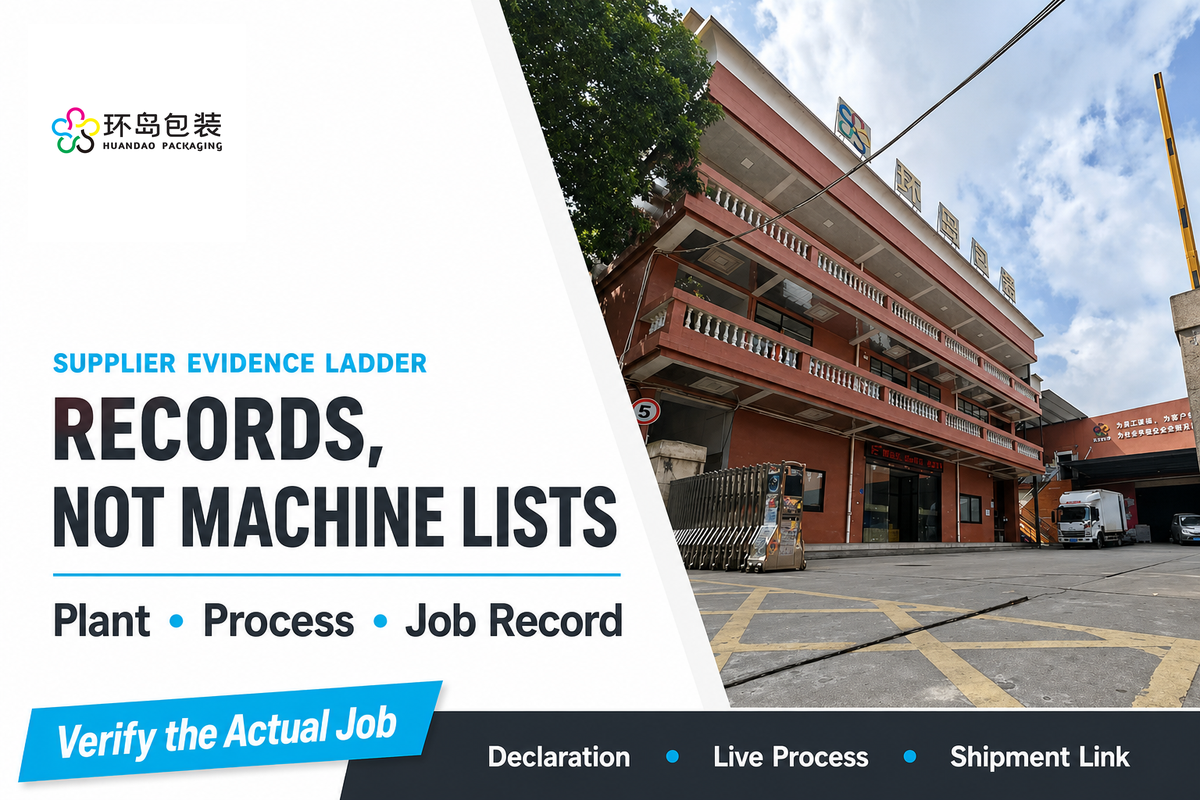
Answer: move through four pieces of evidence: declaration, representative sample, process evidence, and job-related evidence. Factory floor photos and a list of machines show potential capability. The strongest order evidence identifies the exact plant, process, job, sample, result and released shipment.
| Evidence level | Ask to see | What it supports | Remaining gap |
|---|---|---|---|
| 1. Declaration | Company profile, address, process list and broad certificates | Identity and claimed capability | No proof for this custom order |
| 2. Representative sample | Comparable printed and converted sample | Visible process potential | May be from another job or revision |
| 3. Live process evidence | Pre-press record, press controls, coating or lamination, die-cut and folder-gluer workflow | How controls operate at the stated plant | Must still connect to the order |
| 4. Job record | PO/job ID, approved files, material lots, scans, readings, disposition and shipment link | Traceability for the delivered production run | Applies only within the recorded scope |
According to Xiamen Huandao Packaging Technology Co., Ltd., it was established on 30 June 2003, in Xiamen, Fujian, with a registered capital of RMB 20 million. The company is said to be the colour-printing plant of Huan Yin Packaging Group, and has a facility at No. 587 Tongfu Road, Tong’an District, with 133 staff, and isn’t a trading office. The brief also states that the group was brought together under its current name in 2024 and has passed RMB 200 million in revenue.
The company profile reports folding-carton, litho-laminated printed-box and rigid-gift-box production; it also describes Huandao as a National High-Tech Enterprise and says the group is a President Unit of the Xiamen Printing Industry Association. Those organization, status and revenue statements are company-provided and weren’t independently audited for this article.
Huandao provided 20 unique factory images for verification showing the plant, offset printing, lamination, die-cutting, and laboratory inspection. The images show processes to a degree; however, they don’t serve as a substitute for a live job record.
For the actual job, you want to review the current dieline in pre-press, the intended sheetfed offset (or other print route) process, the coating or lamination, the die-cut and folder-glued controls, the lab record, and the MES job identity. This is how the quality of the box moves from a brand claim to an inspectable order record.
When boxes were shipped, the dispatch record should connect back to the released quantity and job. That link is more important than an assurance of similar work leaving the same plant.
Custom Printed Mailer Box FAQs
How much do custom mailer boxes cost?
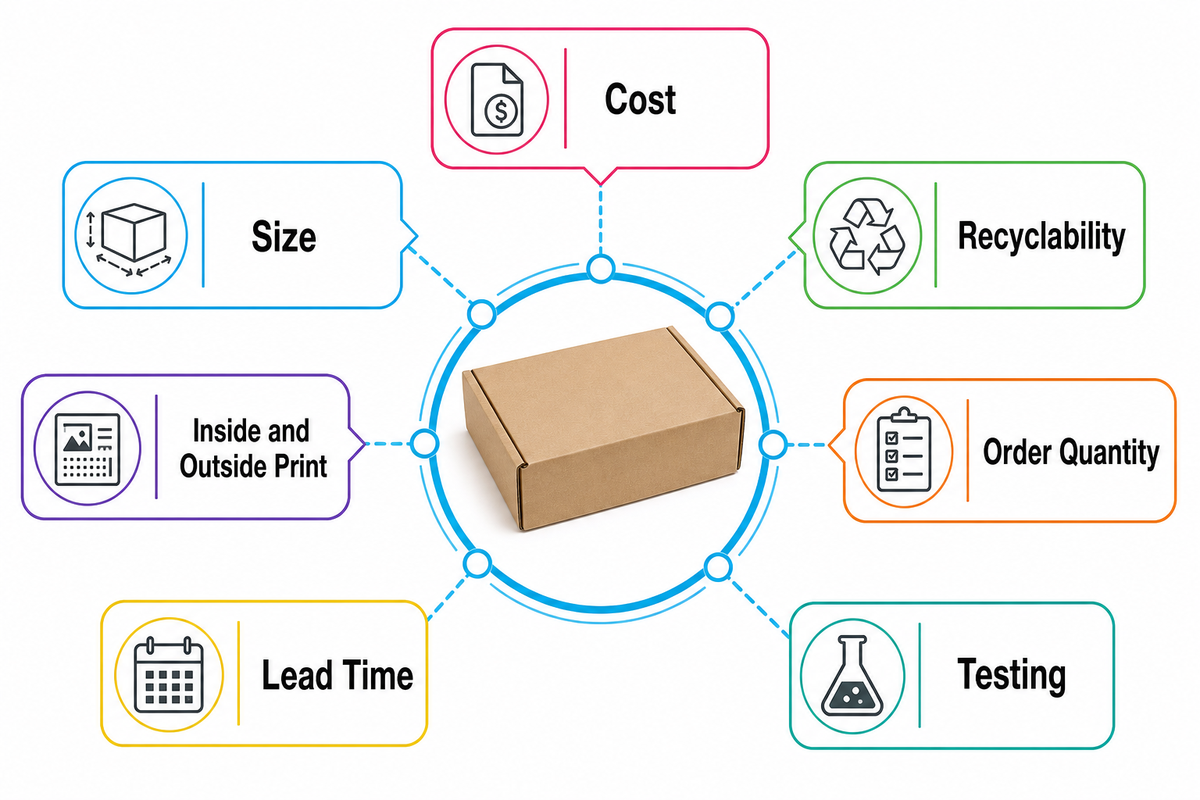
One published price guide lists corrugated mailers at about $1 to $4 per box; where an order lands is set by the finished dimensions, style, board, flute, the print process, the artwork count and coverage, finish, insert, tooling, proofs, quantity, the packing and delivery basis. Compare the same finished pack-out product via the 12-Line Mailer Quote Normalizer, and have each supplier explain deviations, one-time costs, and assumptions about repeat business.
How do I choose the right mailer-box size?
Take the maximum packed dimensions and orientation of the product, and add only the clearances needed for inserts and protection, as well as loading and unloading. Finished internal dimensions, dieline dimensions and external shipping dimensions are different. State the conventions in millimeters, build a sample to illustrate fit, and test closure before release of tooling or mass production.
Are custom printed mailer boxes recyclable?
A paper-based box may be recyclable where local collection and mills accept its complete construction. Other barriers to recyclability can include coatings, films, foils, windows, adhesives, inserts, contamination and local infrastructure. Ask for the material and the scope claim; don’t assume that because something is corrugated that it’s universally recyclable. Don’t make assumptions about certifications such as Sustainable Forestry Initiative just because the box appears to be made of fiber-based materials. The FTC Green Guides summary also says recyclable claims should be qualified when suitable recycling facilities are not available to at least 60 percent of the consumers or communities where the item is sold.
Can a mailer box be printed inside and outside?
Yes, if the selected supplier and construction support both surfaces; the brief should then identify color and finish. Inside and outside panels should also be noted as well as glue or score lines and registration. The presence of a contact-rub risk needs to be disclosed. Boxes with full color printing still need a proof, including boxes with full-color printing on exterior and interior surfaces. If the boxes look great on screen, that screen view shows appearance, not their form, fit and function or how the printed surfaces will behave during scoring, folding and gluing. Approve the dieline, colour target, finish mask and assembled sample for both print surfaces before release.
What is the minimum order quantity?
One published packaging guide compares a 50-box minimum with a 250-unit minimum that can cost much less per piece; the minimum order also varies by supplier, process, size, tooling, artwork and finish. A digital process may enable different order quantities from litho-lamination or flexo, but “order one” and “low minimums” are commercial terms, not engineering terms. Request the applicable minimum quantity for the exact custom order and ask how order size affects pricing.
How long does production take after proof approval?
One published packaging guide puts standard production at 8 to 10 business days after final design approval, with sampling, revisions and shipping adding time. Ask which event starts the clock and whether proof failure or changed order details reset it.
Should I request ECT or burst testing?
Request the method that fits the construction and decision; the tests describe various responses. Neither alone determines parcel survival. Require the supplier to state the board construction, method, sample ID, unit, acceptance criteria, and result, and pair board checks with finished-pack validation for the defined route.
Turn the Guide into a Controlled Brief
Freeze the finished pack-out, create a six-surface artwork map, assign the five approvals, and send the same 12-line request to each supplier. To have Huandao review that controlled brief, use the contact window below. A quotation should follow the decisions, not replace them. Keep the validation line equally scoped: NIST explains that traceability belongs to a measurement result, so the brief should identify the job, sample, method and reference instead of pointing to a generic certificate.
References & Sources
- Fibre Box Association, What Is Corrugated?
- International Safe Transit Association, Test Procedures
- ISTA, 3A Overview
- TAPPI, Standards Subject Index
- NC State BioResources, Corrugated Board Edge-Compression Testing Research
- NIST, Metrological Traceability
- FEFCO, Corrugated Industry Standards and Guidelines
- Packaging World, Inspection and Traceability Data
- UPS, Packaging Guidelines
- GWP Group, Corrugated Board Grade Reference
- Google Patents, Corrugated and Laminated Insert Structure (design context only)
Source note: Standards and guidance are applied only within their scope. Company facts and manufacturing capabilities are attributed to the user-supplied Huandao brief and are marked in source comments as user data.
HUANDAO PACKAGING INSIGHTS
About Huandao Packaging Insights
Huandao Packaging manufactures folding cartons, litho-laminated printed boxes and rigid gift boxes, and also supplies paper bags, retail displays and protective inserts.
Our guides help buyers compare packaging options and prepare a clearer brief before requesting a quote.
Packaging families
Board, print and finish
Artwork, dieline and sample review
Delivery planning
PROJECT DISCUSSION
Talk with the Huandao Team
- Company
- Xiamen Huandao Packaging Technology Co., Ltd.
- Quote input
- Dimensions, filled weight, quantity, artwork or dieline, finish and destination.
- Review scope
- Box, insert and delivery requirements.
- Next step
- Bring the available details to a packaging conversation.