Get in Touch with Xiamen Huandao Packaging Technology Co., Ltd.

Updated October 2026
Custom Folding Cartons are paperboard packages that have been cut, creased, and folded to a specific shape of the product. Custom boxes change the fit, opening, graphics and pack work. Start with the product and its journey. A carton, a locating insert and a parcel shipping case can have different jobs, even when they arrive together.
Custom folding cartons combine a creased paperboard structure with product-specific dimensions and print. Choose the board, closure and packing method together; use an outer shipping case when the distribution route needs it.
Quick reference
- Flat shipping also occurs with collapsible rigid boxes; construction identifies the format.
- Grammage measures mass per area. Caliper measures thickness. Stiffness also changes with fibre direction and moisture.
- A pre-glued bottom changes carton erection work; it doesn’t give every carton the same load rating.
- Compare the cost per useful packed product, including setup and assembly, before increasing an order.
What Are Custom Folding Cartons?
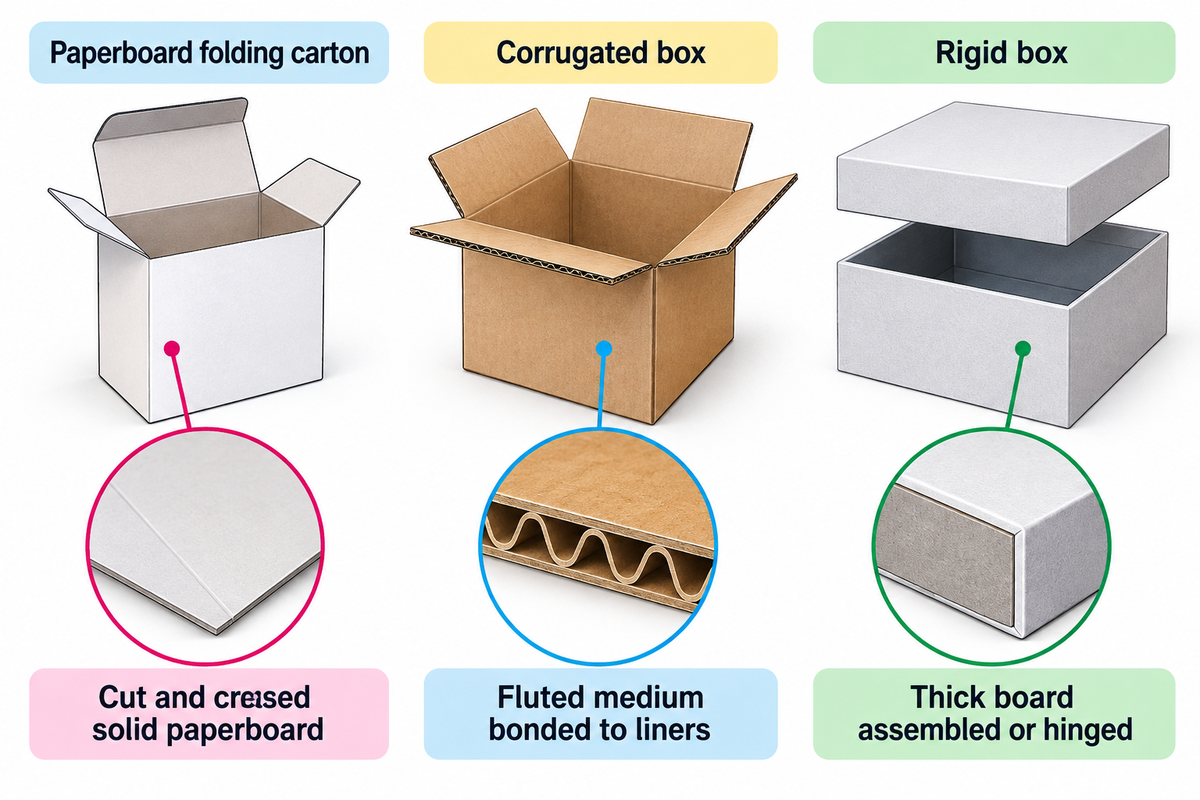
A custom folding carton is a converted paperboard blank that’s used to enclose, display or dispense a product. Printing supplies the visible information. Cuts and creases determine the shape of the blank. Many lightweight folding cartons reach the filling site flat and are assembled there. Product packaging can include tuck flaps, glued ends, windows or a separate sleeve.
Pro Carton’s production overview describes printing cartonboard sheets, cutting and creasing them, then folding and gluing the blanks. Other constructions may also be referred to as cardboard or custom folding boxes, so identify the layers before comparing packaging options.
| Format | Construction | Useful starting role |
|---|---|---|
| Paperboard folding carton | Cut and creased solid paperboard | Printed product box, shelf presentation and information |
| Corrugated box | Fluted medium bonded to liners | Shipping case or a structurally different retail pack |
| Rigid box | Thick board assembled or hinged, often covered with a separate wrap | Presentation and gift boxes |
Some rigid set-up boxes stay assembled. Others fold flat: MILO’s collapsible rigid boxes, for example, use wrapped solid board with folding walls. Flat delivery alone therefore doesn’t separate a carton box from a rigid construction. For a parcel-focused format, see the separate printed mailer box guide.
What is the purpose of carton packaging?
Carton packaging holds the product, carries identification and instructions, and creates a manageable unit for sale or use. A retail carton also provides a surface for branding. The complete construction provides product protection and may include an outer case or an insert.
Read the Carton Anatomy Before Choosing a Box Style
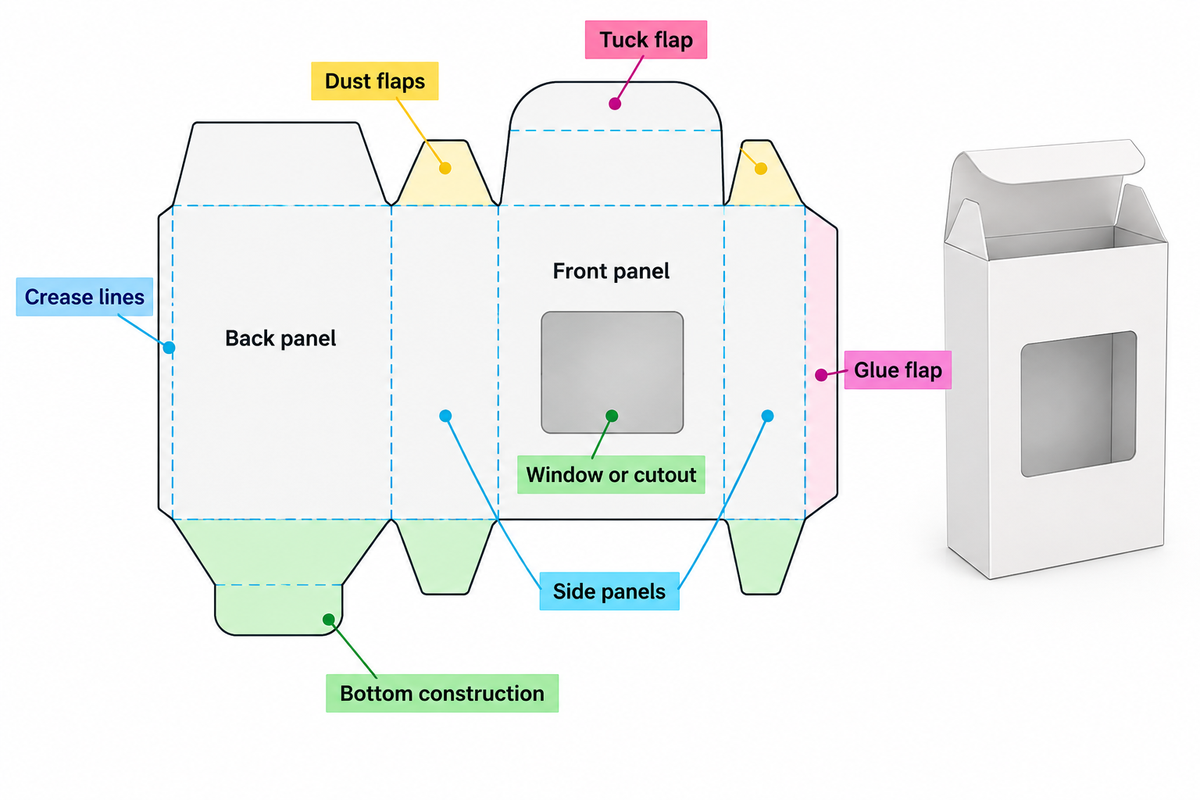
Read a carton dieline as a map of surfaces, hinges, and joints. Panels make walls, creases control folding, and flaps close or connect the structure. A custom design can appear correct as flat artwork, but it can also place text under a flap, crowd a product opening, or cover a glue zone with an unsuitable finish.
Carton Anatomy Atlas
The Carton Anatomy Atlas shows each element of a paperboard blank and its function and the consequence of modifying it.
| Part | Job | Decision before artwork approval |
|---|---|---|
| Front panel | Primary product identification | Keep the display face aligned with the intended shelf orientation |
| Back panel | Instructions and secondary information | Reserve readable space for the required content |
| Side panels | Set the package depth and connect faces | Allow the product and insert to occupy their full packed space |
| Crease lines | Locate folds and reduce bending resistance locally | Match the crease to the selected stock and fold direction |
| Glue flap | Joins the body walls | Keep the bonding area compatible with adhesive and surface treatment |
| Tuck flap | Closes an opening through insertion | Leave a usable insertion path without catching the product |
| Dust flaps | Support and cover the opening sides | Check overlap and interference during closure |
| Bottom construction | Retains the contents after erection | Choose the packing steps and validate the filled structure |
| Window or cutout | Exposes part of the product | Preserve surrounding board and decide whether a film patch is needed |
A crease acts like a planned hinge. The paperboard forming study by Tanninen and colleagues explains how local deformation helps the blank bend along a defined line. The settings for the press-formed tray tooling are part of that study. Ordinary carton dimensions are taken from the actual carton structure.
How do I know what size product box to order?
Start from the maximum packed product size, including any insert, and identify the usable internal size. Outside dimensions include the board and folded structure. A dieline panel is an artwork surface, not automatically the finished internal size. A physical sample of the product shows how much access the packer needs to load and remove it.
Example: a 60 × 40 × 120 mm product with an insert occupying a 70 × 50 × 130 mm envelope needs a carton cavity based on the larger envelope. A designer first develops the fit around that assembly, then allows for board thickness and closure geometry. Printing a 60 mm front panel doesn’t create 60 mm of usable interior width. If the insert changes after artwork approval, the carton size and dieline may need to change as well.
Match Paperboard Properties to the Product
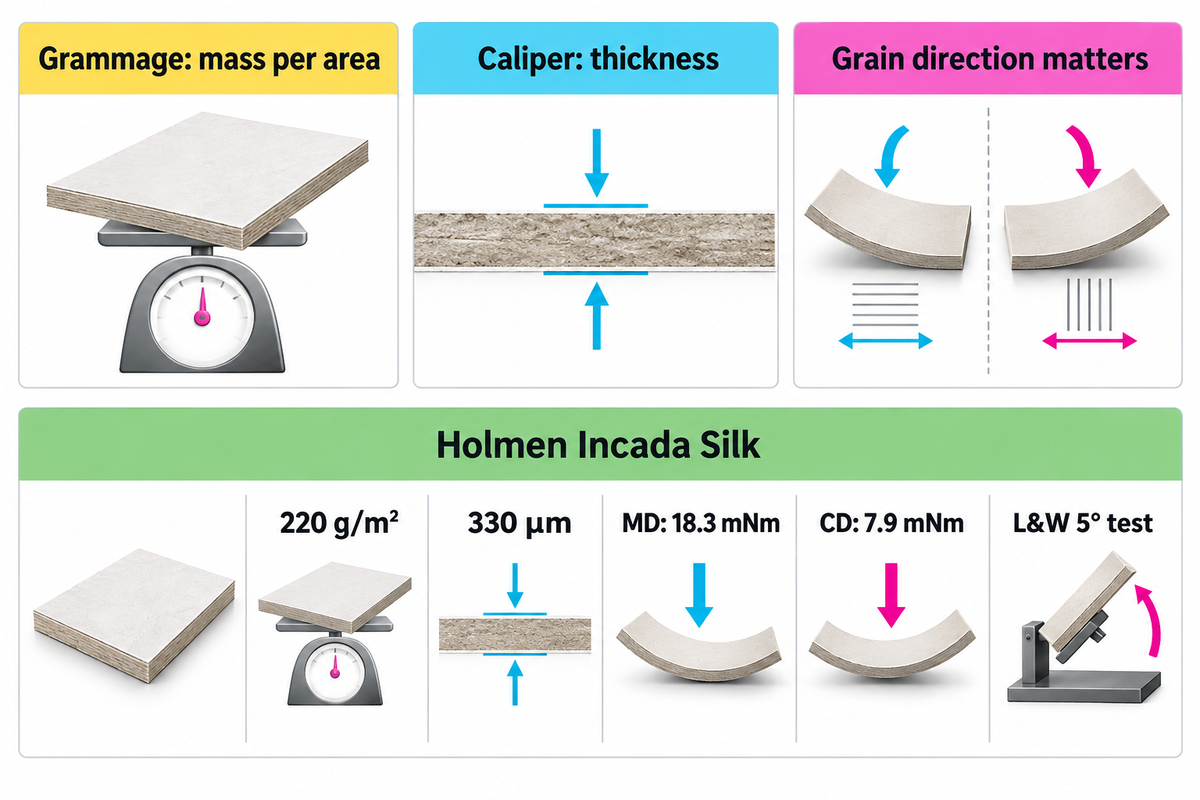
Compare paperboard by grade, thickness, stiffness, grain direction and surface, with moisture conditions kept consistent. Grammage alone doesn’t define a buying specification. Two boards with the same mass per area can have a different volume and bending behaviour. The selected material also has to crease, accept ink and bond through the planned converting process.
What is paperboard?
Paperboard is a sheet material made from bonded paper fibers and is used where a printable, foldable substrate is required. The characteristics of carton grades vary with the composition and structure of the layers as well as with surface treatment. The grades of solid bleached sulfate (SBS) differ from grades of folding boxboard and from kraft-based boards.
SBS paperboard provides a bleached surface to printed packaging. FBB is a multilayer construction. The Holmen Incada family uses chemical-pulp layers for the outside layers and mechanical-pulp layers for the inner layers. CCNB is a recycled board grade with a coated white printing surface. Kraft paperboard retains a brown surface unless covered or treated. Coated or uncoated surfaces alter the manner in which ink, varnish and adhesive meet the sheet.
“stiffness varies significantly between grain and cross-grain directions”
Grammage uses g/m²; caliper uses a length unit such as micrometres or points. ISO 534:2011 specifies thickness measurement methods and related density calculations. Keep the reported method with the value, especially when comparing suppliers.
| Grammage | Thickness | MD bending stiffness | CD bending stiffness |
|---|---|---|---|
| 220 g/m² | 330 µm | 18.3 mNm | 7.9 mNm |
| 240 g/m² | 365 µm | 25.2 mNm | 10.5 mNm |
| 260 g/m² | 405 µm | 33.0 mNm | 14.2 mNm |
| 280 g/m² | 445 µm | 42.0 mNm | 18.3 mNm |
| 300 g/m² | 485 µm | 52.2 mNm | 23.0 mNm |
| 325 g/m² | 540 µm | 65.8 mNm | 29.1 mNm |
| 350 g/m² | 590 µm | 80.5 mNm | 35.6 mNm |
Holmen’s Incada Silk specification uses L&W 5° testing to determine MD and CD stiffness. The figures refer to that grade. They aren’t a conversion from GSM to carton strength or a statement of Huandao’s stocked materials.
Temperature and relative humidity affect paper and board properties. ASTM D685-26 also explains why conditioning history matters even at 50% relative humidity. In a humid warehouse, comparing boards only by dry-sheet values misses part of the service condition. A 2023 review of coated-material converting describes how folding and creasing can damage a coating, so barrier performance belongs to the converted package, not just the uncreased sheet.
Choose Closures by How the Carton Is Filled and Opened
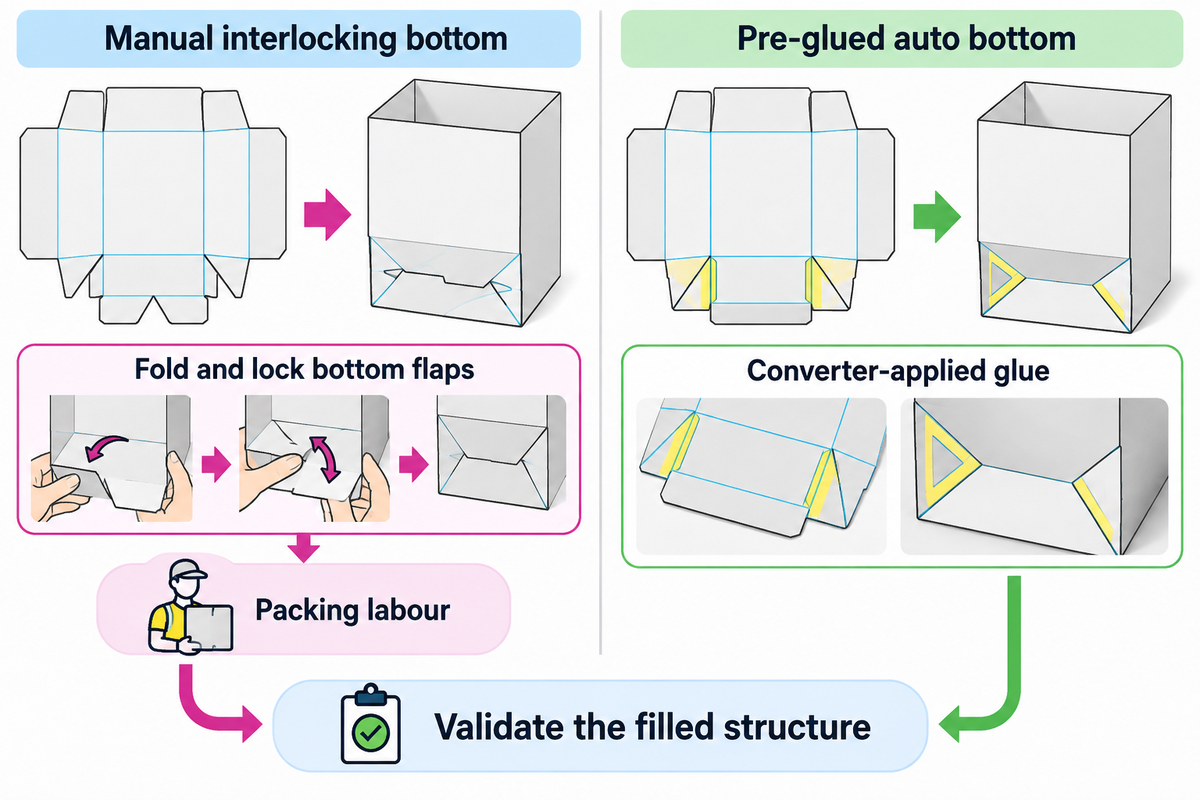
Choose carton styles around product loading, bottom assembly and customer opening. A tuck end suits an opening that must be accessible; a pre-glued bottom reduces the actions needed to erect the base. Sleeves and trays divide the package into individual pieces. Retention still depends on the finished dimensions, board and assembled joint.
Straight tuck end cartons have their main closing flaps facing the same direction. Reverse tuck end cartons close from opposite directions. For more details about these layouts, and for example illustrations, please refer to our straight and reverse tuck comparison.
Manual interlocking bottom
The packer folds and locks the bottom flaps. Compare the actual assembly motions with the available packing labour.
Pre-glued auto bottom
Converter-applied glue connects the base so erection forms the bottom. Extra converting work can trade against packing time.
PAX’s carton construction guide differentiates the assembly processes for snap-lock and auto-bottom boxes. Neither label replaces a filled-pack check. A simple accessory packed by hand may be sufficiently retained by a tuck structure, but a heavier bottle increases the bottom-retention and handling concern.
Follow the Folding Carton Manufacturing Sequence
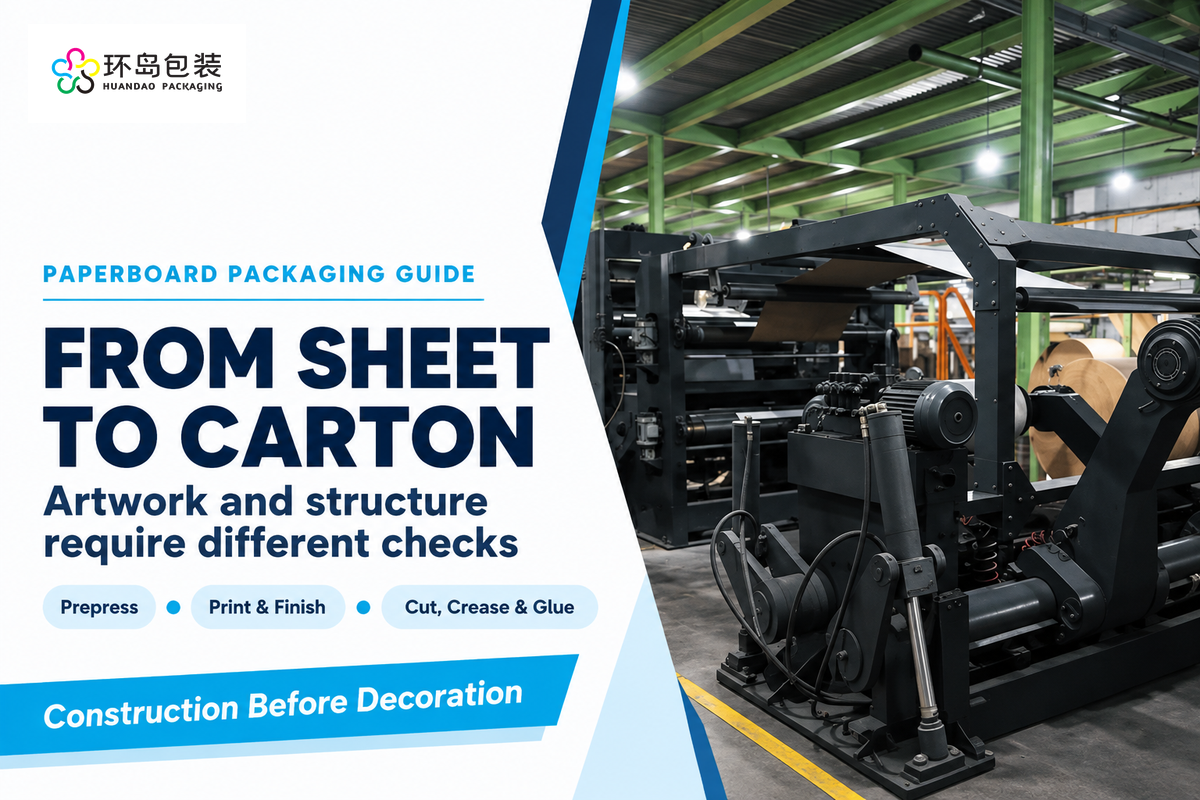
Folding carton manufacturing converts approved artwork and structures to die-cut blanks ready for filling. Prepress puts graphics on dielines and production sheets. Printing and the specified finishes follow a planned sequence with cutting, creasing and gluing. The final checks must include the erected product box as well as its flat print quality.
How are folding cartons made?
Paperboard cartons are made by preparing artwork and sheet layout, printing the board, applying specified finishes, cutting and creasing blanks, and folding and gluing the required joints. Waste is removed from the cut sheet. Many glued cartons are flattened for shipment and erected when the product is packed.
- Prepress: align artwork, dieline and sheet layout.
- Print: apply process CMYK or specified colours to the board.
- Finish: apply the job’s coating, foil stamping, emboss or lamination operations.
- Convert: die-cut, crease and strip the blanks.
- Join: fold and glue the structure, then examine erection and closure.
At Huandao, prepress, sheetfed offset printing, UV coating, lamination, die-cutting and folder-gluing run in-house. Our digital printing serves sampling. Full-color artwork approval and structural approval address different questions. A printed product image illustrates appearance, and a filled carton reveals opening clearance and assembly behavior.
Coating in wrong bonding areas impacts glue adhesion; crease set-up can leave a cracked fold. These are shown in SBL’s folding and gluing troubleshooting guide. For printing options, use our custom printed folding carton guide.
Plan the Product, Carton, Insert and Shipping Case Together
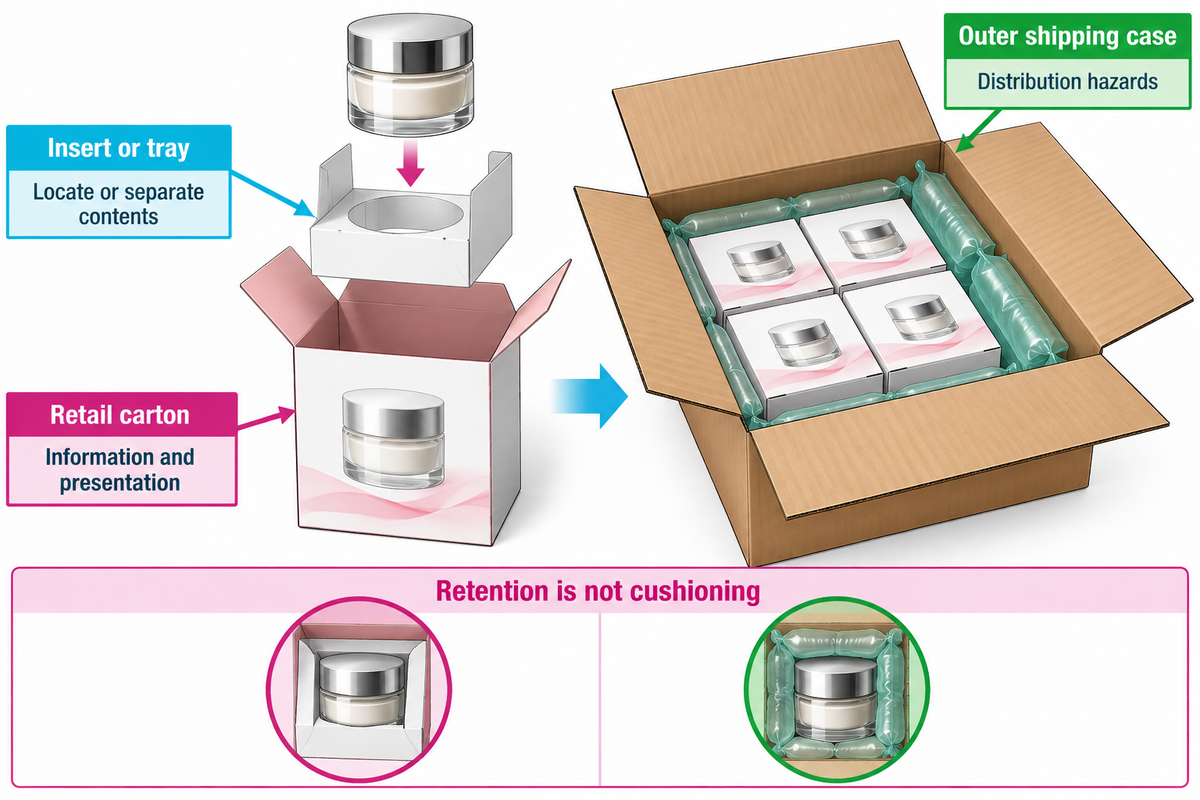
Allocate shelf presentation to the retail carton, product positioning to a suitable insert, and distribution protection to the shipping package. These interact. Increasing paperboard thickness will not automatically stop a glass item moving or provide the cushioning needed during parcel impacts. Design the filled assembly for the desired handling route.
| Layer | Primary job | Interface to examine |
|---|---|---|
| Retail carton | Carry information and present the product | Product access, closure and shelf orientation |
| Insert or tray | Locate or separate the contents | Contact points, retention and removal |
| Outer shipping case and protective materials | Address distribution hazards | Case fit, cushioning and the actual transit route |
Example: a small glass cosmetic container. A brand wants a close-fitting paperboard carton and a clean unboxing experience. Locating the container does not make a stiff paper insert an impact cushion. For individual parcel delivery, protection and a corrugated case may be necessary. Follow FedEx’s breakables guidance for cushioning and restricting product movement; treat glass as breakable even when its retail box looks substantial.
Example: a multi-part accessory kit. Loose packing allows component overlap in a carton. A partitioned paper insert can assign each item a location and give the packing operator a visible missing-part cue. The insert occupies space, which makes the cavity required in the custom product box different. A revised cable length can therefore change both the insert and the fit of the carton. This is a positioning task first; the finished kit’s route determines whether additional protective packaging is needed outside the retail carton.
ISTA’s package-design guidance ties testing to distribution hazards and product vulnerability. Retention is addressed via design, not via presentation. A separate corrugated box construction guide describes the outer case.
Understand Custom Folding Carton Cost Beyond Unit Price
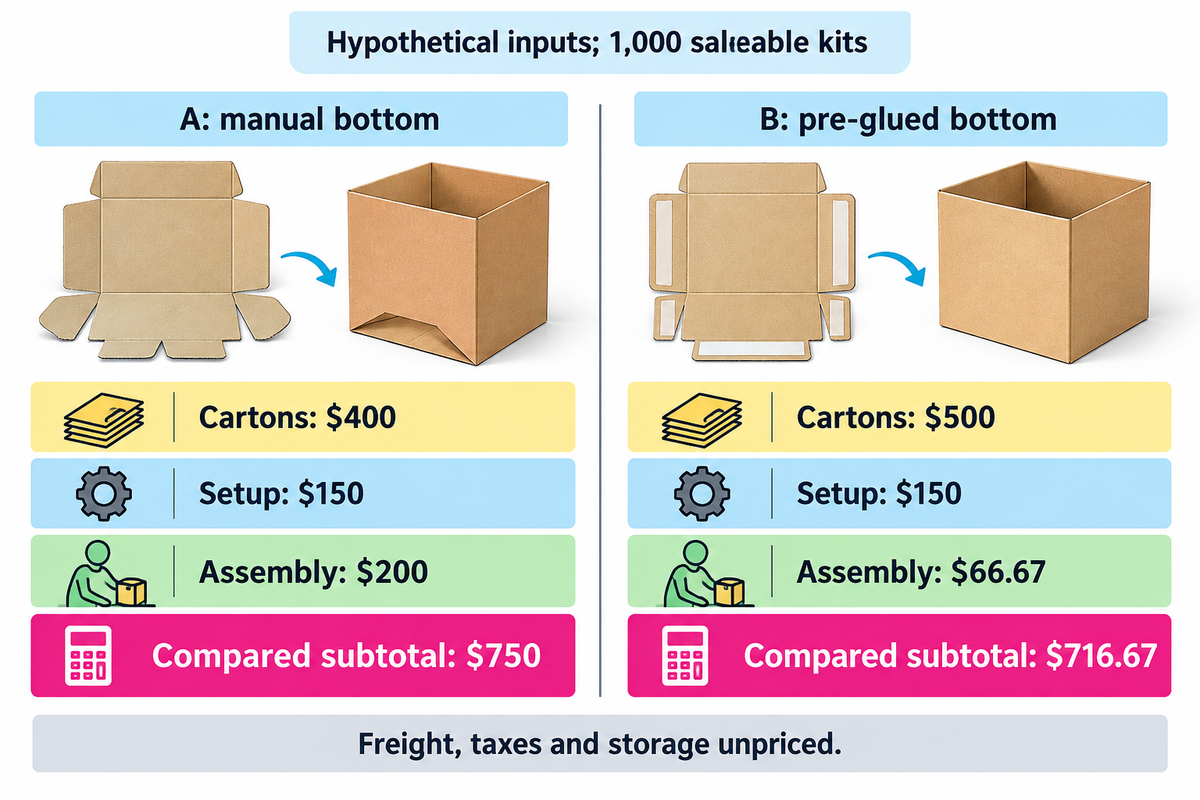
Custom carton costs comprise the material, print and converting costs, and the costs to make the cartons useful at the packing site. Setup spreads over the order quantity. Assembly uses labor. Money gets tied up in unused or obsolete stock. Compare the same finished-packed requirement before deciding that a lower carton unit price is more cost-effective.
Board dimensions affect sheet yield because several blanks can share a production sheet. Finishes add operations; folding and gluing affect conversion work. EM Printing’s cost explanation and PM Packaging’s program-cost discussion describe these mechanisms. NIST’s supply-chain guidance also includes freight, tariffs, inventory and supplier-management costs beyond purchase price.
Assumed inputs: a one-time comparison of 1,000 cartons for 1,000 saleable kits, using hypothetical dollar and labor inputs. Both options result in the same quantity and protection. Other costs (freight, taxes, storage, etc.) remain unpriced; they must be included for a complete cost comparison.
| Input or result | Option A: manual bottom | Option B: pre-glued bottom |
|---|---|---|
| Order quantity | 1,000 cartons | 1,000 cartons |
| Carton unit price | $0.40 | $0.50 |
| Carton purchase subtotal | $400 | $500 |
| Setup charge | $150 | $150 |
| Assembly time per carton | 30 seconds | 10 seconds |
| Labour rate | $24/hour | $24/hour |
| Calculated assembly labour | $200 | $66.67 |
| Compared subtotal | $750 | $716.67 |
| Compared cost per usable kit | $0.750 | $0.717 |
For A, assembly costs 1,000 × 30 seconds ÷ 3,600 seconds/hour × $24/hour = $200. For B, the same calculation with 10 seconds gives $66.67. Adding cartons and setup produces the compared subtotals. Based on the assumptions above, B has a higher carton price, but less assembly work. If the packing line eliminates the assembly work for both options, the labor cost difference goes away.
The hidden bottleneck is pack-out: finance sees the carton invoice while the packing team absorbs repeated bottom-folding motions. A large order may reduce the average setup cost per piece, but increase obsolete printed stock if the product or graphic changes. Record the expected useful quantity before the next revision, rather than considering each carton as a future sale.
Choose a Practical Route from Packaging Need to Production
Use stock paperboard boxes, if the dimension and appearance fit the requirement. Create custom packaging if a different structure is required due to product fit, opening, print, or component arrangement. Compare carton-only supply with coordinated paper components. A folding carton manufacturer and a packaging distributor may offer different development and production scopes.
For a thin, non-fragile item, stock boxes work as a practical starting point when a label supplies the needed information. A custom-made carton becomes useful when loose space disrupts display, the pack must hang on a fixture or instructions need a dedicated panel. Premium custom folding carton packaging adds work only where the structure or finish changes the product experience.
Huandao produces printed paperboard packaging in our Xiamen facility. We can ship consolidated paper inner trays, inserts and outer shipping cartons together with the printed box. Our corrugator can produce single E-flute and single B-flute. Other flute profiles use sourced board. For special project carton solutions and production options, visit our custom folding carton packaging solutions page.
To order custom cartons, provide packaging specialists with packed dimensions, a dieline or artwork, along with the anticipated quantity, filling method and delivery route. Provide contact conditions for the food packaging and indicate the intended sales market. A shared brief allows the supplier to develop cartons that fit the product and the packing process without turning the first discussion into a finish catalog.
What Is Changing in Carton Design and Reorders?
Paper-based packaging design increasingly has to account for sorting as well as the recycling process. The 2026 Version 4 of 4evergreen’s Circularity by Design Guideline includes a chapter called Sorting Disruptors. A window, film or other component can affect where a package travels through recovery; therefore material changes should be given more consideration as opposed to artwork changes.
4evergreen’s guideline covers conventional, flotation-deinking and specialised paper-mill recycling pathways. Folding cartons are recyclable where the complete construction suits the available collection and processing route. Sustainable packaging decisions include the whole construction and the destination’s collection system; choosing eco-friendly materials doesn’t settle every recovery question.
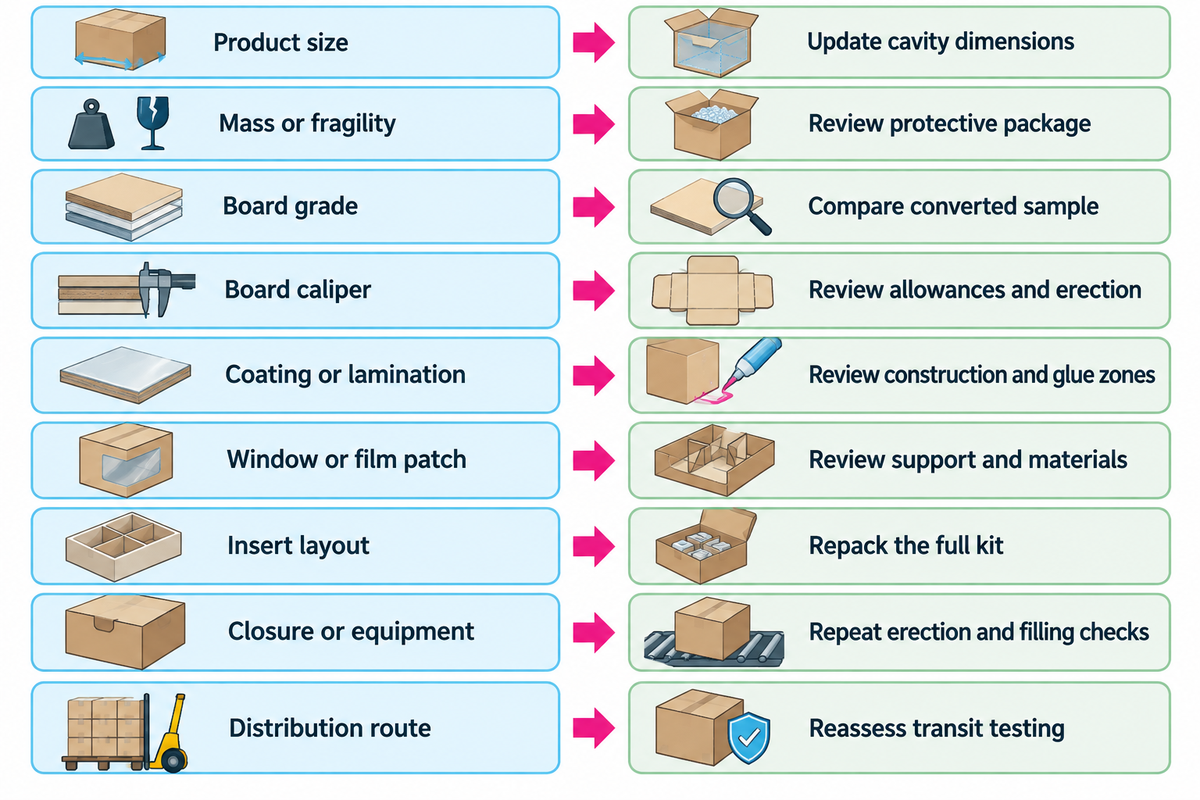
| Change on the reorder | What can change with it | Work to repeat |
|---|---|---|
| Product size | Fit and loading clearance | Update the filled sample and cavity dimensions |
| Product mass or fragility | Retention and distribution risk | Review the complete protective package |
| Board grade | Stiffness, surface and creasing behaviour | Compare material properties and converted sample |
| Board caliper | Fold geometry and internal space | Review dieline allowances and erection |
| Coating or lamination | Bonding, folding and recovery pathway | Review the finished construction and glue zones |
| Window or film patch | Local structure and sorting behaviour | Review opening support and material combination |
| Insert layout | Product position and removal | Repack the full kit |
| Closure or packing equipment | Assembly and retention | Repeat erection and filling checks |
| Distribution route | Handling and environmental exposure | Reassess applicable transit testing |
ISTA’s retesting guidance links retesting to product, package or process changes associated with potential performance. A cosmetic artwork revision alone is different from replacing the board or changing a closure. Keep the approved material specification, structural revision and artwork revision together so a reorder identifies which version is being reproduced.
Frequently Asked Questions
What industries can benefit from using custom folding cartons?
Retail goods with a printable outer package are common applications.
Cosmetics, personal care, household goods and small accessories use folding carton packaging as consumer packaging for identification and presentation. Food and beverage products can use an outer carton around separately contained contents. Direct food contact adds material and intended-use requirements; FDA guidance addresses the food-contact substance and its use conditions, rather than approving a carton by appearance.
Why should you choose custom packaging over stock options?
Choose custom when fit or use requires a different structure.
Custom folding cartons are designed to fit a particular product, locate an insert and position information where the customer sees it. Stock packaging works when its dimensions and opening already suit the product. Customization is useful when improved loading, presentation or handling justifies the initial development, tooling and an order commitment.
Can I use custom folding cartons for subscription box services?
Yes, especially for individual products inside the shipping package.
A folding carton can organize an item within a subscription box and carry the product’s instructions or branding. The outer parcel package still needs the protection required for the full shipment. When contents change each month, review insert fit and packed quantity so a presentation carton doesn’t become an unsupported shipping container.
Can I add security features to my custom folding cartons?
Yes, closures and added seals can show evidence of opening.
Tamper-evident labels, tear features and opening constructions can make interference visible. Choose the feature around the opening sequence and product risk. Tamper evidence and child resistance are different functions; a tear strip alone doesn’t make a child-resistant package.
How does the coating impact my cardstock box?
Coating changes appearance, surface behaviour and later converting work.
A coating can give a gloss or matte appearance and change scuff resistance or how a printed surface feels. UV varnish and film lamination are different treatments. Their interaction with a fold or glue zone matters during packaging and folding operations. The coating choice also joins the board, adhesive and any window in the recovery assessment. For packaging cosmetics, balance shelf appearance with readable fine text and a finish that suits the assembled carton.
Can I get window cartons?
Yes, a die-cut opening can expose part of the contents.
A window may remain open or receive a film patch. Its position changes the board left around the opening and the visible part of the product. Window size, insert position and assembly sequence should be developed together before artwork is finalized.
What is the minimum order quantity for custom folding cartons?
Huandao’s standard minimum is 1,000 pieces per size and style.
Standard MOQ is 1,000 pieces per size and style. Smaller runs are quoted case by case. Quantity affects how setup and tooling costs spread across the order, but storing more cartons can become expensive when artwork or product dimensions change. For a new custom paperboard package, use the expected sales quantity before the next revision as a planning input, then discuss sampling and the production order separately with Huandao. A retained filled sample helps identify later dimensional changes.
Ready to develop a carton around your product? Bring the packed dimensions, filling method and delivery route to Huandao. Our folding carton manufacturing options cover the project-specific discussion, including whether the printed carton, paper insert and outer shipping case should be supplied together.
Cost and dimensional examples use stated hypothetical inputs. Huandao’s manufacturing and supply details are based on company information. Application-specific performance and food-contact requirements belong to the finished package and intended use.
References & Sources
- Pro Carton: Carton Production.
- MILO Group: Flat-Folding Boxes.
- Tanninen et al. (2015): Controlling the Folding of the Blank in Paperboard Tray Press Forming.
- Paperboard Packaging Council: Pick Paperboard Like a Pro.
- International Organization for Standardization: ISO 534:2011.
- Holmen: Incada Silk product specification.
- ASTM International: D685-26, Conditioning Paper and Paper Products for Testing.
- Lev et al. (2023): Converting and its Effects on Barrier Properties of Coated Packaging Materials: A Review.
- PAX: Folding Cartons.
- SBL: 4 Common Folding and Gluing Failures and How to Fix Them.
- FedEx: How to Pack Breakables.
- International Safe Transit Association: Guidelines for Selecting and Using ISTA Test Procedures and Projects.
- EM Printing: How Much Do Custom Folding Cartons Cost?.
- PM Packaging: How to Reduce Cost Across a Large Folding Carton Program.
- National Institute of Standards and Technology: Supply Chain Management.
- 4evergreen: Circularity by Design Guideline, Version 4 (2026).
- International Safe Transit Association: When Should a Packaged-Product Be Retested?.
- US Food and Drug Administration: Preparation of Premarket Submissions for Food Contact Substances, Chemistry Recommendations.