Get in Touch with Xiamen Huandao Packaging Technology Co., Ltd.

A buyer-side guide to closure geometry, dielines, paperboard and corrugated construction, finishes, test evidence and production approval
Tuck end boxes are folding packages whose main closure flap slips inside the box body at one or both ends. This term defines closure geometry. It doesn’t define board grade, establish a tested load or prove the package can travel without an outer shipping case. A useful specification begins with the display face and opening sequence, connects to a dieline and construction/finish stack, and includes a sample and job record.
This guide follows the same sequence. It compares straight and reverse tuck ends, turns product facts into a six-field fit brief, separates solid paperboard from E-flute and B-flute options, and shows what four common test reports can and cannot establish. Prospective buyers that are about to specify an order can review custom tuck end boxes for a defined product and order. That Commercial Page has customization and quotation intent; this article is about selection, verification and change control.
Before teams order custom packaging, they need the engineering brief. This guide does not publish wholesale prices, rank suppliers or teach hobbyists how to make tuck boxes. It describes how to choose and verify the production structure without turning an informational article into a second sales page.
The release rule
Approve the actual system: dieline revision, substrate, print and finish stack, erected sample, packed product, insert and outer case. A familiar style name or a single laboratory number isn’t a substitute for that system.
What Is a Tuck End Box?
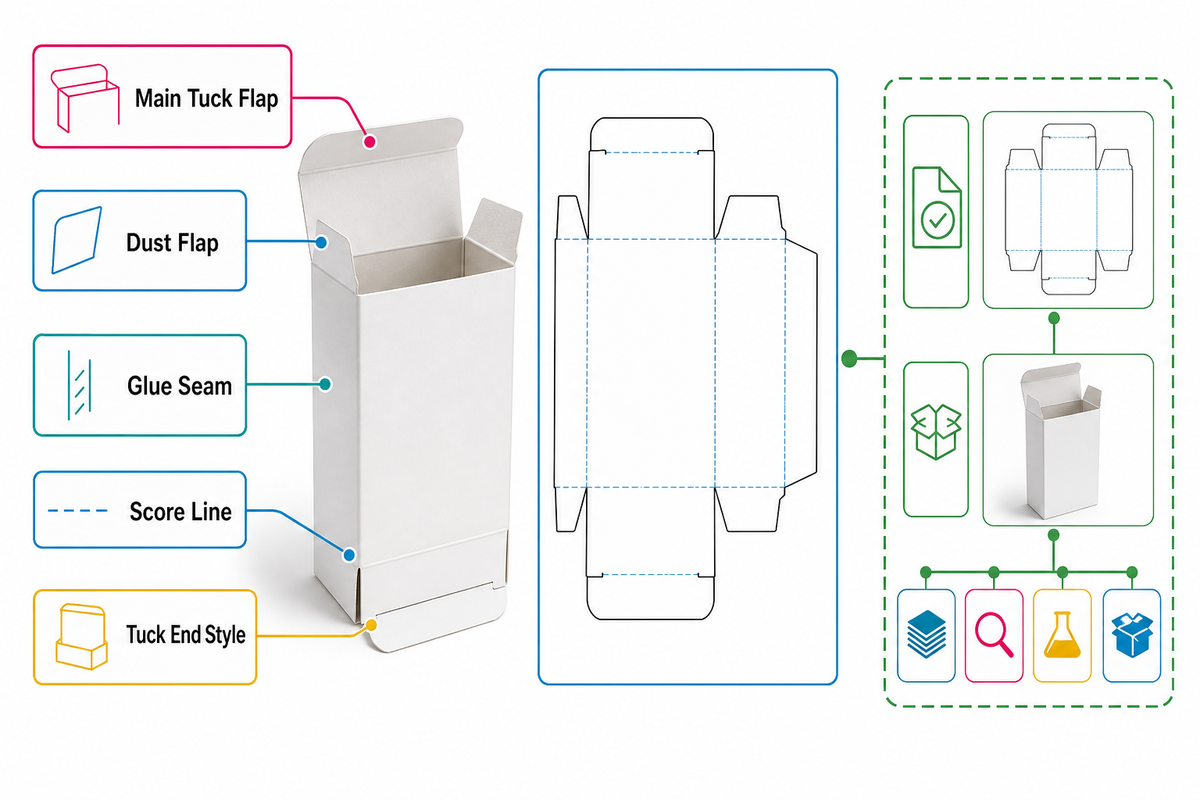
A tuck end box has a main closure flap that bends on a score and enters the carton body. Dust flaps fold inward on the side panels. Body panels are joined with glue. Slit locks, friction features or thumb cuts may modify how the end closes and opens. On a flat drawing, cut lines, score lines, glue zones and panel labels must be read together. Buyers who see only the finished, folded dimensions are unable to decipher which panel has the flap or where the printed front will be.
International packaging vocabulary distinguishes the packaging unit and its components, while industry design-code systems classify the structural blank. Those references help name what’s on the drawing. They don’t assign a board grade or capacity to the word “tuck end.”
| Term | What it defines | What it does not prove | Drawing or sample to check |
|---|---|---|---|
| Main tuck flap | The closure panel that enters the body | Holding force or repeated-use life | Flap length, score and entry slot |
| Dust flap | A side flap behind the main closure | A sealed barrier | Fold order and product clearance |
| Glue seam | The permanent body joint | Joint strength on the production run | Overlap, adhesive and joint position |
| Score line | Where the board is intended to fold | That the finish will not crack | Converted sample on proposed board |
| Tuck end style | A family of closure geometries | Paperboard, flute, load or shipping fitness | Approved dieline and filled prototype |
A tuck closure may be found on either a solid paperboard folding carton or a corrugated structure which may be laminated. A straight tuck end box and reverse tuck end box are two common examples of retail packaging; tuck boxes for playing cards are a narrow application rather than the definition of the family. Roll-end tuck styles use the term “tuck” as well, but the blank, side walls and erecting sequence differ from a glued folding carton. Read the actual design rather than transferring assumptions between style families. The site’s custom printed folding cartons page shows the broader commercial category. This guide remains focused on selection and proof.
A tuck top or top tuck may close only one end, while a seal end uses a different closure method. Custom tuck top boxes, auto-bottom boxes and dispenser boxes are catalog terms that describe distinct box types. Also, lock tuck end boxes add a locking relationship on the drawing. If a listing calls something a popular folding carton or a particular packaging style, the drawing still decides the exact type of tuck. Tuck packaging is defined only after a blank and pack-out are identified.
Is a tuck end box always made from paperboard?
No. Solid paperboard is used for a tuck closure because it folds flat and provides a level surface for printing retail packaging. Rigidity and distribution are considerations that would guide the use of an E-flute or B-flute litho-laminated box with a tuck closure rather than determine it automatically. Closure, substrate, and transportation are distinct parameters which are specified.
Straight vs Reverse Tuck Ends: The 4-View Tuck Geometry Map
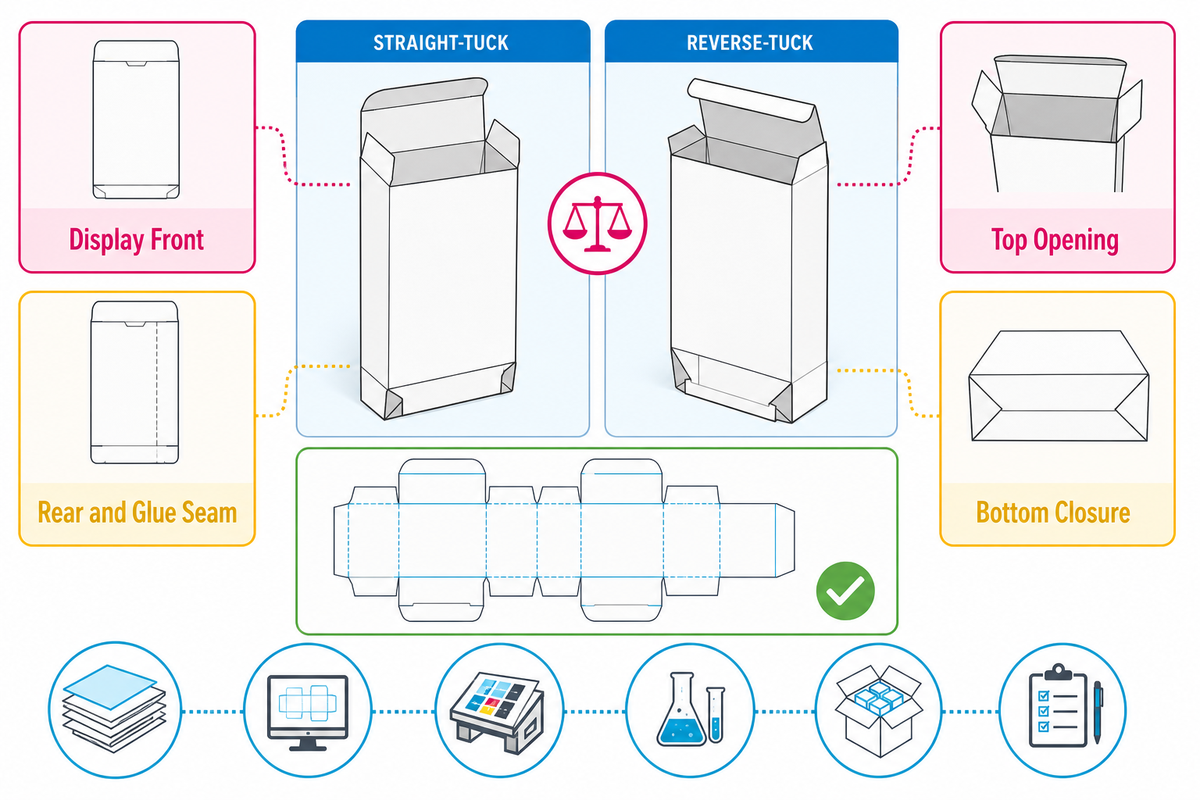
A straight tuck end carton commonly hinges both main closure flaps from the same principal panel. A reverse tuck end carton, on the other hand, usually hinges them from opposing panels. While this difference is helpful, it isn’t sufficient to review art/packaging. A 4-View Tuck Geometry Map asks the buyer to mark the display front, rear and glue seam, top opening, and bottom closure on one drawing. The ISO packaging terminology standard supplies a general vocabulary baseline; the approved dieline still fixes the straight- or reverse-tuck geometry for a specific job.
Use the nickname to shortlist a style, then let the approved dieline settle the visible closure edges, loading end and opening motion. Blank orientation, side-seam position and the converter’s layout can change what appears at the front. Reverse tuck is not always cheaper, weaker or less premium. Straight tuck is not always the better graphics choice. The trade-off belongs to the exact panel map and production layout.
Straight tuck boxes and reverse tuck end boxes can both carry high-quality graphics. A custom straight tuck carton may protect one uninterrupted display panel, while a custom printed tuck layout with opposed flaps may fit the converter’s blank more efficiently. Those are project findings, not universal promises.
| Approval check | Straight-tuck tendency | Reverse-tuck tendency | Proof to retain |
|---|---|---|---|
| 1. Main-flap hinge panels | Usually the same body panel | Usually opposing body panels | Panel-labelled dieline |
| 2. Display front | Confirm which face remains uninterrupted | Confirm top and bottom edges separately | Erected artwork mock-up |
| 3. Rear and glue seam | Map seam beside both closure views | Map seam beside opposing views | Rear-view photograph |
| 4. Top opening | Check flap entry and thumb access | Check flap entry relative to front | Opening sequence sample |
| 5. Bottom closure | Check product load against the lower flap | Check the reversed lower orientation | Filled bottom view |
| 6. Artwork interruption | Inspect both same-side closure edges | Inspect two opposing closure edges | Printed erected sample |
| 7. Hand loading | Verify which end stays open at the station | Verify orientation after turning the blank | Pack-station trial |
| 8. Machine loading | Confirm magazine and closure sequence | Confirm opposing-flap timing | Actual line trial |
| 9. Consumer reclosure | Check repeated access at intended end | Check that the intended end is obvious | Use-cycle observation |
| 10. Blank layout | Review board use and print orientation | Review the alternate nesting opportunity | Converter layout and quote note |
What is a reverse tuck end box?
A reverse tuck end box is a folding carton whose main top and bottom tuck flaps hinge from opposing body panels in a common layout. That geometry can affect blank nesting, visible closure edges and packing sequence. It does not guarantee a cost, strength or appearance outcome. Confirm the front, rear, top and bottom on the approved dieline and erected sample.
From Product to Dieline: The 6-Field Carton Fit Brief
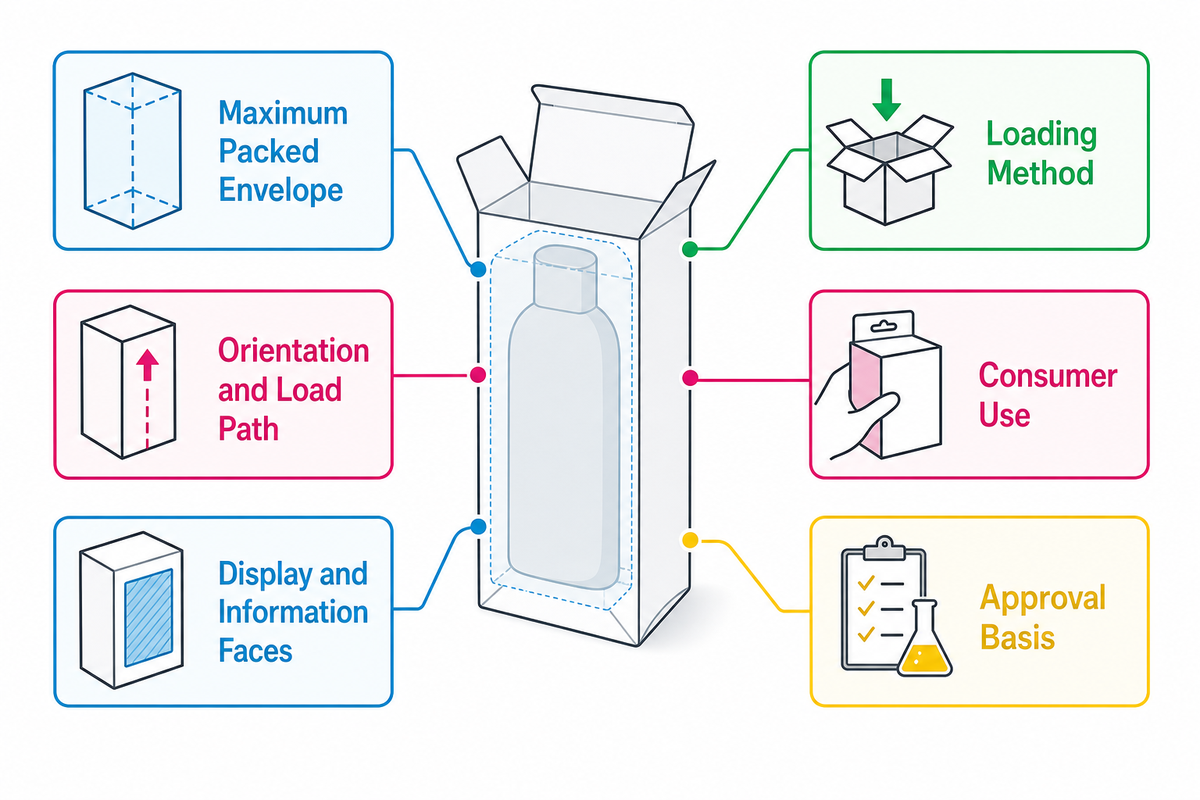
Fit covers all of the elements captured in the 6-Field Carton Fit Brief. The 6-Field Carton Fit Brief records product dimensions and the maximum packed envelope; product orientation and centre-of-mass concern; display and regulatory faces; loading end and insertion direction; consumer opening and reclosure; and the prototype conditions and tolerance basis. These packaging requirements let the structural designer turn a custom size into a controlled box design rather than a guessed cavity. The ISO packaging terminology standard supplies a vocabulary baseline; this fit brief remains a project control framework rather than an industry standard.
- Maximum packed envelope: include caps, pumps, leaflets, inserts, cables, seals and any flexible bulge.
- Orientation and load path: identify the supported base, top-heavy condition, fragile point and any concentrated edge.
- Display and information faces: mark the front, barcode, legal copy, opening cue and any window.
- Loading method: name the open end, insertion direction and hand or machine process. Indicate line condition.
- Consumer use: first opening and reclosure expectation, tamper feature, removal direction.
- Approval basis: State the material, sample condition, measured dimensions, tolerance owner and retest trigger.
Dimensions are usually expressed as length x width x depth, but conventions must be stated. A supplier guide may measure from the middle of one score to the middle of another; that convention should not be copied into a purchase order without agreement. Internal space is affected by board caliper, score geometry, grain direction, dust-flap overlap and the packed envelope. There is no universal “add 2 mm” or “add 5 mm” rule for every product and board.
Packaging design also has to account for assembly. A blank described as easy to assemble may also fail the buyer’s line if the opening force, flatness or the loading end is wrong. Easy assembly is an observed result on the intended process, not a label. Approve the custom die, named box sizes and filled trial together.
Hypothetical worked case: Orion Sample Pack
Assume a filled bottle and leaflet occupy a maximum envelope of 90 × 60 × 180 mm and the product mass is 0.45 kg. The same outer dimensions may describe a top-heavy bottle or a flat kit. The bottle may need an insert and a controlled loading direction; the flat kit may need different dust-flap clearance. The numbers define the prototype input, not a universal allowance.
How much clearance should a tuck end box have?
There are no reliable standard universal allowances. Document actual packed envelope, protrusions, orientation, substrate, board caliper, loading method and consumer opening direction. Let the converter provide a dieline and approve a physical sample of the product and the insert. The approved score-to-score dimensions and tolerance basis are to be shown on the controlled drawing.
Paperboard, E-Flute or B-Flute? The 3-Construction Selection Matrix
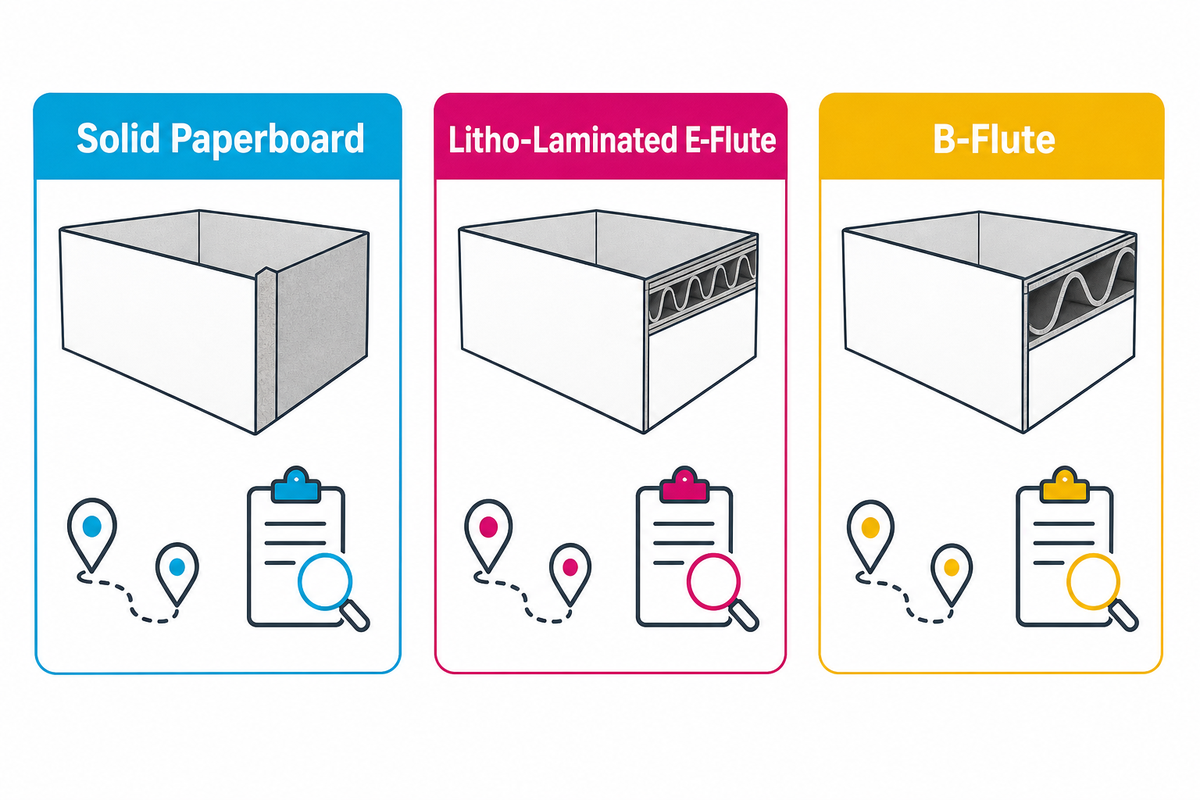
The 3-Construction Selection Matrix starts with distribution role rather than a weight cutoff. Solid paperboard is often suitable for print-led retail containment inside a protective shipping system. Litho-laminated E-flute adds a fine corrugated structure and printable facing. B-flute is thicker and may be shortlisted where panel support and handling risks justify it. Typical guide values put E flute around 1 to 1.5 mm and B flute around 3 mm, but the actual combined board remains a supplier-specific construction.
The right type of packaging depends on the route and packaging materials, not the product category label. Knowing how mailer boxes, boxes for retail packaging and display boxes differ is essential. A folding carton box for pharmaceutical packaging, food packaging, cosmetics packaging or a tea box also needs use-specific contact, regulatory and barrier review; the category name does not supply that evidence.
Flute letter, basis weight and product mass are not interchangeable measures. For example, a broad 0.8 kg product supported throughout can load a pack differently than a 0.4 kg metal part supported by one edge. Decisions about panel span, centre of mass, fragility, humidity, insert design and the outer shipper, as well as how the product will be stacked, handled and shipped, can all change the decision.
| Packaging type | Likely starting construction | Risk to verify | Insert or shipper relationship | Release proof |
|---|---|---|---|---|
| Cosmetic tube | Solid paperboard | Panel bow and surface scuff | Case count and orientation | Filled sample plus rub check |
| Supplement bottle | Solid paperboard with insert candidate | Top-heavy movement | Neck or base restraint | Filled pack-out trial |
| Small electronics accessory | Paperboard or E-flute candidate | Cable pressure and corner impact | Tray cavity and outer case | Complete-kit handling trial |
| Glass bottle | E-flute or supported paperboard candidate | Breakage and concentrated load | Insert plus shipping case | Packed route test |
| Multi-item kit | E-flute presentation pack | Part movement and opening order | Partitioned tray | Complete-kit use cycle |
| Dense hardware part | B-flute or reinforced system candidate | Local puncture and bottom load | Load-spreading support | Filled compression and handling |
| Subscription presentation pack | E-flute candidate | Parcel scuff and product movement | May also need an outer mailer | Route-specific packed test |
| Shelf-ready multipack | B-flute or system-specific corrugated | Loaded display stability | Retail opening and tray function | Loaded display trial |
| Transit-sensitive single pack | Pack-system decision, not style-only | Impact, vibration and stacking | Tuck box, restraint and shipper together | Defined distribution simulation |
For the Orion Sample Pack, comparing a 1.5 mm E-flute candidate and a 3 mm B-flute candidate is only a prototype decision. Neither thickness proves the result. The filled 0.45 kg product, its insert and closure as well as the 24-unit outer case and actual handling route must be checked as one system.
Huandao says its in-line corrugator supplies single E-flute and single B-flute board just in time with zero stock, and that other profiles are made from sourced board. That’s a process description, not a commitment that single E-flute and single B-flute are a good match for a given SKU. When evaluating board, printing, and proofing sequence, consider custom printed folding carton considerations.
UV, Lamination, Spot UV and Foil: The 4-Finish Proof Map
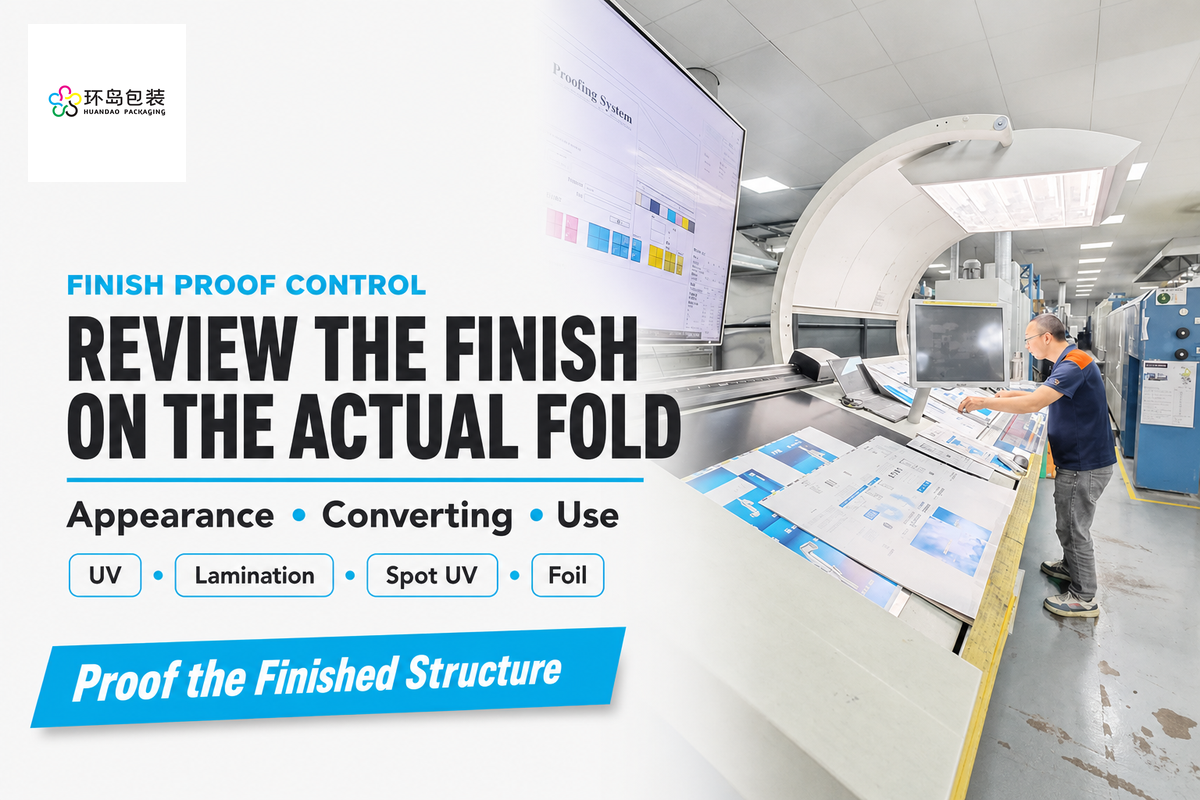
A finish must be approved for appearance, converting and use. A glossy flat proof cannot show whether a score will crack, a laminate will lift, foil will bridge a crease or a coated surface will interfere with glue. The 4-Finish Proof Map keeps visual intent beside the physical question that can make the carton fail.
Premium packaging and product presentation are visual goals, but they don’t predict how a structure will behave during conversion. Custom printed boxes can use the same decoration on different structures, while custom printed tuck boxes need finish decisions tied to their folds. Just because one treatment is selected as a popular packaging option doesn’t mean it’s suitable for all custom packaging projects.
| Finish | Visual purpose | Score or glue risk | Proof to request | Claim review |
|---|---|---|---|---|
| Flood UV coating | Overall gloss and print protection | Crack, slip or glue exclusion | Converted coated sample plus defined rub comparison | Review full component and destination |
| Film lamination | Gloss, matte feel or broad barrier | Edge lift, crease whitening and recovery route | Laminated, die-cut and folded sample | Do not assume paper-stream eligibility |
| Spot UV | Local contrast or tactile highlight | Registration and score crossing | Registered production-equivalent sample | Assess coverage and complete structure |
| Foil stamping | Metallic detail and premium emphasis | Crack, transfer, heat and fine-line loss | Tooling proof on proposed board and coating | Review decoration and local collection route |
ASTM D5264 provides a laboratory procedure to compare abrasion resistance for printed materials such as folding cartons, corrugated boxes, coatings, laminates and substrates. In its own words, “This practice provides a way of comparing abrasion resistance of printed materials under laboratory conditions.” It defines a comparison method. It does not reproduce every scratch, humidity level, score fold, filling line or shipping event.
End-of-life claims merit similar consideration. The Fibre Box Association’s 2025 voluntary standard addresses repulpability and recyclability testing for coated or treated corrugated and equivalent materials. It doesn’t touch on product safety, function, and marketability. Thus, a new conversion proof and a claim review for the destination would be needed for a changed coating or laminate.
What Test Reports Actually Prove: The 4-Test Evidence Map
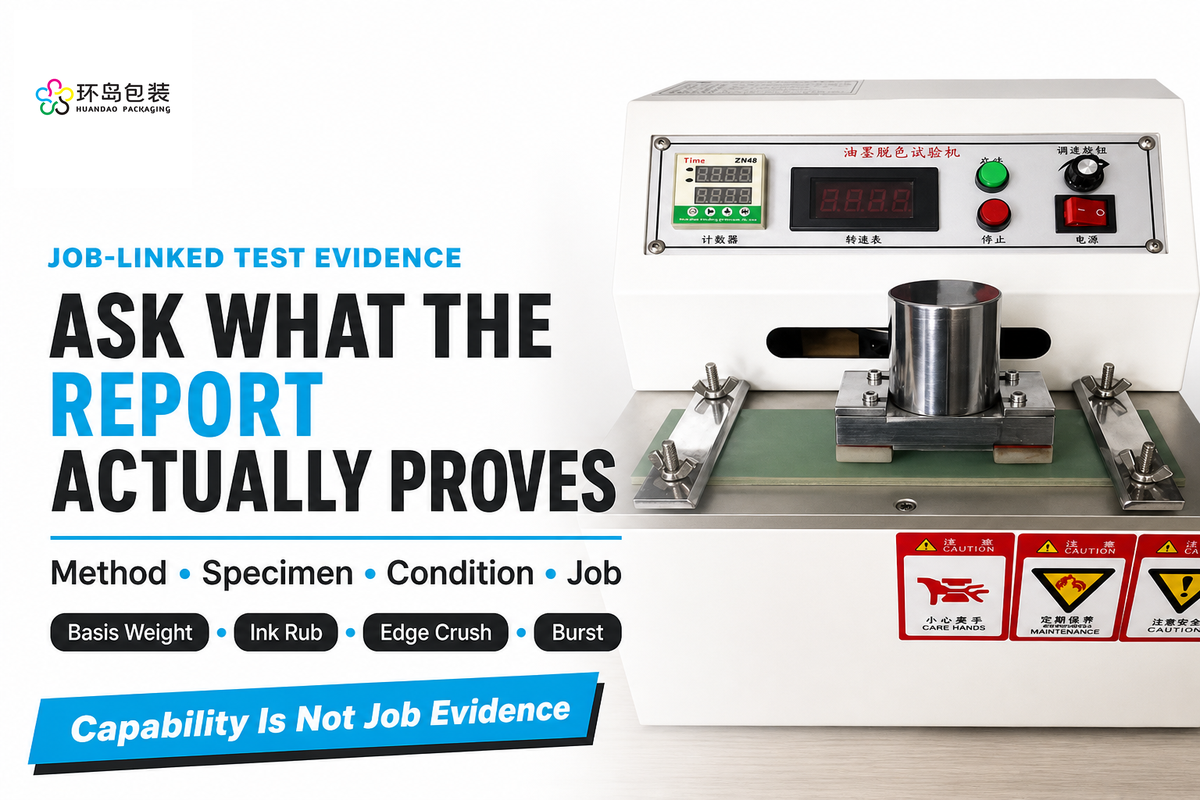
The word “tested” is incomplete until the buyer knows what specimen was tested, under which method and condition, in which units, and how the result connects to the current job. The 4-Test Evidence Map separates basis weight, ink rub, edge crush and burst. One result should not be used to answer four different questions.
Buyer rule: A number becomes order evidence only when the report identifies the method, specimen, condition, units, acceptance criterion, production job and disposition.
4-Test Evidence Map
| Evidence field | Basis weight | Ink rub | Edge crush | Burst |
|---|---|---|---|---|
| 1. Specimen | Paper or board sample | Printed and finished surface | Corrugated-board strip | Paper or corrugated specimen |
| 2. Primary question | Mass per unit area | Relative abrasion resistance | Edgewise compression response | Rupture resistance under method |
| 3. Material identity | Grade, source and lot | Board, ink, coating and cure | Liners, medium and flute | Board construction and side |
| 4. Conditioning | State temperature and humidity basis | State sample condition | State preconditioning and direction | State preconditioning |
| 5. Method | Named mass-per-area method | Named rub method and setup | Named edge-crush method | Named burst method |
| 6. Units | For example g/m² | Cycles, load and rating as defined | Force per length under method | Pressure under method |
| 7. Sampling | Locations and count | Printed positions and count | Direction, locations and count | Locations, sides and count |
| 8. Job link | Material lot and work order | Artwork and finish revision | Combined-board lot and job | Board lot and job |
| 9. Unsupported inference | Finished-pack strength | All transit scuff conditions | Complete-box shipping safety | Stacking or drop performance |
| 10. Buyer decision | Confirm material identity | Compare the print/finish system | Compare corrugated material response | Compare rupture response |
The counter-intuitive point is that a higher or heavier value is not necessarily the safer finished box. Corrugated training material points out that heavier linerboard will generally, but not always, yield higher burst values, and that burst isn’t a good indicator of performance in stacking and handling. A common assumption fails when a board-level value is treated as a complete-package certificate. Package design, dimensions, scores, joints, cut-outs, moisture, insert support and pack-out still influence the safety of the final package.
Durability is another system outcome. An edge-crush value by itself wouldn’t justify a secure packaging claim, and a fibre-based board by itself wouldn’t justify a sustainable packaging claim. Each claim requires the relevant construction, method, destination and finished-pack evidence.
Huandao states that its in-house laboratory issues applicable edge-crush, burst, ink-rub and basis-weight reports on the customer’s production run. Buyers should still check the report ID, job reference, sample identity, conditioning, method, unit, criterion, result and disposition. A job link strengthens provenance; it doesn’t, by itself, establish that a sampling plan represents every unit.
Does an ECT report prove the finished tuck box is safe for shipment?
No. It details the edgewise compression behavior of a corrugated specimen under a method. It doesn’t assess a complete solid paperboard carton, and doesn’t encompass finished dimensions, scores, glue joint, openings, inserts, product movement, stacking pattern, humidity or carrier hazards. Approval of shipment requires the complete construction and finished pack checked against the intended route.
Closure and Packing Problems: The 9-Signal Diagnostic
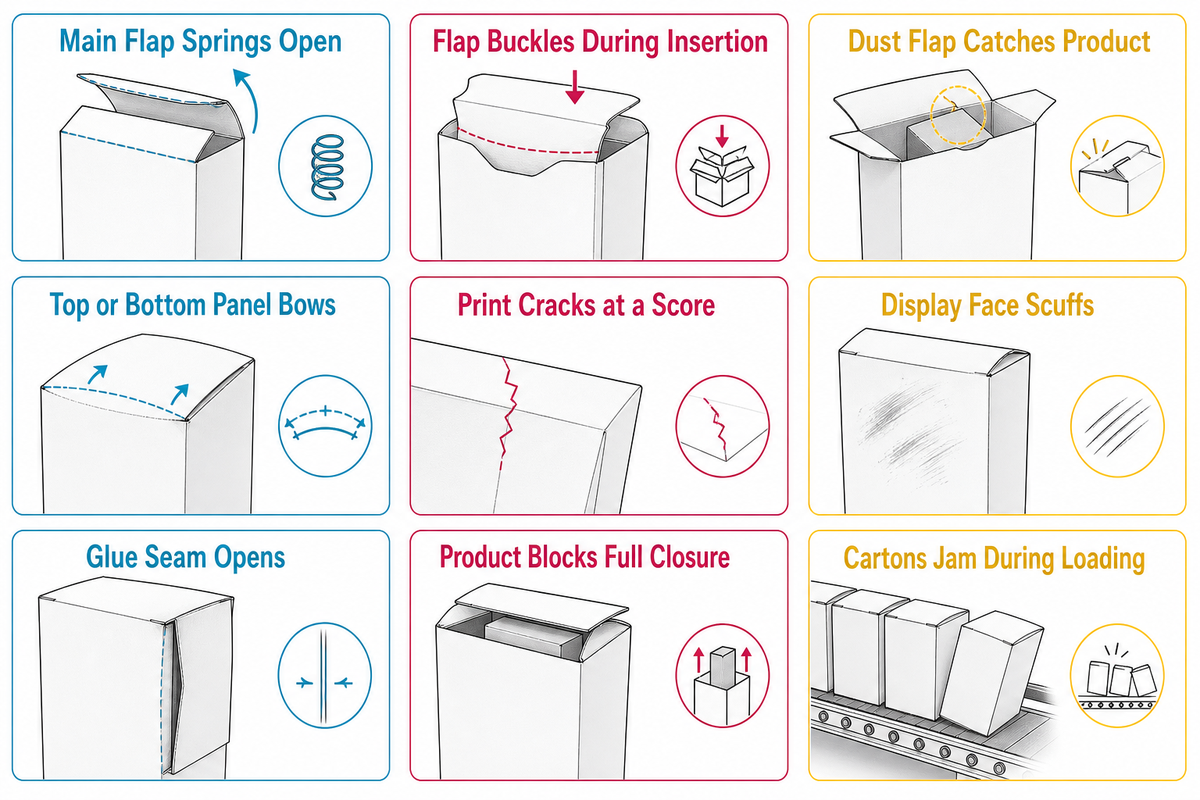
When a carton won’t close, the quickest material upgrade may be the wrong choice. Save the failed sample, approved sample, dieline revision, packed arrangement and process record before changing boards. The 9-Signal Closure Diagnostic routes the first checks; it doesn’t diagnose root cause from a photograph.
Inspect the top and bottom flaps as separate mechanisms. A top closure can look correct while product pressure at the bottom of the box bows the opposite panel. That difference is another reason not to treat a smooth empty-sample close as proof of production performance.
A packaging user described the symptom this way: “When I unfold Box #1, the edges tend to spring back to their original folded position instead of staying straight like Box #2.” The compared samples were reported as 350 g and 400-450 g paperboard, yet replies considered fold memory, scoring, joint restraint and added friction. One respondent also suggested changing to a flap structure, which could create a different packing issue. The lesson is not to turn the sample into a paperweight. Preserve the sample and investigate other factors that could be affecting the closure.
| Visible signal | Evidence to inspect first | Plausible variable | Corrective lever to trial | Reapproval trigger |
|---|---|---|---|---|
| 1. Main flap springs open | Score, flap length, board grain, packed pressure | Fold memory or closure interference | Score or flap geometry prototype | Any geometry or board change |
| 2. Flap buckles during insertion | Entry angle, slit, edge and operator motion | Misalignment or excessive insertion force | Entry geometry and packing aid | New line or hand trial |
| 3. Dust flap catches product | Packed envelope and fold order | Clearance or loading-direction mismatch | Dust-flap shape or insertion sequence | Product, insert or flap change |
| 4. Top or bottom panel bows | Load path, panel span and insert support | Concentrated load or trapped product | Support, orientation or construction | Filled compression check |
| 5. Print cracks at a score | Grain, crease, ink, coating and cure | Finish-stack or converting mismatch | Crease and finish proof | Board, coating or tooling change |
| 6. Display face scuffs | Contact points, rub method and pack station | Surface contact or uncured system | Handling, protection or finish adjustment | New defined rub comparison |
| 7. Glue seam opens | Glue pattern, surface exclusion and joint overlap | Adhesion, setup or stored stress | Joint and adhesive process trial | Material, finish or glue change |
| 8. Product blocks full closure | Envelope, leaflet, insert and cap position | Pack-out mismatch | Restraint or dimensional revision | Any component or orientation change |
| 9. Cartons jam during loading | Blank flatness, opening force and timing | Line-condition or geometry mismatch | Machine trial and controlled adjustment | Production-speed confirmation |
For the Orion Sample Pack, a flap problem on the 90 × 60 × 180 mm prototype should be investigated with the 0.45 kg filled product in place. Removing the product and closing an empty sample can hide insert pressure, leaflet movement or incorrect long-axis placement. The failed and approved samples should carry the same revision identity.
Sample Approval and Consolidation: The 12-Field Packaging Lock Record
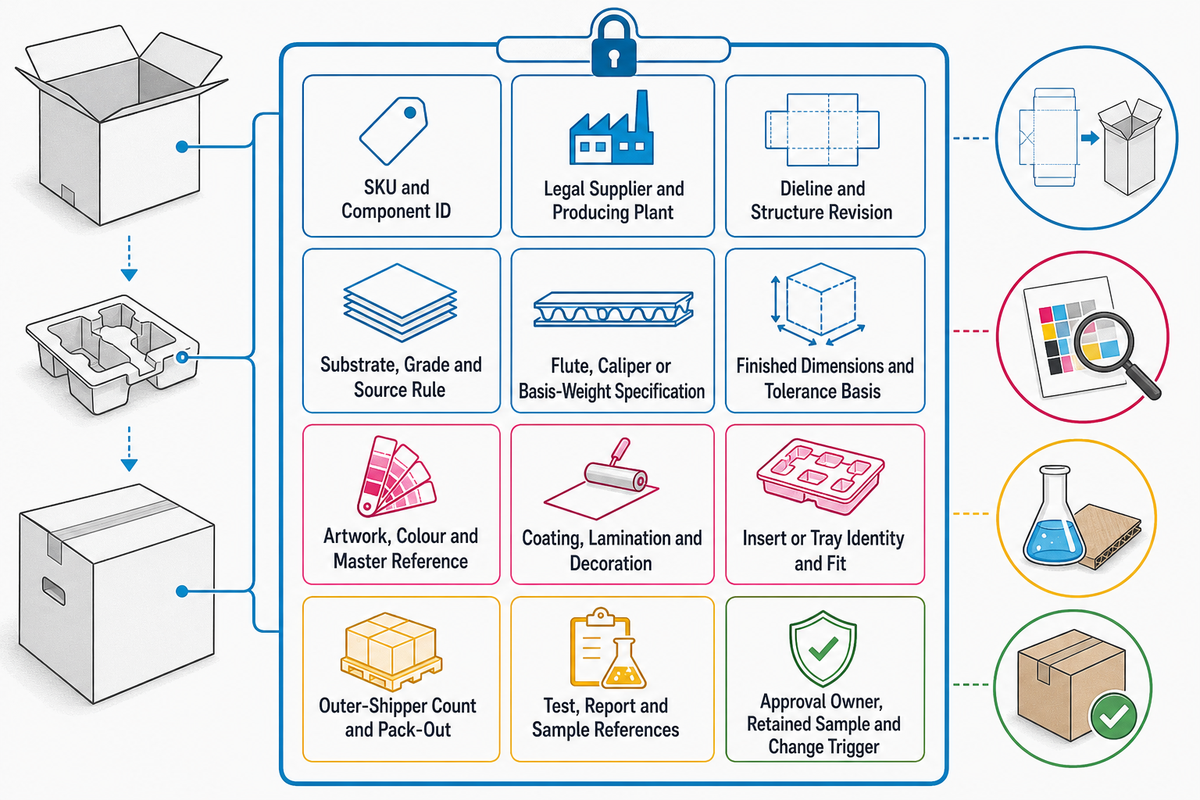
Production boards, artwork, inserts and outer cases can all still be changed between approval and production if identified only by emails. The 12-Field Packaging Lock Record gives each component and decision a controlled home. It can be incorporated in a buyer’s specification system, supplier job file or in a shared approval record, and serves as an original control framework, rather than an industry standard. A test reference should retain the exact method and revision; ASTM D5264 is one example of a laboratory comparison method for printed-material abrasion.
The packaging process ends only when the approved end product, component records and pack-out agree. A material or artwork substitution that appears minor to one department can change fit, rub, fold, glue or recycling guidance for another.
| Field | Record | Why it matters |
|---|---|---|
| 1 | SKU and component ID | Separates carton, insert, tray and shipper |
| 2 | Legal supplier and producing plant | Binds responsibility to the actual site |
| 3 | Dieline and structure revision | Prevents an obsolete blank returning |
| 4 | Substrate, grade and source rule | Controls material identity and substitution |
| 5 | Flute, caliper or basis-weight specification | Names the measurable construction fields |
| 6 | Finished dimensions and tolerance basis | Connects drawing convention to inspection |
| 7 | Artwork, colour and master reference | Identifies the approved graphic state |
| 8 | Coating, lamination and decoration | Controls the complete finish stack |
| 9 | Insert or tray identity and fit | Preserves restraint and loading direction |
| 10 | Outer-shipper count and pack-out | Links the retail carton to distribution |
| 11 | Test, report and sample references | Makes the evidence retrievable |
| 12 | Approval owner, retained sample and change trigger | Defines release and reapproval |
Consolidating the printed carton, inner tray and outer shipping case can decrease the number of handoffs and allow for one pack-out review. It does not certify performance. The three components must share the same SKU, revision, quantities and pack-out orientation. In the case of the Orion Sample Pack, the record would bind the 90 × 60 × 180 mm carton, the named insert and the 24-unit shipper, rather than treat the three purchase orders as separate items.
According to Huandao, each process step is scanned into an MES kanban and is reported in real time to the ERP and intelligent scheduling systems. The useful buyer question is not which software name appears on a slide. The important question is whether the job record refers to the approved dieline, the artwork, the material lot, the retained sample and the relevant test reports.
How to Verify Supplier Evidence on Your Own Job
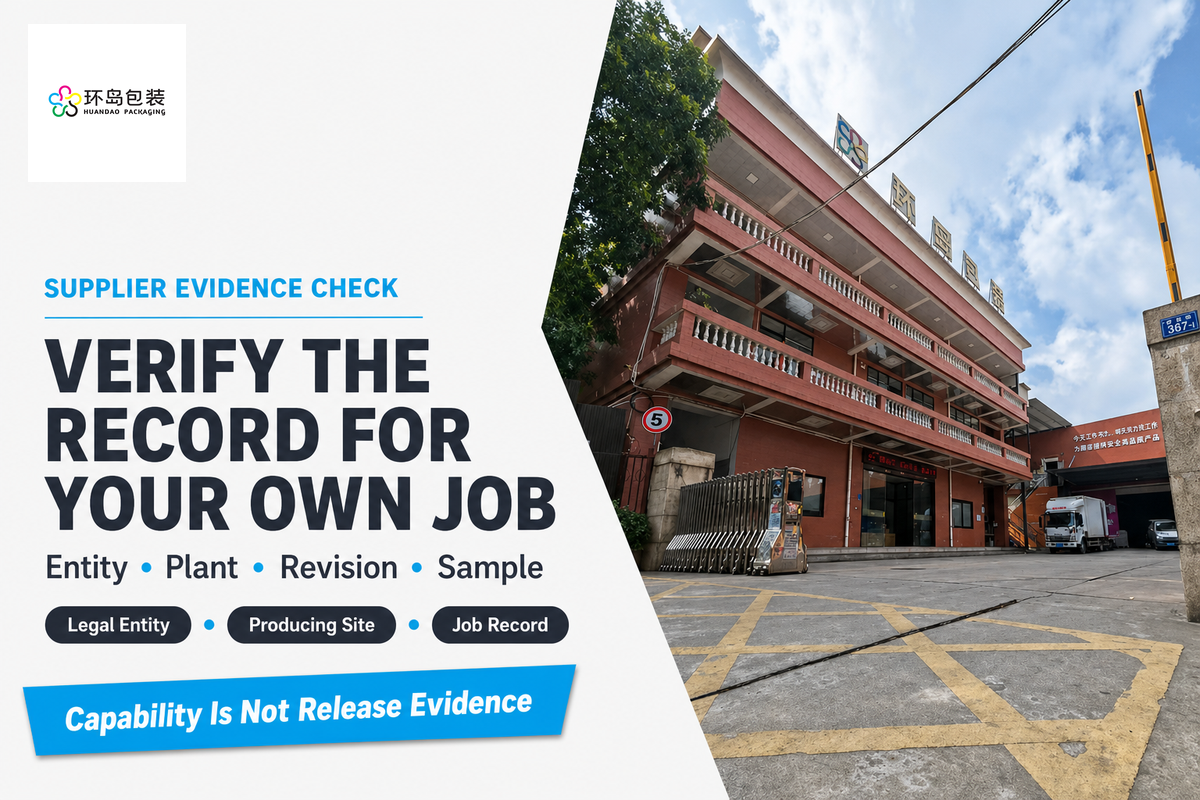
Commence by verifying the legal entity and production address against the supplier’s company and plant information, and then relate every technical claim to the respective job record. A sample capability statement may be useful context, but the release evidence must identify the ordered construction, artwork revision, sample and production lots.
Order evidence and supplier capability are different aspects. A photograph of a factory can show the equipment at an address. A certificate can identify an organization and scope. Neither proves that the proposed material, tooling, shift, sample and report controlled the current production run. Verification improves when each claim points to a legal entity, producing site, job, revision or retained sample.
A packaging company may offer more than one packaging solution. However, the buyer retains the acceptance boundary. A buyer needs to know how the proposed custom tuck box, product box or custom box differs from the approved sample. If the team wants to customize a retail product pack, record every packaging option that changes structure, finish, insert or product packaging evidence.
According to Xiamen Huandao Packaging Technology Co., Ltd., it was founded on 30 June 2003 with a registered capital of RMB 20 million, and has its own plant at No. 587 Tongfu Road, Tong’an District, Xiamen, Fujian with 133 staff members. It has in-house prepress, sheetfed offset printing, UV coating, lamination, die-cutting and folder-gluing. These should be verified for any order documentation affecting approval.
The company-provided profile identifies Huandao as the colour-printing plant of Huan Yin Packaging Group, reports group revenue above RMB 200 million, and describes the group as a President Unit of the Xiamen Printing Industry Association. These statements don’t provide a job specification, validate current certificates or indicate buyer acceptance. An official Xiamen notice issued on 30 December 2025 lists Huandao’s certificate GR202335101429 among qualifications cancelled with effect from 2024, so this guide does not present National High-Tech Enterprise status as current.
Seven verification checks
- Verify the legal entity and producing-plant address on the purchase and job records.
- Match the in-house process claim for this item to the approved routing.
- Match the material source rule to the ordered construction.
- Confirm that the test report corresponds to the job, specimen, method and acceptance criterion.
- Match MES and ERP records to the approved dieline and artwork revision.
- Match inserts, trays and shippers to the same pack-out master.
- Match the consolidated-shipment record to quantities and the freight handoff.
Huandao states that its group can supply inner trays, inserts and outer shipping cartons with the printed box and consolidate them into one shipment with shared freight. This may simplify the coordination; it doesn’t provide a lower landed cost or ensure damage-free delivery. Compare the full pack system and stated delivery basis.
Should the brief reveal a disparity between the requested pack and the available process route, use the supplier’s packaging service overview to clarify the available process scope. Keep the commercial discussion apart from the evidence provided by the guide.
Have a product, sample or current dieline?
Use the popup to review the packed dimensions, orientation, preferred material, finish, inserts, and routing against the specification record. The handoff should list assumptions and proof steps, not make a one-number capacity commitment.
Tuck End Boxes FAQs
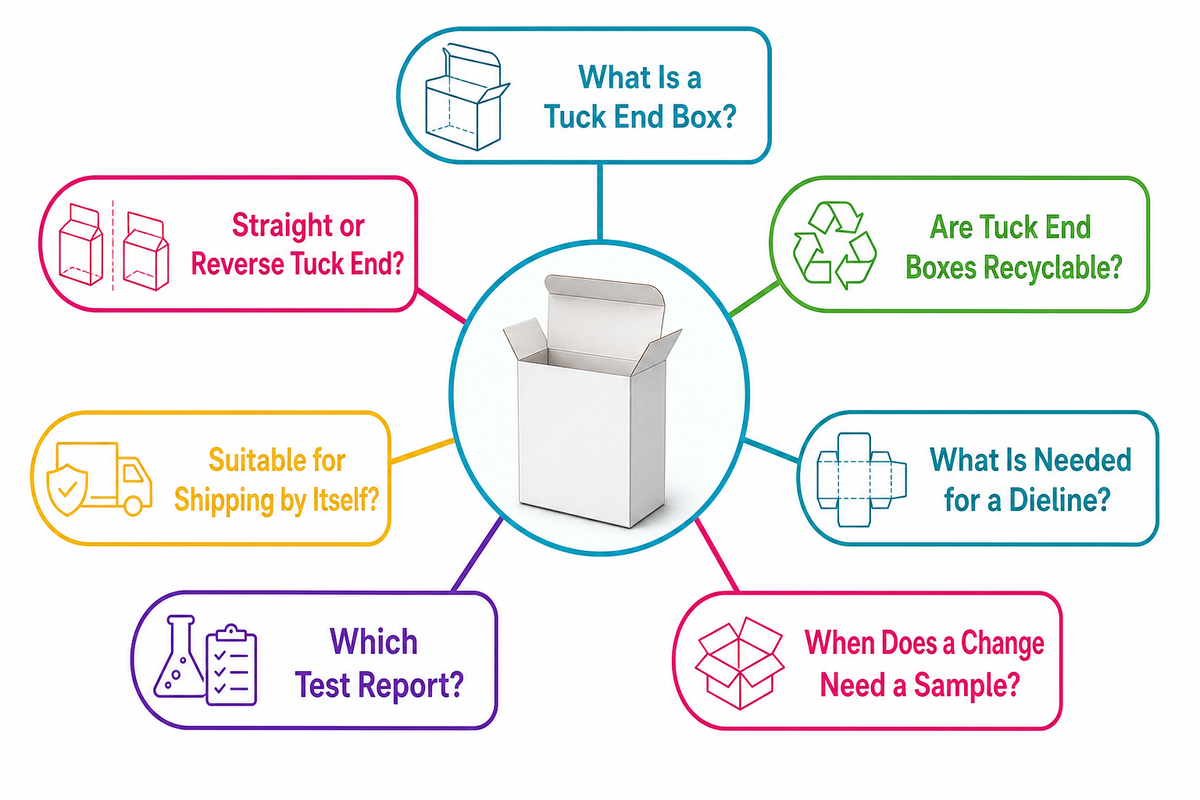
These questions combine recurring buyer gaps about carton construction, finishes, packing and verification. The answers remain conditional where the carton, finish or route controls the result.
What is a tuck end box? A tuck end box is a folding package closed by a flap that slips inside the box body.
The structure normally includes body panels, a glue seam, dust flaps, score lines and one or more main tuck flaps. It can be solid paperboard or corrugated construction. The style name doesn’t specify board grade, load capacity, transit performance or recyclability. Those require other specifications and evidence. The approved dieline and packed sample define the construction actually being accepted. For terminology alone, the ISO packaging terminology standard provides a general vocabulary; it does not verify the construction or performance of this box.
What is the difference between straight tuck end and reverse tuck end? The common distinction is the panel from which each main flap hinges.
In a straight-tuck layout, the main flaps hinge from the same principal panel; in a reverse-tuck layout, they hinge from opposing panels. This affects nesting, closure edges and packing sequence. The labels top and bottom don’t necessarily determine front or back. Mark the front, rear, top and bottom on the approved dieline because the nickname alone does not settle artwork presentation.
Are tuck end boxes recyclable? Some are, but the closure style alone cannot answer that question.
Check the substrate, coatings, film laminates, foil, windows, adhesives, inks and remaining product residue against the destination’s collection and processing rules. A technical test or labeling program only applies to its scope. If a material or finish changes, verify the claim rather than assume it applies automatically. Local rules apply. Collection rules vary by destination and material combination.
Is a tuck end box suitable for shipping by itself? Only when the exact finished pack is designed and validated for that route.
Many paperboard tuck cartons are retail or primary packs that are contained in a corrugated outer case. A corrugated tuck-style box may serve a wider distribution role, but its board result still does not replace evaluation of the complete structure, product, restraint, closure and handling environment.
What information is needed for a tuck end box dieline? Start with the packed product, orientation, visible faces, loading end, opening end and approval basis.
Record the maximum envelope including caps, inserts and leaflets; mass distribution and fragile points; display, barcode and regulatory faces; hand or machine insertion direction; consumer opening and reclosure; and material, tolerance and prototype conditions. Supply the real product or a dimension-controlled model. Approve an erected, filled sample before locking artwork.
Which test report should I request for a paperboard tuck carton? Begin with material identity and the failure mode you need to control.
Basis weight may verify the lot of paperboard, and an ink-rub sample comparison may confirm print abrasion. A solid-paperboard carton doesn’t default to an edge-crush test, which is a corrugated-board test. Add dimensional, score, glue, barcode, pack-out or route evidence, as necessary.
When should a packaging change trigger a new sample? Reapprove when a change could alter fit, appearance, conversion, evidence scope or distribution behavior.
Triggers may include paperboard source, grade, basis weight, flute, caliper, grain, finished dimensions, scores, cut-outs, glue, artwork, color, coating, lamination, foil, insert, shipper count, product orientation, packing line or test method. The lock record should name which changes require a structural blank, printed sample, line trial or packed-route test.
References & Sources
Xiamen Science and Technology Bureau qualification-status notice, 30 December 2025: Certificate GR202335101429 is listed among qualifications cancelled with effect from 2024; this source is used only to prevent an outdated status claim.
- ISO 21067-1:2016, Packaging, Vocabulary, Part 1: Current, confirmed general packaging terminology.
- ECMA Code of Folding Carton Styles: A structural style taxonomy and drawing reference.
- ASTM D5264-98 (2019): Printed-material abrasion-resistance comparison.
- Fibre Box Association, Key Differences Between 2013 and 2025 Standards: Revision scope and summary.
- GWP, Corrugated Board Grades Explained: Flute dimensions and board-grade terminology.
- Packaging Dive, 2025-2026 Folding Carton Market Report: Current market context and the Paperboard Packaging Council forecast.
- Corrugated Curricula, Module 4 Part 3: Burst, board weight and performance boundaries.
- US20190375537A1: A folding-carton flap and locking-relationship example.
Source boundary: External standards and technical sources support terminology and method scope and state of the art. Factory, Staffing, Group, Laboratory, MES and Consolidation statements are company-provided facts. Original maps and records in this guide are buyer decision frameworks, not standards or certifications.