Get in Touch with Xiamen Huandao Packaging Technology Co., Ltd.

An evidence-based look at carton structure, paperboard, printing, proofing, production acceptance and supplier records
Custom printed folding cartons are paperboard packages whose structure, substrate, graphics, finishes, and packed-distribution role must work as one design. Product weight or paperboard GSM alone can’t help in selecting a safe construction. Start with the Carton Decision Ladder, product and load path, pack-out method, closure and finally the means of display or shelf. Before production, apply the 4-Proof Carton Check to material, print, conversion, and distribution evidence tied to the actual job. The four proofs aren’t a replacement for a lot-sampling plan, or functional checks. Market-specific compliance and/or bar code checks aren’t replaced by these proofs. They keep a buying team from approving a flat artwork proof and assuming that the erected, filled, shipped carton has also passed.
For a brand, the useful question isn’t how far it can personalize custom folding cartons or how many packaging production services appear on a supplier list. It’s whether the resulting folding carton packaging fits the product, production method, and route. This guide turns those packaging needs into a verifiable brief.
The release rule
Approve the construction only after the proposed board, print-and-finish stack, converted sample, and packed distribution system have produced the records required for that use. Write down what each record proves, what it does not prove, and what change forces reapproval.
Quick Specification Map
| 1. Product | Dimensions, mass, fragility, contact conditions, restraint, orientation |
| 2. Pack-out | Manual or automated erection, loading sequence, line speed, case count |
| 3. Construction | Style, finished size, grain direction, board family, insert and shipper interfaces |
| 4. Graphics | Color references, coverage, inside print, barcode, legal copy, variable data |
| 5. Finish | Coating, lamination, foil stamping, embossing, glue exclusions, recovery claim |
| 6. Acceptance | Proof sequence, sample size, test method, criteria, deviations, retest trigger |
What Custom Printed Folding Cartons Are, and When They Are Not the Right Pack
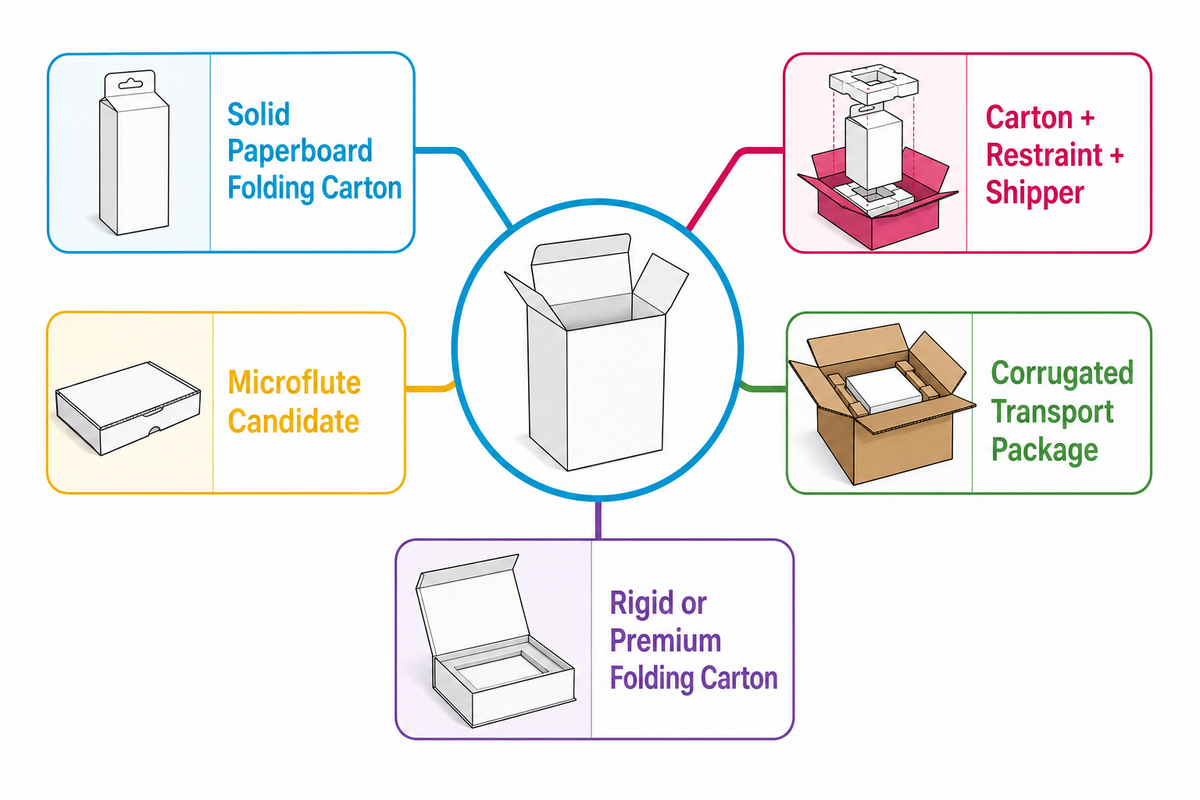
A folding carton is a printed, cut, creased, and glued paperboard package supplied flat and erected before filling. That evidence-first release rule starts with choosing the right packaging family for the job. It suits retail presentation and efficient transport of empty packs. Corrugated cases add a fluted medium for distribution loads; rigid boxes retain a formed shape for premium presentation. These formats can be nested rather than treated as substitutes.
Market wording is less precise. Custom folding boxes, printed boxes, and folding carton boxes can all be used to describe the same basic type of packaging. Retail packaging describes a sales-channel function, while product packaging describes a pack around an article; neither defines board construction by itself.
| Use case | Likely starting family | Main reason | Release evidence |
|---|---|---|---|
| Light retail item | Solid paperboard folding carton | Print surface and shelf efficiency | Filled sample and case-pack trial |
| Fragile glass bottle | Carton plus restraint and shipper | Impact and product movement | Packed route test |
| Dense hardware | Reinforced board or microflute candidate | Concentrated bottom and panel load | Compression and handling trial |
| Chilled or damp route | Condition-tested construction | Moisture changes board behavior | Conditioned filled-pack test |
| Automated cartoning | Machine-compatible folding carton | Feeding, opening, closing, and glue timing | Actual line trial |
| Subscription kit | Carton or corrugated mailer with insert | Multiple parts and parcel route | Complete-kit drop and movement check |
| Premium gifting | Rigid box or premium folding carton | Presentation and repeated handling | Appearance and use-cycle sample |
| Parcel shipping | Corrugated transport package | Distribution hazards | Route-appropriate packed test |
| Counter display | Display-ready carton or tray | Opening geometry and loaded stability | Loaded display test |
| Multi-component product | Carton, insert, and outer case system | Shared dimensions and restraint | Full packaging-system trial |
A 500 g product can load a panel in a different way than a 300 g product. Orientation, empty space, humidity, handling, and the outer case can also affect the result.
What is the difference between corrugated and folding carton?
A folding carton is usually a single paperboard construction which is printed, die-cut, creased and glued, and shipped flat. A retail folding carton may still travel inside a corrugated outer case, so the two packages can perform different jobs around the same product.
Use the Carton Decision Ladder: Product, Pack-Out, Closure, Display
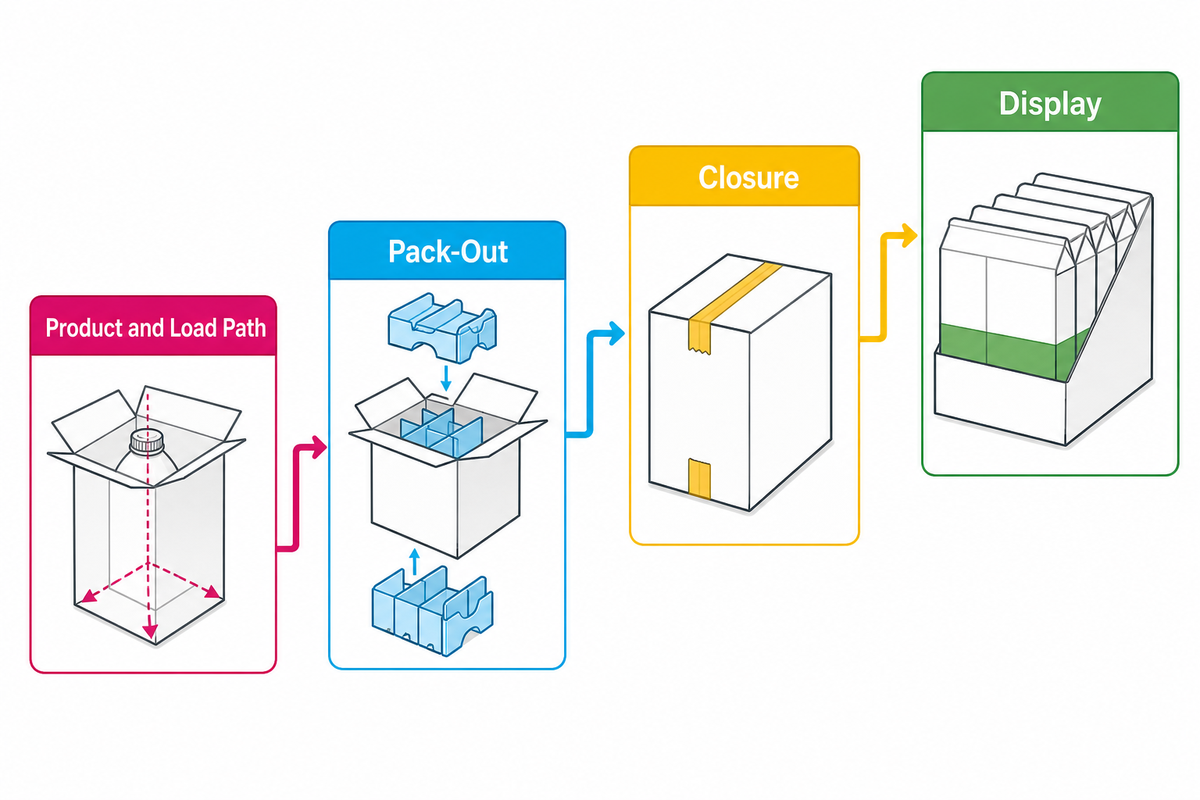
Choose carton styles in four passes: describe the product and load path, define erection and filling, choose the closure, set shelf orientation and decoration. Each pass narrows the structure through a different failure risk. This ordering system stops a familiar tuck shape from being selected before its working conditions are known. The ISTA test-procedure families show why route and hazard assumptions belong in the brief: screening, partial simulation, general simulation, enhanced simulation, member-performance, and development tests answer different questions.
Custom packaging boxes are a form of folding packaging. Folding carton styles, packaging designs, and visible design elements are outputs of the same input sequence. Unique shapes need more, not less, attention to panel support, die-cut waste, opening force, and pack-out.
- Product and load path: record dimensions, mass, fragile points, contact restrictions, center of gravity, and which panels carry load.
- Pack-out: indicate the means of erection (hand, automatic), loading direction, product restraint, closure, and the units loaded per outer case.
- Closure: decide on tuck, lock, adhesive, seal, tamper evidence, or repeated opening.
- Display: confirm shelf face, hanging or window needs, stacking, opening experience, and the surfaces that must stay visible.
| Structure | Best starting fit | Constraint to expose | Validation point |
|---|---|---|---|
| Straight tuck | Clean front and back panels | Same-side tuck interference | Erection and closure |
| Reverse tuck end | Efficient nesting on many layouts | Opposing end behavior | Product loading direction |
| Auto-bottom | Faster hand pack-out | Pre-glued bottom and flatness | Bottom lock under filled load |
| Snap-lock bottom | Moderate bottom support without pre-glue | More assembly steps | Operator repeatability |
| Seal-end | Automated closing or tamper control | Glue application and opening method | Line and adhesive trial |
| Sleeve | Tray wrap or product reveal | Axial movement | Retention and removal force |
| Window carton | Product visibility | Film, glue, recovery, and crack risk | Window bond and filled appearance |
| Hanger carton | Peg display | Tear-out around the hang hole | Loaded hanging trial |
| Display carton | Ship-to-display conversion | Tear strip and remaining stiffness | Opened, loaded display |
| Litho-laminated microflute | Higher protection with printed presentation | Thickness, flute direction, crushing, and scoring | Converted and packed test |
Worked example, not a lookup rule
Consider a hypothetical 0.45 kg product measuring 90 × 60 × 180 mm, loaded upright by hand and packed 24 units per outer case for a parcel route. The ladder can shortlist a paperboard tuck carton with restraint and a microflute alternative. The 0.45 kg figure doesn’t decide between them. Structural samples and a filled 24-unit route trial do.
How can I create my own custom box?
Begin with product dimensions, mass, orientation, restraint, packing method, closure, case count, distribution route, and required shelf face. Give those inputs to a structural designer, who can create a dieline and sample. Package design should begin by defining the erected, filled package. Approve the erected, filled package rather than cutting a shape first and forcing the product, artwork, and packing operation to fit it later.
Choose Paperboard by Product Load, Surface, and Distribution Risk
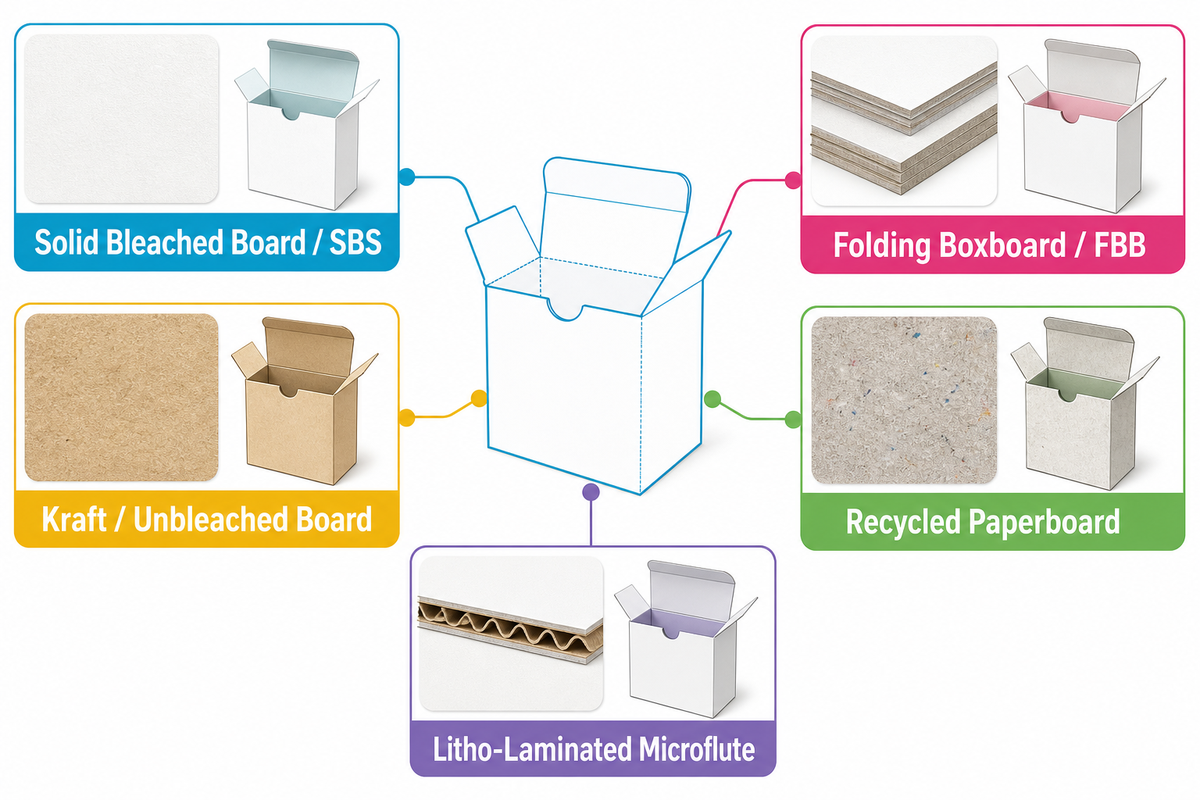
Selection of a board involves comparing different properties of a board, not simply finding the heaviest board. The product and pack-out fields from the decision ladder define which board properties matter most. Basis weight, caliper, density, stiffness, grain direction, moisture, scoreability, surface strength, ink holdout, and gluability describe different behavior. A change in grain direction alters the board stiffness.
| Board family | Useful characteristic | Question before selection | Evidence to request |
|---|---|---|---|
| Solid bleached board / SBS | Bright, smooth print surface | Does the construction need surface quality on both sides? | Grade data and printed converted sample |
| Folding boxboard / FBB | Multi-ply structure with stiffness efficiency | Which grade, caliper, grain, and finish are quoted? | Declared grade plus lot record |
| Kraft / unbleached board | Natural appearance and fibre character | How will the base shade change color reproduction? | Wet proof or press sample |
| Recycled paperboard | Recycled-content option | What surface, odor, contact, and shade limits apply? | Declared content and use-specific review |
| Litho-laminated microflute | Printed liner plus fluted support | Which flute, direction, liner, and compression risks apply? | Component specification and packed test |
Huandao’s commercial page lists 250–400 gsm FBB/GC1/GC2 and 250–350 gsm kraft as company-specific starting ranges. Those bands describe availability, not the load a filled carton can carry. A buyer must take into account the proposed grade, caliper, grain, score geometry, climatic conditions, span of the panel, and the filled-pack result.
Test names need the same care. ISO 3037:2022 covers edgewise crush resistance of corrugated fibreboard. ISO 2759:2014 covers board bursting strength, with a stated range of 350–5,500 kPa; its qualified 250 kPa exception warns that normal accuracy or precision may not hold. A number without material, method edition, conditioning, specimen direction, and result range is not a comparable specification.
What material is used for foldable boxes?
Foldable boxes usually employ paperboard families such as SBS, FBB, kraft, or recycled board. Higher protection designs may use litho-laminated microflute. The family name is just the first field. Caliper, grain, stiffness, surface, moisture behavior, crease geometry, finish, and the filled distribution test determine whether the exact construction is suitable.
Design the Print-and-Finish Stack for Conversion, Not Just the Screen
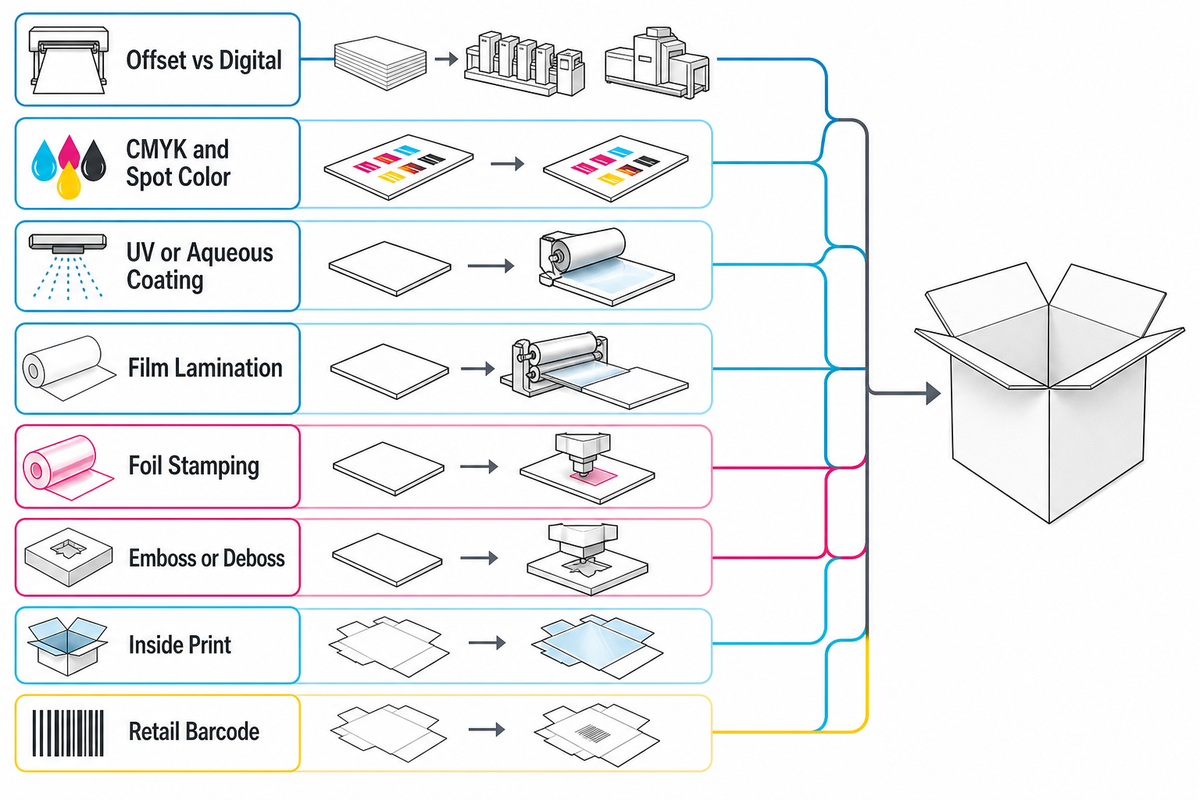
A print file can look correct on a monitor, but yield cartons that scuff, crack at the score, block in a stack, reject glue, and/or won’t scan at retail. Once board properties are fixed, the print-and-finish stack has to preserve them through conversion. Treat offset printing or digital printing, ink, coating, lamination, foil stamping, embossing, die cutting, and folder-gluing as one conversion stack. Each step in the process alters what the next step receives.
Box printing vendors may sell printing services, printing methods, and printing techniques as separate menus. For custom printed boxes, the record joins those choices to the exact packaging material and board condition. Customization and finishing options may contain debossing, but each customizable feature still needs a host panel, tooling allowance, and approval point.
| Decision | Appearance question | Conversion risk | Check on intended board |
|---|---|---|---|
| Offset vs digital | Color target and variable content | Process-specific setup and matching | Production-process proof |
| CMYK and spot color | Reference, tolerance, lighting | Trapping and registration | Agreed press condition |
| UV or aqueous coating | Gloss, matte, and rub target | Cure, score crack, glue exclusion | Rub, fold, and bond test |
| Film lamination | Protection and tactile effect | Delamination, fold behavior, recovery route | Converted sample and claim review |
| Foil stamping | Coverage and fine detail | Heat, pressure, registration, score proximity | Finished press sample |
| Emboss or deboss | Relief depth and location | Panel distortion and reverse-side marking | Erected sample |
| Inside print | Opening experience and hidden copy | Rub, contact, fold, and glue zones | Opened, filled sample |
| Retail barcode | Contrast and placement | Reflectance, quiet-zone intrusion, folds, ink damage | Finished-symbol verification |
For products carrying retail barcodes, check the finished converted package and verify the symbol. GS1 identifies reflective surfaces, compromised quiet zones, folds, distorted modules, weak contrast, and ink damage as scan risks. Verification of print quality of a barcode is different from testing the function of a linked web address.
Food packaging adds another branch. FDA research says photoinitiators in exterior UV-cured printing inks may migrate to food for some intended uses. That is a hazard-identification finding, not a conclusion that every exterior ink or carton is unsafe. Define direct or indirect contact, any inner barrier, the ink and coating system, intended temperature and duration, migration or compliance evidence, and destination market.
What is the best finish for custom boxes?
Not every custom box finish serves all purposes. Pick the right finish based on the look, rub resistance, score and fold behavior, glue area, food-use condition, recovery route and budget. A high-gloss surface may strengthen shelf impact yet create barcode reflectance or glue concerns. Approve the complete finish stack on the board that will be used.
Move from Dieline to Press With a Verifiable Approval Trail
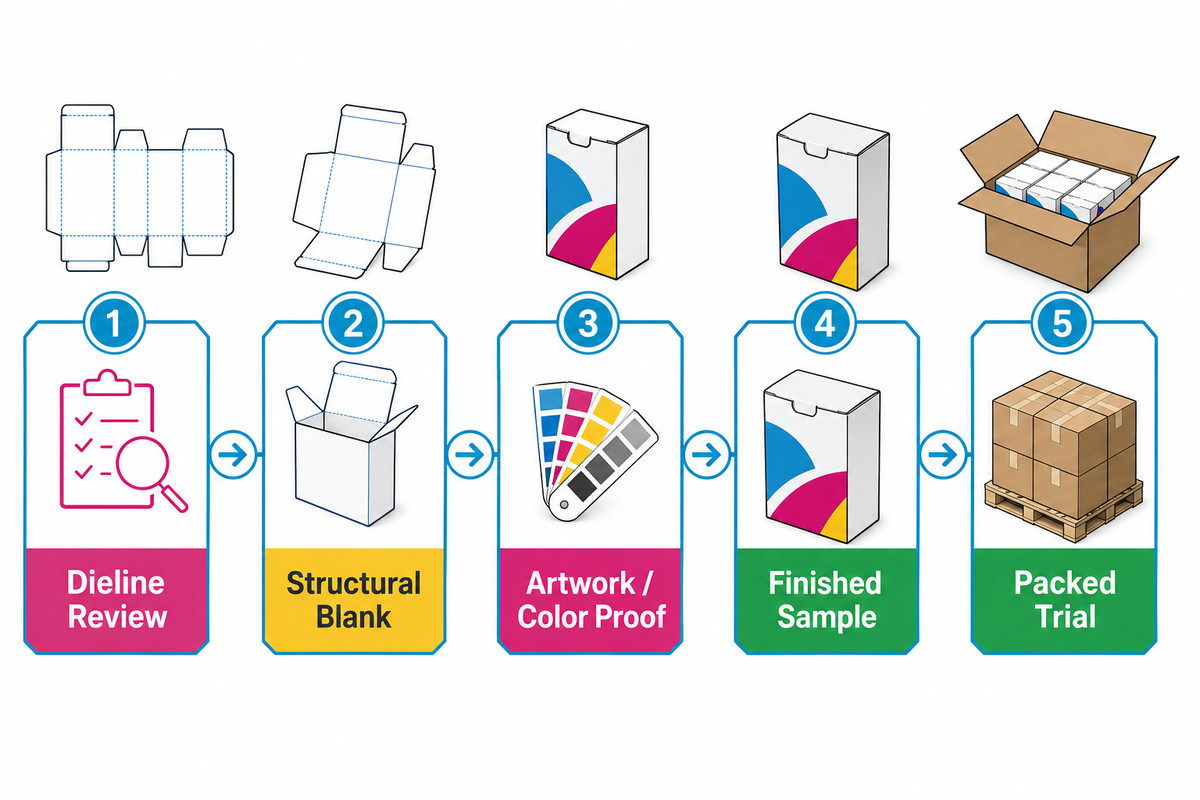
Different samples answer different questions. Some structural blanks check size and assembly but not color. Some proofs check color but not score cracking. A finished sample shows conversion yet may not represent the production lot or packed route. Assign an owner, freeze point, and reapproval trigger to every stage.
| Stage | Can establish | Cannot establish | Reapproval trigger |
|---|---|---|---|
| 1. Dieline review | Panels, cuts, creases, glue and artwork zones | Physical fit or board behavior | Geometry, closure, or pack-out change |
| 2. Structural blank | Fit, erection, loading, closure, insert interface | Color, rub, finish, production repeatability | Board, grain, score, product, or line change |
| 3. Artwork / color proof | Copy, position, separations, target appearance | Converted performance and transit | Artwork, process, ink, or board change |
| 4. Finished sample | Print, finish, score, fold, glue, filled appearance | Whole-lot acceptance or route survival | Material, tooling, process, plant, or supplier change |
| 5. Packed trial | Performance of the defined pack-out and route simulation | Every route, climate, product, or future lot | Pack count, shipper, insert, route, mass, or product change |
ISTA separates screening, simulation, and development tests. It also updates procedures, so a report should state the procedure and version, packed mass, configuration, route assumptions, sample condition, and acceptance decision. A test name without those fields is too thin for comparison.
Hand erection isn’t proof of cartoning-line performance. A peer-reviewed mechanical study found that crease stiffness varies through three characteristic stages during carton manipulation. Folding on a running cartoner therefore differs from a static hand check. Trial the actual scored, coated, and glued carton on the buyer’s equipment when automated loading is in scope.
Can I print on the inside of my custom boxes?
Yes, inside printing is feasible when artwork layers, ink system, contact conditions, fold lines, rub points, and glue zones are specified together. Approve the opened and erected sample, not the flat proof. For food, cosmetics, pharmaceuticals, or another regulated use, confirm the intended contact and destination-market evidence before production.
Run the 4-Proof Carton Check on the Job You Will Actually Ship
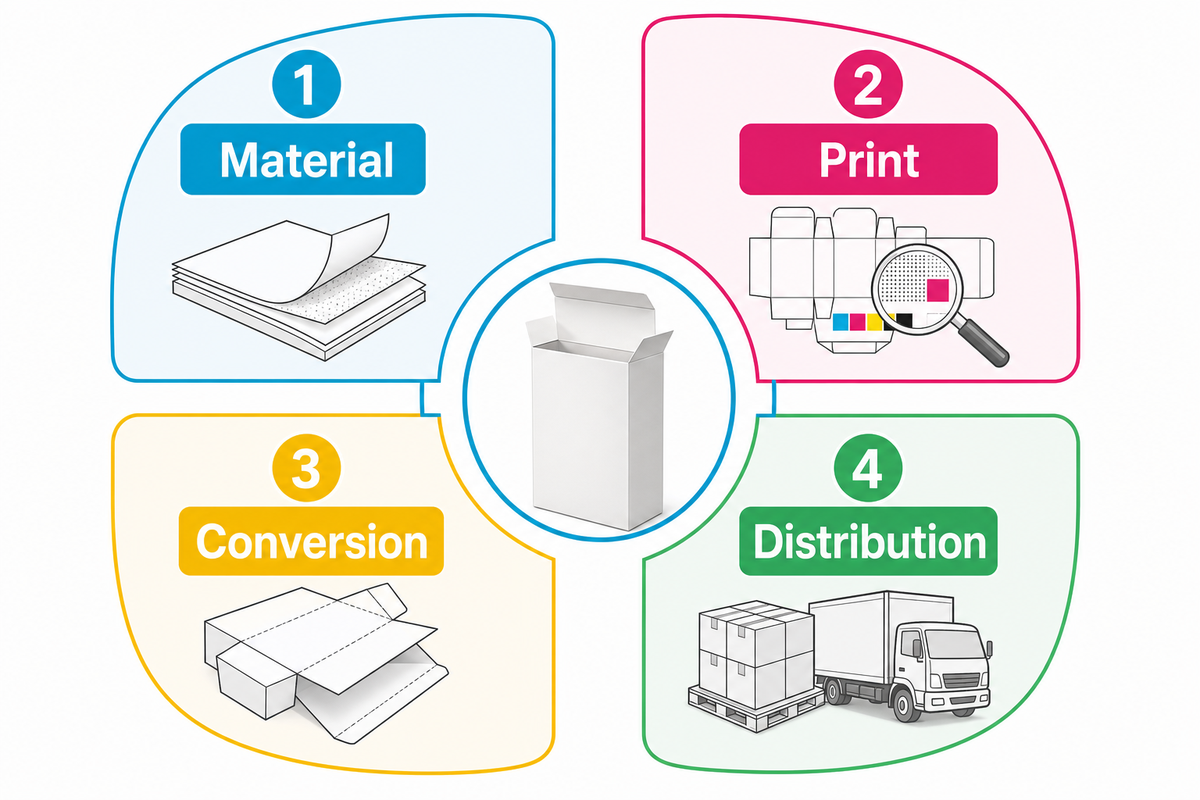
The 4-Proof Carton Check groups acceptance records by risk: material, print, conversion, and distribution. It’s a production-validation framework and is neither a complete market-access decision nor a statistical lot acceptance plan. Each proof requires an identity field that ties it to the proposed construction and production run. For the distribution proof, select the ISTA procedure family that matches the intended purpose; a screening test, a simulation, and a comparative development test do not make the same claim.
| Proof | Record set | What it can show | What it cannot show alone |
|---|---|---|---|
| 1. Material | Grade, supplier, lot, basis weight, caliper, grain, condition | Identity and measured board properties | Filled-carton strength or legal suitability |
| 2. Print | Color reference, process condition, registration, rub, barcode result | Appearance and specified print functions | Crease, glue, distribution, or linked-content function |
| 3. Conversion | Dimensions, score, fold, die cut, glue, erection, line trial | Converted geometry and operation | Route survival or whole-lot quality |
| 4. Distribution | Pack-out, case count, shipper, insert, method/version, outcome | Defined packed-system response | Unmodelled routes, climates, or future changes |
The 9-Point Job Record Checklist
- Job, lot, and component identity
- Approved construction revision
- Sampling plan and sample size
- Test method and edition
- Conditioning and test setup
- Acceptance criteria and tolerance
- Measured result and disposition
- Approved deviation and owner
- Change or failure that triggers retest
Job-linked sampling reports establish provenance. NIST describes lot acceptance sampling as drawing a random sample from a defined lot to support an accept/reject decision; its main purpose is not to estimate the lot’s quality. Record the definition of the lot, sampling rule, acceptance number and disposition separately.
Huandao states that its in-house laboratory issues applicable ECT/burst, ink-rub, and basis-weight reports on the job itself, so the recorded numbers belong to the customer’s own production run. It also says every process is scanned into an MES kanban and reported in real time, with ERP and intelligent scheduling in the background. Treat these as company-attributed examples of the records a customer can request. Confirm the method, component, sample, result, and acceptance criteria for the actual order.
Know When the Carton Needs Microflute, Inserts, or an Outer Case
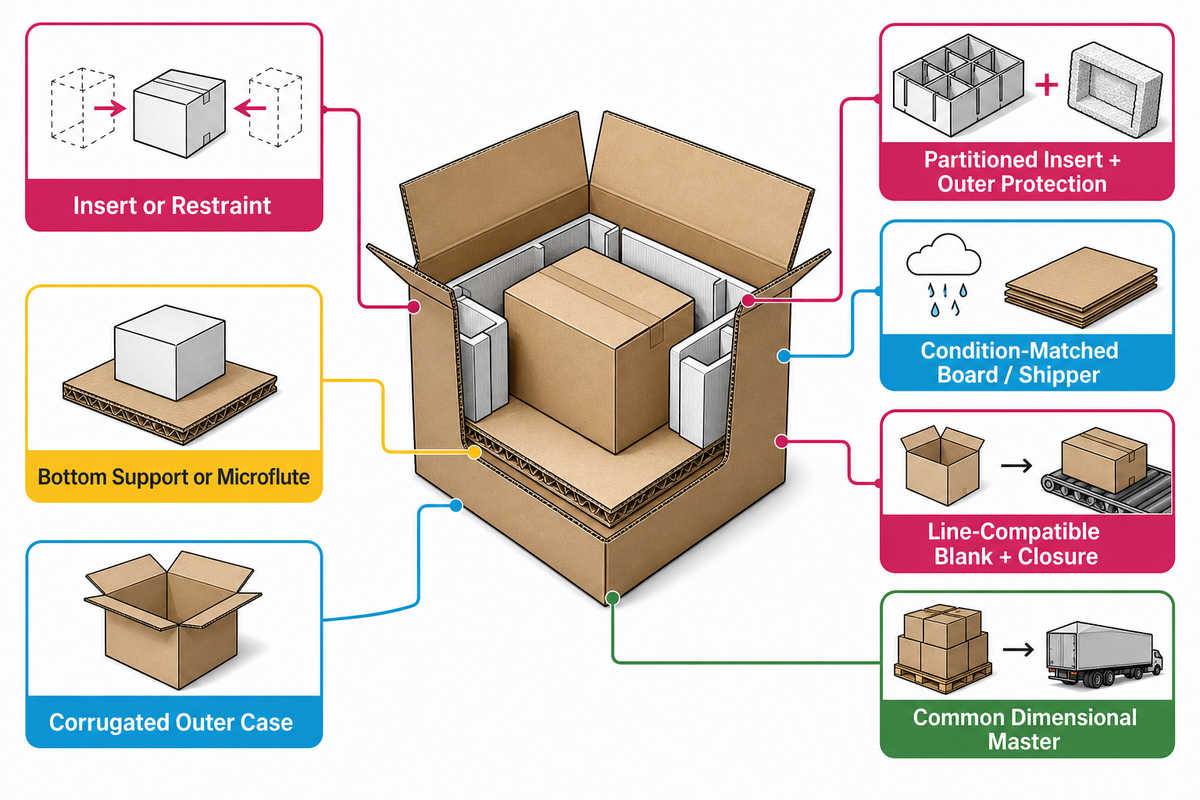
Design the retail carton, insert, and shipper together if they have load, restraint, dimensions, packing sequence, and distribution hazards in common. That system view extends the 4-Proof evidence from a single carton to every component that carries or restrains the product. ASTM D6198 covers transport-package design across shipping containers, interior protection, and unit loads; it excludes a primary pack unless that pack is also the shipping container. Therefore, an attractive retail carton need not carry the parcel route alone.
| Observed risk | Candidate response | Shared interface | Test before release |
|---|---|---|---|
| Fragile product movement | Insert or restraint | Cavity, orientation, removal force | Filled movement and impact trial |
| Concentrated bottom load | Bottom redesign, support, or microflute candidate | Load path and panel span | Filled compression/handling |
| Parcel distribution | Corrugated outer case | Case count, orientation, void, closure | Route-appropriate packed test |
| High-value multi-part kit | Partitioned insert plus outer protection | Part retention and presentation | Complete-kit use and transit trial |
| Damp storage or route | Condition-matched board/shipper | Moisture exposure and dwell time | Conditioned packed test |
| Automated packing | Line-compatible blank and closure | Flatness, opening force, timing, glue | Production-speed line trial |
| Consolidated shipment | Common dimensional master | Carton, insert, case, pallet, freight basis | Full pack-out and load plan |
ASTM D5639/D5639M-25, which applies to corrugated boxes, calls for testable performance attributes and standard methods accepted by both the buyer and seller. It ties requirements to intended use, handling, environment, stacking, content support, drop, and impact. It supports a failure mode decision, not a universal product-weight-to-flute cutoff.
Huandao reports in-line production of single E-flute and single B-flute board. Other profiles are sourced and laminated. The company says it can manage printed cartons, inner trays or inserts, and outer shipping cartons within Huan Yin Packaging Group and integrate them into one shipment. Shared freight may simplify interfaces and consolidation; it does not guarantee lower freight, zero damage, or suitability without the shared specification and packed trial.
What is the difference between cardboard and corrugated cardboard?
“Cardboard” is a vague, common term. Folding cartons usually don’t have a fluted center layer. Corrugated board combines liners with a fluted medium, creating a thicker structure used for cases, inserts, and some retail packs. Be specific about the board construction, flute profile, liners and role instead of writing “cardboard box” on the request.
Build a 6-Field Carton Brief Suppliers Can Quote Without Guessing
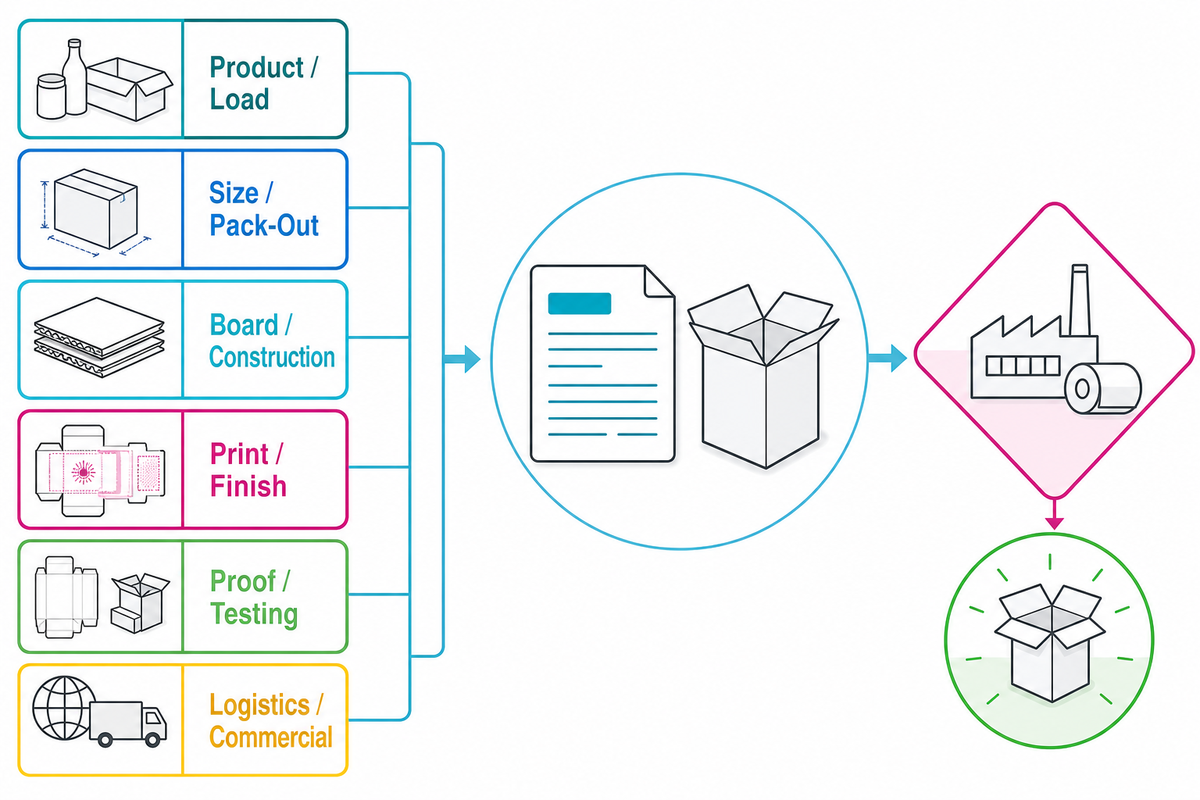
The 6-Field Carton Brief is a starting template and shouldn’t be interpreted as a universal standard. Lock the same product/load, finished size and pack-out, board/construction, print/finish, proof/testing, and logistics/commercial basis before comparing unit prices. Add other fields (food contact, regulatory, line, product or route) if required by the situation.
Ordering custom boxes becomes easier to compare when every packaging company receives the same brief. A custom folding carton packaging request should state its unique requirements, design options, and the boundary between design and shipping. A supplier may suggest an alternate packaging solution, but deviation should be stated beside the quoted line.
| Field group | Lock these line items | Require supplier response |
|---|---|---|
| 1. Product/load | Dimensions, mass, orientation, fragility, contact and restraint | Assumptions and exclusions |
| 2. Size/pack-out | Finished internal size, style, hand/line method, case count | Tolerance and line conditions |
| 3. Board/construction | Grade, caliper/basis weight, grain, flute/liners, tooling | Exact material and substitution rule |
| 4. Print/finish | Process, colors, coverage, inside print, coating, lamination, foil | Process condition and glue exclusions |
| 5. Proof/testing | Blank, color, finished sample, line trial, packed test, criteria | Included scope, sample count, method, retest cost |
| 6. Logistics/commercial | Quantity breaks, flat-pack method, delivery basis, ship-to, schedule | MOQ, lead time, freight basis, payment, deviations |
At least 12 price-bearing lines should be normalized: structure and finished size; order quantity; board; print process and color count; coverage; finish; tooling; structural and print samples; testing; packing method; freight/delivery basis; and approved deviations. A lower unit price can hide a different board, fewer proofs, simpler finish, excluded tooling, smaller case count, or freight that ends earlier.
A free quote only states that the proposal itself incurs no cost. Free design or free design support must still name the deliverables, revision count, dieline ownership, and what happens if the order does not proceed. Complimentary shipping must name the destination and delivery basis, and it isn’t the same as freight being omitted from the cost. Shipping services, if quoted separately, must define carrier scope, handoff, and risk ownership.
Destination market belongs in the brief. The European Commission states that Regulation (EU) 2025/40 began phased application on 12 August 2026, including limits on PFAS in food-contact packaging, while later labelling and circularity measures have separate dates. In the United States, an FDA Food Contact Notification is effective for the named manufacturer, substance, and conditions of use; a chemically similar substance from another manufacturer cannot automatically rely on it. State the authorization route and the identity of the upstream supplier, when that route applies.
Once those fields are complete, the commercial solution page for custom printed folding cartons is the appropriate place to review Huandao’s configuration options and request a quote.
What is the minimum order quantity for folding cartons?
One packaging supplier’s published guide puts typical MOQs for offset-printed folding cartons at 1,000 to 5,000 units, and as low as 50 to 250 units for digital printing at a higher per-unit cost; each supplier’s MOQ is still specific to the job. Carton size, structure, board availability, print process, color setup, finishing, tooling, sampling, packing, and production scheduling all affect the economic batch. Ask for quantity breaks for one specified job and check what changes at each break; a quoted minimum for one style or material isn’t a hard and fast rule.
Audit the Supplier Evidence, Not Just the Capability List
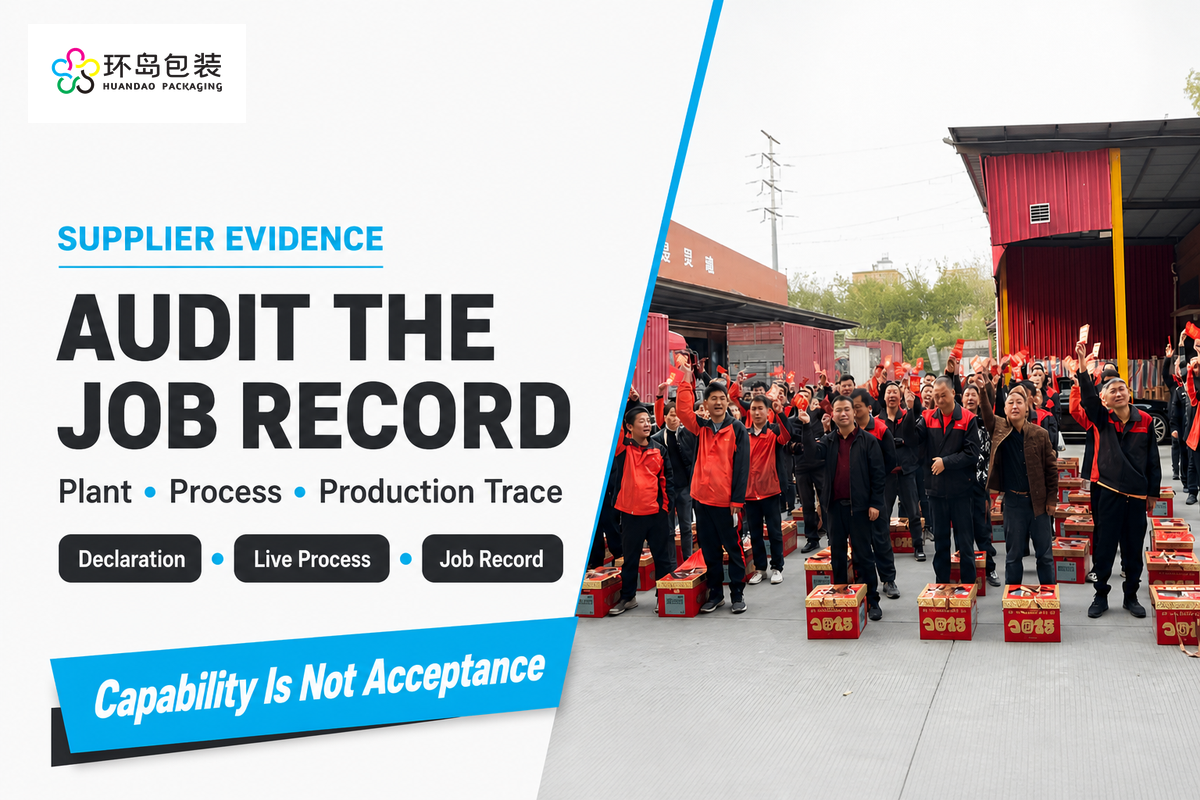
Evidence from the supplier strengthens from a simple declaration to a sample, to a live process, and, finally, to a job-specific record. A list of machines or a photograph of the factory can help locate the supplier’s capability to perform a given process. Whether the proposed board, ink, tooling, shift, test method and acceptance criteria controlled your run shows up in the job-specific record.
Folding carton manufacturers could describe an offer as premium quality, but that expression doesn’t provide an acceptance unit. A quality material claim needs the exact grade, lot, and measured properties. Premium quality folding cartons require agreed tolerances and job records. Packaging experts require measurable attributes before approval. A packaging company serving retail products cannot promise customer retention from the box alone; the carton can support presentation, but the commercial outcome has other causes.
4-level evidence ladder
- Declaration: capability statement, certificate, equipment list, or process description.
- Representative sample: similar material or process, clearly labelled as non-job evidence.
- Live-process proof: Approved process plan, trial output, inspection point or line result.
- Job-specific record: revision, material lot, measurement, result, disposition, and traceable owner for the production run.
Xiamen Huandao Packaging Technology Co., Ltd. says it operates its own plant at 587 Tongfu Road, Tong’an District, Xiamen, with 133 staff. Huandao’s company profile provides organization context. It does in-house prepress, sheetfed offset printing, UV coating, lamination, die cutting, and folder-gluing, backed by an in-house lab. According to the company, it also has an MES, ERP and intelligent scheduling system. These are company-provided facts. Audit the actual process flow and records proposed for the order.
The company was founded on June 30, 2003 with registered capital of RMB 20 million. Huandao reports that group revenue has passed RMB 200 million and that the group can supply inserts and outer cases with the printed carton. Huandao’s manufacturing background provides organization context; it is not a substitute for the job evidence ladder.
Which company makes cardboard boxes?
Paperboard converters make folding cartons; corrugated plants make shipping cases; rigid-box makers build set-up boxes; integrated packaging groups may coordinate several formats. Choose by the required process and evidence, not a generic “cardboard” label. Verify plant ownership, in-house versus outsourced steps, material traceability, inspection records, sample controls, and the exact site producing the order.
Treat Recyclability as a Construction and Evidence Question
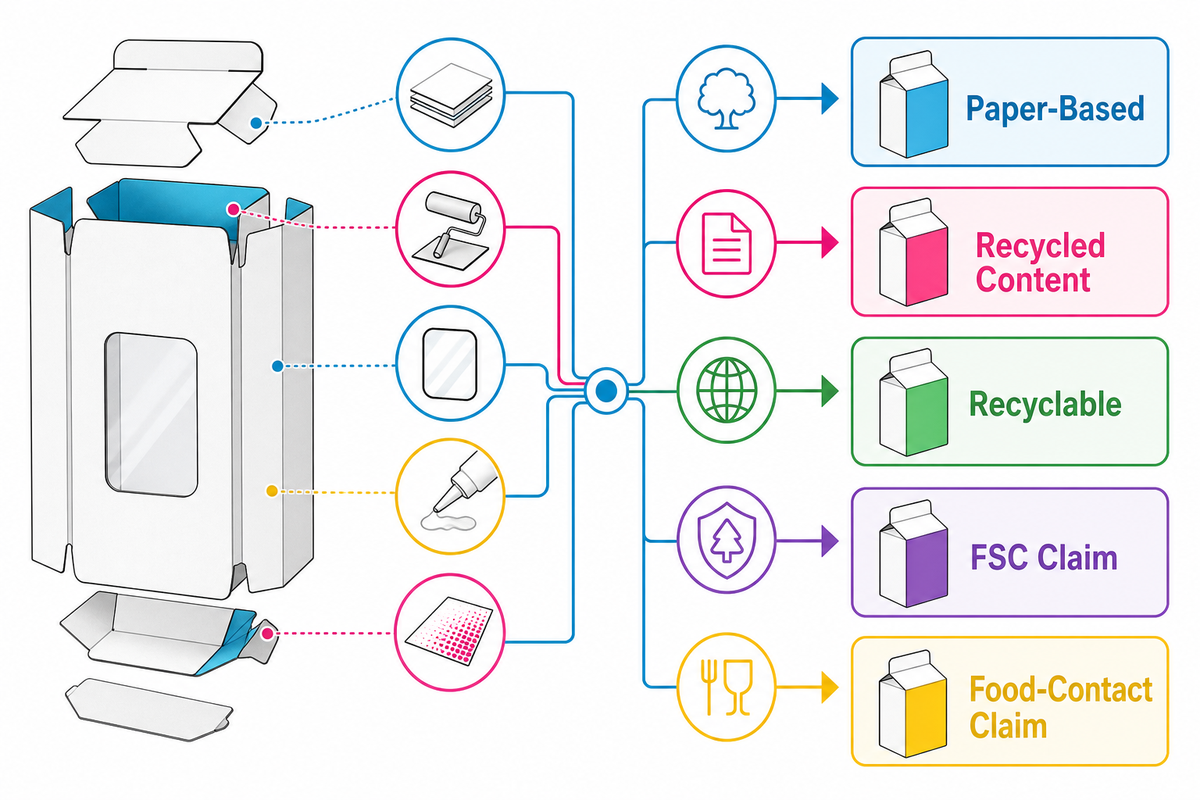
“Paper-based,” “recycled content,” “recyclable,” and “FSC-certified” address different concerns. The FTC says environmental claims should reflect how consumers understand them, be substantiated, and be qualified when needed. FSC Chain of Custody tracks certified material and records it through the supply chain. Neither rule turns a paperboard label into proof for the whole printed, coated, laminated, glued, and windowed construction.
Cardboard packaging and customized packaging are broad labels rather than evidence of recovery. A durable folding carton can also be space-efficient when shipped flat, but the FTC says recyclable claims should be qualified when recycling facilities are not available to at least 60 percent of the consumers or communities where the product is sold. For corrugated components, state the corrugated fiberboard grade and construction rather than rely on the word “paper.”
| Claim | Evidence question | Do not substitute |
|---|---|---|
| Paper-based | What are all components, coatings, films, windows, and adhesives? | Material family for recovery outcome |
| Recycled content | Percentage, component, calculation basis, and record? | Content percentage for recyclability |
| Recyclable | Which finished construction and recovery geography? | A substrate datasheet for local collection/access |
| FSC claim | Certificate holder, scope, product group, label authorization, invoice records? | A logo image or supplier statement for chain-of-custody scope |
| Food-contact claim | Substance, manufacturer, conditions of use, barrier, destination? | A generic ink or board certificate for the finished use |
Local rules can change the label decision. CalRecycle’s SB 343 page gives a 4 October 2026 manufacturing-date boundary for restrictions, while also reporting a 14 July 2026 preliminary injunction blocking enforcement as litigation continues. That dated status is an example, not legal advice. Confirm the sales destination, manufacturing date, current regulator guidance, and legal review before printing an environmental label.
Custom Printed Folding Carton FAQs
Can you get custom boxes made?
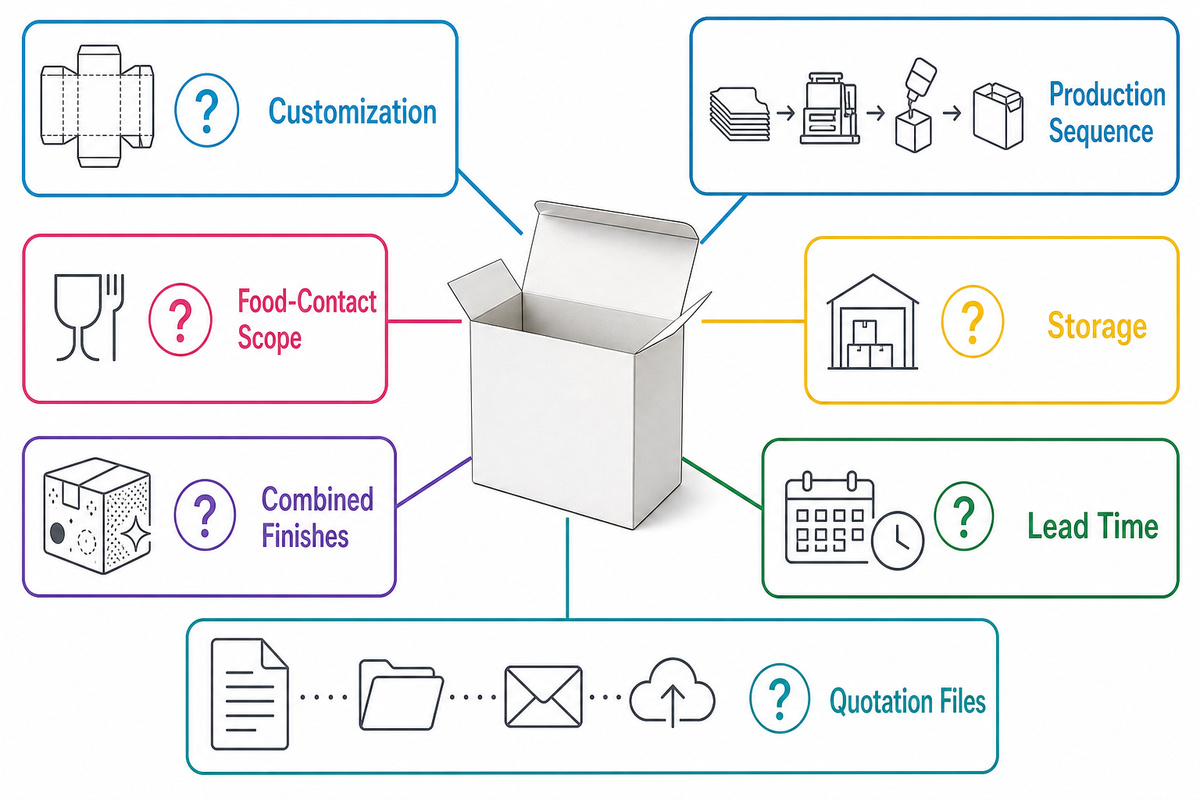
A converter can customize size, carton style, paperboard, printed graphics, inside print, coating, lamination, foil, embossing, window, insert, and packing method. The best first step isn’t deciding on each and every decoration. Send the product, pack-out, closure, display, distribution, and compliance inputs so the manufacturer can propose a construction and state its assumptions.
How are custom printed folding cartons made?
Production generally consists of art work and structural prepress, sheet layout, printing, coating or lamination, die cutting and creasing, waste stripping, folding and gluing, inspection, and flat packing. Additional operations can include foil stamping and embossing, variable coding, windows, and other features. The sequence matters because ink, coating, grain, score geometry, glue zones, and cure condition affect how the carton folds and runs.
Are printed folding cartons suitable for direct food contact?
Certain constructions may be feasible, but in the absence of authorization, “paperboard carton” doesn’t resolve the question. Define direct or indirect contact, food type, temperature, duration, inner barrier, ink, coating, adhesive, and destination market. Justify the regulatory basis for every component and request any manufacturer-specific evidence or notification, as well as migration studies, where applicable. Exterior printing of a finished good doesn’t answer the question for all intended uses.
How should unused folding cartons be stored?
Keep flat cartons clean, dry, supported, and protected from crushing, sunlight, odor, and rapid temperature or humidity changes. Follow the converter’s stacking, acclimation, and shelf-life guidance for the specific board, ink, coating, lamination, and adhesive. Before packing, inspect flatness, blocking, score condition, print rub, and glue performance after storage.
Can windows, foil, embossing, or special coatings be combined?
They can be combined when there’s enough space for all operations on the artwork, tooling, sequence, board and glue plan. A window can change film and adhesive requirements; foil adds heat, pressure, and registration constraints; embossing can distort a panel; a special coating may change folding, barcode reflectance, glue adhesion, food-use evidence, or recovery claims. Map every effect to the dieline so foil, coating, embossing, window film, scores, cut edges, and glue zones do not compete for the same area. Ask the converter to state the operation order and any registration tolerance that’s significant. Approve the complete stack on a converted, filled sample rather than approving each decorative effect in isolation.
How long does a custom carton order take?
For lead time, one online box printer lists 10-15 business days of printing for larger quantity orders and 5 business days for sample orders of fewer than 5 boxes; design, tooling, proofing, testing and freight sit outside that printing figure. Ask the supplier to separate design, sample approval, production, inspection, and delivery dates and to state which customer approvals start each clock.
What files should I send for a folding-carton quotation?
Provide dimensions and mass, orientation, photos and/or CAD when helpful, target internal dimensions, preferred style, pack-out method, case count, route, quantity breaks, destination, board and print expectations, finish, compliance conditions, proof and test scope, delivery basis, target date. If a dieline exists, include the editable vector file with fonts and linked graphics; label it as approved or reference-only. Also provide color references, barcode data and size, legal copy, variable-data rules, glue and no-print zones, plus any existing sample. Identify the source of each critical dimension and whether it is nominal, measured, or a tolerance limit. For an automated line, include speed, magazine orientation, erection and closing method, plus a video or sample blank if available. If a supplier has made assumptions, exclusions, suggested substitutions, and deviations, request that they provide these along with the quoted revision.
Turn the guide into an RFQ-ready decision
Complete the 6-Field Carton Brief, identify which of the 4 proofs applies, and mark every unresolved assumption. Then submit a completed carton brief for a construction review.
References & Sources
- Pick Paperboard Like a Pro Paperboard Packaging Council
- The Carton Packaging Fact File Pro Carton
- ISO 3037:2022 International Organization for Standardization
- ISO 2759:2014 International Organization for Standardization
- ISTA Test Procedures International Safe Transit Association
- ASTM D6198-18(2024) ASTM International
- ASTM D5639/D5639M-25 ASTM International
- What Is Acceptance Sampling? National Institute of Standards and Technology
- 2D Barcodes at Retail Point-of-Sale Implementation Guideline GS1
- Hazard Identification of Exterior Food-Packaging Ink Substances U.S. Food and Drug Administration
- New EU Packaging Rules Enter into Application European Commission
- Environmental Claims: Summary of the Green Guides U.S. Federal Trade Commission
- Chain of Custody Certification Forest Stewardship Council
- Stiffness Characteristics of Carton Folds for Packaging King’s College London / Journal of Mechanical Design
How This Guide Uses Factory Evidence
This article distinguishes general packaging principles from plant-specific statements and job records of Huandao. The 4-Proof Carton Check reflects the company’s ability to connect applicable material, print, conversion, and distribution evidence to a production job, while every suitability decision remains conditional on the exact product, construction, route, and market.
The exact-term SERP is 80 percent commercial while five-engine AI answers cite no Huandao source, exposing an evidence-led informational gap without changing the commercial owner. While this finding set the scope of the information for this guide, it isn’t a ranking claim.