Get in Touch with Xiamen Huandao Packaging Technology Co., Ltd.


By Karry · Updated October 2026
Used around beauty products, or on bottled serums, jars of cream and makeup tubes, cosmetic folding cartons are printed paperboard boxes. Their job combines product presentation, space for product information and support around the container. To compare cosmetic folding cartons means evaluating the board, the converted structure and the printed surface.
A high-quality folding carton can look right as a flat proof and behave differently after folding or filling. A dark panel shows a white crease. A change in brand color shows up in a replacement stock. All that’s true for different problems which require a comparison of their kind.
This guide deals with a carton from raw material to shelf in the beauty industry. Worked out examples are made-up comparisons, and aren’t customer production results. For structures, finishes and project price quotations, contact Huandao at cosmetic folding cartons packaging solution.
What cosmetic folding cartons do, and what they do not do
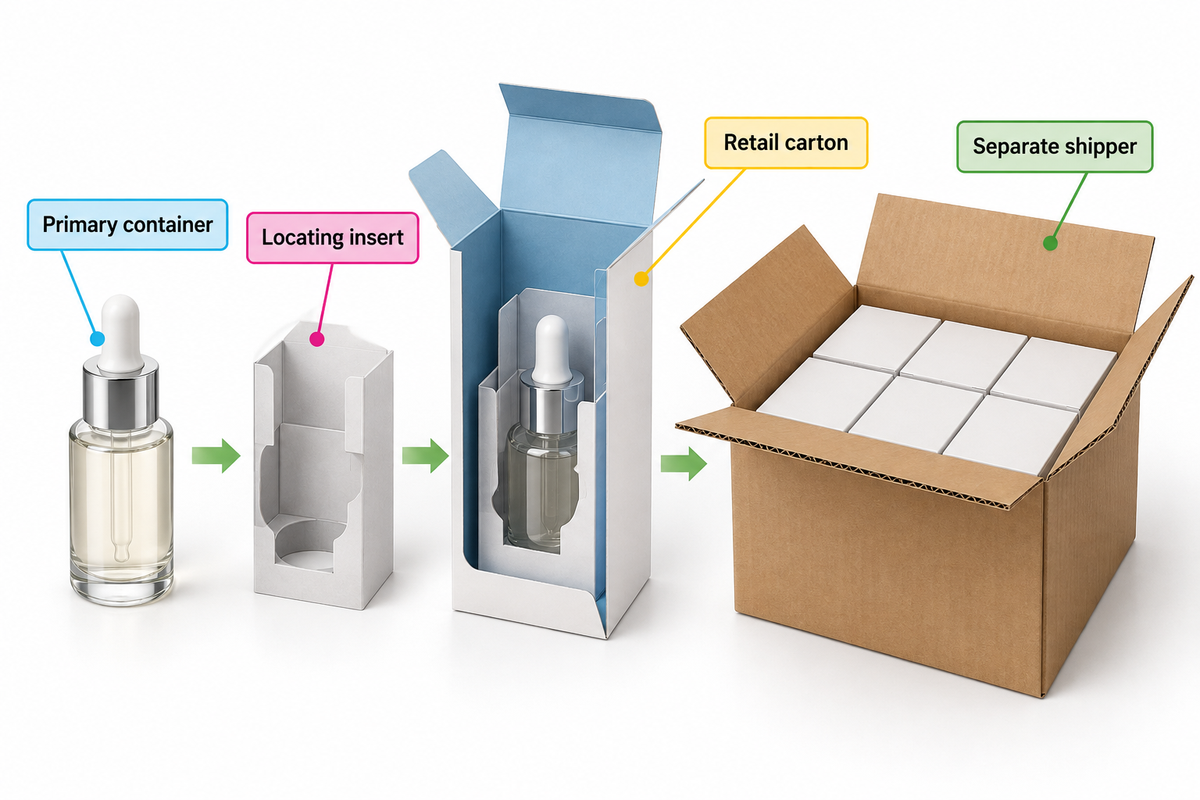
For a serum in a closed bottle, the folding carton surrounds the primary container and presents the product as a retail unit. A separate corrugated shipper supports the grouped unit. Keeping the components different helps identify whether a problem is related to the carton, bottle or shipper.
Pro Carton’s production description follows cartonboard through printing, cutting and creasing, then folding and gluing. The crease creates the intended fold location; the cut defines the panels and flaps. A side seam joins the blank into a body that can be erected for filling.
What are cosmetic folding cartons used for?
Cosmetic folding cartons organize, identify and display individual beauty products or sets. A carton gives a skincare bottle a readable front panel, keeps a small makeup tube in a defined retail format and provides product information. Inserts locate the container, while decorative finishes provide the packaging experience.
Picture a glass serum bottle with a long dropper. The carton may stand attractively, but the bottle can still move inside it. Reducing the outer width of the carton alone may put pressure on the label or make loading difficult. Where the insert touches the bottle, how the carton closes, how the finished retail unit fits in its shipping case are all factors to consider. Product protection comes from that combined unit, not from the printed box alone.
Folding cartons offer room for required artwork on cosmetic products. Readability of the printed copy and approval of the copy are different tasks. The person responsible for the product must effect the artwork review for the destination market; a clear print isn’t approval of the wording and layout. Nor does product safety depend on the outer carton alone.
How to compare carton board without treating GSM as stiffness
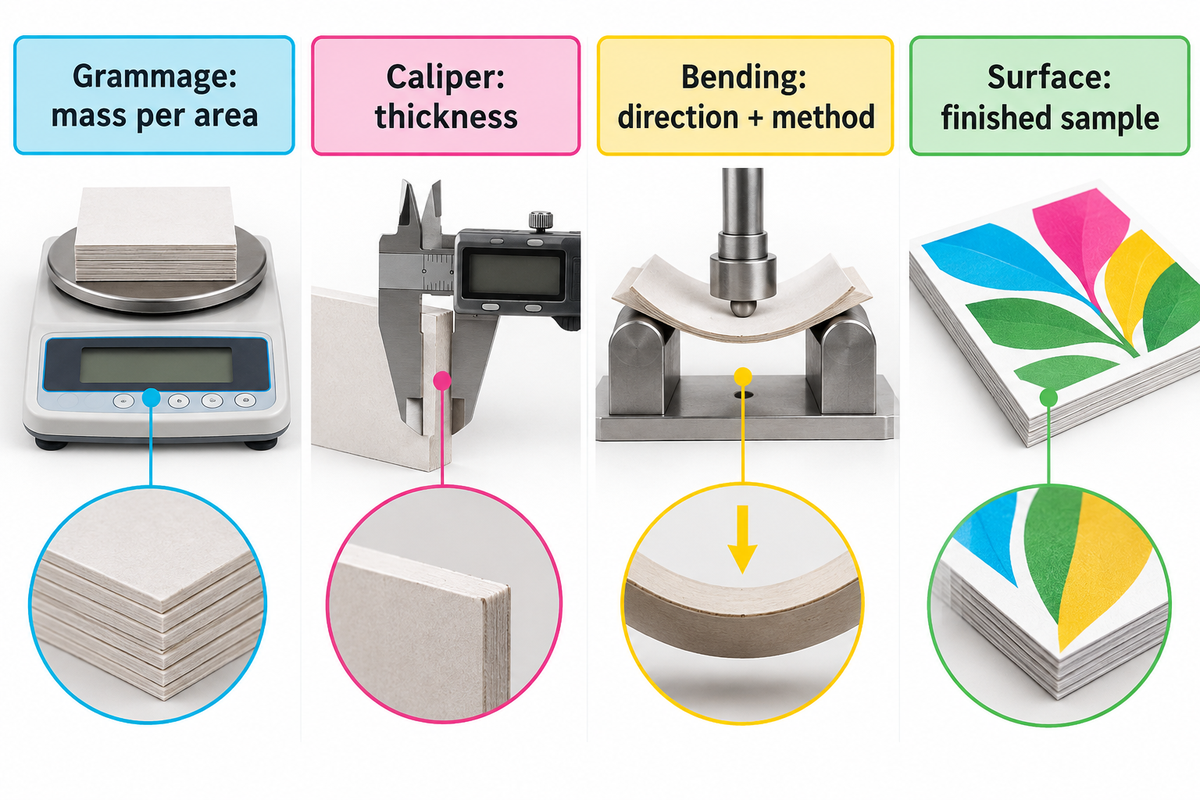
Grammage tells you the mass per area of a board, while caliper tells you its thickness. Bending stiffness describes the resistance to bending under a stated test. None replaces the others. Compare the proposed paperboard materials as a substrate at the intended grade, direction and test method and decide if a heavier sheet will make a better carton.
The Paperboard Packaging Council’s property definitions, written by process engineer Judy Arvan, separate basis weight, caliper, moisture, glueability and machine-direction/cross-direction stiffness. When purchasing, the important question isn’t “How many GSM?” The important question is, “Which board with what thickness and what bending data is this structure?”
| Property | What the reading describes | What to keep beside it |
|---|---|---|
| Grammage, g/m² | Mass per unit area | Exact grade and supplier sheet |
| Caliper, mm or points | Thickness under the named method | Measurement method and tolerance |
| Bending result | Response to the specified bending test | MD/CD direction, method and units |
| Printed surface | White point, coating and surface appearance | A physical printed and finished sample |
One point of caliper means 0.001 inch. An 18-point board is therefore 0.018 inch, or 0.4572 mm. This is a thickness conversion and not a conversion to GSM. Two sheets of the same mass per area can have different thicknesses because of different fiber composition and ply construction.
Stiffness figures also need to be treated carefully. ISO 5628:2019 covers different bending loading methods. A number without its test conditions is a poor comparison. Ask for the same conditions and direction on both candidate grades rather than comparing the biggest numbers on two sheets.
What are cosmetic folding cartons made of?
Cosmetic folding cartons are manufactured from converted paperboard, and are further processed (i.e. printed and/or coated). SBS and folding boxboard are common material families, and recycled-fibre grades are also used in paperboard packaging.
Multilayer folding boxboards and bleached chemical-pulp boards have different constructions and therefore properties. A cosmetic brand choosing between these boards should consider the finished white background and the printed color as well as the fold line and edge of the board. Other considerations should include the board’s stiffness, the source and the color of the fibers, and the board’s recycled content.
Let’s assume procurement has listed a different stock at the same GSM. Place the old and new samples side by side, note their calipers, compare the same panels and close both around the same jar. If the new blank feels different, the matching GSM has not settled the decision. The next comparison would be the grade’s directional bending data and the converted sample, not a reflexive increase in weight.
Folding carton or collapsible rigid box? Compare the construction
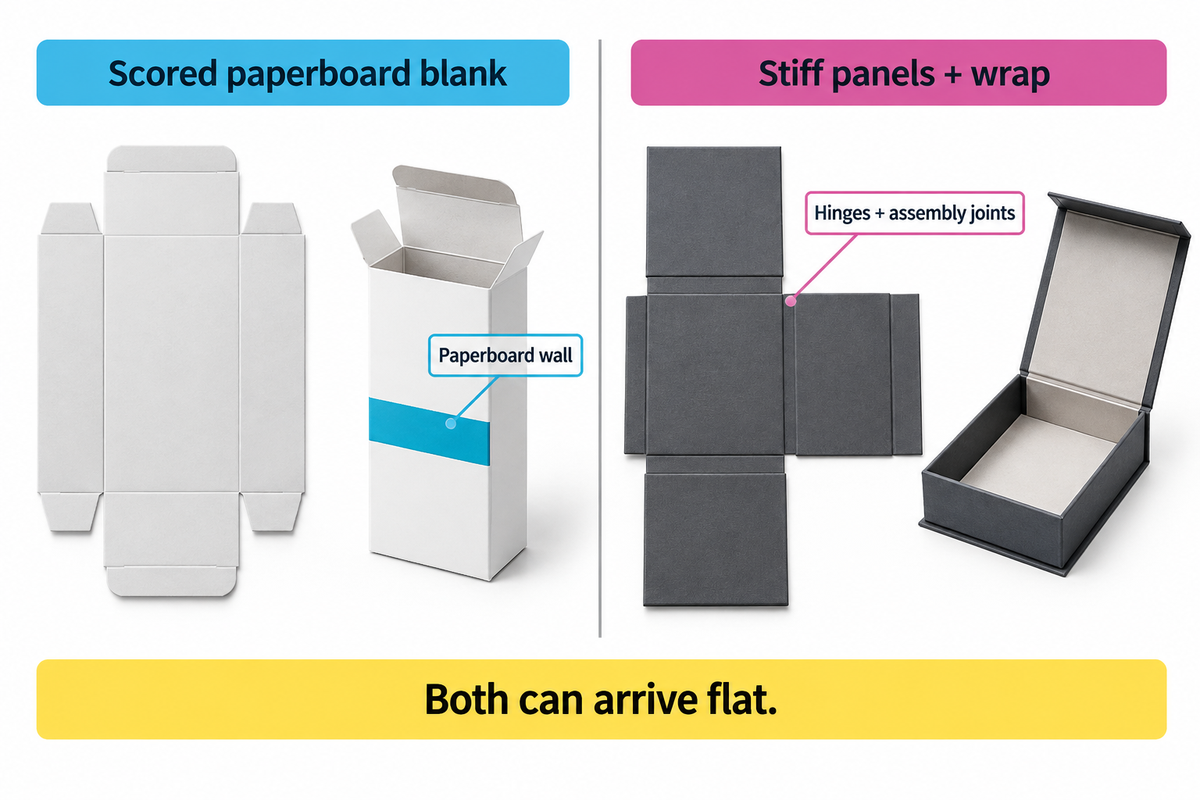
Folding cartons and collapsible rigid boxes can both arrive flat. The more useful distinction is how the walls, wrap and joints are built. A scored paperboard blank folds into the retail carton. A collapsible rigid box uses stiff panels and, when assembled, becomes a presentation box.
The PPC overview of paperboard packaging discusses folding cartons and Set-up boxes separately. It says Set-up boxes tend to remain erected. “Tend to” is important. “Generally” matters: collapsible versions are an exception, so flat shipping is not a reliable way to classify every box.
Paperboard folding carton
- Read the cut and crease pattern in the blank.
- Inspect the side seam and tuck or glued closures.
- Evaluate the printed board as the carton wall.
Collapsible rigid presentation box
- Read the stiff-panel and hinge arrangement.
- Inspect the assembly joints and closure.
- Evaluate the wrap together with its supporting panels.
For a replenishment of a skincare range, the first option may be suitable for a compact retail unit. A presentation set may call for the second. Compare assembled samples and the flat-packed footprint. A cost-effective choice needs to suit the actual packing operation, not just the lowest blank price. Neither “premium” nor “efficient storage” defines construction. Thus choosing the right family of boxes early avoids rigid box expectations from a folding carton quotation.
Structure, inserts and the product inside
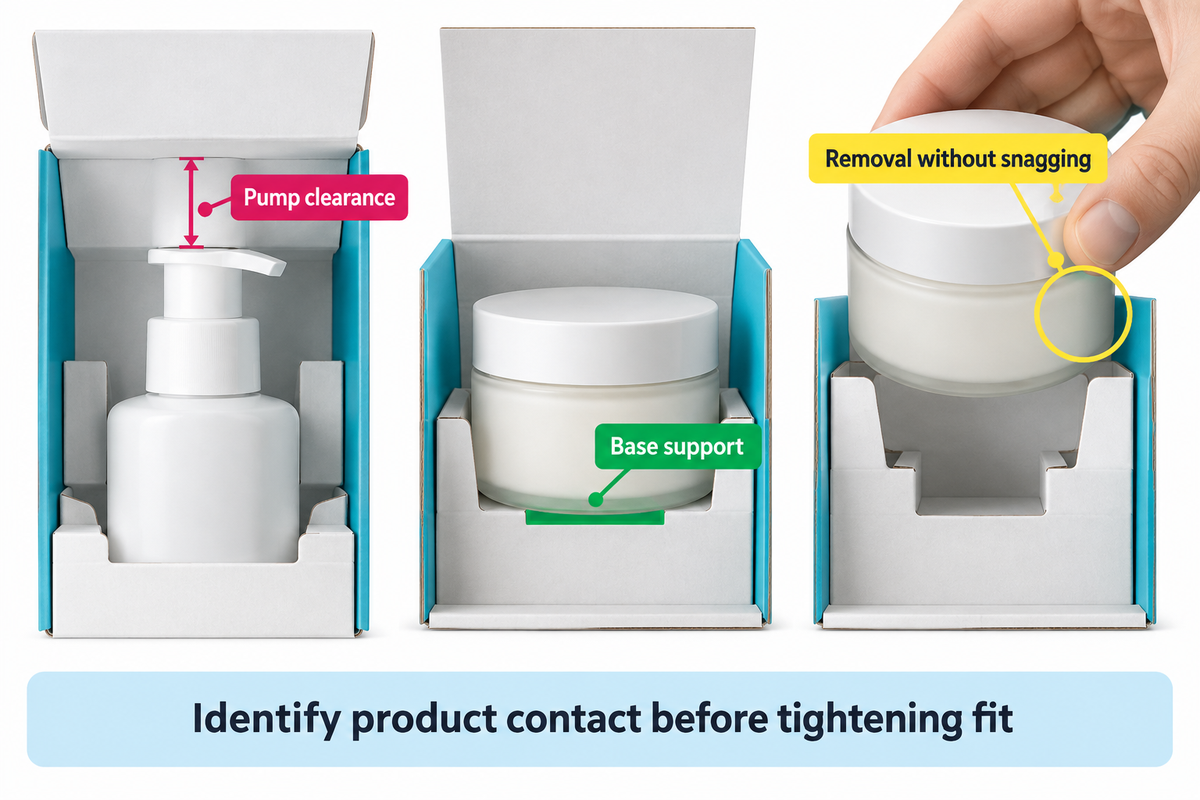
The basic structure of a carton defines the way panels attach to each other and support the contents. The insert defines the contact with the product. Each should be analyzed in relation to the product and the container filled with the product. Choosing a familiar tuck style first and forcing the product into it can leave the actual support problem unresolved.
A reverse tuck has end closure flaps directed to opposite sides, whereas a straight tuck has end closure flaps directed to the same side. An automatic bottom is pre-glued so it forms during erection. An explanation of closure arrangements can be found in the PPC guide to carton styles. Closure names describe function, not load.
A lotion pump has its highest point in the assembled dispenser rather than in the body of the bottle, and the top panel should close without pumping. For a cream jar, check where the base rests, and if removal of the jar catches the lid or the label. A paperboard collar, tray or separate insert solves a different contact problem in each case; access still affects the unboxing experience.
A tuck top can be used for access, whereas a glued closure changes the opening action; a sleeve and tray offers another presentation arrangement. Support and use must be tied to closure arrangements. Huandao’s tuck end box options are a constructible alternative when a project requires a tuck end format.
Before specifying a tighter fit, specify which contact is changing. Support at the wrong point can scuff the primary pack even when the outer carton looks undamaged.
Beauty packaging design for shelf recognition and use
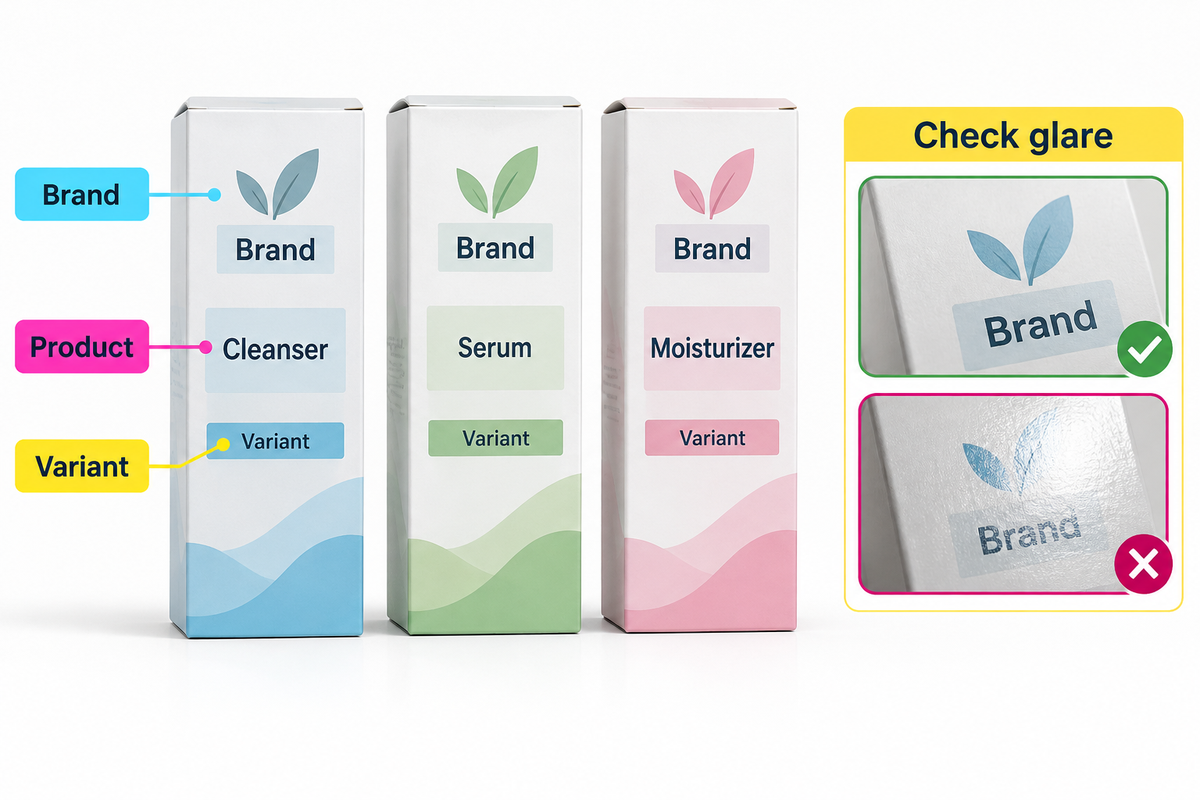
Beauty packaging design makes the product identifiable before decorative detail takes over. Make the brand, product and variant clearly identifiable on the front. Put supporting information on the other panels. A visually appealing carton creates work for retailers and consumers when variants are hard to distinguish.
Imagine a cleanser, serum and moisturizer sharing a white board and cyan identity colour. Place a common position for product name and variant and a clear secondary cue. View the range on retail shelves and consider the narrow side panels that a shopper may see first. An eye-catching metallic mark attracts consumer attention but can’t rescue a lost product name that’s embedded in glare.
Foil stamping and an emboss change the design conversation early. A stamp over small lettering changes the reproduction challenge. The finish must be discussed early. Gloss, matte and soft-touch surfaces change how color and handling marks show up. Compare actual samples, not digital. Consumer demand for a tactile finish doesn’t replace the requirement for the product name to be legible.
In their technical guide to carton finishes, Arkay experts discuss soft-touch scuffing on dark panels, and how the finish can soften saturated graphics. It’s a good design trade-off: a soft, tactile effect that can support brand identity, may need a different graphic treatment or surface choice, in a high-contact area.
Custom cosmetic packaging is customizable at more than one level. Altering a color, a window or an embellishment can also change visibility, panel support or assembly. Compare the whole well-designed package rather than approving each effect in isolation. The broader custom printed folding cartons guide touches upon the structures and vocabularies behind those choices.
Keeping colour and small text consistent across a beauty range
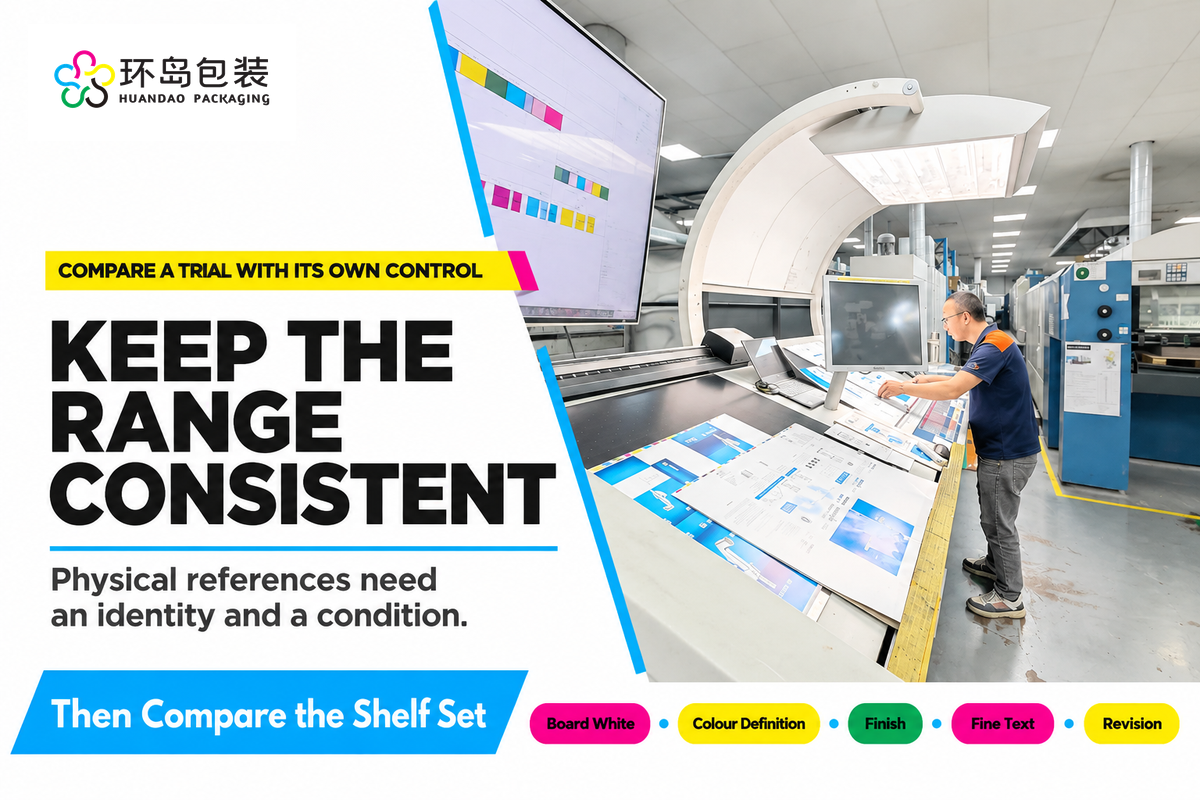
Consistent quality starts with a physical reference and a defined comparison, not a series of copied samples. Board white, finish and ink construction affect the appearance. Small-text legibility requires additional scrutiny. Matching a color swatch on two cartons doesn’t say if the fine print is clean.
ISO 3664:2025 addresses viewing conditions for printed images and reference comparisons; its public scope excludes soft-proofing displays. Treat a screen mock-up and a physical printed sample as different stages. For image detail, Fogra’s print-quality evaluation considers edges and detail sharpness alongside other attributes, rather than using colour alone.
5-Variable Shelf-Set Reference Strip
Maintain a sample set of five comparisons with physical references for board white, color definition, finish, fine text, and artwork revision. The sample’s reference condition and approval date should be noted in the sample’s header. The revision number doesn’t preclude aging of the sample. Store references in a way that damage or fading are easily seen.
| Example SKU | Board white | Colour definition | Finish | Fine text | Revision |
|---|---|---|---|---|---|
| Cleanser control | Approved coated-white grade | Shared physical cyan target | Approved matte surface | Approved side-panel text sample | Range master A |
| Serum finish trial | Keep the approved grade | Keep the shared target | Compare soft-touch with its matte control | Inspect edges after finishing | Record trial change against A |
| Cream stock trial | Compare the proposed stock with its control | Review the target on the new white | Keep the selected finish identified | Inspect the same fine-text artwork | Record stock change against A |
For a serum trial, maintain the same serum artwork on the same stock, with the only variable being the finish. Don’t compare a soft-touch serum against a differently sized cream, and call that a controlled trial. Once each variant of a SKU has been compared against its own control, place them on the shelf. The first comparison isolates a variable. The second considers the family.
A procurement team may view finish trials as a small finish substitution. A designer may view a different shade of cyan. Quality staff may view rub-off fine text. The reference strip allows all three to view the same samples. If a new batch of stock can’t reproduce the look of the old, an explicit choice needs to be made: the stock can be changed, the reproduction adjusted or a new target approved. Repeatedly comparing a new batch with the last batch can allow the range to drift.
Physical standards also have a history. A study of printed color standards by RIT in 1996 looked at variables such as the effects of drying and aging. It doesn’t provide a contemporary estimate of an appropriate replacement interval, but it emphasizes the importance of assessing the condition of the reference instead of considering it as being constant.
Inspect product names, ingredient copy and variant marks at their intended printed size after finishing. Review broken edges and filled-in counters. Keep this print-quality review separate from destination-market review of required label artwork. This reference strip doesn’t give a tolerance or type size.
Reading defects after printing, folding and filling
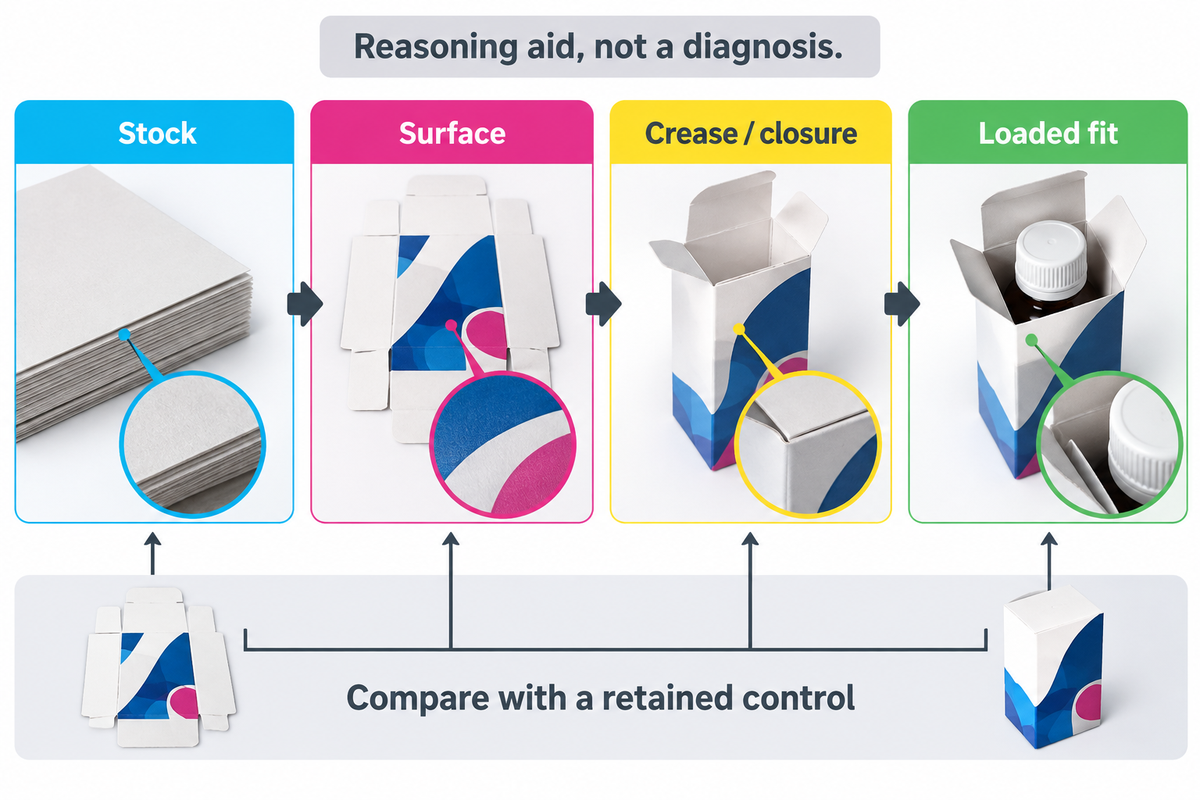
An observation for a finished-carton defect must precede a remedy. Note the location and the affected layer. A white line on a fold, a scuffed dark panel and a bowed closure can appear as general “board quality” issues, but each can indicate a material or process concern.
Discussions among practitioners of dark-solid and UV-coated cartons distinguish damage in the ink/coating from damage that reaches the paperboard. Use that distinction as a question, not a diagnosis. The appearance of a white line doesn’t indicate the next comparison should change the stock, coating or crease setup.
Creasing forms a hinge in the material. Its behavior depends on the board’s plies and the crease geometry; fold resistance and spring-back matter after the carton is erected. A heavier replacement may leave the original issue unresolved. Review the converted sample and change history, before incurring additional material cost.
4-Link Carton Change Cascade
Trace a proposed change through stock, surface, crease/closure and loaded fit. This cascade is a reasoning aid for quality, purchasing and packing teams. It helps keep a plausible explanation from becoming an assumed cause. Be sure to record what changed, and compare the new sample to a retained control sample at the same stage.
| Link | Observation | Competing explanation | Controlled comparison | Lead role |
|---|---|---|---|---|
| Stock | Panel feel or white background changed | Grade, thickness or moisture history differs | Compare identified grades and directional properties | Procurement + quality |
| Surface | Colour, gloss or rub mark changed | Ink/finish combination differs from the control | Compare the same artwork and stock before/after the selected finish | Prepress + quality |
| Crease/closure | White line, spring-back or bowed flap | Material response, crease geometry or conversion sequence differs | Compare converted blanks before loading; record fold location and sequence | Converting + quality |
| Loaded fit | Rattle, bulging or difficult removal | Insert contact or assembled product geometry changed | Load the same product into control and trial; observe contact and closure | Packing + quality |
What if a dark-colored serum carton develops a white line after a stock change? First compare the unused flat sheets and the converted blanks. If the line appears during folding, note whether fibres are disturbed or only the surface looks broken. Use an old stock carton as a control. When stock, coating and crease settings change at once, a better-looking sample leaves the team unable to explain which change mattered. A controlled comparison makes a repeat order easier to explain.
Rub testing answers a narrower question. ASTM D5264-98(2019) describes a laboratory comparison of abrasion resistance on printed materials, including folding cartons. Record the sample, receptor and agreed test conditions with the result. A reported rub result belongs to that comparison; it is not the same exercise as evaluating filled cartons in their shipping pack.
There are also handling issues related to the board. Judy Arvan states this directly in her article.
“Keep in mind that humidity influences curl significantly.”
That observation pertains more to curl than to a general account of cracking. Leave the storage and conditioning history with the samples so that trained personnel can distinguish an altered environment from an altered specification. If the issue appears only after filling, move the comparison to product contact and closure rather than continuing to judge the flat sheet.
Huandao states that its in-house printing and converting services bring those stages into one production discussion. The useful handoff is the control sample, trial sample and named change, not a request to “make the box stronger” without identifying the symptom.
Making material changes without replacing one problem with another
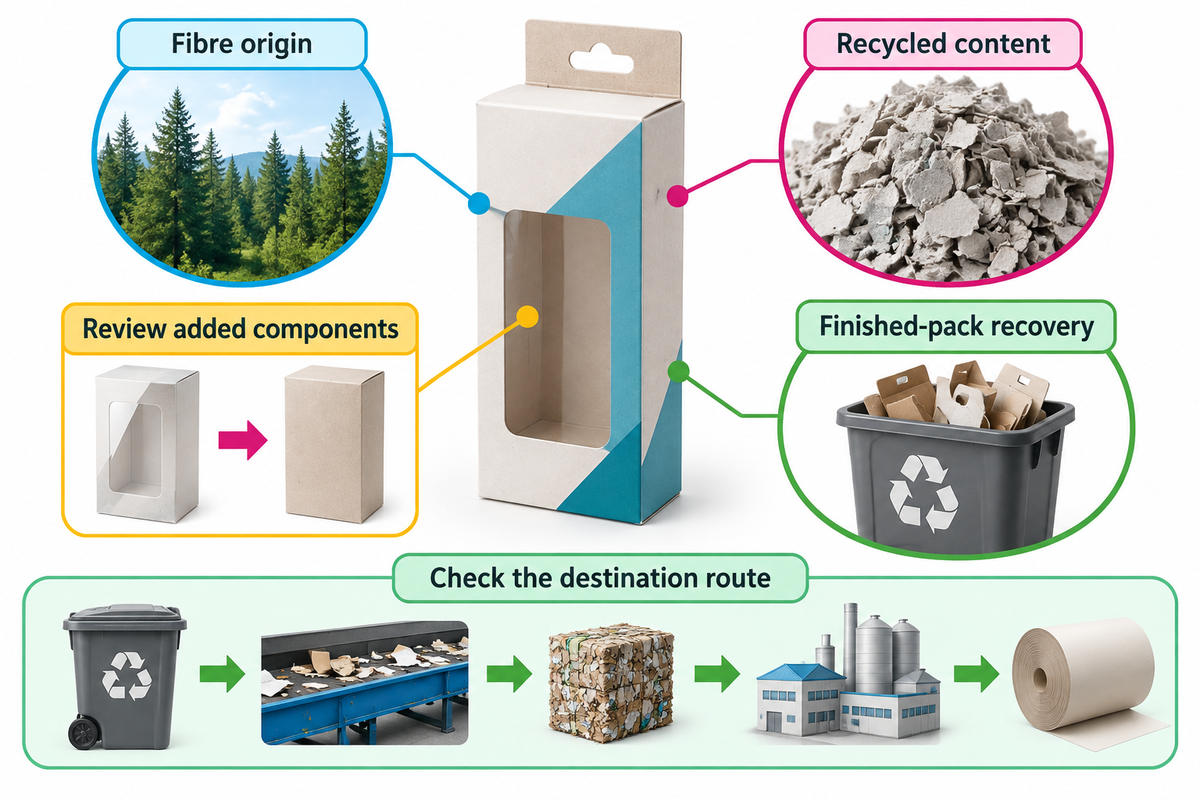
Recyclable, paper-based and recycled-content describe various aspects of the carton. Recyclability refers to the complete carton. Practical recovery also involves the finished carton and collection, sorting and recycling. A brown board or paper insert or an eco-friendly claim doesn’t answer these questions by itself.
The 4evergreen Circularity by Design Guideline’s 2026 description covers different mill pathways and identifies sorting disruptors. That view is also helpful when comparing sustainable packaging options: rather than stopping at “paper”, consider coating and adhesives and other components.
Think about removing a clear window from a makeup carton. The design team still needs to communicate the shade; the structural team still needs to inspect the new opening or closed panel; the packing team still needs to check the product location. A die-cut reveal without film and a fully closed printed panel create different packaging experiences. Compare how the product is seen and how it’s held as well as the material that has been removed.
Soft-touch film and soft-touch coating should likewise be named, not treated as the same thing. Their processes and final constructs differ. The Arkay technical article suggests considering the actual board/finish combination and its repulpability, instead of declaring that every finish falls in one category or the other.
When sourcing, ask about recycled fibre and responsibly sourced fibre separately. If FSC-certified material is specified, determine the applicable product documentation and claim; don’t assume a finished-carton label is entitled to the claim just because the board bears the claim. This guide doesn’t suggest that a particular Huandao carton or facility holds a certificate.
“Environmentally friendly” and “eco-friendly packaging” are broad descriptions. A good sustainable packaging comparison indicates the change and the recovery route it’s intended to support. Don’t claim a carbon footprint saving from reduced material weight without a comparable assessment of the actual package and supply chain.
What to settle before a first run or a repeat order
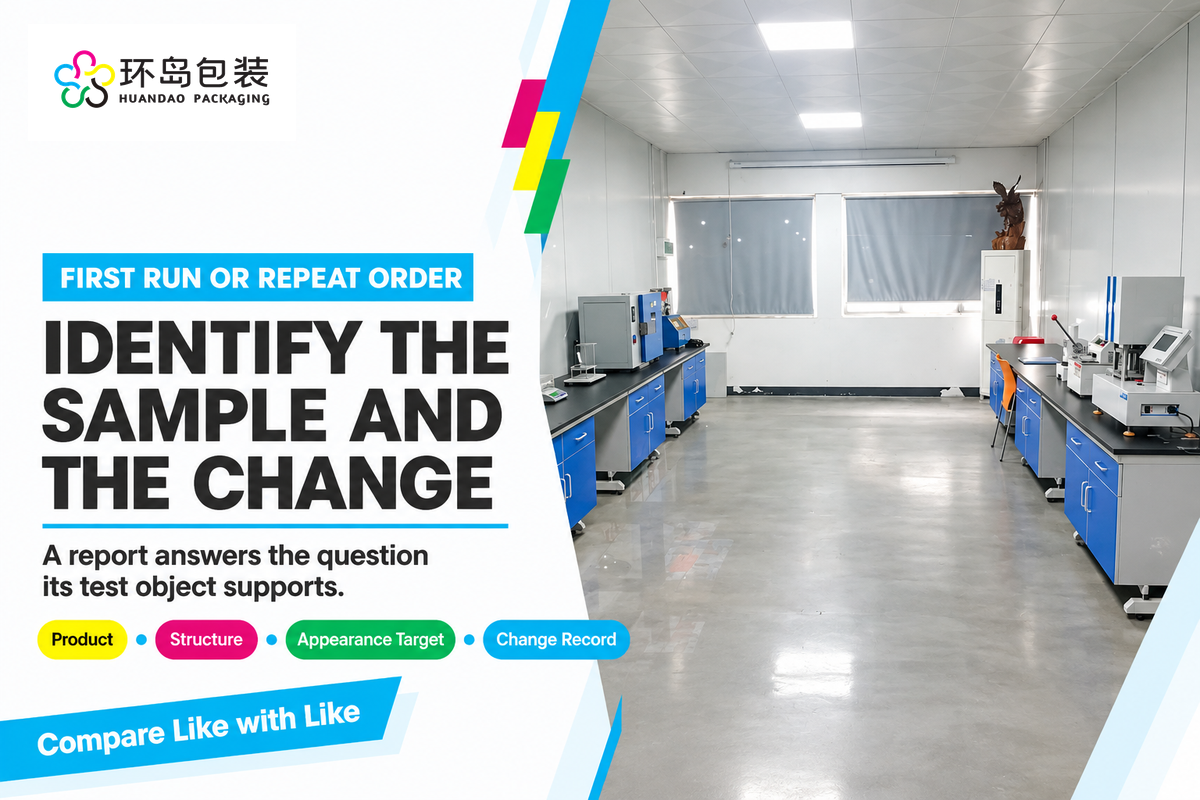
An initial run requires definition of the product, structure and appearance target. A repeat run requires the change record, in addition to definition of the product, structure and appearance target. The best reference is a finished carton with its product and artwork and material identity, rather than a photograph of a box that once looked right.
Huandao states that its in-house lab provides job-specific ECT/Burst, Ink Rub and Basis Weight reports, and that process steps are scanned into MES. Relate each report to its test object. Corrugated ECT or Burst results, for example, answer a different question from folding carton panel stiffness or printed surface abrasion.
Use the custom printed folding cartons service for production-format options after the guide’s material and appearance comparisons are clear. Huandao’s company and factory background describes the work; the project specification should identify the job.
Key takeaway
Compare the board, the converted carton and the filled pack at their own stages. A shared physical reference and an explicit change record make a material or finish decision easier to repeat.
Discuss your cosmetic carton project
Cosmetic Folding Cartons FAQs
Can cosmetic folding cartons be recycled?
Cosmetic folding cartons can be recyclable, but the finished construction and available recovery route matter.
Identify the board and every added component, including windows, films and inserts. A fibre-based carton with a separate non-paper part is a different item from an undecorated board sample. Collection and sorting rules also differ between places and mill systems. Use the destination’s recovery guidance and the specified construction when preparing disposal information, rather than assuming that all paper-based packaging belongs in the same stream. Recycled content describes the material input, not the result of that recovery assessment.
Can the inside of a cosmetic carton be printed?
Inside printing is possible when it is included in the board and production specification.
Plan which inner surfaces will be visible after opening and whether the reverse side of the chosen board gives the intended print appearance. Keep glue areas and the converted fold arrangement in the artwork discussion. An interior message can support product presentation without crowding the front panel, but it should be reviewed on the assembled sample. It does not replace required product information on the appropriate packaging.
Which beauty and personal care products use folding cartons?
Folding cartons for beauty commonly surround skincare bottles, cream jars, makeup tubes and personal care products.
For these consumer products, the inner container and intended use decide the support arrangement. A narrow lipstick tube needs different locating features from a filled moisturizer jar or a lotion pump. Discovery sets may use divided inserts or trays to keep the products organised. Compare the assembled container, insert and carton together instead of choosing the format from the product category name alone. Product integrity and ease of removal remain part of that comparison.
Is there a standard minimum order for cosmetic cartons?
There is no single minimum order that applies to every cosmetic carton project.
Structure, material, artwork versions and finishing affect the production scope. Compare quotations against the same specification and confirm the quantities by design, rather than importing another supplier’s minimum.
Should every panel receive the same decorative finish?
Every panel does not need the same finish; assign decoration to the surfaces where it serves the design.
Review handling areas, fine text and reflected light on the finished sample. A restrained front-panel effect may leave the side-panel information easier to read than a fully decorated layout.
Is a standard tuck carton tamper-evident?
A standard tuck closure is an opening and closing feature, not automatically a tamper-evident system.
A carton that can be opened and reclosed without a visible change should not be described as showing first opening merely because the tuck feels tight. If first-opening indication is part of the packaging needs, specify the intended feature and examine its behaviour on a converted sample. A seal, tear feature or other arrangement changes the opening sequence and may change artwork or assembly. Review how the user opens it, what visible change remains and whether the product can be accessed another way. Keep that functional review separate from any product-specific requirement. Fully customizable folding carton solutions still need a defined purpose for each added feature.
The manufacturing perspective behind this guide
Huandao Packaging supplied the production-capability description used here. The material and print discussions draw on association publications, public standards descriptions and technical sources. The shelf-set strip and change cascade are original worked examples for design, purchasing and quality conversations; they aren’t reports of a customer trial. Karry prepared this guide for readers comparing cosmetic packaging options before moving into a job-specific production brief.
References & Sources
- What Is Paperboard Packaging? Paperboard Packaging Council.
- The Properties of Paperboard Judy Arvan, published by PPC.
- Five Must-Know Folding Carton Designs PPC.
- Carton Production Pro Carton.
- ISO 5628:2019 public scope International Organization for Standardization.
- ISO 3664:2025 public scope International Organization for Standardization.
- Print Image-Quality Evaluation Fogra.
- ASTM D5264-98(2019) public scope and significance ASTM International.
- Circularity by Design Guideline, 2026 description 4evergreen.
- How to Choose the Right Finish for Your Carton Walter Shiels, Josh Kaneff and Max Kaneff, Packaging Digest, October 2026.
- A Study to Evaluate Current Color Matching Procedures Brian McDonough, RIT, 1996; historical reference-ageing research.