Get in Touch with Xiamen Huandao Packaging Technology Co., Ltd.

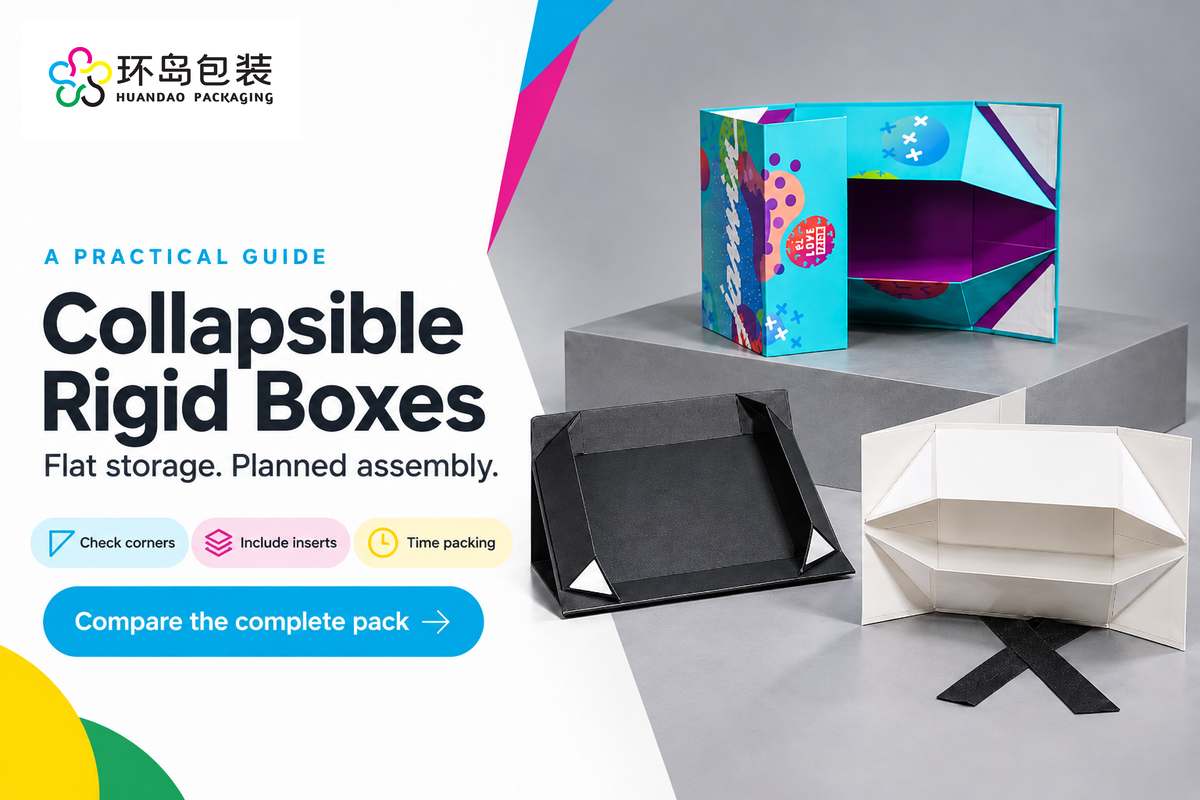
Collapsible rigid boxes consist of rigid-board boxes with flexible joints that allow empty structures to fold flat. Choose this foldable design when storage space is tight and compact incoming deliveries justify the work of erecting the box before filling. Keep a ready-assembled box when time is scarce for packing, and compare a folding carton when the product requires a lighter retail pack.
Updated October 2026 · By XCX
Quick specification guide
- Core: rigid paperboard panels with an outer paper wrap.
- Moving parts: hinge zones between panels; corner locks hold the erected shape.
- Closure: magnetic flap, ribbon or another specified opening system.
- Freight measurement: external shipping-carton dimensions, including separately packed inserts.
- Selection inputs: product size and weight, packing sequence and destination.
Collapsible rigid boxes combine a rigid presentation with flat storage before packing. Their value comes from the complete box-and-insert shipment, the time needed to erect it and the protection of the filled parcel.
- A magnetic lid doesn’t make glued corners releasable.
- Finished customer parcels keep their filled dimensions even when empty boxes arrive flat.
- Bulky inserts can consume the space saved by a flat shell.
- Compare the extra assembly cost with matched freight and storage savings.
How Collapsible Rigid Boxes Work
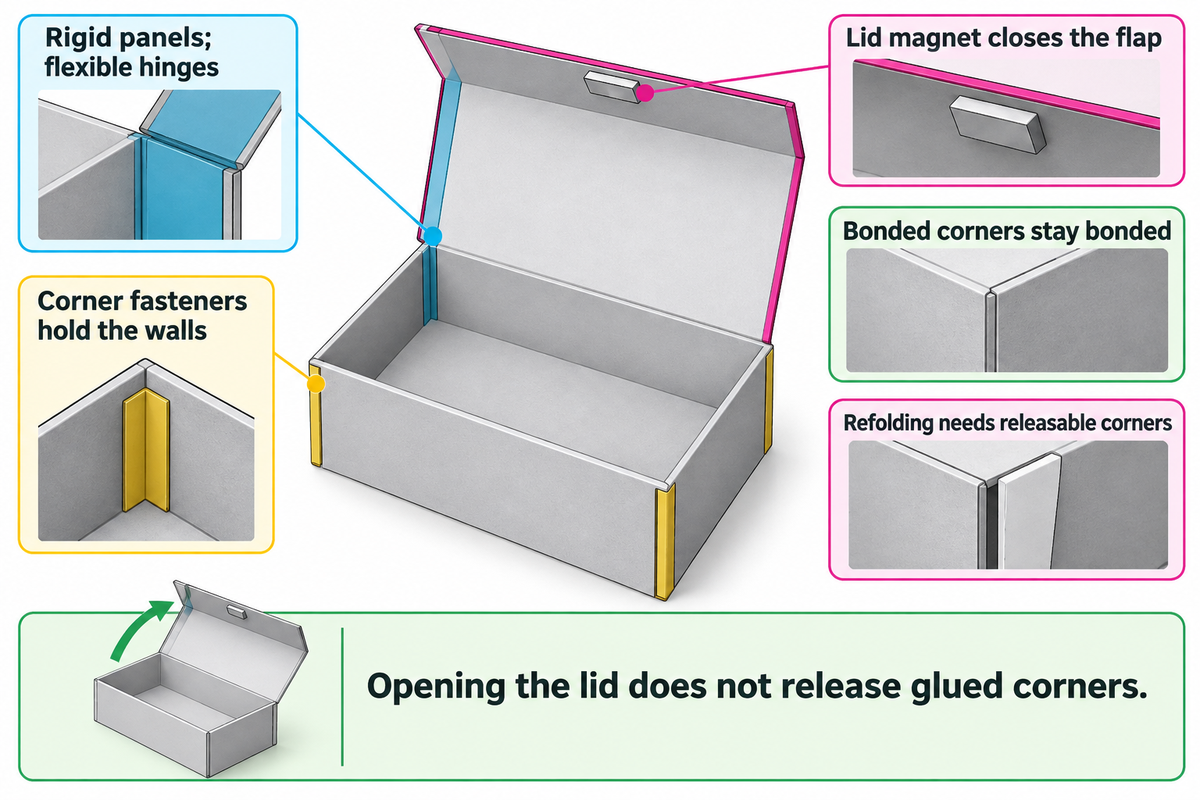
Collapsible rigid packaging works like a book cover with extra panels. The board stays stiff while the paper bridges bend. Raising the walls creates a cavity. Corner fasteners hold it square. The lid closes independently. These boxes fold flat; permanent corner fixing can prevent refolding after first use.
The Paperboard Packaging Council’s rigid-box terminology describes knockdown boxes with folding tabs or collapsing sides, often fixed by tape or glue after erection. Book style boxes can use a connected case around a folding base. One piece boxes keep that outer case together, but still contain several board panels.
What does “rigid packaging” mean?
Rigid packaging can hold its shape because its walls are stiff. For high-end paper gift boxes that usually means a chipboard structure covered with a separate wrap. A folding carton bends along creases in its own sheet. Both can carry print and decoration; their construction and packing tasks differ.
A lid magnet keeps the flap closed. A structural magnet or mechanical lock holds a wall in position. Adhesive corner strips create a bond when their liners are removed and the surfaces are pressed together. Repeatedly opening the lid doesn’t release that bond; pulling bonded corners apart can tear the wrap.
“Board weight can vary, particularly for inners and sides.”
For returnable seasonal use of foldable boxes, pick a releasable corner structure from the start. A collapsible design intended for one-time erection suits a different job, even when both have the same magnetic closure.
Collapsible Rigid Boxes vs Other Box Formats
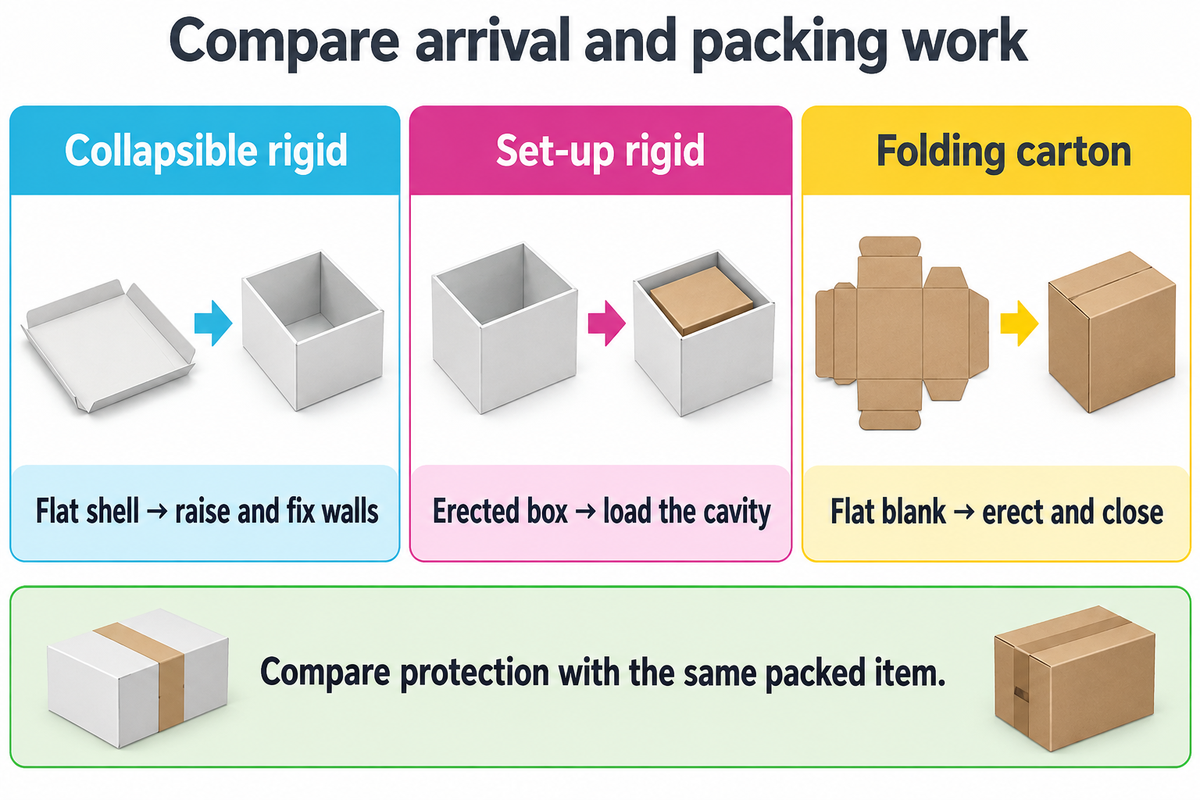
Fold-flat rigid packaging is good for empty-box storage. Pick a traditional rigid box when the packing station needs an erected cavity immediately. Pick a folding carton for a lighter board and opening format that’s more suitable to the product. Compare the same packed item across all three formats before assigning a protection advantage.
3-Format Packaging Comparison: Rigid Box Styles
This comparison separates how a box is built, how it arrives, and what the packing team has to do.
| Decision | Collapsible rigid | Set-up rigid | Folding carton |
|---|---|---|---|
| Structural material | Wrapped rigid panels | Wrapped rigid tray or case | Creased cartonboard sheet |
| Incoming state | Flat shell | Erected box | Flat blank or glued-flat carton |
| At the packing bench | Raise and fix walls | Load the cavity | Erect and close the carton |
| Corner construction | Adhesive, magnetic or mechanical lock | Fixed corners | Folded/glued carton joints |
| Lid choice | Hinged flap or folding lid | Separate lid or attached case | Tucks, flaps or designed closure |
| Insert shipment | Count its cartons separately | May arrive fitted or separate | May be separate or integrated |
| Refolding | Only with a releasable structure | Generally retains its shape | Depends on folds and closure |
| Decorative surface | Separate wrap and liner | Separate wrap and liner | Printed sheet and optional finishes |
| Main packing constraint | Available erection time | Space for erected stock | Erection and closure method |
Use construction terms from the Paperboard Packaging Council for this comparison. These box styles are compared based on packing task, rather than assigned a strength rating. Two-piece rigid boxes provide the separate-lid option; printed folding cartons provide the lighter board alternative.
Decoration traverses frontiers. Packaging Strategies’ 2017 competition report includes a Thoro folding carton with foil and hidden magnets, alongside a Hub Folding Box rigid design. A premium feel or a magnetic feature alone does not identify the structure. Folding boxes, made of cartonboard, can also be decorated and not be wrapped board structures.
| Packing situation | Start by comparing | Reason to change that choice |
|---|---|---|
| Seasonal apparel, little empty-stock space | Collapsible apparel boxes | Packing time is already fully committed |
| Small jewellery, immediate handover | Erected rigid box | Measured storage savings justify erection |
| Light retail refill | Folding carton | Product support needs a different structure |
| Fragile glass gift set | Box and insert as one design | A protrusion touches a wall or lid |
| Heavy electronic device | Supported rigid pack with outer carton | Complete-pack tests reveal movement |
| Subscription boxes packed every week | Repeatable insert/loading sequence | Assembly creates a queue at dispatch |
| Consumer expected to refold the box | Releasable corners | Adhesive joints would be pulled apart |
| Large nonfolding foam tray | Both shell and tray freight | Tray cartons absorb the shell saving |
| Short campaign with no spare packers | Ready-erected format | A timed comparison leaves capacity |
Folding rigid boxes save space only while the stock remains flat. Setup boxes, on the other hand, require space on arrival. Erecting the entire campaign early transfers the storage problem to the packing room. Release boxes in batches that can be accommodated by available benches and shelves.
Choose Materials, Inserts and Finishes Around the Product
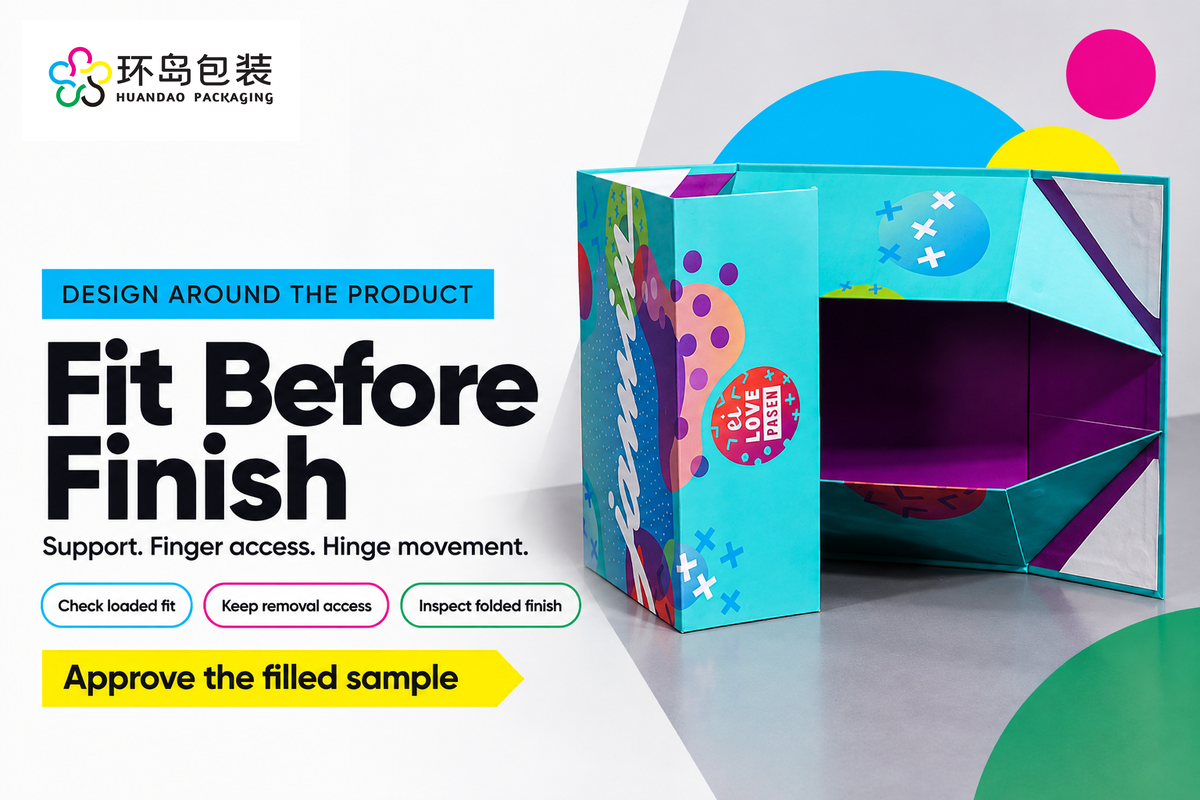
Before final selection of board and decoration, inserts and partitions should be specified to define the product layout and determine the shape of the pack. Rigid materials can hold the shape; the wrap creates the surface and joints of the pack. Board thickness, paper grammage and hinge layout describe different things. Changing one can alter fit or folding without improving the complete pack.
The PPC definitions of inserts, partitions and wraps distinguish support inside the cavity from the decorated shell. Custom inserts should support stable product surfaces and leave finger access for removal. Foam inserts can cushion a fragile item, while a folded paper platform can locate several lightweight pieces.
Example: A cosmetic brand is packing a small bottle and a smaller jar next to it. A tight rectangle around both leaves the bottle cap exposed and makes the jar difficult to lift out. The redesign starts with a custom die-cut insert: support sits under the bottle shoulder, the jar has a finger recess, and the finished insert sets the usable cavity. The brand can reduce empty space without pushing the cap against the lid. Packing staff load the complete set before artwork approval, so the attractive printed sample and the filled sample use the same dimensions. A deeper box is more appropriate if a shallower one loads the cap.
| Part | Task | Sample check |
|---|---|---|
| Greyboard core | Hold the intended wall geometry | Wall bow and corner seating when loaded |
| Wrap and liner | Cover panels and bridge hinge areas | Whitening, cracking and loose edges after folding |
| Paper insert | Locate items and brace the layout | Fit, removal access and packing volume |
| Foam or moulded tray | Support the selected product surfaces | Movement and contact after the complete-pack test |
| Matte or soft-touch finish | Set touch and appearance | Rub marks and visible hinge wear |
| Foil stamping and spot UV | Place emphasis on selected artwork | Registration on the finished panel |
Kraft paper offers a different surface from coated art paper; lamination provides yet another material layer. Premium finishes should be placed on areas that withstand the intended folding movement. Digital printing, offset printing and screen printing have different artwork and production requirements. Choose the print route with the converter before freezing fine lines across a moving joint.
Thicker doesn’t always mean stiffer after storage. In Ham, Youn and Lee’s 2020 paper study, increasing moisture made experimental handsheets thicker while bending stiffness fell. The material result shows that a quality check of a representative sample after storage is warranted. It doesn’t set a gift box load limit.
Compare Incoming Carton Volume and Outbound Shipping
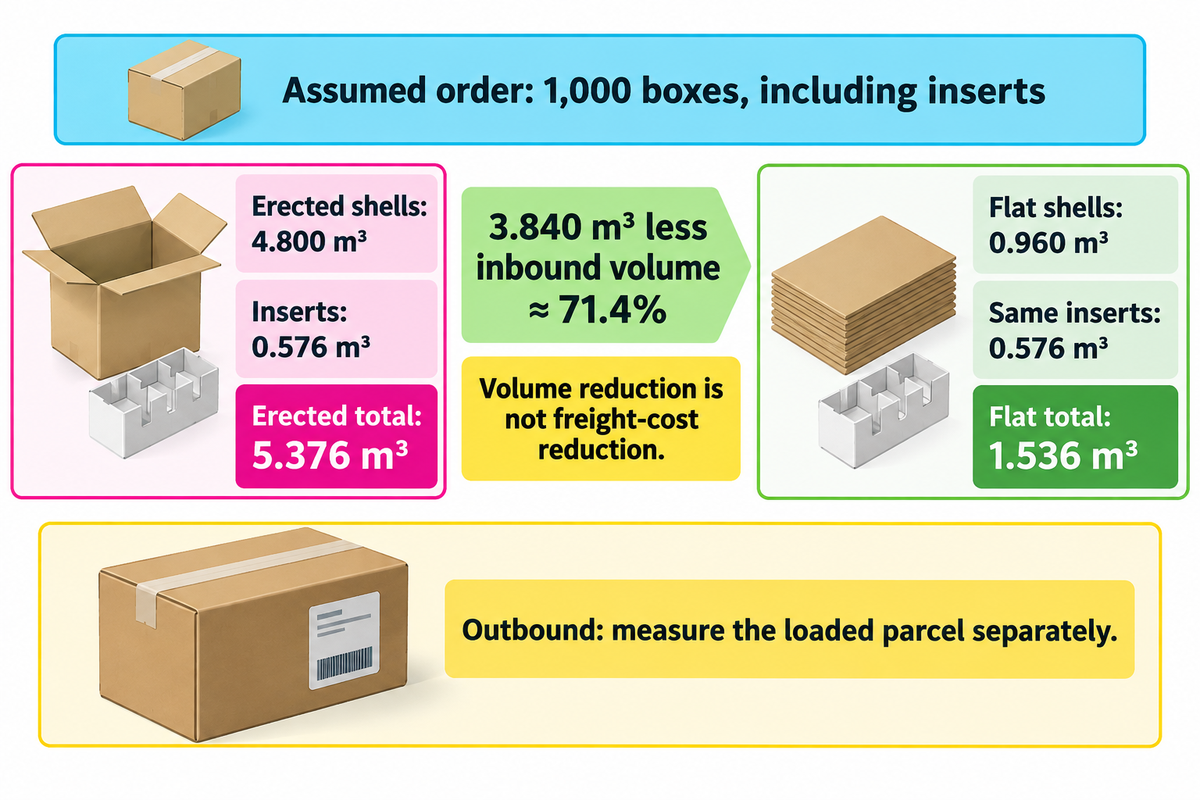
Compare the volume of incoming cartons using external master-carton measurements and quantities for the same order quantity. Include inserts, sleeves, and other separately shipped components. Measure the outbound package separately. Once loaded, collapsible gift boxes retain their finished shape and size. Determine customer shipments from the loaded parcel.
Do collapsible rigid boxes save shipping costs?
They can reduce shipping costs when the shipment of smaller empty packages changes the freight quote sufficiently to offset other costs. The freight quote is based on the complete carton list (including inserts) and the service level selected. Inbound volume reduction doesn’t lead to outbound shipment volume discount.
Example inputs: Both options contain 1,000 gift-box shells. The erected option uses 50 cartons, each measuring 0.60 × 0.40 × 0.40 m outside. The flat option uses 10 cartons of same dimension. Inserts (8 cartons of 0.60 × 0.40 × 0.30 m each) travel separately in both the options.
| Shipment part | Erected option | Flat option |
|---|---|---|
| Shell carton volume | 0.60 × 0.40 × 0.40 = 0.096 m³ | 0.096 m³ |
| Shell carton count | 50 cartons | 10 cartons |
| Shell shipment | 4.800 m³ | 0.960 m³ |
| Insert shipment | 8 × 0.072 = 0.576 m³ | 0.576 m³ |
| Combined incoming volume | 5.376 m³ | 1.536 m³ |
| Combined difference | Reference configuration | 3.840 m³ less, about 71.4% |
Those inputs quantify the space-saving benefit, not a reduction in freight costs. The insert shipment stays the same, and the shell shipment decreases. Procurement sends both carton lists to the forwarder with the same destination, service and delivery terms. Finance compares the charges instead of taking the volume percentage of the invoice. For your carton list, compare shipping carton volume using the external dimensions.
A package carrier may charge by the greater of the actual weight and the dimensional weight. Freight may also include minimum charges and service specific terms and conditions. For consumer shipment, choose corrugated mailer boxes or other appropriate outer pack around the loaded presentation box. The International Safe Transit Association’s design guidance starts with the distribution hazards and product being protected.
Time Assembly Before You Commit to a Packing Rate
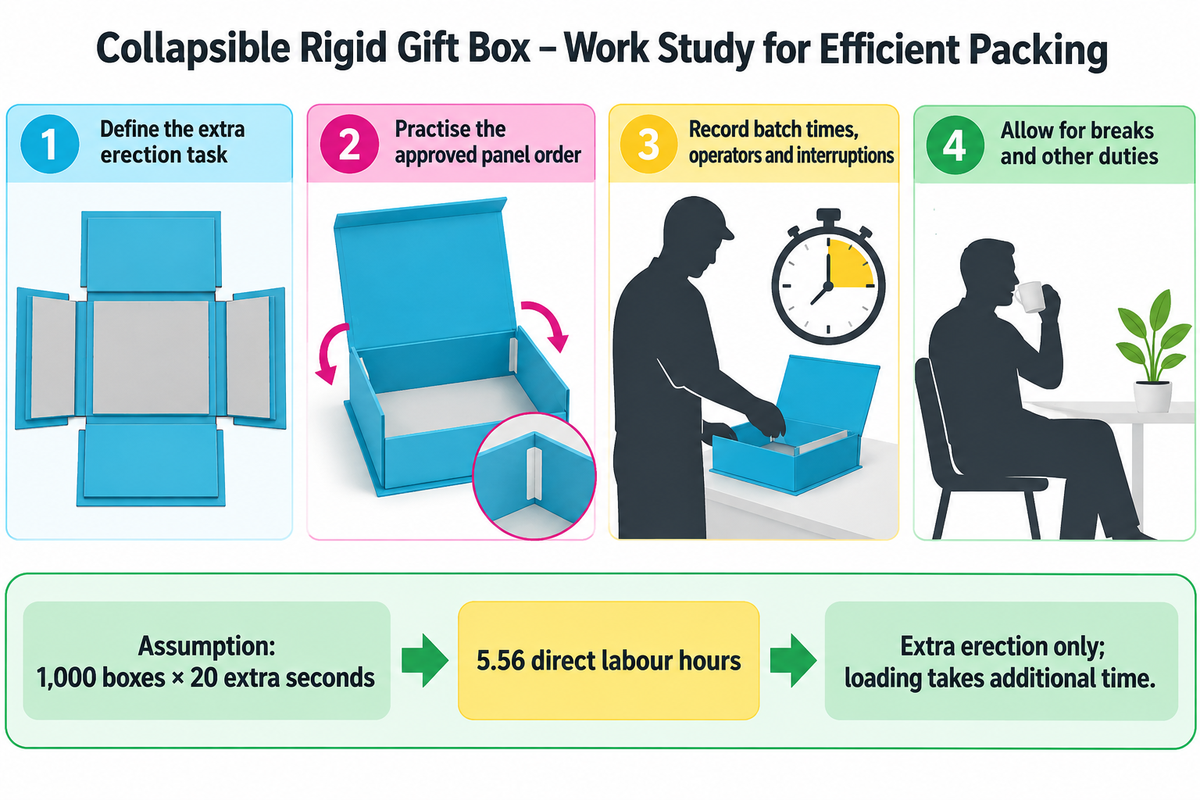
A 1,000-box batch at an assumed 20-second extra assembly per box consumes 5.56 direct labor hours. That accounts for the timed task, not the entire shift. Sustaining packing output also accounts for insert loading and product placement, and normal breaks. Use repeated batches with the same operators and layout.
Are magnetic collapsible boxes easy to assemble?
They are usually straightforward to erect by hand when the panels, locks and insert fit together correctly. Line up the hinges, seat the corners, and engage the fastener. With adhesive versions, align the panels, remove liners, and then engage the fastener. Finally, close the magnetic lid.
Flat stock at the bench
- Uses less empty-stock space.
- Needs an erection stage.
- Requires liner waste or lock handling.
- Can be released in small packing batches.
Ready-erected stock
- Uses the full empty-box space.
- Starts with a cavity ready to load.
- Skips destination corner fastening.
- Needs space near the loading station.
The quickest demonstration hides the routine interruptions. Peltokorpi and Niemi’s 2019 assembly study found that practice and group size changed performance in a mechanical-assembly experiment. For gift boxes, retain your own batch times and staffing details instead of borrowing that study’s rate.
- Set the task boundary. Separate extra shell erection from insert loading and the rest of pack-out.
- Familiarise operators. Use the approved sample and the intended panel order.
- Record repeated batches. Keep durations, batch quantities, operator count and interruptions.
- Plan productive hours. Subtract other duties and normal breaks before allocating the batch.
Suppose a gifting operation has one packer with 6 productive hours available after normal breaks and other assigned duties. It takes almost this entire time to complete the 20-second extra task for the 1,000-box batch, before loading gift sets. A second worker does not necessarily double output if both share one cramped bench or wait for inserts. The supervisor first separates tasks of erecting boxes from loading and places components within reach. Repeated batch records then show whether the revised layout can clear the order. Where the remaining loading work still exceeds the available hours, a ready-erected box removes that extra task. Use previously recorded times of work elements to estimate the assembly workforce required.
Build a Cost Comparison That Includes Labour
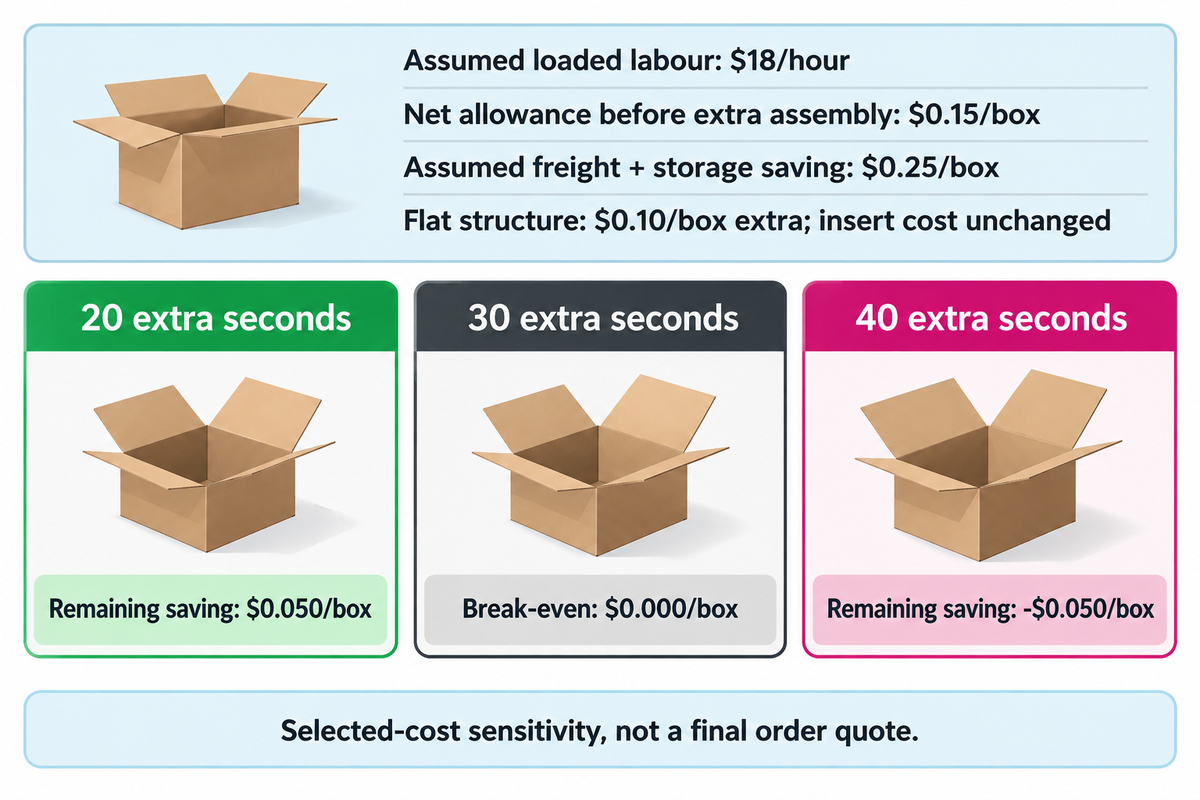
Assembly Break-Even Table
Flat delivery covers the cost of extra assembly only if the remaining freight and storage savings exceed the cost of extra labor. First, subtract any increase in box or insert cost. Divide the per box savings by the loaded hourly labor rate and convert to seconds. This gives the extra assembly time before the cost advantage is lost.
Assumed sensitivity inputs: incoming freight and storage cost $0.25 less per box; the flat structure costs $0.10 more per box; insert cost is unchanged; loaded labour costs $18 per hour. The remaining allowance is $0.15 per box. At that rate, $0.15 ÷ $18 × 3,600 = 30 seconds of added assembly.
| Added assembly | Extra labour per box | Remaining selected-cost saving |
|---|---|---|
| 5 seconds | $0.025 | $0.125 per box |
| 10 seconds | $0.050 | $0.100 per box |
| 15 seconds | $0.075 | $0.075 per box |
| 20 seconds | $0.100 | $0.050 per box |
| 25 seconds | $0.125 | $0.025 per box |
| 30 seconds | $0.150 | $0.000 per box |
| 35 seconds | $0.175 | −$0.025 per box |
| 40 seconds | $0.200 | −$0.050 per box |
| 45 seconds | $0.225 | −$0.075 per box |
In this example, adding 40 seconds makes the flat option $0.05 more expensive per packed unit across the listed items. For 1,000 units, that’s $50 extra. This is a sensitivity comparison, not a prediction of an order’s final cost. A higher labour rate or a smaller freight saving moves the break-even time downward.
The International Trade Administration’s landed-cost explanation includes insurance, tariffs, taxes, and other fees. Until relevant charges are added, consider this a selected-cost subtotal. When comparing sizes, prints and delivery, don’t bury a tooling charge in a single unit price.
| Where work accumulates | What the packer handles | What to record |
|---|---|---|
| Corner fixing | Release liners, alignment and pressure | Extra seconds and rejected corners |
| Insert supply | Separate trays or folded supports | Replenishment delays and insert carton volume |
| Gift-set loading | Several items and presentation layers | Loading time separate from shell erection |
| Dispatch | Outer carton, cushioning and sealing | Complete parcel dimensions and final packing time |
Purchasing owns the matched quotes, finance owns the cost scope and the packing supervisor owns timed work content. Bring all three together on the same comparison. The tool can compare listed-cost subtotals when the above are in order.
Keep the Box Square Through Storage and Handling
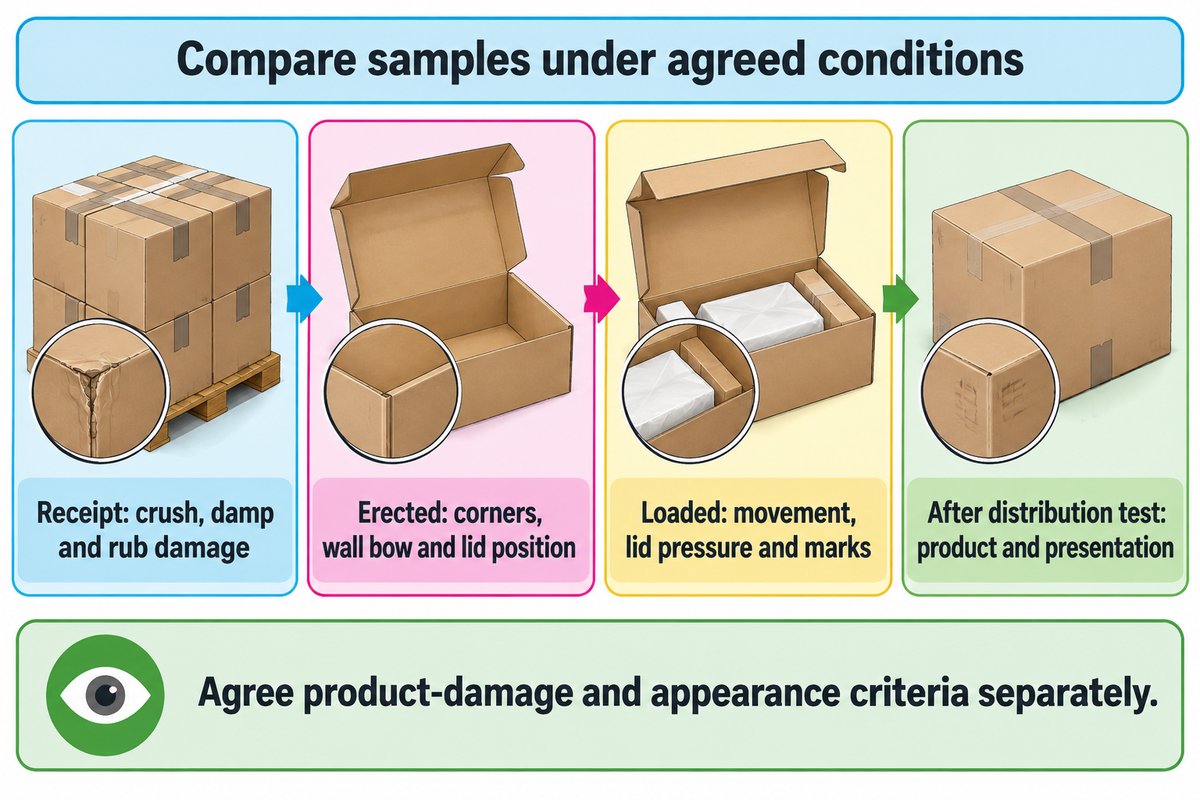
Store flat boxes clean and protected and check erection, closure and the contents of the pack after normal handling. Paper-based panels and wraps respond to moisture. A sample that fits in the office can behave differently when exposed to normal storage. Useful checks can be performed on shipped materials to assess whether the packs arrived in good condition and were opened in a good state by the end user.
ASTM D4332-22 covers the conditioning atmospheres of containers, packages and packaging components. Use the agreed-upon conditions when comparing samples. A board or ink-rub report answers a material question. The filled rigid packaging boxes, insert and outer shipper answer the distribution question.
- At receipt, inspect crushed cartons, damp areas and rubbed surfaces before moving stock to the packing bench.
- After erection, compare corner seating, wall bow and the lid’s closing position with the approved sample.
- With the product loaded, look for movement, lid pressure and marks on exposed product surfaces.
- After the selected distribution test, inspect the product and its unboxing experience as well as the exterior carton.
The 2020 BioResources paper experiment shows why humidity history matters to paper stiffness. Some experimental compositions didn’t return to their original stiffness after a humidity cycle. For a storage sensitive project, the test plan should describe expected exposure and handling conditions rather than a single office inspection.
ISTA’s test-selection guidance connects the process to the shipment and packaged product. Quality staff should agree product damage and package appearance criteria before testing. A luxury rigid packaging surface, for instance, may be unacceptable if scuffing occurs, even if the product remains intact.
Turn Your Product Requirements into a Box Brief
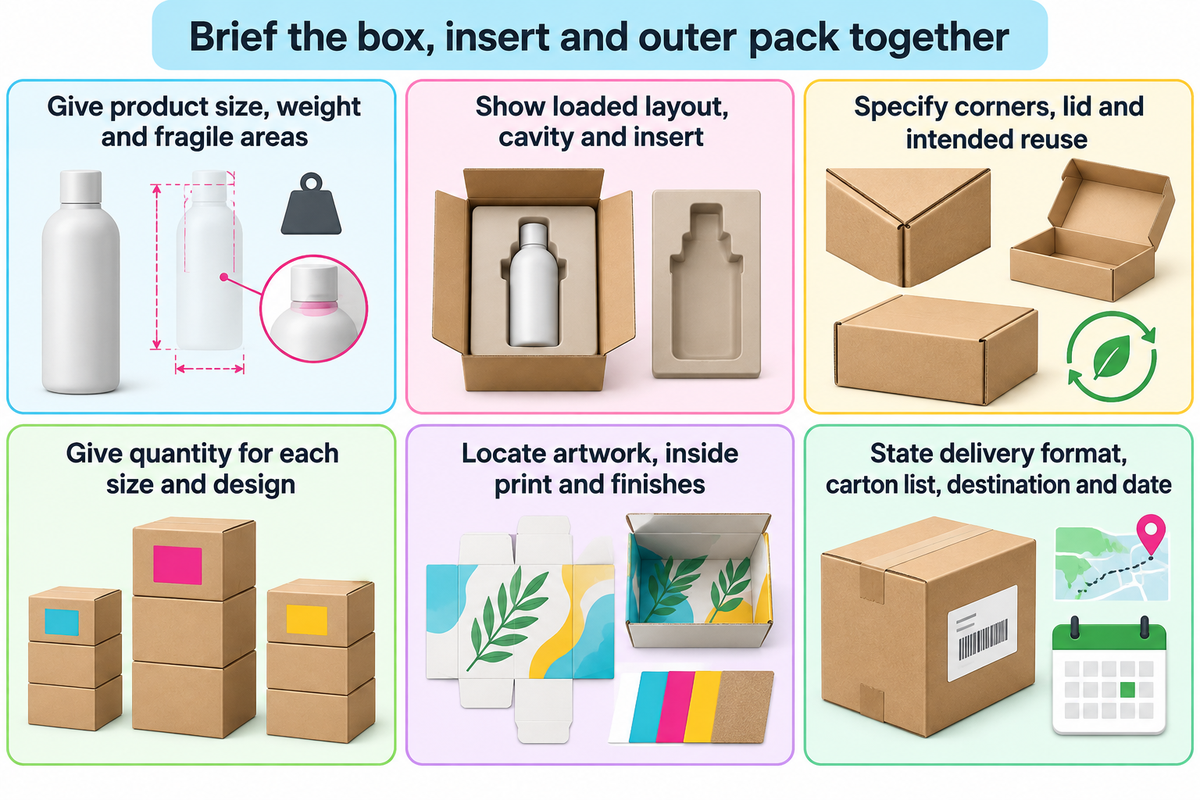
A handy box brief identifies the wrapped rigid structure, the loaded product layout, and the work to be done at the receiving site. When purchasing collapsible rigid boxes wholesale, for instance, specify the quantity per size and design instead of a combined total. Also, include the insert and outer shipping pack so the packaging solution can be reviewed as one complete arrangement.
For custom packaging boxes, include the following information in each custom box brief before comparing customization options:
- Product dimensions and weight, including fragile or protruding areas.
- Usable cavity and custom inserts, with a loaded product arrangement.
- Permanent or releasable corners, lid style and intended reuse.
- Quantity for each of the custom sizes and each printed design.
- Artwork, inside printing and the positions of premium materials or finishes.
- Flat or erected delivery, carton list, destination and required packing date.
Our Xiamen plant, Huandao, handles pre-press, sheetfed offset printing, coating, lamination, die-cutting and folder-gluing in-house. Huan Yin Packaging Group can integrate the inserts and outer cartons with the printed boxes for shipment consolidation. For custom rigid boxes, this integrates the project brief for the box, insert and shipping layer.
Use our custom collapsible rigid boxes solution page to send your product layout and receiving site packing plan. We can assess custom printed surfaces and the structure around that brief. Should your packing line require ready-erected supply, state this at the beginning of your enquiry. Discuss your box project.
Where Fold-Flat Packaging Design Is Heading
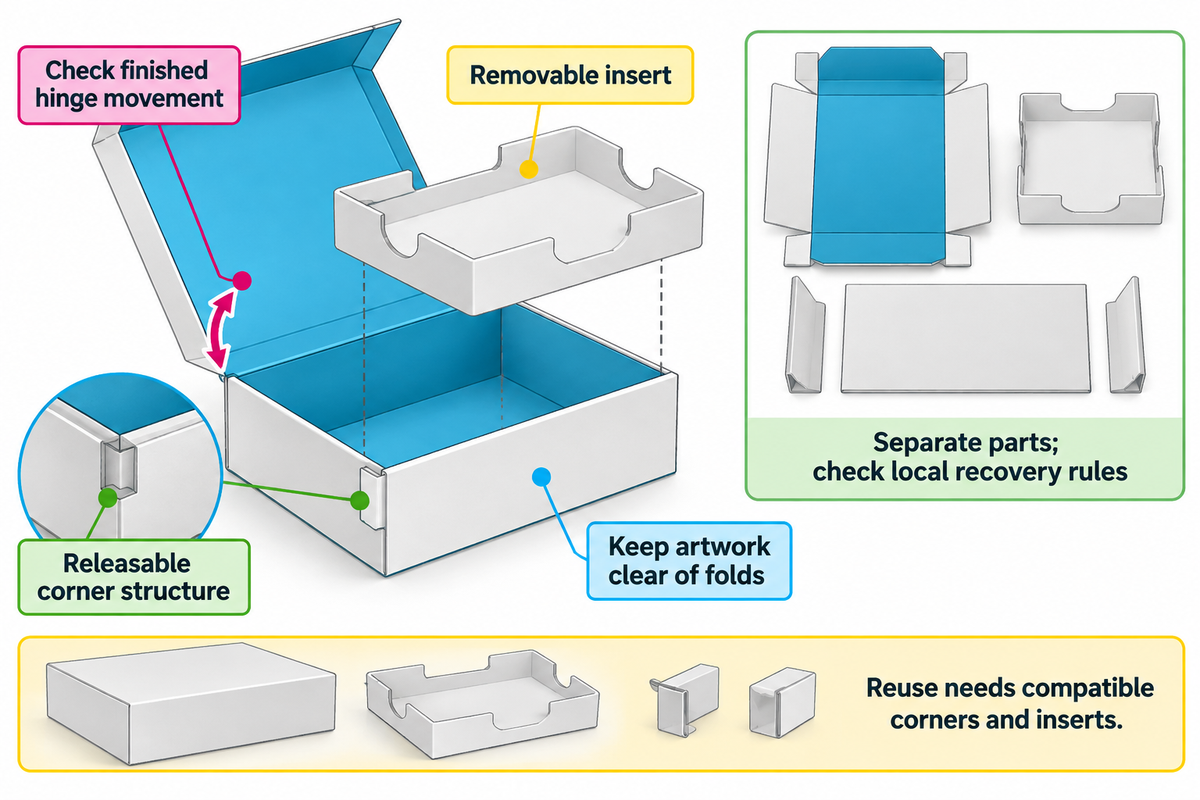
In the next step, foldable packaging should eliminate unnecessary elements while keeping the product supported and hinges functional. A removable paper insert, a releasable wall lock or a different surface paper can change the pack more than adding another magnet. Assess those against the route of assembly and the destination’s recovery route and reuse potential.
Mondi’s March 2025 announcement described a 350 g/m² option in its PERGRAPHICA Classic Rough and Natural Rough range for perfume packaging. This describes a textured paper portfolio rather than a gray board. On luxury custom projects, the opportunity is to look at the texture and print finish, and how the structure folds rather than assuming a heavy assembled box creates a better presentation.
For premium packaging solutions, the selected surface still needs to work at the folds. For a foldable rigid structure, select hinge-wrap paper for its bending movement, including the printed and finished surface. For luxury packaging, look at the finished movement: How far can each panel fold? Does the liner also bend? Where do decorated areas cross the folds? Keep text and logos in stable areas rather than interrupted by a fold.
Refolding itself has a longer history. Packaging Digest’s 2014 Bäks case study describes a flat-delivered box that uses origami hinges and locking flaps fastened with embedded magnets. It can be folded flat again. This is an example of this company’s design work. Reuse requires cooperation of corner structures and inserts rather than labeling the shell reusable.
For sustainable packaging, separating disposal tasks is of the utmost importance. Removal of inserts supports material recovery and recycling. The US Environmental Protection Agency’s recycling guidance directs users to their local programme and notes that shiny or laminated gift wrap often cannot be recycled.
In reviewing new box designs, look separately at the empty shells and insert, and then erect the complete pack and take it apart in the prescribed way. Custom packaging solutions that simplify those steps probably do merit a sample comparison; broad statements about waste reduction should be justified.
Collapsible Rigid Boxes FAQs
Are collapsible rigid boxes durable?
They can be durable when the construction suits the loaded product.
Board, hinges, corner fastening and product support all contribute to durability. A stiff wall doesn’t prevent a poorly seated corner from moving. Compare finished samples with the intended contents and handling route. Keep appearance criteria separate from product-damage criteria, since scuffed premium packaging may fail the presentation requirement even when the product remains intact.
Can inserts be added inside the boxes?
Yes, inserts can locate the product and organise the presentation.
Paperboard platforms, dividers, foam or moulded trays can be designed around the contents. Their dimensions must work with the usable cavity and the wall-folding sequence. Include separately shipped trays in the incoming carton list. A large nonfolding insert may occupy substantial freight space even when the outer shell is delivered completely flat.
Can they be fully custom printed?
Yes, both the outer wrap and the inner liner can carry artwork.
Keep fine text, logos and important alignment points clear of moving hinge zones. Review colour and finish on the chosen surface, then inspect the folded sample with the product loaded. Inside printing can also show packing instructions. Final artwork should follow the approved structural dieline so that turn-ins, joints and covered areas are accounted for.
Do these boxes include magnetic closures?
Magnetic closures are common, but they are a design choice.
A collapsible box can use another specified closure. A magnet in the flap closes the lid; separate structural fasteners hold the walls. Choose the corner design independently when the customer needs to flatten the box again.
Can collapsible rigid boxes be recycled?
Some components can be recycled where the local programme accepts them.
The shell may contain board, wrap, coating, film, adhesive and magnets, while the insert may use another material. Separate removable parts through the intended disassembly route. Local collection rules determine which parts enter each stream. See the US Environmental Protection Agency’s recycling guidance for local collection advice. Laminated or heavily decorated surfaces need particular attention. Reuse a serviceable box where that suits the product, and write disposal instructions around the actual component list rather than an unconditional claim that the complete pack is recyclable.
Are design templates available for custom sizes?
A production dieline should follow the approved size and structure.
Use the converter’s project-specific template for artwork. Customization changes panel positions, hinge areas and turn-ins. Reusing a generic folding gift template can put graphics over joints or leave part of the artwork hidden after wrapping.
Which industries use collapsible rigid boxes?
They suit gift-oriented products where presentation and empty-stock space both matter.
Apparel, cosmetic sets, accessories, corporate gifts and selected electronics are possible applications. The product still sets the insert and protection requirements. A clothing box and a glass-bottle set shouldn’t inherit the same support arrangement merely because their outer boxes look alike. For subscription or seasonal campaigns, the receiving team’s available packing time also affects the choice. Compare the complete pack and dispatch sequence before settling on the format.
References & Sources
- Rigid Box Industry Terminology – Paperboard Packaging Council.
- The Latest in Paperboard Packaging Design Shows in Competition Winners – Packaging Strategies, 2017.
- Influence of Fiber Composition and Drying Conditions on the Bending Stiffness of Paper – Ham, Youn and Lee, BioResources, 2020.
- Getting Started with Design & Testing – International Safe Transit Association.
- Effects of Group Size and Learning on Manual Assembly Performance – Peltokorpi and Niemi, International Journal of Production Research, 2019.
- Determine Total Export Price – International Trade Administration.
- ASTM D4332-22: Conditioning Containers, Packages or Packaging Components for Testing – ASTM International, public scope.
- Boxing champ — Packaging Digest, 2014.
- How Do I Recycle Common Recyclables – US Environmental Protection Agency.