Get in Touch with Xiamen Huandao Packaging Technology Co., Ltd.

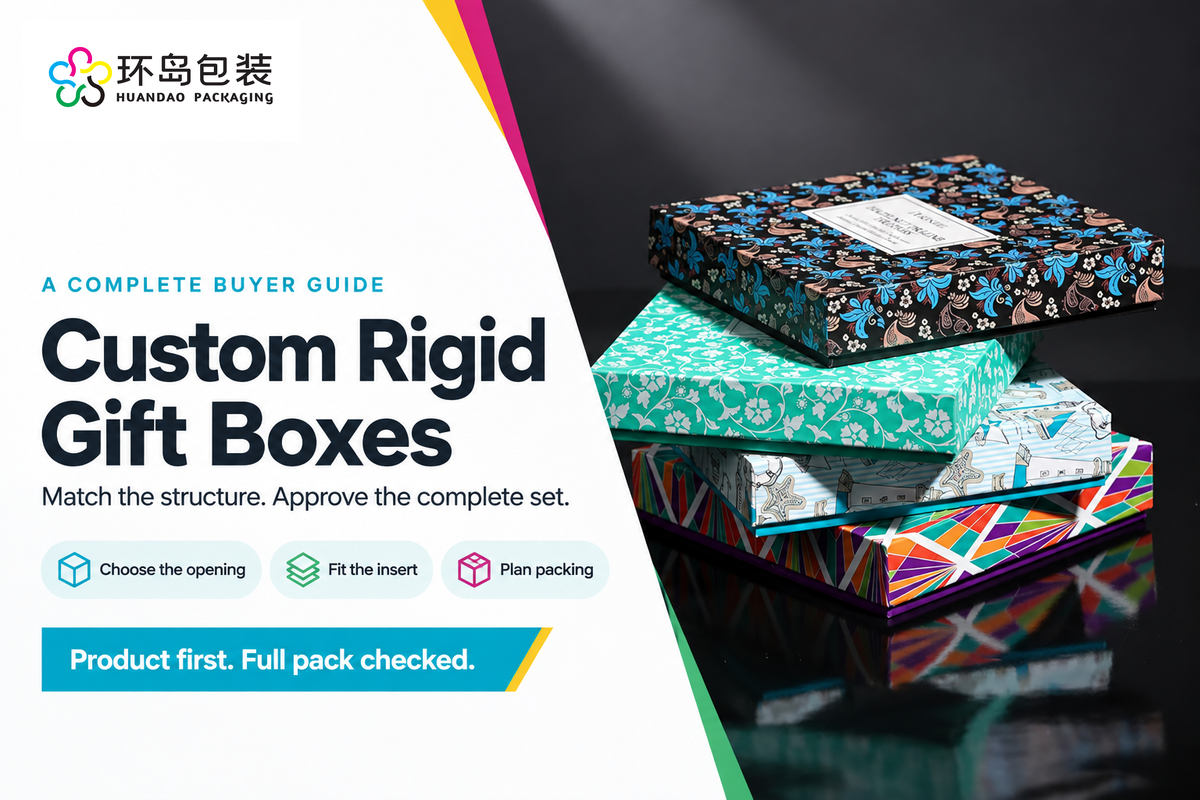
At a glance
Construction: structural board, outer wrap and a product-specific interior. Opening: lift-off, hinged or sliding. Supply form: assembled or collapsible. Approval: the decorated box, filled insert and transport pack together.
Custom Rigid Gift Boxes are made-to-order presentation boxes with a firm structural core, usually covered by printed or decorative paper. Choose the opening around the product and then choose the insert and delivery form. An empty box can still be an awkward presentation, difficult to open and expensive to ship.
Compare the finished gift set by how the product sits, how a customer lifts it out, and how the packing team prepares it for dispatch.
Custom Rigid Gift Boxes combine a structural board core with a decorative wrap. Match the opening and insert to the product, then compare assembled and collapsible supply using both landed packing cost and available packing hours.
Key points
- A magnetic closure describes the opening; it doesn’t tell you whether the box ships flat.
- Core thickness, wrap finish and insert fit solve different problems.
- A lower freight quote can be outweighed by local erection work or a missed packing deadline.
- Structural approval, transport testing and batch acceptance are separate decisions.
Rigid Gift Boxes, Folding Cartons and Mailers: What Changes?
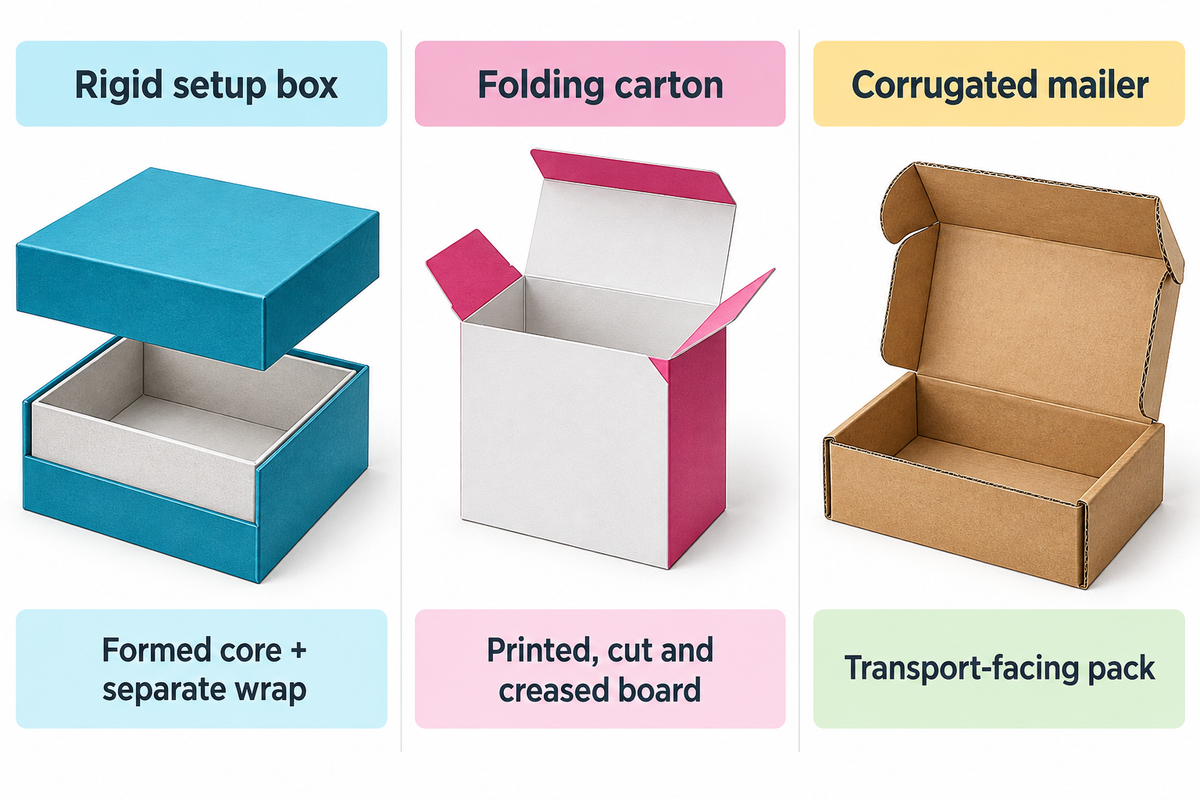
A rigid gift box uses a formed board structure to give a firm presentation pack. A folding carton uses creased board, which is folded to form the shape of the box. A mailer is usually made from corrugated board with a fluted layer to protect goods during transport. The product and the route it takes determine which construction gives the best fit. The thickest looking package isn’t always the best fit.
The terminology of the Paperboard Packaging Council differentiates the chipboard core from the wrap. It also describes knockdown boxes that are supplied flat and erected for use. Therefore, the construction remains rigid and the supply form needs a separate specification.
How do rigid boxes compare to regular folding cartons?
Rigid boxes offer a thick formed structure and a wrapped surface. A folding carton has a creased board construction that can be supplied flat. Choose rigid packaging for a deliberate presentation and storage. Choose folding cartons when supply and assembly need a compact form and when material use and efficiency are of primary concern.
| Construction | How it is built | Useful role | Planning consequence |
|---|---|---|---|
| Rigid setup boxes | Formed core with a separate wrap | Presentation, product reveal, retained storage | Allow for the assembled volume or an erection step |
| Folding carton | Printed, cut and creased board | Retail product packaging and lighter gift packs | Develop folds, locking/gluing and loading together |
| Corrugated mailer | Liners and a fluted layer | Transport-facing pack | Size the complete product-and-cushioning system |
A skincare set sold across the counter may require luxury packaging that displays a set with multiple jars. The same set shipped by parcel network may require transport protection around the presentation. A printed box and outer mailer may therefore be complementary packaging solutions. A lightweight refill or a fast moving retail item may however benefit from a starting point of custom folding cartons.
Which Opening Style Suits Your Product?
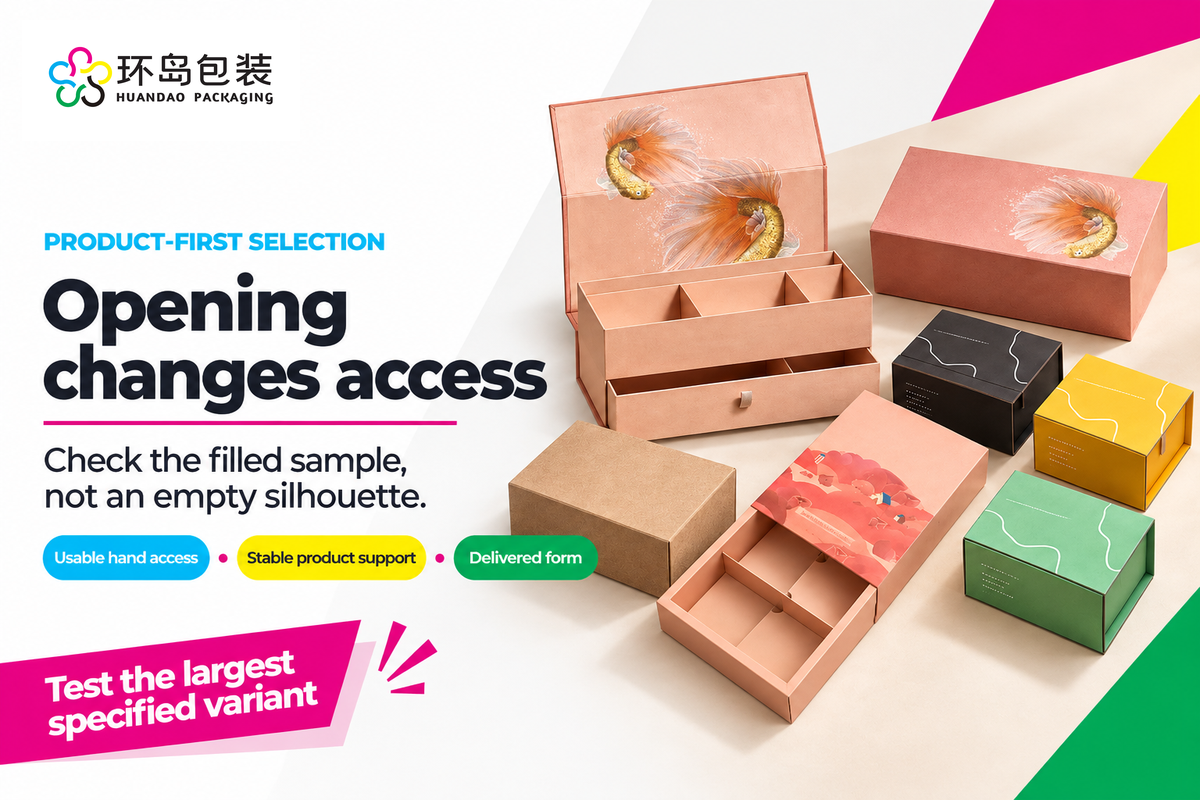
Choose a lift-off lid for an unobstructed top opening. Select a magnetic lid for repeated opening. A drawer can reveal the product in the case of a sliding opening mechanism. Decide whether collapsible supply or an assembled format works best for the packing operation. The Product-First Box Selector keeps customer access and the supply format on separate lines of the brief.
Review premium rigid boxes for the largest and heaviest specified product variants. A pull ribbon in a filled sample needs a good grip, a tall bottle needs stable support, and a broad lid needs room to open on the intended shelf or counter. PPC’s structural definitions may help distinguish drawers and shoulders, hinges, and knockdown forms.
| Product or handling condition | Start with | Why it fits | Sample decision |
|---|---|---|---|
| Several items displayed from above | Two-piece lid and base | The lid lifts clear of the product layout | Can each item be gripped without lifting the whole tray? |
| A set opened and closed repeatedly | Hinged magnetic closure | The lid stays attached | Does the flap align and close with the loaded insert? |
| A small accessory presented in a sleeve | Drawer and tray | The tray exposes the item progressively | Is the pull easy to hold, with controlled tray movement? |
| A bottle needing a defined lid seat | Shoulder-neck construction | An inner collar locates the cover | Are the collar, cover and bottle support aligned? |
| A heavy glass candle | Top-opening box with a fitted cradle | The vessel can be lifted upright | Does the cradle support the vessel without trapping it? |
| A flat journal or document set | Shallow lift-off or book-style box | A shallow cavity limits unnecessary depth | Is there finger access beneath the contents? |
| A retailer sample kit with printed instructions | Hinged presentation box | The inside lid can carry the opening sequence | Can the recipient read it while the products remain visible? |
| A large box ordered ahead of filling | Collapsible supply, if feasible | Flat storage may suit the waiting period | Can the packing station erect it consistently in time? |
| A seasonal range using one product envelope | Common structure with revised wrap or sleeve | Shared geometry can simplify repeat planning | Does every variant fit the same approved cavity? |
Magnetic closure boxes and drawer rigid boxes allow different opening movements. Boxes with magnetic lids may use collapsible panels; a closure name alone does not determine the delivery form. A supplier’s range of rigid box styles may help to identify both.
Check out custom rigid boxes for premium fragrance sets containing a bottle, travel spray, and printed card. A drawer looks nice, but the bottle cap is close to the sleeve. A recipient pulling the tray might press the cap before finding a grip. A sample with top opening gives better access. A finger recess on the insert helps to remove the bottle. The team can keep the same graphic direction and premium finishes while modifying the opening geometry. In this situation, the choice is based on hand movement and product support, rather than luxury rigid boxes in general. The sample is reviewed by the person who will fill the pack, as well as the person approving its appearance.
What Do the Core, Wrap and Insert Each Do?
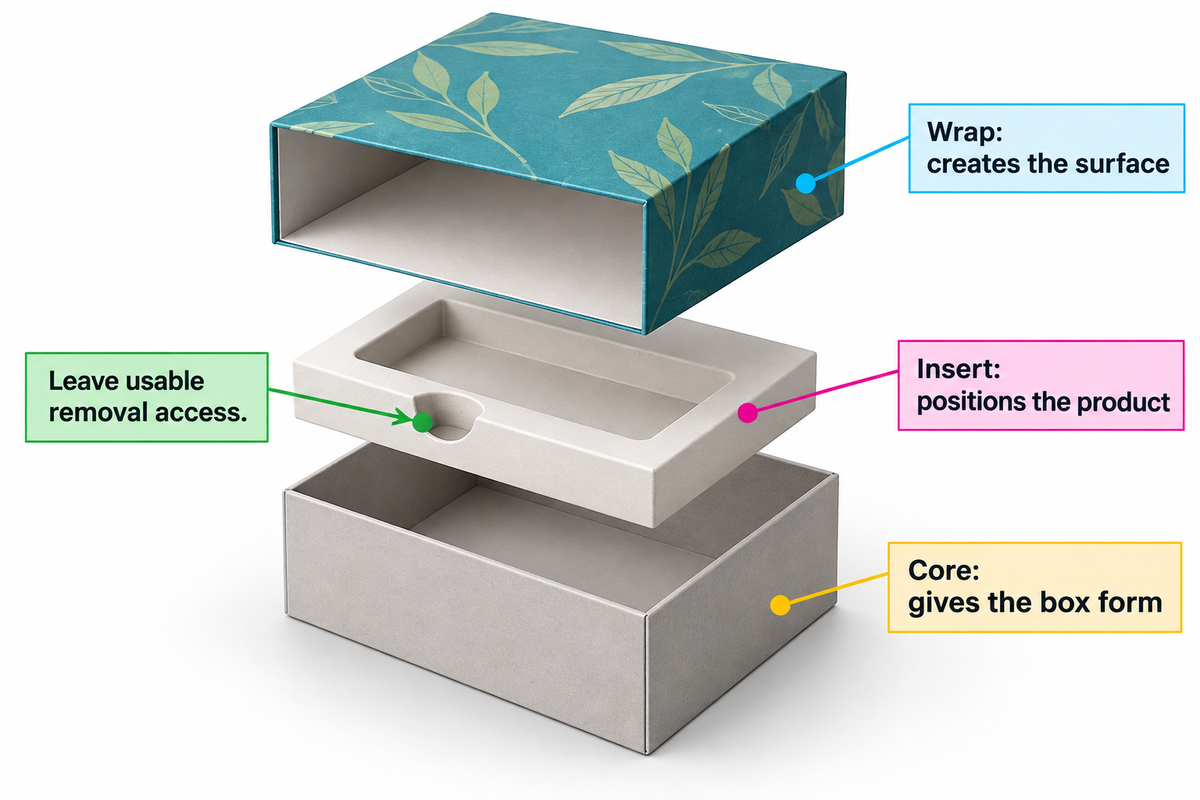
Identify the structural core, visible wrap and fitted insert as components of the custom box. Core determines form, wrap creates a tactile experience and insert places the product. Thickness of the core won’t create finger access or stop a bottle from rattling in the case.
Huandao offers 1.5–3 mm chipboard for two-piece rigid gift boxes. Longer unsupported spans, hinges and fitted interiors warrant a more thoughtful design. Core caliper measures thickness; wrap basis weight describes a different property of the packaging material.
Can I customize the size and inserts of my rigid gift boxes?
Yes. Custom size and insert can be designed around the product and its accessories and the intended opening. Begin with the largest product envelope, i.e. with caps, sleeves and protrusions. The sample then allows definition of the insert’s support points, provides enough removal access and defines the usable internal space. The size of the internal space and the external size of the case should be on different drawings.
Paperboard inserts are ledge and compartment formers. Shaped support is provided by molded pulp. Foam can support a product by conforming to its profile, while a fabric cover provides the contact and presentation surface. Whichever insert material is chosen, assess the filled product box through its intended handling. A soft lining and a protective cushion aren’t interchangeable. For custom rigid setup boxes, the approved wrap and insert belong in the same bill of materials as the core. Top Pack manager John Lee’s Packaging Digest guide likewise develops the opening and fitted interior together.
One of the considerations for custom rigid box packaging is the height of the display, and in some cases the support, for mixed-height products. For custom rigid box packaging with a support platform, a short jar may still need that platform to reach the intended display height. In this case, the support needs to carry the jar during handling, and a ribbon lift may help with removal if the cavity is close-fitting. A support that may work for a lightweight carton may not work for glass.
Examples include Candle rigid boxes where the vessel and lid and weight shape and define the cradle, and the opening may still be lift-off or hinged. Custom made rigid boxes should be identified relative to the final product that’s assembled, rather than to the nominal jar diameter.
Get Box Dimensions and Fit Right
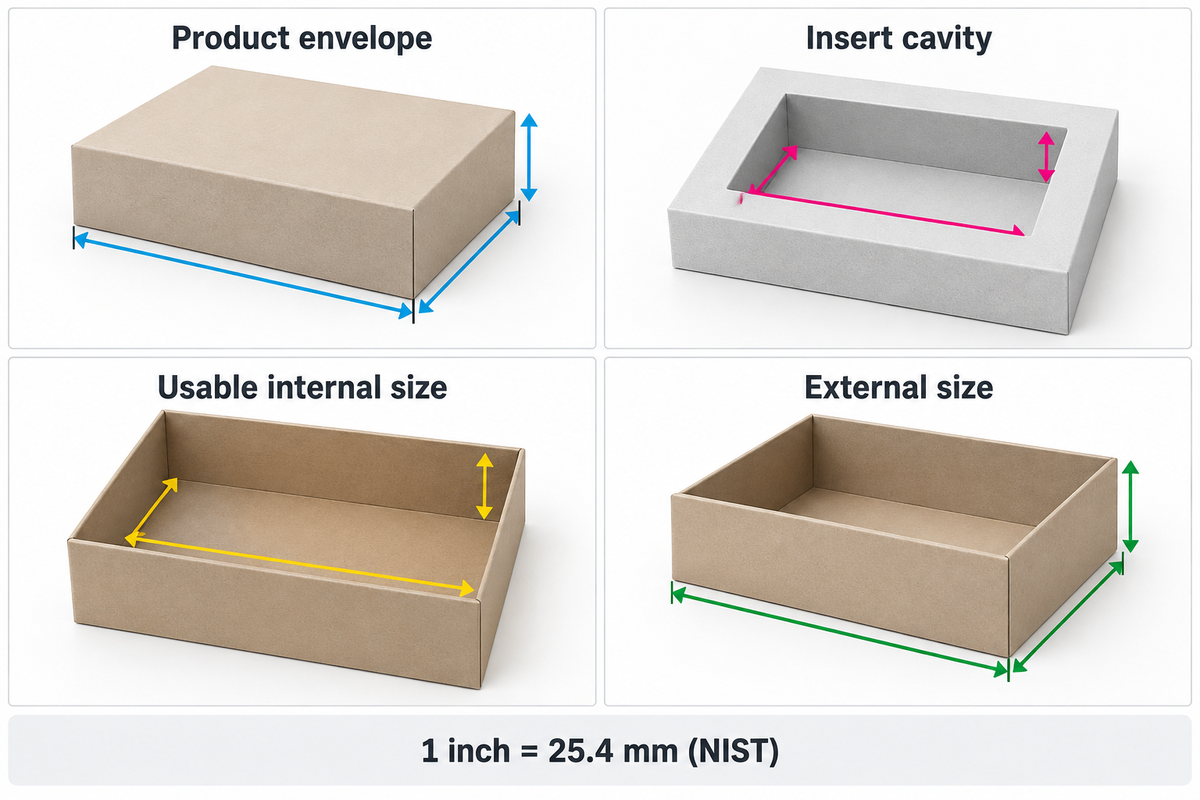
Consider four dimensions: the product envelope, insert cavity, the usable internal size of the box, and the external size. The product must clear its insert cavity, and the filled insert must fit in the box. The external size must be compatible with storage and shipping. A single length-by-width-by-height entry can’t capture all four dimensions.
Engineering note: NIST defines one inch as exactly 25.4 mm. Example: a product dimensioned at 4 × 3 × 2 inches would have an envelope of 101.6 × 76.2 × 50.8 mm, before the addition of the insert, access space, board or wrap. Merely adding twice the core thickness wouldn’t capture details such as turn-ins, collars, or folded insert walls. Our packaging dimension converter does the unit conversion; the structural drawing has to define the dimension basis.
Use the same unit system on the approval drawing, and write the dimension basis next to each size. On rigid gift boxes with lids, the lid and base are kept as a matched pair throughout approval. Sample decisions include the amount of overlap and the amount of lift felt to be correct. For a drawer, the sleeve and tray must move together without obstruction from the product, and the travel must be unrestricted. Custom designed rigid boxes require this fit, before positioning artwork on panel edges; compare box designs which use the same product envelope.
Printing and Premium Finishes: Match the Surface to Handling
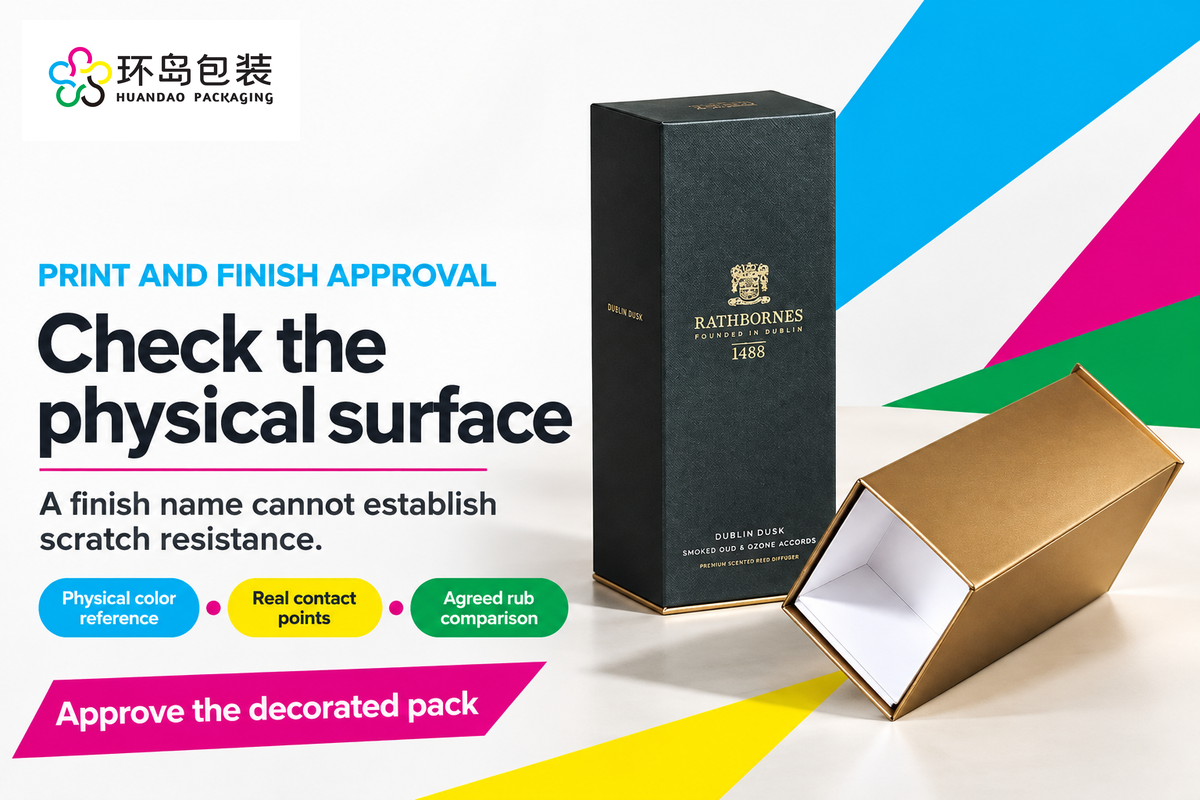
For surface areas that will come in contact with customers, choose prints and finishes around the handling they receive during packing and transport. Full color images are represented with CMYK. Spot colors represent a specific color. Visual and/or tactile differences can be added with foil stamping, embossing and debossing.
A sample must be decorated to demonstrate effects. For premium packaging, the approval sample should demonstrate what’s hidden under the lid, as well as the exterior.
Blemishes and edge marks can be exposed by white rigid gift boxes; however dark solid wraps can make handling scuffs obvious. Matte, gloss and soft touch surfaces, and other effects, should be evaluated based on the stock and finish. Kraft rigid gift boxes use the paper’s own color and texture to create a design; hence, the artwork can read differently on a coated paper stock.
Printed materials experience abrasion during distribution, storage, use, and handling. ASTM D5264-98(2019) describes test conditions. A finish name does not indicate scratch resistance.
“This practice provides a way of comparing abrasion resistance of printed materials under laboratory conditions.”
Visualize custom printed rigid boxes with a black wrap, a foil logo, and a pale fitted tray. The digital proof confirms the placement of the artwork and the direction of the colors. However, the decoration team moves the tray underneath other boxes while loading the carton, and the lid of the topmost box sometimes contacts the carton, and leaves a mark in an area that the screen proof doesn’t represent. The team either alters the sequence of the packing or the finish combination and then performs a physical check with the product and the outer carton. The foil logo remains, and the decision now includes how the surface is handled. This is an easier, more practical route to high end packaging, without adding any special effects that increase the difficulty of producing and handling the pack.
What Changes the Cost, Minimum Order and Lead Time?
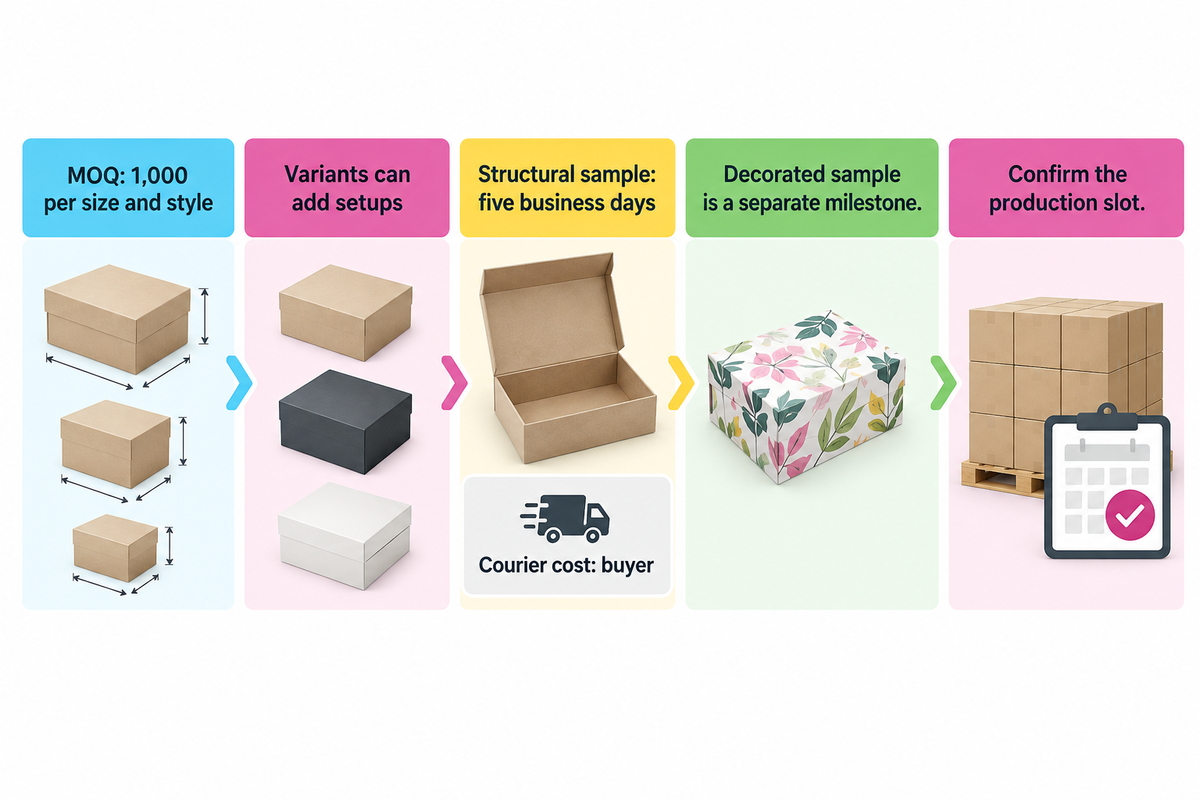
Huandao’s standard minimum is 1,000 pieces for a given style and size, and smaller runs are done on a case by case basis. One published price guide lists rigid boxes at typically $3.00–$12.00+ per unit; the dimensions of the box, the type of wrap and finish, insert, and the versions of the artwork set where a quote falls. The delivery date needs a schedule that includes the separate stages of sampling, approval, production, and transport.
What is the minimum order quantity (MOQ) for rigid boxes?
Our MOQ is 1,000 units per size and style rather than an unlimited mix. Smaller runs are quoted on an individual basis. A simplified order is possible when a range has common dimensions and a shared structure. Using different artworks, inserts or finishes doesn’t simplify the order, and may require separate production runs.
Setup time is part of the quantity effect. ETH Zürich’s production-planning advice distinguishes run time per unit from the setups spread over the batch. More variants can lead to more setups. Smaller batches can also encounter a full production schedule, so “fewer boxes” doesn’t always mean “earlier delivery.”
Huandao provides a free structural sample within five business days, with the courier costs to be borne by the buyer. A dieline response is a different milestone from a decorated sample and an approved production slot. Before you get custom rigid boxes made, separate one-off tooling costs from repeat unit costs. For custom rigid boxes wholesale, compare quotes using the same dimensions, artwork count, insert, packing form and delivery basis.
Empty-Box Freight and the Packing-Line Trade-Off
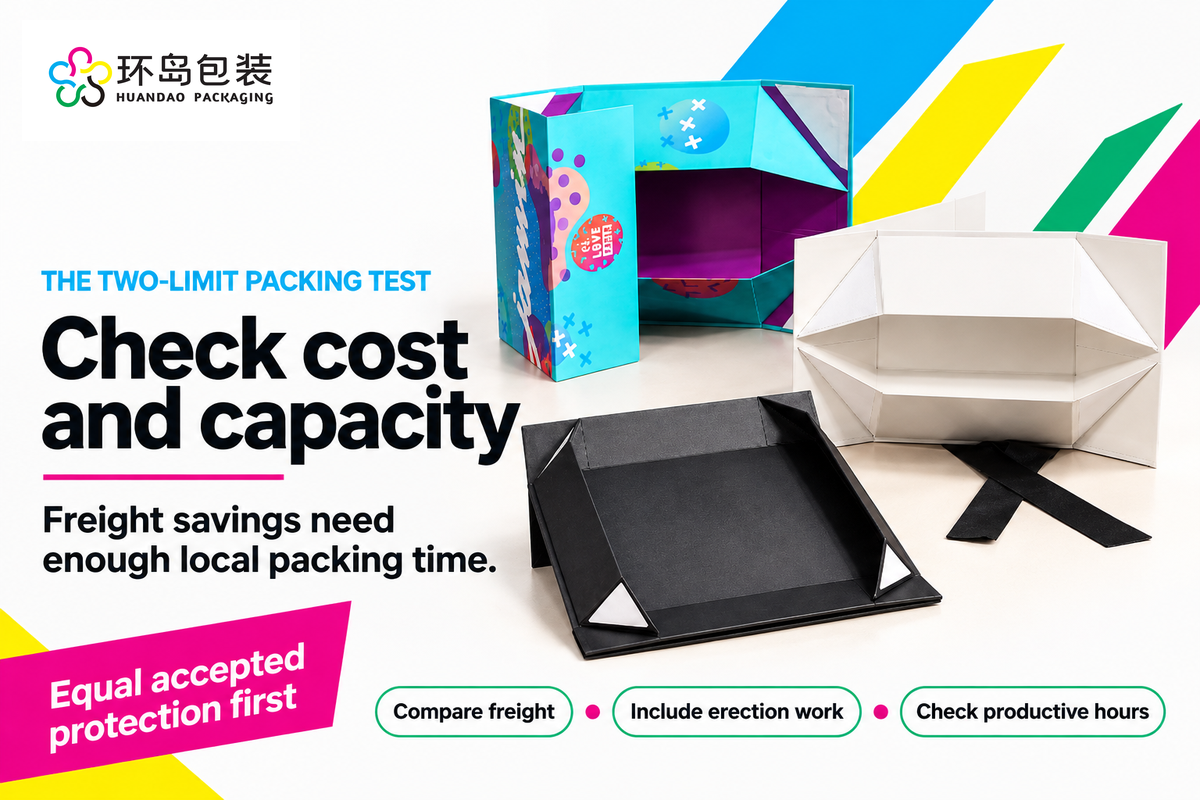
A collapsible box can be selected if its landed packing cost is lower and the available packing station can absorb the extra work of box erection. The Two-Limit Packing Test can be used to check the above two conditions. It begins only when the two designs meet the same standard of product protection, and a cheaper yet unsuitable pack doesn’t enter the comparison.
Compare empty box freight on the same carrier, service and charging basis. Flat supply can reduce shipment volume. Savings appear only when the billed amount falls; for listed domestic classes, USPS bills parcels over one cubic foot (1,728 cubic inches) at actual or dimensional weight, whichever is greater. USPS’s parcel guidance has dimensional weight thresholds, Flat Rate options, and guidance on Priority Mail Express and Flat Rate Box shipments.
Assembled supply
- Uses space at full box volume.
- Arrives ready for insert fitting and loading.
- Can suit a tight local packing window.
Collapsible supply
- Uses the supplied flat-pack geometry.
- Adds erection and corner-setting work.
- Needs enough productive station-hours before dispatch.
Assumed inputs: one packing station, 1,000 gift sets, equivalent accepted protection, eight productive station-hours and labor at $18 per productive hour. Product loading takes 20 seconds per set for either option; the flat box adds 24 seconds of erection. Box acquisition and empty-box freight costs are combined with the labor costs of packing. Other costs attributed to the project such as tools, storage, duties, returns and damage are analyzed separately.
| Input or result | Assembled | Collapsible |
|---|---|---|
| Box acquisition per set | $3.00 | $2.80 |
| Empty-box freight per set | $0.60 | $0.25 |
| Extra local erection | 0 seconds | 24 seconds |
| Common product loading | 20 seconds | 20 seconds |
| Total local work per set | 20 seconds | 44 seconds |
| Packing labor per set | $0.10 | $0.22 |
| Comparison subtotal per set | $3.70 | $3.27 |
| Station-hours for the order | 5.56 hours | 12.22 hours |
| Fits the productive time available? | Yes | No |
The cost limit for extra erection is the acquisition-and-freight saving divided by the labor rate: ($3.60 − $3.05) × 3,600 ÷ $18 = 110 seconds per set. The capacity limit is productive seconds available per set minus common loading: 8 × 3,600 ÷ 1,000 − 20 = 8.8 seconds per set. Additional erection must occur within these limits. The assumed 24 seconds passes the cost test and fails the capacity test.
With 13 productive station-hours, the flat option fits this order. If the labor rate instead rises to an assumed $90 per productive hour, the extra-time cost limit falls to 22 seconds: the collapsible subtotal becomes $4.15 versus $4.10 assembled. Available time and labor rate can reverse the justification independently. Measure complete repeatable packing work, including insert fitting and recurring rework, before replacing the assumed times.
When choosing collapsible rigid boxes, evaluate costs and handling time separately. Procurement evaluates costs, and the packing team evaluates handling time. Chiu, Chung and Lin’s packaging-system research treats these as different goals.
Approve Samples That Represent the Finished Gift Set
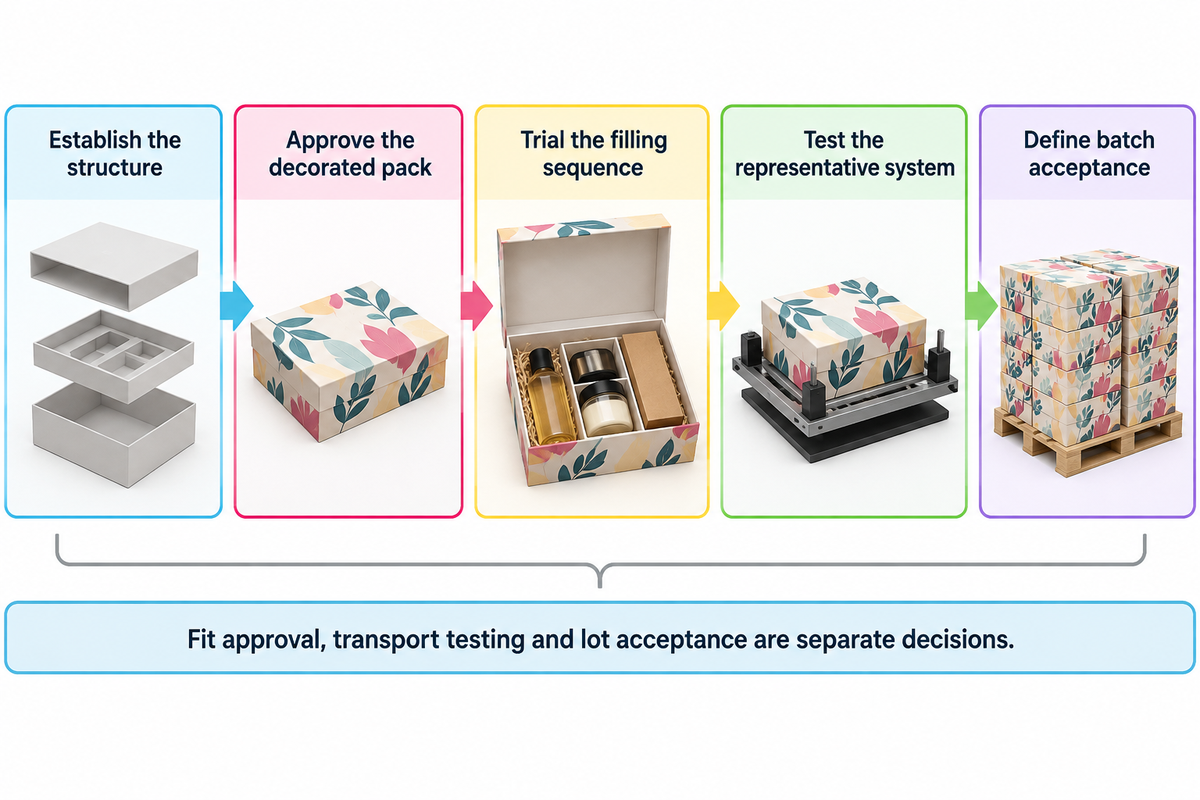
Approve the structure before the decorated surface. Use production-representative products and packaging for the relevant tests. Keep sample approval for fit and appearance, repeated-shipment testing and production-lot acceptance as separate decisions. Approve a production lot as a unit.
Choose transport tests for distribution, following ISTA’s design and testing guidance. A parcel sent through a network and a pallet of sets shipped to a retailer differ in handling. The system includes the product, insert, gift box and shipping carton, and closure.
- Establish the structure. Check the product envelope, cavity, lid movement and removal with a structural sample.
- Approve the decorated pack. Review the selected wrap, print, foil and surface finish under the intended viewing and handling conditions.
- Trial the filling sequence. Fit the insert, load the product, close the box and build the shipping carton using the planned packing method.
- Test the representative system. Choose the relevant transport protocol and conditioning with the laboratory; retain the stated damage criteria.
- Define batch acceptance. Agree the inspected characteristics, sampling plan and acceptance/rejection rules before production release.
| Observation | Object to examine | Useful comparison or record |
|---|---|---|
| Lid is difficult to lift | Matched lid, base and wrap | Approved fit sample and drawing |
| Drawer catches | Filled tray and sleeve | Full travel with the intended product |
| Product is trapped in its cavity | Insert and hand access | Removal trial with the finished product |
| Surface rubs or transfers color | Printed wrap and finish | Comparative rub method and agreed visual limit |
| Color varies visibly | Printed surface on chosen stock | Approved physical color reference |
| Box changes after exposure | Conditioned box or component | Recorded temperature, humidity and conditioning method |
| Product moves in transit | Filled gift set and outer pack | Distribution-appropriate packaged-product test |
| Outer carton needs an edge-crush check | Specified corrugated board | Job-specific ECT record for that component |
| Production variation needs acceptance | Randomly selected lot samples | Written characteristics and lot-acceptance plan |
Conditions of temperature and relative humidity (RH) affect paper-based materials. To make comparisons, conditions of RH and temperature should also be recorded. For packages and components, use ASTM D4332-22 conditioning practices. Identify the test item in the report. An edge-crush test of corrugated board is a different test from a rub test of a printed wrap or a test of a filled gift set.
As ISTA recommends, to increase confidence in test results, repeat tests with fresh samples. One passed packaged product gives limited confidence about other units; repeated passes increase confidence; however, future results for the product may vary. Match the sample programme to the relevant protocol and testing purpose.
A lot acceptance plan describes how a sample leads to an accept or reject decision for a given shipment. NIST explains the associated consumer risk: a sampling plan can accept a lot with an unacceptable defect level. The agreed plan therefore belongs beside the defect definitions and approved reference, rather than being inferred from one attractive sample.
Our Huandao laboratory issues job specific ink-rub and basis weight reports, as well as ECT/burst reports for the supporting corrugated packaging. Reports can follow the customer’s production run and specified component, and can be job specific rather than being of a general strength grade for all rigid gift boxes.
Recycling and Reuse Depend on the Finished Components
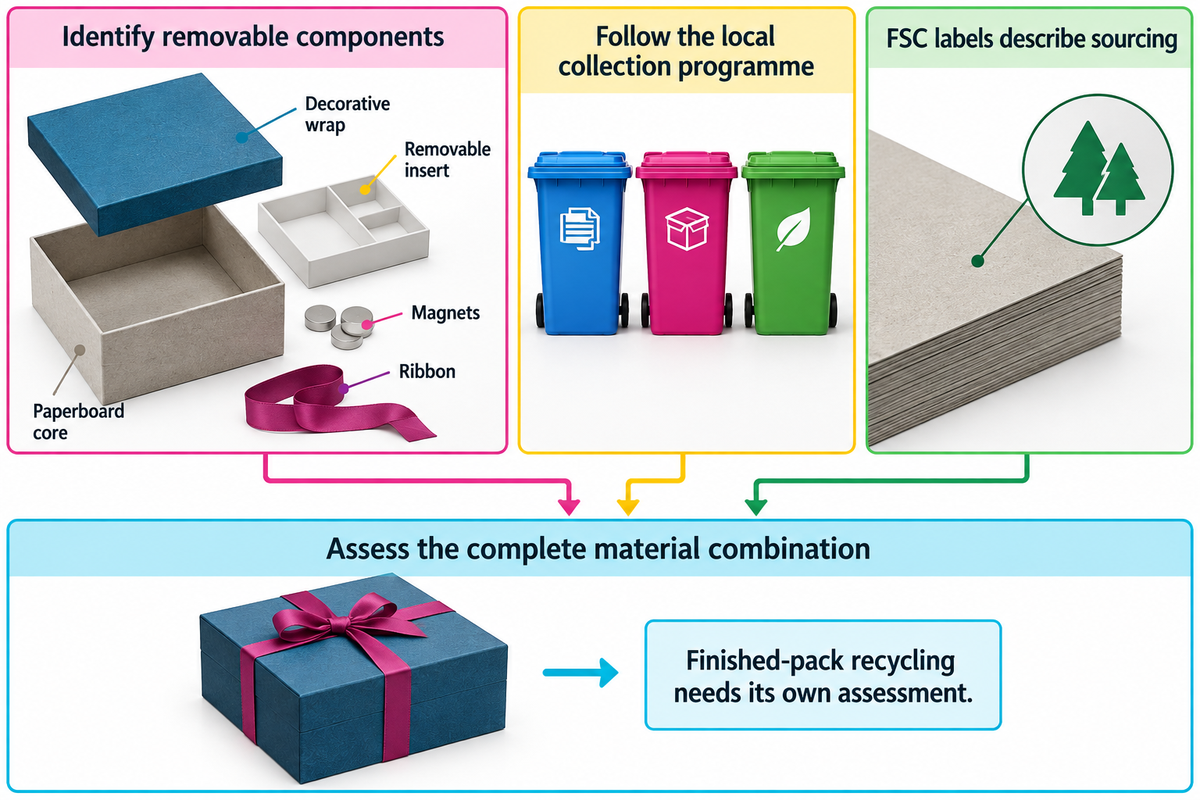
While a paperboard core can structure a paper-led design, it’s the overall combination that influences sorting and recovery. Wraps, laminates, magnets, ribbons and inserts can produce different material streams. Reuse also needs a practical reason. A box that keeps closing and houses something useful has a better second life case than an empty, oversized presentation box.
Wrapping paper that has a shiny or laminated gift layer may not be recyclable, according to U.S. EPA’s recycling guidance; follow the local program’s instructions. A removable insert and component identification can make disposal easier.
The FTC Green Guides, 16 CFR 260.12, use access to appropriate facilities for at least 60% of consumers or communities where the item is sold as the substantial-majority basis for an unqualified recyclable claim. A claim about only part of a pack should identify that part. Sorting instruction and national on-pack claims are two separate tasks.
FSC’s product labels identify verified material sourcing categories; assess the finished pack recycling route separately. The appropriate certified supplier and label approval are required for the labeling process. Specifying a paper preference alone isn’t the labeling process.
Turn Your Choices into a Quote-Ready Brief
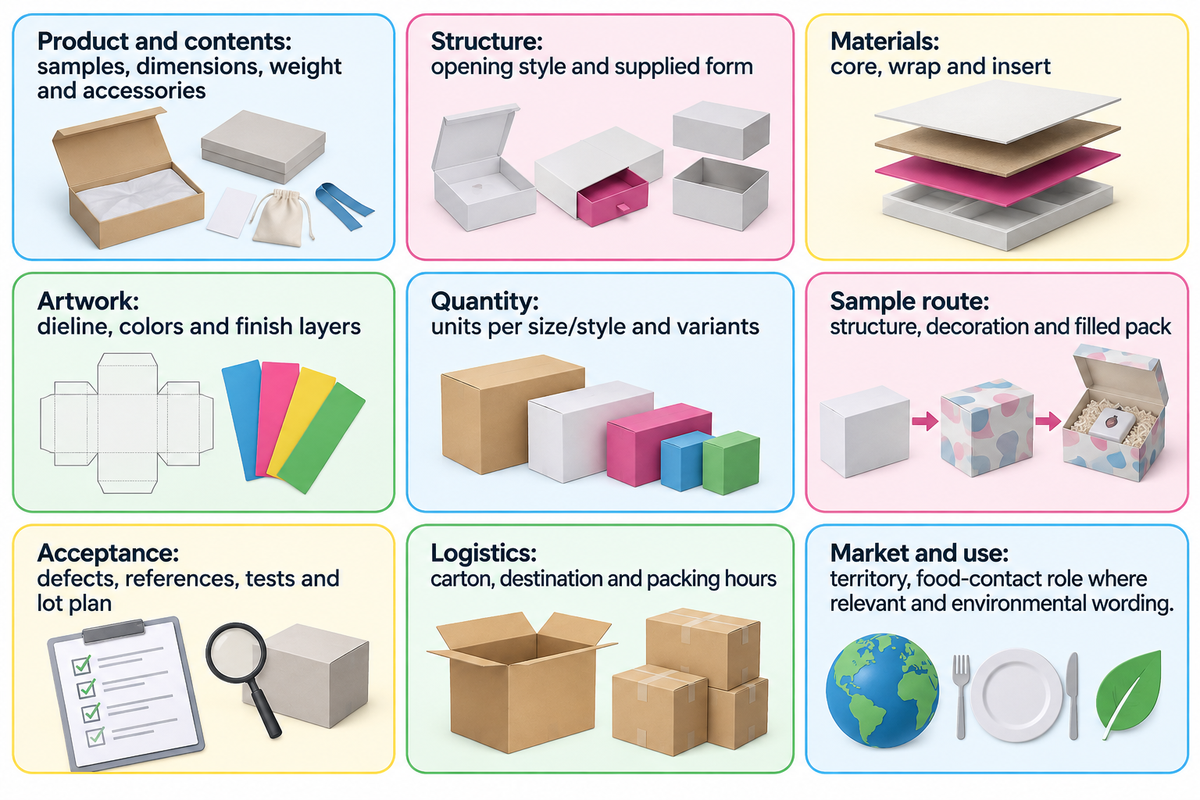
A quote-ready brief identifies the product, structure, materials, artwork, quantities, acceptance route and delivery basis. It allows a rigid box manufacturer to price the same job the brand and packing team intend to approve.
Set your inputs for custom packaging before you order, and don’t let unrelated pictures or the lowest prices compromise your requirements. Instead, make sure you understand the characteristics of the type of packaging (i.e. primary or secondary presentation, fitted interior or exterior transport pack).
Use this checklist to confirm the remaining details with the packaging company. For food gifts, indicate whether a given component touches food directly or is packed around an already packed product, and state the destination market. The requirements for a contact liner and a presentation box may be different.
For EU-bound projects, the European Commission describes phased packaging-rule application from 12 August 2026, including restrictions on PFAS above specified limits in food-contact packaging. This makes the market and contact role useful design inputs prior to selection of a liner or coating. A separately wrapped gift and a direct-contact food compartment need distinct descriptions.
RFQ checklist: send one matched specification
| Input | What to send or confirm | Decision it settles |
|---|---|---|
| Product and contents | Finished samples, dimensions, weight, accessories and contact-sensitive surfaces | Cavity, support and removal |
| Structure | Opening style, lid details and assembled or collapsible supply | Customer access and local packing work |
| Materials | Core specification, wrap, insert and removable components | Construction and material scope |
| Artwork | Approved dieline, logo files, color references and finish layers | Print and finish approval |
| Quantity | Units per size/style and the artwork or insert variants | Run and setup allocation |
| Sample route | Structural, decorated and representative filled samples | What each approval covers |
| Acceptance | Defect definitions, reference samples, test conditions and lot plan | Production acceptance |
| Logistics | Master-carton size, packing quantity, destination, trade term and productive packing hours | Comparable freight and pack-out feasibility |
| Market and use | Sales territory, food-contact role where relevant, and proposed environmental wording | Applicable material and labeling requirements |
We’ve been making printed paper packaging in Xiamen since 2003. In-house processes include pre-press, sheetfed offset printing, UV coating, lamination, die cutting and folder-gluing. Inner trays, inserts and outer shipping cartons can be provided with the printed box through Huan Yin Packaging Group and consolidated into a shipment. For other formats and project assistance, see our custom rigid gift box solutions.
Bring the product and the packing plan together.
Send the product dimensions, quantities and delivery destination for a structure-led discussion.
Frequently Asked Questions
Can you print my logo and branding on the rigid boxes?
Logo and artwork options
Yes. Logos and graphics can be printed on the wrap, with foil, embossing or other suitable effects added to the approved artwork. Custom printed rigid gift boxes need a dieline that shows panel edges, folds and placement. A decorated sample is the useful reference for the selected paper, color and finish combination, especially when artwork crosses from lid to base.
Are rigid boxes delivered pre-assembled?
Assembled and flat delivery
Conventional rigid setup boxes usually arrive erected; collapsible designs are supplied flat for local assembly. Boxes with magnetic closures can use either construction. The quotation should name the supplied form and any insert-fitting work left to the buyer. A box with magnetic hardware still needs its corners, panels and closure checked in the fully assembled condition.
Can I add custom insert options to protect my fragile products inside?
Fitted insert choices
Yes. Paperboard, molded pulp and shaped foam are among the packaging options for a fitted interior. The product’s weight, fragile features and removal path guide the support points. An insert for a premium product should hold it securely while leaving usable grip access. Protection is assessed with the filled box and intended transport pack, rather than from the insert material name alone.
Are rigid boxes actually recyclable?
Finished-pack collection
Paper-based rigid packaging boxes can be recyclable when their finished components suit the receiving programme. Laminates, attached magnets and mixed-material inserts change the sorting task. Component separation and the destination’s collection rules matter alongside the paper specification.
Do rigid gift boxes come with additional options like foil stamping or embossing?
Finishing choices
Yes. Printed rigid gift boxes can combine foil stamping, embossing, debossing, spot UV or lamination with the selected wrap. Keep the essential brand effect and approve its physical result before adding further finishing passes.
Where are custom rigid gift boxes made?
Our manufacturing location
Huandao makes printed paper packaging at our own facility in Xiamen, Fujian, China.
Are custom rigid boxes available for bulk orders?
Bulk-order planning
Yes. Bulk orders are planned by size, style and specification. For rigid gift boxes wholesale, keeping the quantity split, artwork versions and delivery basis clear makes repeat orders easier to compare.
References & Sources
- Paperboard Packaging Council: Rigid Box Industry Terminology
- NIST: SI Units, Length
- ASTM D5264-98(2019): printed-material abrasion practice
- ASTM D4332-22: conditioning packages and components
- Paul Schönsleben, ETH Zürich: setup time, batch size and lead time
- USPS: Parcel Size, Weight & Fee Standards
- Chiu, Chung and Lin: packaging-system cost and handling-time objectives, 2021
- ISTA: Getting Started with Design & Testing
- ISTA: How many samples are required for testing?
- NIST: Lot Acceptance Sampling Plans
- EPA: How Do I Recycle Common Recyclables?
- FTC Green Guides: 16 CFR 260.12, Recyclable claims
- FSC: On Product Labels
- John Lee, Top Pack manager: packaging briefs and production specifications, 2026
- European Commission: phased application of packaging rules, 2026