Get in Touch with Xiamen Huandao Packaging Technology Co., Ltd.

Custom Cosmetic Packaging: From Product Fit to Delivery

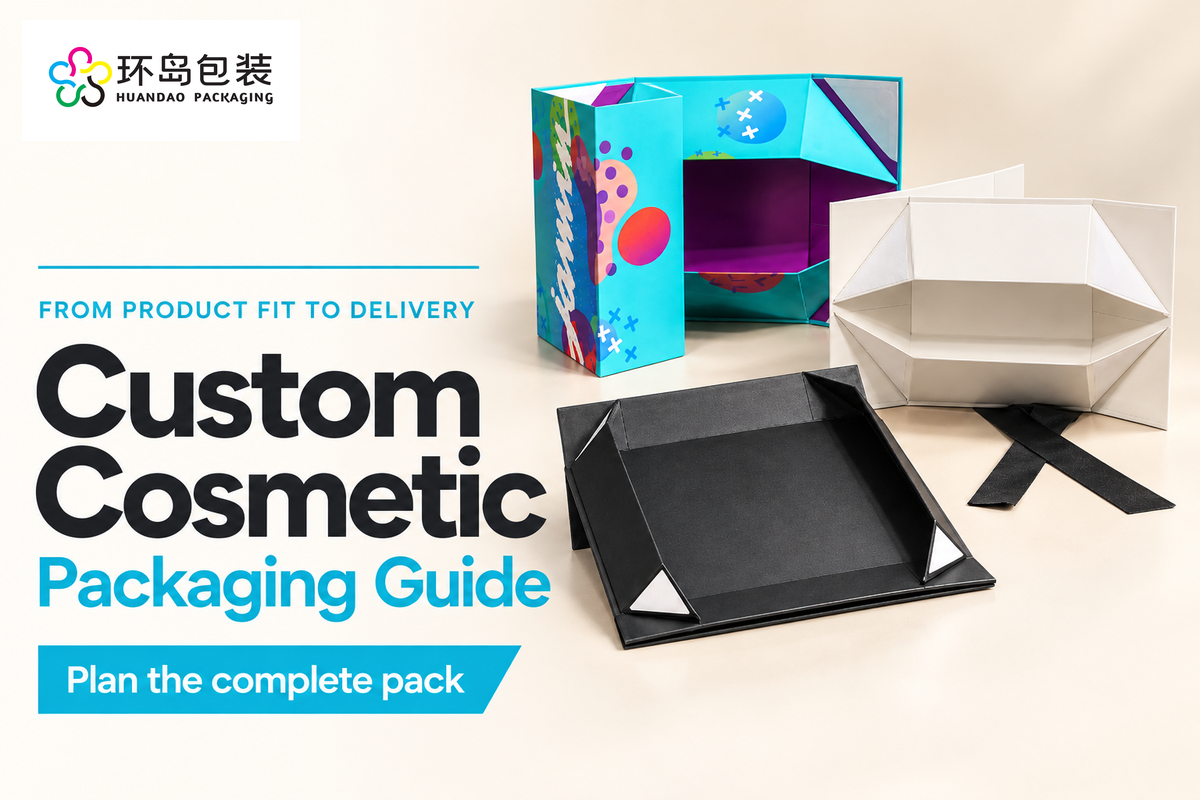
Best practice for Custom Cosmetic Packaging is to plan the bottle, printed box and shipping pack together. Start with the filled product and sales channel. Determine construction, insert, artwork and finish. A beautiful retail carton may still require a separate shipper. A heavy gift box may add assembly and storage costs that a launch budget misses.
Paper-based packaging for beauty products is explained next. The guide also compares a complete custom packaging quote. Bottle manufacture and formula compatibility stay with the product team. For a new brand, this separation helps avoid an unexpected product redesign during a skincare packaging project.
By XCX · Updated October 2026
What Does Custom Cosmetic Packaging Include?
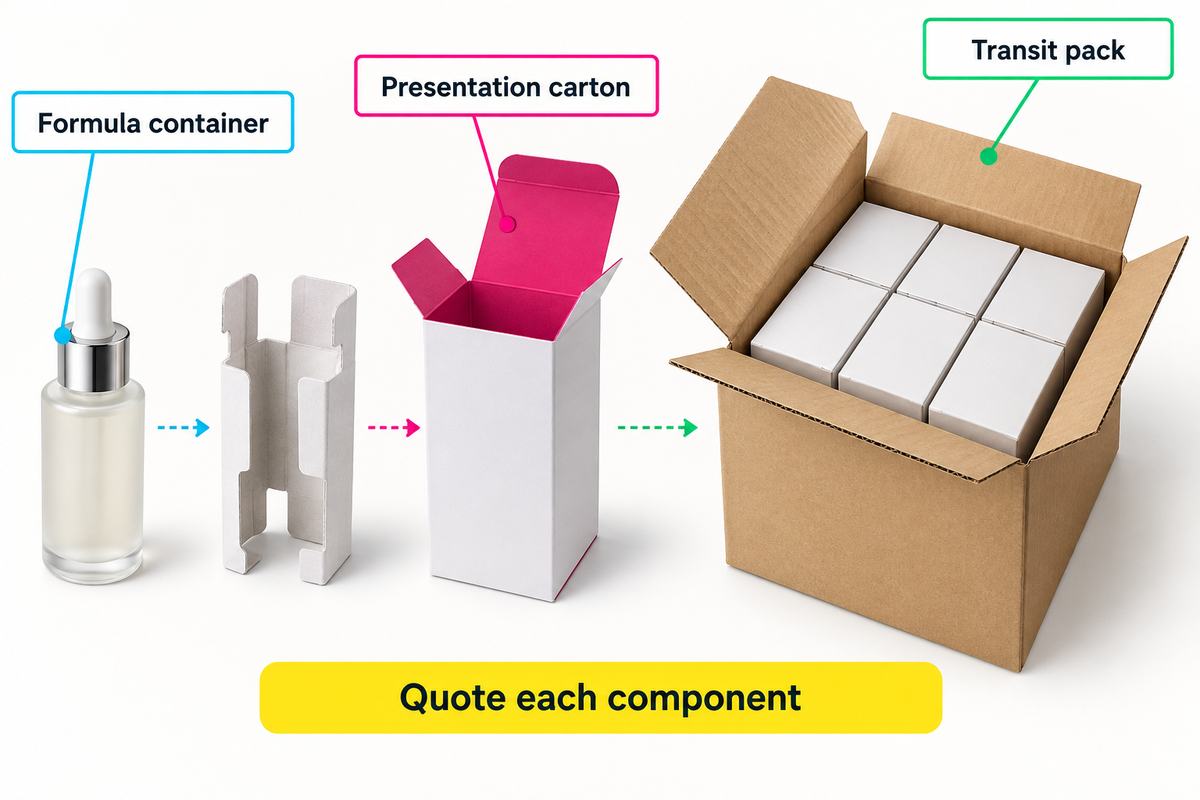
Custom cosmetic packaging includes components that contain the formula, present the product and carry it through distribution. Define which layer needs customization. A stock bottle may require a custom printed carton, while a gift assortment may require an insert and a shipper as well. Each supplier should quote a defined component of that assembly.
The FDA Cosmetics Labeling Guide distinguishes the immediate container holding the cosmetic from its outer container. In practical product packaging, a dropper bottle, cream jar or dispenser contains the formula. The folding carton provides the space for product presentation. A corrugated case or mailer provides the means for distribution.
Those roles should be kept in the drawing. A dropper cap change can impact the closed product height. Height changes can impact the position of the insert support and the carton opening. A larger carton can impact how many products can fit in a shipping case. The decision begins with the assembled cosmetic bottles, rather than with the artwork rectangle.
Makeup packaging also follows the same logic. Lipstick and lip gloss also need their own container and closure review, and then the paper box team works around the approved geometry. This is significant when analyzing cosmetic packaging solutions with respect to different cosmetic products: a bid may include only a few components.
Match the Pack to Retail, Gifting or Ecommerce
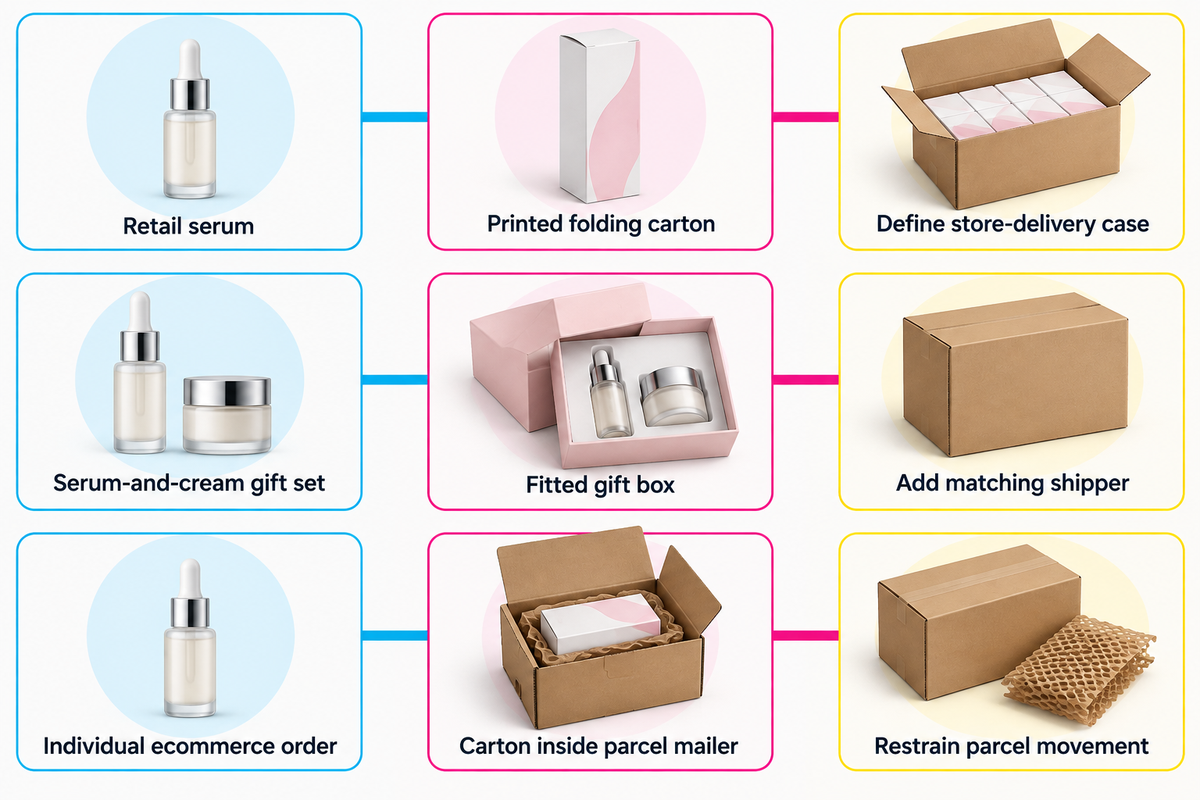
A folding carton is a good starting point for an individual retail product. A rigid box works well to fulfill a gift offering that requires a staged reveal or fixed assortment. Likewise, a distribution pack can be selected around the filled products for parcel fulfillment. Choose packaging options based on handling and assembly, rather than assuming the heaviest box is the best packaging solution.
3-Layer Beauty Pack Map
The 3-Layer Beauty Pack Map connects the decisions made on containment, presentation and transit with the way a beauty product is sold and delivered.
| Product and channel | Presentation starting point | Insert and transit decision |
|---|---|---|
| Single serum for a retail shelf | Printed folding carton | Locate the closed bottle; define the store-delivery case |
| Cream in a glass jar | Carton sized around the jar and lid | Support the body and base; allow removal access |
| Lipstick launch with changing shades | Shared structure with versioned artwork | Separate quantities for each design and shade identifier |
| Serum-and-cream gift set | Two-piece, drawer or hinged gift box | Hold unlike products independently; add a matching shipper |
| Gift launch with limited storage | Evaluate a collapsible rigid construction | Compare received form, erection time and assembled fit |
| Individual ecommerce order | Retail carton inside a parcel mailer, where needed | Restrain movement through the actual parcel route |
| Mixed subscription assortment | Printed mailer with an adaptable layout | Check the smallest and largest planned combinations |
| Refill product | Sleeve or carton around the specified refill | Keep refill containment and disposal instructions component-specific |
| Fragrance sent directly to customers | Retail presentation plus a suitable shipping assembly | Establish product classification and transport mode before release |
The Paperboard Packaging Council’s construction overview describes flat-supplied folding cartons and conventional set-up boxes supplied erected. A collapsible rigid box is an exception to the rule: it can be supplied flat, but still requires assembly. Examine a few rigid gift box constructions in the form received by your packing operation to see which one is most applicable.
Here are three situations. To begin, let’s look at the launch of a serum offered to stores in a carton and a distribution case. Next, let’s consider high-end beauty boxes for a serum and cream gift set, which requires a product specific insert and opening sequence. The same serum and cream set sold online requires parcel handling as an additional step. Our ecommerce packaging systems are designed to address these challenges.
The “public design discussion of a perfume founder” addresses a heavy metal cap versus a bulky rigid box and raises a useful brand question: if the product already offers the required weight and feel, what extra job should the box do? Every added component must have a defined purpose.
Choosing Paperboard, Rigid Board and Inserts
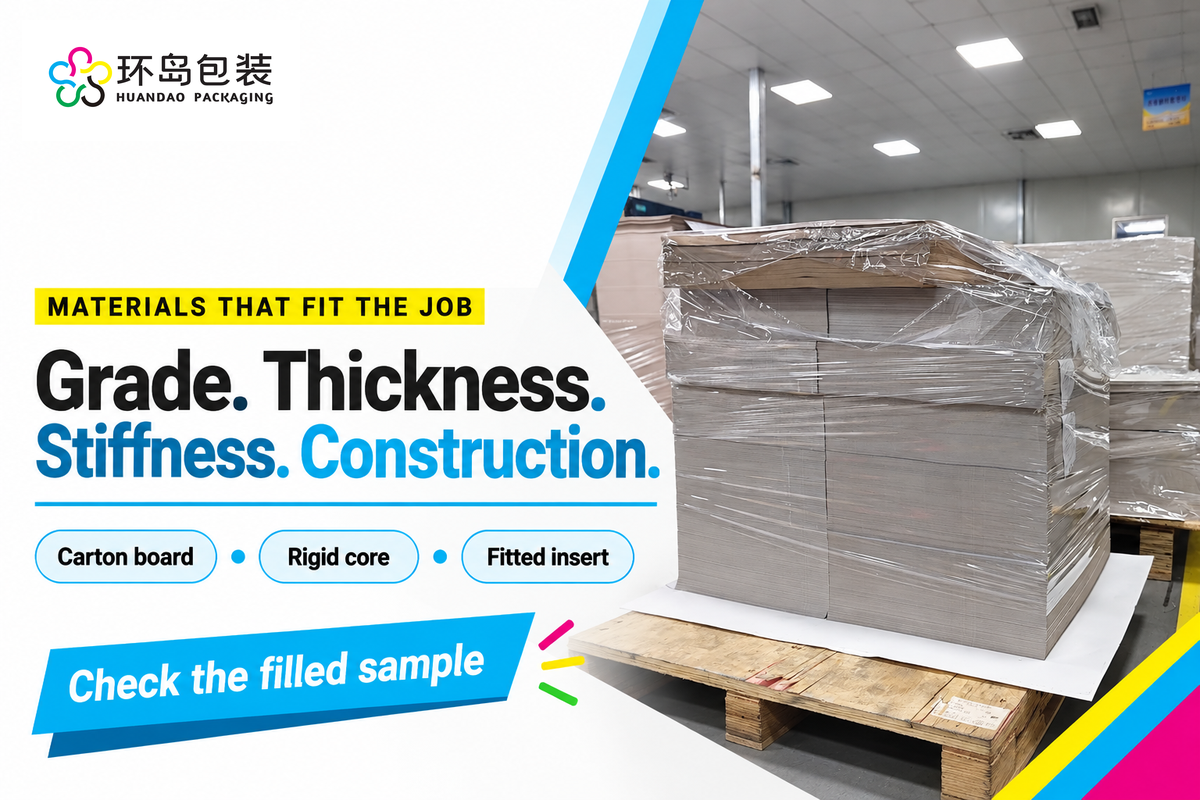
Choose board by grade, thickness, stiffness, and the finished construction. Grammage measures mass per area. It doesn’t specify a universal thickness or provide protection ratings. An insert should be designed to work with the product it supports. Therefore, specifications for material and thickness, and how the insert will work with the product, should be defined and checked on a filled sample before production approval.
Holmen’s Incada Exel technical table shows why the properties stay separate. Its 300 g/m² grade is listed at 540 µm thickness, with bending stiffness of 60.4 mNm in the machine direction and 25.4 mNm across it. The same grade family lists 350 g/m² at 640 µm. Those values describe a particular mill product, rather than a conversion rule for all paperboard.
Our published cosmetic folding cartons include a 300–400 gsm option. The 1.5–3 mm range on our rigid gift box page refers to the two-piece core. A core, decorative wrap and fitted tray are different parts of a pack; putting their numbers into one thickness comparison would obscure the construction.
Graphics are printed on white paperboard and kraft adds its own surface and base color. Paper inserts can locate cosmetic jars or separate an eyeshadow palette from another item. For a broad jar, support under the body is the key; for a tall bottle, it’s along the line of its shape. A thick outer panel leaves that design work undone.
Information regarding the type of board and other constructions should be sought in the cosmetic Folding Carton Materials and Construction Guide. For this question, the decision is whether the chosen box and insert work together for this product and channel.
Fit the Bottle, Jar and Accessories as One Set
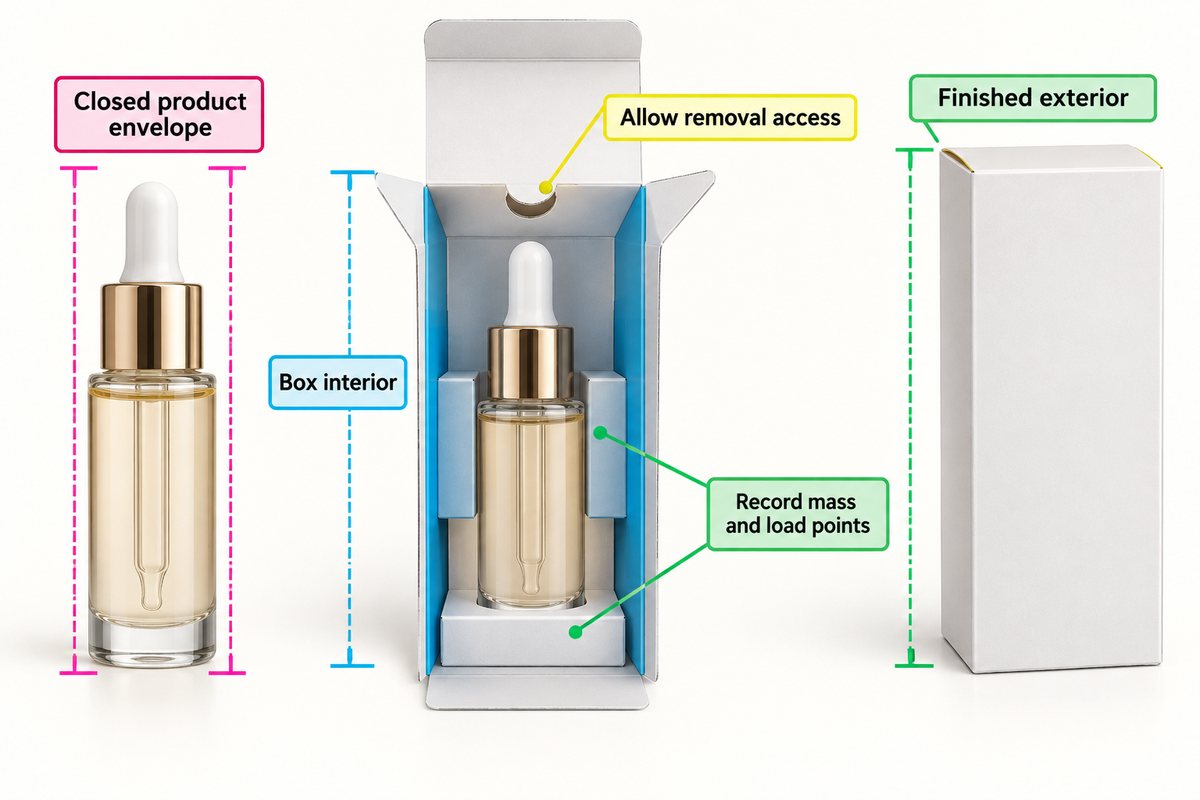
In general, when designing cartons or inserts, the customer should measure the closed, filled product with its cap, pump or applicator and design the carton and insert around that. It’s important to record the mass of the product and the points that can carry load, as this will help to determine how much the carton will need to carry. A finished sample should let the user remove the product without tearing the packaging or pulling a closure against its intended function.
How do I measure the length, width, and height of my custom cosmetic boxes?
State whether dimensions refer to the product, the interior of the box, or the exterior of the finished box. For the box maker, measure the fully closed envelope of the product (or the maximum dimension including a cap or other projection) and provide a labelled drawing and a physical sample if possible. The box designer adds the insert structure and decides on the required interior dimensions.
A container’s nominal fill volume is a poor approximation for this drawing. Two cosmetic bottles can hold the same amount, but be of differing shapes and sizes. Airless pump bottles also need to be included with their complete actuators and protection, and an outline of the reservoir alone would be incomplete.
For a size comparison, assume an external rectangle of 65 × 65 × 130 mm. Its geometric volume is 549.25 cm³. An alternative at 70 × 70 × 140 mm occupies 686 cm³: about 24.9% more. This calculation compares the stated rectangles. Actual case packing and the carrier’s charging rules determine the shipment effect.
FedEx’s dimensional-weight guidance shows that comparisons of actual and dimensional weight are made service-by-service with respect to the package that’s shipped. In determining the dimensional weight of a shipment, the packed shipping unit must be considered. A larger retail box may change the case layout before it changes the parcel shipment charge.
Allow room for fingers or a pull feature and space between products to support the user experience: the customer should be able to remove the product without applying excessive force to the cap. Replace an accessory with a heavier one only after checking its support and the full packed sample.
Build Brand Appearance Around the Finished Pack
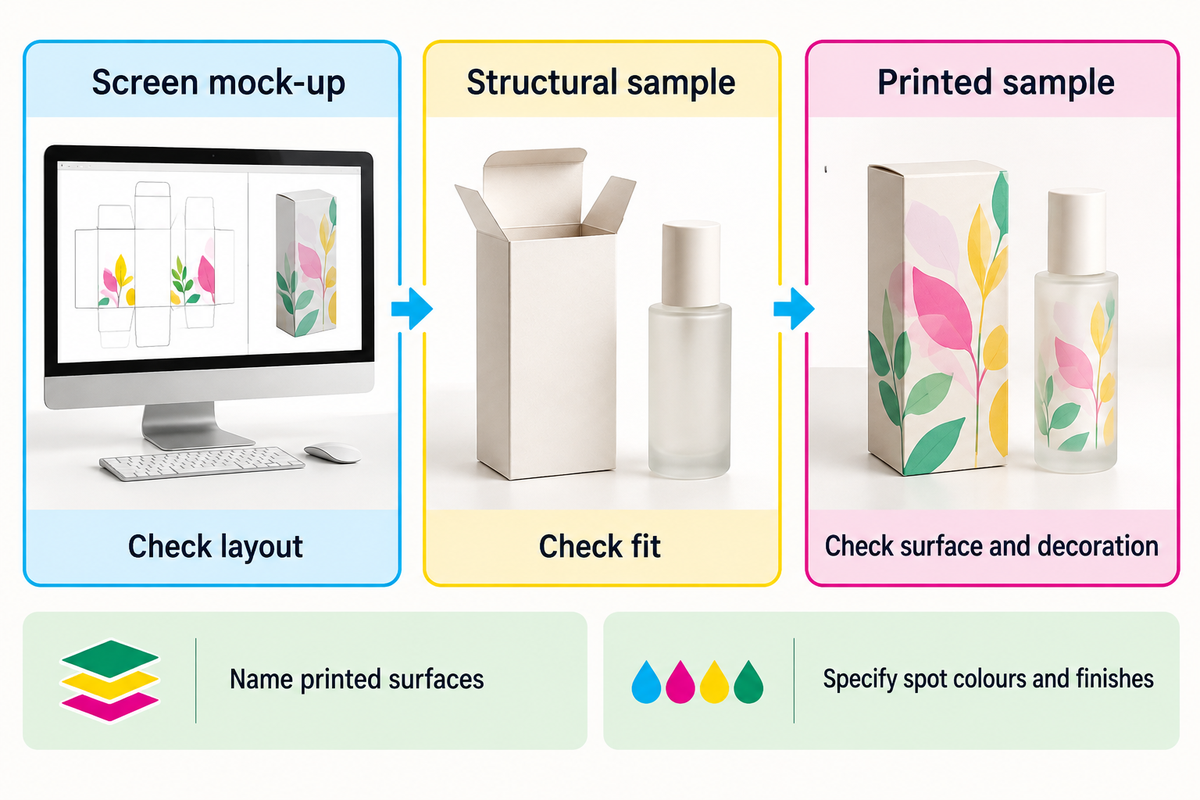
Approve packaging design on the material and construction intended. A screen mock-up is a big help in checking the desired layout. A structural sample checks the fit. A printed sample shows the surface chosen and the decoration. Set aside space for required product information before you arrange the brand name and graphics. Both visual appeal and high-quality cosmetic packaging require a good layout.
Ideation should begin with one feature that’s noticeable to the customer. Examples include using a distinctive color to make a block, or using a tactile opening. Brand appeal should be built around the featured element. A soft-touch surface or gloss may be used to create different tactile effects. Metallic foil may be used to provide a reflective feature. A small stamp may provide the necessary contrast without covering the entire surface. Brand identity should be legible when the package is closed and opened.
Beauty Packaging’s “Making Connections Through Cartons” case reports showcase suppliers’ substrate-specific prints and finishes. The lesson is to assess actual combinations rather than expecting identical ink or white details and finish across various print surfaces.
What is 4/0 vs. 4/4 when designing custom cosmetic packaging?
A carton generally uses any of the following standard print-quote notations. In common print-quote notation, 4/0 means four process colours on one side and no printing on the reverse; 4/4 means four process colours on both sides. Identify which side of the carton becomes the exterior when specifying the process colors. The other side may have an opening detail, but the quotation should name the printed surfaces explicitly.
Some designs created with an online design tool may show artwork or personalization while leaving the press specifics ambiguous; spot colours and special finishes need separate instructions. To be safe, don’t assume that a preview is production approval before checking the dieline, glue areas and the area that’s visible after folding.
ISO 3664:2025 specifies viewing conditions for printed reflective and transmissive media. Agree a physical print-viewing reference with the supplier. For US artwork, there are other reasons for settling usable label space, for example net-quantity placement requirements.
What Does Custom Cosmetic Packaging Cost?
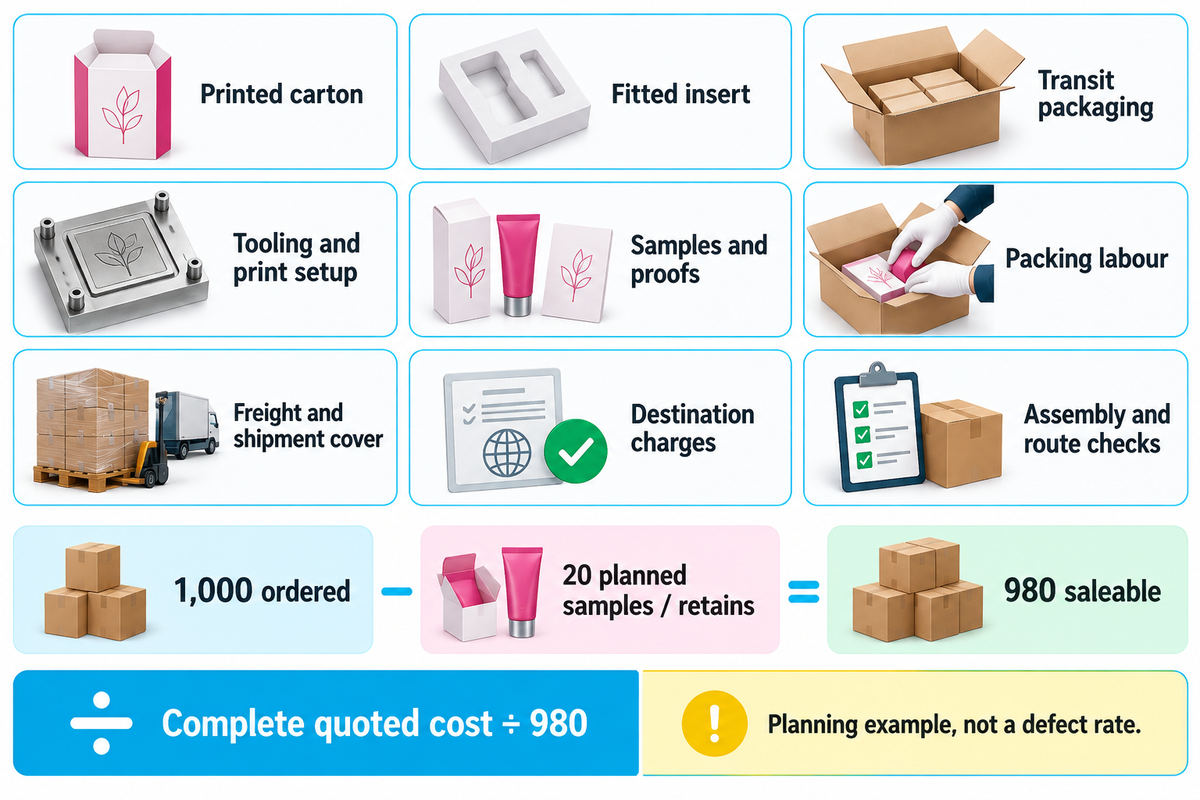
A good rule of thumb for using a cosmetic packaging cost is to take the total quoted project cost and divide it by the number of sets that are available for sale. The carton price is only one of the many inputs. Compare the same scope for structure, print, inserts, assembly and delivery. Also consider planned samples and retained sets. Bespoke cosmetic packaging requires a specification before its price can be compared.
Wholesale cosmetic packaging quotes may look far apart because they cover different work. One may be for the fitted insert and packed shipping case, and the other may be for printed flat cartons only. The International Trade Administration’s landed-cost guidance takes a destination and transportation perspective on top of the product price.
Complete quote scope for 1,000 sets
| Cost line | Basis for this project | Comparison to resolve |
|---|---|---|
| Printed carton | 1,000 of the same specified size and artwork | Board, print sides and finish included in the unit price |
| Fitted insert | One agreed insert per product set | Material, cutting, assembly and supply responsibility |
| Transit packaging | Case or mailer allocated to the ordered sets | Actual packed dimensions and case quantity |
| Tooling and print setup | The approved structure and artwork version | One-time charges versus repeat-order charges |
| Samples and proofs | Agreed structural and appearance checks | Charges and any order credit stated separately |
| Packing labour | Erection, insertion and final packing tasks | Factory-packed versus work left to fulfilment |
| Freight and shipment cover | Agreed route, received form and destination | Included legs and separately charged services |
| Destination charges | Applicable border and local delivery costs | Paying party and delivery terms |
| Assembly and route checks | The approved filled product and pack | Included checks versus separately commissioned work |
Here’s the denominator calculation. Order 1,000 sets and plan to allocate 20 to samples and retains: 1,000 − 20 = 980 saleable sets. Divide the complete quoted cost by 980. Compared with dividing by 1,000, the cost per saleable set is multiplied by 1,000 ÷ 980 = 1.0204, an increase of 2.04%. The allocation is a planning choice, not an assumed defect rate.
Repeat the quantity line for each of the several artwork versions. A lower price attached to more inventory may require a larger launch budget. Compare the end-to-end cost for the actual order and the packing work left at your facility before accepting the lower unit number.
From Samples to Production and Delivery
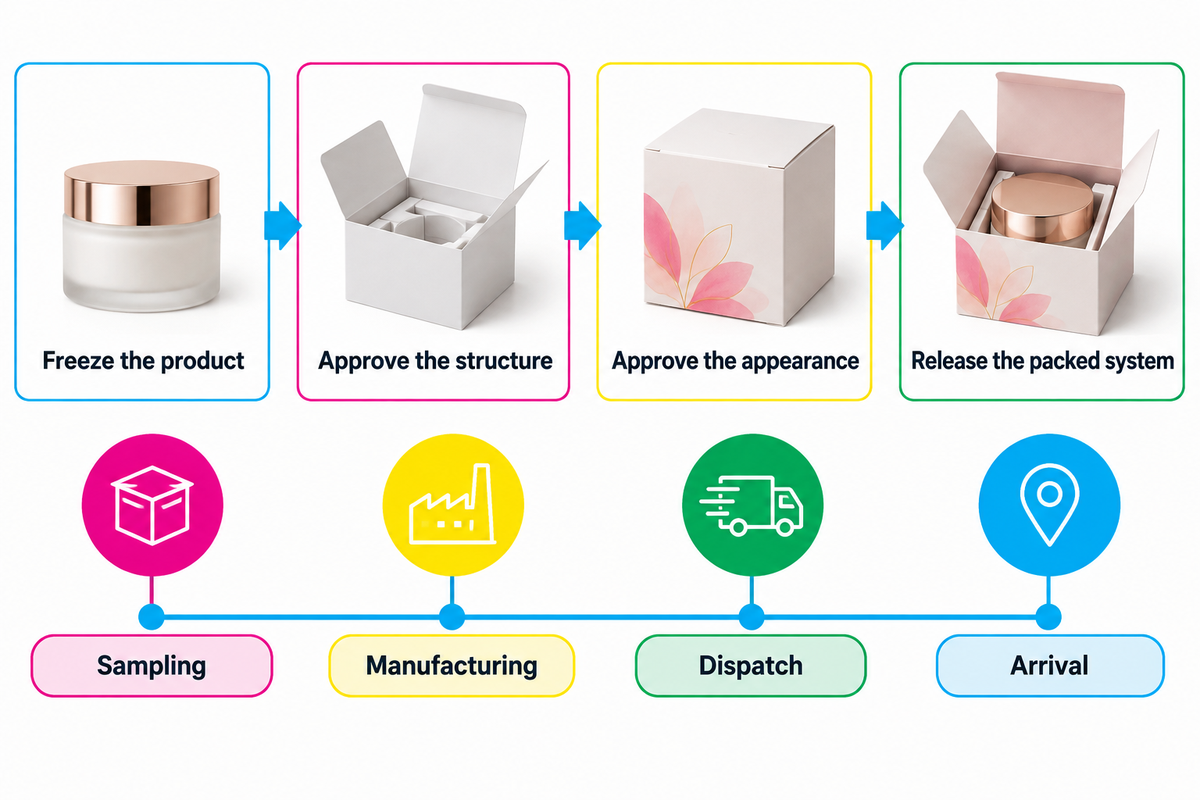
Approve the sample’s fit, appearance and filled shipping assembly before releasing production. Keep sampling, manufacturing, dispatch and arrival as separate dates in the schedule. A production lead time describes only part of the route. A launch commitment also requires approved artwork, product availability, packing work and delivery arrangements to be ready.
“Use representative samples. Both products and packages should be as close as possible to actual production items.”
Build the sample around the actual shipping bottle, insert, closure and outer pack. Establish shipping conditions first for fragrance or another classified product. US class 3 transport provisions include conditional packaging rules and further air transport requirements. A general packaging test doesn’t determine that classification.
- Freeze the product: confirm the closed item, accessories, route and quantity by design.
- Approve the structure: check loading, product location, closure and removal on a physical sample.
- Approve the appearance: review artwork and the chosen decoration on the intended construction.
- Release the packed system: agree production checks, route testing where needed and delivery milestones.
According to Huandao, quality control reports for edge-crush or burst strength, ink-rub and basis weight relate to a given production run and tested sample. A board result and final shipment evaluation address different queries. For the outer case, please refer to our printed corrugated shipping packaging guide for construction rationale.
One skincare buyer’s public account said the boxes were satisfactory, then shipped goods were held up at customs. Use that case to distinguish “finished at the factory” from “available for your launch.” Include requirements, delivery destination and expected arrival date in the order discussion alongside production lead times.
Sustainable Cosmetic Packaging: Match the Recovery Route
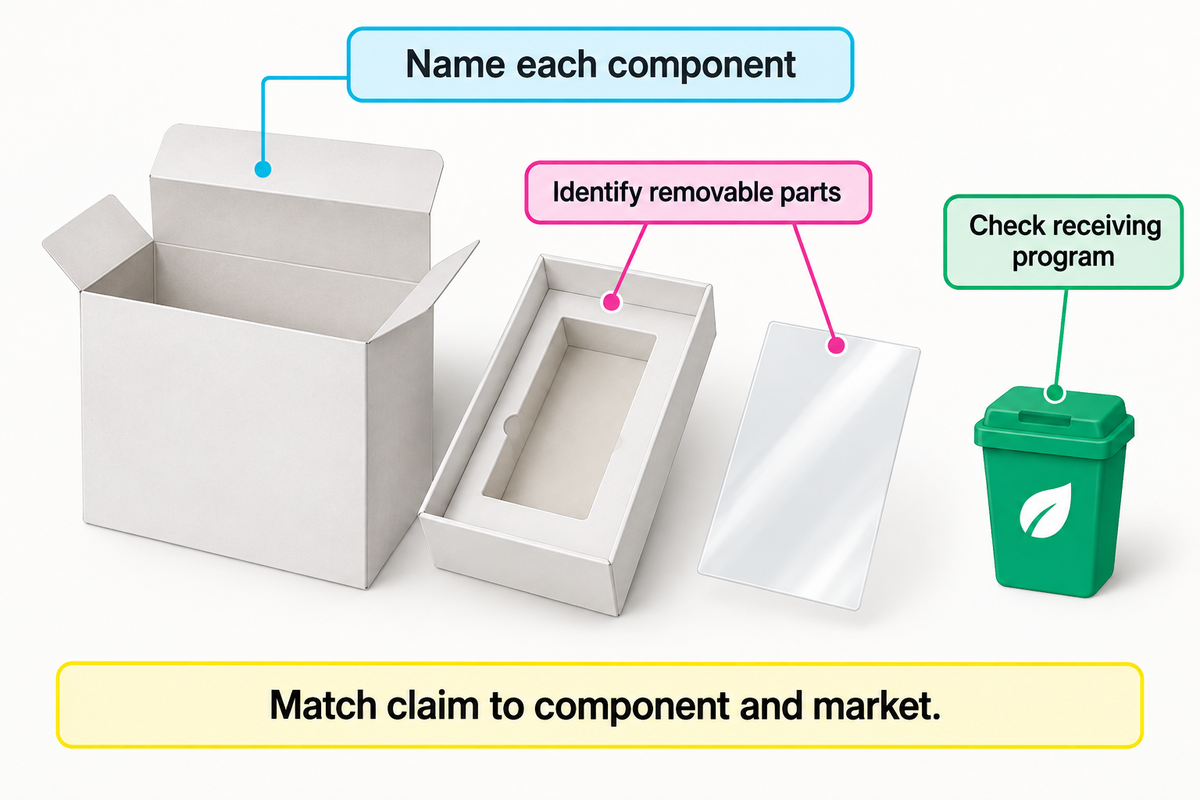
Sustainable cosmetic packaging begins with specifying the material and route for recovery for each element. Recycled content, reusable container design and local recyclability address other concerns. Choose an insert and finish fit for the intended collection system, then tailor wording for ‘disposal’ and ‘marketing’ for the component and the region where it’s sold.
According to the US EPA recycling guidance, readers are advised to verify with the receiving program what’s actually accepted. Give the resulting sustainability requirements in the material brief. A paper carton with a removable tray or window presents a different case from a bonded mixed material pack. Mono-material describes the actual assembly to be discussed with its accessories.
Do
- Name the board, tray and finish in the brief.
- Identify removable parts and the intended recovery route.
- Match consumer wording to the component and selling market.
Don’t
- Treat recycled content as a recovery guarantee.
- Transfer a bottle’s material claim to the whole gift set.
- Use an eco-friendly label in place of a defined construction.
For US marketing, FTC guidance on recyclable claims also considers access to facilities across the sales market. An example in paperboard shows why a generic instruction to check locally can be inadequate to qualify a claim. Define what’s claimed and where, and then adjust the language to that market.
Mintel’s beauty-packaging analysis, updated February 2026, identifies convenience and access barriers around refilling in the beauty industry. Refillable cosmetics therefore need an easy-to-use primary system as well as an appropriate paper outer pack. Airless bottles, PCR content and refill compatibility are container-supplier questions; replacing a carton alone changes a different part of the system.
Choose a Manufacturing Route for Your Launch
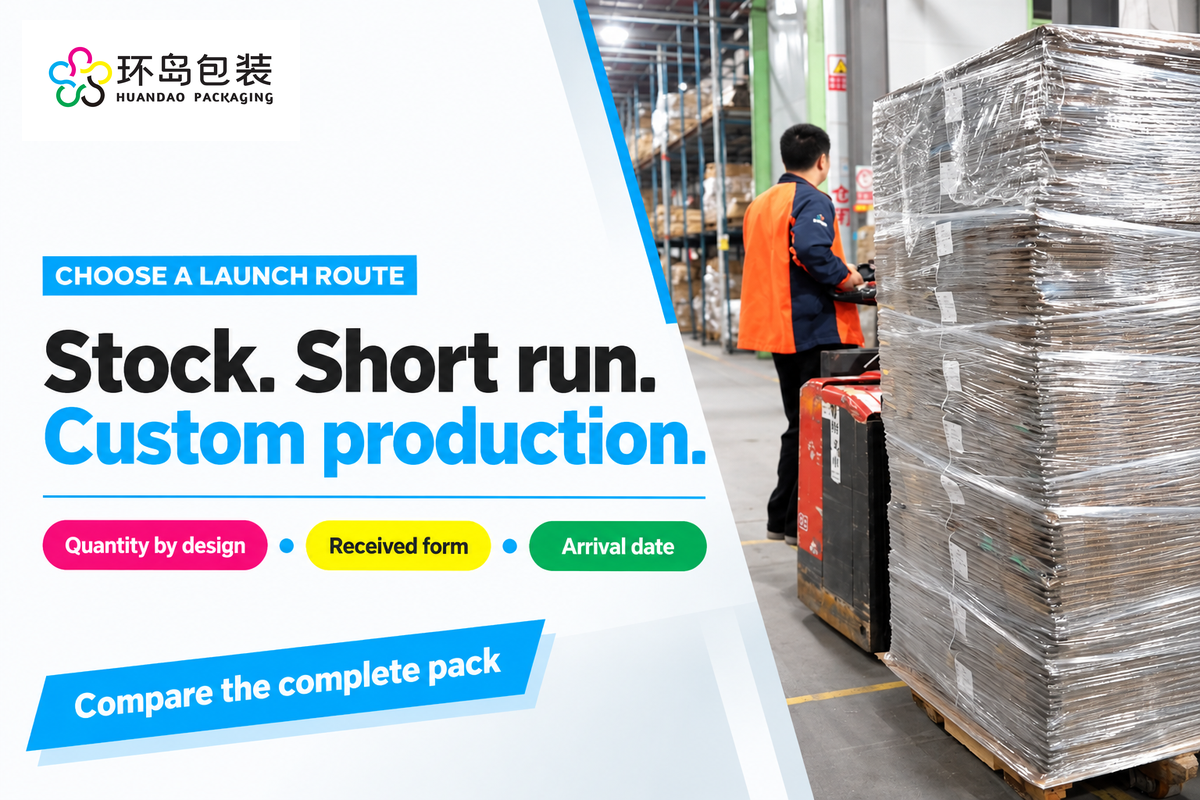
Use an existing pack that meets the needs of the market if it’s suitable for launch. Choose short-run printing if there’s uncertainty in demand or if there are several possible versions of the artwork. Opt for custom production if geometry, construction and the number of repeats warrant it. Ask each packaging supplier to quote a completed pack and its received form rather than choosing a route based on the advertised minimum order alone.
“Cosmetic packaging in stock” can mean undecorated containers or ready-to-ship paper boxes. Confirm what’s stock and ready to ship, whether an insert exists, and what still needs printing. A customizable label or sleeve can create branded packaging without changing the system, but it still requires a fit and artwork check. An offer described as fully customizable also needs a list of the components actually included.
A small run of cosmetic jars may prompt a different quantity limit from the paper carton order. Keep container MOQs, carton quantities and artwork splits separate. Don’t convert a combined assortment total into an assumed production quantity for each design.
The Xiamen factory prints paper packaging. Pre-press, sheetfed offset printing, coating, lamination, die cutting and folder-gluing are all done in-house. MES process records connect the order stages. The factory’s lab reports on the job. The Huan Yin Packaging Group can supply matching trays, inserts and outer cartons and can consolidate all of them in one shipment.
For personal care brands ready to specify that route, take a look at our custom cosmetic packaging options. Bring us the closed product dimensions, design quantities, your selling channel and the required arrival date. With that, we can develop boxes and packaging that support your beauty brand.
Custom Cosmetic Packaging FAQs
Can I customize all parts of the packaging?
Customise the paper box, print, finish and insert as separately specified components.
A beauty pack can combine custom dimensions, artwork, finishes and fitted paper inserts. Specify which components need changing and which remain stock items. Bottles, pumps and formula compatibility need their own supplier review. Huandao’s scope here’s printed paper packaging with coordinated inserts and shipping cartons. Keep the primary-container approval alongside that paper-pack brief.
Can you send me samples of your custom cosmetic boxes & packaging?
Yes. Agree structural and printed sample requirements when defining the project.
A structural sample checks product fit and loading; a printed sample checks appearance on its chosen construction. For a Huandao project, share the assembled product dimensions, quantity, artwork status and intended finish so the sample route can be agreed. Sample charges, courier cost and timing belong in that project’s quotation.
Is there a minimum order quantity for custom cosmetic boxes & packaging?
Huandao’s published standard starts at 1,000 pieces per size and style.
Smaller runs are reviewed individually for the proposed structure and production route. Treat the published minimum as a supplier term, rather than an industry rule. A launch with several artwork versions needs quantities stated for each design, because a combined total can hide how the production order is divided across different cartons.
Can I order eco-friendly cosmetics packaging for delivery within the United States?
Yes. Specify the construction and US delivery scope together.
Describe the board, insert and finish rather than relying on an eco-friendly label. Confirm actual destination collection guidance and the scope of any consumer claim. Quote shipping separately from manufacturing where it isn’t included, and agree the destination before scheduling.
What types of enhancements can I add to my cosmetic boxes to make them unique?
Choose a focused combination of print, surface decoration and opening details.
Options include selective metallic foil, embossing or debossing, spot gloss, a matte surface, interior artwork and a fitted opening sequence. Start with the feature a customer should notice, then check the effect on the finished pack. A fine gold or silver stamp near a fold needs a different review from a complete printed panel. Keep product information readable, leave necessary glue areas usable, and compare the decorated sample with its intended handling conditions before choosing the final effect.
Can refillable cosmetics use a paper retail box?
Yes. Size the paper pack around the actual refill and closure.
A specified refillable primary container can use a paper retail box or a refill sleeve. Keep the durable container and replaceable refill distinct in the brief. Reuse claims and disposal instructions should describe the specific components and their intended collection route.
Does a rigid gift box replace a shipping carton?
A rigid gift box still needs a shipping design suited to the filled product and route.
Glass, pumps and polished surfaces may need restraint, separation or an outer corrugated shipper. Evaluate the intended filled assembly, including inserts and closures, through the selected distribution route. Changing the bottle, assortment or insert can change that evaluation. A presentation box supports the retail opening experience; the shipping assembly also has to handle the journey. Keep both tasks in the same design discussion so a decorative upgrade doesn’t leave the outer delivery pack unresolved.
Plan the product, presentation and delivery as one brief. Share your filled product details and the route you want to build.
This guide was developed using packaging-association guidance, published technical information and Huandao’s paper-packaging scope. Product-specific dimensions, artwork and the assembly to be supplied are agreed for each project.
References & Sources
- US Food and Drug Administration: Cosmetics Labeling Guide
- Paperboard Packaging Council: What Is Paperboard Packaging?
- Beauty Packaging: Making Connections Through Cartons, 2024
- International Organization for Standardization: ISO 3664:2025 public scope
- Electronic Code of Federal Regulations: 21 CFR 701.13, net quantity of contents
- International Trade Administration: Determine Total Export Price
- International Safe Transit Association: Getting Started with Design & Testing
- Electronic Code of Federal Regulations: 49 CFR 173.150, Class 3 exceptions
- US Environmental Protection Agency: How Do I Recycle Common Recyclables?
- Federal Trade Commission: Recyclable Claims, 16 CFR 260.12
- Mintel: The Future of Beauty Packaging, updated 2026
HUANDAO PACKAGING INSIGHTS
About Huandao Packaging Insights
Huandao Packaging manufactures folding cartons, litho-laminated printed boxes and rigid gift boxes, and also supplies paper bags, retail displays and protective inserts.
Our guides help buyers compare packaging options and prepare a clearer brief before requesting a quote.
Packaging families
Board, print and finish
Artwork, dieline and sample review
Delivery planning
PROJECT DISCUSSION
Talk with the Huandao Team
- Company
- Xiamen Huandao Packaging Technology Co., Ltd.
- Quote input
- Dimensions, filled weight, quantity, artwork or dieline, finish and destination.
- Review scope
- Box, insert and delivery requirements.
- Next step
- Bring the available details to a packaging conversation.