Get in Touch with Xiamen Huandao Packaging Technology Co., Ltd.

Two piece rigid boxes consist of a separate base and lid. Made from stiff board, the bases and lids may be covered with decorative paper. The usefulness of these containers begins with access. The lids come away fully, thereby allowing a product or gift to be presented in an open tray. A good-looking packaging box still needs the right internal space, a workable grip and a protective shipping pack.
Two piece rigid boxes combine a separate base with a lift-off lid. Choose lid depth for access, size the finished wrapped components together, and approve the loaded sample before fixing the production specification.
Key points
- Product size, insert size and finished box size describe different objects.
- A shoulder or neck adds a structural component, even when only the lid and base separate during opening.
- Board thickness, opening feel and transport protection need different checks.
- Compare the delivered cost of usable packs, with the same components and freight scope in both offers.
A 2 piece rigid box is a presentation container with a separately formed base and cover that lifts away. The internal surface of the cover can be lined with paper. When made from board, the assembled container takes up its formed space during storage and shipping. At a glance: separate base and lid; full-depth or partial-depth cover; wrapped board construction; optional fitted insert; normally supplied erected.
What are two-piece rigid boxes?
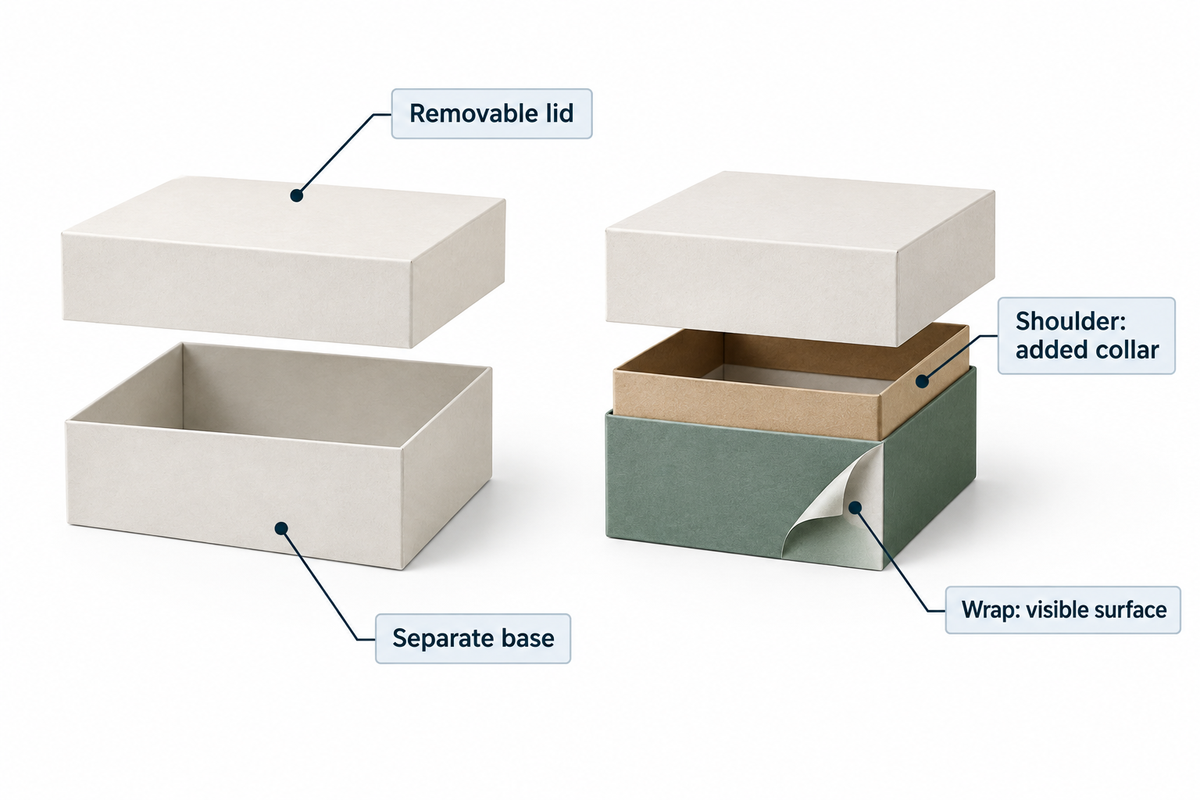
A conventional two-piece rigid box has a separately formed base and removable lid, while magnetic closure and a fold-flat design are separate design features.
The Paperboard Packaging Council’s rigid-box terminology distinguishes the base, cover, wrap and shoulder. Two piece rigid setup boxes may also have partitions, platforms or pull tabs. These also affect the space available to the product inside the box.
For a small jewelry launch, the removable cover of a display case allows the base to be used for a brand display. For a product kit that comes with a number of loose components, the display case gives access to all the internal spaces at once.
Keep component count clear in a drawing. A plain base and cover have two principal structural parts. A shoulder construction adds a collar to the base, making three structural parts, but the base and collar may be handled as one piece when the cover is removed.
Lid depth changes access, appearance and fit
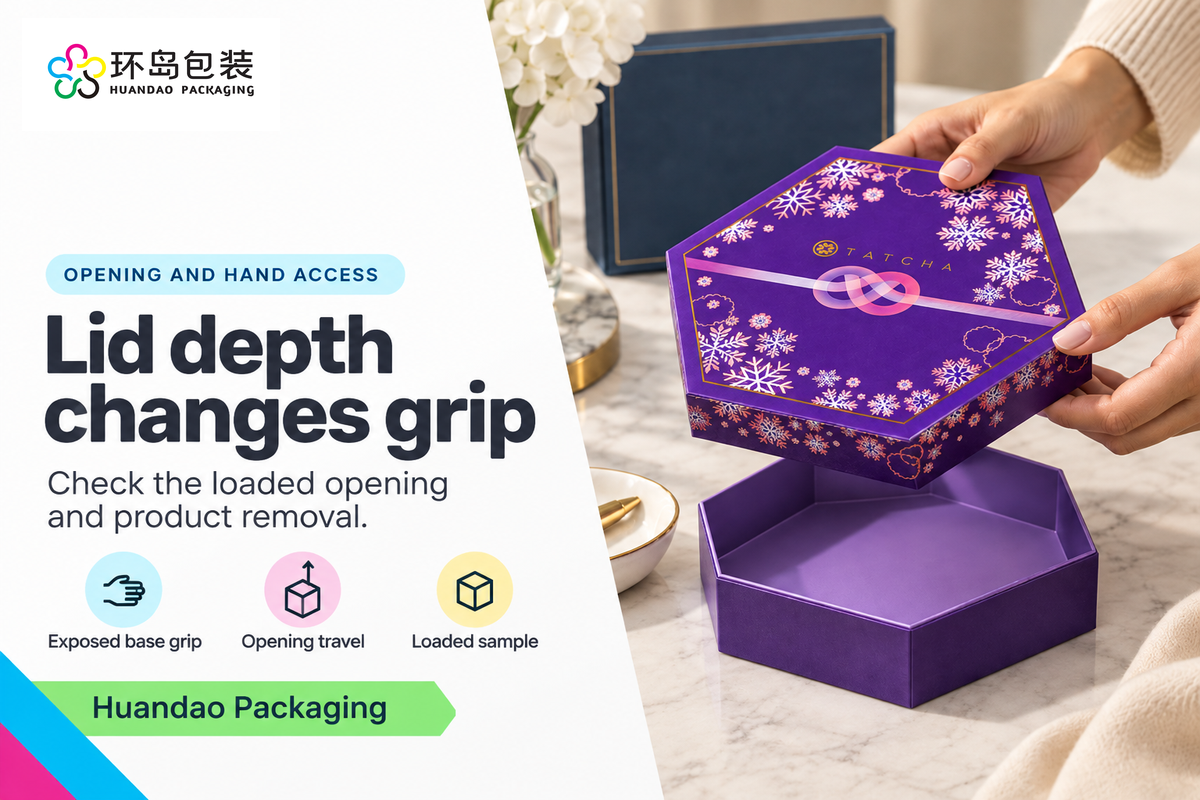
A full-depth cover reaches approximately the height of the base walls; a partial-depth lid leaves some base visible, following the PPC telescope-box distinction. A shoulder construction creates a flush joint or an exposed reveal. Choose between them by how the buyer holds the package, where the opening edge is located, and how the product is removed from the package.
A shallow lid gives less coverage and an exposed base. A deeper cover adds overlap and changes how a package is opened. Treat coverage and grip as geometry choices; assess strength on the complete packaged product. Lid wall straightness, the finished dimensions and the complete packed product still matter.
Picture a cosmetics box where the base sits almost flush to the edge, with the lid almost the same depth as the base. An empty sample may open comfortably on a bench, but a shopper has less base to hold when lifting the loaded box. Consider thumb notches, varying how the base is exposed, and changing the lid depth to improve product access.
Give someone from the brand’s target audience a loaded package in its normal resting position and observe how they open the package without assistance. A two-piece design that feels comfortable to a packer may still be awkward for a customer with limited grip. Check removal as well as closure.
Box dimensions: work from the product to the finished lid
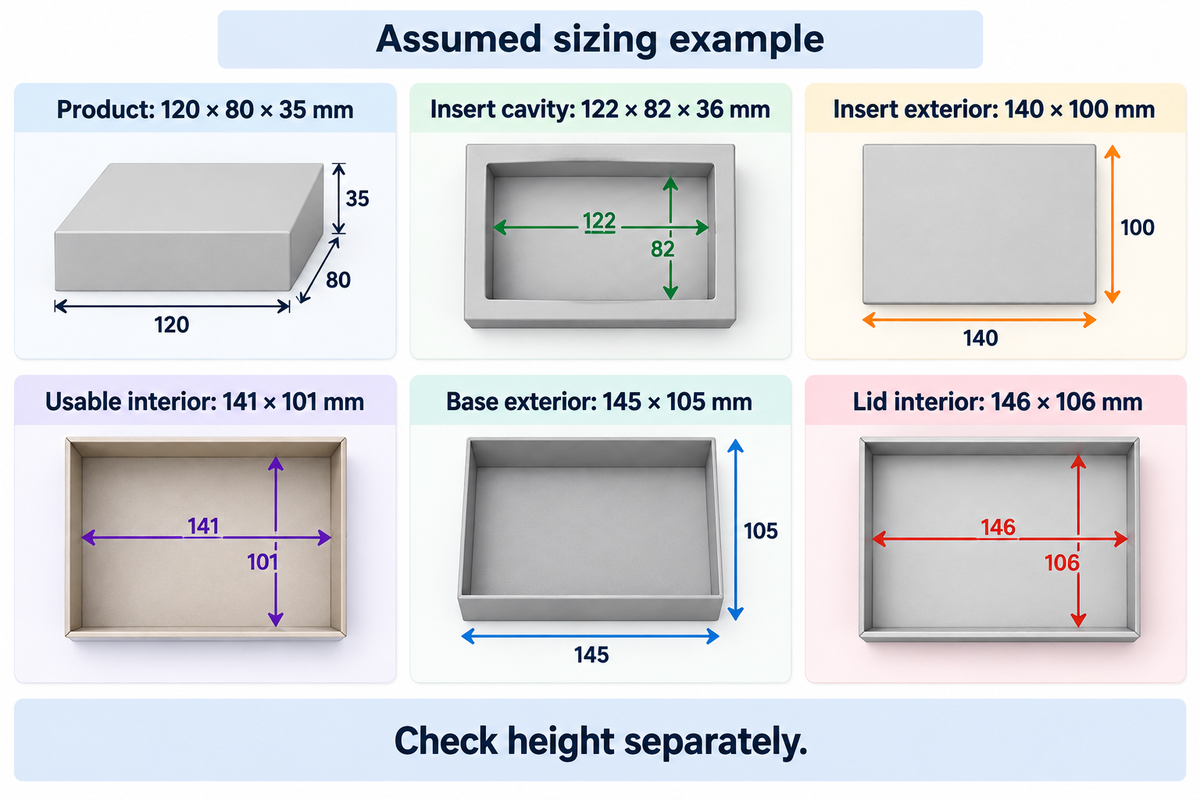
Six measured objects connect the product to a closing lid: the product, insert cavity, insert exterior, usable box interior, finished base exterior, and finished lid interior. Record them separately. The space between a finished base and its lid is a different clearance from the clearance around the product in its insert.
How do I choose the right box dimensions?
Choose the box dimensions by starting with the complete product and its removal space, adding the insert and checking the usable interior of the assembled box. Measure the finished base and lid after wrapping. Use one unit system throughout and explain whether each length, width and height describes an inside or outside dimension.
A cavity also needs to accommodate protrusions, accessories and the way fingers reach the item. A snug rectangular outline can hide a lid-height problem when the product has a raised cap. The rigid box dimension converter helps keep units consistent. NIST’s SI length guidance defines 1 inch as exactly 25.4 mm; conversion precision doesn’t specify manufacturing precision.
| Measured object | Assumed finished size | Question answered |
|---|---|---|
| Product | 120 × 80 × 35 mm | What must fit? |
| Insert cavity | 122 × 82 × 36 mm | What space surrounds the product? |
| Insert exterior | 140 × 100 mm footprint | What must fit inside the base? |
| Usable box interior | 141 × 101 mm footprint | Is there room for the insert? |
| Wrapped base exterior | 145 × 105 mm footprint | What must the lid pass over? |
| Wrapped lid interior | 146 × 106 mm footprint | What is the nominal closing space? |
It’s assumed that the lid-to-base difference is 146 – 145 = 1 mm, along the length of the item, and 106 – 105 = 1 mm along the width. With straight, parallel side walls and perfect centering, this divides to 0.5 mm on each side. In truth, it can be larger or smaller due to off-centered contact and corner build up. The footprint checks also leave a separate height decision: the insert, product and any top padding must clear the closed lid.
Allow for variation before treating that nominal difference as available space. If the base length were 145.0 ±0.2 mm and the lid interior 146.0 ±0.2 mm, the assumed worst-case difference would be 145.8 − 145.2 = 0.6 mm. Those chosen tolerances explain the calculation; they are not a production specification. Check wall angles and wrapped corners on the sample before agreeing the finished limits.
Rigid board, paper wraps and inserts do different jobs
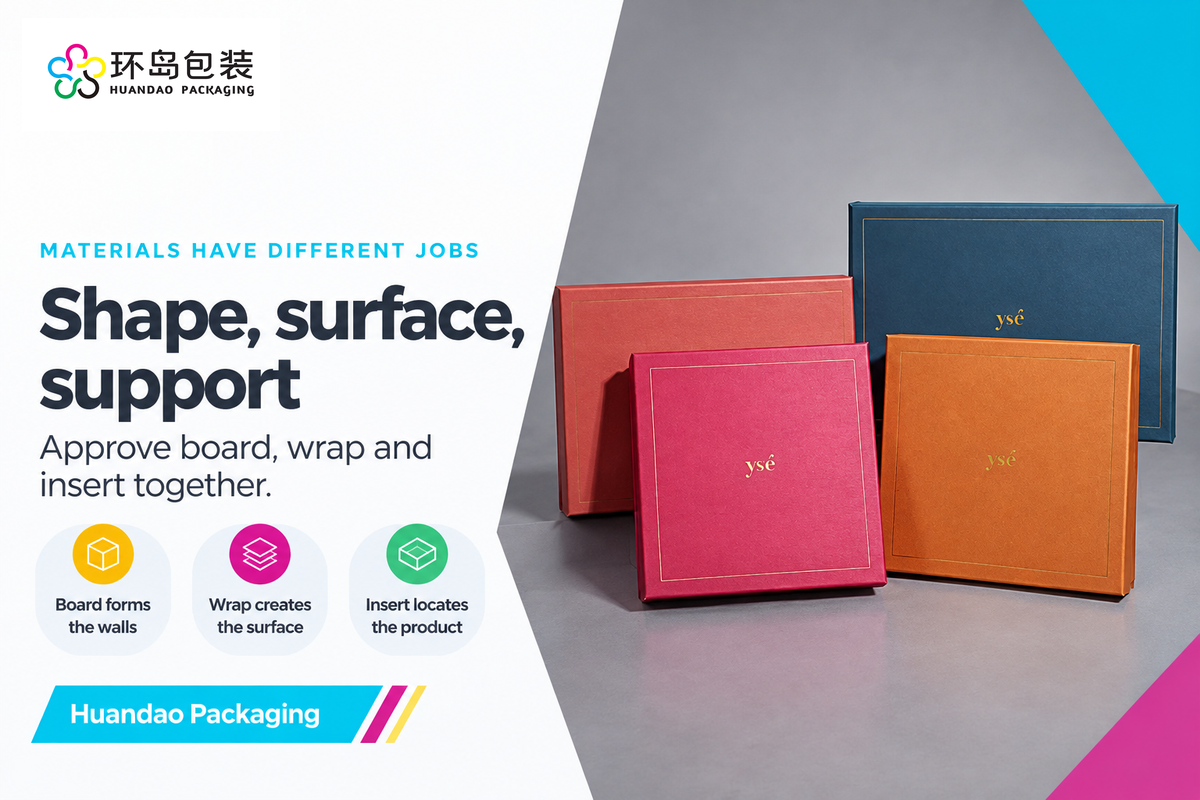
Rigid board forms walls, the wrap creates the outer surface and the insert locates the product within the base. A material change in custom rigid boxes can affect more than the appearance of the package: a different wrap changes the finished contact surfaces, while a different insert can change support points, removal access and the height of the packed item.
PPC’s rigid-box manufacturing description separates the formed board body from its applied wrap. Paper thickness, adhesive and corner turn-ins belong in the finished construction. Comparing board grammage alone leaves those layers out of box design.
At Huandao, our custom rigid two-piece boxes use 1.5–3 mm chipboard. A compact jewelry box and a broad gift set may call for a different board within a custom packaging project. Increased thickness alters the outer dimensions of the box and the lid geometry; approve those changes together, rather than fixing the outer dimensions of the box and substituting a thicker board.
A useful functional distinction appears in the Smithsonian’s archival enclosure example: board built the supports, polyethylene foam added height and cushioning, and a smooth covering reduced friction against fragile paper lining. This project demonstrates why positioning, cushioning and surface protection deserve separate decisions. It’s not a test to see if a retail gift box can be transported.
For gift sets in custom boxes, custom inserts should secure each item while leaving a removal path. A rigid material that firmly holds a bottle can still mark its finish at the points of contact. Check that edge with the actual product surface. Paperboard partitions, shaped pulp and foam each need their own material and fit assessment.
Printing and finishing: approve the wrapped result
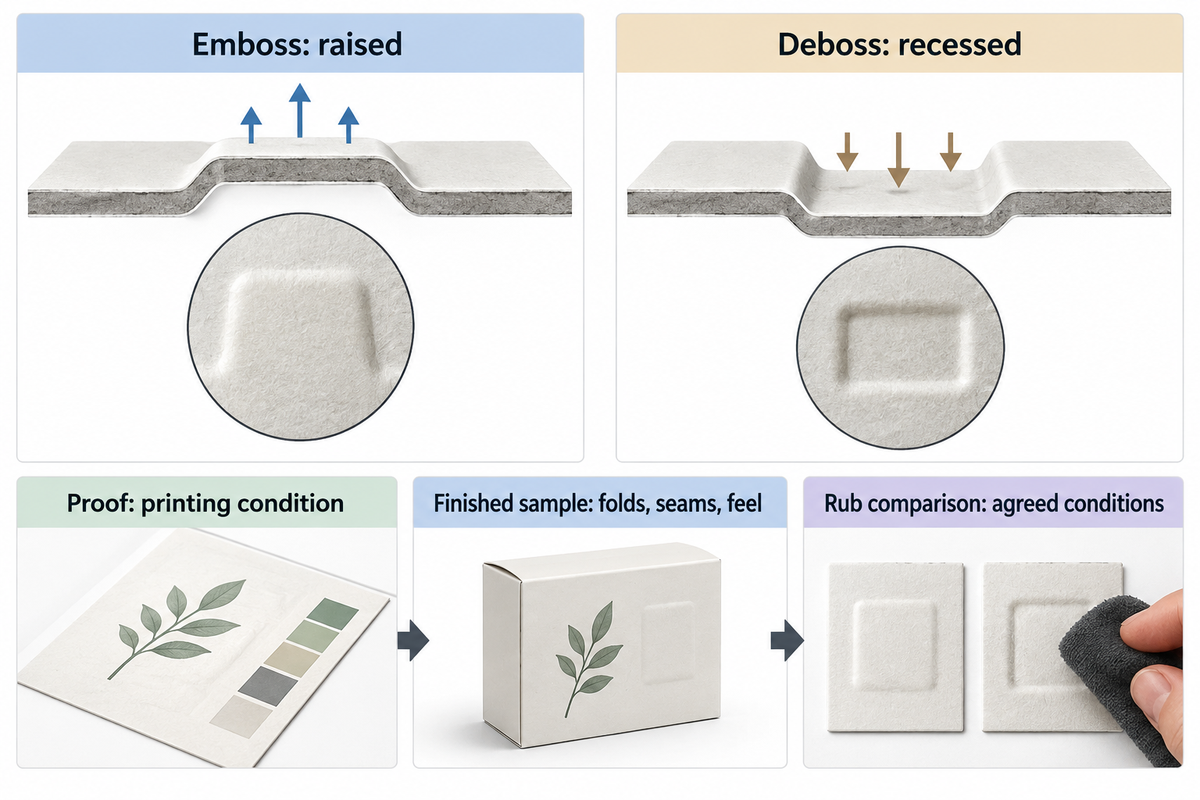
For custom two-piece rigid boxes, select the printing method for the artwork and production run, then approve the surface after wrapping and finishing. A flat color proof, a foil test and an assembled sample help answer different questions. Small type, fine rules and artwork crossing a corner need attention where the printed sheet becomes a three-dimensional package.
Detailed artwork lends itself to offset printing. Custom printed rigid packaging boxes can also use a restrained custom logo on a textured surface. To emboss a mark is to raise it; debossing recesses it. Foil stamping uses a transferred foil finish, while spot UV adds a localized coating effect. For a high-end brand, specify placement against the finished lid edges, rather than only against the flat artwork boundary.
Printing on rigid boxes usually means printing the wrap before assembly. A digital colour proof simulates a defined printing condition, as described in ISO 12647-7:2016 digital proofing. Use that colour stage before the finished sample, where folds, seams and surface feel become visible. Black gift boxes deserve a close look at handling marks. On printed boxes with a dark field, a small rubbed area can stand out.
ASTM describes the purpose as “comparing abrasion resistance of printed materials under laboratory conditions.”
To evaluate a mark close to a lid corner, inspect the wrapped sample from the front and side. High-quality printing on a flat sheet can still place part of the mark on a turn-in. Agree the surface, receptor, load and acceptance criterion for any rub comparison. D5264’s flat substrate coverage and an assembled corner contact check cover differing contact conditions.
9-Check Lid-Fit Diagnosis
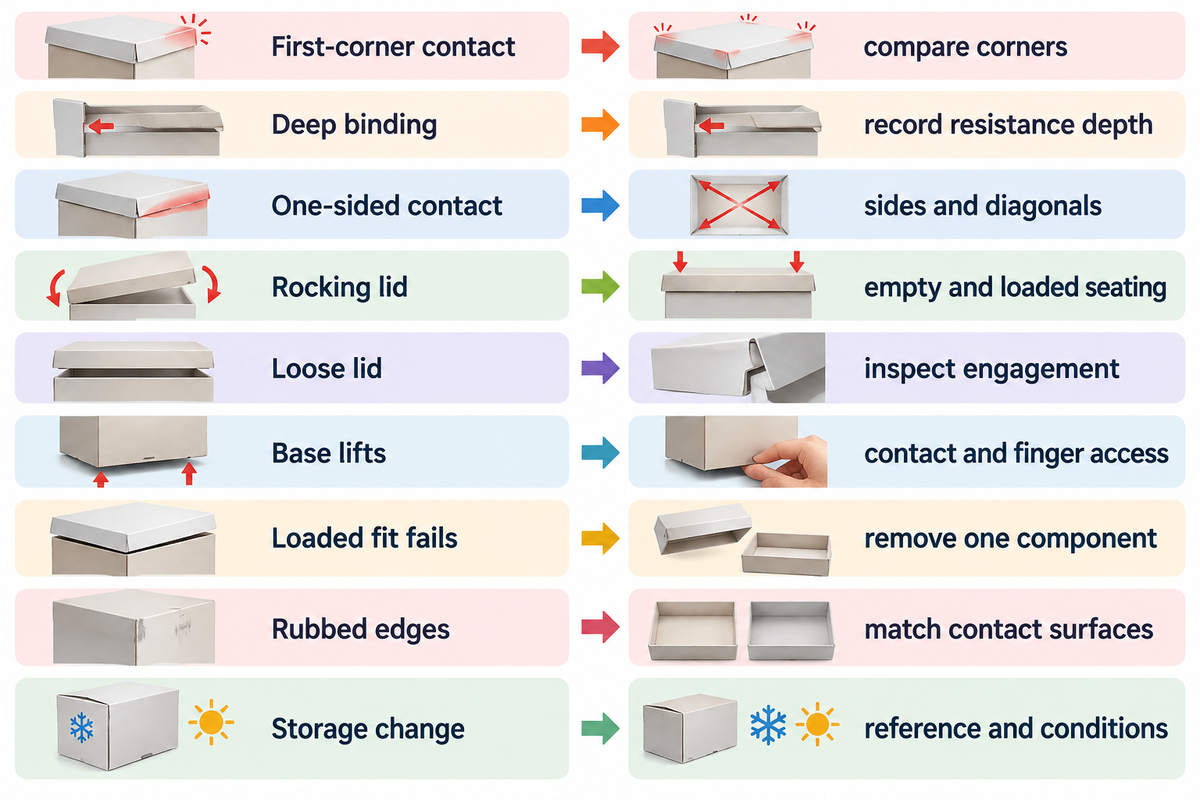
Observe where contact occurs when you look at a lid, and also observe any changes to the behavior of the lid when the box is loaded. Resistance and contact tell you a lot when you measure what’s happening. A stuck cover can involve wall geometry, wrapped corners, the contents or storage conditions; forcing it closed can add damage and hide the original cause. Each observation narrows the next measurement.
| Observation | Possible contributors | Discriminating check |
|---|---|---|
| Contact at the first corner | Corner wrap build-up; unequal wall angles | Compare the contact corner with the other corners before changing the whole lid size. |
| Binding near full engagement | Taper; a local turn-in; shoulder contact | Record the depth where resistance starts and inspect that contact level. |
| One-sided contact | Out-of-square assembly; asymmetric wrapping | Measure matching sides and diagonals; compare lids and bases within the sample set. |
| Lid rocks on the base | Uneven seating; contents above the closing plane | Compare empty and loaded seating on a level surface. |
| Lid slips off too freely | Excessive local gap; inadequate overlap for the intended handling | Inspect engagement and agree how the filled package will be held. |
| Opening lifts the base | High contact resistance; limited base grip | Compare wall contact with the finger access available below the lid. |
| Empty fit works, loaded fit fails | Insert wall pressure; raised product or padding | Remove one packing component at a time and record the change. |
| Rubbed finish at closing edges | Local interference; rough contact edge | Match the rubbed location to the opposing surface before altering the finish. |
| Fit changes after storage | Conditioning change; wall distortion or stacking damage | Compare stored and reference samples under recorded temperature and humidity. |
PPC’s corner and bowing definitions support the geometry checks. ASTM D4332-22 explains cellulosic packaging properties and how conditions (e.g., temperature, humidity) affect repeatability. The atmosphere of the lab should reflect the temperature and humidity being evaluated; a laboratory condition will not replicate the entire delivery route.
Let’s say an empty sample can close fully, but a loaded kit can’t, and the cover stops short of its intended position. The first thing to check should be the product and insert, not increasing the size of the lid. Remove the top pad and check again; then check whether the insert presses the base walls outward. If the lid still binds with the entire insert removed, compare the finished wall dimensions and contact marks. Record the sequence on the sample sheet. Changing the lid size before locating the interference could create a loose empty fit while leaving the raised product unresolved.
Compare two-piece boxes with other packaging structures
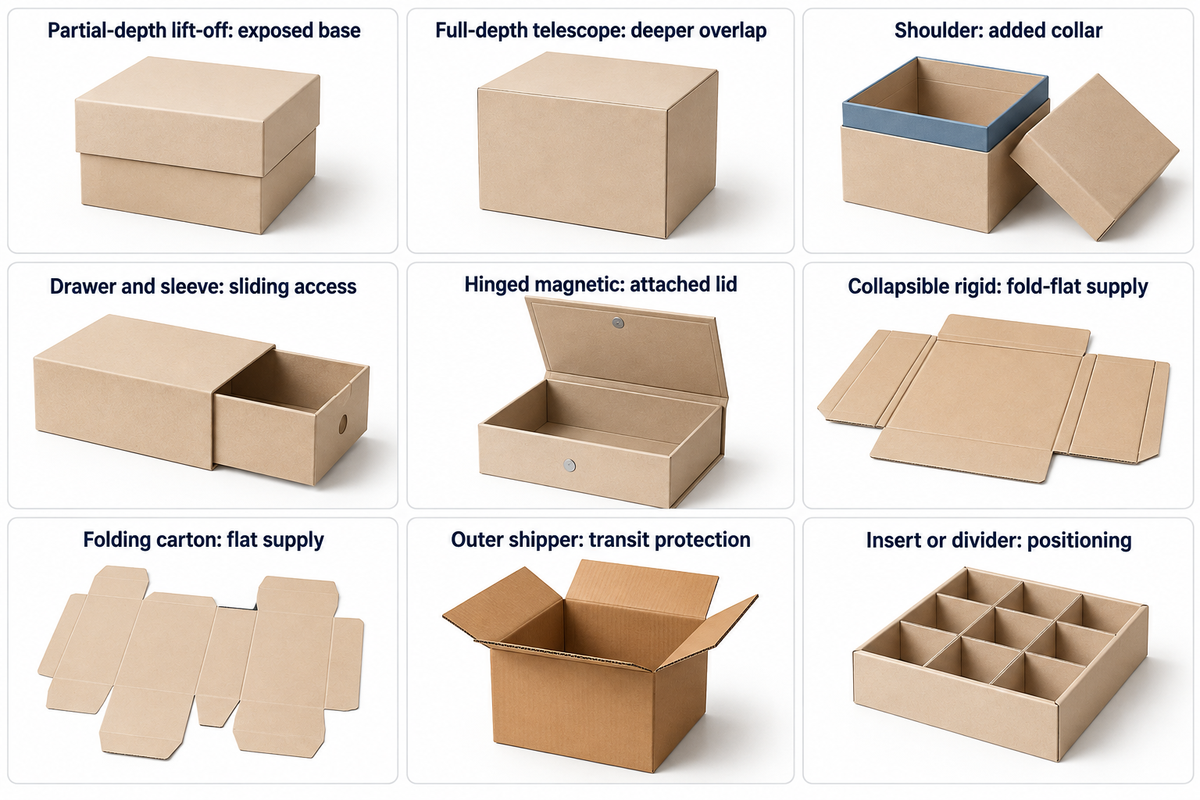
Look at rigid two piece boxes in relation to other structures by opening motion, storage form and function. Lift-off, drawer, and hinged boxes create different access paths. A folding carton reduces the amount of empty storage space. An outer corrugated carton deals with a different part of the distribution pack. When comparing packaging, no one style or design prevails.
| Construction or component | Access / storage | Useful decision |
|---|---|---|
| Partial-depth lift-off box | Exposed base; normally erected | Choose for easy base grip and open-tray display. |
| Full-depth telescope box | Deeper overlap; normally erected | Check grip and opening travel with the filled product. |
| Shoulder/neck box | Lid seats over an added collar | Choose a flush joint or reveal while checking collar contact. |
| Drawer and sleeve | Horizontal sliding access | Provide room for the drawer to extend and a usable pull. |
| Hinged magnetic box | Attached lid; magnetic closure | Keep the lid attached; assess hinge and closure separately. |
| Collapsible rigid box | Fold-flat before assembly | Trade empty storage savings against assembly work. |
| Folding carton | Flat supply; erected for packing | Consider where compact storage outweighs a rigid feel. |
| Corrugated outer shipper | Encloses the presentation pack | Select around the packed product and distribution hazards. |
| Fitted insert or divider | Internal positioning component | Control movement and removal access; pair it with a box structure. |
Different types of rigid construction and supporting components appear together deliberately: The outer shipper and insert are parts of the same packaging solution. A magnetic box could also be collapsible. Compare the different opening formats in rigid gift box styles before making a final decision.
Can these rigid boxes be used as shipping cartons?
Use an outer shipping carton for an ordinary rigid gift box shipment unless the filled presentation package has been designed and tested as the exposed shipper. Evaluate the product, insert and outer protection together, using a distribution test suited to that configuration and agreed damage limits.
ISTA’s packaged-product design guidance starts with the distribution environment and representative products and packages. A heavier board cannot by itself resolve an oversized shipping carton or an unsuitable closure. Reassess performance with changes in the product or pack configuration.
Cost, minimum orders and the delivered pack
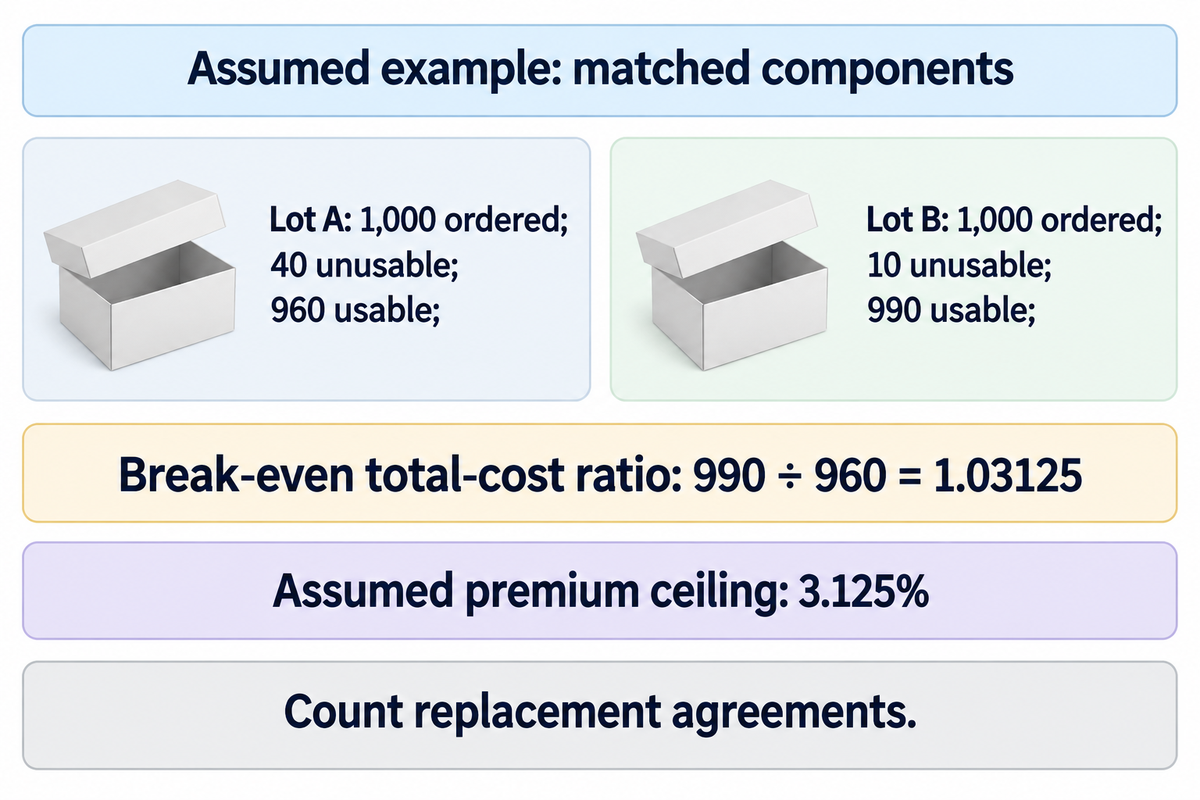
One published price guide lists a standard 6×6×3-inch two-piece lid-and-base rigid box with full-color printing and soft-touch lamination at about $5.00–$8.00 per unit at 1,000 units; for two piece rigid gift boxes, compare the total included shipment cost against usable, accepted packs. Match size, board and insert scope. Separate production from freight. Box packaging quoted at the lowest price can lose its advantage when the order includes different finishing, pack quantities or shipping responsibilities. Keep each size and artwork variation separate.
The International Trade Administration’s total export-price guidance includes the product, insurance, freight, applicable tariffs and taxes, and other fees in landed cost. Use the relevant charges for the delivery terms and count them once. Tooling and sampling charges should also be clearly allocated when comparing the first order against a repeat order.
Consider two lots, each of 1,000 packs, which are identical in terms of included components. Assume lot A leaves 40 unusable packs and lot B leaves 10, with no replacements or salvage credits. Usable quantities for lots A and B are 960 and 990 respectively. To give the same cost per usable pack, B’s total included cost can be 990 ÷ 960 = 1.03125 times A’s, or 3.125% higher. A premium below that threshold for B would mean a lower usable pack cost in this case. Actual rejection counts must come from the order, not this exercise. If the supplier replaces the rejected packs or freight is paid by the supplier for the replacement, include that in the analysis.
For your own comparison, divide each lot’s included cost by its accepted usable quantity. The box quotation comparison tool helps you organize matched quotations. For a different freight input, you can use the shipping carton volume comparison tool.
With a wholesale 2 piece box order, check if the minimum quantity applies to each size, print version or combined quantity. For two sizes with the same custom logo, separate dimensional approval is required. Kraft boxes with a simple print and a coated, foil-decorated gift pack should carry separate finish specifications, even if the seller describes both as premium packaging.
Sample approval before a wholesale order
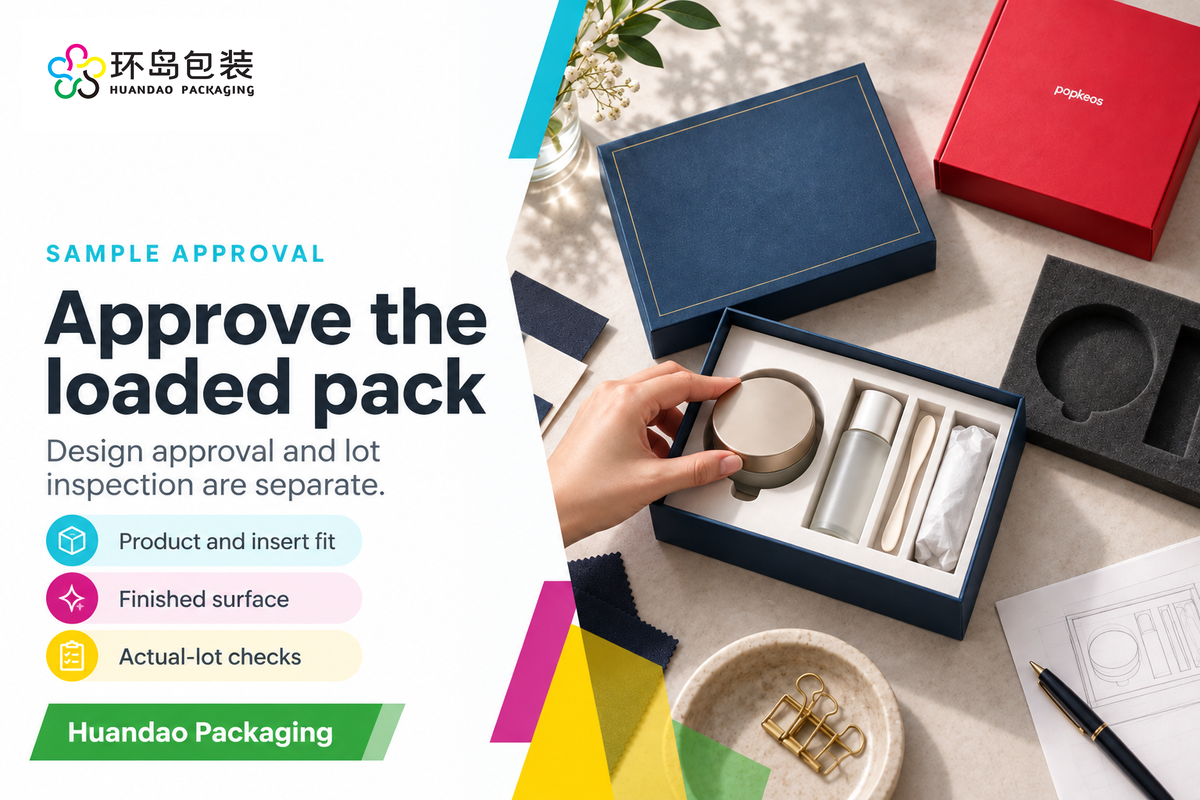
Approve the sample against a design specification, and then decide how the production lot will be inspected. An empty structural sample checks a different question from a printed proof or finished loaded pack. Keep the approved construction, artwork revision and inspection criteria together so a later material change does not pass unnoticed.
- Confirm the structure. Check the product, insert, finished cavity, opening and removal access.
- Approve the finished surface. Compare custom printing options, colour and decoration on the agreed substrate and assembled shape.
- Define the lot checks. Record the dimensions, appearance criteria and inspection method for the production order.
- Evaluate the shipping pack. Use representative contents and the selected distribution configuration when transport performance is required.
NIST’s acceptance-sampling explanation concerns samples selected at random from the actual lot for an accept-or-reject decision. ISTA’s guidance on test sample numbers says most ISTA procedures require a minimum of one packaged-product, but three successful tests of identical packaged-products improve assurance and five or more are recommended when possible.
At Huandao, we coordinate the printed box with group-supplied inner trays, inserts and outer shipping cartons, so the components can ship together. Our Xiamen plant performs pre-press, offset printing and finishing. Job-specific ECT/burst, ink-rub and basis-weight reports describe the relevant materials from that production run; a material report and a complete packed-product transport test have different scopes.
Our published minimum is 1,000 pieces per style and size. When your project moves to sourcing, our two piece rigid boxes for your packaging brief page gives the available construction and sample options. Keep the design checklist with that enquiry.
Industry outlook: material choices and the next packaging brief
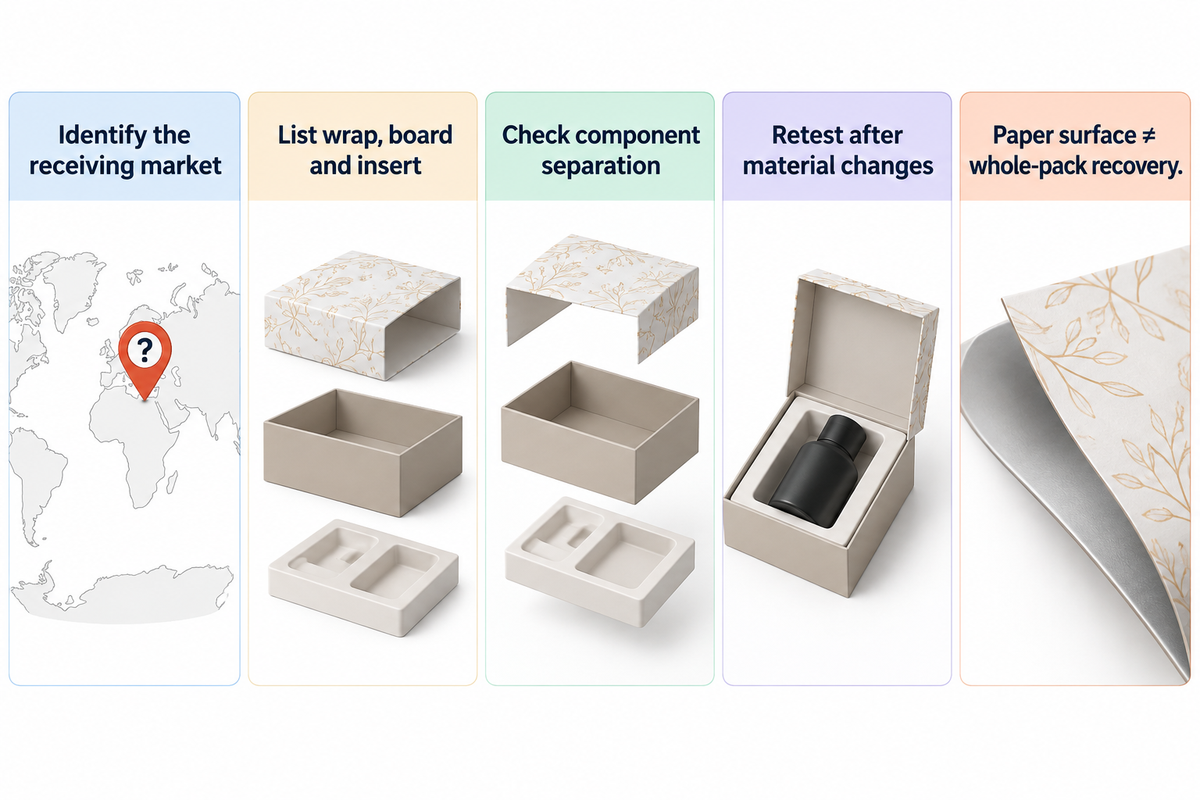
When describing a new packaging project, the appearance of the paper used leaves a lot of questions. A removable insert, decorative laminate, and a magnetic closure, for example, would each raise different separation questions. Plans for reuse and recycling should explain the complete design and the market in which it will be sold.
The Sustainable Packaging Coalition’s 2026 Sustainable Packaging Trends Report identifies regional definitions of recyclability as a design issue. For a packaging customer, a practical option is to provide market-specific instructions. For a packaging buyer, the practical response is a destination-specific brief: identify the collection system, list the components and check whether the user can separate them. Material choices suitable for one program may need different instructions for a different program.
An alternative design for 2026 might be to replace the integral, mixed-material insert with a removable one, while keeping the same product support requirement. Choose the insert for retention and contact protection first, then examine separation and collection. Replacing foam with a paper-shaped cavity changes stiffness and contact geometry; the loaded sample should be tested again. Calling the new material paper does not settle the performance or recovery question.
For gift packaging, the U.S. Environmental Protection Agency’s common-recyclables guidance tells households to follow local program rules. This is a good boundary for the gift packaging, which is sold in different markets. Claims about the board’s fiber content must be separated from claims about the finished package. A box kept for storage has a reuse function; eventual collection still needs its own instructions.
Do
- Identify the receiving market and collection route.
- List the wrap, board and insert separately.
- Check the loaded pack after a material change.
Don’t
- Infer whole-pack recovery from the paper surface.
- Transfer one component’s certification to every part.
- Use a reuse idea as a recycling instruction.
Frequently asked questions
Can I order a sample of a two-piece rigid box?
Huandao offers blank structural and digitally printed samples; confirm the sample scope and courier charge for your project.
A blank sample is useful for the cavity, lid fit and product-removal check. A digital version helps assess artwork placement, while a press-run finished sample adds the specified production surface and finishing. Our published offer distinguishes these stages and notes that press-run finished samples carry a fee. Pack the intended product and insert into the sample before signing the dimensional approval.
Is there a minimum order quantity for custom two piece rigid boxes?
Huandao’s published minimum is 1,000 pieces per size and style.
For a custom 2 piece order, treat that as a supplier-specific ordering term, rather than a minimum for every manufacturer. Identify each size in the enquiry and state how many artwork versions it needs. A combined order total can hide a small run within one version. Custom sizes, foil tooling, insert construction and packing requirements also belong in the quotation, so repeat orders can be compared against the approved specification.
Can I add tissue paper or an insert?
Tissue and inserts can be added, provided the loaded contents still clear the closing lid and remain easy to remove.
Tissue changes the packed height and the contact surface around the product. An insert adds a defined cavity and can control movement, but its outside dimensions must fit the base without spreading the walls. For jewelry boxes, check small-item retention as well as the visual opening. For chocolate boxes, specify an appropriate food-contact barrier or inner pack rather than assuming the decorative wrap is suitable for direct contact. Review every added layer in the finished sample and record how it is assembled.
Can I design my own logo and artwork on two piece rigid boxes?
Customize a 2-piece rigid box with artwork and logos applied to the wrap and approved on the finished construction.
Keep the brand artwork revision tied to the dieline. Approve custom two piece boxes with the same lid orientation as the drawing, and compare decoration crossing an edge on the assembled sample.
How should unused rigid boxes be stored?
Store unused boxes clean, dry and supported, following the material and packing conditions agreed for the order.
Keep the protective shipping packs closed until the boxes are needed. Separate them from wet floors, leaking walls and sources of surface contamination. Avoid stacking arrangements that press unevenly on lids or exposed corners. Temperature and humidity changes can affect cellulosic materials, so record conditions when investigating a fit change rather than assuming the original sample dimensions still describe every stored box. For a seasonal release, retain a reference sample with the order identification and compare stored examples before packing the products. Use the outer-carton stacking guidance agreed for that shipment.
What products fit shallow rigid boxes?
Shallow rigid boxes suit products whose packed height leaves room for support, removal and lid closure.
Cards, scarves and low-profile accessories are possible applications. Include folded material, inserts and protrusions in the height check instead of choosing the box from the product’s flat outline alone.
Turn the sample checks into a clear brief
Send the product dimensions, intended opening, insert needs and destination with your brand artwork. We can review the printed box, inner packaging and outer-carton requirements together.
The examples for sizing and usable-pack cost provide teaching calculations with stated assumptions. Specific ordering and production information applies to Huandao. Confirm the final construction and acceptance criteria against the approved project sample.
References & Sources
- Rigid Box Industry Terminology, Paperboard Packaging Council.
- SI Units, Length, National Institute of Standards and Technology.
- The Luxurious Rigid Box, Paperboard Packaging Council.
- Fitting Unusual Collections into Standard Boxes, Smithsonian Institution Archives, 2019.
- Digital proofing: ISO 12647-7:2016 public abstract, International Organization for Standardization.
- ASTM D5264: public abrasion-test scope, ASTM International.
- ASTM D4332: public conditioning scope, ASTM International.
- Getting Started with Package Design and Testing, International Safe Transit Association.
- Determine Total Export Price, International Trade Administration.
- What is Acceptance Sampling?, National Institute of Standards and Technology.
- How many samples are required for ISTA testing?, International Safe Transit Association.
- 2026 Sustainable Packaging Trends Report, Sustainable Packaging Coalition.
- How Do I Recycle Common Recyclables?, U.S. Environmental Protection Agency.