Get in Touch with Xiamen Huandao Packaging Technology Co., Ltd.

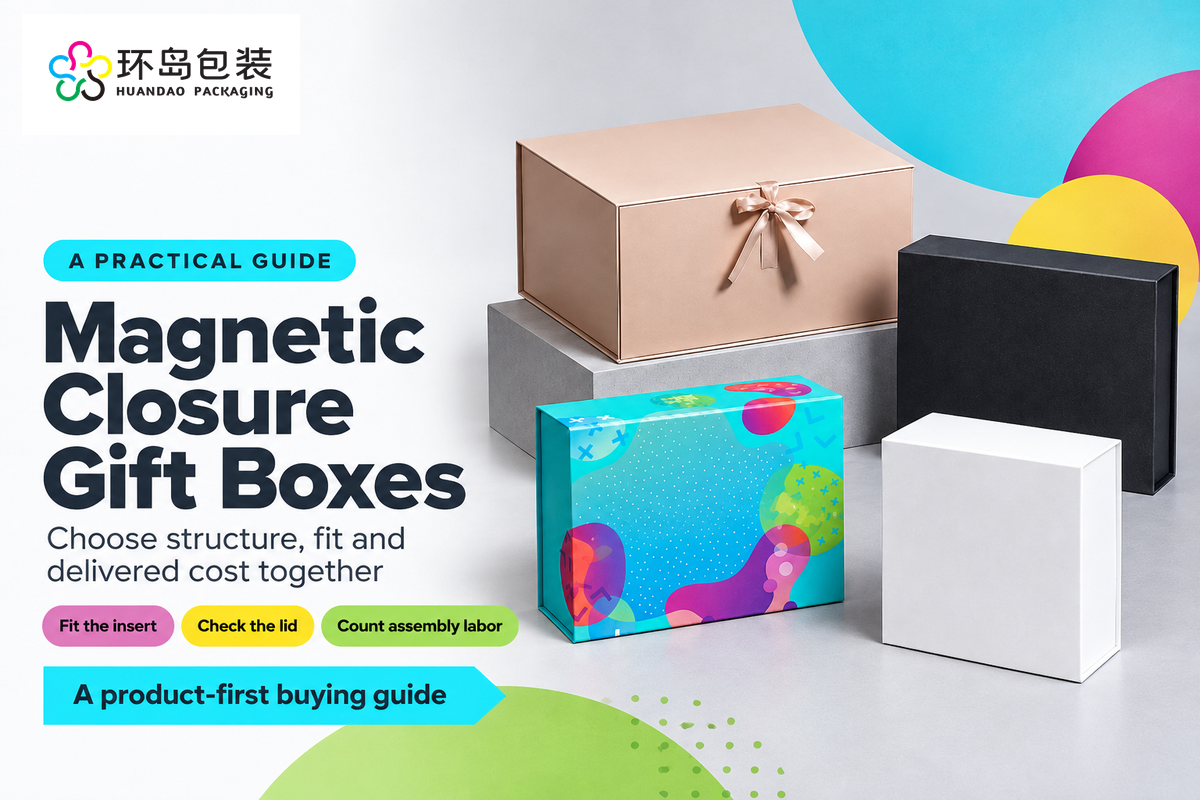
Magnetic closure gift boxes use a hinged lid and a concealed closure to hold the lid in place. The closure can allow users to repeat the opening action. Support for the contents is determined by the outer (shipping pack) and/or insert. Consider what construction is utilized around the filled product and what packing method is used.
Updated October 2026
Magnetic closure gift boxes combine a hinged cover with a magnetic closing flap. Assembled boxes reduce setup work; collapsible designs reduce empty storage volume. Select the insert and lid fit together, then compare delivered cost including destination assembly.
Magnetic Closure Gift Boxes: How the Lid Works
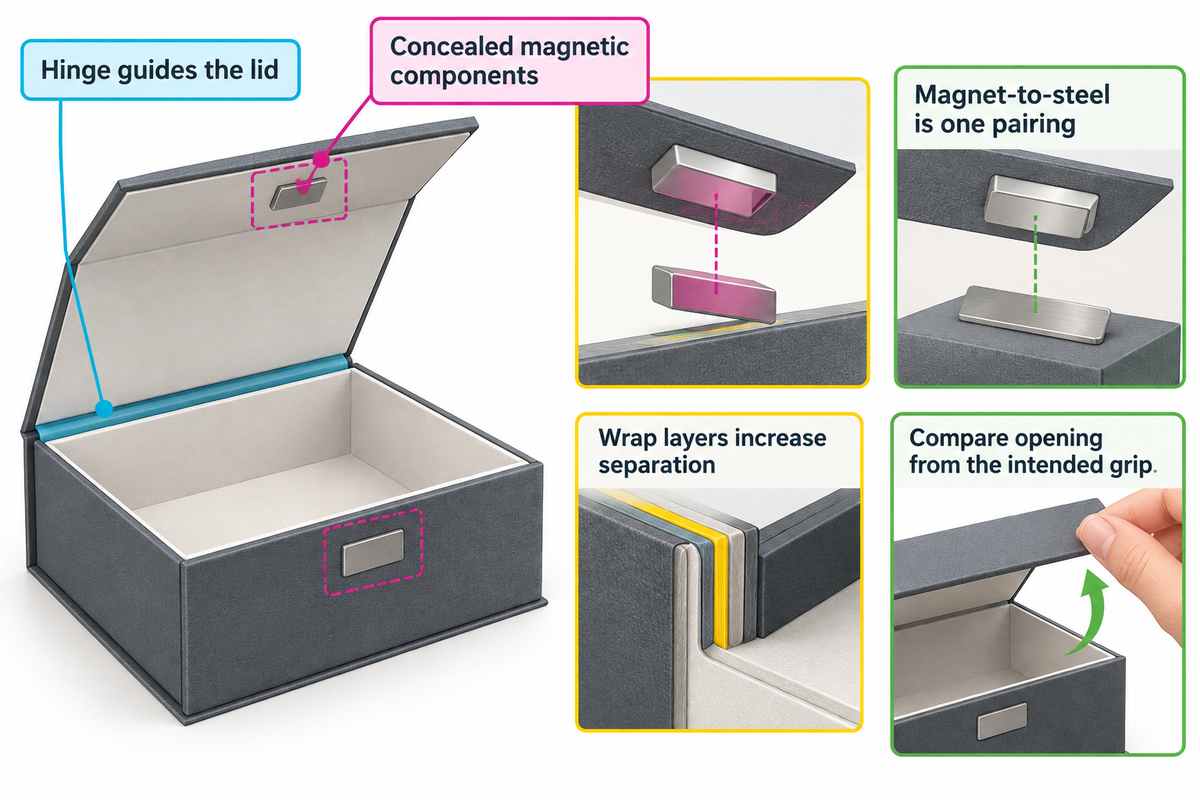
A magnetic gift box closure relies on hidden components that attract one another across a flap and its mating panel. A hinge directs the motion of the lid. Consider a book cover that has a catch. The hinge tells the cover how to move and the catch holds it in the final position.
“A method of attaching one side of a lid to a base.”
The rigid cardboard body supports the arrangement of a hidden magnet and a steel target. Consider what pairing the approved sample uses and then compare magnetic boxes of two suppliers.
Contact matters. Wraps with extra layers, a flap bowed in a certain direction, or targets placed away from each other can increase separation. The University of Kentucky’s magnetic-force demonstration shows how distance and orientation are variables in attraction. A finished box adds hinge resistance and geometry to all of this. A bare magnet’s pull is obviously not a reliable substitute for trying the complete lid.
If a small flap is used, magnetic force may be working against you. A finger, ribbon or edge opening may be better. Compare direct pulling over the magnet to opening from the intended grip with boxes with a magnetic catch.
When purchasing requires a secure magnetic closure, describe use. Is it repeated opening in retail? Passing a gift across a counter? Keeping an unloaded box erected? Each uses the flap differently. Check each use on the approved construction.
Magnetic Gift Boxes: Compare the Construction
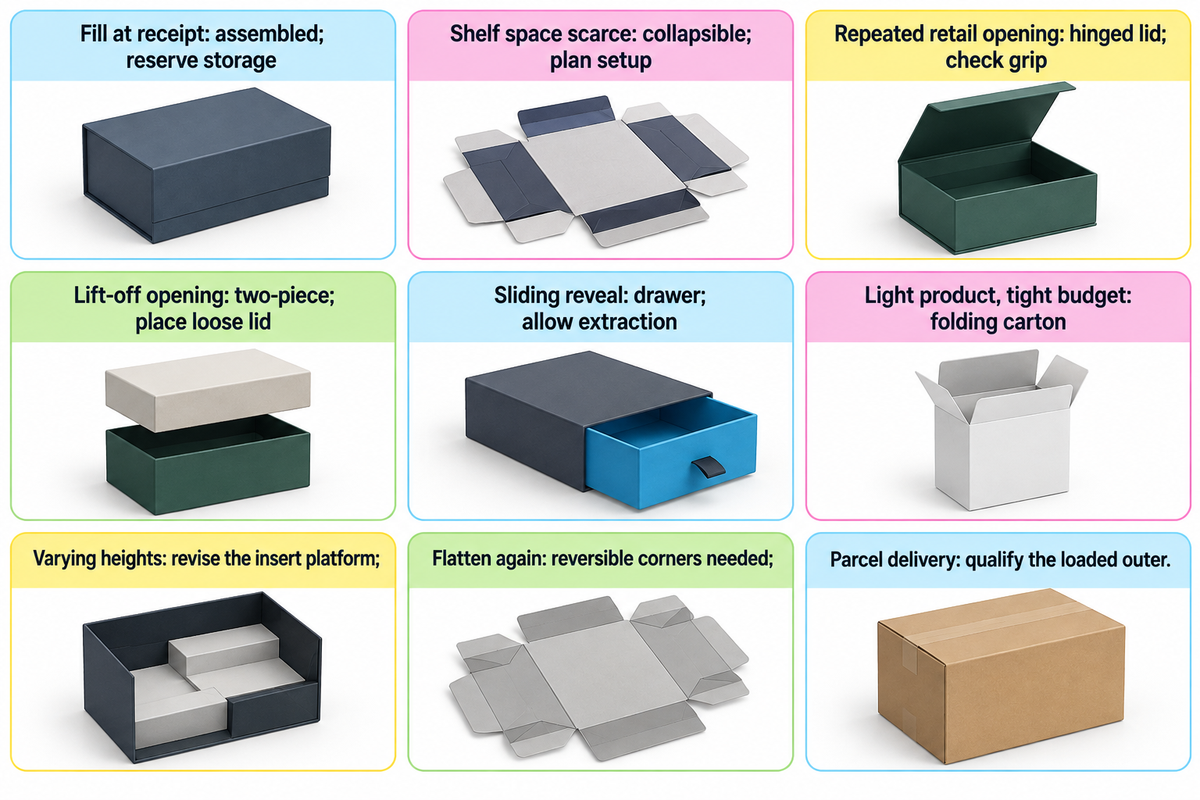
Choose an assembled magnetic box when labor is limited and empty box storage is available. Choose a collapsible form when storage or inbound cube matters and someone can erect it consistently. Lid style describes the opening action; the folding and locking determine how the box becomes usable.
Not all flat designs use the same adhesive tabs. One Uline magnetic gift box is held together in its assembled form by the magnetic lid, rather than an adhesive strip. Check the erection sequence before planning either reuse or assembly labor.
| Condition | Construction to consider | Decision-changing limitation |
|---|---|---|
| Boxes filled immediately at receipt | Supplied assembled | Reserve space for empty erected boxes |
| Empty inventory occupies valuable shelves | Collapsible magnetic box | Assign setup labor before the launch |
| Repeated opening during retail display | Hinged magnetic lid | Check grip access and hinge behavior |
| Separate lid should lift completely away | Two-piece rigid box | Plan somewhere to place the loose lid |
| Product is revealed by sliding | Drawer rigid box | The drawer needs enough extraction space |
| Light products with a tight unit budget | Folding carton | Confirm the required support with its insert |
| Changing product heights share a presentation | Rigid box with a revised insert platform | Recheck top clearance for every version |
| Receiver should flatten the empty box | Reversible collapsible structure | Permanent erection tabs may prevent flattening |
| The parcel enters a delivery network | Gift box inside a protective outer | Qualify the complete loaded shipping pack |
Consider a small shop preparing wedding gifts at a narrow counter. Staff can fill each box between serving customers; moreover, there’s space under the counter for a short stack of assembled boxes. A flat box saves shelf space in the back room, but its extra setup competes with serving time. An assembled version is a sensible starting choice here. Move the same order to a central packing room with a planned assembly shift, and the balance shifts the other way. The buying team should compare the received carton plan with a timed erection at that location. The form of the supply can change, and an attractive opening sequence remains the same.
Two-piece rigid boxes open with a lift-off lid. Drawer rigid boxes slide out. Collapsible rigid boxes fold flat when empty. Choose your boxes based on the opening action and storage needs.
Size the Product, Insert and Lid as One System
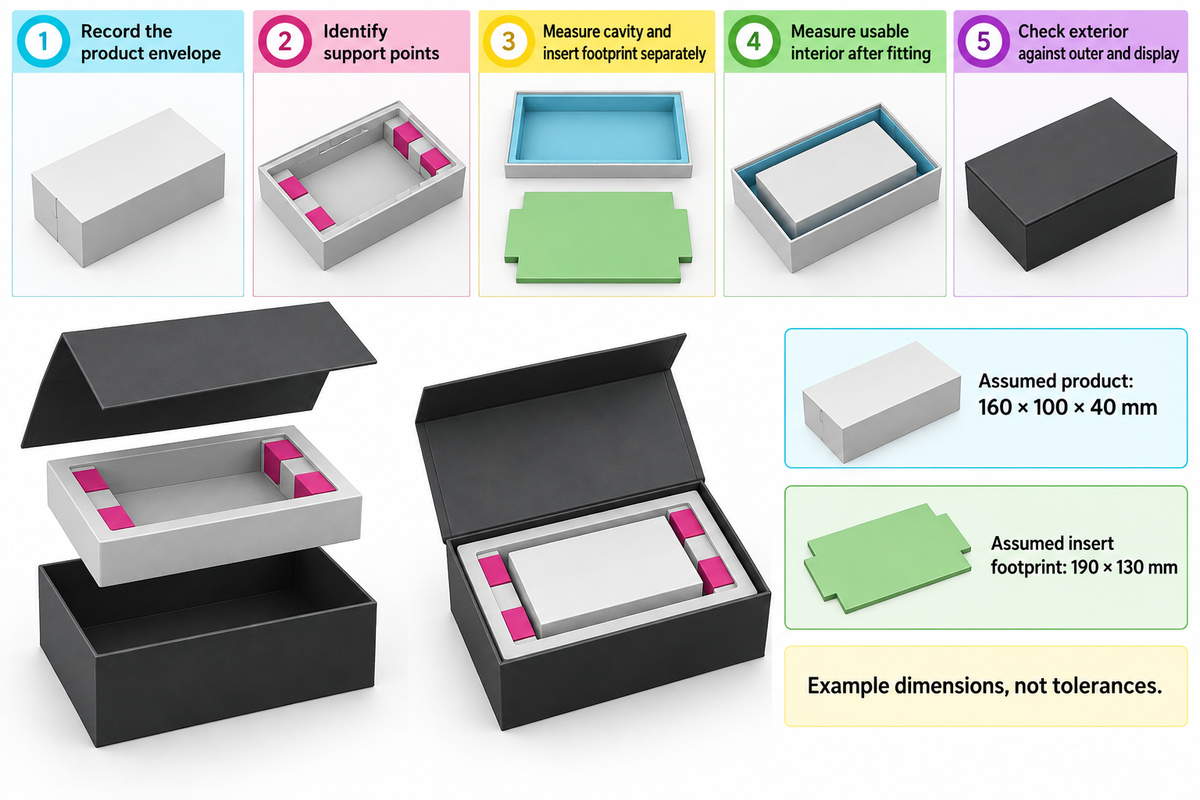
Size magnetic closure boxes to the packed product. Then size the insert footprint and the usable box interior around the packed product. External box dimensions may answer a different question, for example whether the box will fit a shelf or the shipping outer. If an exterior of a box is large, it may hide an undersized internal cavity.
How do I choose the right magnetic gift box size?
Start with the largest completed configuration of the product, which may include caps, handles, wrapping and other accessories, and build an insert sample around it. Measure the footprint and the loaded height of the insert sample and pick the usable internal box size. Leave sufficient access for removal. Close the lid without pressing on the product.
- Record the product’s maximum envelope in its intended orientation.
- Mark each support point and any part that should carry no packing load.
- Measure the insert cavity separately from the insert’s outside footprint.
- Measure usable interior space after the insert and lining are fitted.
- Check the closed exterior against the shipping outer and display limit.
An example of assumed sizing illustrates the difference. Let’s say an item is wrapped at 160 × 100 × 40 mm, and the proposed insert footprint is at 190 × 130 mm. A nominal 190 × 130 mm external box isn’t an adequate solution. Its walls would use some of the space available. Even an internal footprint would require checks for insert placement and removal, as well as space left under the closed lid. The dimensions illustrated are measurement dimensions, not manufacturing tolerances.
A merchant specification illustrates why the labels matter: Uline S-24576BL lists a 13 × 10.75 × 5.5 in. interior and a 13.5 × 11.25 × 5.875 in. exterior. Transfer the distinction to your drawing, rather than transferring that product’s dimensions to your own order.
A square box may provide a visually pleasing solution to a collection while wasting space around a long bottle. Use the layout of the actual items being shipped to make your decision, rather than relying on the outline alone. If purchasing wants a size for a group of products, for example, approve the tallest and least supported versions of those products separately.
Magnetic Box Wraps: Matte, Gloss and Handling
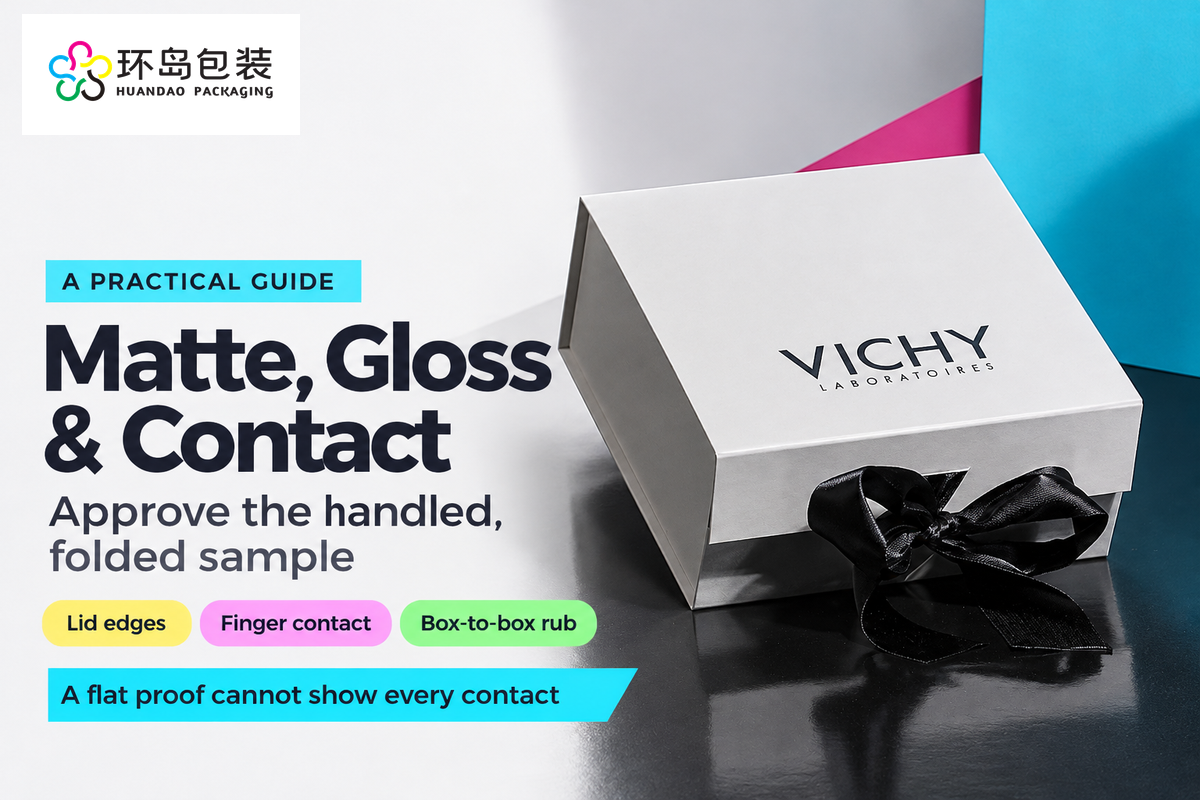
Examine printed box finishes by handling the sample magnetic box. Matte and gloss change the appearance of color and marks; foil adds another contact surface. Approve the finished object for a luxury presentation because a flat proof can’t show folded edges or repeated flap contact.
White magnetic gift boxes and dark printed boxes reveal dirt differently. A plain white magnetic box makes edge alignment and wrap joins easy to inspect. High gloss creates sharper reflections which are suitable for a decorative presentation, but can make irregularities in surface contacts conspicuous. Choose the effect with the lighting used in the shop or the photograph.
With a matte magnetic box, compare finger contact on the lid to rubbing where one packed box touches the next. Those are different exposures. Tissue between boxes can change contact during handling, but also adds packing time and material. A glossy sample that looks clean in isolation may get rub marks in the full carton.
In ASTM D5264-98 (2019), comparative abrasion testing of printed materials with a Sutherland rub tester is described. For your job agree the sample preparation and acceptance criteria rather than treating the standard number as a universal rub-cycle guarantee. Review the lid edge, fold and foil detail alongside any flat test specimen.
At Huandao, we do pre-press, sheetfed offset printing, UV coating and lamination, all under one roof. Thus, we can discuss the print and surface sequence together. A logo proof still needs its approved size and position on the finished box; a small foil mark crossing a fold deserves closer attention than the same mark on a flat surface.
When the brief asks for a premium finish within a fixed budget, compare a restrained print treatment with the added film or foil operations. A display window also changes the covered panel and material selection; examine its edge in the finished sample. Keep one approved color reference for later production reviews.
Pack Gift Sets Without Crushing or Product Movement
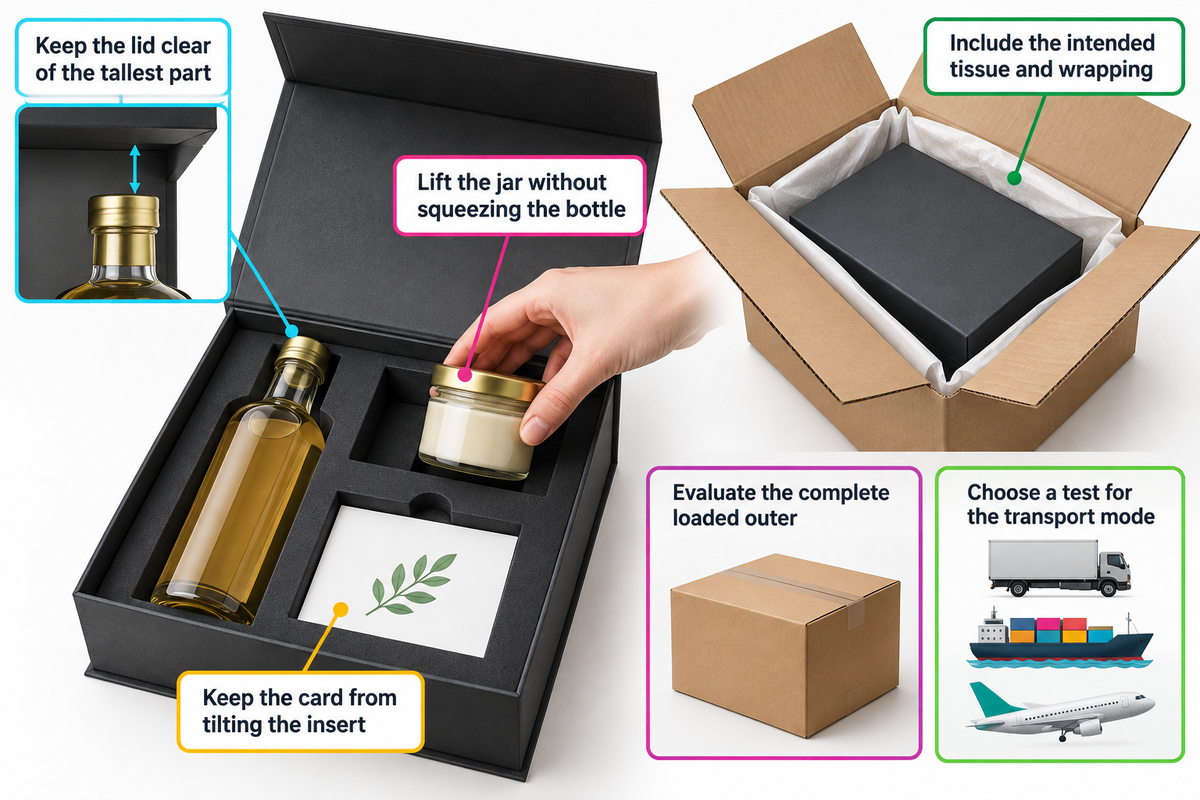
A gift-set insert should support the product at suitable contact points, separate items that can collide and leave a clear removal path. The magnetic lid completes the presentation. A protective shipping outer handles the parcel environment, so judge these parts as a loaded assembly rather than choosing cushioning from appearance alone.
Consider a holiday cosmetic set containing a glass bottle, a jar and a gift card. A single deep cavity makes a neat collection. The tall bottle cap can become the first point of contact for the lid. Begin by adjusting support heights to ensure the lid clears the tallest part of the collection. Give the jar enough play to lift it out without squeezing the bottle. Place the card where it can’t slide under a support and tilt the insert. Repeat the same steps for a Christmas gift shipment, but this time, include the intended tissue and wrapping. Then place the loaded presentation box in its proposed outer and evaluate the entire package. A better-looking cavity alone hasn’t resolved the delivery problem.
For cosmetic packaging, inspect the finished product, which includes its labels, to determine clearances for pumps and caps. A shoe set has different requirements: a wide supported base and enough space for removal can matter more than a narrowly defined cavity.
ISTA’s procedure families clearly delineate screening and transport simulation. Choose the appropriate family of procedures for the product/package combination and the mode of transport. Different questions are answered by a parcel test, a shelf presentation test and repeated opening: determine which of the three the sample has actually been subjected to.
Check the pack after it’s been stored and loaded in a representative manner. An older US Forest Service paperboard study from 1986 suggests cyclic humidity can impact the behavior of compressively loaded paperboard. This mechanism justifies tracking storage history when a pack that functioned correctly at first later changes shape. It, however, doesn’t set a humidity or life limit for your gift box.
Through Huan Yin Packaging Group, we can integrate the printed box with inner trays, inserts and outer shipping cartons in one shipment. Compare the corrugated mailer box with the actual filled gift set, including the surfaces that will come in contact during delivery.
Diagnose Magnetic Lids That Will Not Close
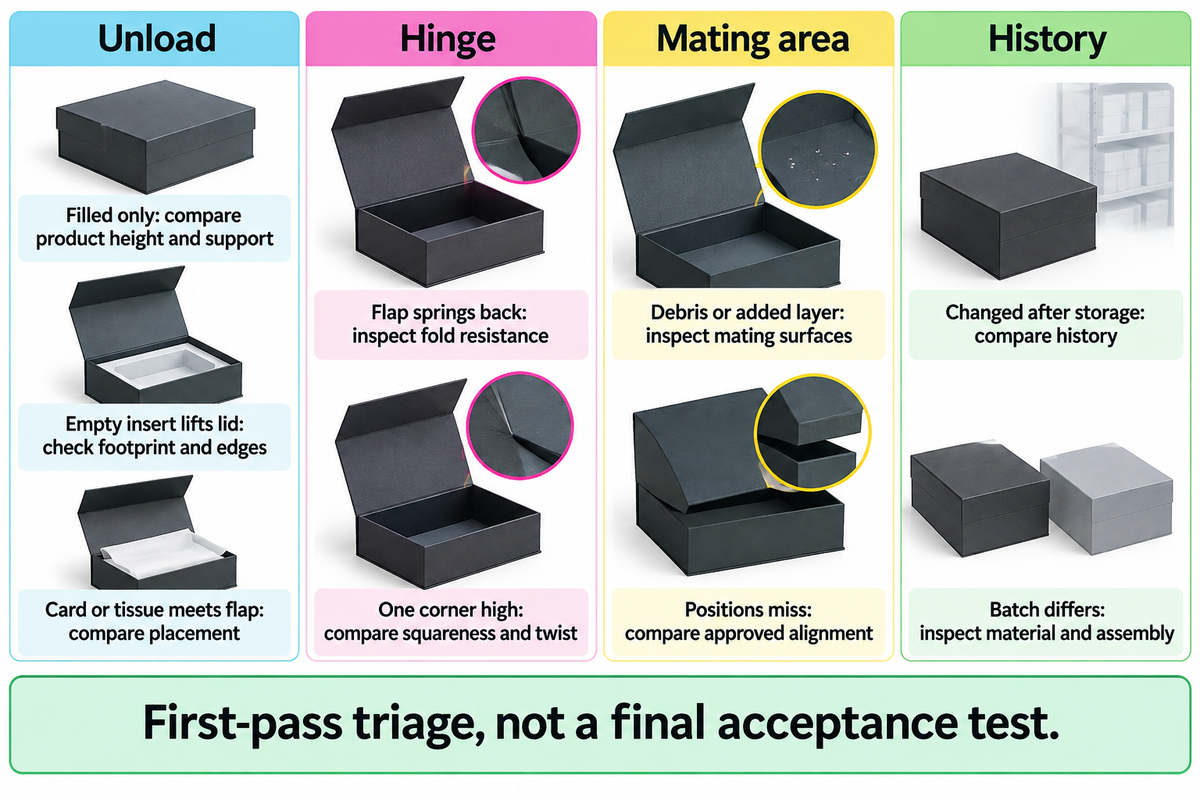
A lid that lifts needs a fit and movement check, before a stronger magnet is specified. Compare the empty box with the insert-only state and the fully loaded state, and check the hinge and magnetic components in the mating position. Record when the problem began: immediate assembly faults and changes after storage can have different causes.
Why are my magnetic closure gift boxes not working?
Check the insert for an obstruction or if it’s overfilled. Check the hinge for resistance and the closing position of the lid. The 4-Check Lid Fault Finder below is a practical first-pass triage, not a final acceptance test. If the closing position of the lid is correct, but the lid still doesn’t close flush, it’s an unexplained fault and should be returned to the supplier with the samples used for comparison.
| Check | Observed condition | Next comparison | What to change or investigate |
|---|---|---|---|
| 1. Unload | Closes empty, lifts when filled | Insert-only versus loaded | Product height or support position |
| 1. Unload | Lifts with the empty insert | Insert removed versus installed | Insert footprint, lining or proud edges |
| 1. Unload | Gift card or tissue meets the flap | Accessory removed versus included | Accessory placement and wrapping allowance |
| 2. Observe the hinge | Flap springs back before mating | Unobstructed closing path | Fold behavior and restoring force |
| 2. Observe the hinge | Only one corner remains high | Opposite corner and base squareness | Twist, board bowing or uneven erection |
| 3. Inspect the mating area | Closure positions do not meet | Approved sample alignment | Component location or erection geometry |
| 3. Inspect the mating area | Visible debris or an extra layer separates panels | Clean approved mating surfaces | Remove loose obstruction; avoid adding layers |
| 4. Compare history | Worked initially, changed after storage | Retained sample and storage conditions | Moisture exposure, sustained loading or deformation |
| 4. Compare history | One batch differs from the approved sample | Same load and opening action | Ask the supplier to inspect material and assembly differences |
Observations are checked before a cause is assigned. A magnet can still attract even if the flap can’t reach its target. Conversely, a flap can still meet its target neatly but can open too easily for proper handling. Photograph the closing position. Compare product performance under the same product load.
The resistance of paperboard folding also depends on the material and loading arrangement, as explained in a 2018 Lund University thesis abstract on folding paperboard. Therefore, investigating a stiff hinge is a better choice than scoring or recutting a finished box. Cutting can damage the wrap and alter the approved structure.
If the packing team can’t reproduce a customer’s failure, ask for the loaded configuration and storage history before changing all magnets. A returned sample with the product and the insert in place is more helpful than an isolated magnet request.
Compare the Cost of Assembled and Flat-Packed Boxes
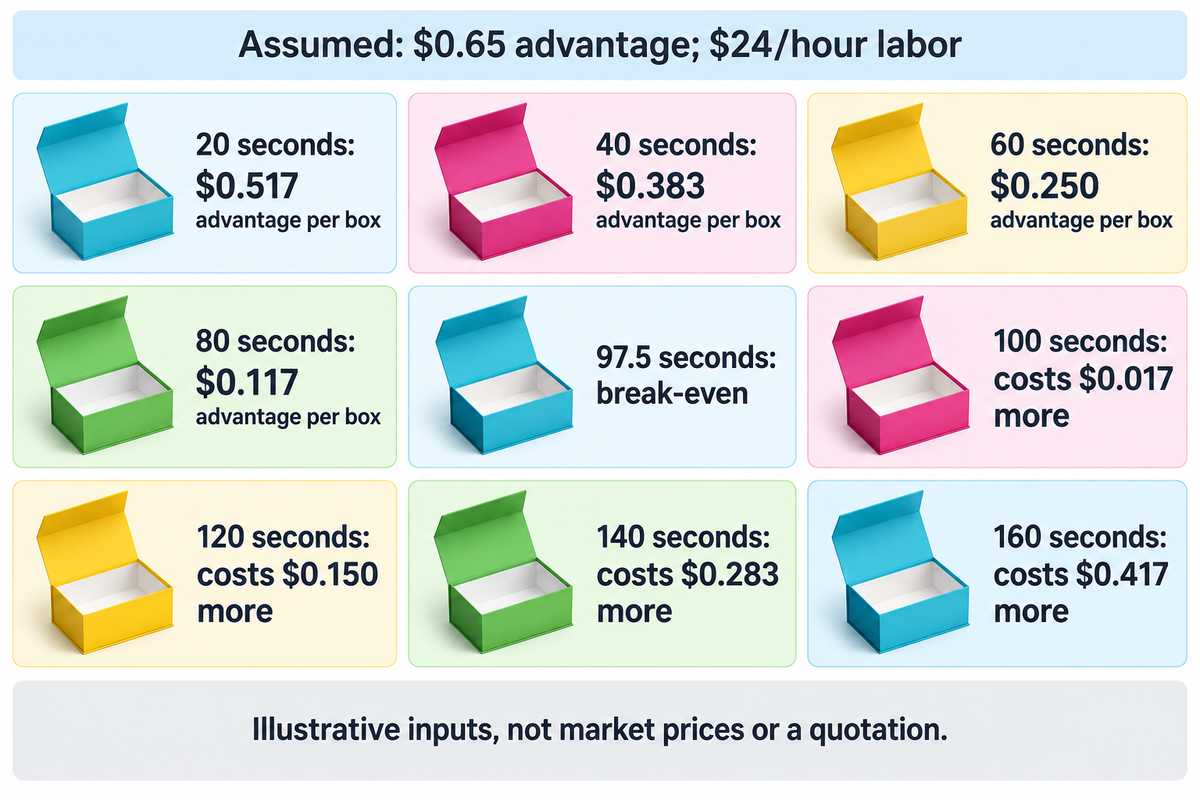
Compare flat packed and assembled magnetic closure gift boxes, at the same delivered scope, including destination assembly. Flat supply reduces cost only if the advantage in purchase and freight costs exceeds the extra local cost of assembly. Calculate the assembly time threshold before assuming a lower empty shipping volume produces the lower total.
Mississippi State Extension’s product-cost framework includes direct labor and packaging among variable costs. Let S be the per box advantage of flat supply before additional assembly labor, and R the loaded hourly labor rate. Other costs being equal, the threshold would be 3,600 × S ÷ R seconds per box.
Use these assumed inputs: an order of 2,000 boxes, a $0.65 per-box flat-supply advantage before assembly labor, and a loaded labor rate of $24 per hour. The threshold is 3,600 × $0.65 ÷ $24 = 97.5 seconds per box. At an average assembly time of 40 seconds per box, extra labor costs $533.33 across the order. Subtracting that from the $1,300 initial advantage leaves $766.67. At 120 seconds per box, labor rises to $1,600 and flat supply costs $300 more. These are illustrative purchasing inputs, not market prices or Huandao quotations. Time the intended operators through a representative batch, including retrieving parts and clearing waste, before replacing the assumptions with your own figures.
| Average assembly time | Extra labor per box | Remaining advantage from assumed $0.65 |
|---|---|---|
| 20 seconds | $0.133 | $0.517 per box |
| 40 seconds | $0.267 | $0.383 per box |
| 60 seconds | $0.400 | $0.250 per box |
| 80 seconds | $0.533 | $0.117 per box |
| 97.5 seconds | $0.650 | $0.000 per box |
| 100 seconds | $0.667 | Costs $0.017 more per box |
| 120 seconds | $0.800 | Costs $0.150 more per box |
| 140 seconds | $0.933 | Costs $0.283 more per box |
| 160 seconds | $1.067 | Costs $0.417 more per box |
Separate inbound empty boxes from outbound filled parcels. An unchanged qualifying USPS Priority Mail Flat Rate outer doesn’t become cheaper just because the presentation box inside becomes smaller. For a different service, use the actual rules of dimensional weight and your contracted rate. If assembly adds rejects or temporary labor and a storage step, include them when finding the lower cost option.
Buy Stock or Custom Magnetic Boxes?
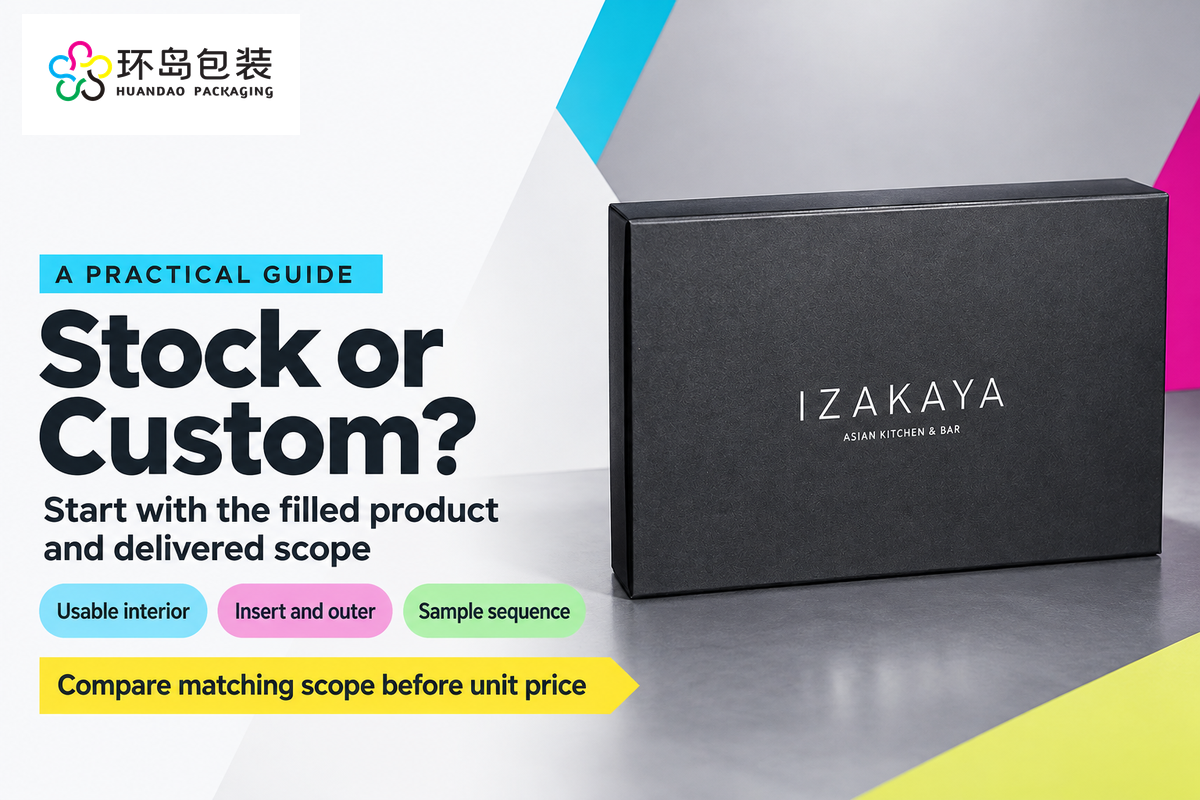
Buy stock magnetic boxes if an available interior fits the loaded product and delivery timing takes priority over structural changes. Choose custom magnetic closure gift boxes if the insert, opening action or printed presentation needs a different design. Compare the approved filled sample to the delivered scope before you compare headline unit prices.
Where can I buy bulk gift boxes with magnetic closure?
Buy bulk boxes from a stock packaging merchant for the available size or work with a manufacturer for the specified structure and insert. Send the product envelope, packed quantity, surface brief and destination with your inquiry. Are boxes sent to you assembled? Is the quote for the insert and protective outer also included?
A shop may use a plain stock box with a printed sleeve or decorative ribbon while gauging the demand for a gift-giving occasion. A ribbon bow should leave the opening grip accessible. For a business launch with a number of products, a custom insert may organize the collection without the need for a different outer shape for each set.
Request the sample sequence, artwork approval point and production timing together. A short delivery promise may assume approved artwork or available stock; changing the design later changes the planning basis. If you ship by air, have the forwarder check the actual packed-carton arrangement and route rather than infer shipping requirements from the word “magnetic.”
We manufacture printed paper packaging at our Huandao facility in Xiamen. For a structure, insert and finish discussion, please see our custom magnetic closure gift boxes solution and bring the filled product brief. Use the approved sample as reference for subsequent production checks.
What Is Changing in Magnetic Gift-Box Design?
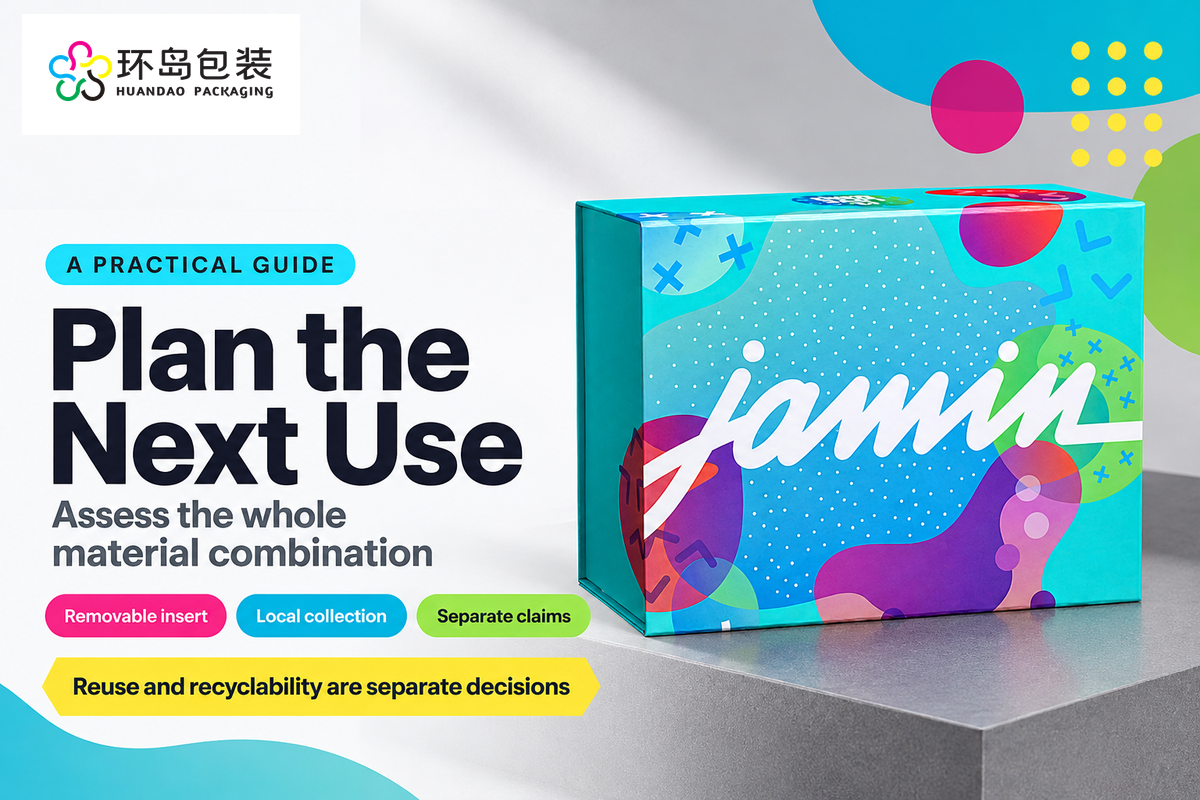
Examples of magnetic gift-boxes show how designers can make presentation choices that affect end-of-use material recovery. There are alternatives for paper structure that give designers different options, but each completed pack has to be assessed for its intended recovery route. Paper with an exterior coating isn’t the whole material combination; the rest includes inserts, adhesives, and magnets.
Cepi’s version 3 recyclability laboratory method, finalized in February 2025, describes some criteria for the characterization of rejects and adhesion of sheets. This provides a design question: what happens to the total material combination in the conventional paper mill process?
Trade reporting offers concrete examples rather than a universal direction. Packaging World’s Heat/Delta Global report describes a magnet-removal design. A later HejBuddy/Metsä Board microflute gift-pack example explores another paper structure; it isn’t evidence that a microflute pack performs like every magnetic rigid box.
Reuse potential is dictated by contents and volume of storage. A box with an accessible lid can hold keepsakes, but a formed bottle holder may restrict flexible later use. A minimal removable insert is still helpful, provided it supports the product. Evaluate the trade-off before putting permanent mixed-material decorations.
For marketing, distinguish recycled content, intended reuse and recyclability. The FTC Green Guides summary says US recyclable claims need qualification where appropriate facilities are available to fewer than 60% of consumers or communities where the item is sold. To clarify, contact the relevant collection program regarding the finished pack, and its separable components, before printing disposal instructions.
Frequently Asked Questions
Are magnetic gift boxes reusable?
Yes, an intact box can be reused when its structure and insert suit the next contents.
Check the hinge, wrap and closing surfaces before using it again. Remove loose accessories that obstruct the flap, and avoid loading a presentation box with heavier contents simply because it still closes. A removable insert makes it easier to change the use, but should remain fitted when it’s needed to support the original product. Store the box dry and unloaded.
Can I add a logo to a stock magnetic box?
Often yes, through a suitable printing service, applied label or separate sleeve.
Confirm the proposed method on the existing surface before placing the order. A laminated glossy lid and an uncoated paper wrap don’t behave identically during printing or adhesion. Keep the logo clear of the opening grip and moving fold. Approve a finished sample with the intended artwork size so its position, edge detail and color are evaluated together.
Do magnetic closure gift boxes need a ribbon?
No, a correctly specified magnetic closure can hold the lid without a decorative ribbon.
Add ribbon for the intended presentation or as a designed pull feature. Check its path on the filled sample because a bow trapped between the flap and front panel can interfere with mating. A ribbon used to lift an insert also needs an attachment appropriate to that task. Its decorative appearance says little about how much load the attachment can carry.
Can I repair a damaged magnetic box?
Minor cosmetic damage may be repairable, but structural or detached-component faults need supplier assessment.
Keep a loose magnet away from children and stop using a box with a detached component. Adding glue or another magnet can change the closing gap and damage the finish. For a production batch, retain the faulty sample and the approved reference.
What is the fastest way to order a small quantity?
Start with an available stock size and a simple decoration method.
Check stock, decoration time and the shipping destination together. A flexible artwork brief may help, but verify fit with the intended product before buying the batch.
How does a magnetic box differ from a ribbon-tied box?
The magnetic box closes through attraction at a mating panel; the ribbon-tied box relies on the specified tie arrangement.
A ribbon can be decorative on either construction. Compare the opening steps and repeated use with the intended receiver rather than judging the closure from a product photograph.
Are magnetic closure gift boxes recyclable?
They can be, where the local collection program accepts the finished materials and any parts needing different treatment, such as a concealed magnet or foam insert, can be separated.
Paperboard, a concealed magnet, a laminated wrap and a foam insert can require different treatment. Ask the local program which parts it accepts and how it wants them separated. A laboratory assessment of technical recyclability addresses a specified processing route; local collection access is another part of the decision. A recycled-content statement describes material origin. None of these labels automatically substitutes for the others. When writing instructions for a retail pack, describe the particular components and the destination market rather than promising the same disposal route everywhere. If the receiver is likely to keep the box, give useful reuse guidance without presenting reuse as proof of eventual recycling.
Preparing a product brief? Send Huandao the product and insert details, and we will discuss sample construction and finishing.
Statements in this section are based on the company information of Huandao. The diagnostic sequence is editorial guidance, and the costs are calculated based on the assumptions given. Job-specific dimensions and acceptance criteria are defined on the approved drawing and sample.
References & Sources
- Paperboard Packaging Council: rigid box industry terminology.
- University of Kentucky: range of the magnetic force.
- Lund University: paperboard folding thesis abstract, 2018.
- ASTM D5264-98(2019): public abrasion-test scope.
- ISTA: test procedure families.
- US Forest Service: paperboard behavior in changing humidity, 1986
- Mississippi State Extension: product pricing and break-even concept.
- USPS: Priority Mail and Flat Rate service information.
- Cepi: recyclability test method version 3, 2025.
- Packaging World: Heat/Delta Global fashion mystery-box design.
- Packaging World: HejBuddy gift box using Metsä Board microflute.
- FTC: environmental claims summary of the Green Guides.