Get in Touch with Xiamen Huandao Packaging Technology Co., Ltd.

Updated October 2026
Custom Counter Display Boxes help organize small products for display in a branded countertop fixture. Plan assortment, retailer space, shopper message, and a refill routine, and then test a few in the field before widely deploying.
A product display can look great when it’s full, but awkward after a few purchases. This guide covers decisions behind a usable retail program, from format selection to cost comparison of displays that actually touch the counter.
Key takeaways
- Choose custom printing when the campaign needs a specific fit, message or assortment.
- Check the external footprint and the internal product arrangement separately.
- Test full, half-full and last-unit conditions before approving production.
- Include delivery and store labor in the budget, then divide by usable placements.
What custom counter display boxes do in a retail program
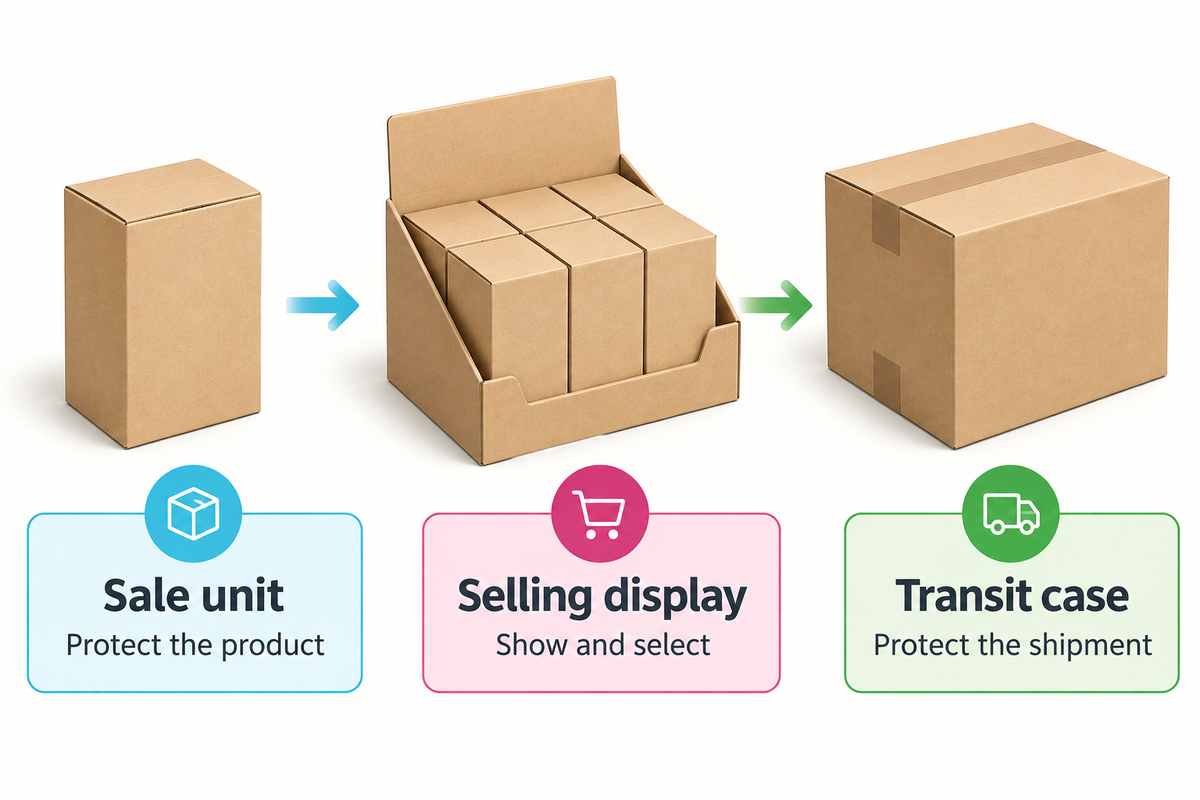
Use counter display boxes to group sale units in a manner that allows the shopper to see and select them. A counter display has several jobs. It holds the assortment in an accessible manner and has a short message. Individual product packaging protects the sale units. A transit case may be needed to get the display to the store.
Consider three roles for packaging. The first is the carton a shopper buys. The second is the display from which the shopper picks, and the third is the case that transports the carton through the supply chain. A package may perform two or all three of the roles. Some structures combine these roles. A separate transit configuration may be specified even when the selling display has a fold down header.
- Point of purchase: help shoppers recognize the product and compare variants.
- Point of sale: keep checkout access, prices and the sale unit’s barcode usable.
- Distribution: specify how the packed display is protected and handled before opening.
For custom packaging projects, choose the packaging solution after separating the packaging roles. The broader retail display box formats include options beyond the counter, including floor displays. If the main requirement is delivering a pack and converting it to a selling fixture, start with and explicitly define the route for PDQ display packaging.
Custom printed displays, stock trays or reusable stands?
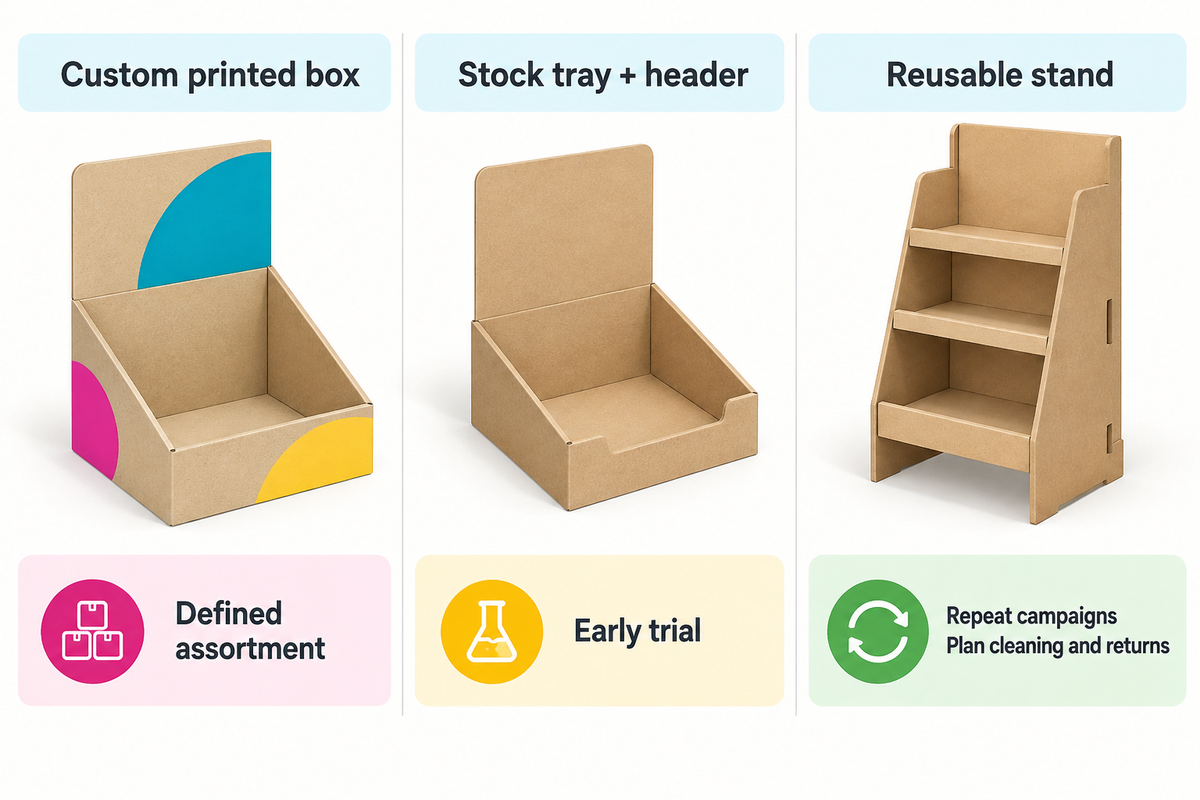
Choose the format that changes with the campaign. Custom printed display boxes work with a limited assortment and message. Stock trays can support an early test. Reusable display stands can be used for repeat campaigns, when cleaning, storage and return handling are practical. With retail brands, a longer estimated life leads to different operating work, rather than a better value. Cost comparisons also need a common scope; Leader Display’s supplier guide lists structure, printing, quantity and shipping among the inputs.
| Decision | Custom printed box | Stock tray + header | Reusable stand |
|---|---|---|---|
| New assortment still changing | Delay the final dieline | Useful for testing arrangements | Check adjustable dividers |
| Unusual product shape | Specify custom inserts | Check stability without modification | Allow for fixture development |
| Short seasonal message | Print campaign graphics | Replace the header | Use replaceable signs |
| Frequent assortment changes | Review leftover printed stock | Keep tray and sign separate | Confirm adjustable compartments |
| Tight retailer footprint | Design within the approved space | Accept available sizes only if they fit | Include feet and projecting parts |
| Small regional trial | Compare setup and minimum order | Often worth quoting alongside custom | Account for each store’s fixture cost |
| Repeated wiping | Validate the specified finish | Check exposed edges | Agree a cleaning method |
| Store assembly capacity | Time the actual fold-and-fill task | Test header attachment | Check tools and instructions |
| Campaign end | Plan component separation | Retain usable trays if appropriate | Assign return, storage and repair |
Let’s consider an illustrative example. Illustrative launch: A snack brand is experimenting with two flavors in a limited test in a small regional chain. The company wants a custom shape to represent the pouch artwork. Store managers still have to decide the counter position, and the second flavor may change after the test. Ordering custom printed boxes now would fix the brand in an uncertain situation. A stock tray, with a replaceable header, allows the team to observe removal and refill work first. If the test shows a stable assortment and a useful position in the retail store, the next order can justify a custom display. The decision depends on the tests and observation, rather than custom printing looking better.
Plan assortment and countertop layout together
Discuss custom sizes only after determining the available space. Set the product mix and the space together, and then adjust both using a physical sample. Measure the packed products, the external display footprint, header height and the space for a shopper’s hand. An arrangement that fits geometrically may not fit when a customer removes an item, or an employee adds an item in the back.
Assortment and shelf space are complementary elements of Hübner and Schaal’s retail optimization research. Considering them simultaneously supports their argument, but doesn’t demonstrate a general rule for countertop display boxes. For a case in point, a cosmetics display may require different facings, even within a product family, for a narrow neck bottle vs. a wide carton.
How many products can a cardboard counter display hold?
There’s no fixed unit count: usable capacity depends on sale unit, internal dimensions, dividers and removal access. Give the supplier packed samples and the retailer’s external size limit. For an illustrative three-variant assortment, if we assume that each variant is made up of eight units, then that gives us a total of 24 units, but this number is just a planning figure until a loaded sample is available to confirm if the assortment can be properly displayed and is handled adequately.
Don’t define the outer box dimensions as usable product space. Allow for thickness of walls and folds. Allow for custom inserts; to test stability, check product weight, especially if a beverage display or tall bottles create a heavy, unstable load above the base.
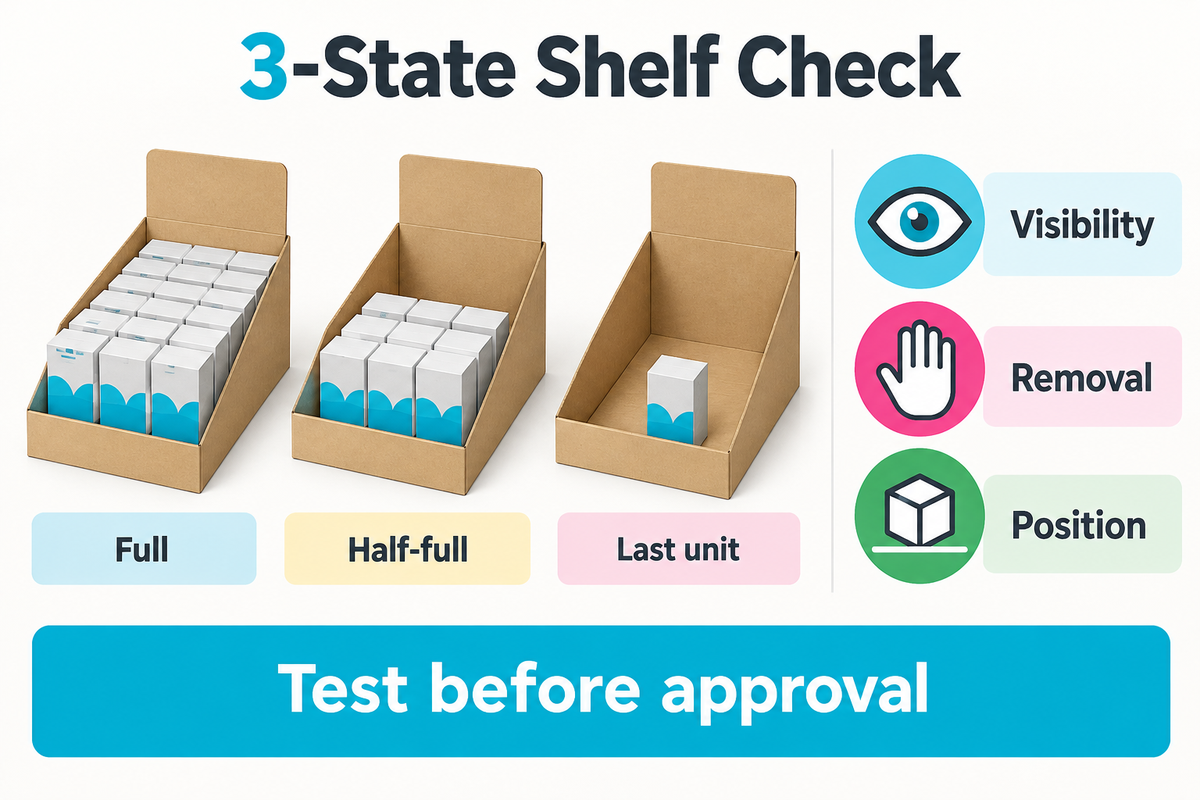
3-State Shelf Check
Be sure to examine a display full, half-full and with one unit left, paying particular attention to visibility, removal and positioning of the product in each case.
| State | Check | Observation to seek | Response if it fails |
|---|---|---|---|
| Full: 24 units | Visibility | Each variant and its price can be identified | Reduce header or front-wall obstruction |
| Full: 24 units | Removal | The front item lifts out without dragging another | Change clearance or divider spacing |
| Full: 24 units | Position | Products stand without bowing the front | Review load and support with the converter |
| Half: 12 units | Visibility | Remaining variants are still distinguishable | Move identification onto a fixed visible area |
| Half: 12 units | Removal | Rear units remain reachable | Shorten the reach or change the layout |
| Half: 12 units | Position | Units do not fall into an empty neighboring lane | Test a divider or narrower lane |
| Last: 1 unit | Visibility | The final unit is visible from the shopper approach | Review front-wall height |
| Last: 1 unit | Removal | The shopper can grasp it without lifting the tray | Revise the opening and grip space |
| Last: 1 unit | Position | The remaining item stays in its intended lane | Adjust restraint without making refills awkward |
Illustrative depletion problem: a personal-care launch opens with three equally stocked variants. The most popular sells first leaving the center lane empty. A photo of the full custom cardboard counter display wouldn’t show the other cartons tipping into that empty center lane. Adding a divider may prevent tipping, but a too tight fit could slow down refills. Therefore, the sample review would involve testing product removal, changing the divider and evaluating the additional handling. Marketing gets a clearer presentation. Operations has to decide if the work to refill is acceptable. If it’s not, a different lane arrangement or fewer variants may be the better solution.
When evaluating POP displays, describe the refill method in your brief. Dispenser boxes require a usable removal opening. A display rack may require a different loading method. Test those before selecting a method for products in retail.
Choose customization that helps shoppers buy
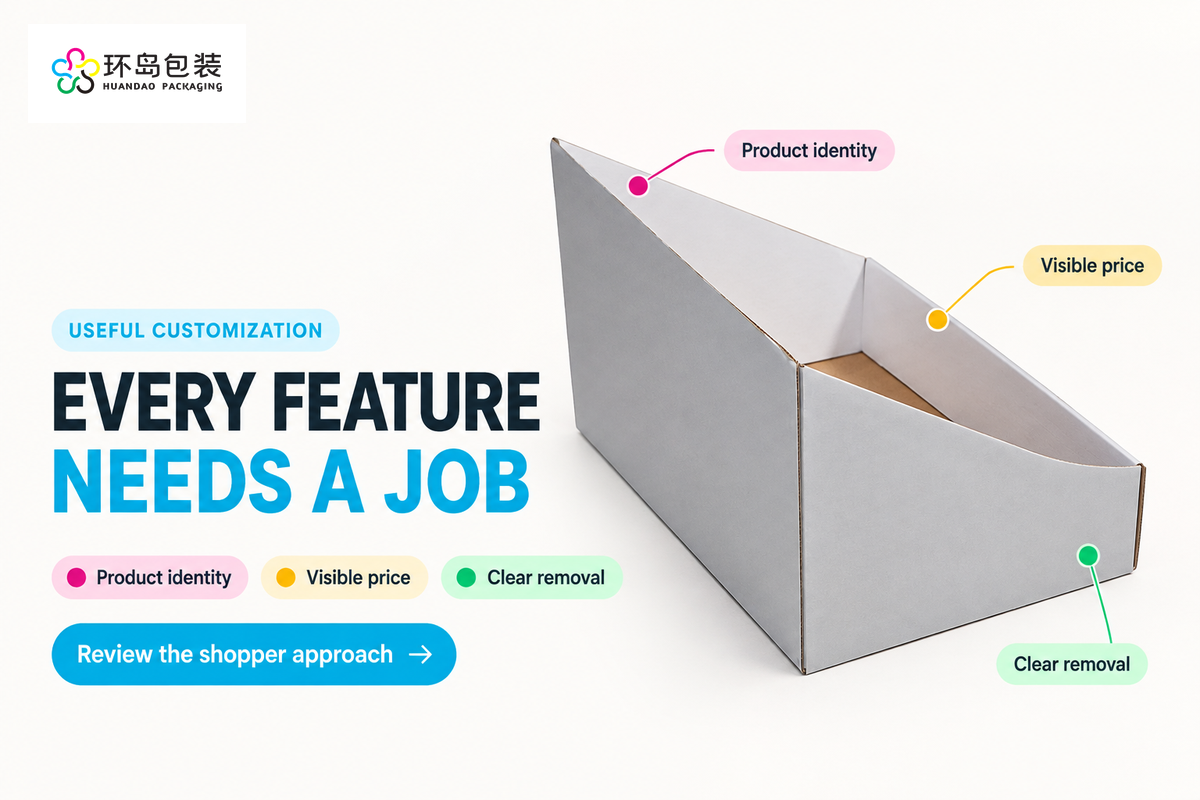
A customizable structure should showcase products clearly. Every custom feature should have a job. Printed content and graphics should identify the product, explain the immediate reason to consider it and help recognize variants. Structural features should help improve fit, product visibility or removal. Create displays around those requirements before adding decorative cuts, finishes or larger headers. Graphics that stand out on shelves can still be difficult to read from a crowded checkout queue; review the actual approach.
- Lead with the product: show what the item is at the distance shoppers approach.
- Make selection clear: use product information to separate flavor, size or use information from the main brand message.
- Keep buying information usable: leave a visible price position and an unobstructed route to the sale unit.
Custom boxes with a branded display header can carry brand identity without repeating every detail from the packaging boxes inside it. For a custom cosmetic launch, the header may identify the range while lane labels help differentiate variants. Custom cut lines and holes should help to support the product or improve removal.
Barcode design needs its own check. GS1 US guidance provides information on barcode design, quiet zones and full barcode height. A decorative barcode on a display shouldn’t take the place of a functional barcode on the product being sold.
Match display materials to the campaign conditions
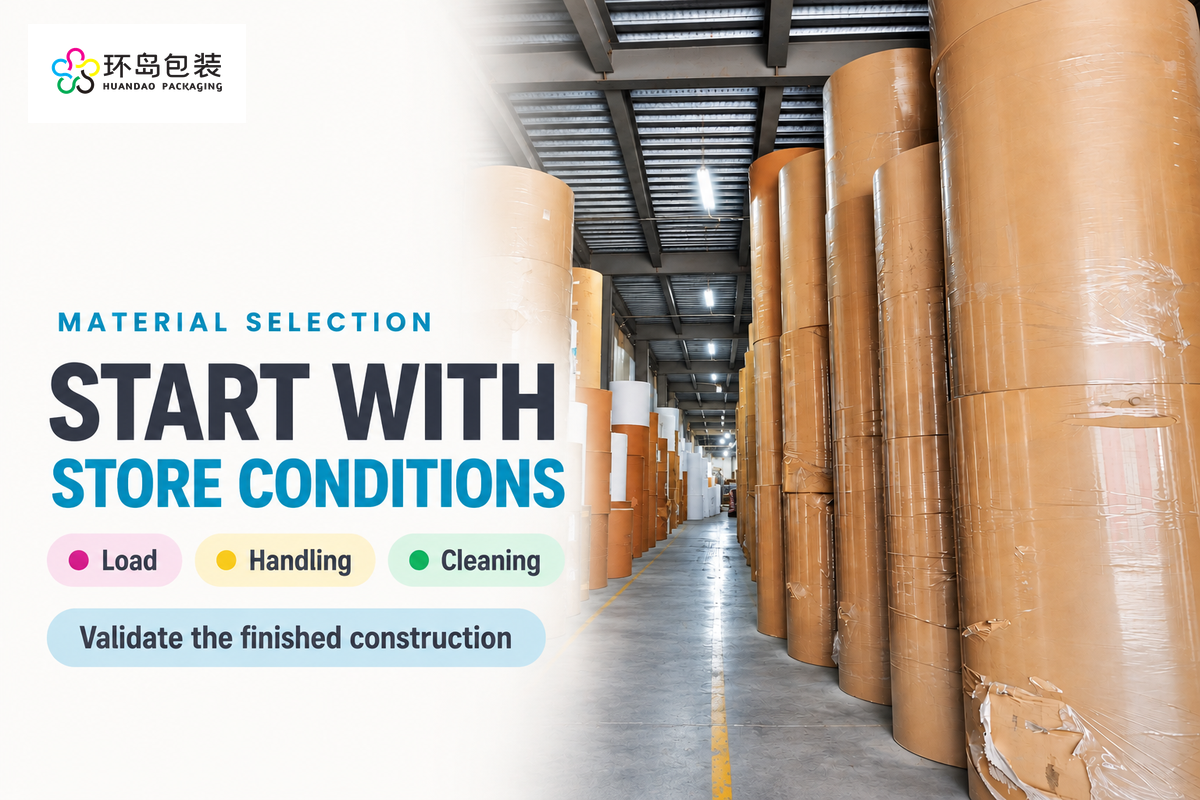
The actual load, method of handling and expected exposure should determine the chosen material and finish. A lightweight promotion and a repeatedly refilled countertop display may need different constructions. Ask the converter to evaluate the condition of the packaged products and the anticipated service conditions; “cardboard” doesn’t determine strength and service life.
The fluted board used in some corrugated counter displays can give it structural depth. Folding paperboard can suit other formats and print requirements. For a corrugated display, grade, geometry, support, and assembly all need to be analyzed. Even durable corrugated cardboard needs a proper design for the loading case. Use the details found in cardboard counter display construction to see which options are available once the retail and point-of-sale plan is determined.
Do: Check that the finish holds up to the store’s routine for handling and cleaning.
Avoid: Assuming a glossy sample or heavier board automatically means the display will stand up to store handling.
Keep sourcing and disposal claims separate. FSC labels describe sourcing categories; they don’t establish that every finished display is locally recyclable. The FTC’s environmental claims guidance also cautions against broad, unqualified claims such as “eco-friendly.” With materials like cardboard, ask for the complete construction and the retailer’s collection route before approving such artwork.
Budget for deployed displays, not just printed boxes
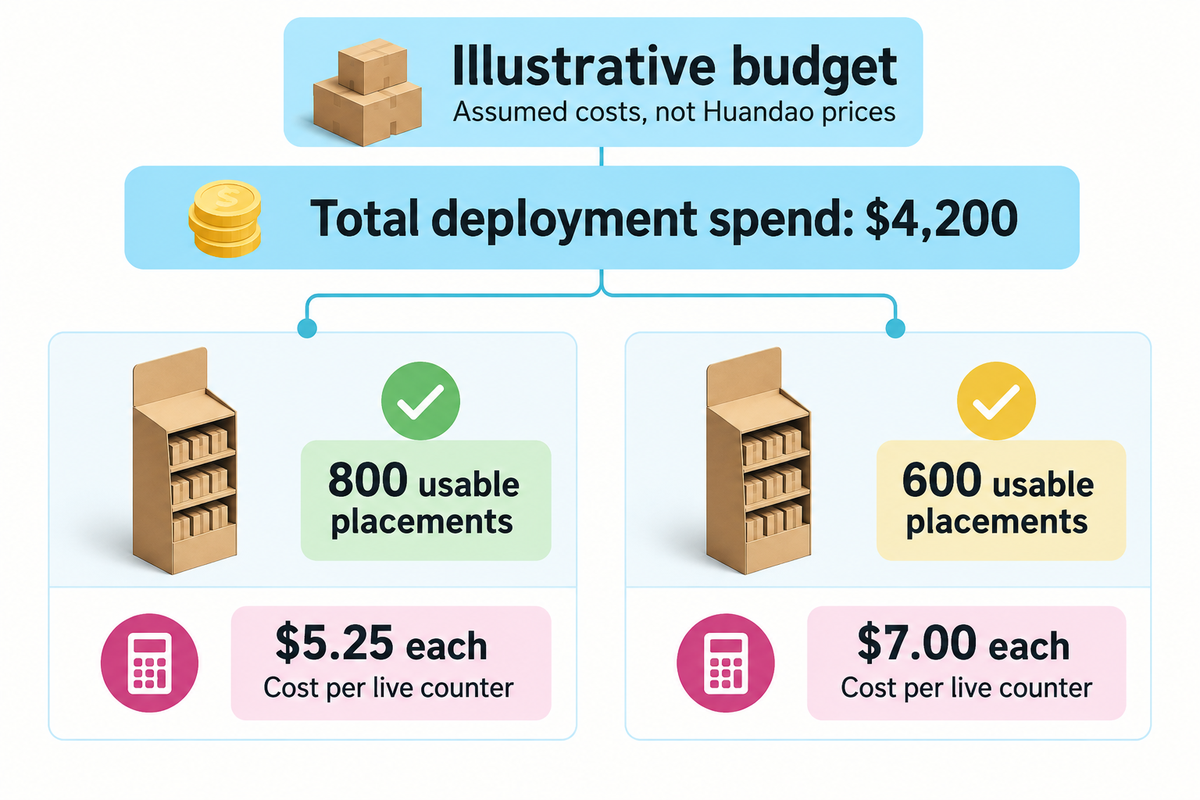
Make sure the total deployment spend reflects the actual displays that have been installed and are in use. Be consistent when including costs for display quotes, setup, distribution, and store labor. Finished displays that are sitting in a stockroom and can’t be used because store space isn’t available to accommodate them, are an extremely expensive waste of marketing funds.
Execution losses are measurable. Zeng, Agarwal and Stamatopoulos’s 2024 study examined about 15,000 displays across ten campaigns at one major retailer: 29% never reached the sales floor. This historical sample is evidence to track placement, not a forecast for your campaign or for cardboard display boxes specifically.
| Item | Assumption | Cost |
|---|---|---|
| Printed displays | 1,000 × $3 | $3,000 |
| Setup | One campaign | $400 |
| Distribution | Campaign allocation | $600 |
| Store labor | Campaign allocation | $200 |
| Total deployment spend | Sum of these four items | $4,200 |
| 800 usable placements | $4,200 ÷ 800 | $5.25 each |
| 600 usable placements | $4,200 ÷ 600 | $7.00 each |
Cost per live counter = total deployment spend ÷ installed, usable displays. This measures deployment efficiency. It isn’t a profit or return-on-investment calculation; those require incremental margin and other campaign costs.
- Ordered → delivered: record shortages, damage and misrouted shipments.
- Delivered → installed: record approval, space or assembly problems.
- Installed → usable: record missing stock, hidden prices and structural failures.
When quoting display boxes wholesale, match order quantities, versions of artwork and delivery terms before comparing wholesale rates. Assign each failed unit to its first failed stage so the same loss is not counted twice.
Illustrative budget decision: finance approves the $4,200 scenario expecting 800 usable placements. During store prep, only 600 locations confirm space and staff availability. Although the purchase price doesn’t change, the deployment cost increases from $5.25 to $7.00 per live counter. Buying a less expensive finish would only solve part of the issue. The team investigates if other stores can use a smaller footprint, simpler assembly or later delivery. This would allow them to revise the rollout quantity or phase deliveries. This connection helps procurement understand why displays are placed in stores, as opposed to just taking a factory invoice to determine the total cost for a campaign.
Run a small store trial before rolling out
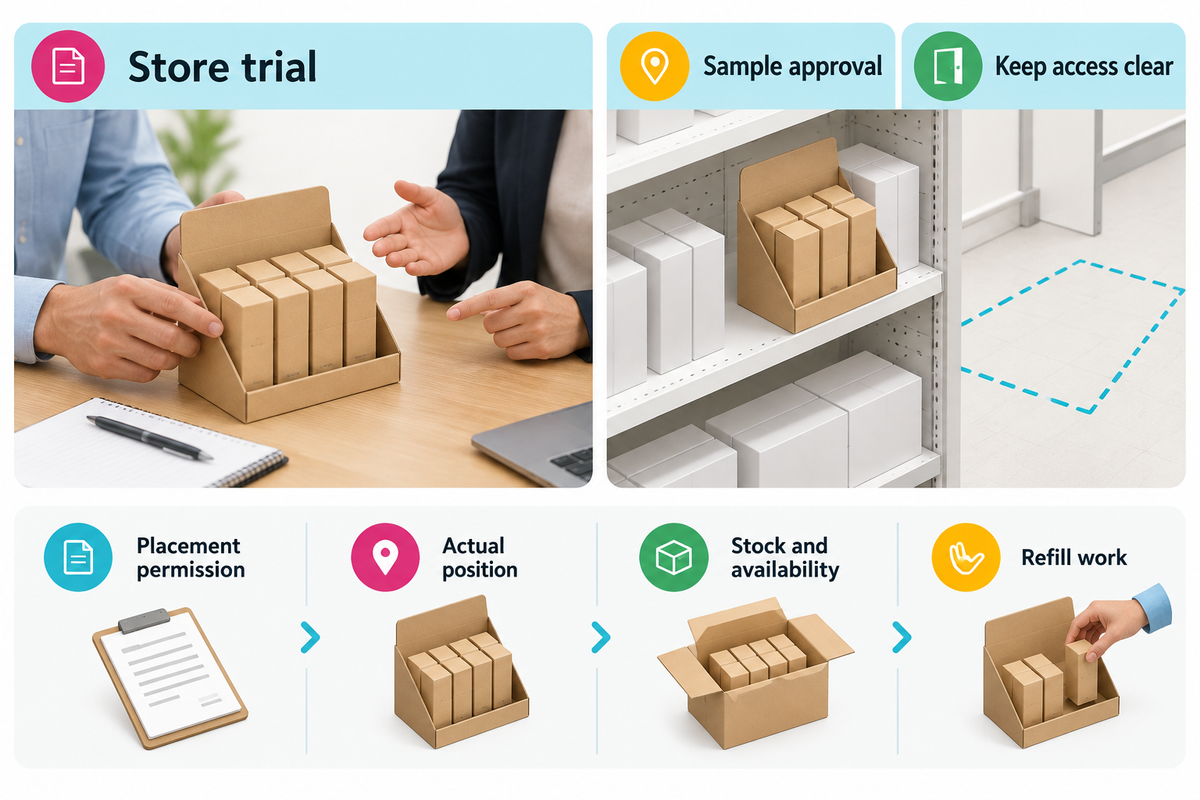
Undertake a small trial to locate handling and placement issues prior to launching a major campaign to more retail locations. Observations can be allocated to store management, brand and finance owners. Trials can highlight awkward refills or concealed prices. A trial can reveal an awkward refill or hidden price quickly; deciding whether the display can boost sales profitably needs a more deliberate comparison over a suitable trading period.
As an example, three stores over a period of seven days can provide an initial commissioning check. Those figures are meant for illustration and not for validation. The following can be recorded during each visit.
- Planned and actual position, with a photo and installation date.
- Opening stock, deliveries, closing stock, units sold and unavailable hours.
- Assembly and refill minutes, damage and store comments.
- Price, promotion and assortment changes that could explain sales differences.
Prolonged sales observations can cover relevant trade cycles and be compared to baseline or matched stores. Track category sales and margin as well as the displayed item. A display can shift purchases between items in a category. Areni, Duhan and Kiecker’s wine display experiment showed brands that were featured lost sales and competing regions that weren’t featured gained sales.
A 2009 field experiment in two Icelandic supermarkets checked product display and supply daily. Use those controls as practical trial lessons. Confirm that the display is present and stocked before interpreting changes in sales.
How do I get a counter display approved by a major retailer?
Learn how the retailer currently evaluates and approves displays before locking in the process. With the requested format, submit the proposed pack, display, external dimensions, artwork and how it will be assembled. Identify who approves the sample and who authorizes placement in the store. A supplier’s successful production sample is not the retailer’s permission to install it.
Service access must be maintained. The US Department of Justice accessibility primer says that, if part of a route is obstructed by merchandise, that route is not usable. Don’t assume a limit on display height is universal. Ask the retailer to confirm placement for the actual store layout.
Keep counter displays useful after the first refill
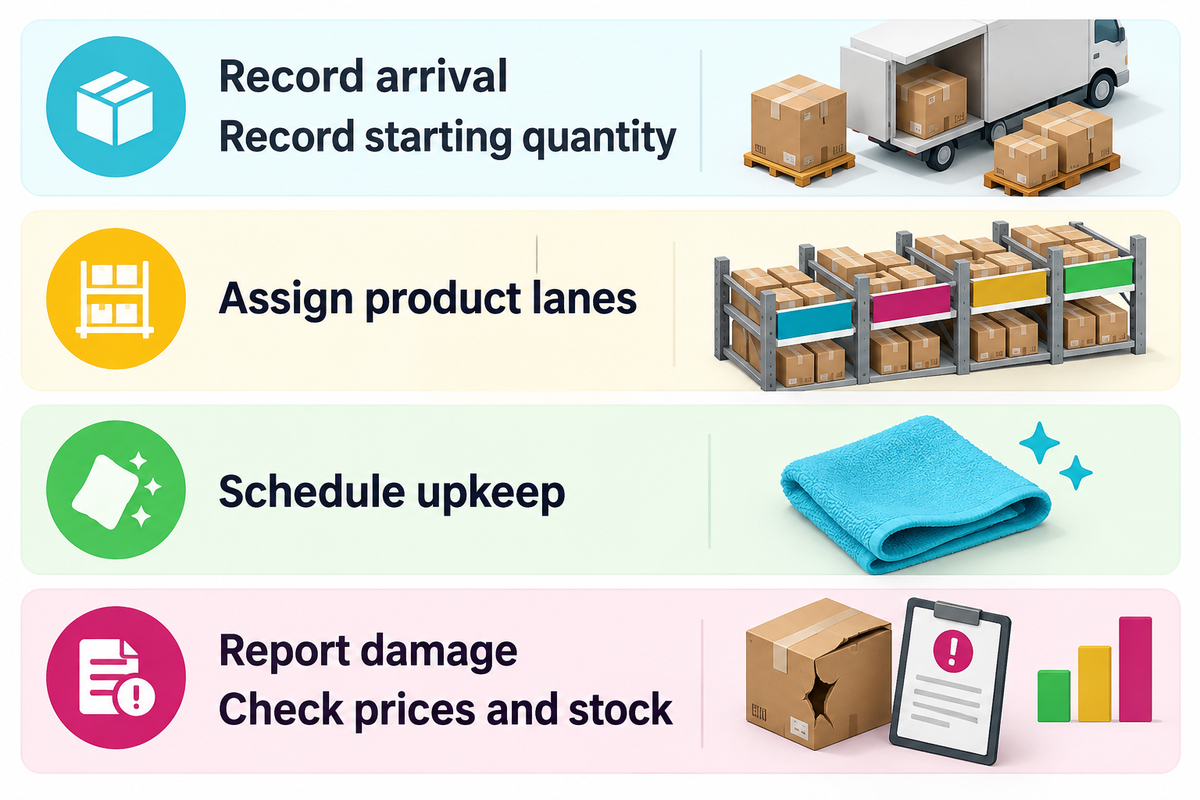
Agree who controls and adjusts the display. Decide what stock belongs in which lane. Determine what will trigger sales staff to call for a restock. Calibrate to expected demand and time until the next visit. Staff must have a clear path to report damaged display units, missing prices and variants that repeatedly run out.
The regular check should not be burdensome. Gabe Trahan’s NCPA store-display checklist recommends recording display arrival and starting quantities, checking and rotating dated stock.
“Put the display on a weekly dusting and straightening schedule.”
Schedule a quicker check if the store conditions call for it. When checkout staff repeatedly move the box to create working space, revisit the location or format. A different placement or shelf-ready display arrangement may work better than insisting on a busy counter.
Turn the retail plan into a supplier conversation
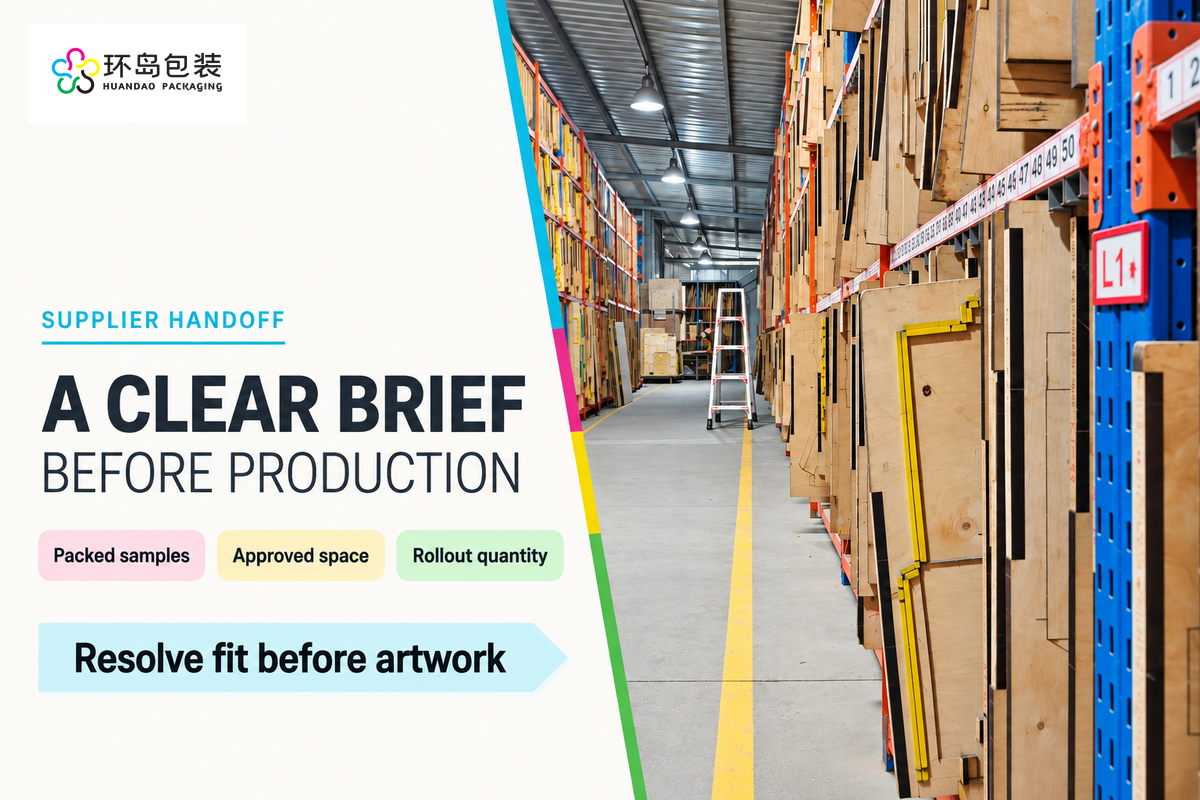
Describe your packaging needs and give the supplier enough information to propose a structure for the intended program. Start with the actual products, approved space, quantity by version and delivery route. Then discuss the range of custom print and finishing options. A concise retail brief helps separate a product-fit issue from an artwork preference or a store-handling issue.
| Brief item | Provide | Resolve | Owner |
|---|---|---|---|
| Products | Packed samples, weights, variant mix | Fit and removal | Product team |
| Retail space | Approved footprint and position | Header and access limits | Retail operations |
| Campaign | Quantity by version and rollout dates | Run size and delivery sequence | Procurement |
| Handling | Flat or filled route; refill plan | Assembly and transit configuration | Logistics |
| Artwork | Files, price area and required claims | Proof and finishing approval | Brand team |
| Acceptance | Loaded sample and trial observations | Changes before production | Program lead |
Xiamen Huandao Packaging is the brand behind this guide. Check out their custom counter display boxes page for their current terms and manufacturing options, then send your retail brief for discussion.
Ready to discuss the structure? Send your product samples, counter dimensions and rollout quantity for the discussion. This will help situate the store conditions for the initial discussion.
Frequently asked questions
Can I order counter display boxes in a small quantity for one region?
Although small runs may be possible, the minimum quantity for display packaging boxes will depend on the structure, print route and versions. To assess the benefits of custom display boxes for a regional trial, compare a stock tray with a printed header and a fully custom structure, including setup and sample costs.
Do counter display boxes ship flat or already assembled?
Both arrangements are possible. It depends on who assembles and fills the display and how it is transported to the store. Flat packing saves space occupied by empty display units, but leaves assembly downstream. A prefilled display needs its transit configuration assessed separately; an attractive open tray does not prove a loaded pack will make it through distribution.
Can I get a display sample before full production?
Ask what each sample represents. A blank structural sample can be checked for fit and assembly; a printed sample helps assess graphics. Either sample may or may not reflect the final production finish and transport performance. Huandao has stated that it will provide a set of free, blank structural and digitally printed samples, with the buyer paying the courier costs, while finished press samples will cost. Find out which sample route will apply to your project.
What finishes can be applied to counter top display boxes?
There are many options available. These include coatings, laminations, foil, or raised features. Select against glare, and handling and cleaning conditions, and finally approve the finish on the substrate.
Are cardboard counter displays recyclable?
Yes, after the local collection and recycling system accepts the finished construction. Other materials such as films, window layers, coatings, adhesives, and attachments can affect final disposal decisions. Be sure to get a list of components and disposal instructions, and check the retailer’s local collection route. A paper-based structure or sourcing label alone does not mean the finished unit belongs in the paper recycling stream in all stores. During the trial, observe what employees remove, where they place it, and if the process is practical. Use the observations to determine how to simplify the construction and include disposal instructions.
Can I also order custom inserts for my custom display packaging?
Inserts can also separate variants or support unstable items. Test the removal of the inserted item with partially empty lanes. A snug fit may look good in photos, but inhibit shopping and refilling.
References and sources
Sigurdsson, Saevarsson and Foxall: supermarket product-placement experiment, 2009
- Hübner and Schaal: integrated assortment and shelf-space optimization, 2017
- GS1 US: placing barcodes on products
- FSC: sourcing label meanings
- FTC: summary of the Green Guides
- Zeng, Agarwal and Stamatopoulos: in-store display execution study, 2024
- Areni, Duhan and Kiecker: point-of-purchase displays and product choice, 1999
- US Department of Justice: accessible service counters and routes
- Gabe Trahan, NCPA: store-display checklist, 2018