Get in Touch with Xiamen Huandao Packaging Technology Co., Ltd.

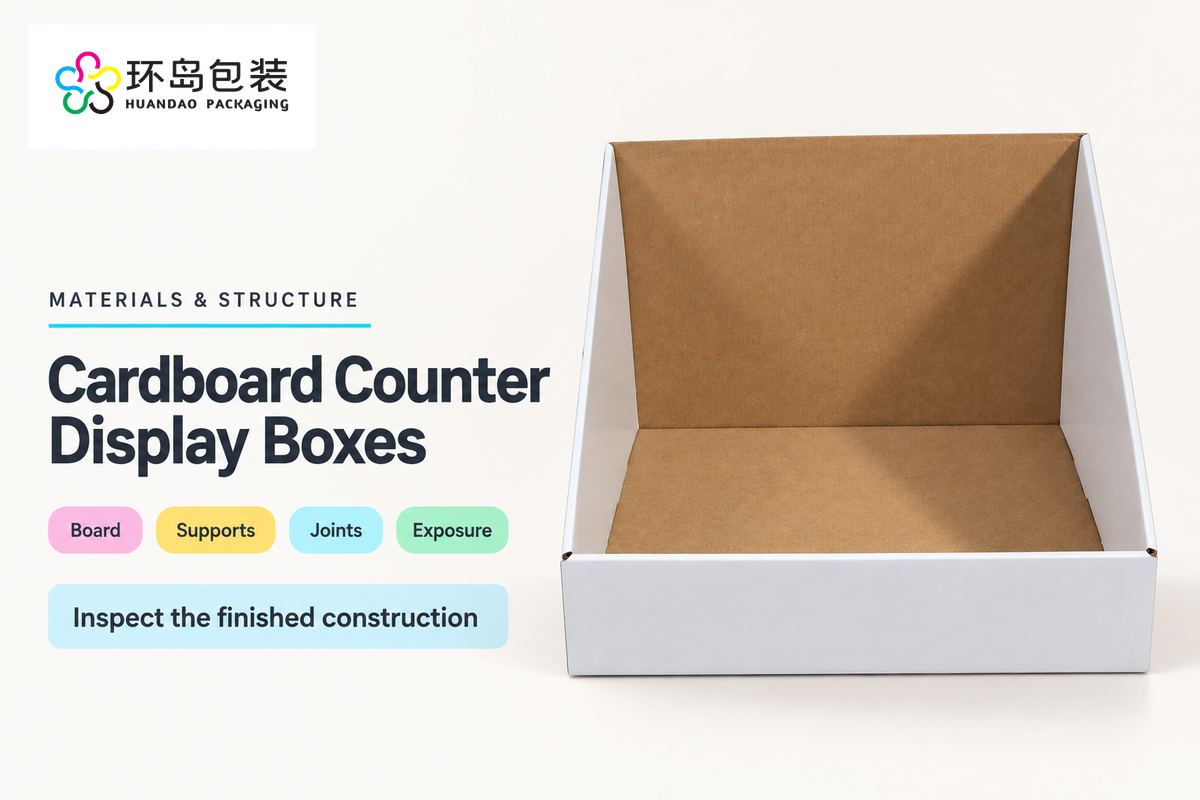
Cardboard Counter Display Boxes are open paper-based trays or small stands. Select the construction by following the product weight through the base, shelves, and joints. A flat tray resting on the counter requires a different construction from an elevated shelf carrying the same products.
Updated October 2026
Material selection at a glance
- Paperboard gives a compact, foldable blank; corrugated board adds a fluted layer between liners.
- Thickness, bending stiffness and edge-crush resistance describe different properties.
- Compare loaded samples with the same product arrangement, support and exposure history.
- Inspect the printed, folded construction before approving the production version.
What are cardboard counter display boxes?
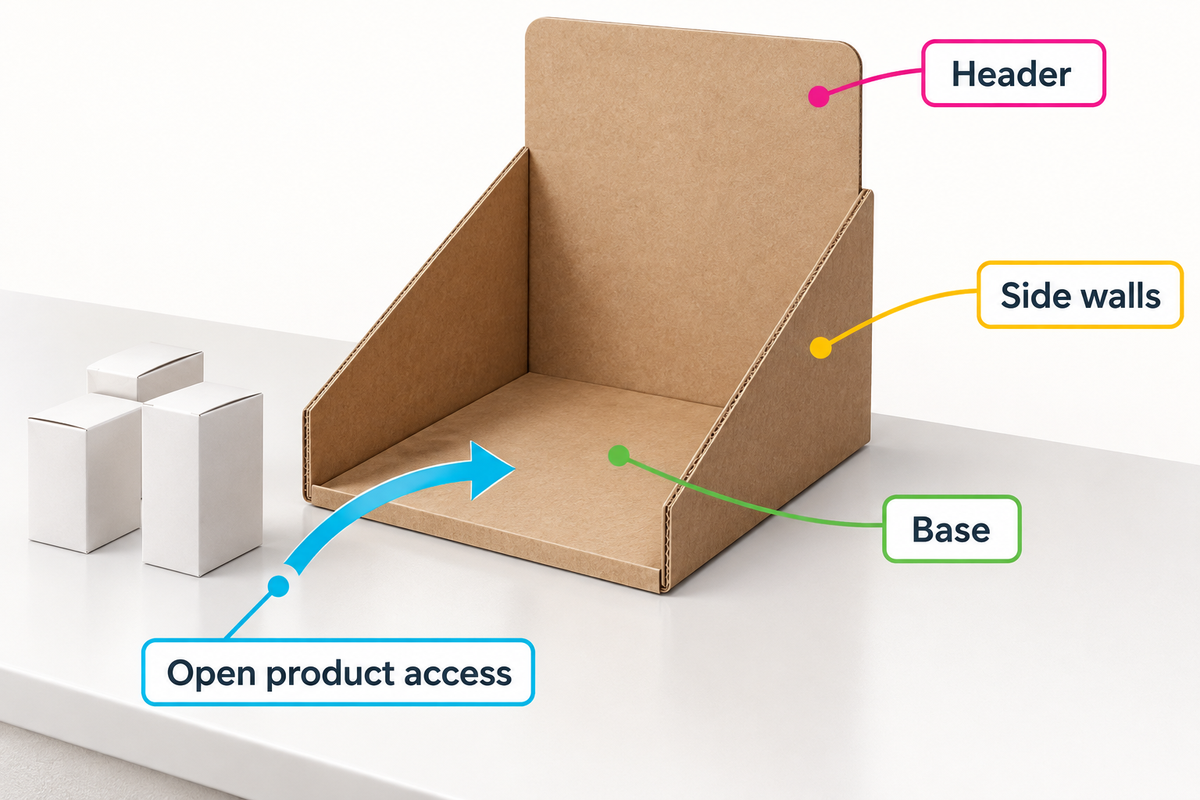
Retail counter display boxes are product holders with an open front or top. They’re usually placed near checkout counters. This point-of-sale format leaves merchandise accessible. The base carries merchandise and side walls and inserts organize it. A header can add a message above the products without enclosing them in a shipping carton. Check product visibility before choosing its height.
As with closed cardboard boxes, opened shapes also deserve their own inspection. Removing a lid or front panel also changes which edges and panels remain connected. A closed pack may have a continuous wall while the open product display may have only a low lip. Trace the structure in the position shoppers will use.
Small products also impose different local loads. A broad carton spreads contact across the bottom of the carton while a narrow bottle concentrates contact in a small area. Items of greater height also need support to keep them in place as well as a place to stand. A brochure pocket also has a different task: it needs to hold thin sheets while keeping its front accessible.
The selection of a PDQ display packaging format involves a separate decision on delivery. A floor display structure is a different case entirely. Neither should be picked based on a table-top mock-up.
Paperboard versus corrugated board for counter displays
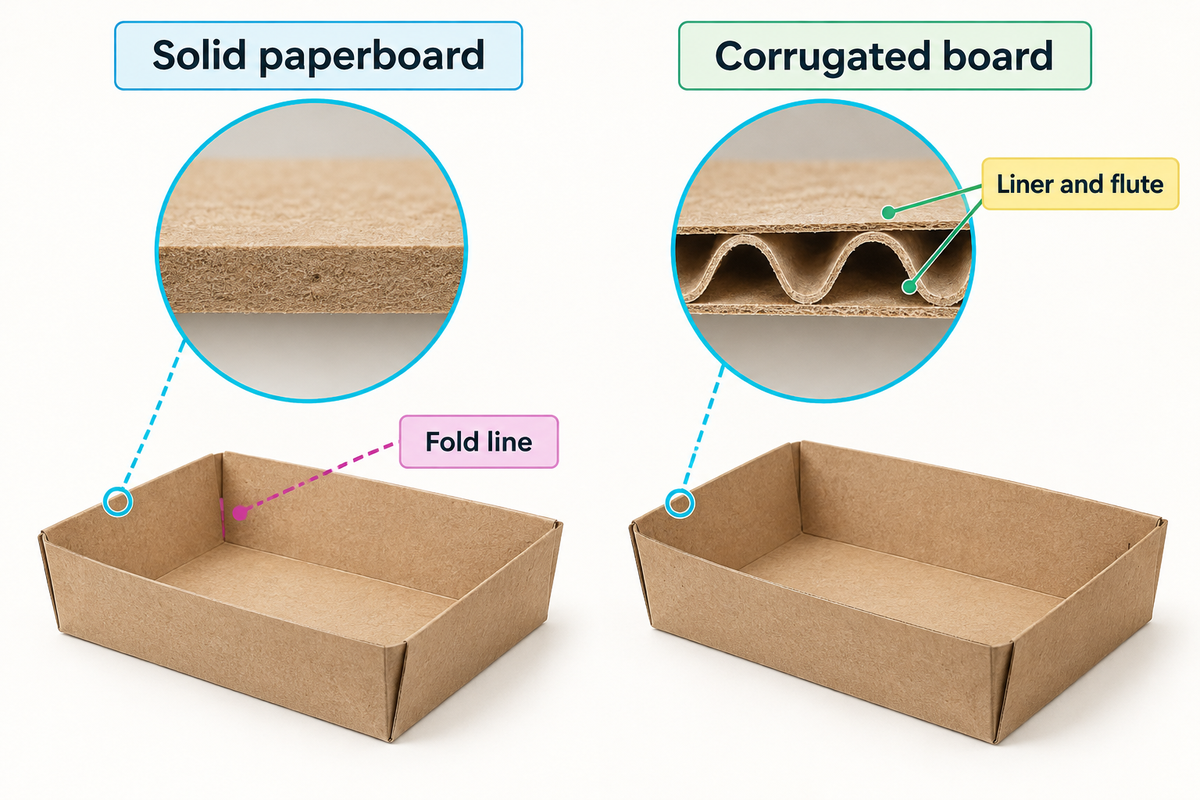
Paperboard is well suited to forming compact folded trays with detailed printed surfaces. Corrugated cardboard, on the other hand, provides a liner-and-flute construction for broader panels and supported tiers. Generally, product contact area and proposed shape determine the choice of material in counter display packaging. However, the family of materials remains a choice within the design, rather than a shortcut to its carrying capacity.
Solid bleached board, recycled board and kraft-based grades differ in their surfaces and converting behavior. Packaging Strategies’ comparison of carton substrates explains those distinctions. The practical specification includes the grade and finish, alongside the blank dimensions; “cardboard” alone leaves too much open.
Solid paperboard construction
- Inspect the fold line and printed surface together.
- Use the actual caliper when discussing crease tooling.
- Support broad bases where the design needs it.
Corrugated construction
- Record the liner and flute arrangement.
- Keep the board orientation identifiable.
- Inspect flute crushing at supports and folds.
Consider a cosmetic range with flat cartons and narrow bottles. A shallow tray may put the cartons over the counter. Raised bottles introduce a shelf span and contact points at their bases. Thus comparison of a shelf support or insert may prove valuable before changing all panels to a heavier stock.
A plastic insert may be used to separate products; however, its connection to the shelf base should be drawn before using it as shelf support. For individual product packs, cosmetic folding cartons should be measured in their filled condition so the display fits the finished pack.
Are cardboard counter displays environmentally friendly?
Paper-based displays can offer useful material-recovery options, but their environmental performance includes the complete construction and its disposal route. A removable plastic insert and an all-paper partition create different separation tasks. In this case, evaluate the board, coatings, and attachments together, then consider how the store handles the used displays. For a recyclable display, use a board-and-attachment combination accepted by the collector, and simplify any needed separation.
Follow the load through the base, shelves and supports
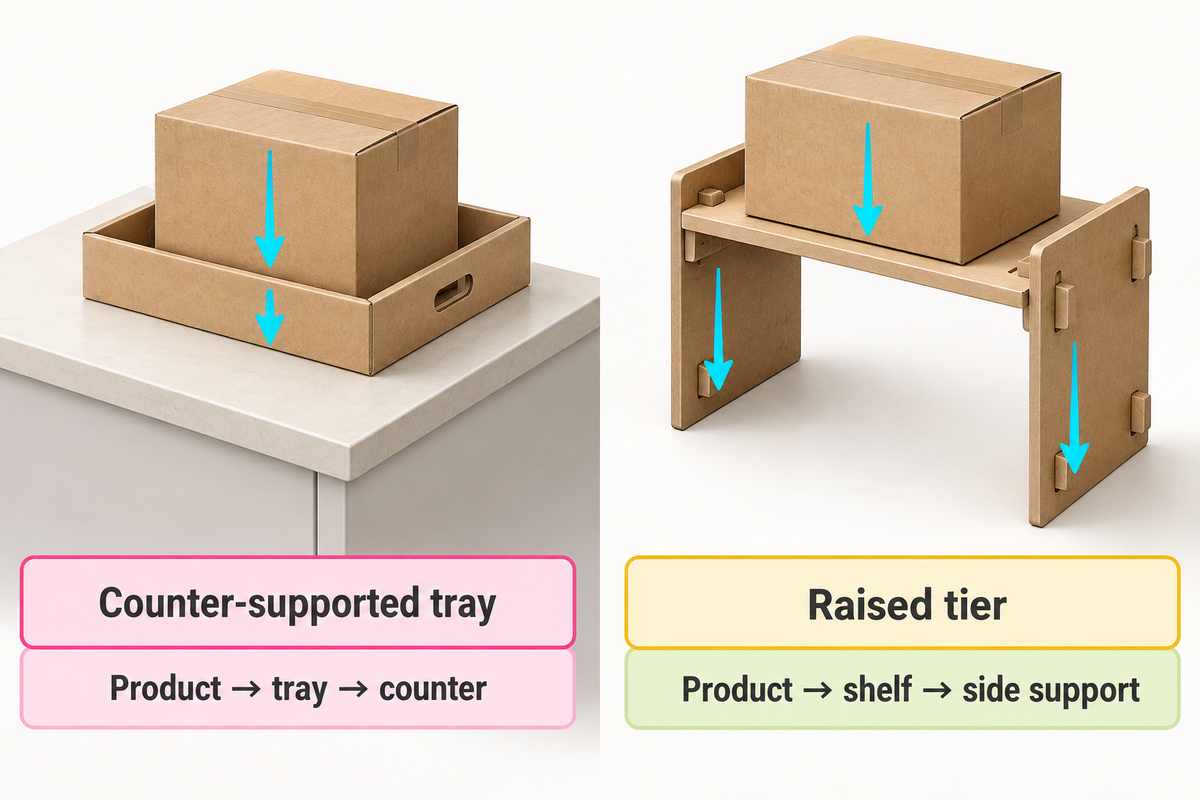
Weight is transferred to the counter from the merchandise through a connected path consisting of the support and the contact area of the base. Analyze that path before incorporating additional materials.
Assumed inputs: 24 packed products, each weighing 120 g. Product mass is 24 × 120 g = 2,880 g, or 2.88 kg. This is the merchandise mass, not a display load rating; the display’s own mass is additional. Changing the position of the products (from a lower to a higher tier) shifts the support problem, but doesn’t change the weight of the merchandise.
Locate the next prototype change by following the load path and identifying where the structure first bends, separates or loses support. Below are examples of such changes. These examples represent possible changes to be compared on samples, not automatic solutions.
| Structure or contact | Route to inspect | Candidate comparison |
|---|---|---|
| Counter-supported tray | Product base → tray → counter | Flat contact versus a rocking or uneven base |
| Raised tier | Product → shelf → side support | Existing span versus an added support |
| Wide shelf | Loaded middle → shelf edges | Support position before a whole-board upgrade |
| Divided tray | Partition contact with base and walls | Loose divider versus a connected support design |
| Narrow bottle bases | Small contact areas → shelf surface | Local pad or insert versus the original shelf |
| Tab-supported shelf | Shelf edge → tab → receiving slot | Seating and slot fit before changing stock |
| Glued corner | Connected panels through the bonded area | Joint construction and bond continuity |
| Uneven product arrangement | Loaded side → local support and base | Actual arrangement versus an evenly spread load |
There was a 2023 study of asymmetric corrugated boards where specimen orientation and the type of contact between the specimen and the support impacted measured bending stiffness. Retain both of these details in the sample record. Depending on which side of the board is presented, different liners can be in contact with the support and compressed during bending.
For a cardboard display stand with multiple tiers, examine each shelf connection. A counter shelf that overhangs its support creates a different bending arrangement. A stiff top panel can be supported by a poor tab connection. Additional thickness to the panel doesn’t improve the connection.
What thickness, flute and test values actually tell you
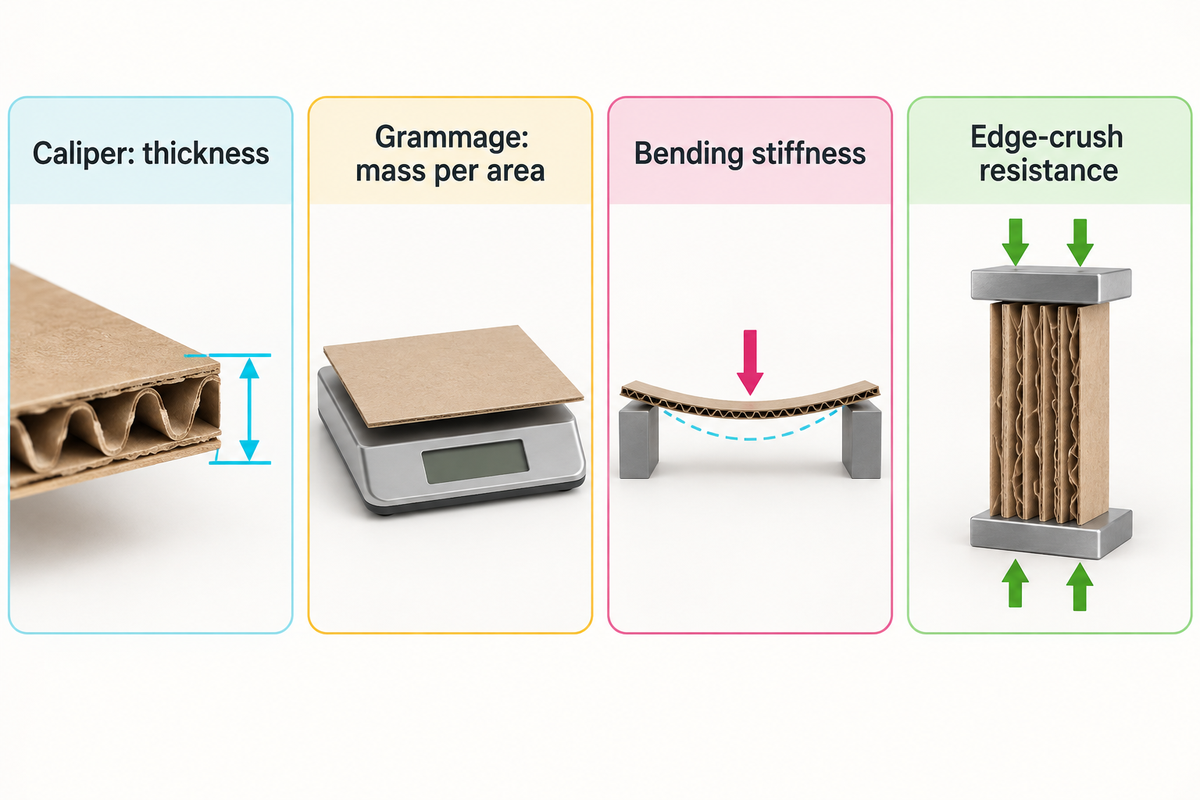
Caliper, grammage, and edge crush resistance are measures of thickness, mass per area, and a specific compression response, respectively. Bending stiffness is a measure of resistance to bending. Compare values of packaging materials in separate fields and connect them to the geometry of the completed counter display.
Grammage is written as g/m² or gsm and caliper is written in units of length (mm). A heavier sheet can have a different density and thickness from another grade. Tooling of the crease must match the board being converted so a stock substitution also requires a review of fold quality.
The FEFCO testing catalogue separates board measurements from packaging tests. It lists tests including edgewise crush resistance, water absorptiveness, glue-bond adhesion, and compression tests for packaging. A shelf load requires consideration of the assembled display shape and loading arrangement.
| Specification | What to record | Use in the comparison |
|---|---|---|
| Board family | Paperboard or liner/flute construction | Identify the material architecture |
| Grade | Supplier’s exact grade designation | Track material substitutions |
| Grammage | Mass per area in g/m² | Compare basis weight |
| Caliper | Thickness and measurement basis | Review fit and converting setup |
| Flute arrangement | Flute type and direction in the blank | Keep panel orientation consistent |
| Edge-crush result | Method, units and specimen conditions | Compare like-for-like board tests |
| Bending result | Direction, supported span and loaded face | Interpret a panel’s bending response |
| Assembled sample | Product arrangement, joints and environment | Observe the finished construction |
Custom sizes require more than outside dimensions. Usable dimensions of interior compartments as well as clearances around the actual product size must be provided. A custom corrugated insert pressed against a side wall alters the loaded shape. Keep that contact in the comparison instead of replacing the products with an unrelated weight.
Moisture, coatings and changes during use
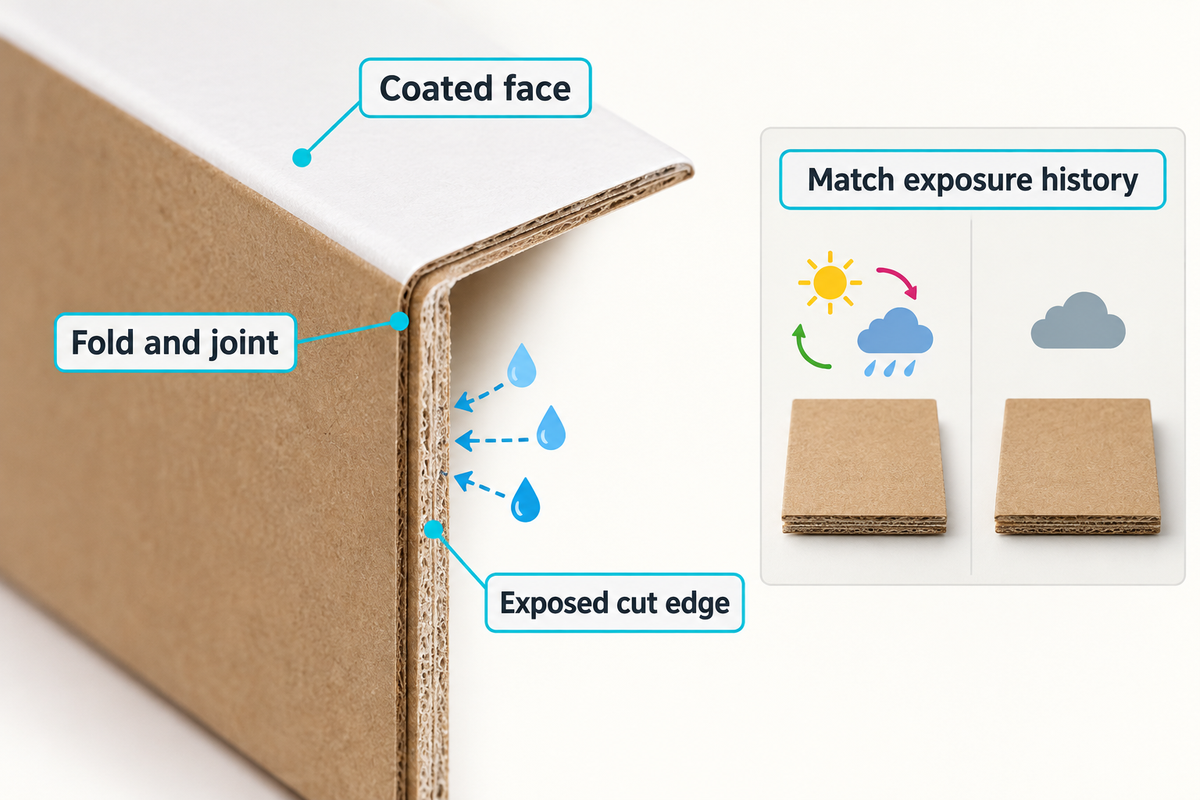
Moisture and sustained loading can alter how a paper display bends over time. A coating treats a particular face; exposed edges, folds and joints also deserve attention. Samples should be taken from the same environment, as matching the room reading at the time of the final observation doesn’t indicate that the sample started out the same way.
A numerical study of corrugated-board stiffness used a reference condition of 23 °C and 50% relative humidity. Those numbers represent the environmental conditions of the comparison baseline in this study. Samples for retail stores should reflect the stores’ own exposure histories and conditions.
“Cyclic relative humidity accelerated the rate of creep compared to a static high humidity environment.”
McKenzie’s specimen tests also documented differences in creep related to board direction. For a counter top display near an entrance, indicate the storage location and describe any changes in exposure, and compare it to a sample kept in a stable environment. Be sure to use the same panel orientation in both examples.
Different clues are given by water marks, edge swelling, and surface curl and separation of layers. Photograph the first area to show deterioration. If failure starts at a cut edge, comparing only the face coating leaves that entry point unchanged. Finishing options should be evaluated on the cut and folded sample.
A spill provides a different kind of exposure from humid air. When reviewing packaging solutions, a brief surface-wipe exposure and an extended loaded comparison answer different questions.
Printing, folds and joints: inspect the finished construction
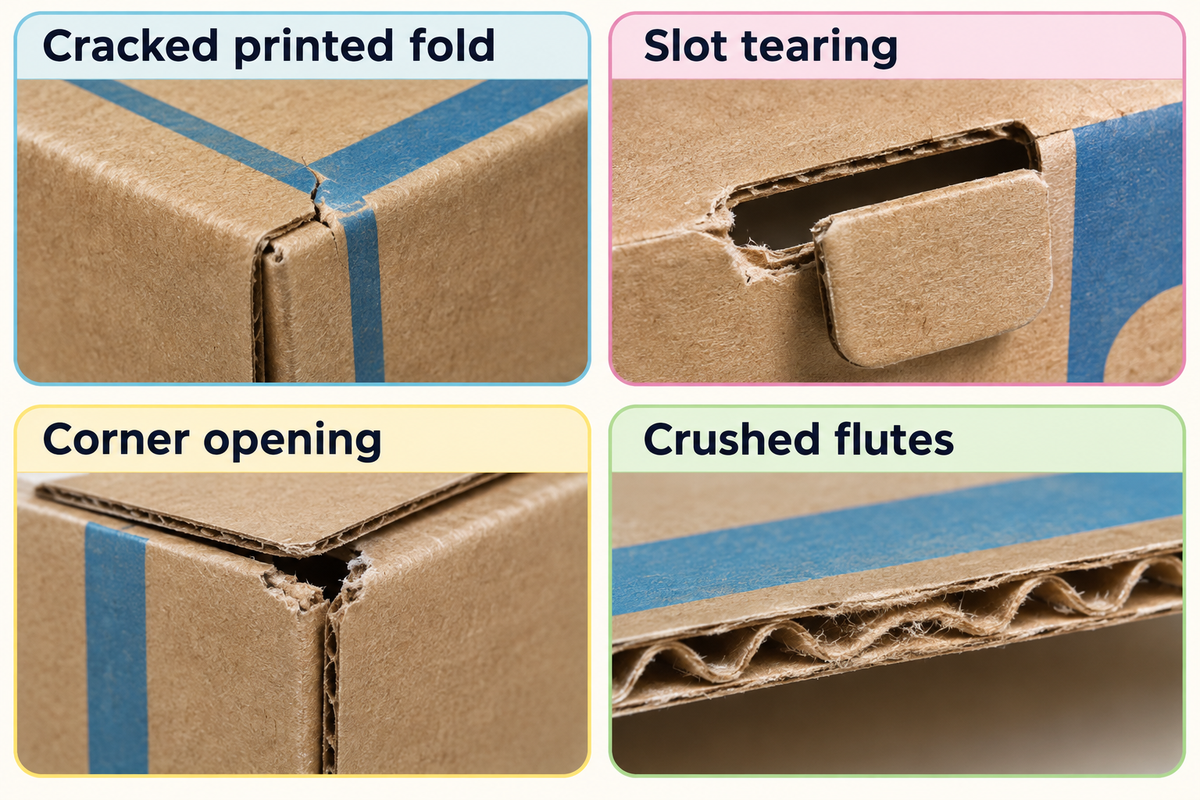
Inspect custom printed boxes after folding and assembly. A flat sample shows color and surface appearance, whereas the folded structure may show poor alignment of tabs and cracked print. Compare the actual board, print coverage and finish so the artwork proof is followed by a representative structural sample.
Purposefully creasing a board is intended to create a controlled fold. The 2023 paperboard creasing-and-folding study discusses the relationship of scoring and folding and their influence on paperboard. Folding settings should be documented for material specification and not assumed to be the same for a different board.
| Observed symptom | Inspect first | Hold constant while comparing |
|---|---|---|
| Cracked printed fold | Crease, grain direction and print coverage | Artwork and board grade |
| Shelf sag | Span and actual supporting edges | Product position and packed mass |
| Slot tearing | Tab seating and concentrated contact | Assembly sequence and load |
| Corner opening | Joint overlap and bond continuity | Panel dimensions and surface finish |
| Crushed flutes | Local contact and converting pressure | Board orientation |
| Scuffed print | Rubbing contact at product removal | Product pack and removal motion |
| Rocking base | Base flatness and joint alignment | Counter surface |
| Swollen edge | Cut-edge exposure and nearby moisture | Storage and exposure history |
“Easy to assemble” is only usable once the tabs seat completely and the intended folds are formed without forcing the blank. An assembly that includes repeated bends may result in a condition that differs from the approved sample. Retain the assembly instructions with the version being compared.
How can cardboard counter display boxes be used for business branding?
To print your brand, use the header and visible panels, while keeping access to the product. Place the logo above the product tops to retain brand visibility when the tray is full. Review printed surfaces that cross folds, since a cracked crease may interrupt lettering or a solid color. CMYK artwork and a chosen coating should be reviewed on the same stock intended for production.
As a marketing tool, the display carries artwork that’s subject to repeated handling at a high-traffic counter. Advanced printing and premium packaging finishes change the appearance, but don’t eliminate the need to inspect corners. For artwork customization options, the “custom counter display boxes” page covers the commercial specification.
Compare loaded samples under matched conditions
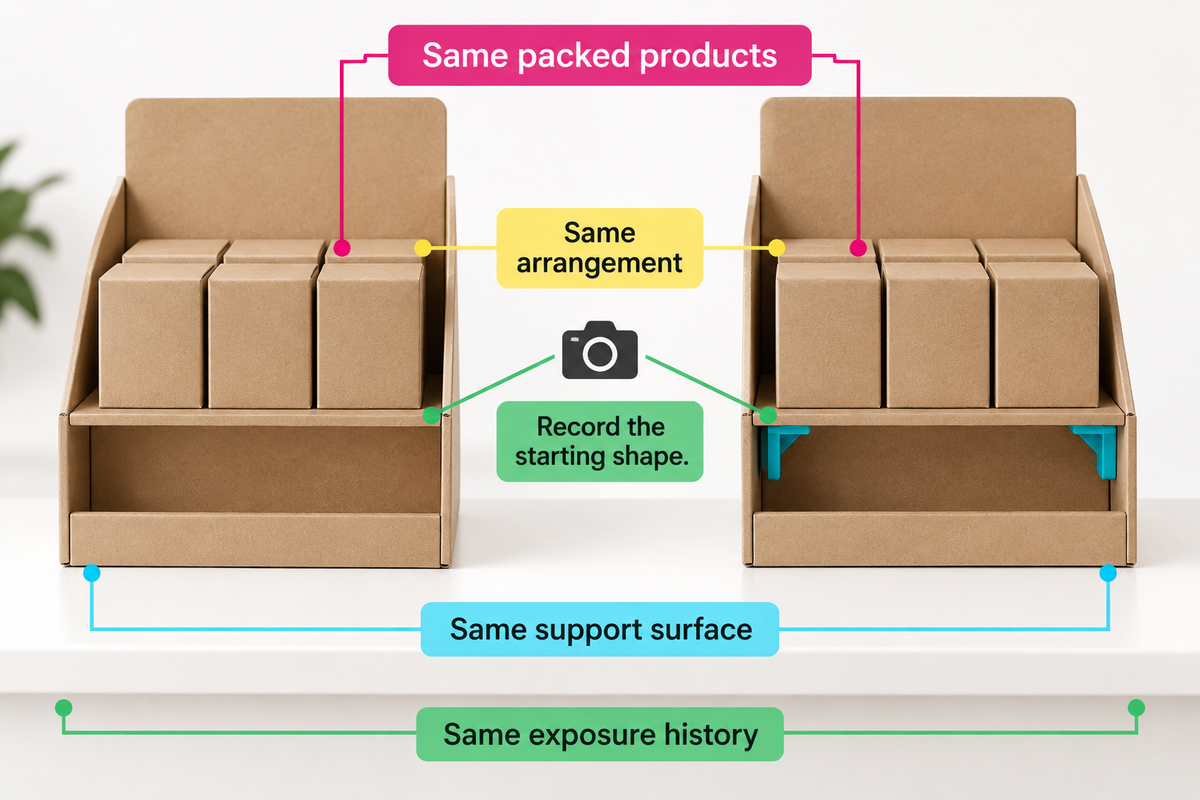
Compare prototypes with the same packed products, arrangement, support surface and exposure history. Identify different construction before loading. Measure or photograph the same locations at the same times, so differences in shelf movement can be traced to design changes rather than a changed comparison setup.
In a 2022 cold-storage box study, product fill and exposed panel area affected creep behavior. The filled boxes experienced earlier side-panel displacement, while restricting the area of exposed panels reduced the amount of moisture absorbed. For an open display comparison, note side contact and any exposed surfaces. Also include the weight of the product being displayed.
- Identify the samples. Record the material grade, blank revision and finish.
- Match the setup. Use the same packed products, positions and support surface.
- Record the starting shape. Photograph shelf edges, base contact and joints.
- Repeat the observations. Keep observation times and handling consistent.
- Compare the change. Separate shelf movement, joint opening and surface damage in the record.
Begin with the intended product arrangement. If, in one version, a shelf is placed against a side wall, and in the other it’s clear, note that as a construction change. A custom cardboard counter top display may gain support from an insert, but the insert must maintain the intended contact throughout assembly.
Brief observations reveal differences that can be compared. Service-life decisions require observations to be made of the intended use condition and duration. Keep a sample of an approved version. Later changes to the board or conversion can be compared against that sample.
Can I get a sample of my counter display?
A sample shows fit and assembly if it’s structural, or shows surface and fold appearance if it’s printed. A production-representative sample shows the intended material, print and converting process. State which question each sample answers. Use the actual product when discussing the sample with the converter.
Review countertop display boxes and their individual product packs together. A change to custom printed folding cartons can alter contact, clearance and removal even when the display blank stays unchanged.
Balance material cost, useful life and end-of-life choices
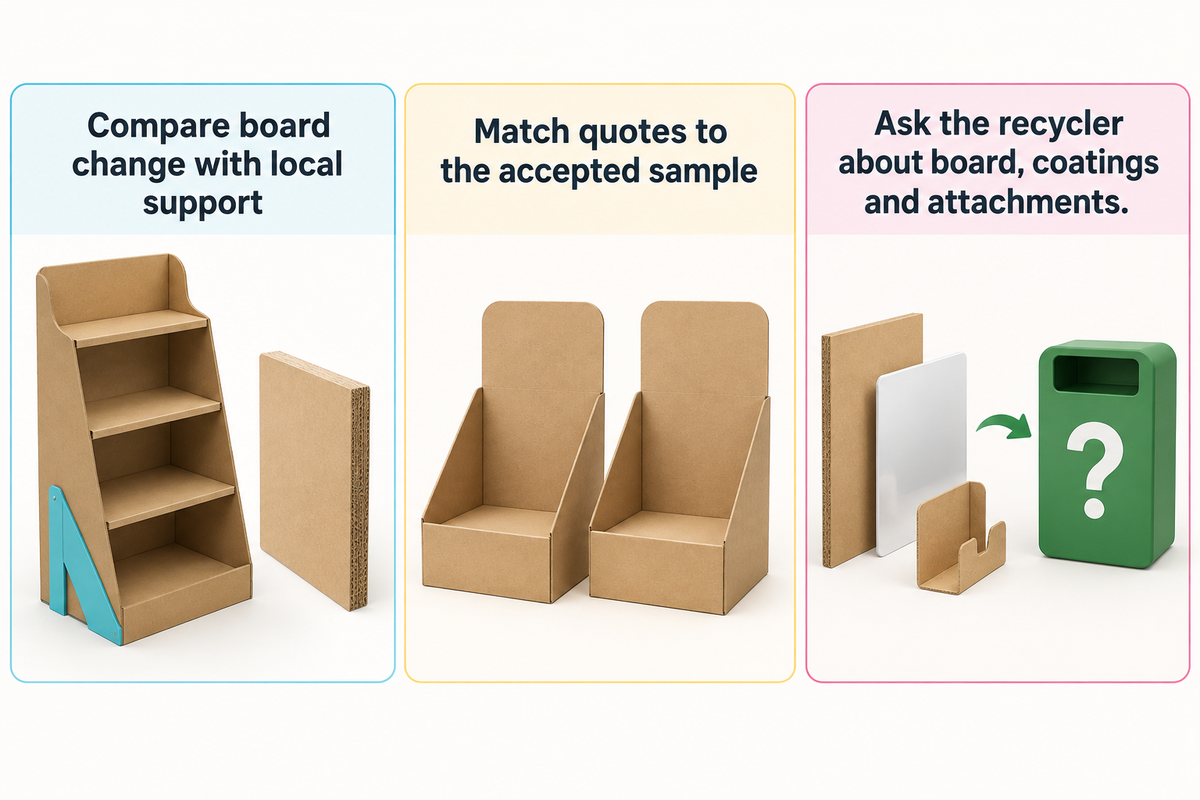
Compare a change in board with local reinforcement and simpler geometry before approving a higher material cost. A supported shelf, revised joints or a different insert may address the observed issue more directly.
Ordering boxes in bulk repeats a small specification difference across the entire order. For display boxes wholesale, compare stock, converting, printing, finishing and packing separately. Affordable prices are relevant when the quoted scope matches the accepted sample; a lower price for a different grade is a different offer.
FEFCO has published a 2025 update to its corrugated guidelines on packaging recyclability. It describes a ‘traffic-light’ approach in an annex. Assess barriers and attachments alongside their practical benefit, and account for the separation step a removable component adds.
The Federal Trade Commission’s environmental-claims summary distinguishes material claims from access to recycling facilities. Establish whether the local collector accepts the finished combination of board, coatings and attachments before giving disposal instructions.
For a handoff, provide packed dimensions and weight, a sketch of how the product is supported, a comparison to the sample, and photographs of defects. Huandao Packaging’s cardboard counter display boxes page is the place to discuss the corresponding construction and quotation.
Frequently asked questions
What is a cardboard display called?
Common names include counter display, countertop display and POP display.
POP means point of purchase. A pop counter display places products on a service or checkout surface, while a larger stand rests on the floor. The name identifies the merchandising format. Include a drawing of the open shape and product arrangement when specifying display packaging boxes so the supplier can identify the structure you mean.
How do you make a display stand with cardboard?
Start with a cut-and-fold prototype matched to the actual products.
Measure the packed products, draw the base and supports, and assemble the blank in its intended orientation. Place the products in their proposed positions, then inspect base contact, shelf movement and joints. Keep a record of each design change. A finished custom display needs its printing and converting choices checked on the same construction.
Where can I buy a cheap cardboard display box?
Compare stock-display sellers and packaging converters using the same dimensions and construction.
For cardboard display boxes wholesale, include the board grade, insert, printed area, finish and packing arrangement in each request. Review freight and sample costs separately. Compare box styles by their usable compartments. A stock tray can be a starting option when these fit; custom display boxes become relevant when the product arrangement requires another blank or support design.
Who makes cardboard displays?
Packaging converters and retail-display specialists make cardboard displays.
Discuss structural design, die-cutting, printing and assembly as separate capabilities. Quality materials still need suitable converting and correctly formed joints. For custom cardboard display work, evaluate the physical sample and the proposed production specification together. Custom boxes with added inserts need those inserts included in the sample.
Does thicker cardboard always make a stronger counter display?
No. Thickness is one input; supports, direction and joints also affect the assembled response.
A thicker shelf can still sag across an unsuitable span or separate at a poorly seated tab. Locate the first movement in the loaded structure, then compare a specific support or material change under the same setup.
Can laminated cardboard still absorb moisture?
Yes. A covered face can coexist with exposed cut edges and folds.
Check exposed edges and joints after representative exposure; a face coating leaves those details to evaluate.
Does an edge-crush test give a shelf load limit?
No. Edge-crush testing measures board compression in a defined specimen arrangement.
An open shelf bends between its supports and transfers loads through its connections. Its evaluation needs the actual board orientation, shelf geometry, product contact and assembled joints. Keep the board result and the loaded-display observation in separate fields.
Discuss your display construction
Send your product dimensions, packed weight and sample photographs to Huandao Packaging. Include the area that bends, opens or scuffs so the construction discussion starts with the observed problem.
About this material guide
Huandao Packaging presents this guide to explain paperboard construction and loaded-sample comparisons. The comparison tables are practical design aids based on published material research; the worked merchandise-mass example uses stated assumptions.
References & Sources
- A comparison of folding carton substrates and appropriate applications Packaging Strategies.
- Bending stiffness of unsymmetrical multilayered corrugated board BioResources, North Carolina State University, 2023.
- Testing methods and recommendations European Federation of Corrugated Board Manufacturers.
- Influence of humidity and temperature on corrugated board BioResources, North Carolina State University.
- Bending creep of corrugated fibreboard in cycling relative humidity Andrew David McKenzie, Massey University, 1999.
- Paperboard creasing and folding research AIMS Materials Science, 2023.
- Influence of different box preparations on creep performance Gray-Stuart and colleagues, Packaging Technology and Science, 2022.
- Standards and guidelines European Federation of Corrugated Board Manufacturers.
- Environmental Claims: Summary of the Green Guides United States Federal Trade Commission.