Get in Touch with Xiamen Huandao Packaging Technology Co., Ltd.

Updated October 2026
A pale logo on brown kraft can be very different from the same logo on white paper. A design that wraps around a bag may also need a different production route from a logo printed on an existing stock bag. These decisions need to be determined before the artwork is finalized.
Custom Paper Bags combine a paper grade, a folded structure and a printed surface. Combine these elements: the contents determine the shape of the bag, the paper/grade determines the printed result, and the printing route determines the location of the artwork. This guide connects those decisions without treating a heavier sheet or a digital preview as a finished-bag guarantee.
At a glance
- Choose construction around the packed contents.
- Approve colour on the intended stock and printing condition.
- Distinguish layout approval from colour and physical-sample approval.
- Compare quantities by artwork version, not just total bags.
- Check the finished bag’s recycling route before printing environmental claims.
Custom Paper Bags: Choose the Construction First
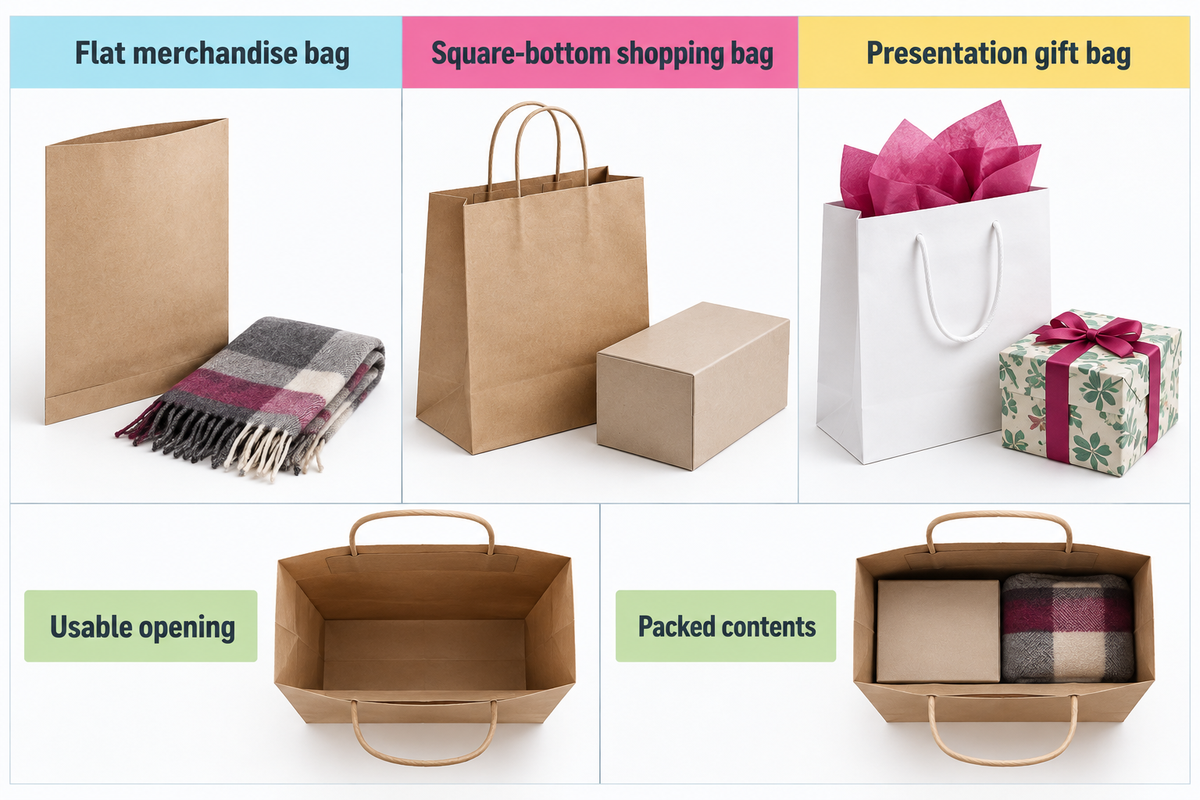
The construction of a paper bag should reflect the shape of its contents and how the user carries it. Flat merchandise bags suit slim goods; a square-bottom carrier provides a base for boxed products. A presentation-led gift bag adds display and opening considerations, while direct food contact introduces a separate material-selection question.
With a boutique selling a folded scarf, a bag may offer enough depth without a wide base. With a rigid cosmetics box, a wide base may be required. The packed product, including its rigid box or protective wrap, is considered when determining the size of the bag.
| Construction | Start here when | Design question |
|---|---|---|
| Flat merchandise bag | Contents are slim and easily supported | Can the item enter without catching the opening? |
| Square-bottom shopping bag | A boxed item needs a defined base | Does the gusset fit the packed depth? |
| Presentation gift bag | Unboxing and coordinated graphics matter | Where do folds, handles and tissue interrupt the design? |
Paper grocery bags and bags for restaurants may look similar, but the intended food contact matters. Take-out bags carrying a sealed food carton differ from packaging that touches unwrapped food. Don’t assume that because a paper looks like a to-go bag, it’s safe to use in food contact.
Paper bags provide the carrying layer around a packaged product. The inner box or wrap may still be needed to protect the goods; choosing the carrier does not automatically replace that protection.
For bags for retail clothes, pick a carrier that complements the packaged garment and inserts; the apparel packaging options provide a wider view of the packaging. If the design requires handles, the paper bags with handles guide should be used to decide attachment and load path.
Twisted paper handles are one construction option, not a load rating. A description such as sturdy handles should lead to a question about the complete bag and its intended contents. A custom bag needs to fit the customer’s carrying task as well as the checkout display.
Kraft Paper vs Coated Art Paper: Match the Printed Result
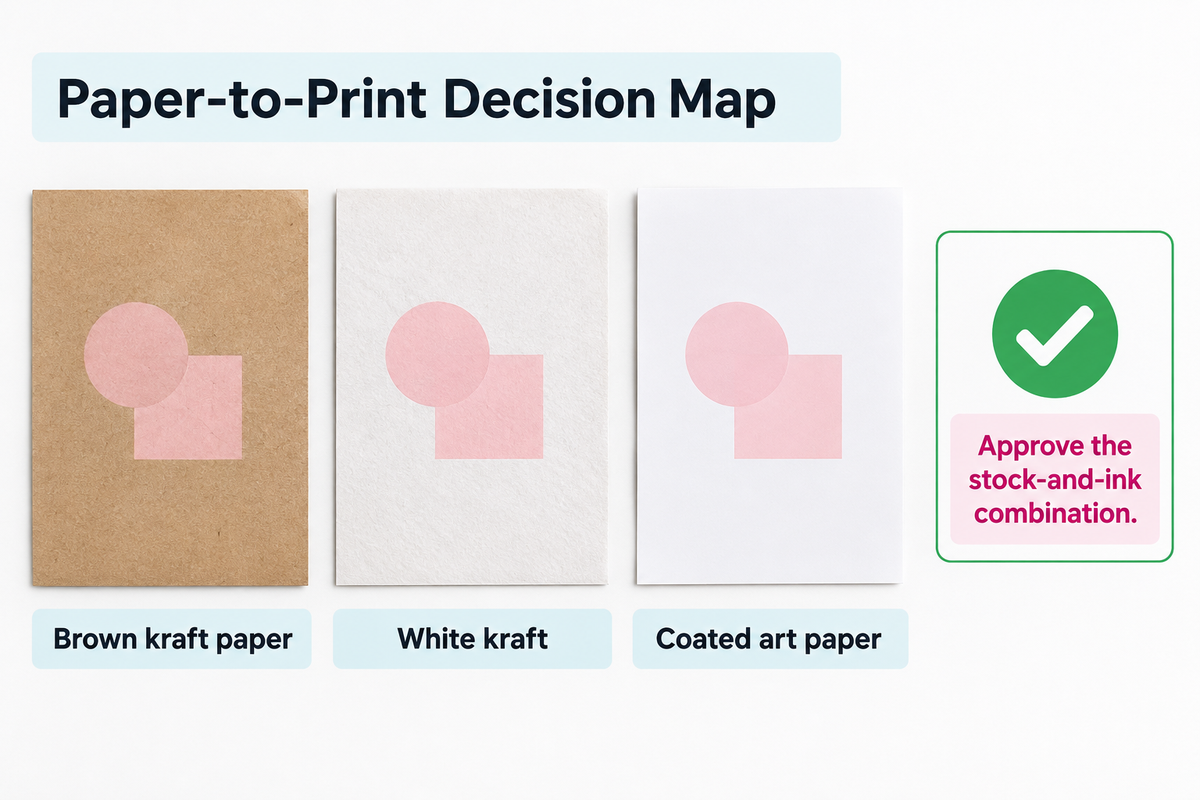
Choose kraft paper when its fibrous background supports the design. For a smoother, lighter paper, consider art paper. Paper characteristics, ink, and process must be chosen carefully for the intended effect.
Brown paper is part of the image. Translucent pale ink doesn’t erase that background. White paper changes the starting point, but switching stock also changes the object the buyer approves. The X-Rite resource outlines packaging color consistency because of the impacts of the substrate, ink and process on color in packaging.
Paper-to-Print Decision Map
| Artwork priority | Paper direction to explore | What to approve |
|---|---|---|
| Natural background and a simple dark logo | Brown kraft paper | Logo contrast on the selected brown shade |
| Pale brand colours on a light background | White kraft or a suitable coated stock | Colour under the proposed ink and finishing conditions |
| Photographic full color graphics | A surface matched to the planned print method | Image detail, solids and colour in representative output |
| Visible recycled character | A documented recycled paper grade | Actual sheet appearance and the stated fibre content |
Illustrative design scenario: A pale pink mark against a kraft brown background is the request of a beauty brand. Its designer requests the brown surface; its marketing manager requests the pink to match the white cartons. Compare actual stock and ink samples to determine the final color. A darker logo may preserve the kraft appearance, while a white substrate changes the design direction.
Recycled kraft paper describes content of materials used, not a particular color. Ask for the selected kraft bag grade’s documentation rather than reading recycled content from the brown appearance. The same is true of eco-friendly claims. Likewise, an eco-friendly claim needs a specific basis; natural-looking custom printed kraft paper bags do not establish an environmental benefit by appearance alone.
Consider the cosmetic packaging formats alongside the carrier for the evaluation of beauty packs. The designer should own the color reference, the converter the production condition, and the buyer the approved physical reference.
Branded paper bags work best with the selected background supporting the mark. To make your brand legible, compare contrast at the size customers will actually see. Approving contrast is required when choosing paper instead of different materials.
Paper Weight, Grain and Bag Size: Read the Specification
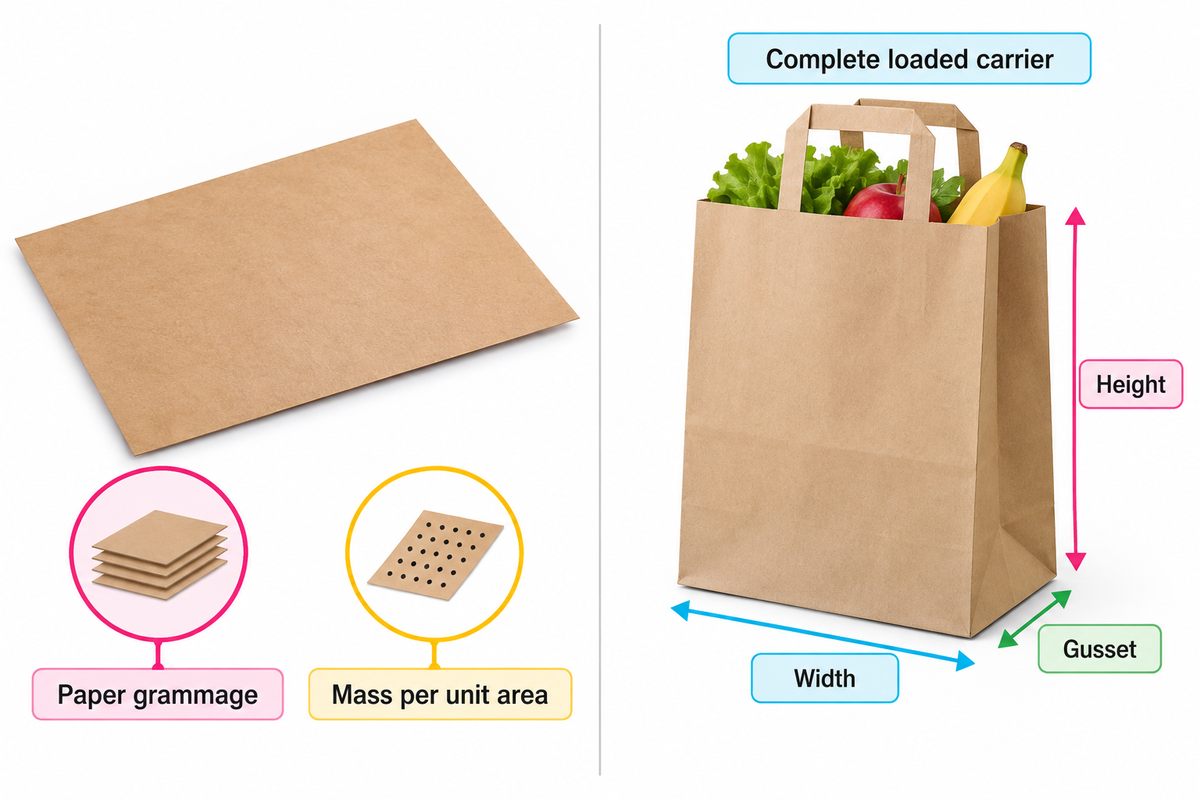
Grammage measures the mass per unit area of paper used in bags; however, it doesn’t determine the finished bags’ carrying capacity. Several other factors influence how a structure can hold goods, including the dimensions of the bags, the grain of the paper, folds, adhesive joints, and the attachment of handles, to name a few. Record those variables together instead of using a heavier paper weight as the acceptance rule.
The public scope of ISO 536:2019 concerns grammage measurement. A test of a completed loaded carrier addresses a different set of questions. The Paper Bag platform’s quality explanation describes whole-bag performance testing rather than a universal conversion from grams per square metre to kilograms carried.
“local grammage was not the best descriptor for any material.”
Considine and colleagues, 2024 paper-stiffness study hosted by the USDA Forest Service
In the study of twelve commercial materials, the measurement of local stiffness and variation of the materials was the focus, not the finished bag load rating. Its practical lesson is to keep the measurement attached to the property it describes.
What is the most durable paper bag material?
Choose a paper grade for the required properties, then assess the completed carrier with its intended contents and carrying conditions. No paper name alone identifies the most durable finished bag. A heavier coated sheet may provide a different printing surface without resolving a weak joint, an unsuitable fold or a handle attachment problem.
Write widths, gusset depth and height next to your dimensioned drawings. Show the opening and packed contents. A paper shopping bag with a folded top requires a clarification: what height does the drawing measure? A supplier shouldn’t have to guess if an allowance is already included. If the outer box changes, repeat the fit check with the revised pack.
Custom Printed Bags: Stock Overprinting or Print Before Conversion?
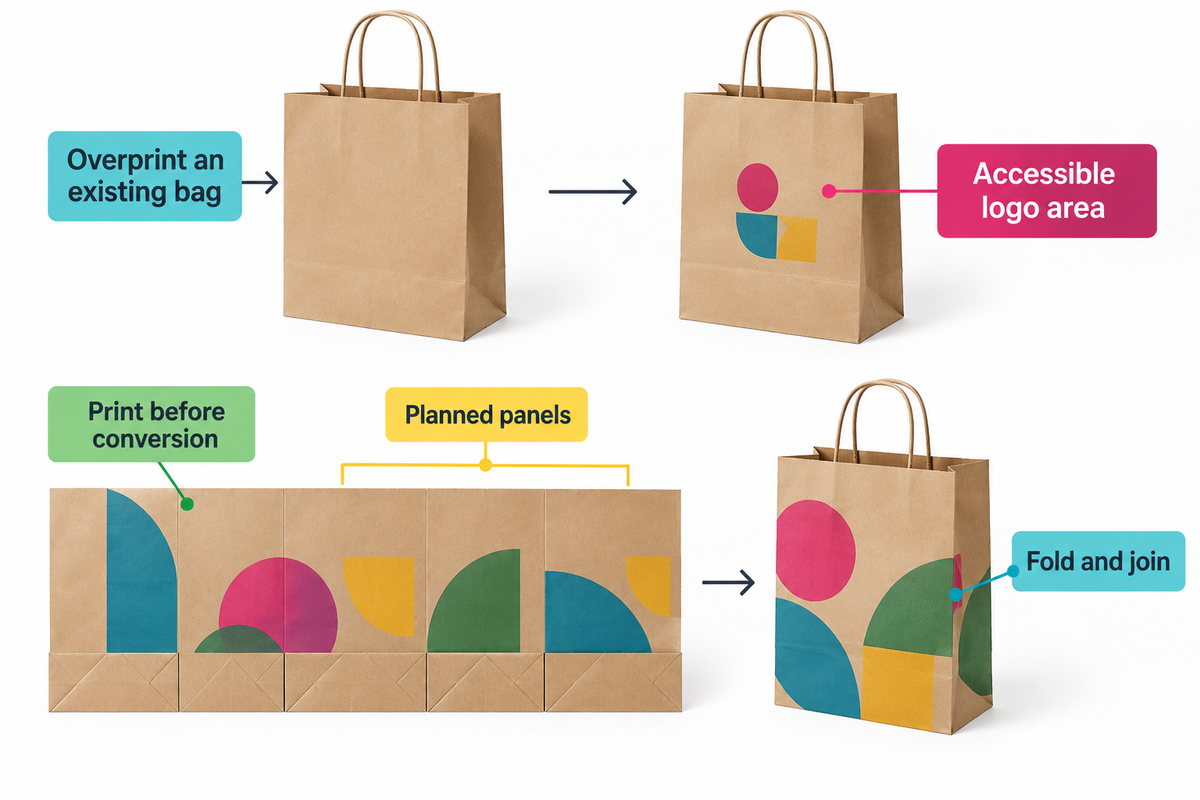
Choose stock overprinting when an available shape fits the contents and its accessible area fits the design; explore printing before conversion for graphics that must reach other panels. A finished carrier presents folds, seams and areas for handles to the printer. Those limitations should be taken into account for placement of artwork.
Wisconsin Converting’s 2018 explanation of post-printed and inline-printed bags identifies these physical differences. Its historic quantities describe that supplier’s offering at that time; they aren’t current minimum order quantities for another manufacturer.
| Route | Useful starting point | Ask before designing |
|---|---|---|
| Overprint an existing bag | An available size and a defined accessible logo area | Where are the seams, folds and prohibited print zones? |
| Print before conversion | Graphics that extend across planned panels | How will the flat artwork align after folding and gluing? |
How do my message and logo get printed on paper bags?
Your logo is prepared for a specified bag layout and print process, then printed either on a formed bag or on paper that is later converted. The supplier should identify the process, printable area and colour arrangement. Approval should show the artwork in relation to folds, seams, the base and handle positions.
Flexographic, offset, screen and digital printing are processes, not alternatives to stock overprinting or full custom manufacture. Confirm the converter’s actual route. A custom printed paper bag might use sheetfed offset printing before conversion. In another case, a job might use stock with a simpler overprinted image as a carrier.
Illustrative event scenario: A team running a business stand requires a giveaway bag with a single business logo. If an existing shape can accommodate the contents and the mark can fit in an available print area, look into stock overprinting. If the design needs a continuous panel image through the gusset, request a route that can produce that layout. A promise of fast turnaround is only useful after stock and artwork approval and dispatch conditions are set.
Keep retail packaging components aligned. A carrier and custom folding cartons may share a visual system while requiring separate and different artwork templates and color references.
Custom-printed paper bags come in various configurations. Before asking which printed paper bags are available, evaluate whether an existing format can accept the desired image. The answer should reveal a usable format and a print area, rather than a wide assortment of styles.
Logo Printing: Prepare Artwork for the Actual Paper Bag
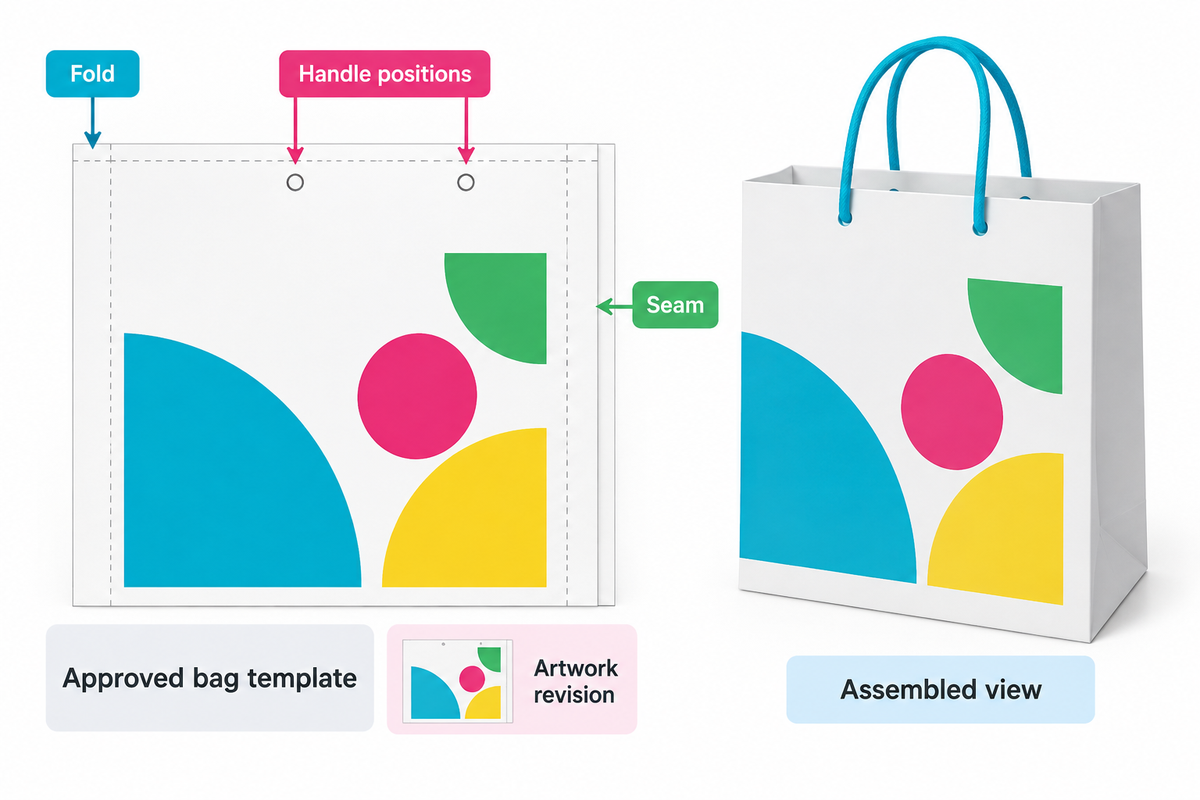
Prepare artwork on the approved bag template, in the correct stock, with the printing route and finished size determined. Place important text and marks where the converter confirms they remain visible on the assembled carrier.
Can I customize paper bags with my brand or logo?
Use one or more of the graphic design elements such as typography, colors and layout to personalize a paper bag. The available combination follows the supplier’s production route and the bag construction. Start with a dimensioned template and a usable logo file, then confirm colours and placement on output that represents the proposed material and process.
For bags with logo printing, send editable artwork if available and state the color references. Ask the printer how to submit the fonts and linked images and transparencies. Use a screenshot to explain an idea and give production art to show the correct scale.
A brand or business with several logo versions should name the approved one. Various colors in a mockup can represent different options; mark the approved one to prevent the printer from interpreting the presentation.
Check the brand’s logo on the assembled view as well as the flat layout. A centered mark on a flat view can be misplaced once handles and top folds occupy the same space. Paper bags with logos on two different views also need an orientation check; the second view isn’t always a simple repetition of the first view.
Full color printing reproduces an image through a defined ink and colour-management process. Spot-colour work uses separately specified inks. Multiple colors may affect preparation differently from a single-colour design; request the actual separation plan before making a version change. Don’t assume that a design called “3 colors” is done the same way as a four color image.
For custom paper bags with logo placement near a fold, move the artwork only after confirming the printable zone. X-Rite’s achievable-colour guidance also explains why visual expectations should be agreed upon in the intended production context. Brand recognition benefits from an attainable, repeatable reference rather than an approval based on a bright screen.
Paper Gift Bags: Choose Finishes That Survive Handling
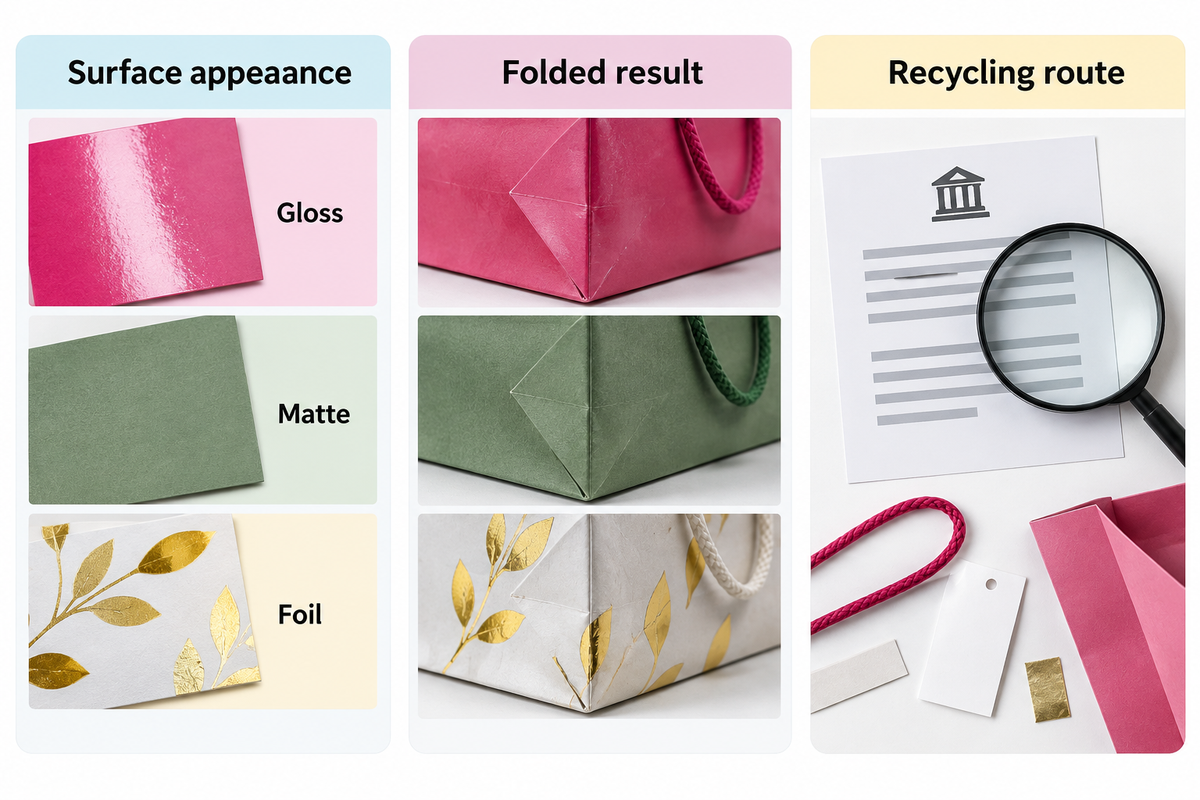
A finish changes how a gift bag looks and feels. Compare the finished print after folding and normal contact, especially in dark solids, corners, and creases. Gloss, matte, and foil finishes and local coatings should be considered in the context of the complete bag design, not in isolation as a flat printed swatch.
Rub marks may occur in different ways on dark and light surfaces of custom paper gift bags. Therefore, compare the finished print sample with the unfinished print sample. A crease also creates a viewing condition that a flat sheet can’t show. Acceptable or unacceptable changes need to be determined prior to sample approval.
The method described in ASTM D5264-98 (2019) allows for a more scientific approach to evaluating the abrasion resistance of printed materials. Like all tests, a report describing the method and the conditions of the test, and the acceptance criteria of the test would need to be evaluated; naming the test alone does not establish a bag’s resistance to all handling conditions. Assess carrying capacity with a complete loaded-carrier test, separately from a printed-surface rub test.
In general, the type of finish selected will impact the recycling route. The UK government’s material assessment guidance identifies double-sided plastic lamination and adhered glitter among paper variants not widely collected at kerbside, with specified take-back exceptions. This assessment doesn’t necessarily apply to all laminated bags. Evaluate the construct of the bag to determine if the receiving market collection and recycling systems support the intended end of life scenario for the bag.
For custom gift bags intended as party favors, decorative appeal may drive the first decision. But take into account how the recipient will have to deal with the components. A ribbon, a reinforced top and the bag body should be considered together before printing a whole-package claim.
The customer experience also includes opening and carrying the package. Ask what strong and durable means for that use: a surface that resists scuffing and a structure that supports the contents are separate requirements, and personalization should not obscure either one.
Samples: What Each Approval Can Actually Settle
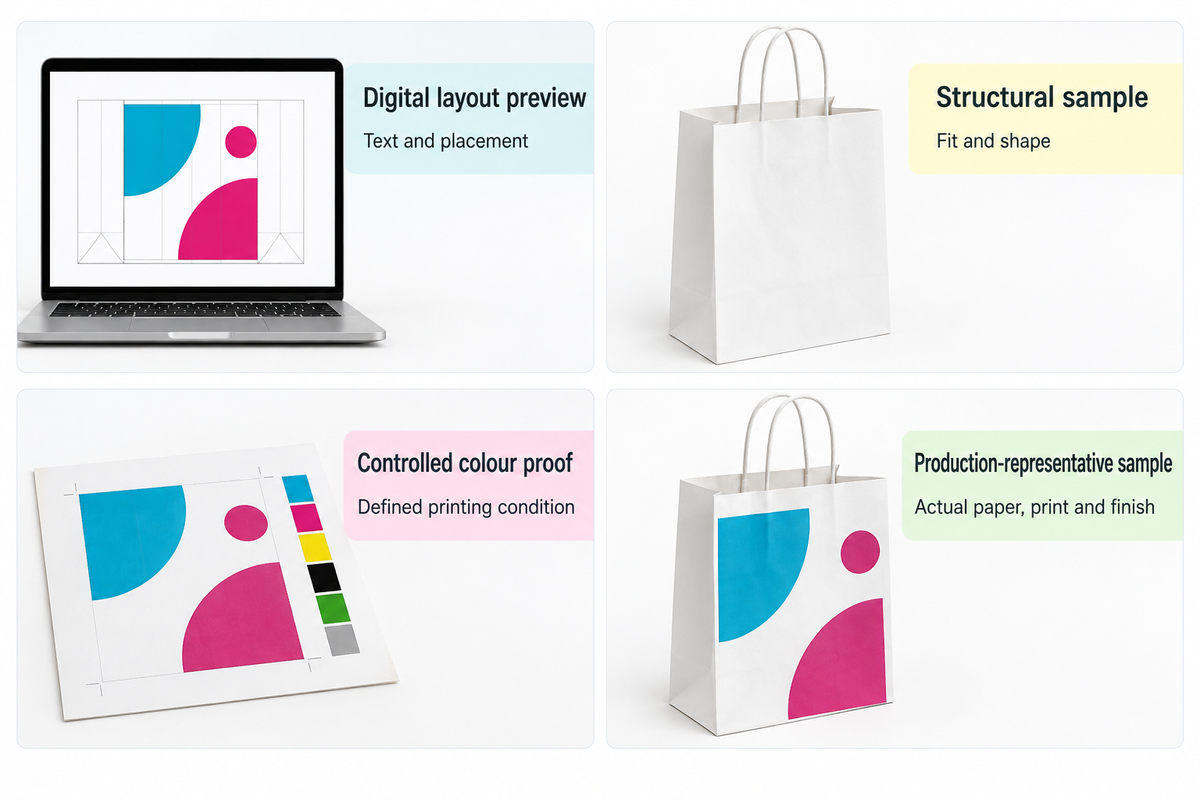
Separate questions should be addressed for fit, graphics, color and finish, even if the samples combine a few of these elements. A layout preview can show the position and content of the text. An unprinted sample can show shape. A controlled colour proof and a production-representative physical sample provide different kinds of information and need clearly identified approval criteria.
| Approval item | What it helps settle | What to identify |
|---|---|---|
| Digital layout preview | Text, artwork version and placement | Template revision and scale |
| Structural sample | Fit, opening and assembled shape | Dimensions and construction represented |
| Controlled colour proof | Colour for a defined printing condition | Proofing condition and viewing agreement |
| Production-representative sample | Actual paper, print, finish and folded result | Any difference from the planned production run |
Paul Sherfield’s FESPA guidance on approval cycles separates content approval from accurate color approval. This is a useful differentiation, particularly if a digital sample has previously been approved; note what was actually approved.
A digital proof is not necessarily only a layout check. ISO 12647-7:2016 addresses hard-copy proofing for defined printing conditions, and Fogra characterisation data include defined matte and gloss lamination conditions. Such simulation, however, will not provide the texture and construction of the finished carrier.
Retain the approved reference with its revised artwork, paper type ID and finish description. If the supplier substitutes the stock after approval, determine which approvals must be repeated.
Bulk Orders: Why Size, Artwork Versions and Timing Change Cost
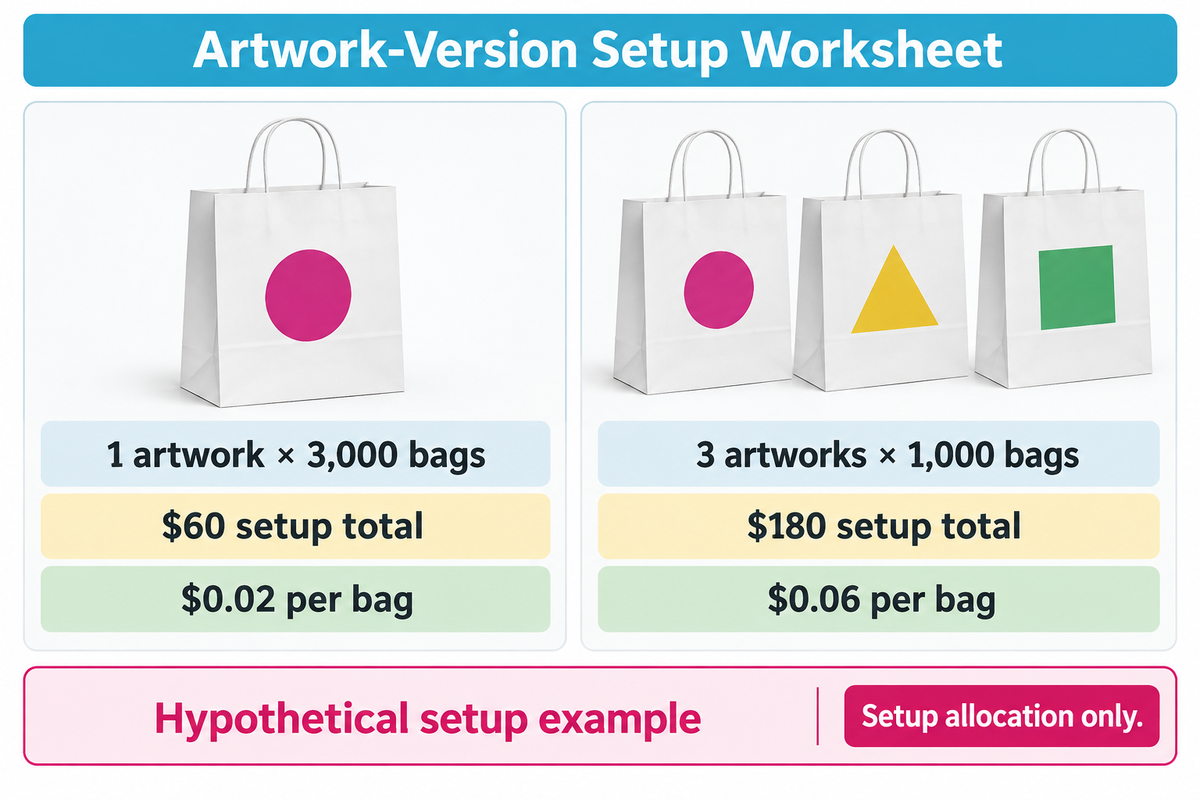
When comparing bulk bag quotes, ensure the quotes are for the same dimensions, material, print specification, finish and quantity per artwork version. The total bag count can mask a very different production job when it’s broken down by design. Ask how each version is done and charged, and separate the cost of production from freight and delivery.
Illustrative seasonal scenario: A retailer wants to purchase 3,000 custom paper shopping bags. The designer suggests three seasonal artwork versions, and the finance manager wants to budget with a single-design price. Both need the same artwork version breakdown to make a comparison.
Artwork-Version Setup Worksheet
In this illustrative example, each artwork version has an assumed $60 setup charge. For the example only, we’ve invented that charge; it isn’t a Huandao quotation or an industry average. The example isolates setup allocation and excludes paper, printing, finishing, packing and freight.
| Assumed order | Assumed setup total | Setup allocation per bag |
|---|---|---|
| 1 artwork × 3,000 bags | $60 × 1 = $60 | $60 ÷ 3,000 = $0.02 |
| 3 artworks × 1,000 bags | $60 × 3 = $180 | $180 ÷ 3,000 = $0.06 |
Replace the assumptions with the supplier’s actual quotation. If artwork versions share preparation, the supplier may allocate charges differently. Wholesale prices are comparable only if the quoted specification and included services match; a lower unit figure can exclude a required sample or delivery.
At Huandao, the public Custom Paper Bags solution page lists material, printing and samples to help discuss a real specification. Use it to configure a sample and to get a quotation. For the broader ordering process, follow the existing custom paper shopping bags purchasing guide.
State required arrival date separately from dispatch. Leave approval and shipment responsibilities visible in the schedule; otherwise a production estimate can be mistaken for a delivered-date commitment.
Design Changes: Follow the Effects Beyond the Artwork
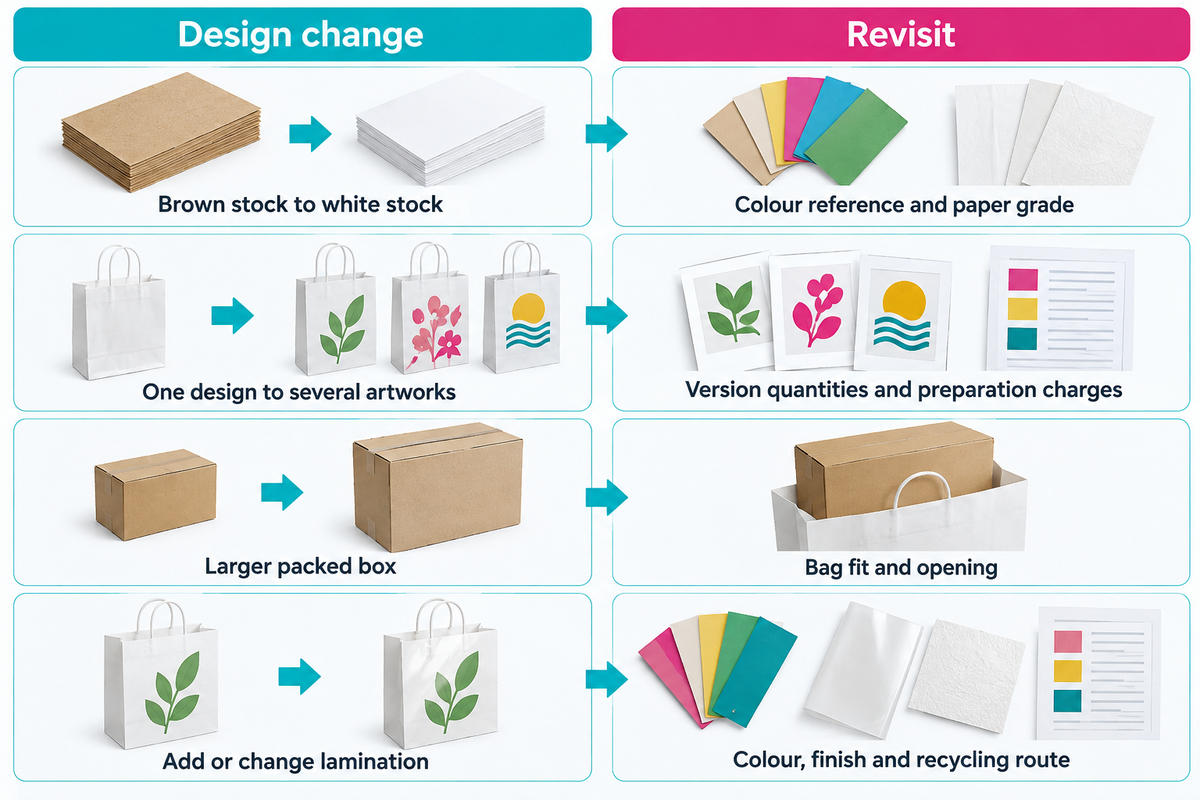
A design change can reopen decisions around choice of materials, printing, and approval, even when the logo itself remains unchanged. Identify which physical or production condition has changed, then repeat the relevant comparison. This ensures a design change that appears minimal to the client doesn’t replace the object agreed to by the buyer and printer.
| Design change category | Revisit | Owner to involve |
|---|---|---|
| Brown stock to white stock | Colour reference and paper grade | Designer and print team |
| One design to several artworks | Version quantities and preparation charges | Buyer and finance |
| Larger packed box | Bag fit, opening and construction | Packaging team |
| Add or change lamination | Colour, folded finish and recycling route | Print team and market-compliance owner |
| Move artwork into a gusset | Printable area and production route | Converter |
| Change handle style | Attachment layout and complete-bag performance | Packaging team and converter |
| Add foil decoration | Finish placement on the folded sample | Designer and finishing team |
| Resize the logo | Legibility and clearance from folds | Designer and pre-press team |
| Change the intended contents | Contact requirements, fit and carrying use | Buyer and packaging team |
| Revise the required arrival date | Approval, production and shipment schedule | Buyer and logistics team |
For personalized gift bags, each of the approved versions should be identifiable. The word “approved” should refer to a particular layout and physical specification, and not a folder containing several files similar in nature. Personalized paper graphics still have to land on the same intended construction.
A change to the paper surface also reopens the colour reference, as explained in X-Rite’s substrate and process guidance. Record the new stock alongside the revised artwork rather than carrying the old colour approval forward automatically.
Huandao describes its own Xiamen plant as integrating pre-press, sheetfed offset printing, coating, lamination, die-cutting and folder-gluing. The company also mentions job specific laboratory reporting and digital production tracking. Those capabilities support a discussion about the proposed job; a board ECT or burst report should not be substituted for a finished carrier’s carrying-performance assessment.
If a carrier, an inner presentation pack, and a shipping carton are coordinated, ask which component a report or sample represents. One consolidated shipment does not make their test properties interchangeable.
Small paper bags keep the same need for clear dimensions even when their contents look simple. A packaging solution for a boxed gift can change when the box changes. Record that change to reuse the previous approval.
2026 Outlook: Compare Carbon Data Within Its Boundaries
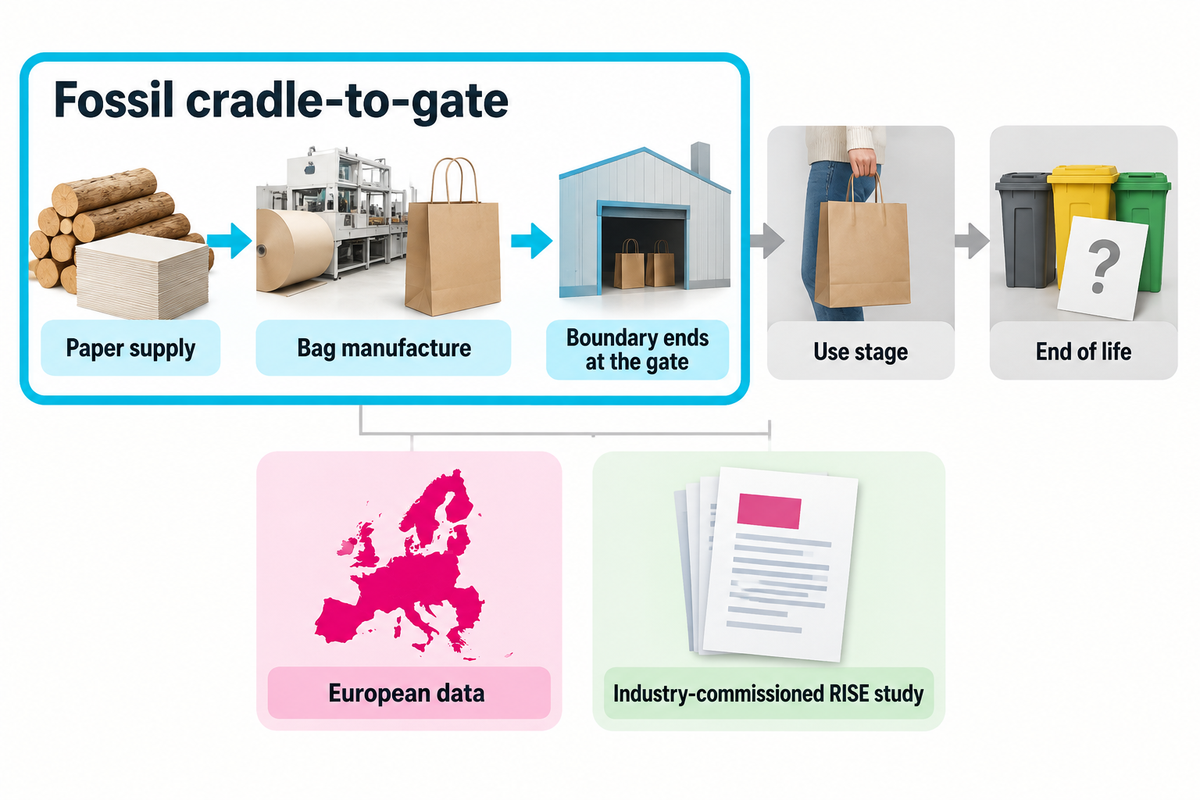
Environmental test data should only be compared after construction of the bag, the data year and the measurement boundaries have been matched. A light carrier and a reinforced gift bag are different products and so are different paper grades.
On 6 October 2026, EUROSAC reported a study commissioned by The Paper Bag platform and conducted by RISE Research Institutes of Sweden. Using 2024 European data, it reported fossil cradle-to-gate footprints of 16.6, 45.6 and 82.9 grams of carbon-dioxide equivalent for three example carrier bags weighing 20, 55 and 100 grams respectively. The published study announcement states the scope of the study, and the examples of high-recycled-content bags have been excluded.
These figures aren’t Huandao measurements, a complete life cycle comparison, or evidence that paper always outperforms plastic bags. For a 2026 packaging review, request the precise weight of the bag, the paper source, the study region and the stages that have been included, and then compare two carbon numbers.
Recyclable is a different claim. The US Green Guides provision on recyclable claims addresses both the package’s recyclability and availability of suitable recycling facilities. Brown paper bags can’t establish either of those through color. Should replacing plastic shopping bags be the objective, define the carrying use case and the receiving waste system, and be clear on the material.
For eco-conscious purchasing, define the finished bag and the property being measured in the specification, and state the measurement conditions. Ask what is being measured, for which finished bag, and under which conditions. Keep that information with the approved design and don’t replace it with a vaguely environmental tagline.
Single-use packaging and a carrier intended for repeated use should be compared against the same required service. For takeout, distinguish the outer carrier from the package that touches food items. A food service bag’s appearance alone can’t establish suitability for that contact.
Frequently Asked Questions
Are all paper bags the same?
No. Paper bags have various constructions and uses. A flat merchandise sleeve does a different job from a square-bottom carrier or a presentation gift bag. Consider print requirements, bag opening, the contents to be packed, and how the bag will be handled, before selecting a format; appearance is deceptive, and bags that appear to be the same may not have the same properties.
How are paper bags made?
Paper bags are made by cutting or forming paper into the required panels or tube, then folding and joining it. Printing may occur before conversion or on already formed or cut bags. The converter may add reinforcement and other embellishment and handles as required. The sequence of operations in the conversion of a bag follows the construction of the bag and the converter’s equipment.
Can paper bags be recycled?
Some paper bags can enter suitable paper recycling systems, but acceptance depends on the finished construction and local collection arrangements. Coatings, laminates, attached components and contamination matter. Before making public statements, the completed bag must be checked against the requirements of the collection systems, and claims must be qualified for the market where the product is sold.
What is custom kraft paper?
In bag production, custom kraft paper normally refers to a specified kraft grade, and a particular size, print or conversion design. Confirm the paper colour, weight, surface and documented fibre content rather than treating the phrase as a complete material specification.
What is the minimum order for custom paper bags?
Huandao’s public product page shows a standard minimum of 1,000 pieces per size and style, with smaller orders considered on a case by case basis. Confirm the quantity for each artwork version and ask what’s included in the quote. A stock bag with a simple overprint and a purpose-made printed carrier can involve different preparation, so another seller’s minimum is not a reliable promise for the proposed job.
References & Sources
- International Organization for Standardization, ISO 536:2019, grammage measurement
- USDA Forest Service, Considine et al., Heterogeneity characterization of commercial structural papers, 2024
- ASTM International, D5264-98(2019), abrasion resistance of printed materials
- UK Government, Recyclability assessment methodology: assessing materials
- FESPA, Paul Sherfield, Proofing and approval cycles: a practical guide
- International Organization for Standardization, ISO 12647-7:2016, digital proofing
- Fogra, Characterisation data
- EUROSAC, Carbon footprint of paper carrier bags, 6 October 2026
- Electronic Code of Federal Regulations, 16 CFR 260.12, Recyclable claims
Turn the design into a clear specification
Bring the packed-product dimensions, artwork versions and preferred paper-and-finish reference. Huandao can review the proposed printed packaging job with those decisions visible.