Get in Touch with Xiamen Huandao Packaging Technology Co., Ltd.

Custom Die Cut Boxes: From Flat Dieline to Finished Pack

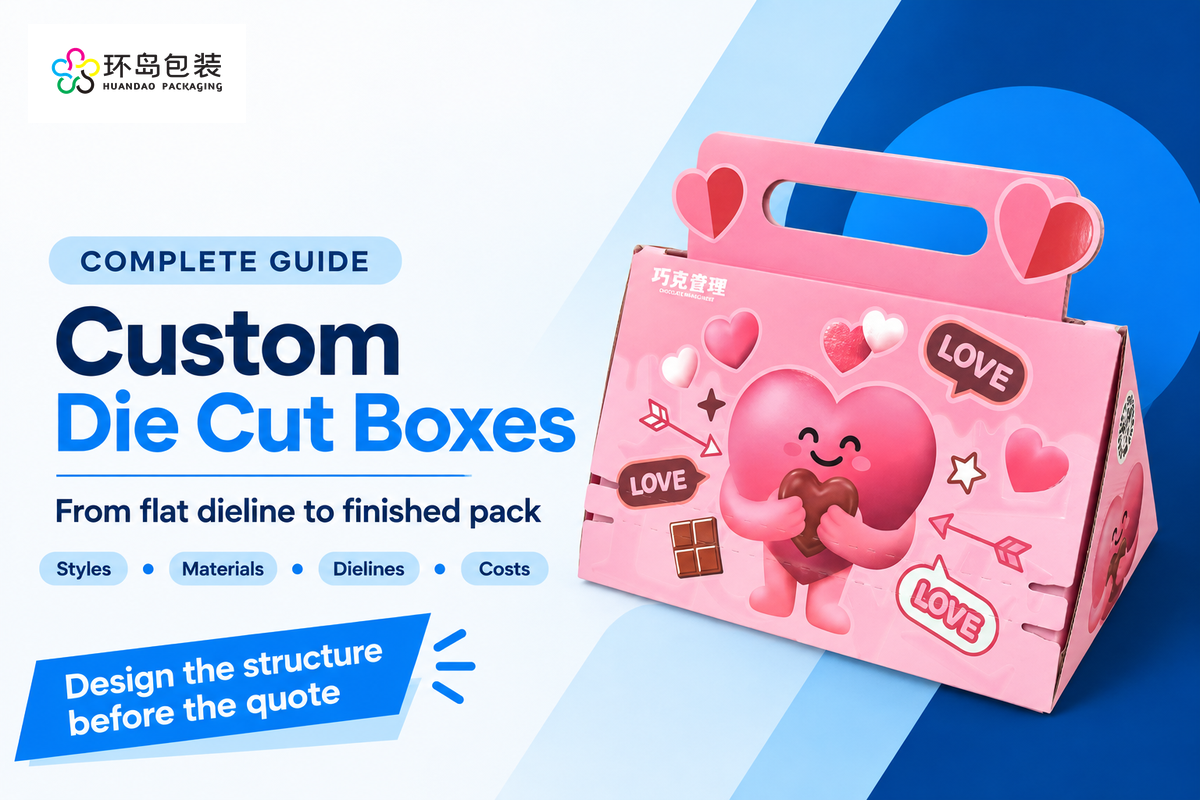
Packaging design guide
Custom die-cut boxes are made by cutting and creasing a flat blank into a predetermined shape. This describes a converting method and isn’t describing a single material, print method, or strength rating. Folding cartons, corrugated mailers, and rigid wrapped boxes all contain die-cut parts, but they can be printed, folded, and shipped differently, and ultimately, recycled differently. There can be a packaging solution only if the structure matches the product and the job of distributing it.
This instruction explains the steps from a product drawing to a repeatable packing job. It includes choices such as construction, function of panels, creation of a die line, cutting route, approval of a production-representative sample, and evaluation of the landed cost. It’s written for educational purposes, independently from Huandao Packaging’s custom die cut boxes solution page, which is prepared for the commercial enquiry.
Working rule: record the construction, board or paper family, finished dimensions, closure, expected environment, quantity and acceptance tests as separate fields. A style code or a flute name should never be the only specification.
One blank, one revision. Maintain this discipline from the first sample, through the press run, because a change in the coating, insert, fold direction or a closure, can alter the load path and the product’s fit, even if the dimensions haven’t changed.
What Are Custom Die Cut Boxes?
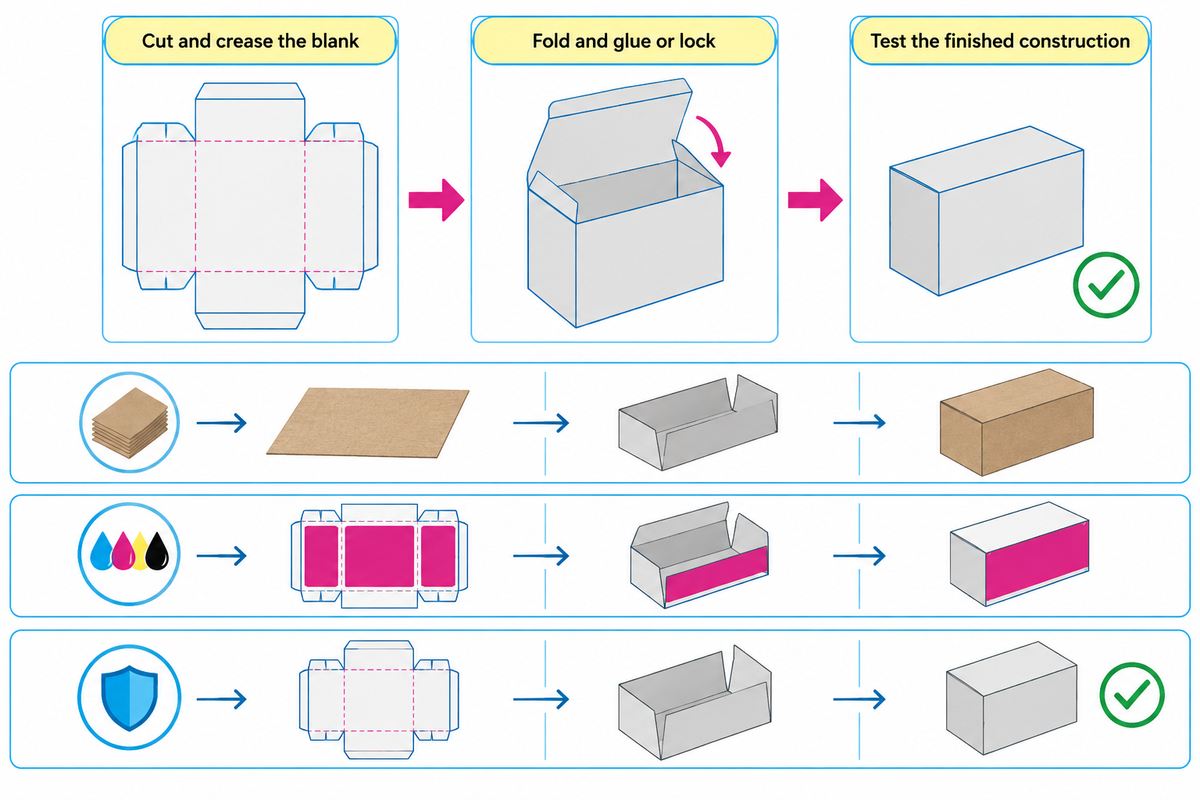
A die is a form fitted with cutting and creasing rules. Cut rules separate the blank. Creasing rules create fold lines. The blank is printed and finished. FEFCO production guidance documents the relevant construction or test context. The finished blank is folded and glued to a box. That’s why a die cut box can have a shaped opening, a tuck closure, an auto-bottom, a handle, a window or an insert carrier. A regular slotted container can’t have those features.
The term “custom” describes features such as the outline, the dimensions, the locking feature, the print map, the board, the insert, or a combination of these. A custom die cut box, for example, could be paperboard, corrugated or a rigid wrapped construction. FEFCO describes production of corrugated boards as a series of forming and converting processes with printing, die cutting, folding and gluing processes combined as required. The Fibre Box Association divides board into liner, medium and flute and box style. In an RFQ, ask for the complete name of the construction instead of using “cardboard” as a blanket term.
Various combinations of materials and features can result in packages with similar appearances. One buyer may look for die-cut box, packaging box, custom packaging, product packaging or custom die-cut packaging, and another may look for die cut packaging boxes, die cut boxes wholesale or custom die cut packaging boxes. All these can comprise retail packaging, custom printed cartons, cardboard boxes, shipping boxes and gift boxes. The blank, board, and purpose determine the resulting package.
FEFCO’s code identifies the same corrugated construction for both the buyer and converter. It’s a system to communicate common designs and isn’t a proof or a certificate that the box will stack the way it’s intended to. The performance of a finished product is determined by a number of factors such as the type of board, dimensions, openings, closure, conditioning, assembly, and distribution.
Box Styles: Match the Opening to the Job
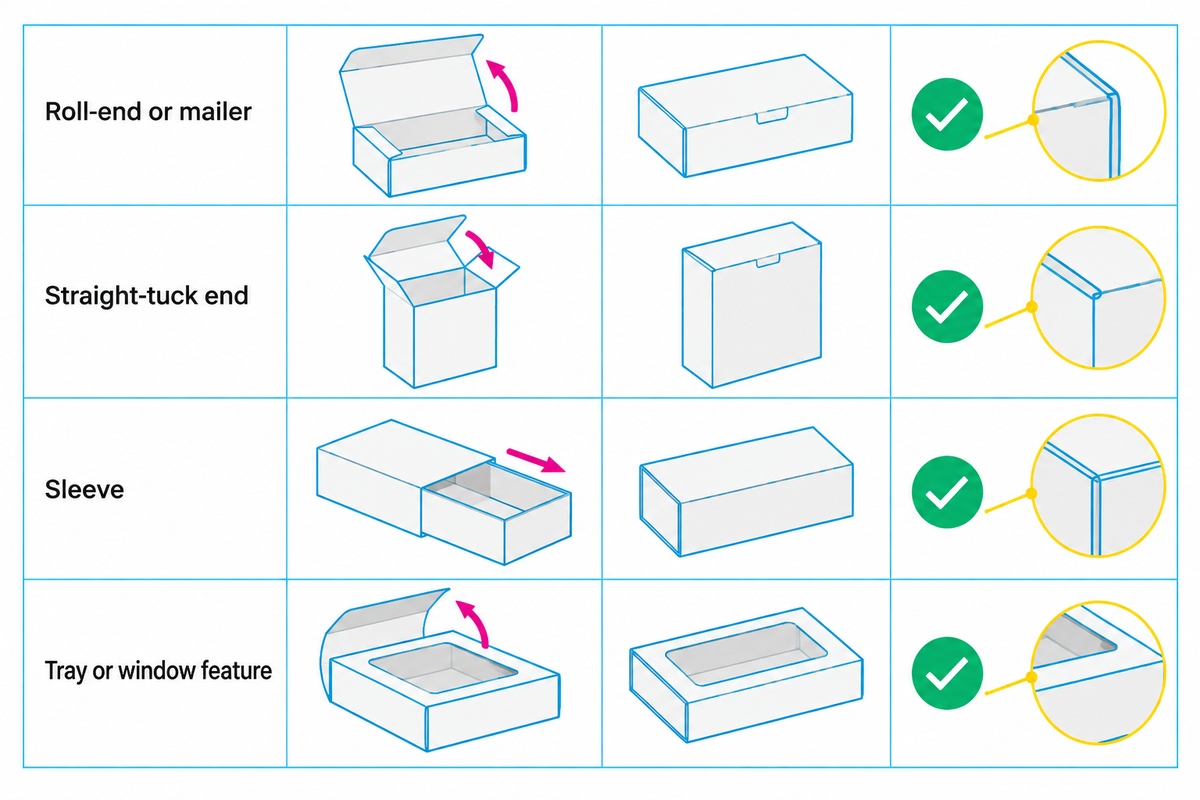
Start with the packing motion. Is the product dropped vertically into a box, slipped through a sleeve, loaded into a mailer or put into a tray? The motion that packs the product usually helps to determine the style quicker than a long list of visual effects.
You may need to choose retail boxes or die-cut display boxes for a retail product and a premium presentation boxes program may need a tray and sleeve. These are various choices within the same type of packaging brief.
| Style or feature | Useful when | Check before approval |
|---|---|---|
| Roll-end or mailer | A flat shipper should open without a separate lid and present a broad printed face. | Lock engagement, corner crush, return opening and whether the product needs an insert. |
| Straight-tuck end | A retail carton needs a familiar top opening and efficient flat packing. | Tuck length, opening force, grain direction and whether repeated opening will whiten the fold. |
| Reverse-tuck end | Front and back panels need different visual or shelf functions. | Which tuck enters first, where the glue flap sits and whether the barcode stays away from a seam. |
| Snap-lock or auto-bottom | Packers need a base that locks or erects with fewer manual steps. | Bottom engagement, board thickness, machine or hand-loading sequence and flat-pack volume. |
| Sleeve | The product already has a tray, bottle or inner pack and needs a printed outer layer. | Friction, sliding clearance, seam position and whether the sleeve can be removed for recovery. |
| Tray, dispenser or window feature | Display, dispensing or product visibility is part of the use case. | Product retention, cut-out strength, patch film and the local recycling route. |
| Display carton | The pack must open on shelf or present the product without a separate fixture. | Front-panel stiffness, tear-away lines, shelf handling and replenishment. |
| Hanging-tab carton | The product needs a retail peg or display slot above the box. | Tab tear strength, load path, barcode position and repeated handling. |
| Four-corner tray | A shallow product needs a fast open top and controlled corner folds. | Corner compression, insert movement, crease alignment and nesting. |
FEFCO codes are design codes and can aid communication of corrugated styles. The FEFCO Code documents the relevant construction or test context. However, they shouldn’t replace the fields in the last column. For a folding carton, name the opening and closure in plain terms and attach the blank. For a rigid gift box, name the construction of the board and state if a lid is attached or a board insert is used. This helps prevent confusion between similar box families.
In a volume quote, custom die cut boxes wholesale and die cut packaging boxes wholesale provide a buying route as opposed to a performance class. This project is also referred to as custom die-cut boxes, die cut cardboard boxes or die-cut cardboard. A box die defines the rules, and box die cutting is the converting operation. When packaging needs varies across packaging products, compare box packaging, rigid boxes and round boxes with the actual insert and ship route. Favor boxes, kraft boxes and pyramid boxes are style examples; they still require the same fit, closure and recovery checks.
Packaging Materials: Paperboard and Corrugated Explained
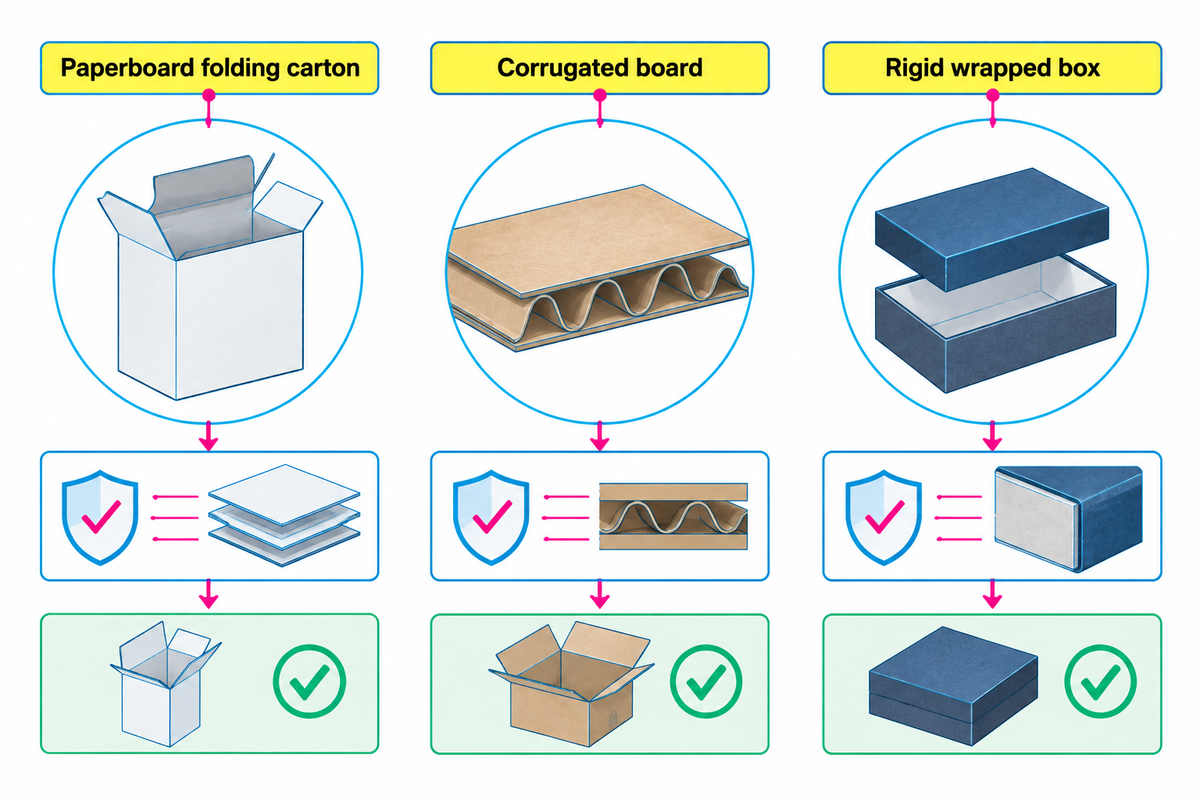
Paperboard folding cartons are chosen based on print coverage and an aesthetic shelf display, and are relatively compact when folded. FEFCO production information documents the relevant construction or test context. Corrugated boards, on the other hand, have a built-in fluted medium between liners and are therefore better suited for cushioning and bending rigidity. Thus, a corrugated mailer may be better suited for parcel handling, and a paperboard carton for a lightweight retail unit. A rigid box has a different wrapped board build and is better suited for a more substantial presentation with a reusable feature.
For examples of adjacent references, see Huandao’s folding carton, packaging, corrugated mailer boxes and rigid gift boxes references. They support different product families; this guide keeps the decision framework between them.
A flute in a label is a directional sign. A finished box requires other factors, including the type of flute, and the combination of flutes used (i.e. single, double, etc.). The Fibre Box Association indicates that deeper profiles (>3 flutes) provide more cushioning and vertical compression than shallow profiles, which can be used for graphics and retail structural displays. A flute profile can also vary, depending on the supplier. Huandao describes in-line single E- and B-flute supply and the sourcing of A, C, F, BC, and other profiles. This has more to do with the plant and supplier capability than assigning a specific profile to a product.
Separate the basis weight of the board from the rest of the package. Tests for basis weight, edge crush, burst and box compression measure different things and, therefore, answer different questions. A primary study on corrugated boxes concluded that geometry and board stiffness, as well as other factors, such as opening, moisture and stacking, impact compression. In a comparison of two samples (300 × 200 × 200 mm), BC-780 recorded a higher no-offset BCT than EB-965, even though the ECT values for the flutes weren’t ranked the same way as the BCT. This is a measured result based on the test conditions and the grades of the paper.
Cut-Fold-Fit Loop
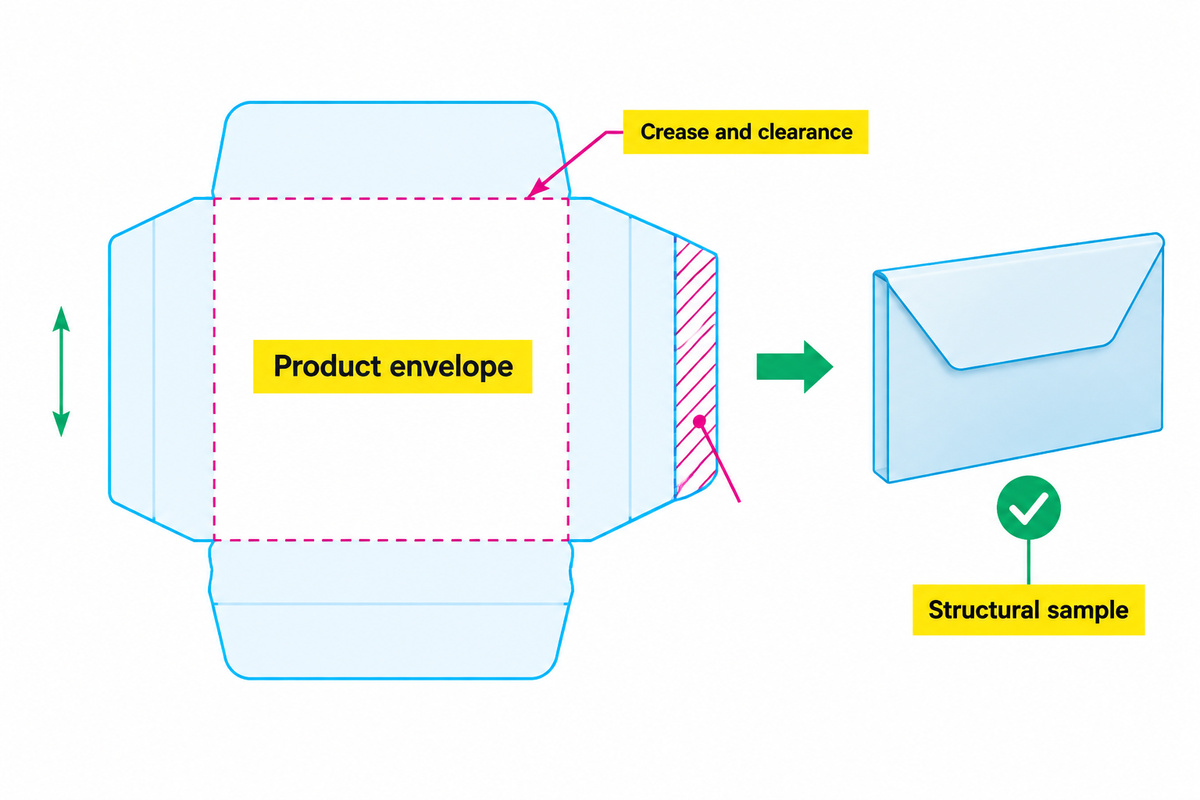
Use this panel map during structural approval. FEFCO testing recommendations documents the relevant construction or test context. For each panel or feature, write its function and the evidence that clears it:
| Panel field | Question | Approval evidence |
|---|---|---|
| Product and clearance | What touches the product, and where can it move? | Loaded blank and packed sample |
| Load-bearing wall | Which walls receive stacking or hand pressure? | Board brief and finished-box test |
| Closure / lock | Does it close, stay closed and reopen as intended? | Repeated hand or machine cycle |
| Crease / grain / flute | Do fold direction and board direction support the motion? | Structural sample on production stock |
| Artwork / barcode | Will folds, glue lands and cuts interrupt the information? | Assembled print proof |
| Insert / window | Does the feature protect, show or hold the product without creating a recovery problem? | Loaded sample and pathway review |
Dielines: Turn Product Dimensions into a Foldable Box
A dieline is a map of cut lines, folds, creases, safe zones, bleeds and sometimes perforations. The peer-reviewed crease study documents the relevant construction or test context. It begins with the packed orientation of a product and shows the clearances that the product and packing process need. It doesn’t matter if you guess a product’s length, width and height, and place it in a template and assume it will fold correctly.
Two studies published in the peer-reviewed BioResources journal support why this is the case. One studied crease patterns in forming paperboard trays. The other investigated the thickness of the material and the clearance of the mould, and also reported the existence of defects and fractures in the formed product. The conditions and processes used in the two studies are specific to the studies. These studies support the validation of rules, not tolerance limits for the rest of the custom box.
Which dimensions belong in the first structural brief?
You should provide a converter with information regarding the product (orientation and envelope), the type of material used for protection (if any) and insertion, closure sequence and force required to open the package, expected load, environmental range, and whether the box is shipped flat or assembled. State if the given dimension is external, internal, or ‘blank’. Provide enough information for a useful first pass at determining envelopes, and state if there’s anything the client should be concerned about. A useful first pass for a product measuring 160 × 90 × 45 mm might reserve 3 mm on each internal side, producing a 166 × 96 × 51 mm working envelope. This isn’t to say the envelope provided is a design assumption for every product. Many things, such as the type of product, packaging material (if any) and packer speed can affect what the ‘useful’ envelope is.
Three proofs are essential when risk warrants them: fit and motion structural proof, digital printed proof for artwork, and a press run proof for change in production substrate and/or coating/lamination. Retain the revision number on the structural proof. A PDF can look correct, while in reality, a flap of glue collides with a lock or a barcode crosses a fold.
Customized die cut boxes often need custom packaging boxes and custom packaging materials recorded separately. The blank, insert, and finish, each, should have a revision, to ensure a later change doesn’t alter the package.
Die Cutting: Flatbed, Rotary and Digital Routes
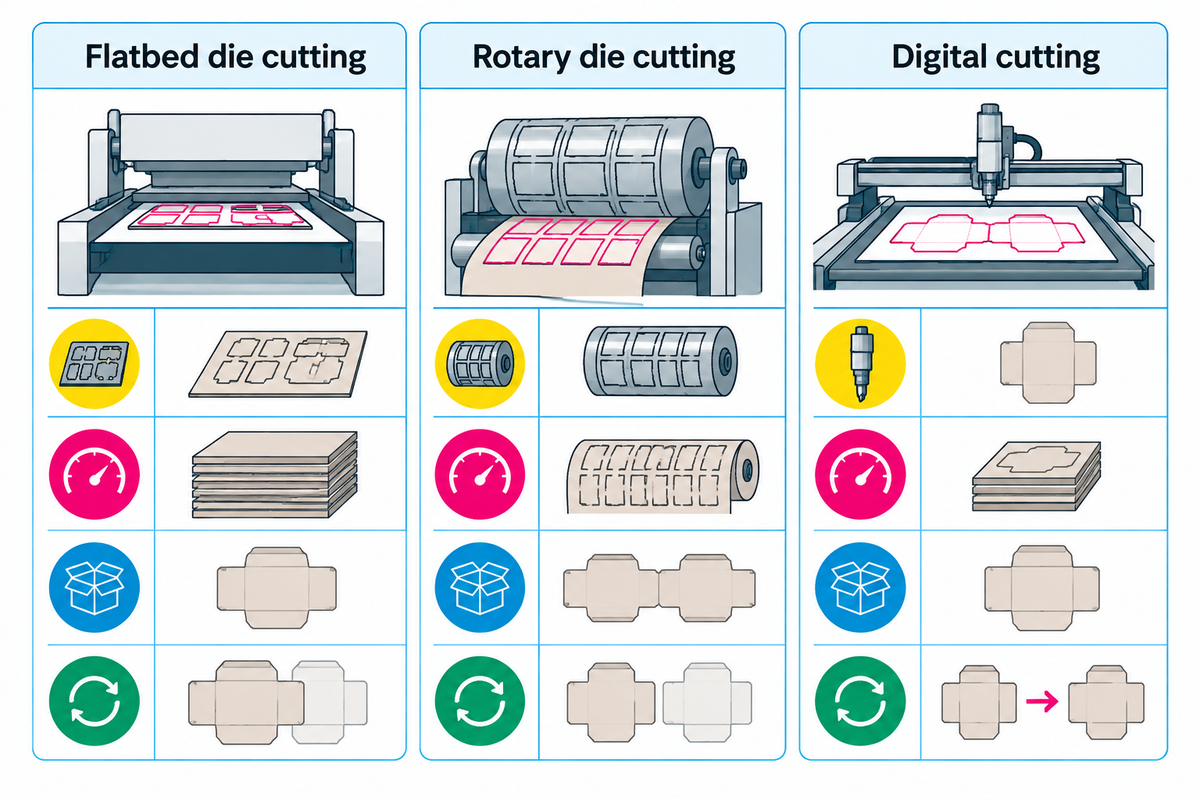
Flatbed die cutting relies on a shaped rule form and a press stroke. FEFCO production guidance documents the relevant construction or test context. It’s a known route when an repeat order justifies tooling and many identical blanks are required. Rotary die cutting uses a cylindrical form and a continuous or a semi-continuous motion. It’s appropriate when there’s a match with board and format for high throughput corrugated conversion. Digital cutting removes or lessens the need for tooling for samples, prototypes, and short runs. However, edge quality and economy depend on the machine and stock.
Print method and route are different things. Boxes can be printed in multiple ways. Compare the route with quantity, frequency of revision, type of board, registration, waste, set up, sample, and repeat order tooling. A 2015 trade report described a digital print and crease installation by one converter. This is a specific example of a particular plant, and doesn’t describe all suppliers.
A custom printed die cut project can use a die press or a digital cutting table. The route chosen should be examined against the die-cut cardboard boxes, board and registration actually required.
Prototype first. Measure the blank. Then price the repeat.
When there are many variables within a single project, such as multiple sizes, changing inserts, a printed outer shell, and a parcel exposed to different climates, be sure the buyer understands that the lower-price conversion quote brings higher assembly-time costs, more protective material, or more pallet volume, and a higher risk of a late structural revision.
That record becomes the operational hand-off between design, procurement, quality and the packing line, tying the drawing to the stock, finish, quantity and acceptance test that the repeat order will actually use. Everyone then reviews one shared set of assumptions for revision level, board family, finish, quantity and acceptance testing before the packing line releases the repeat order.
Printed Die Cut Boxes: Design Across Folds and Seams
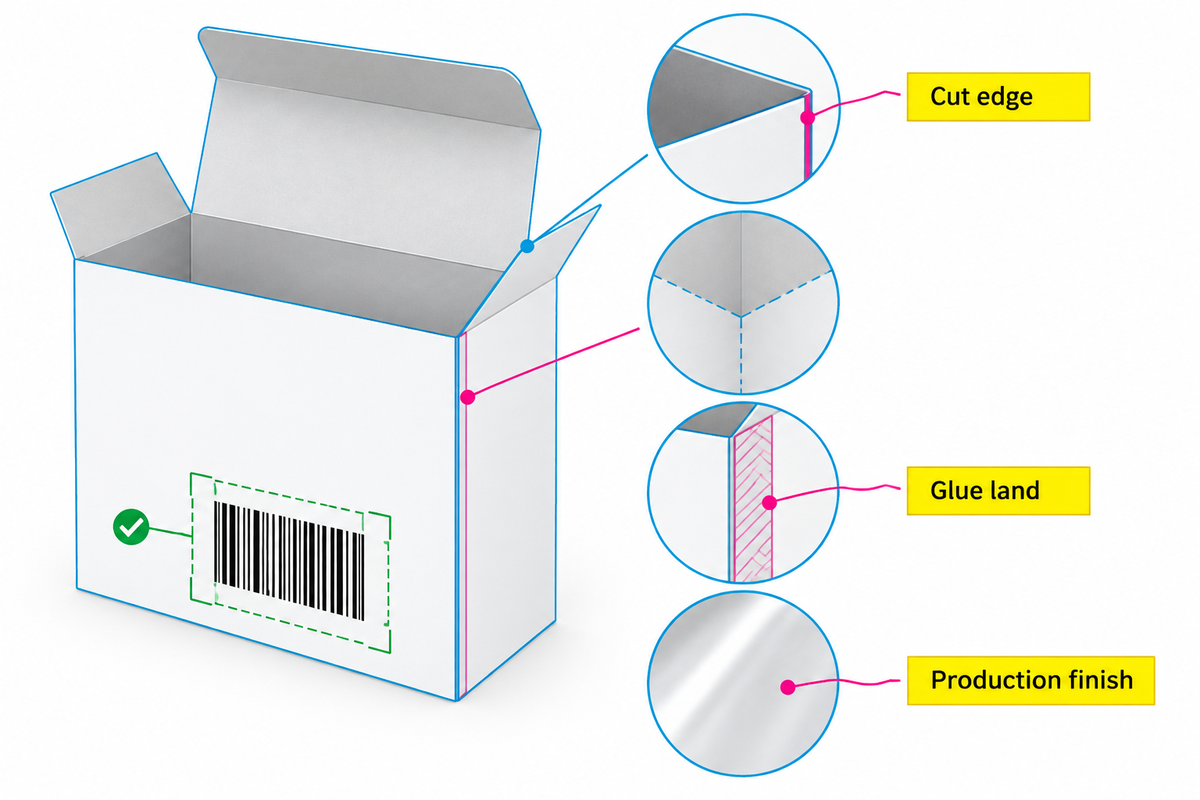
Design the assembled box and then unfold it. Keep important text, bar codes and regulatory marks out of cut edges, creases, glue lands and hidden panels. Extend the background color through a bleed where the printer specifies it, but keep high contrast text in a safe area that survives folding.
When a printed piece drives the brief, a printed corrugated boxes is a good reference. However, the final art still needs to be approved on the assembled die-cut blank.
Finishing changes the structural conversation. UV coating and film lamination affect folding and cracking. Foil, varnish, window patches, and adhesive can affect recycling. A coated crease can appear clean on a digital proof and whiten or split on the stock. Ask which side is printed, which side is folded in, and whether the same finish and curing conditions were used.
Huandao’s supplied facts state that the process included in-house prepress, sheetfed offset, UV coating and lamination, die-cutting, and folder-gluing. They state job-specific ECT, burst, ink-rub and basis weight reports. Those belong to the process discussion and shouldn’t be used as a universal certificate or promise that a report approves distribution.
Die Cut vs RSC Boxes: Compare the Whole Packing Job
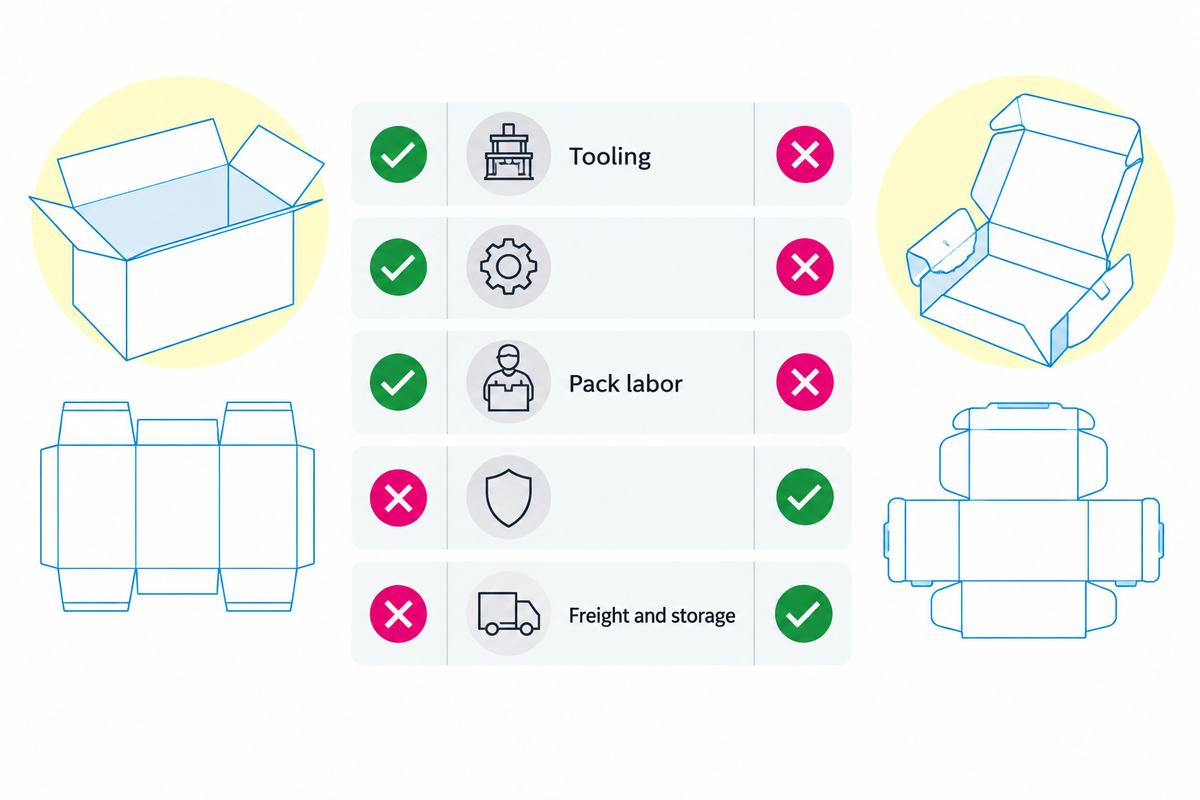
A regular slot container can be a good option when the product can fit in a rectangular shipper and uses standard flaps secured with tape or staples. The FEFCO Code documents the relevant construction or test context. Complexity in a structure earns its right when it simplifies or improves packaging, increases product retention, or creates a useful opening. For some packages, it may be the only way to solve the problem of packing an irregular product without adding a bigger problem down the line. Sometimes comparing the cost of the blank alone may not tell the whole story; compare the job when the box is delivered.
Compare standard boxes with die cut shipping boxes and custom box packaging when packed on the same product. Blank cost may shift the cost burden to tape, labor, or product inserts and increase damage.
| Cost or risk field | Question to put in the quote | Why it changes the decision |
|---|---|---|
| Tooling | Is the die new, reusable, owned by whom, and what changes trigger a remake? | Fixed cost can be spread across repeats, but a structural revision can reset it. |
| Setup and waste | How are make-ready, nesting, trim and spoilage handled? | A lower unit price can hide a high first-run setup or waste allowance. |
| Pack labor | How long does erecting, loading, closing and taping take? | An auto-bottom can save labor in one line and complicate another. |
| Protection | What insert, clearance and stacking condition are included? | A cheaper box that causes damage or rework is not cheaper. |
| Freight and storage | Are boxes shipped flat, assembled or consolidated with inserts? | Volume, pallet pattern and inventory days can dominate the paper cost. |
Here’s a transparent arithmetic example, with assumptions stated before the numbers: assume a $300 tooling charge, a $0.60 variable box cost, no tax, freight, storage or assembly charge, and a repeatable die. At 500 boxes, tooling allocation is $0.60 each and the illustrative total is $1.20; at 2,000, allocation is $0.15 and total $0.75; at 10,000, allocation is $0.03 and total $0.63. These aren’t Huandao prices or a market benchmark. They show why quantity and repeat orders matter, and why the quote should list tooling and variable conversion separately.
Prototype Failures: Fix Fit, Cracks and Closures
Don’t patch a failed prototype by changing three variables in one trial. Capture the failure with a photo. Make a mark on the dieline to denote the revision, and identify the stock and finish. Repeat the test with a single variable change. The primary shifted-flap study found a notable reduction in the static load-bearing capacity of the test samples constructed with the offset-flap closure. The published compression study documents the relevant construction or test context. The study also showed that the closure’s performance is variable with respect to grade and geometry. Thus, a load path closure offset from the primary load path doesn’t mean that closure is defective.
First-Run Fault Finder
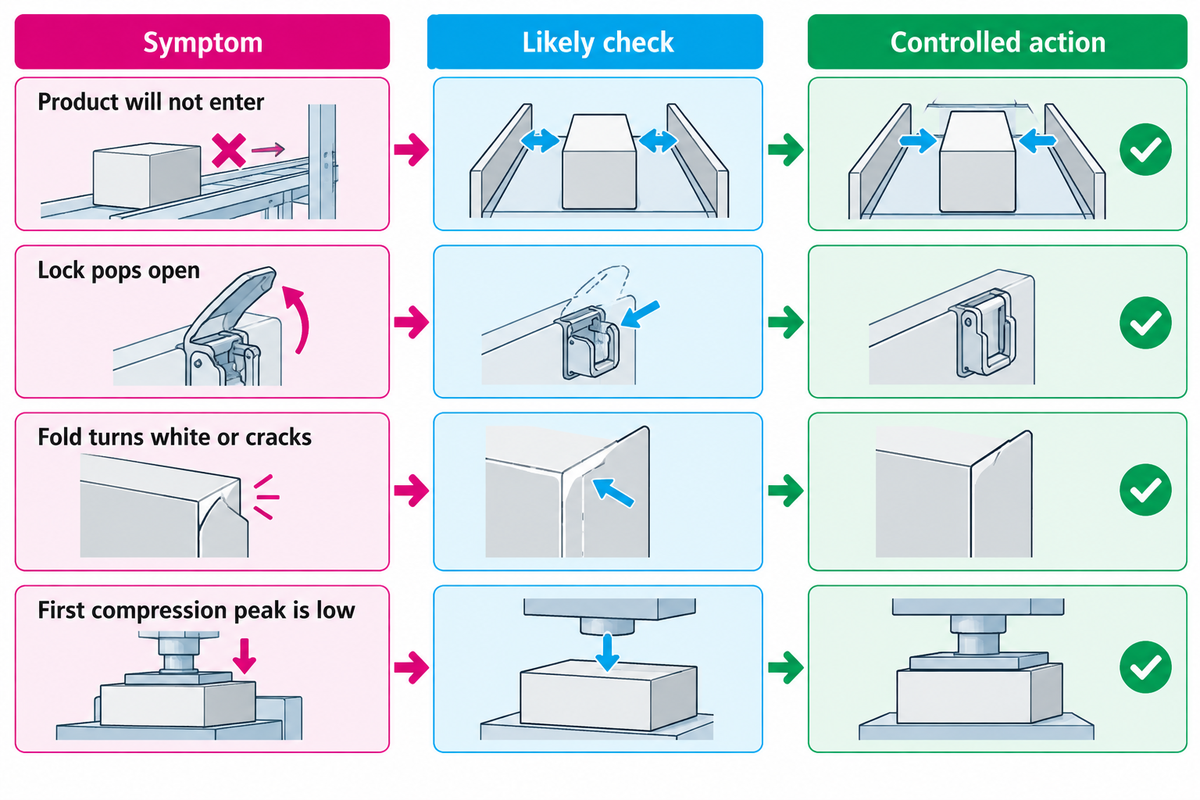
| Observed symptom | Likely checks | Next controlled action |
|---|---|---|
| Product will not enter | Internal versus external dimensions, insert interference, glue flap and fold sequence. FEFCO testing recommendations documents the relevant construction or test context. | Mark the contact point on the blank; adjust one clearance and re-sample. |
| Lock pops open | Tuck length, slot width, board caliper, scoring depth and loading direction. | Test the closure empty and loaded; do not solve a structural collision with extra glue. |
| Fold turns white or cracks | Grain/flute direction, coating, moisture, crease rule/channel and folding radius. | Compare an uncoated or correctly scored control on the intended production stock. |
| First compression peak is low | Shifted creases, which walls load first, geometry, openings, board direction and assembly. | Run a finished-box test with the actual dimensions and conditioning; do not rank by ECT alone. |
| Window lifts | Patch adhesive, dust, coating, cure and the radius around the cut-out. | Use the same patch construction in the press-run sample and inspect after flexing. |
| Artwork crosses a seam | Flat-to-assembled mapping, bleed, safe zone and glue-land position. | Approve the folded print proof, not only the flat artwork PDF. |
| Box varies between lots | Board conditioning, caliper, tooling wear, rule height, machine setup and sample method. | Write a lot-level acceptance plan and retain the blank revision with the report. |
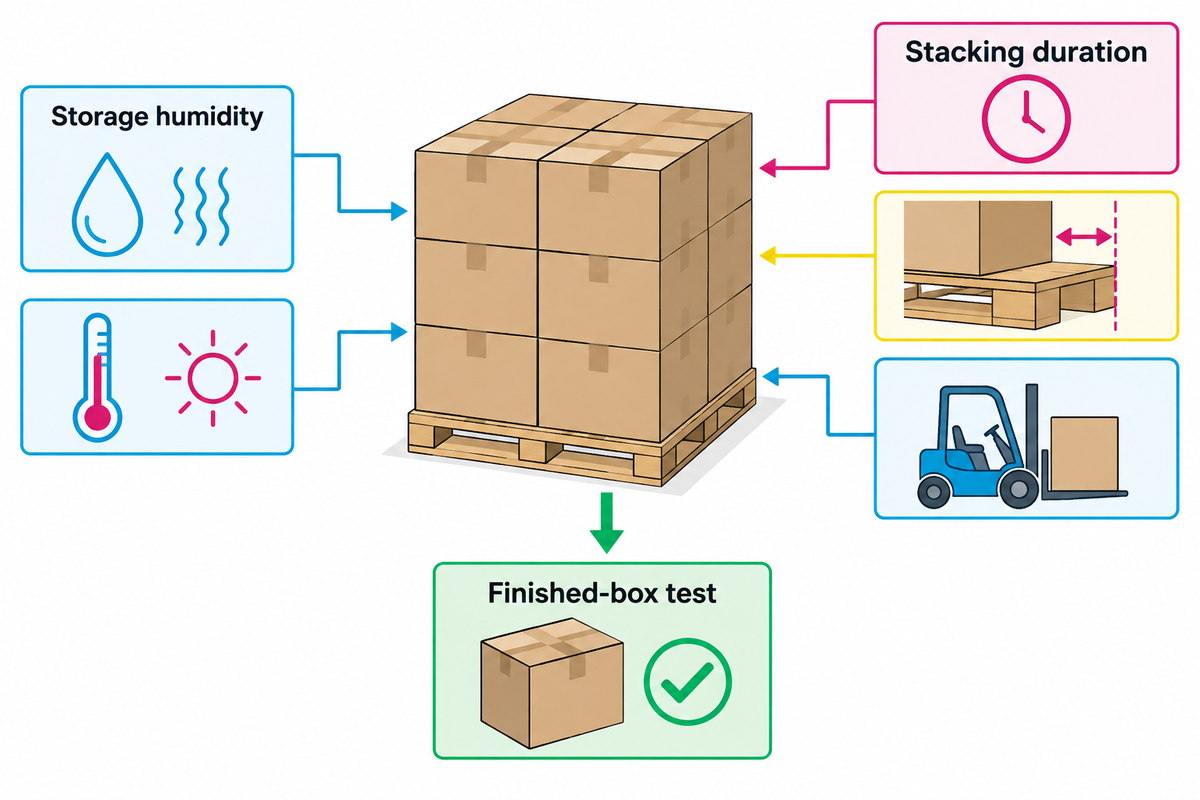
Environment belongs in the test brief. Corrugated paper is hygroscopic and anisotropic. Storage and transport conditions such as humidity and temperature, the duration of storage, how the pallets are overhung, and how the paper is handled can all affect the results. Request the acceptance and conditioning methods rather than copying a figure from a dry lab into a shipping promise.
Die cut box inserts and dispenser boxes should be tested in conjunction with the product, because cardboard packaging may behave differently if an insert alters the load path. These boxes provide protection only if the insert, closure and board work in unison as a system.
Recycling: Plan What Happens After Unpacking
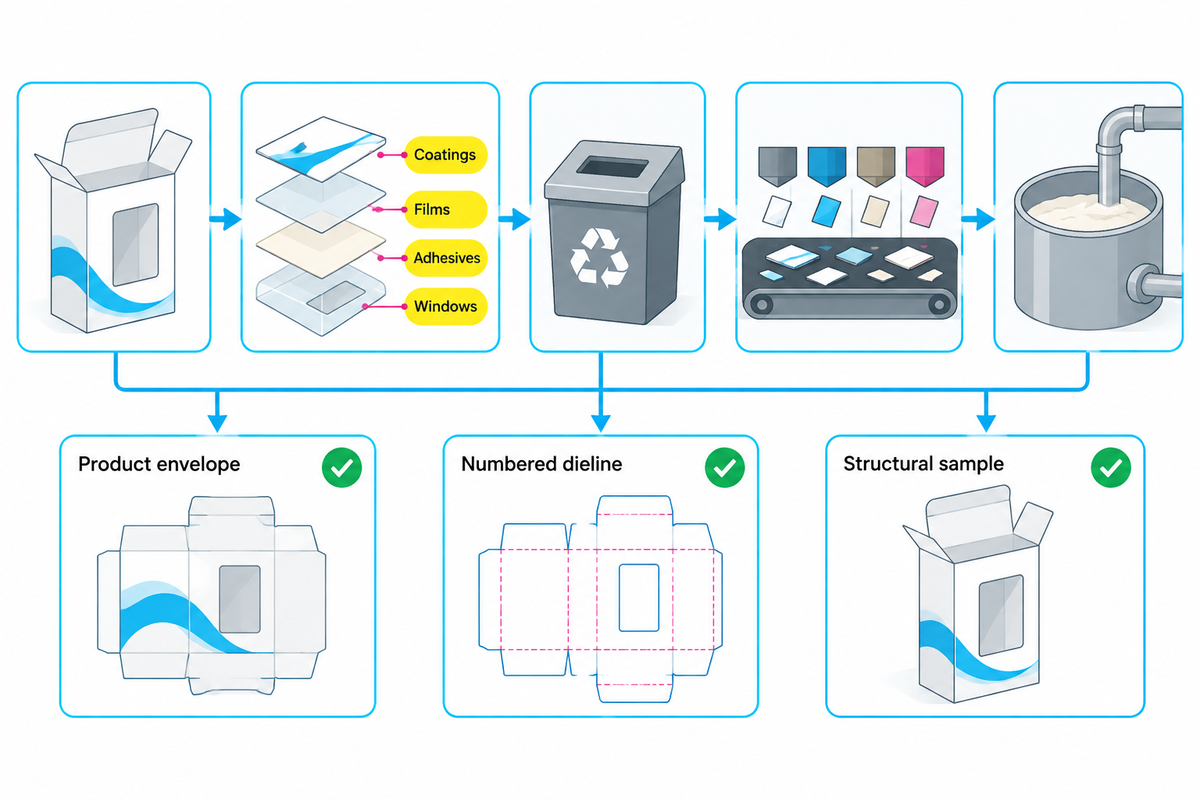
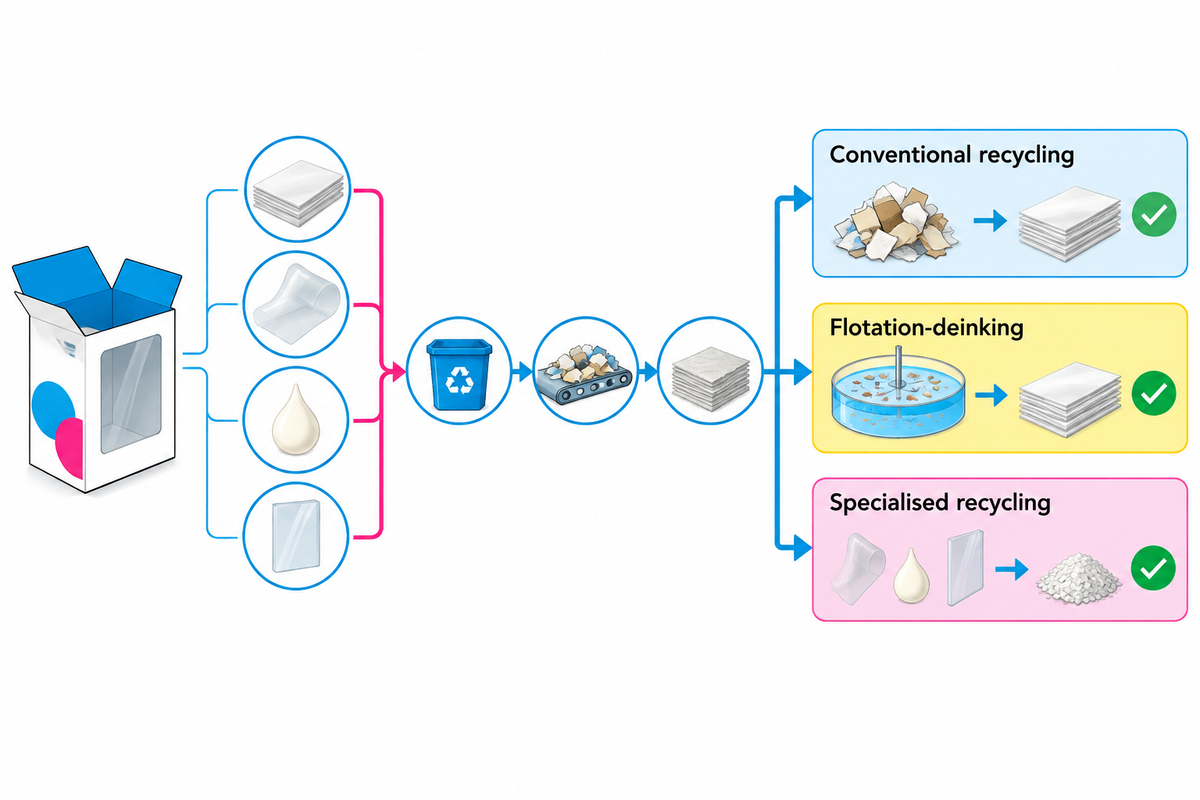
“Paper-based” is a starting point and shouldn’t be assumed to be the final result. The FEFCO Code documents the relevant construction or test context. The 4evergreen Circularity by Design Guideline, version 4 (2026), includes other pathways, and adds a chapter on disruption of sorting. Coatings, laminations, and adhesives can behave differently in different systems. A feature may be appropriate for one route and need a different design or test for another.
The brief should include the targeted market and collection system. Non-paper components should be identified, and the converter should be questioned about whether they remain attached through the various phases of the collection and sorting system. The converter should be required to provide a relevant test protocol and/or pathway statement. A blanket claim that a box with a coating, laminate or window is recyclable shouldn’t be allowed based on one guideline. Discipline should be extended to the buyer to help prevent an attractive finish that later creates contamination, delamination or sorting problems.
Questions Buyers Ask About Custom Die Cut Boxes
Are custom die cut boxes worth it?
They can be worth it when a shaped structure removes packing labor, protects an irregular product, improves presentation or reduces void. The FEFCO Code provides the relevant construction context for comparing box styles. Compare tooling, conversion, labor, damage, freight and repeat quantity instead of judging the blank price alone.
Can a die cut box have spot UV or embossing?
Yes, when the board, artwork, finishing sequence and fold map support it. Keep the effect away from critical creases and glue lands until a production-representative sample confirms the result.
Are printed die cut boxes durable?
Yes, they can be durable when the paper or corrugated structure, geometry, closure, finish, environment and distribution load are matched. Printing alone neither strengthens nor weakens every box; the finished construction must be checked.
How large should a die be?
Die size follows the blank, margins, cutting equipment and layout. The supplier should confirm the tool against the actual blank revision and stock; a generic maximum isn’t a safe specification.
Why do small quantities cost more?
Tooling, setup, proofing and make-ready are spread over fewer pieces. A short digital or sample route can reduce tooling for a prototype, while a repeat production die may lower unit allocation at larger quantities.
Can I approve a white sample for color?
No. A white structural sample is useful for fit and motion, but it can’t approve print color, coating, lamination or artwork registration. Use a digital print or press-run sample for those decisions.
Can die cutting replace a rigid gift box?
Sometimes a shaped folding carton or corrugated presentation pack can meet the job, but a rigid wrapped box has a different construction and feel. Compare protection, appearance, assembly and end-of-life requirements before changing families.
From the Guide to Your Own Packaging Brief
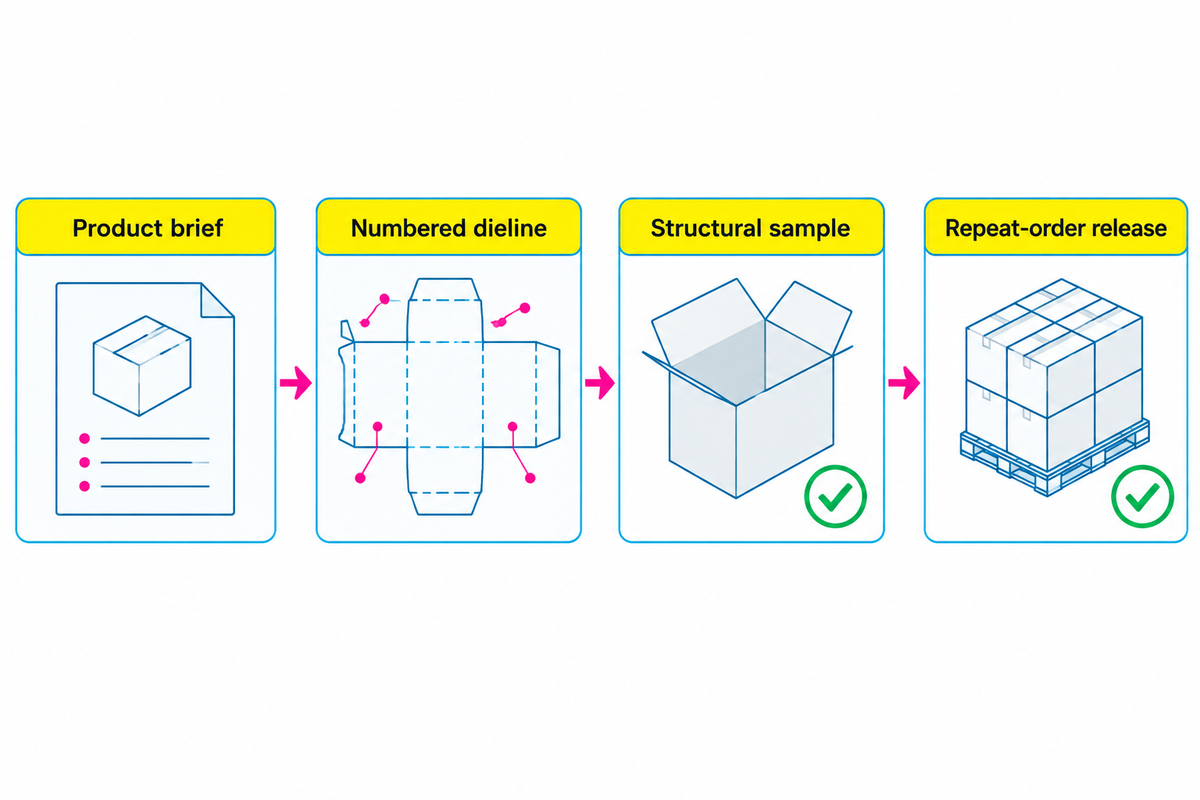
The first review should include the product envelope, packed orientation, opening motion, distribution route, anticipated environment, target quantity, artwork, finish and insert plan. A numbered dieline and a structural sample should be provided. A quote should indicate an understanding of tooling, conversion, assembly, freight and the assumptions being made for repeat orders. Window or coated components should have a recovery pathway defined.
A packaging company can evaluate high-quality custom samples to compare effective packaging options. The sample is evidence only for the tested construction. Customized packaging and a named finish don’t eliminate the requirement for a board, load and recycling brief.
Huandao Packaging’s own facility combines prepress, sheetfed offset printing, coating and lamination, die-cutting and folder-gluing, with group supply available for related trays, inserts and outer shipping cartons. With these capabilities, a consolidated packaging brief is possible, but the correct structure still comes from the product, packing line and distribution. Start with the blank, and then make the commercial decision after testing the folds.
References & Sources
- FEFCO Code — construction communication system and 12th-version notice.
- FEFCO Production Process and Testing Methods — converting sequence and test-method scope.
- Mrówczyński, Garbowski and Knitter-Piątkowska, Estimation of the Compressive Strength of Corrugated Board Boxes with Shifted Creases on the Flaps — measured study; values apply to its stated samples and BCT setup.
- BioResources, Controlling the folding of the blank and Combined effect of thickness and mould clearance — tested paperboard tray-forming conditions, not universal carton tolerances.
- Fibre Box Association, What is Corrugated? — directional flute and style explanation.
- 4evergreen Circularity by Design Guideline — Version 4 (2026), pathway-specific circularity guidance.
Company capability statements in this guide come from the supplied Huandao brief and are not independent certification or customer-case evidence.
HUANDAO PACKAGING INSIGHTS
About Huandao Packaging Insights
Huandao Packaging manufactures folding cartons, litho-laminated printed boxes and rigid gift boxes, and also supplies paper bags, retail displays and protective inserts.
Our guides help buyers compare packaging options and prepare a clearer brief before requesting a quote.
Packaging families
Board, print and finish
Artwork, dieline and sample review
Delivery planning
PROJECT DISCUSSION
Talk with the Huandao Team
- Company
- Xiamen Huandao Packaging Technology Co., Ltd.
- Quote input
- Dimensions, filled weight, quantity, artwork or dieline, finish and destination.
- Review scope
- Box, insert and delivery requirements.
- Next step
- Bring the available details to a packaging conversation.