Get in Touch with Xiamen Huandao Packaging Technology Co., Ltd.

Updated November 2026
Food Folding Cartons are printed paperboard packs that protect, present or group food products, but the phrase covers two different jobs. Within food packaging, folding cartons for food may surround a sealed pouch, tray, bottle or bag as secondary packaging. They may also form part of the food-contact construction. That boundary modifies the board, coating, ink, adhesive and evidence in the brief.
For food and beverage projects, the useful starting point is the product and its route, not a generic board name. Compare packaging options only after fixing what touches the food, the exposure, the filling and display mechanics, and the distribution system; the best folding carton is the one that fits those conditions. The rest of the packaging design can then follow these conditions.
Food Folding Cartons use a foldable paperboard structure for retail packaging or as one layer of a food pack. Specify contact role, exposure, filling, display and distribution before choosing board, barrier, print or box style.
Quick specification rules
- Direct food contact and indirect food contact require different material and authorization checks.
- Grammage, caliper, stiffness, surface and barrier are separate paperboard properties.
- A decorated sample approves appearance; production records belong to the actual job.
- A retail carton doesn’t automatically replace corrugated packaging for distribution.
- Compare quotations only after every supplier receives the same component and delivery scope.
What Are Food Folding Cartons and What Do They Contact?
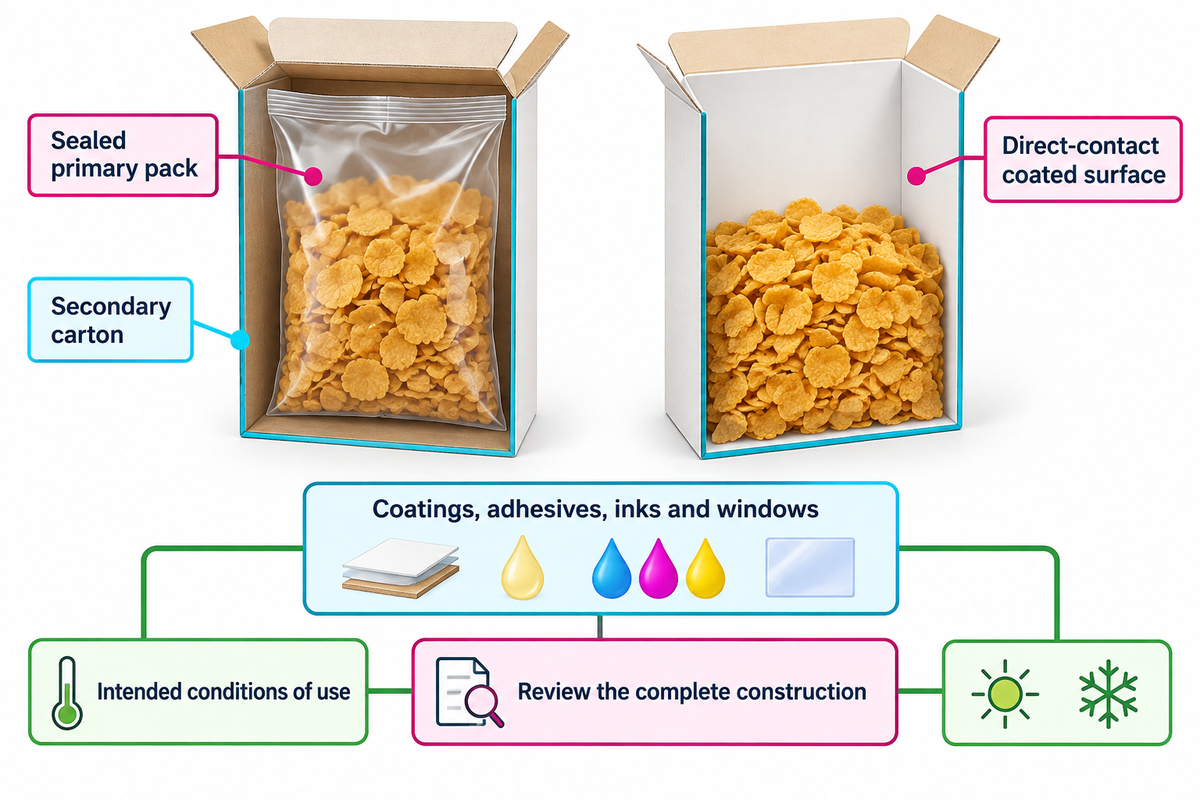
A food folding carton is a cut, creased and usually printed paperboard package used as a retail carton or food container or as an outer package surrounding a sealed primary package. In custom packaging, classify the contact path before dealing with product packaging as a graphics exercise. The complete food contact article comprises all substances which might reasonably migrate under the intended conditions of use.
What is a folding carton box?
A folding carton box starts as a flat custom paperboard blank, so carton design and folding carton design decisions must be checked on the converted pack. Creases define the folds, cuts define the outline, and a glue seam or tuck flaps hold the erected shape. The Paperboard Packaging Council describes folding cartons as flat-shipped paperboard packaging commonly made from 10–36 point board. Huandao’s broader custom folding cartons guide explains the structure without classifying the folding carton in a food-contact role.
For product specifications and customization options, see food folding cartons.
Package layers provide answers to various questions. The primary layer houses the food. Secondary packaging groups, displays or protects the primary pack. A corrugated shipper can provide a third distribution layer. Cereal boxes around sealed liners therefore have a different contact path from a folding food box whose coated surface directly holds the product. The same applies to custom cartons and custom printed boxes.
Custom folding carton packaging and wider custom packaging solutions describe a supply format, not a food contact decision. The assessment is based on the total construction and the intended conditions.
“The overall regulatory status of a food contact material is dictated by the regulatory status of each individual substance that comprises the article.”
That FDA rule reaches coatings, adhesives, inks and windows when their use can contribute substances to food. Components used in compliance with 21 CFR 174–179 need no further FDA review, while other routes can include generally recognized as safe status, prior sanction, a threshold exemption or an effective Food Contact Substance Notification. “Food grade” on a board name cannot replace the construction-level review.
Turn Food and Distribution Conditions into a Carton Brief
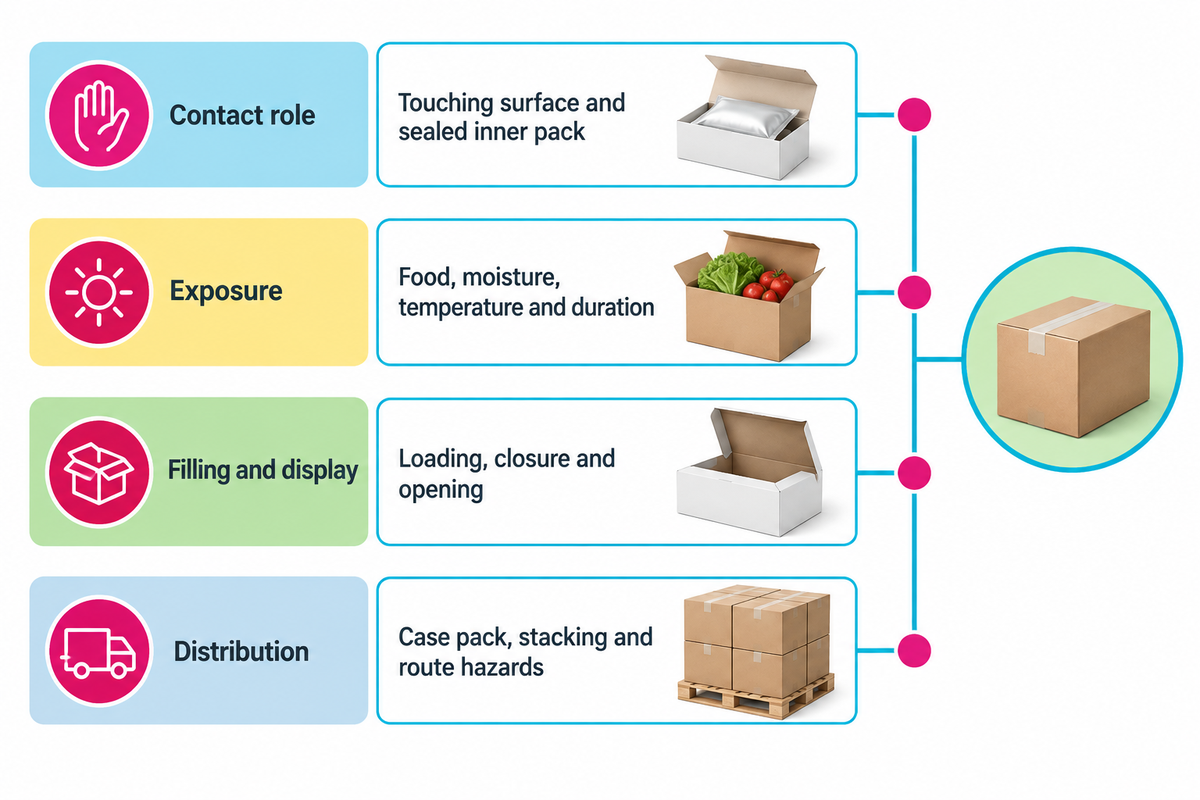
Define the food and distribution route before discussing graphics or a standard folding carton style. Record contact role, exposure to food and the environment, filling and display, and distribution. Those conditions become inputs for material choice, structure, sampling and testing.
This sequence stops a common error: approving artwork while the inner pack, temperature route or shipper is still changing. It also separates food safety questions from the ordinary presentation requirements applied to consumer products. The buyer can take each decision to paperboard cartons, flexible packaging, trays and shipping boxes without needing any layer to perform each task. Packaging boxes, like display boxes and mailer boxes, need the same route definition for their assigned tasks though their roles may differ.
- Fix the contact role: state which surface touches food and which sealed pack sits inside the carton.
- Describe the exposure: record food type, grease or moisture, temperature, duration and destination market.
- Map filling and display: give loading direction, closure, equipment, shelf face, opening and retention needs.
- Map distribution: name case pack, stacking, storage, transport route and the hazards the full pack must face.
ISTA advises designers to think about supply-chain hazards and balance them against product vulnerabilities. A pack sold from a shelf, fulfilled through ecommerce or sent directly from a manufacturer may see different orientations and handling. State those packaging needs in your brief, then select the distribution check which reproduces the pertinent risk as opposed to labeling the check with a nondescriptive name.
Common mistake: a buyer selects an attractive recyclable board, then adds a film window, grease barrier and adhesive without revisiting contact status or the destination recycling route. Record the complete build when defining contact role and exposure.
Match Paperboard, Barrier and Structure to the Food
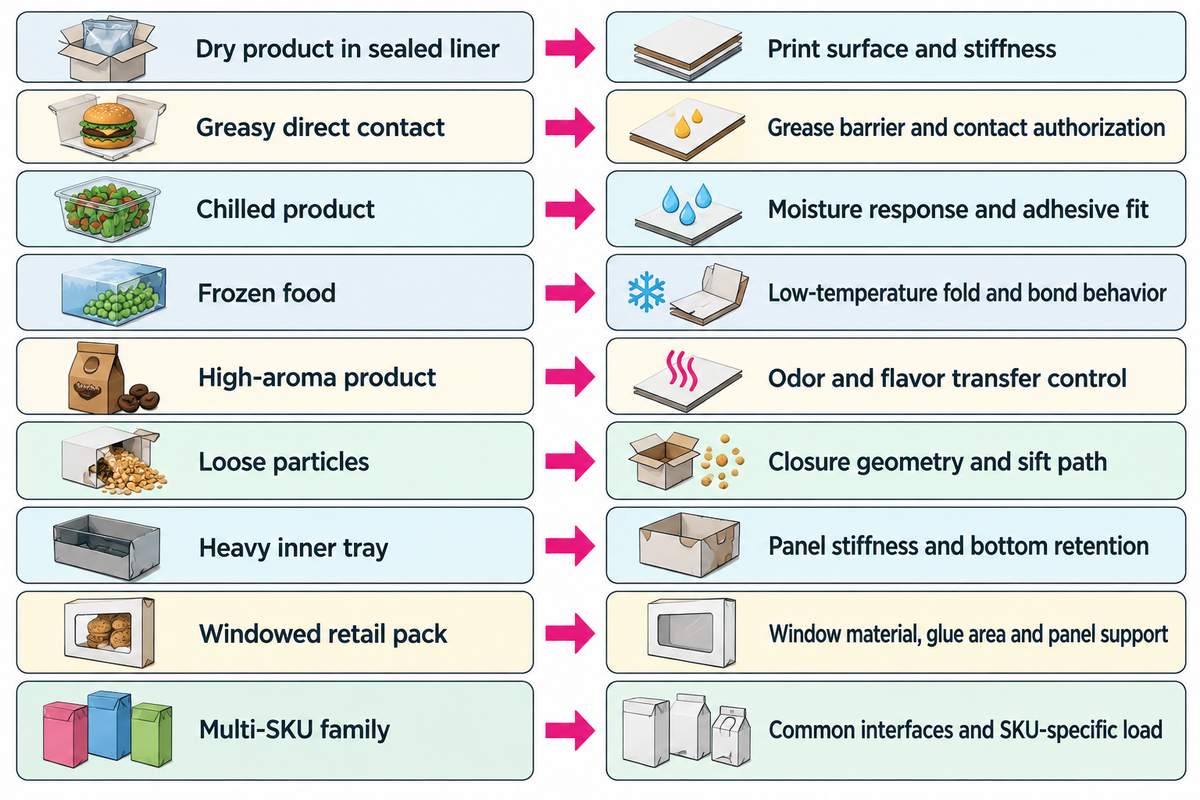
Match board, barrier and structure as one converted package. Grammage reports mass per area; it doesn’t state caliper, stiffness, fold behavior or barrier performance. Start with the exposure, choose a property family, select a carton structure, and test the converted sample under the planned food and packing conditions.
What board GSM should I use for my folding carton?
Specify paperboard GSM together with caliper, stiffness direction, surface, barrier and crease behavior; there’s no universal GSM for every folding carton. A 2023 BioResources review found commonly studied paperboard substrates at 190–350 gsm, bio-based coatings at 1–21 gsm and plastic extrusion references starting at 17 gsm. These are research ranges, not buying recommendations.
190–350 gsmstudied paperboard substrates
1–21 gsmbio-based coatings in the review
17 gsmlowest extrusion reference reported
In the same review, average stretch at break in the machine direction (2.0-2.5%) is less than in the cross direction (5.0-7.0%). This may partially explain the difference in coating behavior and creasing after rotation.
| Food or use condition | First property to define | Structure or sample question | Evidence to keep |
|---|---|---|---|
| Dry product in sealed liner | Print surface and stiffness | Does the liner fit without distorting panels? | Approved structure and board identification |
| Greasy direct contact | Grease barrier and contact authorization | Do folds and glue zones preserve the barrier? | Complete construction and intended-use basis |
| Chilled product | Moisture response and adhesive fit | Does condensation reach the board? | Conditioned sample result |
| Frozen food | Low-temperature fold and bond behavior | Does the carton crack during packing or opening? | Temperature and dwell conditions |
| High-aroma product | Odor and flavor transfer control | Which layer isolates the food? | Material and exposure record |
| Loose particles | Closure geometry and sift path | Can product escape through seams? | Filled sample and closure revision |
| Heavy inner tray | Panel stiffness and bottom retention | Does the base hold through handling? | Filled-pack check |
| Windowed retail pack | Window material, glue area and panel support | Does the opening weaken the display panel? | Decorated structural sample |
| Multi-SKU family | Common interfaces and SKU-specific load | Which changes require a new dieline or sample? | Revision-controlled specification |
Creasing, folding and forming can damage barrier and pigment coatings even when the flat sheet performs well; review those coatings at the fold, glue seam, window edge and closure on the decorated carton.
Compare Folding Cartons with Corrugated, Rigid, Flexible and Plastic Packs
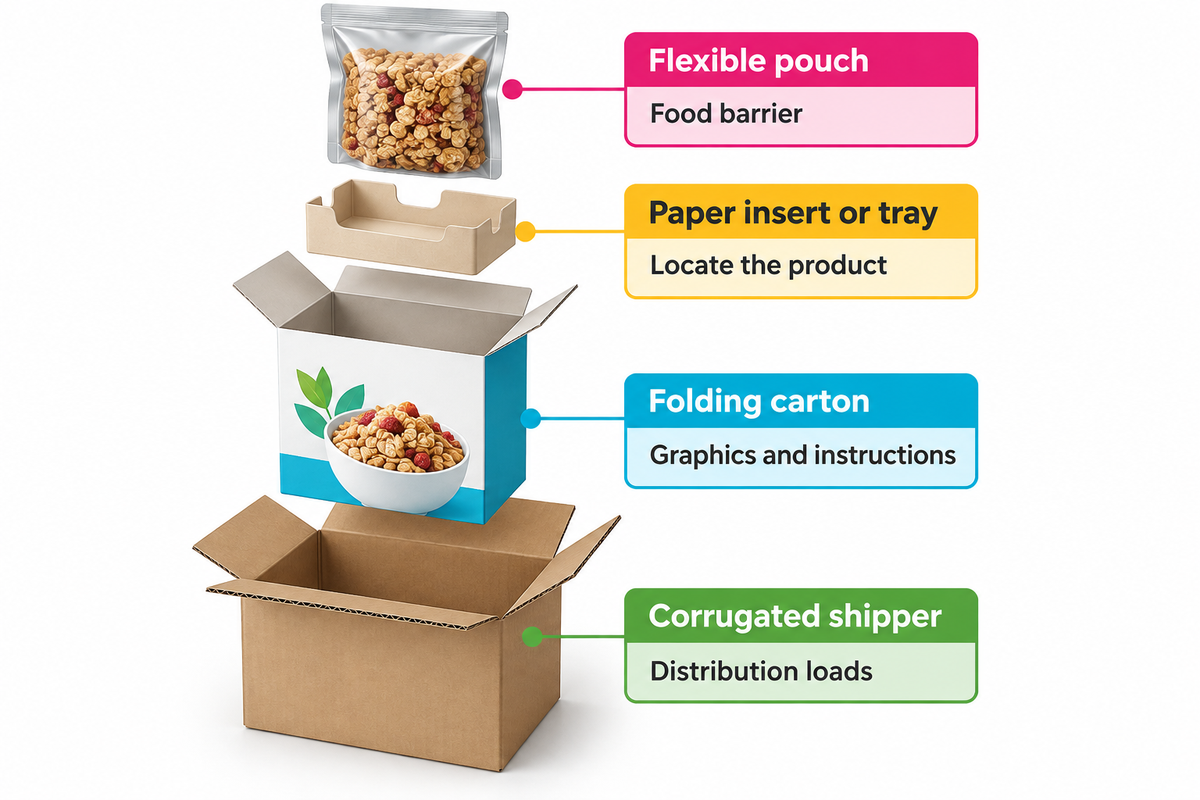
Select the packaging format by system role. Different carton types solve different erection and loading tasks; auto-bottom boxes are one example, not a universal answer. Folding carton packaging solutions provide a printable paperboard shell, usually shipped flat. Corrugated adds a fluted structure to cases and reinforced retail packs. Rigid, flexible and plastic formats solve different presentation, barrier, shape, and handling tasks. No format wins every situation.
A retail shelf pack for a retail product can use more than one format. A pouch may provide the food barrier, a folding box may carry graphics and instructions, an insert may locate the product, and a corrugated case may take distribution loads. Comparing only the visible food boxes hides the work assigned to the other layers.
| Format or layer | Construction cue | Useful role | Do not assume |
|---|---|---|---|
| Standard folding carton | Creased solid paperboard | Retail graphics, information and light containment | Full shipping protection |
| Auto-bottom carton | Pre-glued folding base | Faster manual erection | Universal bottom load rating |
| Litho-laminated microflute | Printed liner on corrugate | Reinforced display or retail pack | Same fold detail as solid board |
| Corrugated shipper | Fluted medium between liners | Distribution case and stacking unit | Direct food contact authorization |
| Rigid box | Set-up board with a wrap | Premium presentation and reuse | Flat shipment or low assembly work |
| Flexible pouch | Film, foil or paper laminate | Barrier and low empty-pack mass | Self-supporting shelf panels |
| Plastic container | Molded tub, tray or bottle | Shape retention and primary containment | Paper recovery route |
| Paper insert or tray | Die-cut or formed fibre component | Positioning, separation and presentation | Transit cushioning without validation |
| Outer case plus dividers | Corrugated case system | Group handling and distribution protection | Retail graphics as its main job |
Packaging products for food service packaging or beverage packaging may assign different layers to containment, graphics and distribution. If the product requires a direct contact barrier, that layer must be shown. If impact protection belongs to the shipper, that case and divider must be shown and the pack quantity must be stated in the packaging requirements. A single material comparison can’t replace the system diagram.
Specify Printing and Finishing for the Actual Handling Route
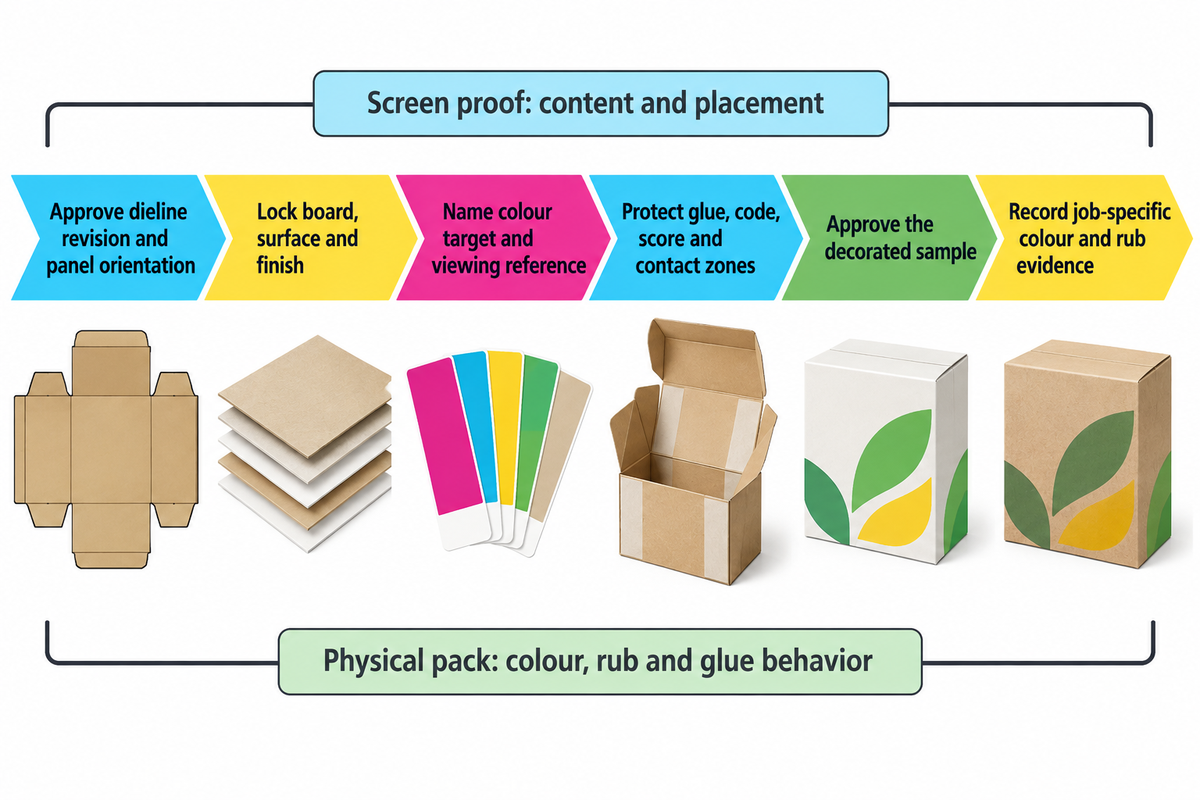
Bind colour and finish approval to one substrate, one print build, one finish build and one viewing reference. Add the handling exposure the printed cartons will be subjected to. Print and packaging approval must be bound together. A screen proof can approve content and placement, but production colour, rub resistance and glue behavior must be approved on the decorated physical pack.
How do I ensure color consistency across print runs or substrates?
Set one colour target and name the substrate, coating or lamination, print process and viewing condition used for approval. ISO 3664:2025 covers reference viewing conditions for graphic technology and excludes soft-proofing displays. That boundary is why a monitor image cannot become the only approval reference for custom printed packaging.
Keep artwork controls separate from production evidence. The artwork file handoff guide covers dielines, bleeds, fonts, images, colors and finishing. A signed colour proof or agreed production sheet then carries the visible standard into carton production.
Handling determines the rub check. TAPPI T 830 descriptions distinguish dry rub, wet rub, wet bleed or transfer, wet smear and functional rub. State the condition and acceptance criterion in the job specification. This is where packaging and retail requirements meet the production record.
Artwork-to-production handoff
- Approve the dieline revision and panel orientation.
- Lock the board, surface and finish build.
- Name the colour target and viewing reference.
- Protect glue, code, score and food-contact zones in the artwork.
- Approve a decorated sample for appearance and structure.
- Record production colour and rub evidence against the named job.
Huandao states that prepress, sheetfed offset printing, ultraviolet coating, lamination, die-cutting and folder-gluing run in its Xiamen plant. That process ownership may shorten the number of hand-offs, but the buyer still needs the approved substrate, reference and acceptance criterion attached to the job. More details on proofs are in the custom printed folding cartons guide.
Validate Food-Contact Layers and Converted Samples
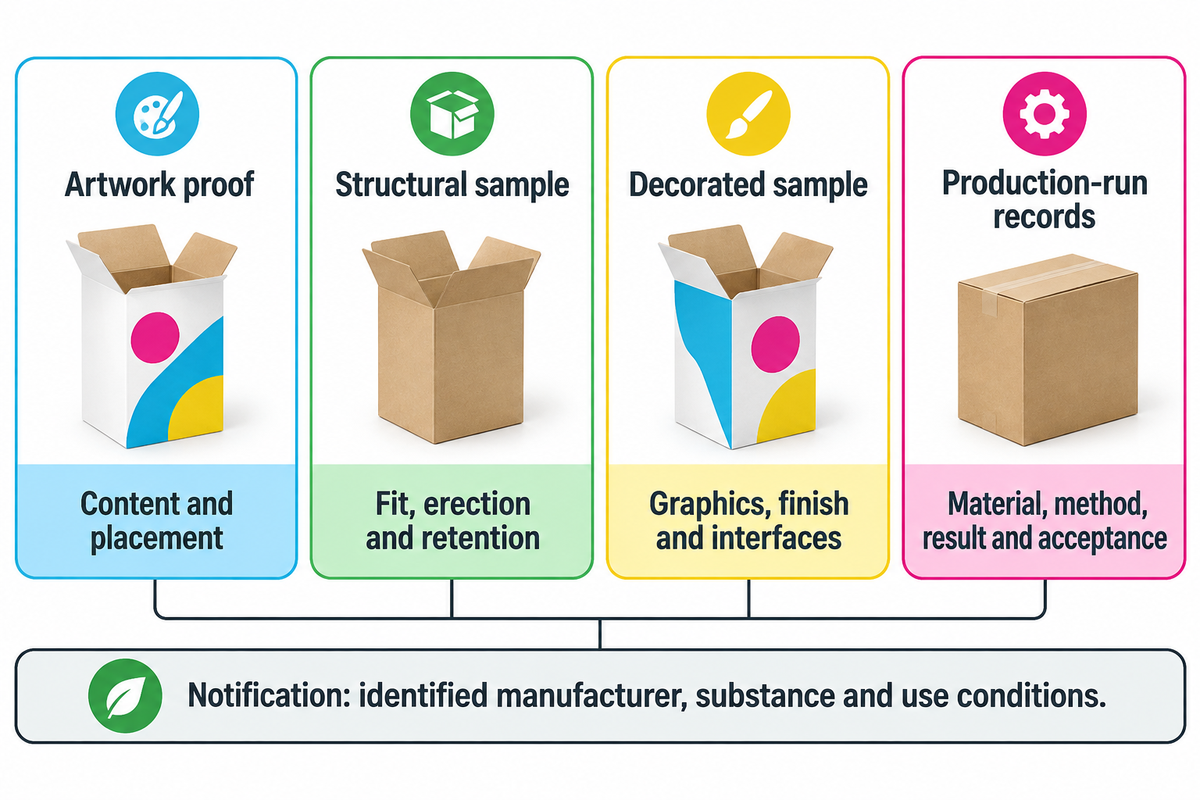
Separately approve artwork, structure, decoration and production record. Digital proofs answer questions related to content and placement. For fit and erection, a structural sample is requested. Decorated samples are requested to answer questions related to appearance and structure. Production run level records define what the factory actually made and measured for the production job.
Paperboard cartons move from prepress and sheet layout to printing, the specified finish, die-cutting, creasing, waste stripping, folding and gluing. Inspection is done as per the approved job plan. Some custom boxes ship flat; pre-glued carton structures are folded and erected at the filling site.
| Approval stage | What it answers | Evidence owner | What remains open |
|---|---|---|---|
| Artwork proof | Text, barcode, images, colour separations and finishing layers | Brand and prepress | Physical fit and converted performance |
| Structural sample | Dimensions, erection, loading, opening and product retention | Structural designer and buyer | Production print and finish |
| Decorated sample | Graphics, finish, fold appearance, window and glue interfaces | Printer, converter and brand | Full-run consistency |
| Production-run records | Named material, method, result, acceptance and release | Factory quality system | Use beyond the recorded job and conditions |
A current authorization must be congruent with the actual component and its use. FDA states that a Food Contact Substance Notification is effective for the identified manufacturer, substance and conditions of use. A similar substance manufactured by a different company does not fall within the scope of the notification. The Federal Register notice 90 FR 653 also shows that listed notifications can become ineffective; the named entries took effect on January 6, 2025, with June 30, 2025 reserved for the listed table-2 existing-stock cases.
Test reports need the same discipline. A 2024 review of paper and board methods found that traditional testing can overestimate and sometimes underestimate migration into food. Read the test method, sample construction and the exposure model, and evaluate the results accordingly. A generic report or laboratory list cannot establish realistic performance for another coating, supplier or contact condition.
The company mentions that process steps are captured in an MES Kanban system, integrated with the ERP and scheduling system. Use the sample-stage guidance to match the question to the sample stage.
Diagnose Cracking, Scuffing, Glue Failure and Transit Damage
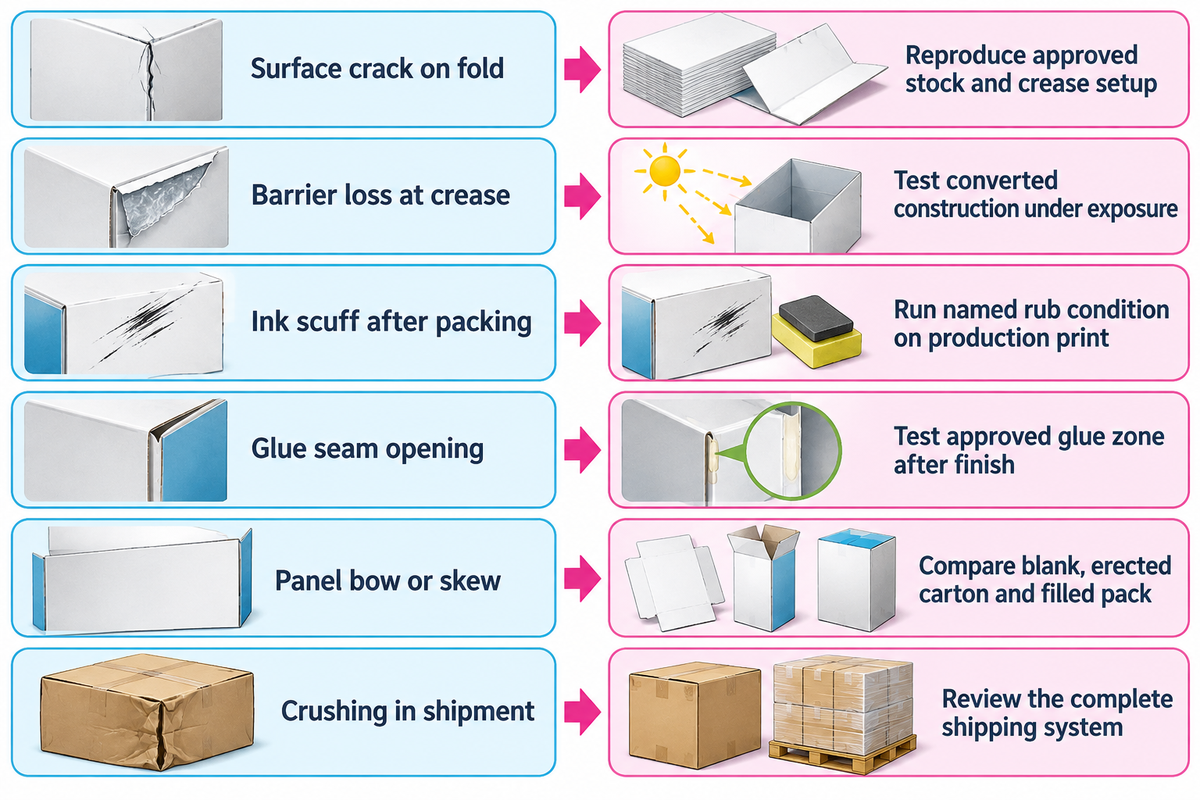
Fold cracking points to board, moisture, grain, crease geometry, coating and the fold route. Scuffing points to ink, finish and handling exposure. Glue failure points to adhesive, surface treatment and application. Transit damage points to the filled pack and distribution system.
A flat coated sheet may pass barrier tests but fail after conversion. The BioResources review states that creasing, folding and forming can damage barrier and pigment coatings. Small cracks may need microscopy even if they reduce barrier properties. Increasing crease pressure isn’t always a solution because the material and groove eventually reach a useful limit beyond which damage can occur.
| Symptom | First checks | Controlled next action |
|---|---|---|
| Surface crack on fold | Board moisture, grain, score position, rule and matrix, coating | Reproduce the fold with the approved stock and crease setup |
| Barrier loss at crease | Coating extensibility and converted fold | Test the converted construction under its exposure |
| Ink scuff after packing | Ink cure, finish, contact surface and dry or wet route | Run the named rub condition on production print |
| Glue seam opening | Adhesive chemistry, viscosity, amount and treated surface | Test the approved glue zone after the specified finish |
| Panel bow or skew | Moisture balance, crease alignment and folding setup | Compare flat blank, erected carton and filled pack |
| Crushing in shipment | Case pack, void, stacking and distribution hazards | Review the complete shipping system before changing board |
Do
- Keep the failed sample and job identity.
- Change one material or process input at a time.
- Reproduce the actual fold, pack-out and handling route.
- Record the correction with the next approved revision.
Don’t
- Do not change the board grade until the failure is located in the filled pack and shipping system.
- Do not add more glue to an incompatible surface.
- Do not blame grain direction without reproducing the fold with the approved board and crease setup.
Set Food-Contact Scope Before Comparing Quotes
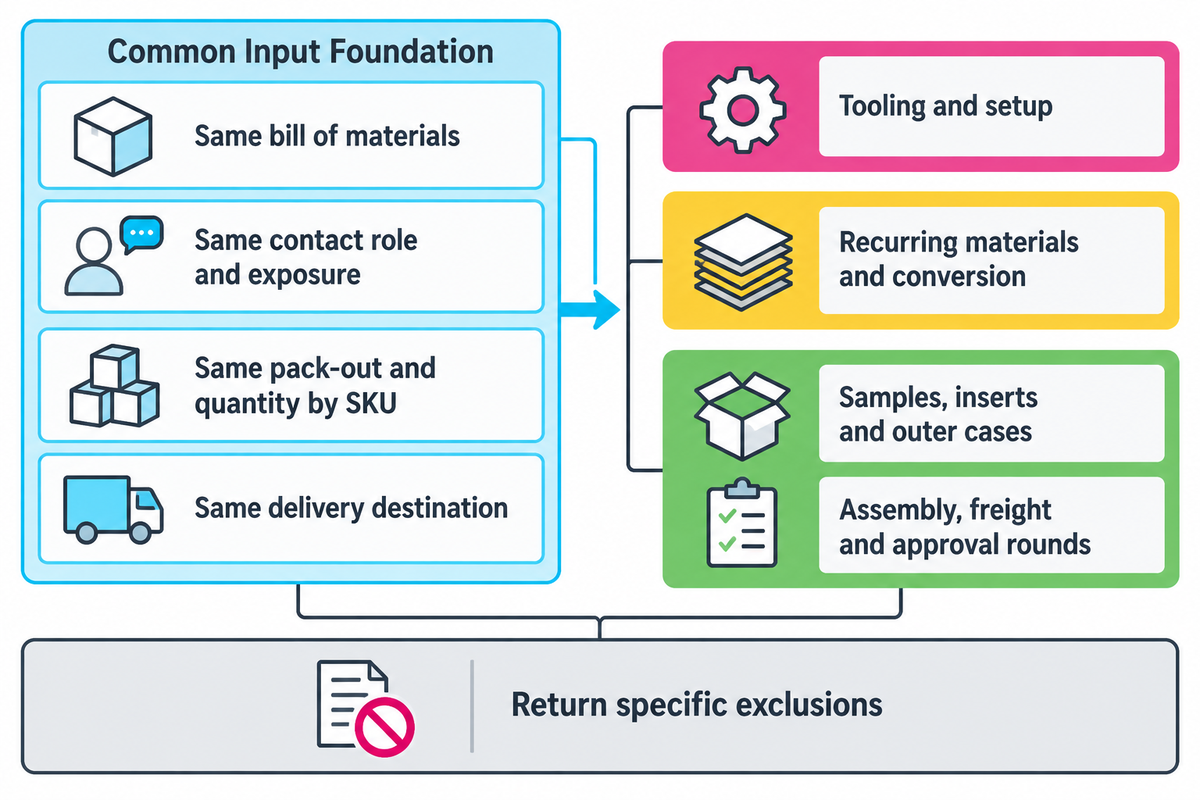
Make food-carton quotations comparable by fixing one bill of materials, one contact role, one exposure, one pack-out plan, one quantity by SKU and one delivery destination. Separate tooling and setup from recurring materials and conversion. Then specify samples, inserts, outer cases, assembly state, freight terms and approval rounds.
| Quote line | What to state | Why it changes the comparison |
|---|---|---|
| Finished carton | Inside dimensions, style, board and assembly state | Defines the recurring unit |
| Artwork versions | Quantity by SKU and language | Splits print setup and stock |
| Tooling | Dieline, die, foil, emboss and ownership | Separates one-time cost |
| Samples | Proof, structural sample, decorated sample and approval rounds | Defines development work |
| Components | Window, tray, insert, divider and outer case | Prevents partial-pack pricing |
| Quality records | Named reports and sampling plan | Prices the requested evidence |
| Packing form | Flat, pre-glued, erected or kit packed | Moves labour between supplier and filler |
| Delivery | Destination, Incoterm and shipment split | Defines freight and responsibility |
| Schedule | Approval milestone, production window and transit | Separates lead-time stages |
Minimum order quantity is a production result rather than a universal characteristic of a carton. Sheet layout, board purchase, print setup, custom die-cut tooling, finish, glue, number of artwork versions and factory loading can move the quoted quantity. Stock boxes and other stock packaging avoid some setup, but may leave unused space or require labels and extra packing work.
An incomplete SKU brief causes rework, and a change in the schedule when finish, artwork, and/or size change after approval. Each supplier should return the same component scope, with its specific exclusions. A low unit price may omit the die, inserts, shippers, testing and/or freight. That’s a different package, and not a cheaper version of the same package.
Check Food-Contact Responsibilities in Supplier Evidence
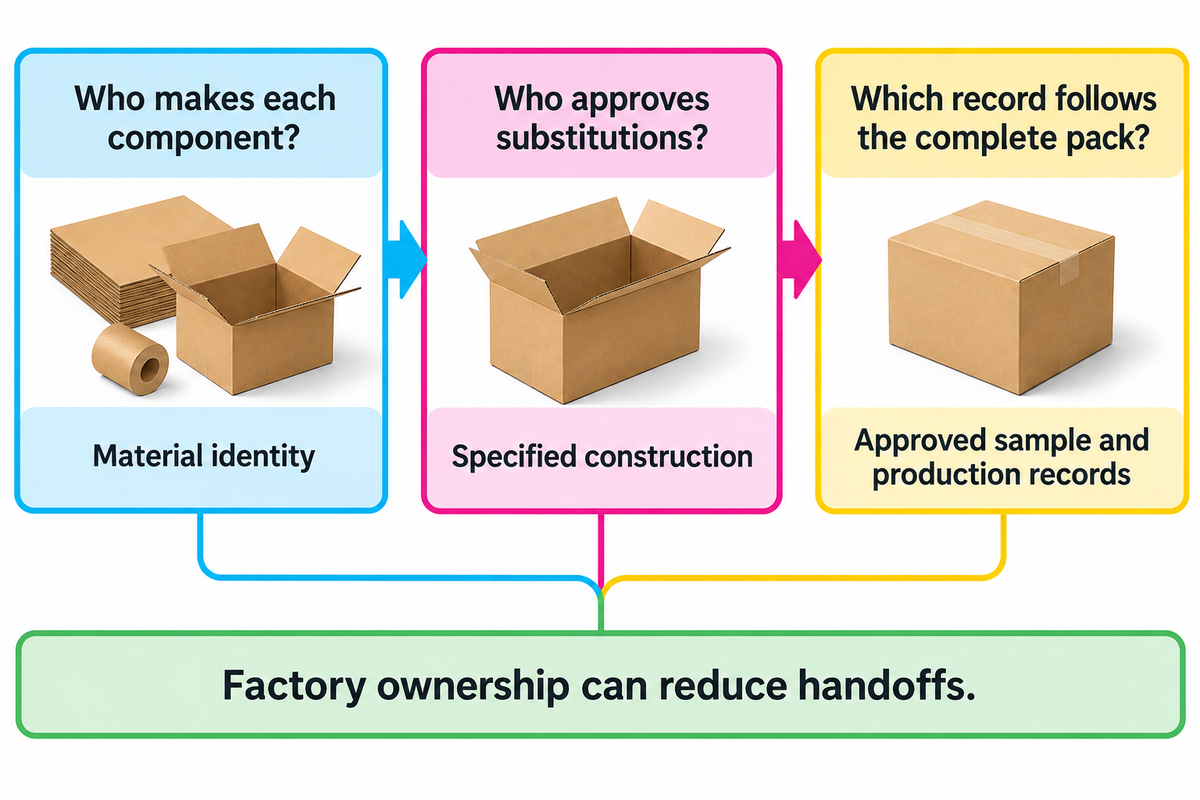
Folding carton manufacturers may provide similar packaging services while controlling different production steps. Factory ownership can reduce handoffs, but the approved sample and production records must identify the actual construction.
Huandao states that Xiamen Huandao Packaging Technology Co., Ltd. was established in 2003 in Xiamen.
The company states that prepress, sheetfed offset printing, ultraviolet coating, lamination, die-cutting and folder-gluing run in-house. The company states that E- and B-flute board is corrugated in-house and converted fresh; flute is selected to the application, including E, B, C and double-wall BC. That boundary matters because material identity, quality evidence and food-contact authorization depend on the specified construction.
The buyer should still name who makes each component, who approves substitutions, and which record follows the complete pack.
Record Food-Contact Conditions for the Supplier Brief
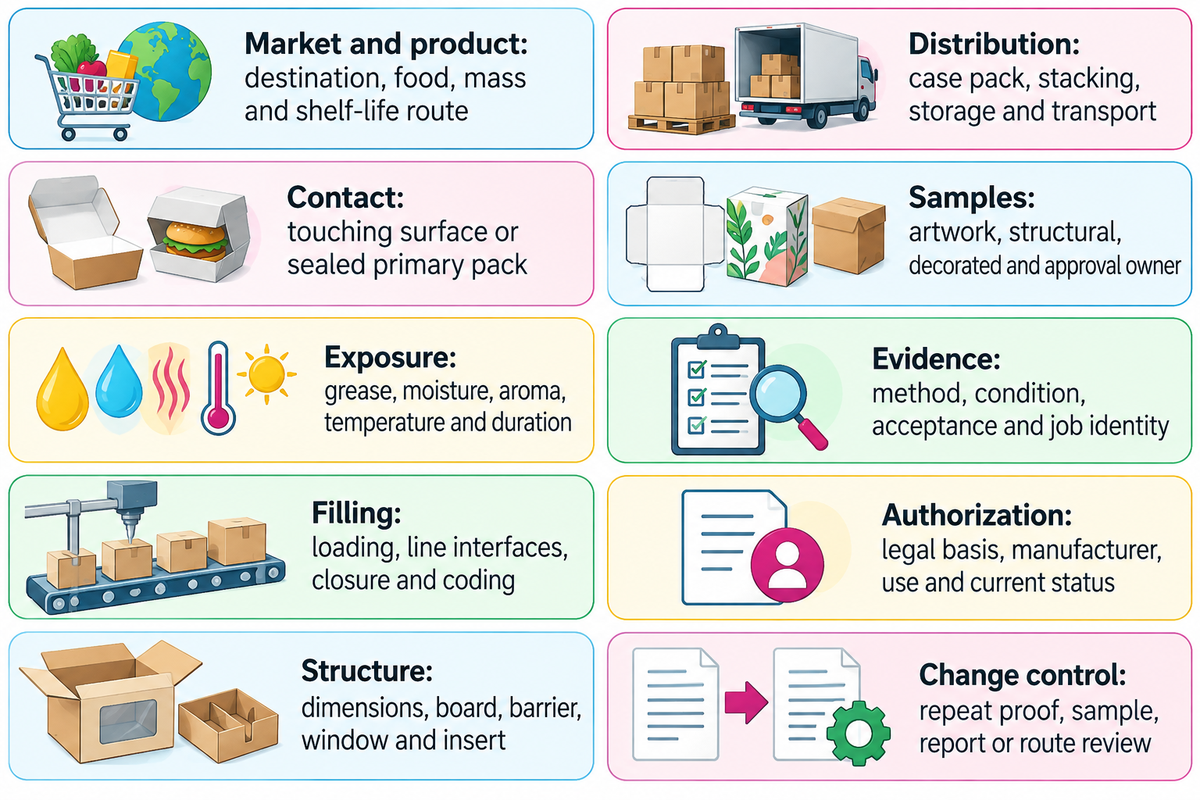
A complete food carton brief freezes the contact role, destination market, food and storage conditions, filling route, structure, graphics, sample stages, run-level evidence, component ownership, and current authorization and delivery scope prior to quoting or production.
Key takeaway
Specify the complete pack and its route, then ask for evidence tied to that construction and job. A board name, generic certificate or attractive sample cannot stand in for those linked decisions.
Copy into your supplier brief
- Market and product: destination country, food description, net mass and shelf-life route.
- Contact: direct-contact surface or sealed primary pack, plus substance and supplier identity where required.
- Exposure: grease, moisture, aroma, temperature, duration, condensation and heating conditions.
- Filling: manual or automatic loading, line interfaces, closure and coding.
- Structure: usable inside dimensions, style, board properties, barrier, window, tray and insert.
- Distribution: units per case, outer case, stacking, storage, transport and destination.
- Samples: artwork proof, structural sample, decorated sample and approval owner.
- Evidence: method, condition, acceptance criterion, sampling and production-job identity.
- Authorization: legal basis, manufacturer identity, conditions of use and current status.
- Change control: inputs that require a new proof, sample, report or distribution review.
The specification worksheet captures these fields as a reusable brief. Keep the approved file with physical samples and job reports so repeat orders can separate an artwork revision from a material, structure or supplier change.
Frequently Asked Questions
Are folding cartons recyclable?
Yes, paperboard folding cartons can enter paper-recovery streams when the local program accepts the complete construction. Windows, barrier layers, adhesives, food residue and mixed materials can change that route. Identify the actual board and components, then use the collection and mill guidance for the destination market instead of applying a blanket recyclable claim.
Are folding food boxes microwave-safe?
Use a folding food box in a microwave only if its complete construction is suitable for the intended heating conditions. Paperboard alone is not enough. Inks, coating, adhesive, window, metallic decoration and food load all matter. A retail carton around a sealed tray does not inherit the tray’s heating instruction.
What is the difference between a straight tuck end and a reverse tuck end box?
A straight tuck end carton places the top and bottom tuck flaps on the same panel side; a reverse tuck end places them on opposite sides. The layout changes nesting, erection and opening behavior. Product loading, display face, closure security and packing direction should decide between these tuck end boxes.
How long does folding carton production take?
Allow a job-specific production lead time after artwork, structure and material approval. Prepress, material availability, printing, finishing, die-cutting, folder-gluing, inspection and freight each add a stage. Compare schedules only when suppliers use the same approval milestone, packaging process and delivery term.
Can I add a window to a food folding carton?
A window can show the product or its primary pack, but it changes panel stiffness, material separation and glue area. Specify contact role, opening size, window material, fogging exposure and display orientation. Test product retention on a structural sample and check glue, visibility and scuffing on the decorated sample.
What is the minimum order quantity for folding carton boxes?
There’s no universal minimum order quantity for folding carton boxes; the job-specific minimum reflects tooling, sheet layout, board purchase, print setup, finish, structure, artwork versions and factory schedule. Ask suppliers to separate setup cost, quantity breaks and repeat-order assumptions so quotations use the same production scope.
Can the supplier support future growth without a packaging redesign?
Retain the approved structure and dieline for growth when they, the artwork controls and the evidence remain usable at planned quantities. Record how repeat orders, artwork revisions, board substitutions, filling lines and component suppliers are controlled. A new product size, barrier need, filling method or shipping route may reopen structural or distribution approval.
Send one complete specification, not six disconnected requests
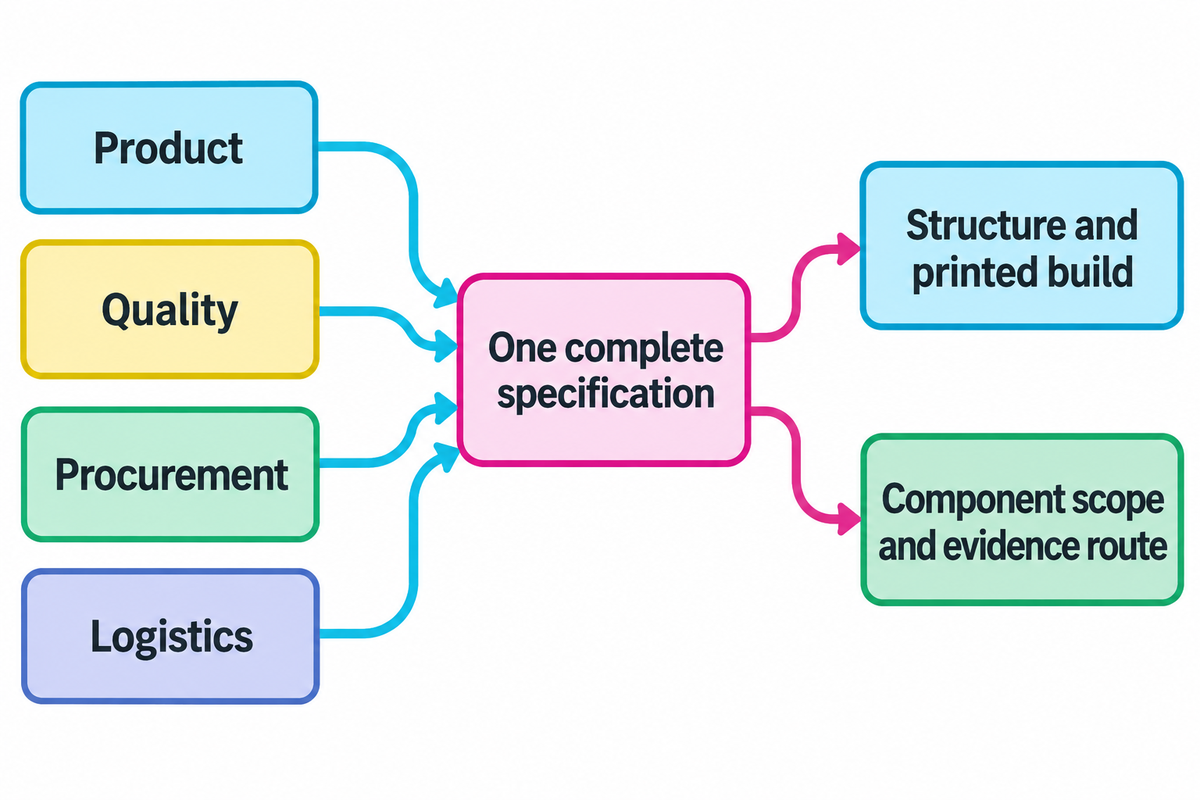
Use the checklist to align product, quality, procurement and logistics before the first sample. Huandao can then review the structure, printed build, component scope and evidence route against the same brief.
Transparency Note: Technical and regulatory statements above link to government, research, standards, and association sites. Information about Huandao’s company, processes and systems comes from Huandao. They do not create a blanket food-contact approval, certification or performance guarantee.
References & Sources
- Determining the Regulatory Status of Components of a Food Contact Material, U.S. Food and Drug Administration
- What is Paperboard Packaging?, Paperboard Packaging Council
- Pick Paperboard Like a Pro, Paperboard Packaging Council
- Getting Started with Design and Testing, International Safe Transit Association
- Converting and Its Effects on Barrier Properties of Coated Packaging Materials: A Review, BioResources, North Carolina State University
- ISO 3664:2025 Viewing Conditions, International Organization for Standardization
- Food Contact Notifications That Are No Longer Effective, 90 FR 653, U.S. Food and Drug Administration
- A Critical Review of Test Methods for Paper and Board Food Contact, National Library of Medicine