Get in Touch with Xiamen Huandao Packaging Technology Co., Ltd.

Printed Paper Bags: How to Specify Paper, Size & Print

Printed paper bags are engineered by either printing flat paper webs or sheets before tube forming and bottom folding (pre-conversion manufacturing) or by overprinting pre-assembled stock carriers after conversion. Choosing the right route requires accounting for virgin or recycled fiber length, Width x Gusset x Height clearance, handle load paths, and surface coatings with respect to your actual payload.
Packaging buyers often learn about the two manufacturing routes only after receiving a shipment with cracked gusset folds or detached handle patches. When a carrier has to withstand a rigid carton, survive wet transit, and pass municipal repulpability tests, choosing by basis weight or catalog photo alone results in rework. This specification guide focuses on substrate physics, dimensional clearance, handle mechanics, press selection, 2026 carryout rules, laboratory verification, and factory qualification.
What Distinguishes Custom Printed Paper Bags from Stock Post-Printed Carriers?
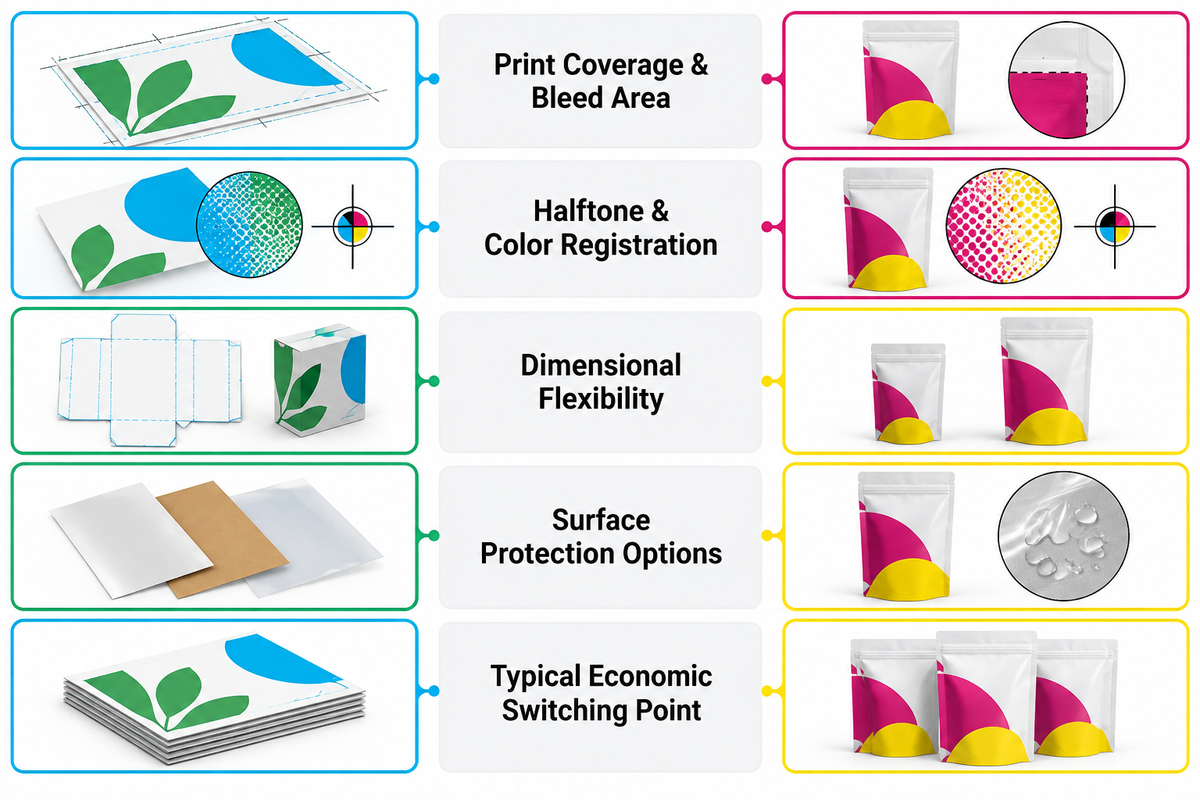
The major mechanical limit in paper bag manufacturing is whether the paper is printed before or after the bag tube is formed. In pre-conversion manufacturing, a roll-fed flexographic press or a sheet-fed lithographic offset press is used to print the substrate. For a foundational overview of carrier formats across retail categories, see our custom paper bags guide.
Unlike the printed method, post-printed stock carriers start as blank, pre-made bags that are pulled from warehouse inventory. A printer feeds one folded bag at a time through a slow-speed flexo, screen or hot foil stamping station. Since side gussets, bottom flaps and internal handle patches are glued to the side of the bag walls, paper thickness is uneven. Crossing a side gusset or printing over a handle patch can cause ink to skip or plate crush.
If you want your brand to have edge-to-edge flood colors, Pantone graphics wrapping around side gussets, or custom dimensions aligned with primary product boxes, then you should go with pre-conversion custom printed paper bags. Evaluating full pre-conversion custom printing early also unlocks broader customization options across cuff folds, ribbons, and interior patterns that shape the unboxing customer experience. For last-minute runs of 1,500 pieces or fewer to a trade show where a centered logo on plain white paper or brown paper is acceptable, post-printing remains a suitable option. Many local cafes keep a stock of brown paper bags on hand for similar reasons while scheduling factory runs for seasonal campaigns.
| Specification Parameter | Pre-Conversion Custom Manufacturing (Flat Sheet or Web) | Post-Conversion Stock Overprinting (Pre-Made Bag) |
|---|---|---|
| Print Coverage & Bleed Area | Full-bleed coverage across front, back, side gussets, bottom panel, and top turnover cuff | Restrict overprinting to the flat central areas of the front and back panels, with margins from folds and handle patches confirmed by the printer |
| Halftone & Color Registration | 150–200 LPI process CMYK plus tight spot Pantone trapping on sheetfed offset; 110–133 LPI on inline flexo | Spot line art, screen ink, or foil stamp on folded bags with wider multi-color registration tolerance |
| Dimensional Flexibility | Engineered to exact millimeter Width x Gusset x Height around the customer’s inner carton or bottle | Locked to stock catalog sizes in the supplier’s warehouse inventory |
| Surface Protection Options | Inline aqueous varnish, UV coating, or BOPP/cellulose film lamination applied flat before scoring | Stock bags can use paper coated or laminated before conversion; applying a uniform finish after assembly is difficult around folds and seams |
| Typical Economic Switching Point | Huandaopack cites 1,500 bags as a typical switching point from stock overprinting to custom sheetfed offset, while inline flexo suits larger runs | Smaller short-notice event batches or seasonal tests using existing stock sizes |
How Paper Grade, Fiber Length, and GSM Affect Bag Strength and Print Holdout
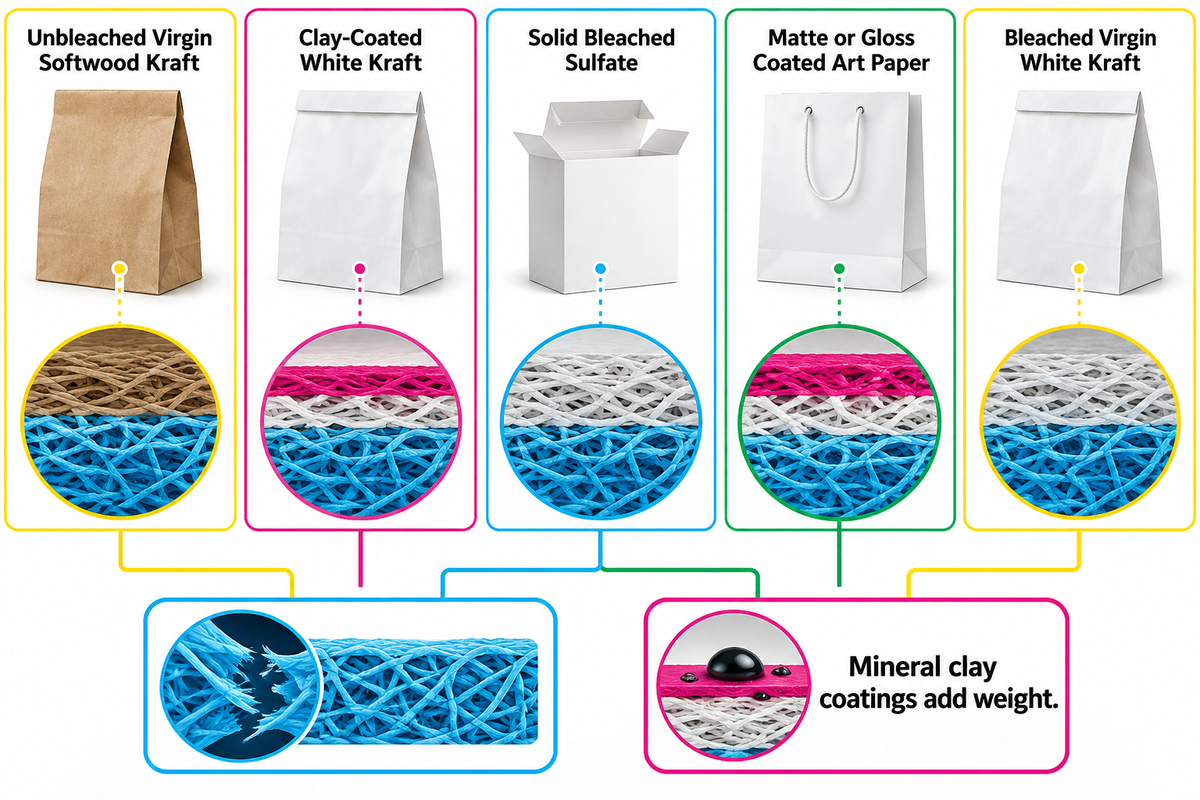
Buyers usually think that a 200 gsm coated art paper bag is stronger than a 130 gsm virgin brown kraft bag due to the paper bag feeling thicker and stiff. In paper physics, grams per square meter (GSM) shows the total mass of a sheet including coatings and fillers, and not the strength of the fiber network. Therefore, engineers evaluate kraft paper bags and high-volume kraft paper shopping bags pulp furnish before approving basis weight. Even if recycled kraft paper bags are chosen to fulfill the sustainability targets, stepping up caliper keeps branded bags feeling sturdy in the shopper’s hand.
According to technical testing data published by PaperIndex Academy on GSM and burst factor, GSM alone does not predict bag strength. PaperIndex reports that 80 gsm virgin semi-extensible sack kraft can exceed 350 kPa in burst strength; its burst index is the measured burst pressure divided by its basis weight. ISO 2758 (TAPPI T403) covers paper burst testing in the cited 70–1,400 kPa range; ISO 2759 covers paperboard, while TAPPI T807 addresses linerboard. Results from different methods are not directly interchangeable. Results from different methods are not directly interchangeable.
Art paper (C1S ivory board or C2S art paper) uses a mineral kaolin clay and latex coating to provide a smooth surface to accept 150-200 LPI offset halftone dots. The mineral clay adds mass to the sheet without providing tensile or Elmendorf tear strength, therefore a coated art paper bag can tear more than an unbleached virgin kraft bag of equal GSM. Shorter fibers in the hardwoods used in paper bag can also crack along 90-degree gusset scores unless reinforced by film lamination or longer fibers of softwood pulp.
As documented in PaperIndex Academy’s delivery failure analysis, untreated kraft paper can lose at least 90% of its dry tensile strength when saturated by chilled-beverage condensation or rain. Wet-strength resin (WSR) can cross-link cellulose fibers to give structure to the sheet and allow it to retain its shape in a wet condition.
Which paper is used for paper bags?
Manufacturers use five core paper grades to produce printed paper bags, namely unbleached virgin brown kraft, bleached white kraft, post-consumer recycled (PCR) kraft, C1S ivory board, and C2S art paper.
| Paper Grade Category & Furnish Type | Typical GSM Range | Strength & Fiber Profile | Ink Holdout & Print Fidelity | Primary Retail or Foodservice Application |
|---|---|---|---|---|
| Unbleached Virgin Softwood Kraft | 80–150 gsm | Long virgin softwood fibers provide high natural tear and burst resistance (exceeding 350 kPa at 80 gsm for semi-extensible sack grades per PaperIndex) | Uncoated porous surface absorbs more liquid ink vehicle; best for bold flexo spot colors | Heavy grocery carriers, wine bags, hardware and multi-box takeout bags |
| Bleached Virgin White Kraft | 90–160 gsm | Strong long-fiber network paired with a clean bleached white base | Clean uncoated white sheet prevents brown substrate color shift under light pastel inks | Pharmacy bags, bakery carriers, fashion apparel twisted-handle shopping bags |
| High-PCR Recycled Brown Kraft | 100–170 gsm | Shorter re-pulped fibers (175–200 kPa at 80 gsm for standard recycled liner grades per PaperIndex); requires specifying burst strength alongside GSM | High ink dot gain and slight fiber flecking; suits earthy eco-friendly branding | Retail checkout bags; PCR content alone does not establish finished-bag compliance in California or Washington |
| Wet-Strength Resin (WSR) Virgin Kraft | 100–140 gsm | Cross-linked resin furnish retains wet tensile strength under condensation where untreated kraft weakens rapidly | Matches standard kraft holdout; compatible with water-resistant flexo inks | Chilled beverage delivery, cold-chain grocery pickup, and rainy-climate food takeout |
| Clay-Coated White Kraft (CCK) | 110–160 gsm | Combines virgin kraft fiber backing with a smooth clay topcoat | High gloss and sharp halftone dot definition while preserving kraft tear resistance | Branded quick-service restaurant carriers and mid-tier specialty retail bags |
| C1S Solid Bleached Sulfate (Ivory Board) | 190–250 gsm | High bending stiffness; moderate tear resistance; requires pre-creasing along folds | Superior exterior print smoothness with uncoated interior surface for glue bonding | Cosmetic boutique bags, electronics launch bags, and structured gift carriers |
| C2S Matte or Gloss Coated Art Paper | 157–250 gsm | Mineral clay coat on both sides; requires pre-creasing or film lamination to prevent fold cracking | High offset print fidelity (150–200 LPI CMYK, metallic inks, and tight registration) | Turn-top Euro totes for jewelry boxes, luxury fashion, and corporate gift packaging |
| Fluorochemical-Free Grease-Resistant Paper | 70–120 gsm | High internal sizing and refined fiber density to block oil penetration | Smooth calendered finish; vegetable-based or water-based inks are not inherently low migration | Pastry pinch-bottom merchandise bags, bakery bags, and roasted coffee bags |
| Specialty Dyed & Embossed Textured Board | 180–260 gsm | Pulp-dyed through the sheet core so fold lines never expose a white subsurface crack | Textured linen or buckram surface; optimized for metallic hot foil stamping and blind debossing | High-end watch, fragrance, and VIP event favor carriers |
Specify Bag Structures and Width x Gusset x Height Clearance Around Boxed Goods
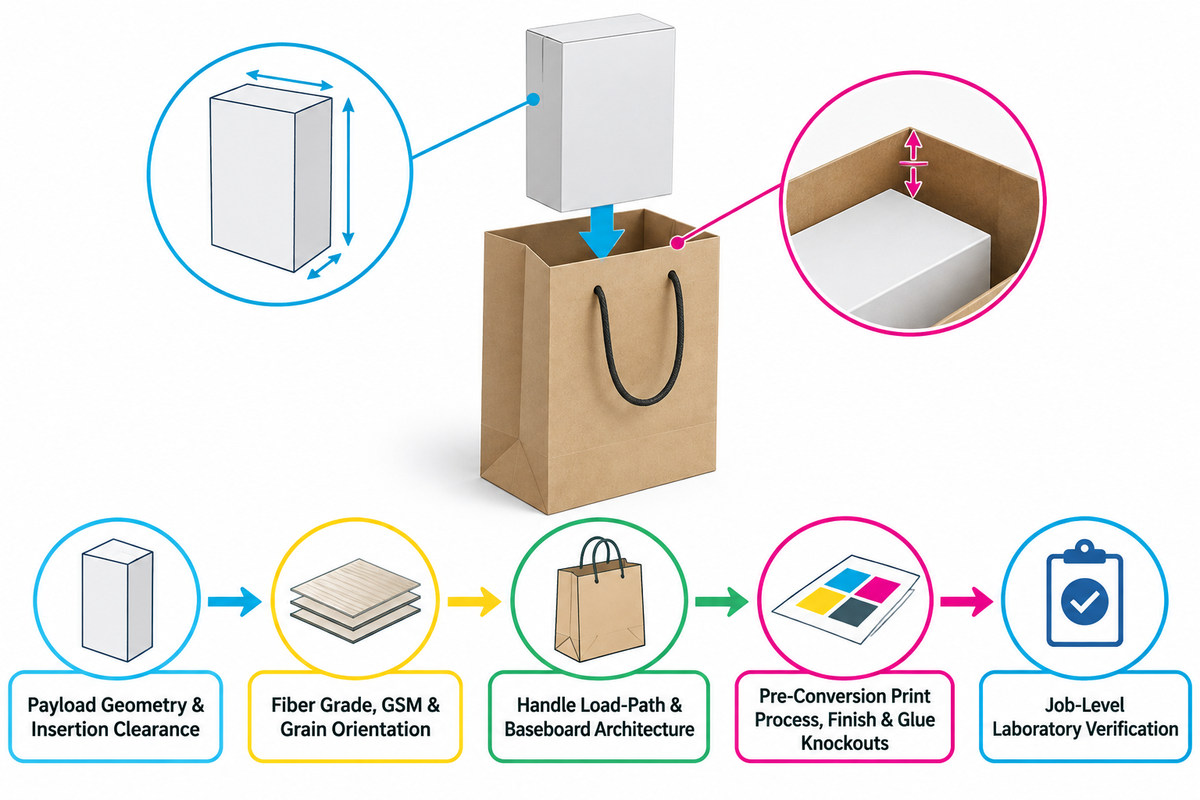
For more information, please refer to ePackPrinting’s engineering guide on paper bag gussets. Every gusseted paper bag is specified in the sequence Width (W) x Gusset (G) x Height (H). Width is the measurement from the left crease to the right crease of the front face. The depth of the side wall when fully expanded is measured as Gusset, and Height is measured from the flat bottom base to the top opening edge.
In North American wholesale catalogs for wholesale paper carriers, twisted-handle paper shopping bags products and custom paper shopping bags with twisted paper handles are usually labeled with trade names such as Cub (8 x 5 x 10 in) or Vogue (16 x 6 x 12 in). European converters usually use metric formats and specify dimensions such as 250 x 100 x 300 mm as shown in ePackPrinting’s paper bag specification guide. Be sure to add the element of measurement in each case as Width, Gusset/Depth, and Height in order for converters to properly identify the order of dimensions for wholesale custom runs in a sustainable custom packaging program.
The most common mistake by a buyer is to take the outer dimensions of custom folding cartons and use them to define the bag sizes. Because side gussets fold inward and the top mouth pinches together when lifted by the handles, a rigid box with zero clearance will jam or tear the side folds. Coordinating custom paper shopping bags with primary retail packaging dimensions prevents that bottleneck for wholesale paper carriers, twisted paper handles, and wholesale custom Euro totes when brands order custom runs in a sustainable custom packaging program.
The 5-Variable Bag Build Matrix
Step 1: Payload Geometry & Insertion Clearance (W x G x H)
Per ePackPrinting, increase product depth by 10-20 mm (1-2 cm) for boxed goods, and increase height and width for smooth insertion, and to ensure the top mouth of the box closes below the handle arch.
Step 2: Fiber Grade, GSM & Grain Orientation
Select paper laminate by required bursting strength (kPa) and service condition (wet or dry) and orient paper grain in the laminate parallel to the main load or score lines to reduce fold cracking.
Step 3: Handle Load-Path & Baseboard Architecture
Design handle attachments, top turnover collars, and bottom board inserts to withstand carrying stresses dynamically rather than weight statically, and validated the bag with actual payloads.
Step 4: Pre-Conversion Print Process, Finish & Glue Knockouts
When you order custom bags, match flexographic, sheetfed offset, or digital printing to the artwork resolution and order volume, pre-crease graphic boards before folding, and leave unprinted and unvarnished glue reserve strips on structural seams.
Step 5: Job-Level Laboratory Verification
Require production-lot test reports covering ISO 2758 / TAPPI T403 burst, ASTM D5264 ink-rub resistance, ISO 536 / TAPPI T410 basis weight, and whole-bag carrying performance before shipment.
Worked Dimensional Clearance Example: Suppose you are sizing a printed paper bag for a rigid product box measuring 20 cm wide x 8 cm deep x 25 cm high, as illustrated in ePackPrinting’s measurement guide. Matching an 8 cm deep box to an exact 8 cm gusset feels too tight in real packing and stretches the side folds. Adding 2 cm (20 mm) of width allowance, 2 cm (20 mm) of gusset depth allowance, and 5 cm (50 mm) of height allowance yields a 22 cm (W) x 10 cm (D/Gusset) x 30 cm (H) bag that lets the 8 cm deep box enter smoothly and sit flat on the base.
What bag size do I choose for wine bottles?
PackagingSource lists 5 x 3 x 13 in single-wine bags and 6 x 3 x 13 in double-wine bags. PackagingSource lists 5 x 3 x 13 in for a single wine bag and 6 x 3 x 13 in for a double wine bag, but their 76 mm gussets do not clear every bottle in the stated 76–85 mm diameter range. For bottles up to 85 mm in diameter and 330 mm tall, a 110 x 90 x 360 mm bag provides 5 mm of depth clearance for one bottle, while a 180 x 90 x 360 mm carrier provides 10 mm of total width clearance for two side by side.
Match Handle Styles, Patch Reinforcements, and Bottom Boards to Real Payloads
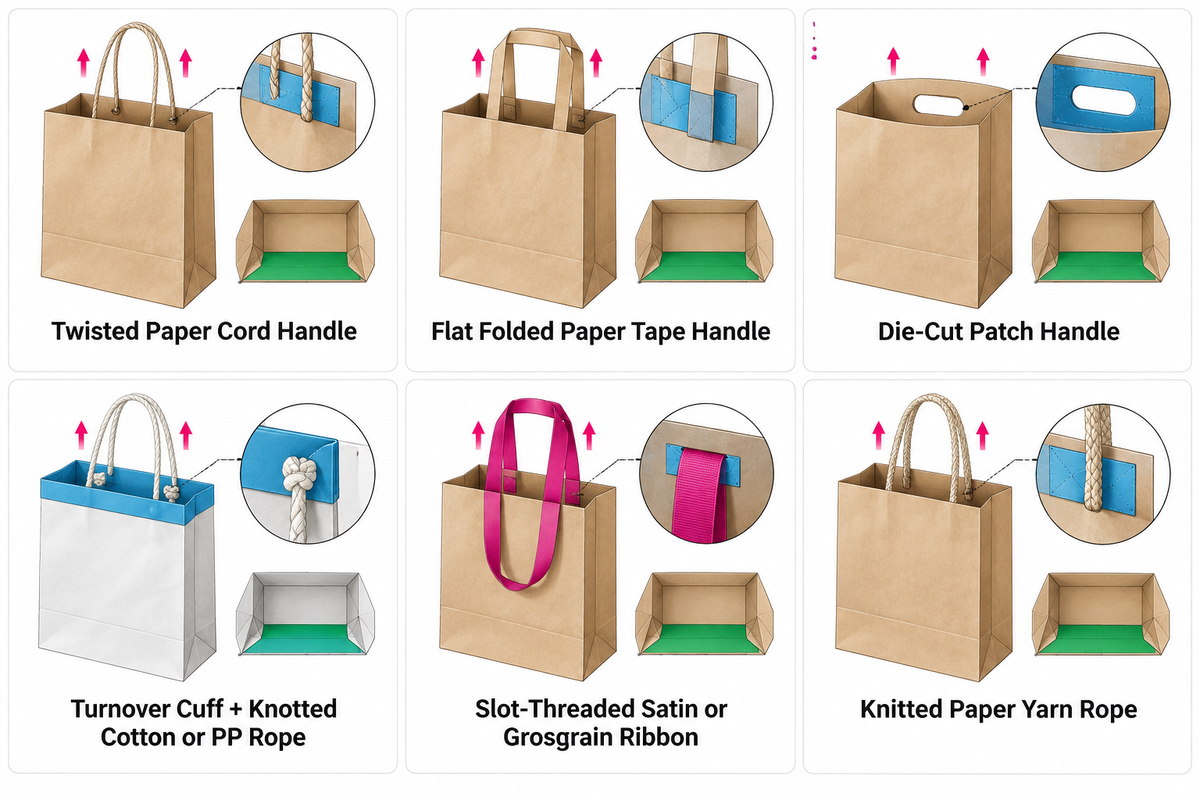
A common field failure is thinking that a static hanging test in the office is adequate, as reported in packaging failure study by PaperIndex Academy. As PaperIndex Academy’s packaging failure study reports, delivery swinging, stacking pressure, and drops can create forces 3x to 5x higher than the packed weight alone, depending on carrying motion and bag geometry. The geometry of the bag affects the overall carrying load. A motionless weight is not the same as a dynamic carrying load. Compare the ergonomics of the cord and ribbon in our paper bags with handles guide for further information.
Engineering a durable load path means strengthening the three highest stress concentrations: the top handle anchor, the vertical side gussets, and the bottom block fold. A landmark example of mono-material structural engineering is Apple Inc.’s retail paper bag patent (USPTO publication US20160264304A1, granted as US10259616B2). To prevent brittle fold lines and handle tear-out on a bag body made from white solid bleached sulfate (SBS) paper with at least 60% post-consumer recycled (PCR) content, the patented structure incorporates three reinforcements:
- Corrugated Turnover-Collar Insert: A corrugated cardboard turnover reinforcement insert is glued inside the top fold and debossed to a thickness of 0.5 to 1.0 mm along the handle conduits, with handle holes positioned 15 mm below the top edge.
- Knitted Paper Yarn Handle: An 8-stitch circular-knit paper yarn handle with a diameter of at least 6.5 mm delivers soft rope-like hand comfort while remaining compatible with paper-mill repulping.
- Corner and Full-Span Bottom Inserts: For secondary corner reinforcements, rigid inserts extend 10-20 mm beyond bottom corners, and a full-span bottom insert is placed in the base panel to distribute the downward load.
Keep in mind an important engineering boundary: individual handle tensile numbers and single-sheet burst indices do not equal whole-bag safe carrying capacity. Complete carrier qualification should follow EN 13590:2003 or cyclic jolt testing with the buyer’s actual product so the bag remains easy to carry.
| Handle Architecture | Attachment & Reinforcement Mechanics | Typical Paper GSM & Base Support | Indicative Payload Application (Verify Whole Bag) | Curbside Recycling Impact | Primary Failure Mode if Under-Specified |
|---|---|---|---|---|---|
| Twisted Paper Cord Handle | Automated inline hot-melt or cold-glue internal fiber patch | 100–150 gsm kraft; optional rigid baseboard for boxed goods | Everyday retail shopping and boxed takeout; verify safe payload on assembled bag | Mono-material paper construction supports standard hydropulping | Patch delaminates from bag wall if interior ink/varnish invades the glue zone |
| Flat Folded Paper Tape Handle | Multi-ply folded kraft strip glued inside or outside the top hem with wide patch | 90–130 gsm brown or white kraft; standard block bottom | Restaurant takeout and grocery bags; wide strap distributes finger pressure | Curbside recyclable paper construction with zero non-paper components | Strap tears at the folded crease if paper grain runs perpendicular to handle length |
| Die-Cut Patch Handle | Kidney- or oval-shaped cutout in bag wall backed by an internal glued reinforcement card | 120–180 gsm kraft or C1S board | Flat apparel, books, or lightweight boutique items | Paper-stream compatible when glued with water-dispersible adhesive | Corners of the die-cut slot propagate tears when lifted with one finger |
| Turnover Cuff + Knotted Cotton or PP Rope | Folded top cuff housing a reinforcement card insert; cord threaded through 4 holes and knotted | 150–200+ gsm C1S/C2S board or heavy kraft plus rigid bottom board | Heavy luxury gift sets, boxed cosmetics, and beverage carriers | Synthetic PP cord, cotton rope, and metal grommets require removal before pulping | Knot pulls through punch holes if top turnover card insert is omitted |
| Slot-Threaded Satin or Grosgrain Ribbon | Ribbon fed through die-cut flat slots in a reinforced turnover cuff and glued or heat-tipped inside | 150–200+ gsm C1S/C2S board plus rigid bottom board | Luxury cosmetics, fragrance, jewelry, and bridal gift bags | Polyester satin ribbon is a non-paper contaminant in standard MRF paper streams | Frayed ribbon ends slip out of glue channel under sudden lifting jolts |
| Knitted Paper Yarn Rope (Mono-Material Luxury) | Circular-knit paper yarn (>=6.5 mm diameter) anchored through debossed corrugated or kraft collar insert | 160–230 gsm virgin or high-PCR SBS/kraft + full bottom insert | Premium retail carriers requiring rope feel with all-paper construction | Paper yarn handles, aqueous coating, and repulpable hotmelt can support paper recycling where the local collection program accepts the finished bag | Higher unit component cost than standard twisted paper cord |
Compare Printed Paper Bags with Plastic Bags, Reusable Totes, Mailers, and Cartons
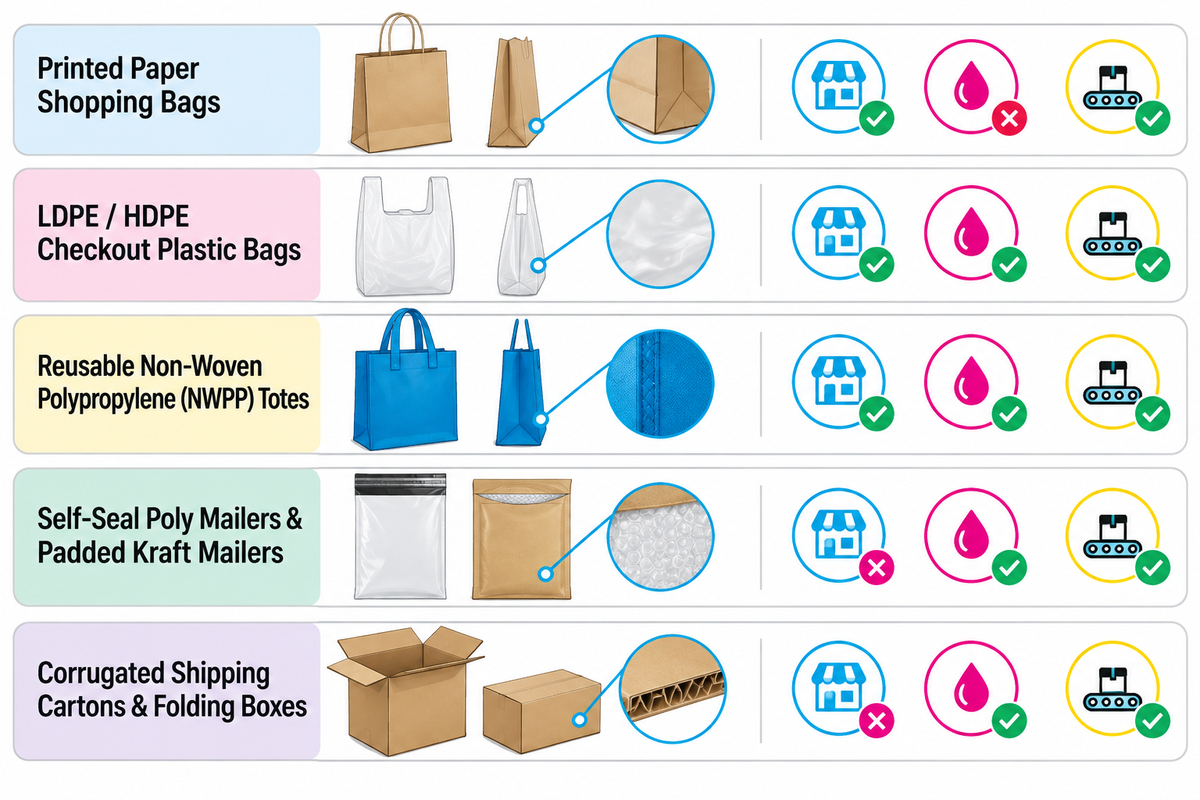
Printed paper bags are not a complete substitution for flexible and rigid carriers. US EPA Containers and Packaging Product-Specific Data tracks paper and paperboard containers and packaging generation and recovery from 1960 to 2018, while US EPA Common Recyclables guidance notes that only 8.7 percent of U.S. plastics generated in 2018 were recycled. At the same time, Packaging Dive’s analysis of 2026 state packaging laws notes that state lawmakers are replacing checkout plastic film bags with recycled paper bag rules.
While a well-defined paper carrier is a versatile choice for dry retail and restaurant handoffs, determining where paper is better and where other formats are necessary prevents costly field failures.
- When NOT to choose printed paper bags: Do not opt for uncoated paper shopping bags when shipping unattended e-commerce parcels through automated belt sorters, where conveyor chutes can snag handles and rain can weaken uncoated seams. Likewise, do not use kraft bags for contact with wet ice, raw meat trays, or large sharp-edged metal objects that exceed the bag’s puncture limit.
| Carrier Format | Structural & Print Advantages | Moisture & Transit Durability | End-of-Life & Regulatory Standing (2026) | Ideal Use Case vs Failure Boundary |
|---|---|---|---|---|
| Printed Paper Shopping Bags (Kraft / C1S / C2S) | Stands upright for fast counter loading; crisp 360-degree billboard branding; compatible with tissue paper presentation | Moderate; requires WSR furnish or film lamination for rain/condensation; open top unsuitable for parcel couriers | Unlaminated printed kraft shopping bags can enter established paper recycling streams; California’s covered stores require recycled paper carryout bags with manufacturer, country-of-origin, and postconsumer recycled content information printed on the bag | Best for: In-store retail stores, boutique apparel, takeout dining, and trade shows. Avoid for: Unboxed parcel post. |
| LDPE / HDPE Checkout Plastic Bags | Waterproof, high elongation before puncture, lowest unit weight and warehouse storage cube | Immune to rain and chilled condensation; flexible film conforms around irregular containers | Banned for retail checkout in California (SB 1053, Jan 1, 2026) and multiple US states; rejected by curbside bins | Best for: Wet/frozen industrial liners where permitted. Avoid for: Regulated retail carryout and eco-conscious brands. |
| Reusable Non-Woven Polypropylene (NWPP) Totes | Stitched or ultrasonic seams hold heavy loads across multi-trip grocery cycles | Water-resistant synthetic fabric; resists tearing on sharp carton corners | Not curbside recyclable; requires repeated multi-trip reuse to offset higher per-bag polymer material use | Best for: Paid membership grocery totes and heavy conference bags. Avoid for: Single-trip gift or takeout handoffs. |
| Self-Seal Poly Mailers & Padded Kraft Mailers | Tamper-evident adhesive strip; zero protruding handles to snag automated parcel sorting conveyors | Poly mailer film resists rain, but water can enter through a puncture, damaged seam, or poorly sealed closure; padded kraft mailers cushion flat softgoods in postal networks | Kraft mailers recycle in paper streams; poly mailers require store drop-off film collection | Best for: Direct-to-consumer apparel and book e-commerce shipping. Avoid for: Upright counter handoff or multi-item dining takeout. |
| Corrugated Shipping Cartons & Folding Boxes | Corrugated shipping cartons can be specified by edge-crush and box-compression strength; folding boxes have different structural requirements | High crush and drop protection under ISTA parcel transit protocols | Broad municipal recovery infrastructure across corrugated and paperboard streams | Best for: Primary product containment and palletized or parcel freight. Avoid for: Casual walk-out pedestrian carrying without a handle. |
Choose Between Flexographic, Sheetfed Offset, and Digital Printing plus Surface Finishes
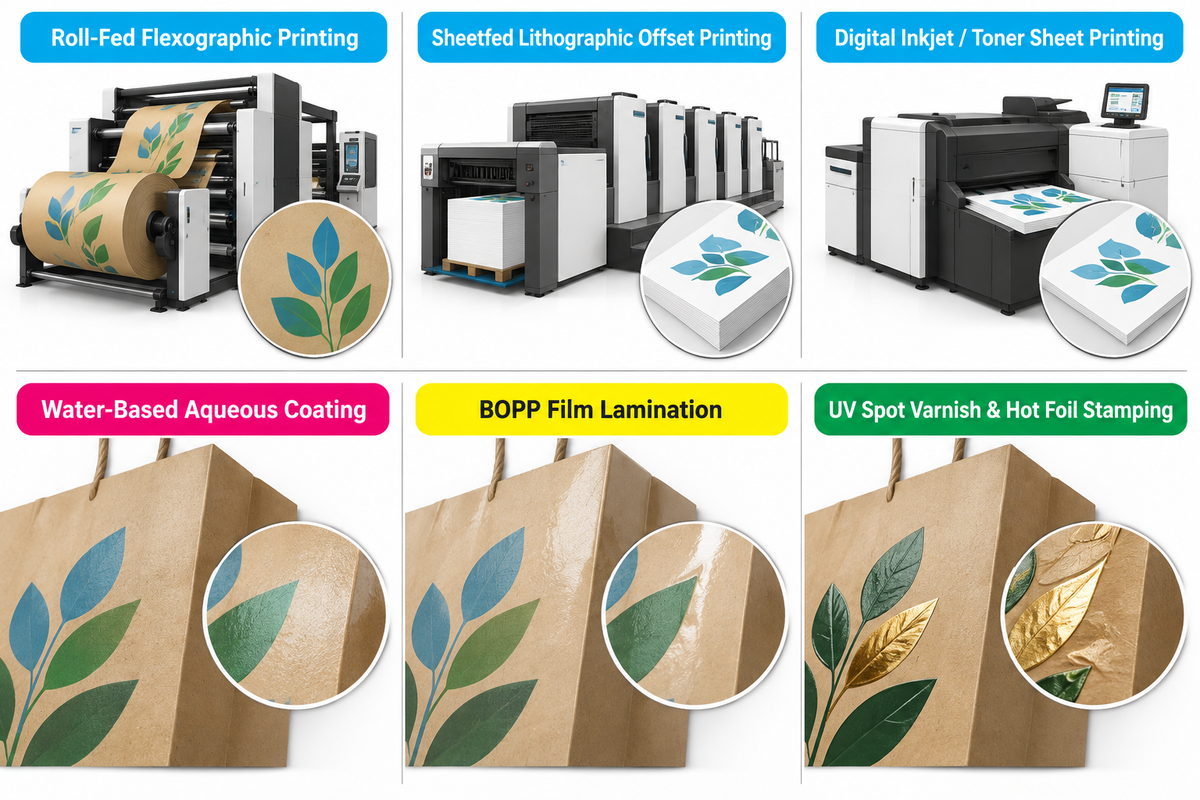
Selecting the wrong press technology or surface coating is the primary cause of two notorious production defects: fold-line ink cracking along the 90-degree gusset scores and side-seam glue delamination during transit.
As analyzed in BespokePackage’s engineering study on printed paper bag fold cracking, heavy solid ink coverage on high-grammage boards (such as 300 gsm SBS or 200+ gsm C2S art paper) creates a brittle cured ink layer on a 90-degree fold. When the converter folds the side gusset against the paper grain without proper score relief, tensile strain ruptures the surface fibers and exposes a white crack line. However, a 2026 Packaging Technology and Science study (Wiley, doi:10.1002/pts.70071) on 226 g/m² dispersion-coated paperboard showed that brittle functional barrier dispersions can still crack after steel-rule creasing. Pre-creasing with the grain and using a flexible ink-and-coating system can reduce fold cracking on graphic boards, although brittle barrier coatings can still crack at the score.
Prepress dieline hygiene is as important as the adhesive selection. With water-based cold glues, you can stick to uncoated paper and other suitable surfaces. Compatible hot-melt adhesives can stick to prepared coated surfaces. If your prepress operator floods ink, UV varnish, or aqueous coatings in the bonding zones, the adhesive sits on top of an ink film and pops open under load. Sometimes, structural glue strips can use areas that are unprinted, unvarnished, and sized to the adhesive to seal. If a brand uses a branded closure sticker to seal tissue inside a folded bag mouth, test the adhesive against the aqueous varnish first to see if it prematurely peels.
Huandao states that Xiamen Huandao Packaging Technology Co., Ltd. does pre-press, sheetfed offset printing, UV coating, film lamination, die-cutting, and folder-gluing at their Xiamen plant. With this integration, press operators and die-making technicians can calibrate glue-flap knockouts and crease depths on the same production floor before mass conversion.
Ink or hot stamp, which should I choose?
Flexographic or sheetfed offset printing can do continuous gradients, and full-bleed color. Color count, plates, and press configuration can affect costs. Metallic hot foil stamping can do mirror-gold or silver opaque accents on dark board.
| Press / Finish Technology | Resolution & Color Capability | Score-Line Crack & Scuff Protection | Glue-Flap & Dieline Requirement | Best Economic & Structural Fit |
|---|---|---|---|---|
| Roll-Fed Flexographic Printing | 85–133 LPI photopolymer plates; 1 to 8 spot Pantone or process colors using water-based inks | Water-based inks penetrate uncoated kraft fibers without forming a brittle surface crust | Specify ink-free glue tracks in the flexographic artwork and confirm their alignment during production | High-volume automated runs of uncoated brown or white kraft SOS and twisted-handle bags |
| Sheetfed Lithographic Offset Printing | 150–200 LPI halftone screens; exact CMYK photography + Pantone spot colors + inline coating | High ink film thickness on coated board requires protective varnish or lamination + pre-creasing | Leave unprinted, unvarnished knockout strips on side-seam and bottom glue flaps sized to the adhesive | Custom retail shopping bags, boutique gift bags, and Euro totes requiring fine photographic or Pantone graphics |
| Digital Inkjet / Toner Sheet Printing | Zero plate setup; variable-data QR codes, regional language versions, and multi-SKU artwork | Toner/UV-ink layers can crack on sharp 180-degree folds unless scored prior to folding | Maintain a toner-free glue reserve along all structural bonding flaps | Short-run product launches, influencer seeding kits, and multi-SKU seasonal sampling |
| Water-Based Aqueous Coating (Matte / Gloss) | Clear protective seal applied inline on offset press; preserves natural paper feel | Can reduce ink rub-off and minor fold scuffing; paper-compatible aqueous coatings that pass repulpability testing can preserve fiber recovery | Knock out coating plate along side-seam and bottom glue flaps unless using specialized adhesive | Curbside-recyclable coated or uncoated retail bags requiring clean rub resistance |
| BOPP Film Lamination (Matte / Gloss / Soft-Touch) | 15–25 micron polypropylene film thermally bonded over the printed sheet | Bridges 90-degree gusset and bottom folds and can reduce visible fiber cracking | Requires solvent/hot-melt lamination glue or unlaminated glue-flap window for reliable bonding | Heavy-ink 180–250 gsm C1S/C2S luxury bags and wet-weather reusable retail carriers |
| UV Spot Varnish & Hot Foil Stamping | High-gloss raised UV contrast or metallic gold/silver/holographic foil transferred via heated brass die | Keep rigid foil and spot UV away from gusset fold scores so the finish does not flake | Keep foil and UV varnish strictly outside top-cuff and bottom fold lines | Logo focal points on matte-finished boutique, cosmetics, and jewelry bags |
Design for Curbside Recyclability, PCR Mandates, and 2026 Bag Regulations
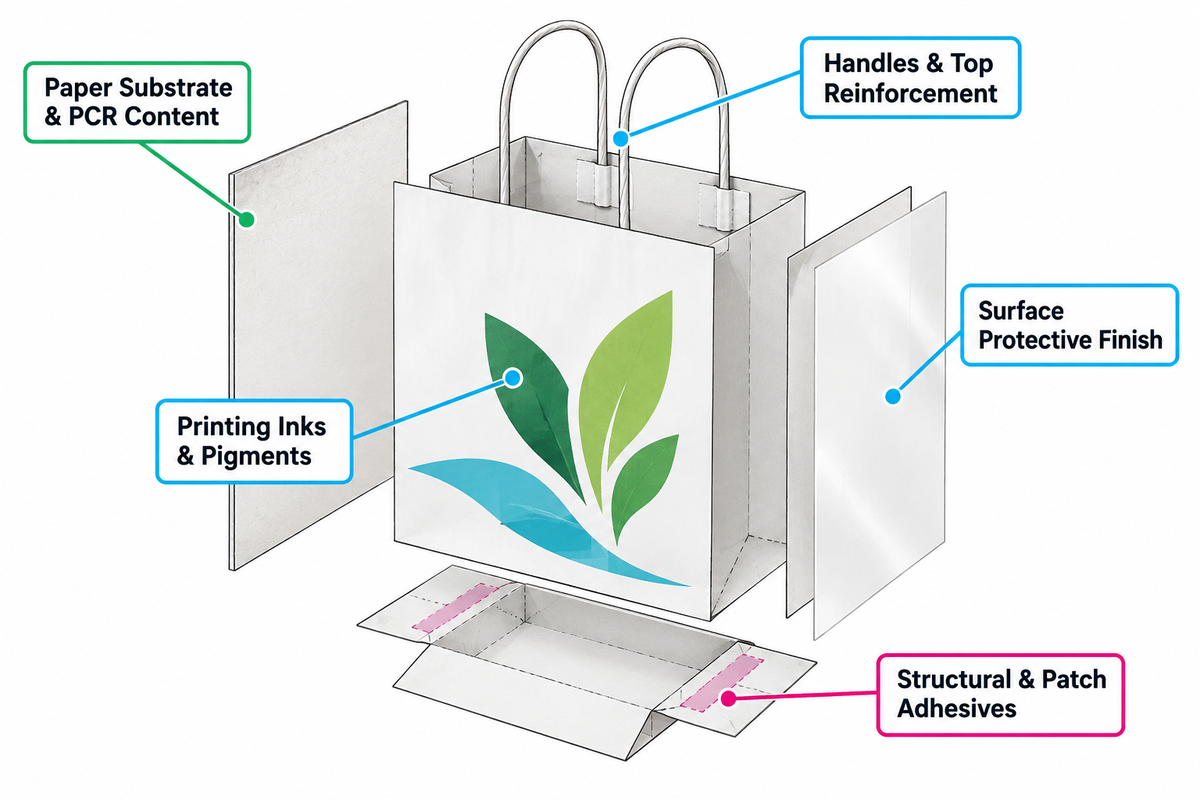
Per compliance requirements and the return of municipal fiber, paper bag specifications are now written on purchase orders. In the United States, CalRecycle’s official guidance on California Senate Bill 1053 (SB 1053) and Packaging Dive’s 2026 packaging law report confirm that starting January 1, 2026, covered stores in California may only offer recycled paper bags at checkout, charging at least 10 cents. Under California SB 1053, covered recycled-paper carryout bags require at least 40% postconsumer recycled content if rated above eight pounds, or 20% if rated at eight pounds or less. Two years in, on January 1, 2028, the threshold for recycled material in those bags will rise from 40% to 50%.
It’s important to note that SB 1053 also mandates disclosure on the bags. Critically, California SB 1053 also mandates on-bag artwork disclosures: every regulated carryout bag must have the manufacturer’s name, the country where the bag was manufactured, and the percentage of post-consumer recycled material printed visibly on the bag. Packaging Dive’s 2026 regulatory tracker, also reveals that starting in 2026, Washington State and Maine will have similar laws that cover carryout bags as well as food and beverage PFAS.
Beyond statutory PCR percentages, buyers must separate technical mill repulpability from consumer marketing claims. The US EPA Recycling FAQ and US EPA Common Recyclables guidance note that shiny or laminated paper gift wrap and bags can disrupt paper recycling; sorting occurs at recovery facilities, while repulping occurs at paper mills. In Europe, the 4evergreen Circularity by Design Guideline (Version 4, February 2026)—developed by more than 380 experts across the paper-based packaging value chain—provides design criteria for standard, flotation de-inking, and specialized recycling mills. It notes that plastic lamination and non-dispersible adhesives below 68°C (DIN EN 1427:2015) or smaller than 2 mm can hinder fiber recovery.
According to the US FTC Green Guides, an unqualified claim that a bag is “Recyclable” is permissible if recycling facilities are available to at least 60% of the consumers or communities where the bag is sold.
| Bag Component | Curbside-Compatible Specification (Standard Mill Stream) | Specification Requiring Qualification or Specialized Recovery | Compliance & Anti-Greenwashing Verification Step |
|---|---|---|---|
| Paper Substrate & PCR Content | Uncoated or clay-coated kraft/SBS; for covered California SB 1053 checkout bags, ≥40% PCR for bags holding more than 8 lb and ≥20% PCR for bags holding 8 lb or less, rising to ≥50% PCR on Jan 1, 2028 | Wet-strength resin (WSR) sack grades (require prolonged high-shear pulping in standard mills) | Verify mill lot certificate and print manufacturer name, country of origin, and PCR % on bag base |
| Printing Inks & Pigments | Water-based flexo inks or vegetable/soy-oil offset inks free of heavy metals and PFAS | Heavy UV-cured cross-linked inks or full-coverage metallic foil laminates | Request an ink supplier declaration confirming mineral-oil-free and PFAS-free formulation |
| Surface Protective Finish | Plastic-free water-based aqueous varnish or dispersion coating | One-side BOPP/PET film lamination (reduces fiber yield; two-sided film lamination rejected by standard mills) | Do not print unqualified “Curbside Recyclable” claims on film-laminated Euro totes |
| Handles & Top Reinforcement | Twisted paper cord, flat paper tape, or circular-knit paper yarn + kraft/corrugated collar insert | Polypropylene (PP) rope, polyester satin ribbon, cotton cord with metal eyelets | Instruct consumers to detach non-paper rope/ribbon handles before recycling, or switch to paper handles |
| Structural & Patch Adhesives | Starch/dextrin cold glues or repulpable/screenable hotmelts (softening point >68°C, size >2 mm) | Low-melt wax blends or non-dispersible pressure-sensitive hotmelts that cause paper-machine stickies | Specify adhesive grade on the manufacturing bill of materials |
Diagnose Tearing, Scuffing, and Fold Cracking with Job-Level Lab Tests
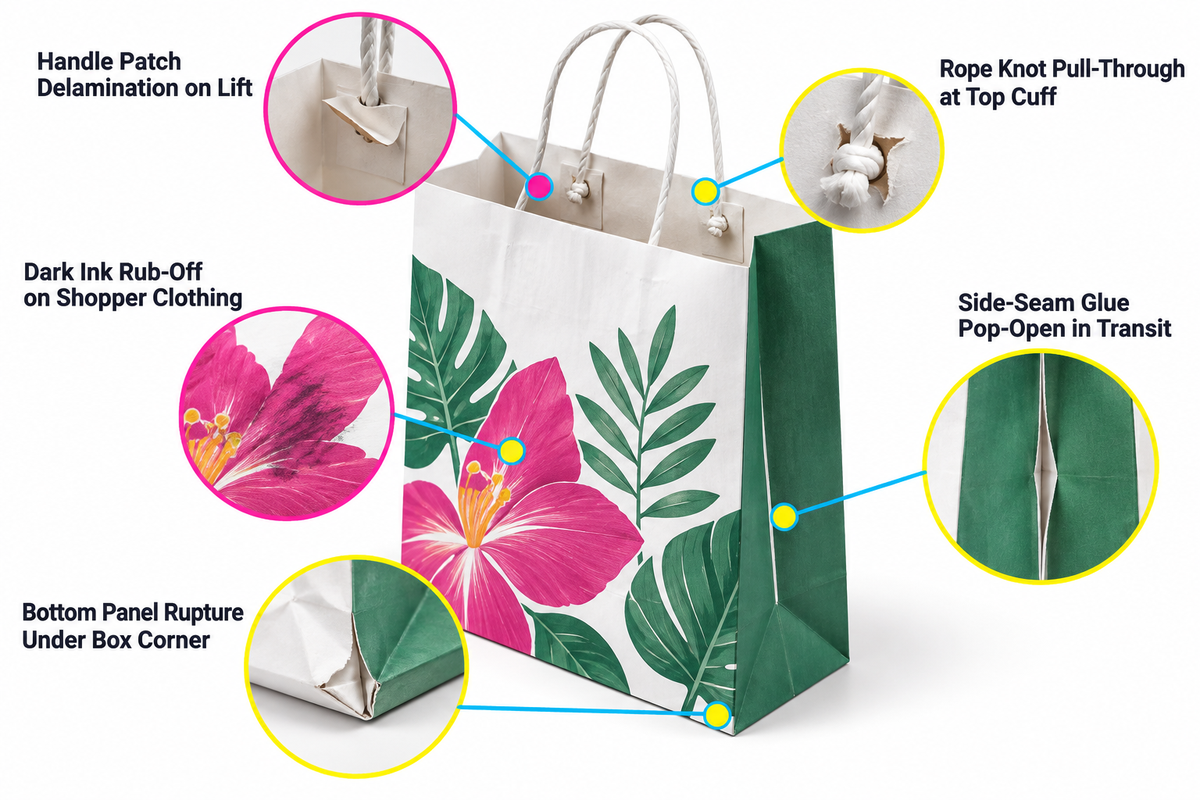
In an air-conditioned office, approving a pre-production hand sample rarely guarantees the survival of a 20,000-unit production run through humid ocean container shipping or retail checkout loading. Paper is hygroscopic. It absorbs and loses moisture based on relative humidity, resulting in fluctuations in tensile and flexural stiffness, score-line ductility, and glue open time. Before approval of mass conversion, procurement teams should consider our paper bag sample approval checklist and standardized lab test results.
As detailed in PaperIndex Academy’s testing guidelines, under ISO 187, paper samples are conditioned at 23°C ± 1°C and 50% ± 2% relative humidity until they reach equilibrium before physical testing. A test performed in Bangkok at 80% RH will differ from a test performed in Phoenix at 15% RH unless conditioned. Because ISO 2758 and TAPPI T403 results can also differ, purchase orders should specify one test method explicitly.
According to Huandao, Xiamen Huandao Packaging Technology Co., Ltd. has an in-house test lab at their Xiamen plant. The laboratory issues Edge Crush Test (ECT) for corrugated board, bursting strength, ink-rub, and basis-weight test reports on the customer’s own production run, tying the numbers on the report to the shipped lot.
How are paper bags made?
Commercial printed paper bags are made in six sequential stages: printing flat paper rolls or sheets on flexo or offset presses, applying protective varnish or film lamination, and die-cutting and score-creasing the blank. Converters then glue the side seams, fold and seal the bottom, and attach patch or rope handles. The finished product is then sent to a laboratory for testing.
| Defect Category & Failure Mode | Root Mechanical or Chemical Cause | Standardized Verification Test Method | Target Production Acceptance Specification |
|---|---|---|---|
| Bottom Panel Rupture Under Box Corner | Weak bag paper or concentrated box-corner loads | Test the bag paper’s burst strength under ISO 2758 / TAPPI T403 after ISO 187 conditioning and assess the assembled bag under its intended load | Specify burst strength for the bag paper; a bottom board can spread concentrated loads but cannot replace that specification |
| Handle Patch Delamination on Lift | Ink or varnish in the patch glue zone, or insufficient hotmelt | Assess the patch bond with a peel test and the assembled bag with a separate carrying test (such as EN 13590:2003) | The patch bond and whole-bag carrying capacity must each meet their specified requirements |
| Rope Knot Pull-Through at Top Cuff | Omitted top turnover reinforcement card or punch hole placed too close to the top edge | Cyclic vertical jolt suspension test using the intended product payload | Reinforced turnover collar insert (or debossed corrugated collar) with handle holes positioned at least 15 mm below the top edge per US20160264304A1 |
| White Crack Line Along 90° Gusset Score | Paper folded perpendicular to grain, shallow crease channel, or unlaminated heavy flood ink | 180-degree manual and machine pre-fold inspection after ISO 187 conditioning | Pre-crease with the grain using a 0.7–1.0 pt crease rule and verify fold appearance on the actual coated or laminated stock |
| Dark Ink Rub-Off on Shopper Clothing | Slow-drying offset ink on low-holdout paper without protective aqueous varnish or lamination | ASTM D5264 or TAPPI T830 Sutherland Ink-Rub Tester (dry and wet rub evaluation) | Meet buyer-agreed rub transfer limits on the production sheet; apply matte/gloss aqueous varnish or BOPP film where needed |
| Side-Seam Glue Pop-Open in Transit | Flood ink or silicone varnish contaminating the side-seam glue lap | 180-degree seam peel test after ISO 187 conditioning and transit temperature simulation | Continuous fiber-tear bond along the side seam length; unprinted, unvarnished glue reserve strip in prepress dieline |
| Wet-Bottom Blowout with Chilled Goods | Condensation can weaken untreated kraft and the bag bottom | Assess wet tensile strength and water absorptiveness on conditioned samples | Wet-strength paper and a water-resistant base reduce the risk of bottom failure |
| Basis Weight Down-Gauging (Sheet Too Thin) | Supplier substituting thinner stock than contracted on the purchase order | ISO 536 / TAPPI T410 gram-scale basis weight check after ISO 187 conditioning | Actual lot basis weight within the contracted tolerance (for example, 80 GSM ± 3% or 80 g/m² ± 5%, accepting 76 to 84 g/m² per PaperIndex) |
| Brand Color Drift Across Bag & Carton Runs | Uncalibrated press profiles or no color drawdown on the actual stocks | Measure press-sheet color differences with a spectrophotometer and use buyer-agreed tolerances against an approved drawdown on the actual stock | Match the approved brand colors on the actual bag and carton stocks |
Do Specify Job-Level QC & Dieline Knockouts
- Lot specific lab reports for paper bag production run include burst strength, ASTM D5264 (ink-rub) resistance, and ISO 536 / TAPPI T410 basis weight tests.
- Specify unprinted, unvarnished glue reserve strips on every side seam and bottom flap in the CAD dieline sized to the adhesive and seam geometry.
- Relying on static hang checks to test the capacity of a rigid box to carry items secured inside a bag, is highly unreliable.
Don’t Rely on Brochure Specs or Static Hang Checks
- Never accept a multi-year mill data sheet as proof of passing ink-rub or seam-peel inspection on finished bags.
- Never compare GSM of art paper and virgin kraft without checking burst strength (in kPa) and tear resistance.
- Never approve bag dimensions by matching outer box length and width 1:1 without adding at least 10 to 20 mm (1 to 2 cm) of gusset and insertion clearance.
Break Down Unit Cost Drivers, Plate Fees, Minimum Order Quantities, and Freight Cube
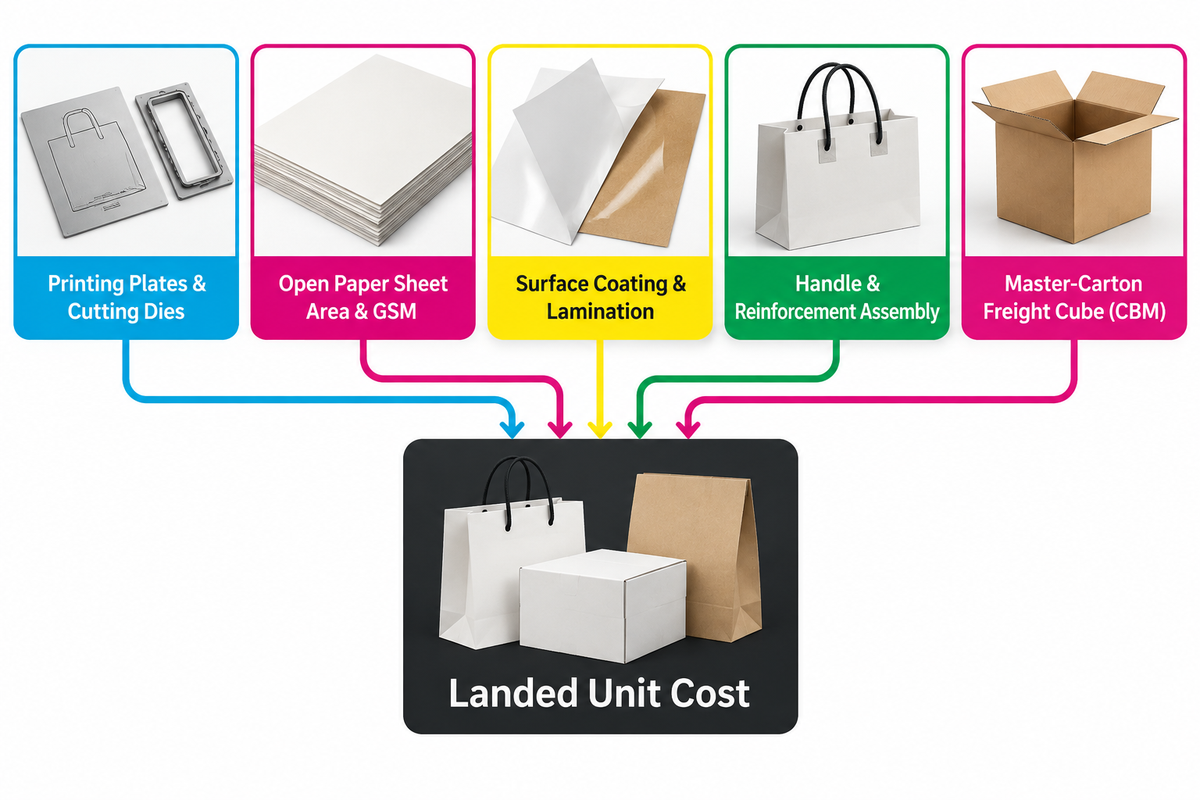
When two suppliers quote different unit prices for a printed paper bag, the difference reflects paper grade, GSM, ink coverage, surface finishes, pre-press tooling, assembly method and master-carton freight cube. A helpful quote breaks down one-time set up costs from per-bag and freight production costs, so the buyer can evaluate total landed costs at their desired order quantity. Published converter cost guides from GMS Industries and BrandtBox report that high-volume automated runs typically range around $0.30 to $1.50 per bag, whereas low-volume custom luxury bags can exceed $4.00 per bag. Those converter guides also note printing plate fees of $40 to $1,500 and hot-foil stamping dies of $80 to $250, while production lead times vary by factory schedule, order quantity, and shipping lane.
First, separate one-time setup and tooling costs from unit run costs. With roll-fed flexographic printing presses, photopolymer plates are needed for each color station and explain why inline flexo presses set higher minimum order quantities to amortize plate mounting and web threading waste. With sheetfed offset, litho plates and cutting dies are aluminum and are separate, and Huandaopack cites 1,500 bags as an economic switching point between post-printing stock bags and printing before bag conversion, rather than a minimum order quantity for each offset bag run. Adding metallic hot foil stamping or 3D embossing introduces a CNC-engraved brass or magnesium stamping die plus a separate press pass.
Second, evaluate assembly labor mode. An automated twisted-handle kraft bag is made at high speed by a roll-fed or sheet-fed bag-making machine which forms the tube and finishes the bottom, handle, in one continuous pass. On the other hand, a luxury C2S Euro tote, with a folded and cuffed top, a glued cardboard collar, a hand-threaded ribbon, and a bottom board requires several finishing steps.
Third, calculate the packed master-carton cubic volume (CBM) before signing a FOB quote. Although paper bags fold flat after conversion, heavy laminated bags with rigid bottom boards and knotted rope handles stack with loft inside corrugated export cases. When brands ship fold-flat bags with collapsible rigid boxes (see our collapsible rigid boxes guide), a shared packing plan can reduce shipment volume and landed freight cost per unit.
| Cost Driver Category | Cost Nature (Fixed vs Variable) | Primary Specification Lever | Procurement Quote Normalization Rule |
|---|---|---|---|
| Printing Plates & Cutting Dies | Fixed one-time setup per SKU size and artwork version ($40–$1,500 for printing plates; $80–$250 for foil dies per GMS Industries / BrandtBox) | Number of spot Pantone colors, offset litho plates, steel-rule dieline, and brass hot-foil dies | Request itemized setup fees separate from unit piece price so reorder unit cost drops cleanly |
| Open Paper Sheet Area & GSM | Variable per bag based on unfolded blank area, paper grade, and basis weight | Unfolded sheet length (2W + 2G + Glue Lap) x sheet height (H + Cuff + Bottom Fold) x GSM | Matching bag dimensions to standard parent sheet widths and grain direction can reduce trim waste depending on imposition |
| Surface Coating & Lamination | Variable per square meter of sheet area | Inline water-based aqueous varnish vs offline thermal BOPP matte/gloss/soft-touch film lamination | Specify inline aqueous varnish when curbside recyclability and lower unit cost outweigh film fold-bridging |
| Handle & Reinforcement Assembly | Variable machine speed vs manual labor | Inline machine-glued twisted/flat paper handles vs hand-threaded rope/ribbon + manual baseboard insertion | Confirm whether top turnover card and bottom board GSM are explicitly included in both quotes |
| Master-Carton Freight Cube (CBM) | Variable landed logistics cost per bag | Packed carton dimensions, pieces per carton, and LCL vs FCL container utilization | Require suppliers to state master-carton L x W x H (mm), gross weight (kg), and pack count on the initial quotation |
Qualify Manufacturers by In-House Process Ownership and Consolidated Pack Shipments
The final risk in custom paper bag procurement is intermediary subcontracting. Many online packaging brokers and trading offices showcase studio photography of coordinated retail bags, folding cartons, and rigid gift boxes, but own zero printing presses or converting lines. Splitting bags, inner boxes, and shipping cases among workshops creates added points of coordination for color matching, lot-level testing and freight consolidation.
Working with an integrated converting manufacturer eliminates the hand-off gaps. From company records provided by Huandao, Xiamen Huandao Packaging Technology Co., Ltd. was founded on 30 June 2003 with RMB 20 million (RMB 20M) registered capital. Its self-owned plant at No. 587 Tongfu Road, Tong’an District, Xiamen, Fujian, China employs 133 staff (133 employees) as a direct factory rather than a trading office, manufacturing printed paper packaging including folding cartons, litho-laminated printed boxes, rigid gift boxes, and printed paper carriers. Huandao is a color-printing plant of Huan Yin Packaging Group. In 2024, the group consolidated its color-printing, corrugated carton, and protective packaging manufacturing and passed RMB 200 million (RMB 200M) in group revenue. Huandao is a National High-Tech Enterprise of China, and the group is a President Unit of the Xiamen Printing Industry Association and operates under the values: “quality is fundamental, service is the soul.”
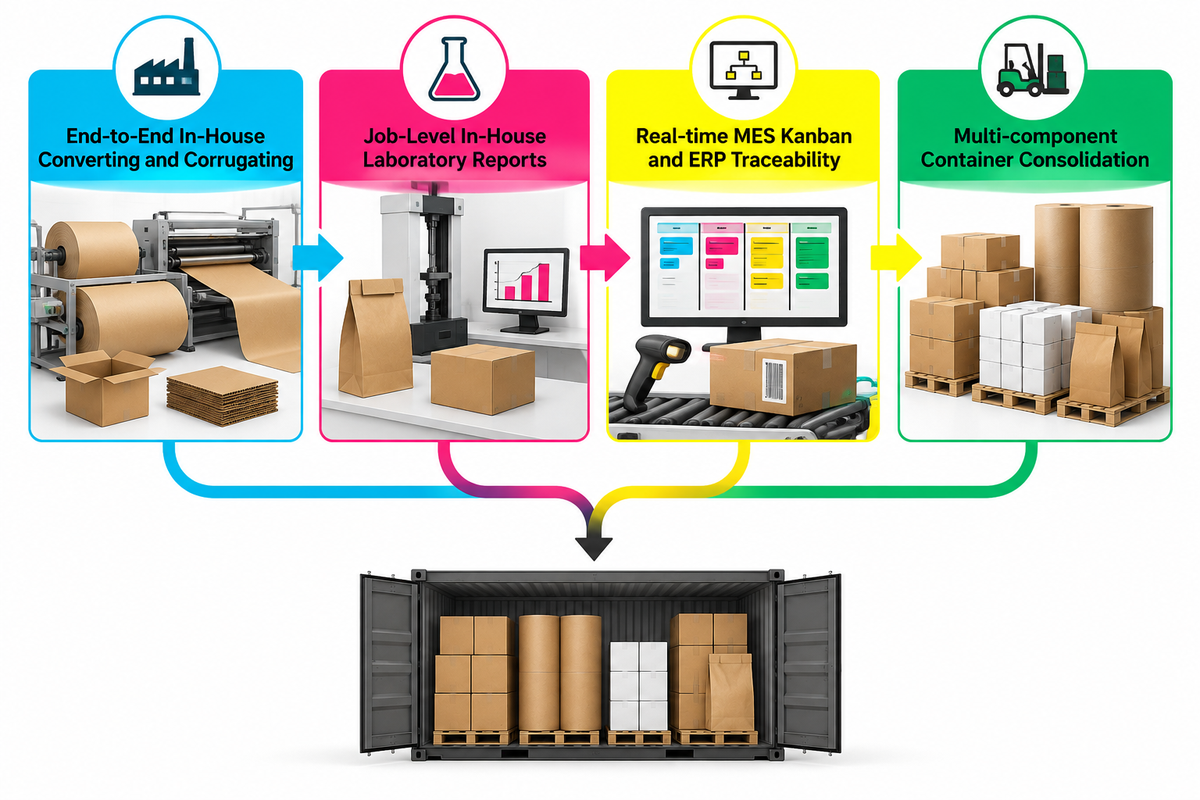
According to Huandao, the Xiamen manufacturing facility integrates four verifiable capabilities under one roof:
- End-to-End In-House Converting and Corrugating: Huandao runs the entire process of converting including pre-press, sheet fed offset printing, UV coating, and film lamination, as well as die-cutting and folder-gluing. An in-line corrugator supplies single E-flute and single B-flute board just-in-time with zero stock, and other board flute profiles are sourced.
- Job-Level In-House Laboratory Reports: Huandao’s in-house laboratory issues ECT/bursting strength, ink-rub, and basis-weight test reports on the customer’s own production run, tying every quality number directly to the shipped lot.
- Real-time MES Kanban and ERP Traceability: Each step in the production process is scanned into a MES kanban and reported in real time, linked to the ERP and intelligent scheduling.
- Multi-component Container Consolidation: Huandao being part of Huan Yin Packaging Group allows inner trays, inserts, printed boxes, retail carriers and outer shipping cartons for the same product to be supplied together and consolidated in the same shipment and with the same freight.
When your engineering parameters are settled, you can configure custom bag structures as part of a packaging solution. Visit our printed paper bags solution page to request our Xiamen Engineering team to provide factory dielines and production quotes.
Key Engineering Takeaways for Procurement Teams
- Separate GSM from Fiber Strength: Mineral clay coatings on C1S/C2S art paper add weight and print gloss without adding tear resistance; specify bursting strength (kPa) under ISO 2758 or TAPPI T403 alongside GSM.
- Size Around the Inner Box: Follow the 5-Variable Bag Build Matrix by adding at least 10 to 20 mm (1 to 2 cm) of gusset allowance beyond product depth, such as sizing an 8 cm deep box into a 22 x 10 x 30 cm bag.
- Design for 2026 Rules: Bags with heavy payloads can use a bottom board insert and reinforced top cuff. Under California SB 1053, covered recycled-paper carryout bags require at least 40% postconsumer recycled content if rated above eight pounds, or 20% if rated at eight pounds or less; the minimum rises to 50% in 2028.
- Demand Lot-Linked Lab Proof and Consolidated Freight: Require ISO 2758 / TAPPI T403 burst, ASTM D5264 ink-rub, and ISO 536 / TAPPI T410 basis-weight reports from your own production run, and consolidate bags with inner boxes and outer shipping cartons.
Copyable 10-Field Printed Paper Bag RFQ Specification Brief
Use the ten specification fields below when requesting comparable factory quotes for custom printed paper bags:
- Bag Style and Format: Specify twisted-handle shopping bag, flat-handle bag, turn-top Euro tote, SOS block-bottom bag, or pinch-bottom merchandise bag.
- Finished Dimensions (Width x Gusset x Height in mm): Label Width (W), Gusset/Depth (G), and Height (H) explicitly.
- Inner Payload Geometry and Weight: State inner box L x W x H (mm), net payload weight (kg), and required dynamic carrying test method.
- Paper Grade, GSM, and PCR Content: Specify virgin brown/white kraft, recycled kraft (% PCR), WSR kraft, or C1S/C2S board with target GSM and tolerance (such as ±3% or ±5%).
- Printing process and coverage: Specify sheetfed offset (150-200 LPI), roll-fed flexo, or digital printing, and exterior and reverse-side interior color counts.
- Surface Protection and Finishes: Specify paper-compatible aqueous varnish, BOPP film lamination, spot UV, or hot foil stamping.
- Handle and Reinforcement Spec: Specify handle material/diameter, top turnover collar insert, and bottom board insert.
- Prepress and Regulatory Markings: Specify unprinted glue-flap reserve strips, pre-creasing parallel to grain and required on-bag manufacturer, origin, and PCR % markings.
- Mandatory Job-Level Lab Reports (ISO 187 Conditioned): Require ISO 2758 / TAPPI T403 burst, ASTM D5264 ink-rub, ISO 536 / TAPPI T410 basis weight, and EN 13590 carrying tests on the production lot.
- Order Quantity and Shipment Consolidation: State target quantity; master-carton dimensions and CBM; and whether inner trays, folding cartons, rigid boxes, and outer shipping cartons will be consolidated in a single shipment.
Frequently Asked Questions
Can printed paper bags be recycled?
Unlaminated printed paper bags made from brown or white kraft paper and printed with water-based or vegetable-oil inks are generally allowed in municipal curbside paper recycling programs, as long as food grease and other non-paper attachments are not present. Bags coated with BOPP or polyester film lamination, metallic foil laminates, or synthetic rope handles, can complicate paper recycling, and component separation or disposal may be necessary, based on collection practices.
Why are printed paper bags so expensive?
Unit cost reflects open paper sheet area, virgin or coated paperboard basis weight (GSM), printing plate or die setup charges, surface lamination or varnish, and handle assembly labor. Low-volume orders amortize fixed prepress, cutting-die, and press makeready costs across fewer bags, whereas high-volume runs on automated roll-fed flexo or sheetfed converting lines reduce the per-bag conversion and setup cost.
Can I use these paper bags for food purchases?
Printed paper bags commonly serve as secondary carryout packaging around sealed takeout containers, bakery folding cartons, or wrapped food items where the bag interior does not directly contact exposed food. When unwrapped food touches the bag directly, the food-contact surface must be suitable for that food and its intended use; moist or greasy foods may also require an appropriate barrier.
How many bags do I have to order?
Custom pre-conversion sheetfed offset typically switch from stock overprinting around 1,500 units, and high speed roll-fed flexographic production starts at 5,000 to 20,000+ units, while post printing digital runs serve smaller batches. Separately request volume price breaks and one-time setup fees from suppliers.
Can I print two colors, or both sides?
Yes. Two-color spot Pantone graphics and two-sided (outside plus inside) printing are available when paper is printed on flat sheets or rolls before bag forming. Printing before bag forming allows printing across exterior panels, gussets and bottom flaps. The inside branding would require printing the other side of the sheet or web. Overprinting pre-made stock bags after assembly is usually limited to flat centers of front and back panels.
Do paper bags come with a colored handle?
Yes, both twisted paper cord and flat paper tape handles come in natural brown and/or bleached white or custom-dyed colors. Luxury turn-top bags can use Pantone-dyed cotton rope, polypropylene cord or printed satin ribbon.
What if I need more than 1,500 bags, or print on the gussets?
Orders of 1,500 units or more, or projects requiring continuous prints on the front face and side gussets of bags should move from printed stock bags to custom conversion. Printing paper sheets before creasing and tube forming allows edge-to-edge color registration across the gusset folds, custom Width x Gusset x Height and inline or cuff-reinforced handle. Share your target artwork coverage, box dimensions and expected delivery date so the manufacturer can access roll-fed converting.
References & Sources
- PaperIndex Academy — Paper Bag Raw Material Grades: GSM and Burst Factor Explained (80 GSM virgin semi-extensible sack kraft >350 kPa vs recycled 175–200 kPa; ISO 536 basis weight tolerances of ±3% and ±5%; ISO 187 conditioning at 23°C ± 1°C and 50% ± 2% RH).
- PaperIndex Academy — Diagnosing Packaging Failures: Why Paper Bags Tear During Delivery (3x to 5x dynamic delivery and handling forces; ISO 536, ISO 2758, and ISO 1924-2 verification methods).
- United States Patent and Trademark Office — US20160264304A1 / US10259616B2: Bag (Apple Inc.) (>=60% PCR white SBS bag body, 0.5–1.0 mm debossed corrugated turnover collar insert, 15 mm handle hole offset, >=6.5 mm 8-stitch circular-knit paper yarn handle, and 10–20 mm corner reinforcement extensions).
- California Department of Resources Recycling and Recovery (CalRecycle) – Carryout Bag Requirements (SB 1053 & PRC Section 42280) (recycled paper carryout bag mandate effective January 1, 2026; 40% PCR on bags above 8 lb and 20% PCR on bags 8 lb or less, rising to 50% PCR effective January 1, 2028, with mandatory printed manufacturer name, country of origin, and PCR percentage).
- EPA: Containers and Packaging Product Specific Data (paper and paperboard containers and packaging 1960-2018 data on municipal solid waste in the U.S.).
- U.S. Environmental Protection Agency (EPA) — Frequent Questions on Recycling and How Do I Recycle Common Recyclables (Curbside paper acceptance rules, 8.7% U.S. plastics recycling rate in 2018, and exclusion of shiny or laminated paper gift wrap and bags).
- U.S. Federal Trade Commission (FTC) — Environmental Claims: Summary of the Green Guides (Substantial majority >=60% community recycling access threshold for unqualified recyclable claims).
- 4evergreen Alliance — Circularity by Design Guideline for Fibre-Based Packaging (Version 4, February 2026). 4evergreen Alliance — Circularity by Design Guideline for Fibre-Based Packaging (Version 4, February 2026) (Developed by more than 380 experts across the paper-based packaging value chain for standard, flotation de-inking, and specialized paper mill recycling streams).
- Packaging Dive — State Packaging Laws Taking Effect in 2026: Bags, Foam, PFAS (California SB 1053 checkout paper bag 10-cent minimum charge and 40% to 50% recycled content transition, plus Washington and Maine 2026 packaging rules).
- Packaging Technology and Science (Wiley, 2026, doi:10.1002/pts.70071)
(SEM observation of steel-rule creasing crack behavior on 226 g/m² dispersion-coated paperboard). - International Organization for Standardization — ISO 2758:2014 Paper — Determination of Bursting Strength (Standard scope for paper burst testing 70–1,400 kPa vs ISO 2759 for paperboard and TAPPI T807 for linerboard).
- Swedish Institute for Standards / CEN — EN 13590:2003 Packaging — Flexible Carrier Bags for the Transport of Various Retail Goods (Test method for volume and carrying capacity of flexible carrier bags).
- ePackPrinting — What Is a Gusset on a Paper Bag? (Width x Gusset x Height measurement sequence, 1–2 cm gusset allowance, and worked 20 x 8 x 25 cm box to 22 x 10 x 30 cm bag example).
- BespokePackage — Printed Paper Bag Fold Cracking, causes and prevention (300 GSM SBS fold-cracking mechanics and 0.7-1.0 pt pre-creasing rules).
HUANDAO PACKAGING INSIGHTS
About Huandao Packaging Insights
Huandao Packaging manufactures folding cartons, litho-laminated printed boxes and rigid gift boxes, and also supplies paper bags, retail displays and protective inserts.
Our guides help buyers compare packaging options and prepare a clearer brief before requesting a quote.
Packaging families
Board, print and finish
Artwork, dieline and sample review
Delivery planning
PROJECT DISCUSSION
Talk with the Huandao Team
- Company
- Xiamen Huandao Packaging Technology Co., Ltd.
- Quote input
- Dimensions, filled weight, quantity, artwork or dieline, finish and destination.
- Review scope
- Box, insert and delivery requirements.
- Next step
- Bring the available details to a packaging conversation.