Get in Touch with Xiamen Huandao Packaging Technology Co., Ltd.

Custom Candle Packaging: Engineering & Buyer Guide

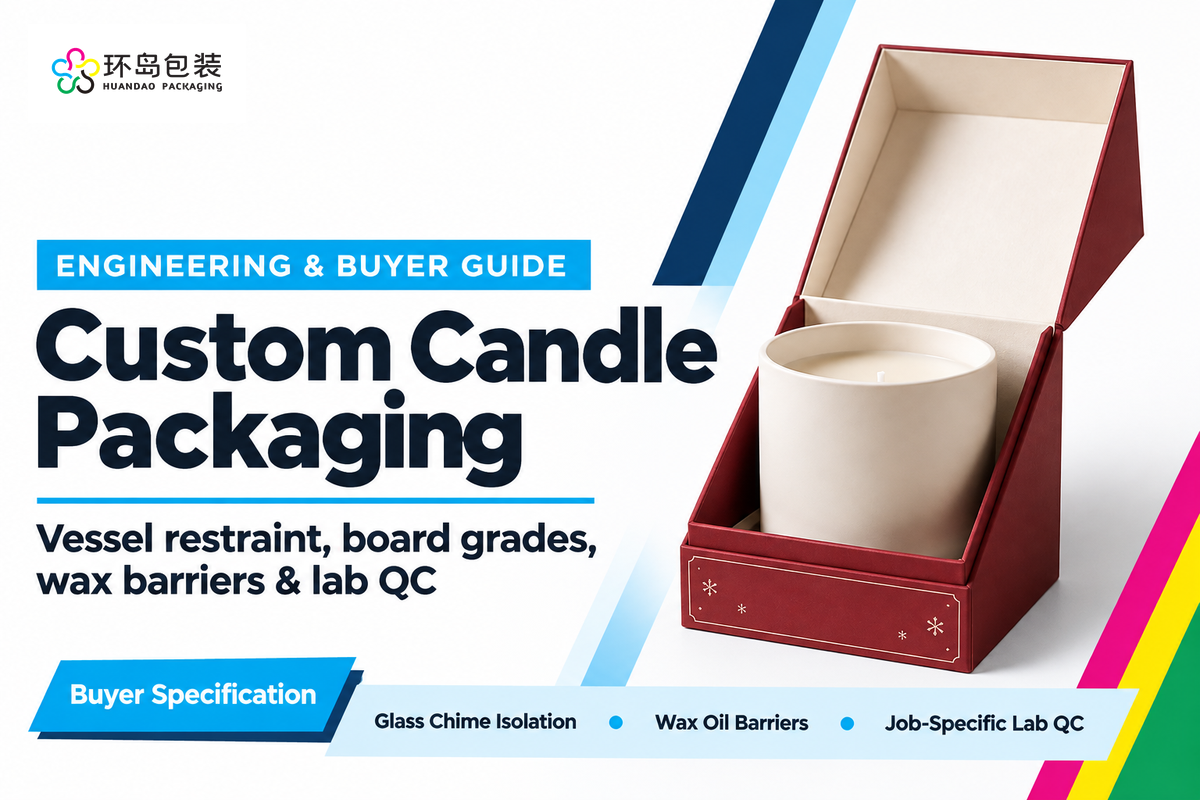
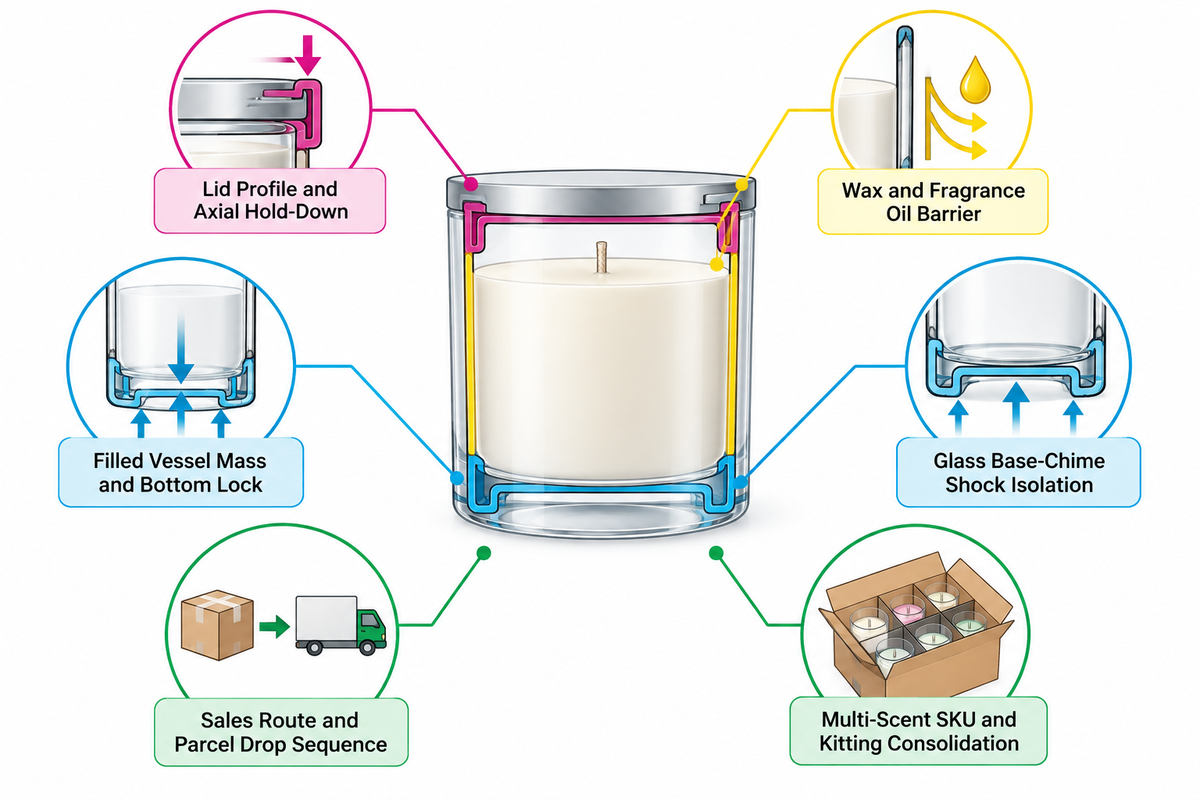
Custom candle packaging is built around six interconnected variables: the weight of a filled vessel, the fragility of the glass base and chime, the geometry of the lid hold-down, wax and fragrance oil exposure, drop hazards in the distribution channel, and the economics of multi-scent SKU kitting. Rather than selecting a generic candle box from a stock catalog, procurement and packaging engineers match paperboard caliper, corrugated flute profiles, internal suspension fitments, and fire-safety warning panels to the actual filled candle jar.
When a candle brand orders candle packaging boxes based on empty jar drawings or aesthetics alone, costly transit and retail failures follow. Heavy glass tumblers can shatter at the bottom chime during parcel drops. Loose metal lids can rattle against the glass during transit. Fragrance oil wicks can soak up uncoated cardstock during transit, and dark matte cartons can scuff before reaching the store. Well-engineered custom candle box packaging prevents these failures at the dieline.
Whether you source packaging for candle lines sold in boutiques or you ship subscription kits nationally via the United Parcel Service, tolerances in design and engineering are the determining factors for success of the product. This guide reviews formats, board and flute profiles, glass jar inserts, and wax barriers. It covers luxury rigid boxes, e-commerce parcel math, offset print, ASTM F2058 and FPLA labels, job-specific lab tests, and kitting.
How Filled Vessel Mass, Glass Fragility, and Sales Channel Dictate Custom Candle Packaging Structure
Filled candle vessel weight and sales route dictate packaging structure. They determine which packaging family protects your candle products from filling line to unboxing. Shelf jars in master cartons face different mechanical stress than jars shipped individually via parcel networks. Evaluating your custom product packaging by industry hazard profiles prevents both under-protecting brittle glass containers and overspending on rigid structures. Every product box must be paired with the exact size you need and the sales route it takes.
According to the technical definitions of paperboard packaging by the Paperboard Packaging Council (PPC), folding cartons can be between 10 to 36 point, fold flat for storage and shipping, and constructed from multiple types of virgin and/or recycled fibers, such as SUS, SBS, CUK, CRB, and FBB. When premium custom candle boxes require thicker walls and high-definition graphics, mini-flute cartons use an E, F, G, or N corrugated medium laminated to a printed liner. For a luxury presentation, a candle may use a thick 36 to 120 point board overlaid with a printed paper, and remain erect for shipping.
The 6-Axis Candle Vessel Restraint Protocol
- Axis 1 – Filled Vessel Mass and Bottom Lock: For lighter retail jars, consider using a 10 to 36 point folding carton with a crash-lock bottom. Heavier single or multi-wick vessels may require a switch to an E-flute corrugated or 36 to 120 point rigid grayboard.
- Axis 2 – Glass Base-Chime Shock Isolation: Suspend the brittle bottom heel of the glass candle jar 10 mm to 15 mm above the outer box floor. Corner drops should not strike the glass directly. Use a folded paperboard cradle, false bottom, or other similar design to accomplish this.
- Axis 3 — Lid Profile and Axial Hold-Down: Engineer top collar inserts or recessed cavities with a 10 mm hold-down around wood, metal, or glass lids. Restraint in this location stops closure pop-off under vibration.
- Axis 4 – Wax and Fragrance Oil Barrier: Use a coated dust cover to isolate a volatile fragrance oil and/or a wax pool from the outer box, and an oil-resistant liner to keep the lipids from staining the outer box.
- Axis 5 – Sales Route and Parcel Drop Sequence: Separate the boutique retail presentation boxes from single-parcel e-commerce packages that have been validated to meet ISTA 3A distribution testing.
- Axis 6 — Multi-Scent SKU and Kitting Consolidation: Share cutting dies across scent variants around the standard 1,000 pieces per size and style MOQ, and consolidate boxes, inserts, and outer cartons into one shipment.
Keep the structural boundary in mind: paperboard point caliper (10 to 36 point) or rigid greyboard thickness (36 to 120 point) alone does not guarantee glass jar survival. The internal insert also needs to match the weight of the filled vessel. Even with a rigid box, if the internal cavity allows the vessel to bottom out or slide around, drop shock will still be transmitted to the jar. A rigid candle box is not always the right choice for every launch. When order quantities sit far below 1,000 pieces per size and style, when jar geometry is unfrozen, or when parcel protection is the only job, a folding carton or corrugated mailer works better. Brands can customize the structure for various candle vessels to balance cost and protection.
| Candle Box Format | Board / Wall Construction | Shipping & Assembly State | Primary Protection & Brand Role | Best-Fit Candle Applications |
|---|---|---|---|---|
| Printed Folding Carton (with Paperboard or E-Flute Insert) | 10 to 36 point SBS, FBB, CUK, or CRB paperboard (per PPC) | Shipped flat; fast erecting with auto-lock or crash-lock bottom | Compact freight volume, crisp sheetfed offset graphics, and retail shelf protection when paired with a fitted insert | Wholesale retail tumbler candles, travel tins, votive multipacks, and wax melt sleeves |
| Litho-Laminated Single E-Flute Box | Offset-printed top sheet laminated onto single-face or double-face E-flute corrugated medium | Shipped flat; folds along pre-creased score lines into a rigid-feeling carton | Bridges retail folding cartons and shipping boxes by adding fluted crush cushioning for heavy glass jars | Heavy multi-wick jar candles, ceramic vessels, and club-store retail display packs |
| Two-Piece, Drawer & Collapsible Rigid Candle Boxes | 36 to 120 point greyboard core overlaid with printed wrap paper (per PPC) | Shipped pre-erected for two-piece and drawer styles, or flat in collapsible corner-lock magnetic format | Controlled reveal, deep base restraint, and luxury keepsake presentation for premium candle lines | Flagship luxury candle jars, home-fragrance gift sets, and seasonal discovery collections |
| Corrugated E-Commerce Candle Mailer System | Single B-flute or sourced BC-flute corrugated box with die-cut suspension collar (15 mm bottom air cell) | Shipped flat; self-locking mailer or RSC outer shipper | Absorbs ISTA 3A parcel drops and vibration; protects the inner retail candle box during courier transit | Direct-to-consumer (DTC) single-jar orders, subscription boxes, and multi-jar mail-order bundles |
Paperboard Grades, Corrugated Flute Profiles, and Greyboard Calipers by Candle Jar Weight
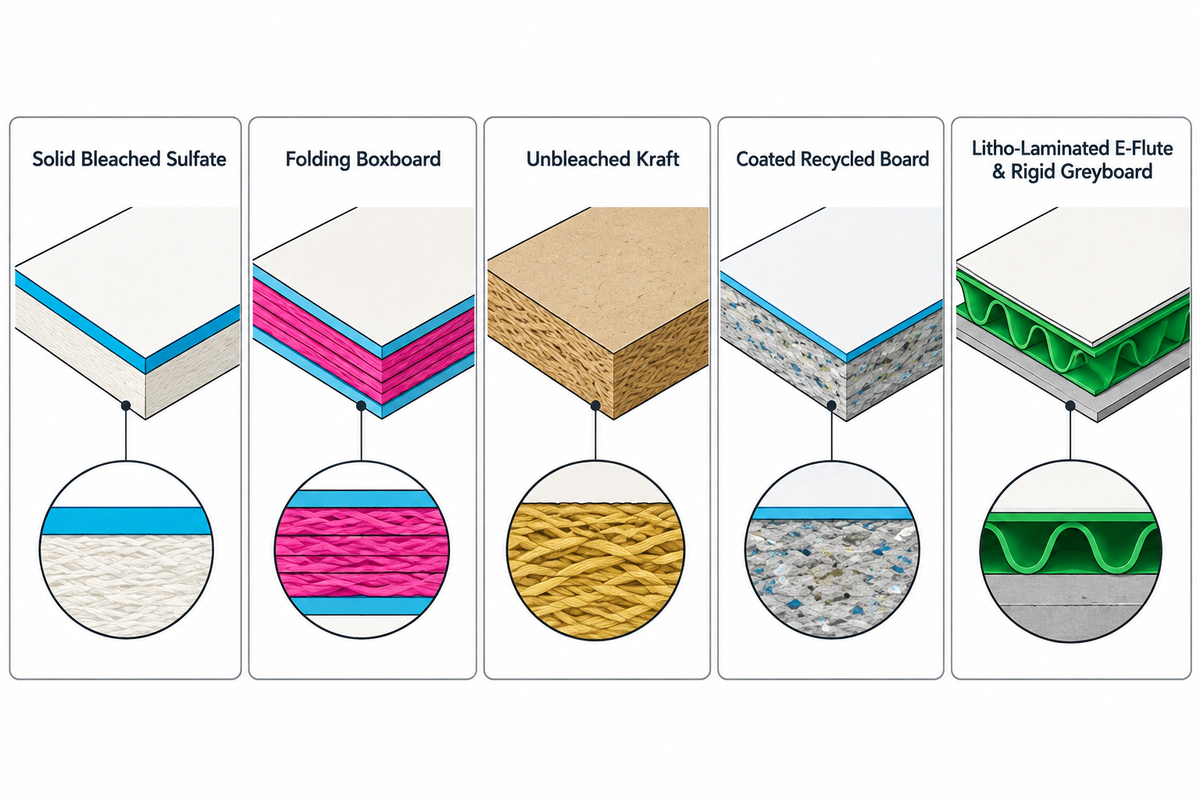
Selecting the right candle packaging material requires specifying the exact pulp furnish, caliper, grain direction, and flute profile on your structural dieline rather than asking a supplier for generic cardstock. In commercial candle making, jar weight and wax chemistry dictate how much vertical compression the board must carry. The Paperboard Packaging Council guide to 4 types of paperboard defines the 4 primary folding carton grades as Solid Bleached Sulfate (SBS), Coated Unbleached Kraft (CUK/SUS), Folding Boxboard (FBB) and Coated Recycled Board (CRB). Candle makers ordering custom folding cartons along with their candle packaging supplies, match each substrate to their jar weight and finish stack.
A brilliant white, clay-coated SBS offers a superior surface for printing, with a smooth surface from a top layer of bleached virgin hardwood fibers. That smooth white surface makes SBS ideal for luxury cartons with fine typography, hot foil, and embossing. CUK (or SUS) uses unbleached kraft fibers to provide a natural brown surface with high tear resistance, and high opacity. Due to the kraft fibers changing the appearance of light and transparent inks, brand colors must be proofed on the actual kraft stock. FBB (C1S ivory board) provides high bending stiffness per unit weight, thus offering flat and non-bowing panels on retail shelves, while CRB serves lighter dry accessories.
When glass weight or transit cushioning demands corrugated board, converters use single-face or sheet-to-sheet lamination. As PackRite notes on single-face laminated corrugated, single-face lamination bonds a printed top sheet onto a fluted corrugated medium in C, B, E, or F profiles. According to Huandao, its Xiamen factory runs an in-line corrugator that supplies single E-flute and single B-flute board just in time with zero stock. On the other hand, A, C, F, BC and other flute profiles are supplied from sourced board, so the sourcing boundary remains visible in every quotation.
What materials are custom candle boxes made of?
Custom candle boxes are made using 10 to 36 point folded carton board (for instance SBS ivory board, FBB, unbleached kraft, or CRB). Luxury styles make use of rigid grey board lined with printed paper, and protective inserts and shipping boxes use E-flute, B-flute, or BC-flute corrugated.
| Substrate or Flute Grade | Point Caliper / Profile Class | Structural & Mechanical Behavior | Print & Finish Compatibility | Recommended Candle Packaging Role |
|---|---|---|---|---|
| Solid Bleached Sulfate (SBS) | 10 to 36 point virgin bleached board (per PPC) | Bright white through-sheet; clean 90-degree crease folding and high odor neutrality for scented products | Clay-coated top surface for 6-color sheetfed offset, Pantone solids, foil stamping, and deep embossing | Primary retail candle boxes, boutique gift cartons, and die-cut wax dust covers |
| Folding Boxboard (FBB / C1S Ivory Board) | 10 to 36 point multi-ply virgin board | High stiffness-to-weight ratio resists side-wall bowing around cylindrical candle jars | Smooth coated white exterior with clean cream reverse side; supports matte, gloss, and soft-touch lamination | Standard retail tumbler cartons, diffuser sleeves, and tapered candle boxes |
| Unbleached Kraft / CUK (SUS) | 10 to 36 point unbleached virgin kraft fiber | High tear and puncture resistance; supports crash-lock bottoms under heavy jars | Natural kraft fiber aesthetic; requires substrate-specific ink drawdown and signed proof for accurate brand colors | Botanical and Artisan candle cartons, folded paperboard jar inserts, and carrier packs |
| Coated Recycled Board (CRB / CCNB) | 10 to 36 point recycled paperboard | Lower bending stiffness than virgin SBS/CUK; best paired with wider crease channels | Clay-coated white printing top over grey recycled back | Lighter tealight candle packaging, matchbox sleeves, and secondary dry accessory boxes |
| Rigid Greyboard (Wrapped Setup Core) | 36 to 120 point high-density chipboard/greyboard (per PPC) | Non-collapsing structural core; supports V-grooved sharp corners and deep base restraint | Overlaid with printed, laminated, foil-stamped, or textured specialty wrap paper | Two-piece telescope boxes, sliding rigid drawers, shoulder-neck boxes, and multi-scent gift sets |
| In-Line Single E-Flute Corrugated | Fine micro-flute profile (supplied in-line at Huandao) | Low-profile flute provides flat crush resistance and clean die-cut edges without excessive bulk | Supports litho-laminated offset top sheets for retail or e-commerce packs | Heavy jar litho-laminated retail boxes, internal suspension collars, and compact DTC mailers |
| In-Line Single B-Flute Corrugated | Medium single-wall flute profile (supplied in-line at Huandao) | Greater cushioning depth and stacking structure than E-flute; resists corner impact | Direct flexo or litho-laminated outer liner | Protective e-commerce candle shipping boxes, jar partitions, and transit overboxes |
| Sourced F-Flute Micro-Corrugated | Ultra-fine micro-flute profile (sourced board route) | Thin rigid profile with minimal flute shadow under smooth offset liners | High-graphics offset litho-lamination for retail cosmetic and home-fragrance cartons | Slim luxury fluted cartons and multi-votive display trays |
| Sourced A, C, and BC Double-Wall Flutes | Heavy single-wall (A, C) and double-wall (BC) profiles (sourced board route) | Maximum vertical stacking compression (e.g., 32 ECT / 65 lb class) and 200 psi puncture protection | Printed with handling markings, barcode labels, and brand identifiers | Master shipping cartons, wholesale 12-jar case packs, and palletized ocean-freight shippers |
Engineering Glass Jar Restraint: Insert Geometries, Chime Shock Isolation, and Lid Hold-Down Tolerances
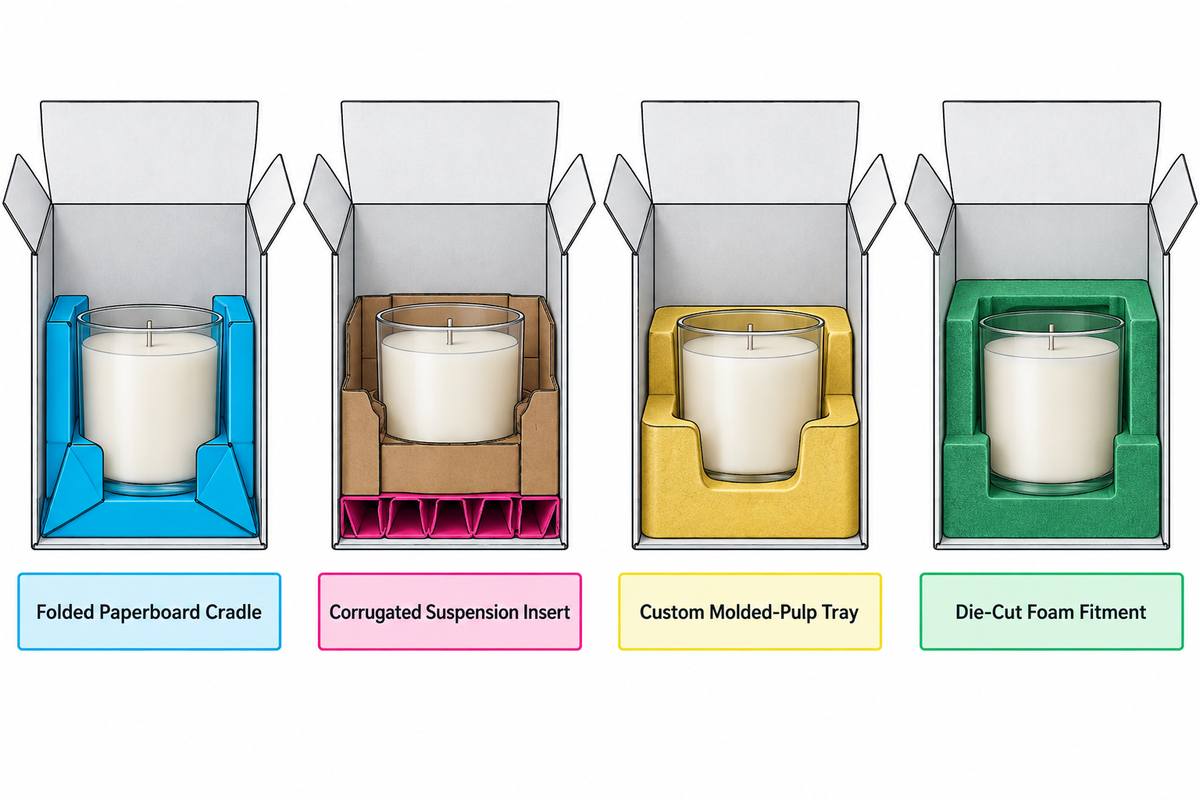
Glass is rigid and brittle, making internal restraint the single most critical mechanical subsystem when you design custom candle boxes. The risk of breakage increases when a filled candle jar can move around in the cavity, or when a heavy lid comes loose. Breakage can also occur when the bottom heel of a glass rests against the outer floor of the box. A thoughtful box design with boxes tailored to the vessel immobilizes the jar across all six axes to protect your products during handling.
Before a cut is made on an insert die or a request is made to receive a dieline, packaging engineers physically measure the filled vessel. The measurements include maximum outer diameter, body taper profile, total height of the vessel with the lid seated, lid overhang, and the weight of the filled vessel. Using the 3D CAD model, an engineer builds a 10 mm to 15 mm bottom air cell (a suspended false floor) and a top neck collar, creating a cost-effective air gap that isolates the fragile glass chime while providing finger access so customers can lift the candle out easily during unboxing.
Choosing a protective insert balances shock absorption, aesthetics, and end-of-life recovery. As reported by Grand View Research on low-carbon footprint packaging, in 2025, the paper and paperboard segment accounted for the largest revenue share of 36.6%. The molded fiber segment is anticipated to grow at the fastest CAGR of 9.4%.
Folded paperboard and E-flute corrugated inserts support mono-material curbside recycling. Molded pulp and die-cut EVA or EPE foam inserts, on the other hand, address complex gift cavities. Still, no insert is assumed safe for glass without physical drop testing.
| Protective Insert Type | Structural & Cushioning Mechanism | Best-Fit Candle Vessel Profile | Visual Presentation & Finish | End-of-Life & Tooling Considerations |
|---|---|---|---|---|
| Folded Paperboard Cradle (SBS or Kraft) | Die-cut and creased 10 to 36 point paperboard platform with locking tabs, rim collar, and 10 mm to 15 mm bottom air-cell standoff | Light-to-medium single-wick glass jars, travel tins, and retail shelf folding cartons | Can be printed or dyed to match the outer candle box interior seamlessly | Low steel-rule die tooling cost; keeps the entire package mono-material paperboard |
| Die-Cut E-Flute / B-Flute Corrugated Suspension Insert | Multi-layer fluted collar and 15 mm false bottom that absorbs corner and edge impact energy | Heavy single-wick and 3-wick glass tumblers, ceramic jars, and e-commerce mailers | Available in natural kraft, bleached white, or laminated wrap to hide raw flute edges | Economical die tooling; high shock attenuation and curbside paper recyclability |
| Custom Molded-Pulp Tray | Contoured wet-pressed or dry-pressed fiber cavity molded to the exact jar and lid silhouette | Round or contoured jars and multi-component candle + diffuser sets at scale | Smooth wet-pressed matte fiber look or natural textured pulp finish | Requires dedicated metal molding tooling; fiber-based recovery appeal |
| Die-Cut EVA / EPE Foam Fitment (Paperboard or Velvet Lined) | Closed-cell elastomeric foam cut to a gentle interference friction fit around the vessel | Heavy luxury crystal/stoneware candles, fragile glass cloches, and multi-scent discovery coffrets | Top surface laminated with flocked velvet, specialty paper, or dyed cardstock | Multi-material construction; requires qualifying recyclability claims under FTC 16 CFR 260.12 |
Wax and Fragrance-Oil Migration Control: Dust Covers, Interior Coatings, and Scent Retention
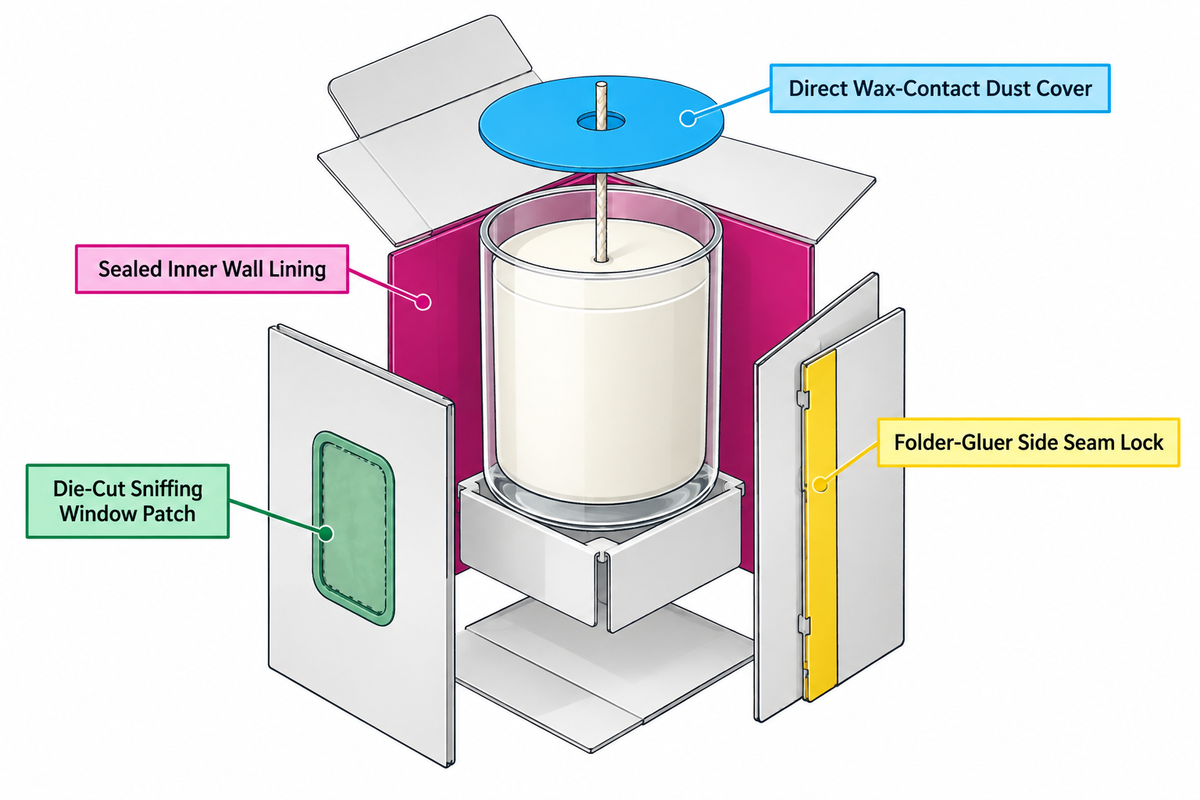
Scented candles introduce a chemical packaging challenge that standard dry retail goods never face: volatile fragrance oil vapors and low-melting vegetable waxes interact directly with uncoated cellulose fibers. If an open candle top or wax melt comes in contact with raw paperboard during storage and shipping, for example, fragrance oils in the wax melt can migrate into the paperboard. That lipid migration leaves translucent grease halos on the exterior print and weakens glue seams across your tailored packaging.
To prevent lipid staining and terpene-induced yellowing on white boxes, brands pair interior barrier coatings with a die-cut paperboard dust cover seated directly on the wax surface around the centered candle wick. According to 21 CFR 176.170 for paper and paperboard components, specific water-repellent resins added before sheet forming are limited to 1.6 percent by weight of the dry paperboard fibers. Components contacting dry solids fall under 21 CFR 176.180. Newer packaging migration studies, indexed by NIH PubMed Central (PMC12096275) and ScienceDirect, corroborate that volatile organic compounds migrate through unisolated paperboard layers when stored in a stack. Stipulating an aqueous oil-resistant dispersion coating or laminated interior liner for each unique candle prevents fragrance oil migration and bleed, while maintaining the graphic finish on the outer layer.
Are custom candle boxes suitable for scented candles?
Yes, custom candle boxes are appropriate for scented candles, especially if an oil-resistant aqueous coating or an interior barrier liner is employed. Additionally, a 10 to 36 point paperboard wax dust cover with a center candle wick (pull tab) and low-odor Virgin SBS or kraft board is recommended.
| Wax & Fragrance Exposure Zone | Primary Chemical or Thermal Risk | Recommended Material & Coating Specification | Pre-Production Verification Check |
|---|---|---|---|
| Direct Wax-Contact Dust Cover | Soy/coconut wax sweating and fragrance oil wicking into raw paperboard fibers | Virgin SBS or cotton/kraft board with aqueous grease/oil-resistant barrier coating on the wax-facing side; die-cut candle wick slot and pull tab | Elevated-temperature contact check against the actual poured wax and fragrance load |
| Inner Wall of Folding Carton or Rigid Base | Volatile terpene and vanillin vapors yellowing bright white uncoated interiors over time | Sealed interior aqueous varnish, dyed-core specialty wrap paper, or laminated liner inside the cavity | Closed-box scent aging check to confirm zero discoloration or odor cross-talk |
| Folder-Gluer Side Seam & Bottom Lock | Concentrated essential-oil vapors softening standard hot-melt adhesives | 8 mm to 12 mm unvarnished glue flap bonded with high-tack cold dispersion or solvent-resistant adhesive | Seam fiber-tear pull test after conditioning with the scented candle enclosed |
| Die-Cut Sniffing Window Patch | Fragrance vapor softening window-patch glue or fogging thin plastic films | Rigid PET or cellulose acetate window film with wide glue margin kept clear of direct wax contact (or windowless cutout for enclosed jars) | Window bond peel check and optical clarity inspection |
Luxury Rigid Candle Boxes, Home-Fragrance Gift Sets, and Specialty Vessel Formats
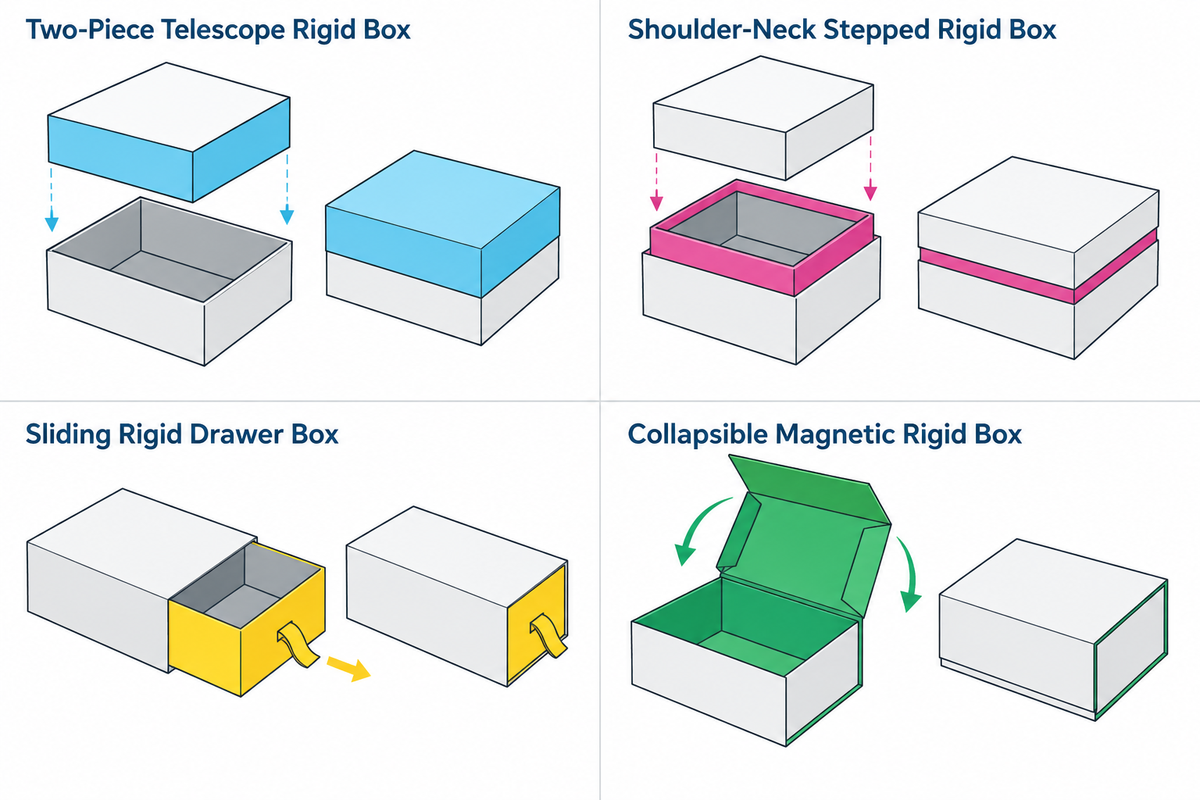
When a candle brand is looking for an elegant retail presentation for seasonal coffrets or department stores, upgrading to custom rigid boxes transforms the tactile opening experience. Built around a 36 to 120 point greyboard core (per PPC), luxury candle packaging boxes provide non-flexing walls and crisp V-grooved 90-degree edges. When you create custom candle boxes in rigid greyboard, deep structural bases restrain heavy glass, ceramic, or stone vessels to make a lasting impression during unboxing.
Four structural styles lead luxury candle programs: two-piece lift-off lid boxes, shoulder-neck stepped boxes (with flush packaging edges), sliding rigid drawer boxes, and collapsible magnetic rigid boxes. For brands shipping export volumes, where pre-erected rigid boxes consume excessive container space, foldable rigid structures provide an engineering solution. For instance, in USPTO Patent US8573471B2 (Foldable Box), a series of laminated cardboard panels ship flat and lock together to form a rigid box. One of the embodiments in that patent measures 150 mm × 150 mm × 25 mm (150×150×25 (h) mm). Classic single-piece creased gift box constructions are also illustrated in USPTO Patent US3905540A.
According to Huandao, two-piece rigid candle boxes are engineered by checking lid overlap, base depth, board wrap, and fitment geometry together before the custom candle box artwork is frozen. In contrast, rigid drawer boxes create a controlled reveal with a space for a protective insert. For multi-item home-fragrance gift sets—combining a scented candle, reed diffuser, or discovery trio—custom candle boxes provide dedicated divider cavities that keep every component secure and leave a lasting impression.
| Luxury Rigid or Specialty Format | Structural Geometry & Closure | Unboxing & Restraint Advantage | Freight & Assembly Trade-Off | Ideal Candle & Home-Fragrance Use Case |
|---|---|---|---|---|
| Two-Piece Telescope Rigid Box | Full or partial telescopic lift-off lid over a deep 36 to 120 point greyboard base | Broad unbroken artwork panels and controlled friction air-release reveal; deep base holds heavy jars | Ships pre-erected; highest structural stiffness with zero packing-line assembly | Signature luxury jar candles, collector editions, and heavy ceramic vessels |
| Shoulder-Neck Stepped Rigid Box | Inner neck ring glued into the base creates a stepped shoulder where the outer lid seats flush | Allows contrasting color reveal on the exposed neck ring and centers the lid automatically | Ships pre-erected; requires tight neck-to-lid tolerance control | High-end perfumery candles, prestige retail gift boxes, and limited-edition launches |
| Sliding Rigid Drawer Box | Outer rigid sleeve with slide-out inner drawer and grosgrain ribbon pull or thumb notch | Horizontal slide reveal prevents customers from lifting a heavy jar by the lid alone; doubles as a keepsake drawer | Ships pre-erected; requires calibrated drawer-to-sleeve clearance so humid air does not bind the slide | Boutique candle lines, candle + matchbox pairings, and luxury subscription gifts |
| Collapsible Magnetic Rigid Box | Scored greyboard panels with corner locks and concealed magnets (e.g., US8573471B2 150 mm × 150 mm × 25 mm flat-fold architecture) | Delivers rigid luxury unboxing while folding flat for ocean freight and warehouse storage | Higher unit converting complexity offset by major sea-freight cube reduction | Large candle + reed diffuser gift sets and international export gift programs |
| Multi-Cavity Home-Fragrance Gift Set | Rigid box or litho-laminated carton with multi-compartment insert for jar, diffuser bottle, reeds, and accessories | Separates fragile glass bottles from metal accessories and prevents component collision | Custom multi-cavity insert tooling required; benefits from single-supplier kitting | Holiday gift coffrets, 3-scent discovery kits, and corporate gift boxes |
| Taper, Pillar & Tealight Partitioned Cartons | 10 to 36 point folding carton or E-flute tray with interlocking paperboard cells and base pedestal | Prevents slender taper candles from snapping and unjarred pillar wax from scuffing against carton walls | Ships flat; fast manual or semi-automated multi-pack loading | Dinner taper pairs, sculpted pillar candles, votive 6-packs, and tealight candle packaging |
E-Commerce Parcel Survival: Corrugated Overboxes, ISTA 3A Drop Mechanics, and Dimensional Weight Math
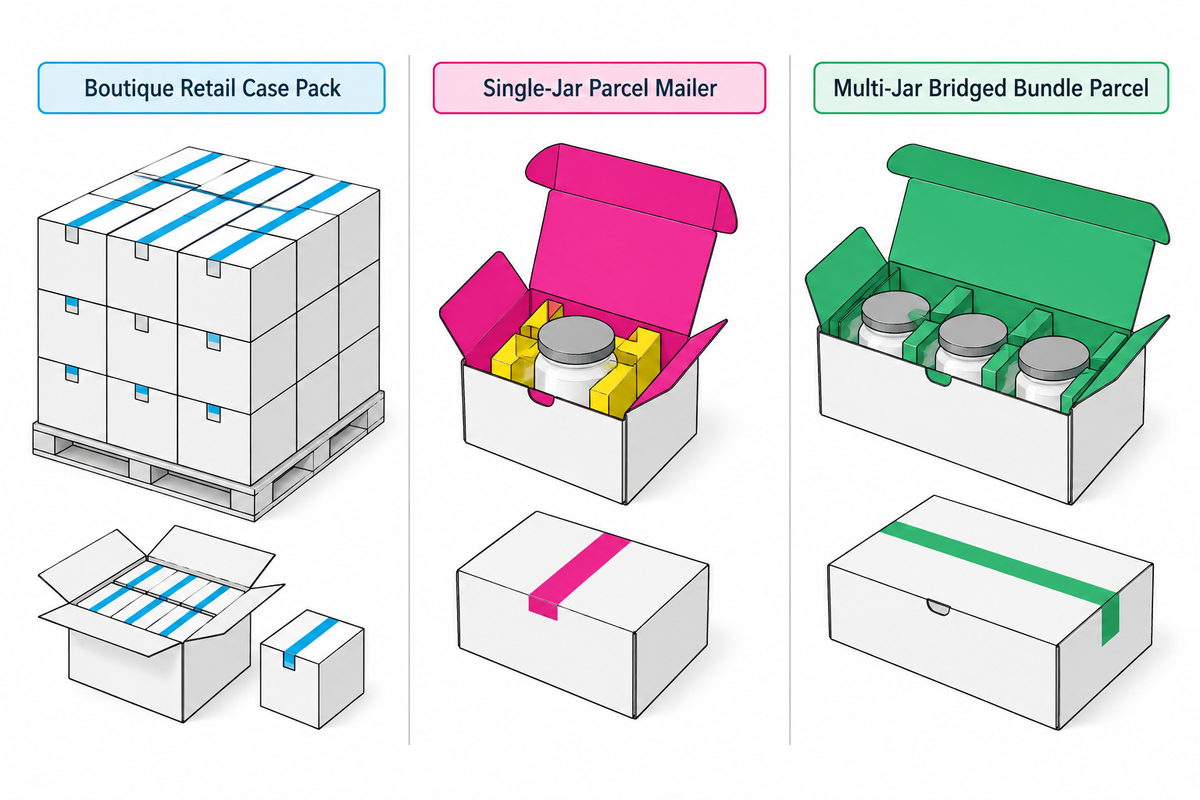
Printed retail candle boxes (10-36 pt folding cartons; 36-120 pt rigid gift boxes) are designed for face out, in-store merchandising. A printed candle box is not designed for sortation and delivery via a parcel courier. In direct-to-consumer (DTC) e-commerce, individual parcels face conveyor chutes, sorting impacts, and stacked delivery vans across extended shipping time. A Virginia Tech Center for Packaging and Unit Load Design (CPULD) study evaluated five e-commerce packaging solutions under an ISTA 3A testing sequence. It confirmed that primary, secondary, and tertiary components (internal and external) must be assessed as a unified system for distribution.
Note the verification boundary here: Huandao’s in-house paper and print laboratory reports (ECT, burst, ink-rub, basis-weight) document the customer’s production run. They do not replace formal ASTM D4169 or ISTA 3A packaged-product distribution testing on filled glass candle jars. Formal verification of parcel shipment is requested by the buyer using the ISTA 3A or ASTM D4169 test protocol with filled candle vessels, the internal inserts, and the outer custom corrugated boxes or mailers.
Right-sizing the outer corrugated candle shipping boxes also controls parcel shipping costs for small and mid-sized DTC brands. Consider a typical engineering estimate for a 2-jar DTC candle gift set (2 × 10 oz soy candles in heavy glass tumblers). Each filled jar is estimated to weigh 580 g (1.28 lb) with a 92 mm outer diameter and 105 mm height (with the lid) for a total set weight of 1.16 kg (2.56 lb).
- Oversized Stock Box Baseline: A stock carton of 380 mm × 260 mm × 180 mm (14.96 in × 10.24 in × 7.09 in) has 1,086 in³ (17,784 cm³) volume. Dividing by 139 gives 1,086 / 139 = 7.81 lb (17,784 / 5,000 = 3.56 kg), billing at 8 lb instead of 3 lb.
- Right-Sized B-Flute Mailer: A FEFCO 0427 B-flute mailer of 265 mm × 155 mm × 145 mm (10.43 in × 6.10 in × 5.71 in) cuts volume to 363 in³ (5,956 cm³). With an E-flute divider (15 mm bottom cell, 12 mm bridge, 10 mm top hold-down), dimensional weight drops to 363 / 139 = 2.61 lb (1.19 kg), saving 5 lb of billed air.
How durable are custom candle boxes in protecting products during shipping?
For retail, a printed folding carton or rigid candle box protects the vessel. However, through parcel carriers, durable shipping requires a complete pack-out system that includes a right-sized single E-flute, B-flute, or BC-flute corrugated outer shipping box, as well as an internally suspended insert and potentially ISTA 3A drop-test validation.
| Distribution Channel & Pack-Out Route | Primary Box + Insert Architecture | Outer Shipping Container | Primary Mechanical Hazard | Recommended Verification Standard |
|---|---|---|---|---|
| Boutique Retail Shelf (Palletized Case Pack) | 10 to 36 point folding carton or 36 to 120 point rigid box with paperboard/fluted cradle | Sourced BC double-wall master carton with interlocking cell dividers on shrink-wrapped pallet | Vertical warehouse stacking compression (up to 65 lb on 32 ECT board) and ocean container humidity | Job-specific ECT & Mullen burst lab reports (FEFCO TM 8 / TM 4) + case stacking check |
| DTC E-Commerce Single-Jar Parcel | Retail candle box (or direct fluted cradle) with 15 mm suspended bottom air cell and 10 mm top lid collar | In-line single B-flute die-cut mailer (FEFCO 0427) sized tightly around the primary pack | Free-fall corner/edge drops and random parcel vibration | ISTA Procedure 3A or ASTM D4169 single-parcel distribution sequence |
| Multi-Jar Subscription or Gift Bundle Parcel | Rigid gift box or multi-cavity E-flute tray with 12 mm inter-jar bridge and 15 mm bottom cushion | Single B-flute or sourced BC-flute overbox engineered below carrier DIM-weight breakpoints | Jar-to-jar internal impact and dimensional-weight freight surcharges | ISTA 3A multi-drop sequence + carrier DIM divisor audit (L × W × H / 139) |
Offset Print Control, Kraft Color Proofing, and Decorative Finishing for Candle Boxes
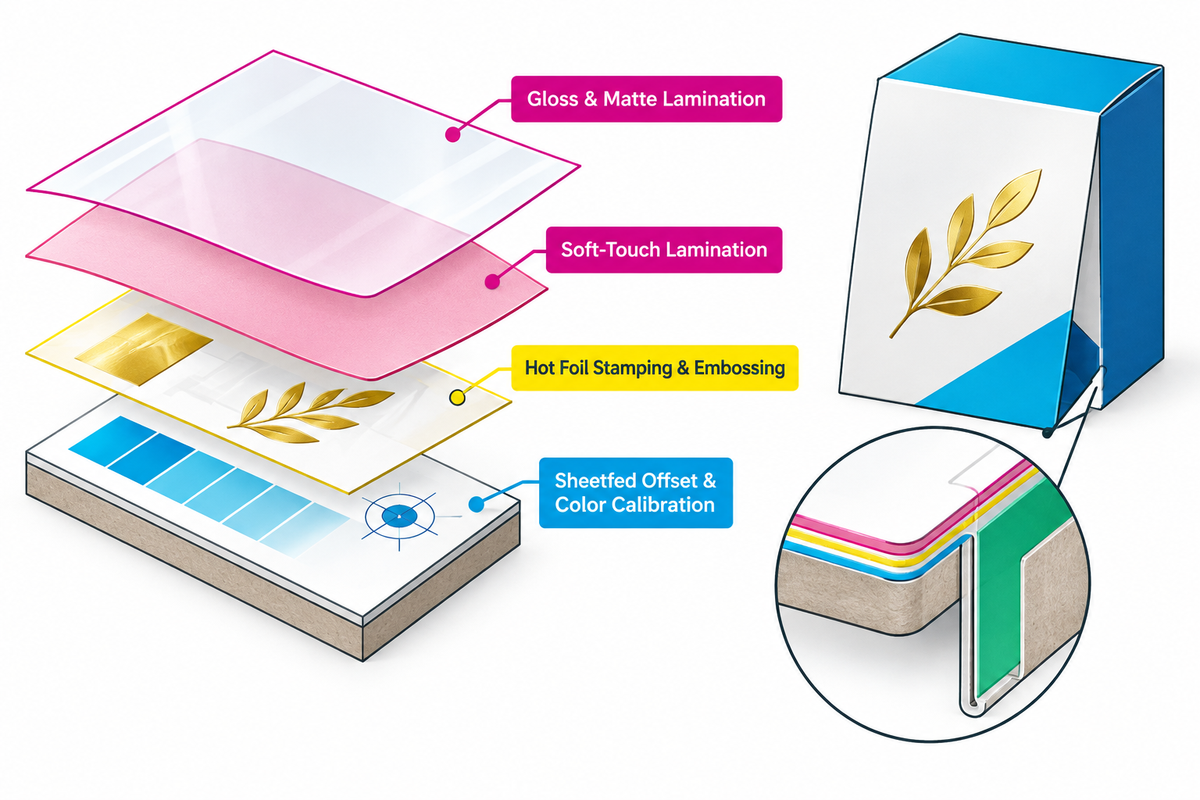
For home-fragrance brands, color accuracy and surface tactility carry the brand identity before the customer ever smells the candle. Matching primary candle boxes to retail carrier bags, like those in our printed paper bags guide, requires binding the substrate, ink system and finish stack to a signed contract proof. Thoughtful customization crafted from high-quality paperboard helps enhance your brand on crowded retail shelves. As technical guides from X-Rite on controlled ISO 3664 D50 lighting and ISO 13655 M-standards explain, evaluating press sheets under standardized D50 illumination prevents metameric color shifts across ivory boards and unbleached kraft stocks.
According to Huandao, the entire process from pre-press to sheetfed offset printing, UV coating, lamination, die-cutting and folder-gluing happens at the Xiamen facility. Huandao prints CMYK plus up to two Pantone spot colors on a six-color sheetfed offset press with in-line coater. Color is calibrated using X-Rite to G7 against a signed contract proof and a Delta E tolerance. Digital printing is not the default production route for a wholesale order. When printing on brown kraft board, transparent inks shift dark and warm, so proofing must use the intended kraft substrate and ink strategy to elevate your candle presentation.
The finishing process must avoid dark-field scuffing and crease cracking on unique packaging. Converting records from Dixsons Enterprises and Superior Lithographics show that improper creasing depth or insufficient liner moisture damages paper fiber along the fold. Pressroom operators on PrintPlanet recommend scoring and folding printed and UV-coated sheets at 90 degrees to ensure that brittle ink and coatings do not flake off.
What finishing options are available for candle packaging?
Various finishing options are available for custom candle packaging including gloss and matte lamination, soft-touch lamination, anti-scratch matte varnish, and Spot UV coating. Brands can also request gold, silver, or hologram hot foil stamping, embossing, debossing, and window patching, all of which are quoted based on the board and artwork.
| Decorative Finish Option | Production Route at Huandao | Visual & Tactile Effect | Engineering Decision Point & Risk Control | Qualification & Tooling Scope |
|---|---|---|---|---|
| Gloss Lamination | In-house lamination line | High-sheen surface that deepens color contrast and wipes clean of dust or wax smudges | Confirm glare expectations under retail store spotlights; bridges fibers across 90-degree folds | Quoted by sheet area and board grade |
| Matte Lamination | In-house lamination line | Muted, low-glare contemporary finish across folding cartons and rigid box wraps | Dark solid colors (black, navy, forest green) require rub and fingerprint review | Quoted by artwork coverage and board |
| Soft-Touch Lamination | Available specialty film finish | Velvety, tactile surface popular on luxury candle packaging boxes | Check rub resistance, hot-foil release, and Pantone color shift on the chosen soft-touch film | Pre-production sample recommended |
| Matte Anti-Scratch Varnish / Film | Available protective finish | Preserves a dead-matte look while resisting scuff marks during carton packing and parcel vibration | Essential for dark unlaminated or matte-finished candle cartons; verify via ASTM D5264 rub test | Sample recommended for dark solids |
| Spot UV Coating | In-house UV coating route | High-gloss contrast or tactile raised sheen over selected logos, patterns, or scent names | Keep Spot UV 2 mm to 3 mm clear of 90-degree crease lines and 8 mm to 12 mm glue flaps to prevent cracking | Requires dedicated Spot UV separation layer |
| Gold & Silver Hot Foil Stamping | Available heated-die stamping | True metallic specular reflection on brand crests, borders, and serif typography | Fine lines and textured papers require proper die temperature and dwell to avoid foil bridging | Custom metal stamping die quoted |
| Holographic Foil Stamping | Available specialty foil route | Prismatic multi-color light diffraction for seasonal or modern home-fragrance editions | Directional foil repeat position and substrate smoothness must be approved on sample | Custom stamping tooling quoted |
| Embossing (Blind or Registered) | Available relief tooling route | Raises logos or botanical patterns in 3D relief above the paperboard or wrap surface | Review relief depth, fiber stretch, and reverse-side show-through on the actual board caliper | Male/female embossing die quoted |
| Debossing & Window Patching | Available structural/tooling route | Recesses a scent-label frame into rigid wrap paper or adds a clear viewing/sniffing window | Deboss depth must suit greyboard wrap; window size, film, and glue margin require structure review | Tooling and structure review required |
Candle Fire-Safety Labeling, Regulatory Copy Placement, and Dieline Pre-Press Rules
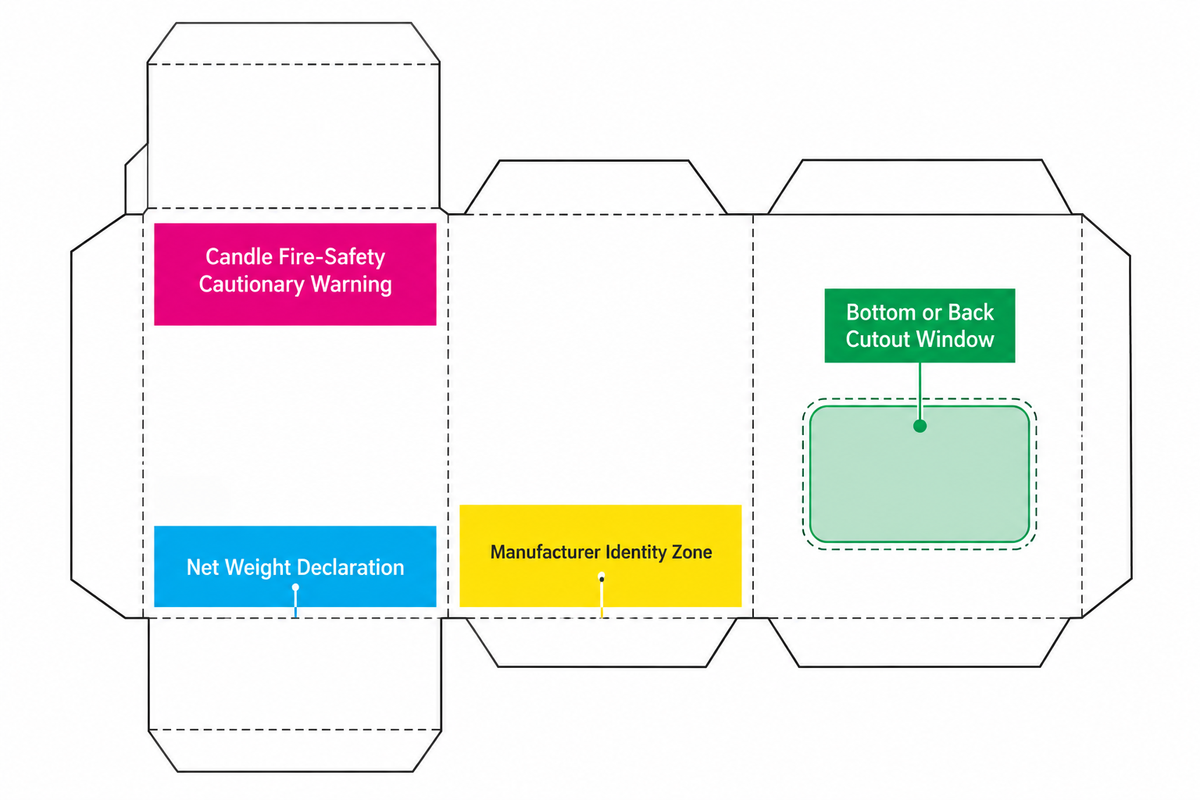
When an opaque folding carton or rigid box encloses a candle jar, the outer box becomes the primary package presented to the shopper at retail—triggering mandatory fire-safety and consumer-commodity labeling rules that apply. This is important when ordering candle boxes for your business across U.S. and European retail channels. The US CPSC Candle Business Guidance and NCA Safety Standards Overview define U.S. candle compliance; they center on ASTM F2417 and ASTM F2058 (Candle Fire Safety Labeling).
Under ASTM F2058, fire safety cautionary warnings must be prominent on packaging. Three important rules – keep within sight, keep away from things that catch fire, and keep away from children – are communicated with safety pictograms and text on the warning labels. If the warning sticker is only affixed to the bottom of the glass tumbler in a closed custom candle box, the warning is not visible at the point of sale. Your packaging dieline must either print the ASTM F2058 warning block on the outer box or incorporate a bottom or back cutout window that exposes the jar label across your range of candle sizes.
Additionally, candle boxes sold in the U.S. must adhere to the requirements of the Fair Packaging and Labeling Act (FPLA) at 16 CFR Part 500. In particular, 16 CFR 500.6(b) requires that the net quantity declaration appear on the principal display panel and be placed within the bottom 30 percent of the label panel area, in lines generally parallel to the base. 16 CFR 500.8(a) requires weight statements to be expressed in both avoirdupois weight (ounces/pounds) and SI metric mass (grams). Note the regulatory boundary. Remember the regulatory boundary: placing an ASTM F2058 cautionary label on the outer box or FPLA net weight in the bottom 30 percent of the principal display panel addresses point-of-sale labeling visibility. It does not substitute for ASTM F2417 candle burn-safety testing.
| Regulatory or Pre-Press Element | Governing Standard / Rule | Outer Candle Box Dieline Requirement | Common Artwork Mistake to Avoid |
|---|---|---|---|
| Candle Fire-Safety Cautionary Warning | ASTM F2058 & U.S. CPSC Candle Guidance (plus EN 15494 for EU/UK markets) | Print fire-safety pictograms, signal word, and cautionary text on the outer box panel (or die-cut a viewing window to expose the jar warning) | Hiding the only fire-safety label on the bottom of the glass jar inside a sealed opaque carton |
| Net Weight Declaration | U.S. FPLA 16 CFR 500.6(b) & 16 CFR 500.8(a) | Place dual avoirdupois and metric net weight (e.g., Net Wt. 8 oz / 227 g) in the lower 30 percent of the Principal Display Panel parallel to the base | Printing net weight only in ounces, placing it on the top lid, or crowding it without required letter-height spacing |
| Manufacturer / Distributor Identity | U.S. FPLA 16 CFR 500.5 | Specify corporate name and place of business conspicuously on the outer package | Omitting distributor/manufacturer location on gift sets sold through retail chains |
| Fragrance Allergen & Hazard Copy | EU CLP Regulation (EC) No 1272/2008 (where exported to EU/UK) & CA Prop 65 | Reserve high-contrast unembossed text block on back or bottom panel for sensitizing fragrance allergens and UFI codes | Running metallic foil or low-contrast grey ink on 6-point allergen disclosures |
| Retail Barcode (UPC-A / EAN-13) | GS1 Barcode Contrast & Quiet-Zone Rules | Print dark bars on a matte white or high-contrast light box with clean left/right quiet zones | Printing barcodes in metallic gold foil, red ink, or over textured wrap seams that fail retail scanners |
| Dieline Bleed, Crease Keep-Out & Glue Flap | Sheetfed Offset & Folder-Gluer Pre-Press Protocol | Extend artwork bleed beyond cut lines; keep fine text 2 mm to 3 mm clear of 90-degree scores; leave 8 mm to 12 mm glue flaps unvarnished | Flooding UV varnish or BOPP lamination across the side glue flap, causing seam pop-open in warm storage |
Production Quality Control, Run-Specific Lab Reports, and Verifiable Sustainability Claims
Only specifying premium packaging solutions and decorative finishes safeguards your candle brand if the factory can verify those physical properties on your actual production run. Meanwhile, brands asking for eco-friendly packaging or eco-friendly packaging solutions have to strictly adhere to the legal framework for recyclability and forestry claims. In engineering terms, “eco-friendly” is not a material specification, and a natural brown kraft look does not automatically prove a defined recovery outcome when you make your candle line.
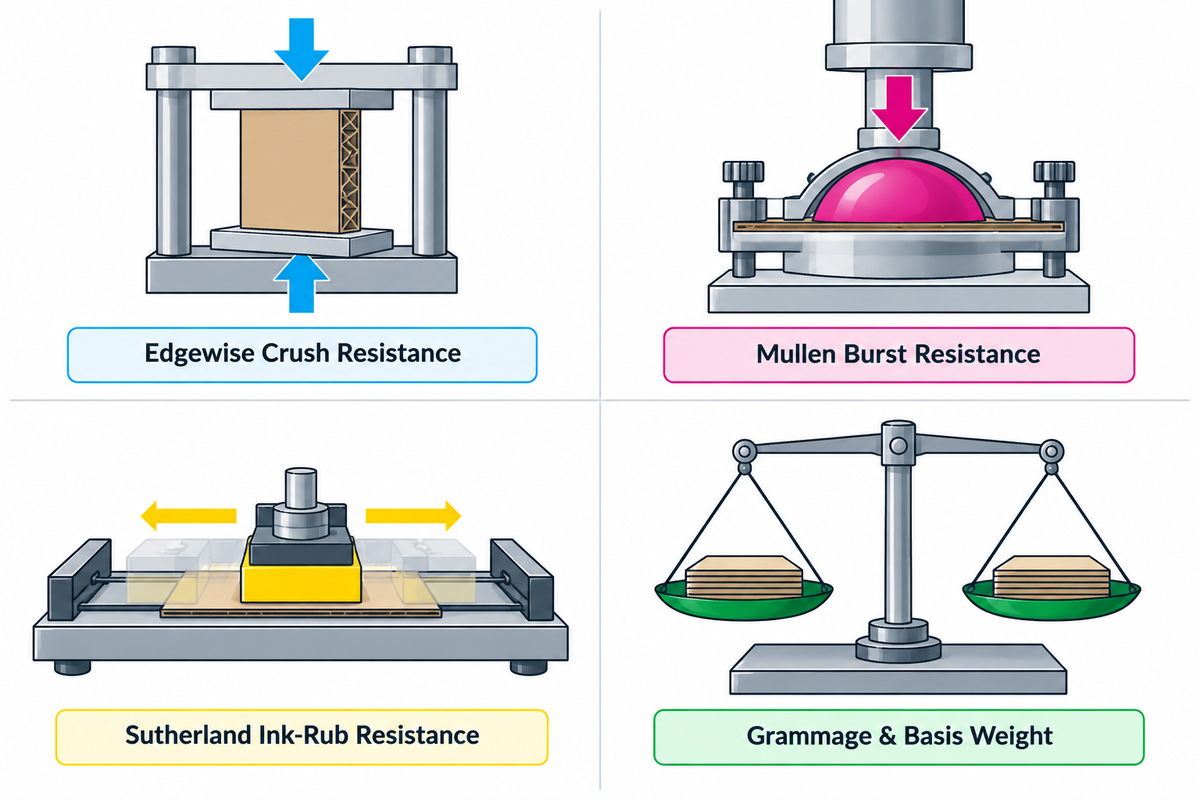
According to Huandao, within its ISO 9001 and ISO 14001 certified operations, quality control follows the approved structure and signed contract proofs through production. Every process step is scanned into an MES kanban, and is real-time synchronized with the ERP and intelligent scheduling. Huandao’s in-house laboratory issues four job-specific test report groups (i.e. ECT, burst, ink-rub and basis-weight) on the job itself, and so the numbers belong to the customer’s own production run:
- Edgewise Crush Resistance (ECT — FEFCO Method 8 / TAPPI T811): Verifies vertical stacking column stiffness on in-line E-flute, B-flute, and sourced corrugated shipping cartons. As noted in Prime Packaging’s ECT vs. Mullen burst analysis, ECT and Mullen burst tests measure different mechanical forces and cannot be substituted for one another (32 ECT stacking up to 65 lbs vs. 200 psi puncture resistance).
- Mullen Burst (FEFCO Method 4/TAPPI T810): Measures the hydraulic bursting resistance of corrugated and paperboard against rough handling during transport.
- Rub Resistance (ASTM D5264-98(2019) Sutherland Rub Tester): Evaluates the scuffing and abrasion of the printed inks and/or matte laminations and/or anti-scratch coatings and determines if they will mark dark candle boxes during transport.
- Grammage/Basis Weight (TAPPI T410): Verifies that the corrugated and paperboard liners in your production runs are in accordance with the quoted GSM. In addition, as noted in ISTA’s retesting guidelines, the packaged products should also be re-evaluated if the vessel geometry, inserts, or board specifications are changed.
For sustainability claims on eco-friendly candle boxes, two independent compliance frameworks apply. First, under the U.S. FTC Green Guides at 16 CFR 260.12(b)(1), marketers can make unqualified recyclable claims only when recycling facilities are available to a substantial majority (at least 60 percent) of consumers or communities. According to U.S. EPA recycling data, paper makes up 23 percent of municipal solid waste and Americans recycled about 68 percent of the paper they used in 2018. However, adding plastic film lamination, foam inserts, or magnetic closures requires qualifying the claim. Second, under Forest Stewardship Council (FSC) Chain of Custody rules (FSC-STD-40-004 and FSC-STD-50-001), applying an on-product FSC label requires active Chain of Custody certification and order-level document verification. According to Huandao, FSC CoC board is available on request, with certificate scope, label use, and order documents confirmed in the quotation.
Do Specify Run-Specific Lab Reports & Defined Material Claims
- Ensure required in-house lab report groups (ECT, burst, ASTM D5264 ink-rub, and basis-weight) in your RFQ so acceptance criteria match your own production run.
- Have a plain structural sample reviewed with your filled glass candle jar and lid before the release of the printed pre-production sample and the signed contract proof.
- Identify the board furnish, coating, and insert material and provide the scope of the FSC Chain of Custody in the quoted price. Qualify recyclable claims per 16 CFR 260.12 if film laminations or mixed-material inserts are used.
Don’t Confuse Paper Lab Reports with Transit Tests or Vague Eco Labels
- Rarely, if ever, do certificates for raw boards or print lab certificates reflect a full package courier drop trial or finished candle burn test.
- Never take shortcuts with phrases like “eco-friendly box” or think that a brown, kraft-like appearance means it is curbside recyclable or FSC certified.
- Never freeze rigid box inserts before finalizing the diameter of your candle jar, lid overhang, and thickness of your wax dust cover.
MOQ Economics, Multi-Scent SKU Consolidation, and Complete Custom Candle Packaging RFQ Brief
According to published specs of candle packaging from Huandao, the standard minimum order quantity (MOQ) is 1,000 pieces, per style and size, with smaller lots evaluated on a case-by-case basis. According to Huandao, buyers should expect about 8 weeks from the date of final proof to production of complex rigid packaging (time in transit excluded). Understanding how setup tooling, multi-scent artwork splits and freight consolidation intersect around the 1,000 piece baseline is important for both small businesses and established home fragrance brands to control cost. Keep in mind that unit pricing of custom candle box, tooling amortization, and ocean freight costs vary with the finished size and thickness of the board and inserts, as well as the number of finish passes and shipping terms.
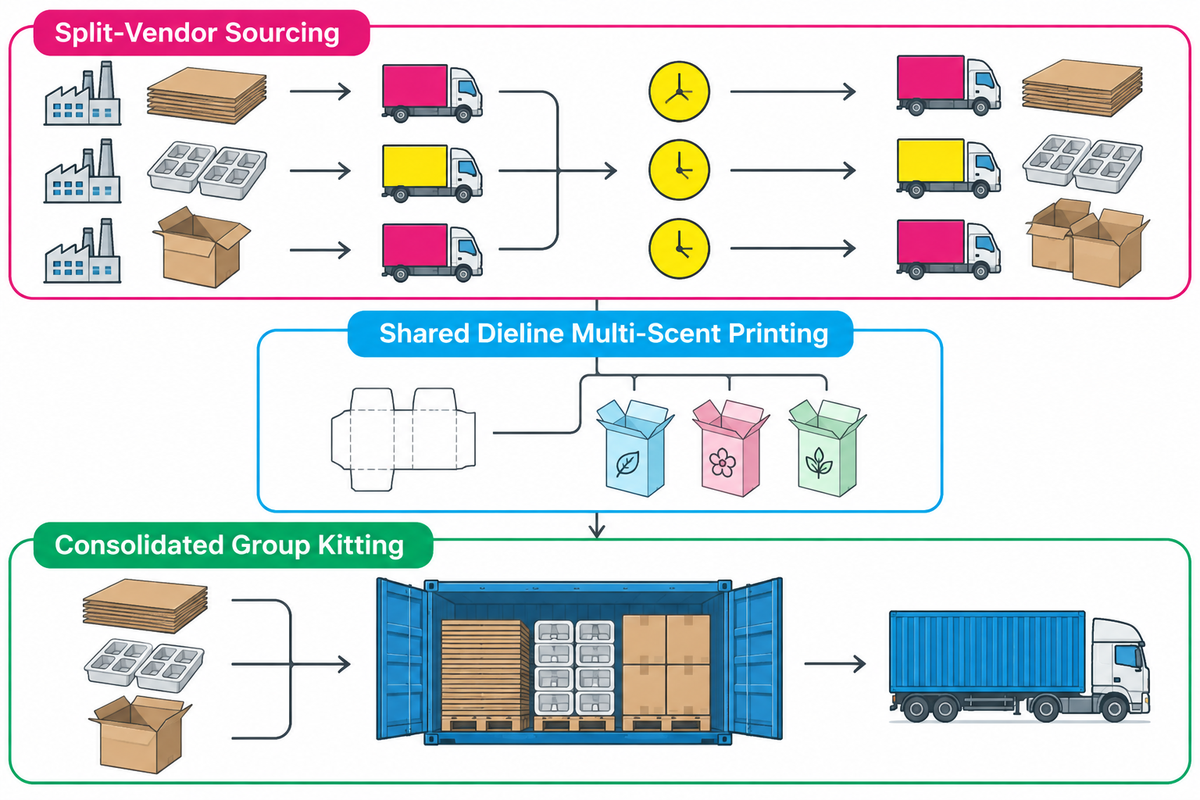
What is not included in a headline box discount? As documented by iContainers in its international landed cost case studies, the ocean freight component often adds a significant unit cost per item, in addition to the factory price. On the other hand, fulfillment engineering data provided by AWI Logistics on kitting costs, illustrates that while engineered kitting increased per unit cost by $1.80, it saved $4.20 per kit by eliminating returns and reshipments. When candle brands split their candle box order across separate vendors for cartons, inserts, and master candle shipping boxes, they pay multiple drayage bills and risk cavity-to-shipper mismatches.
Sourcing from a single integrated manufacturing plant eliminates split-vendor waste and makes professional packaging accessible to businesses of all sizes scaling multi-scent lines. According to company info provided by Huandao, Xiamen Huandao Packaging Technology Co., Ltd. was established on 30 June 2003 in Xiamen, Fujian, China, with registered capital of RMB 20 million (RMB 20M). Since then, it has manufactured printed paper packaging—including folding cartons (10 to 36 point), litho-laminated printed boxes, and rigid gift boxes (36 to 120 point). Huandao is the color-printing plant of Huan Yin Packaging Group, which was formed around it, later adding corrugated carton and protective packaging. Brought together as Huan Yin Packaging Group in 2024, group revenue has passed RMB 200 million (RMB 200M). Huandao is a recognised National High-Tech Enterprise, and the group is a President Unit of the Xiamen Printing Industry Association, guided by the stated values: “quality is fundamental, service is the soul.”
According to Huandao, its plant at No. 587 Tongfu Road, Tong’an District, Xiamen, Fujian, China, has 133 employees and operates as a full-fledged facility, not a trading office. As Huandao is a part of Huan Yin Packaging Group, the inner trays, protective inserts, and outer shipping cartons of the same perfect candle product can be supplied together with the printed box. Those components can be consolidated into a single shipment with shared freight (with DDP delivery quoted upon request).
Get your custom structure reviewed. Compare bulk discounts across fragrance variants, or review FAQs and Jar Fit Input Planner before you place an order. Our engineering team in Xiamen is ready to provide you with a comparable, written quotation based on your vessel dimensions through our custom candle packaging solution.
| Cost & Schedule Driver | Why It Impacts Candle Packaging Quotes | Practical Engineering & Procurement Lever |
|---|---|---|
| Rigid Setup vs. Folding Carton Structure | 36 to 120 point rigid boxes add greyboard, wrap paper, hand/semi-auto assembly, and pre-erected freight volume compared to flat-shipped 10 to 36 point folding cartons | Reserve rigid drawer or two-piece boxes for flagship luxury candles and gift sets; use folding cartons or E-flute boxes for core wholesale tumblers |
| Multi-Scent SKU Artwork Variants (at 1,000-Piece Standard MOQ) | Separate box dimensions for every scent require separate cutting dies, folder-gluer setups, and insert tooling | Standardize one jar size and structural dieline across all scents so cutting and insert dies are shared while only offset printing plates change by scent |
| Insert & Fitment Complexity | Multi-part foam or custom-molded cavities add tooling setup and manual assembly time | Supply physical filled jars early so a single folded paperboard or E-flute suspension collar can restrain both jar and lid cleanly |
| Sampling & Complex Rigid Production Schedule | Complex rigid candle packaging requires multi-step greyboard machining, wrapping, and curing after final proof approval across scheduled business days | Release vessel dimensions early, approve the plain structural sample for jar fit first, then sign off the printed pre-production sample and contract proof |
| Split-Vendor Sourcing vs. Consolidated Group Kitting | Ordering boxes, inserts, and shipping cartons from separate suppliers adds split domestic trucking legs, higher landed logistics overhead, and fitment errors | Consolidate the printed candle box, dust cover, protective insert, inner tray, and outer corrugated shipping carton into one shared-freight group shipment |
Key Engineering Takeaways for Custom Candle Packaging Buyers
- Start with the Filled Vessel: Apply the 6-Axis Candle Vessel Restraint Protocol to select 10 to 36 point folding cartons, E/B-flute boxes, or 36 to 120 point rigid boxes.
- Isolate Glass Chimes and Wax Oils: Suspend glass jar bases 10 mm to 15 mm above the floor, restrain lids with a 10 mm collar, and specify oil-resistant coatings on dust covers.
- Comply with Point-of-Sale Labeling Rules: Print ASTM F2058 fire-safety warnings on the outer box and place dual-unit net weight in the lower 30 percent of the front panel per 16 CFR 500.6(b).
- Verify Run-Specific Lab Reports and Consolidate Kitting: Request Huandao to provide job-related ECT, burst, ASTM D5264 ink-rub, and basis-weight lab reports, and ship folding cartons, rigid boxes, inner fitments, and master shippers in the same container load.
Copyable 10-Field Custom Candle Packaging RFQ Specification Checklist
Copy and send these 10 engineering inputs when requesting a structure review and comparable written quote rather than taking a gamble on a guess for a generic box online:
- Filled Candle Vessel Data: Give the maximum jar diameter, body taper, total height with lid seated, lid overhang, and filled weight (g/oz), and provide physical jars or 3D data.
- Sales Channel and Pack-Out Route: Explain boutique retail shelf display, luxury gift set, e-commerce single parcel ship, wholesale case, or mixed ship channels.
- Box Format and Style: Describe printed folding cartons (auto-lock or crash-lock bottom), litho-laminated single E-flute box, two piece telescope rigid box, sliding rigid drawer box, or collapsible rigid box.
- Substrate Grade and Flute Profile: Describe 10 to 36 point SBS, FBB, CUK or CRB board; 36 to 120 point grayboard; or in-line E/B-flute vs. sourced A, C, F or BC board.
- Internal Insert and Wax Dust-Cover Specification: Describe a folded paperboard cradle or E/B-flute collar, molded pulp or EVA/EPE insert, and if a grease-resistant wax dust cover is required.
- Quantity by Size, Style, and Scent SKU: State total order quantity against the 1,000-piece standard MOQ per size and style, and list how many scent artwork variants share the same structural dieline.
- Color and Print Control: State CMYK + Pantone spot color count (6-color offset + coater), interior print requirements, and signed X-Rite G7 / ISO 3664 D50 tolerances.
- Decorative Finish and Pre-Press Reserves: Indicate lamination (gloss, matte, or soft-touch), varnish (matte anti-scratch), Spot UV, hot foil stamping, embossing, debossing, window patching, etc., keeping barcode and glue areas clear.
- Regulatory Labeling and Lab Reports: Confirm outer-box ASTM F2058 and FPLA 16 CFR 500 copy placement, and select job-specific lab reports (ECT, burst, ink-rub, basis-weight) and FSC CoC documents.
- Sampling, Consolidated Kitting and Delivery: State whether inner trays and inserts should be consolidated in one shipment, specify destination or DDP, and request pre-production samples (structural, printed).
Frequently Asked Questions
How do I measure the dimensions of my candle box accurately?
Measure the filled candle jar rather than an empty drawing: record the maximum outer diameter across the widest point, total height with the lid seated, any lid overhang, and total filled weight. Give physical samples to your packaging engineer to help determine finger-access cutouts, outer box dieline, clearances, and internal inserts.
Do you provide inserts for candle protection?
Yes, custom candle packaging can be engineered with folded paperboard cradles, single E-flute or B-flute corrugated suspension collars, molded-pulp trays, or die-cut EVA and EPE foam fitments. Each insert is built around the specific candle jar diameter, lid profile, and distribution route, then verified on a plain structural sample before mass tooling is released.
What is the minimum order quantity for candle boxes?
Per Huandao, the standard minimum order quantity is 1,000 pieces per size and style for custom printed folding cartons and rigid candle boxes. Smaller launch runs are quoted case by case based on reviewing the box structure, paperboard or greyboard grade, artwork count, print route, decorative finish stack, and hand assembly requirements.
Can I order a sample of candle packaging?
Yes. Plain structural samples to check jar fit, and printed pre-production samples to approve color and finish are made prior to mass production and sample terms are stated in the quotation.
How long does production take for custom candle boxes?
Production lead time starts only after the physical jar data, structural dieline, materials, artwork, signed contract proof, Delta E color tolerance, packing method, and commercial terms are fully approved. Standard printed folding cartons move rapidly through in-house sheetfed offset printing, coating, die-cutting, and folder-gluing across scheduled business days. By contrast, according to Huandao, complex rigid candle gift boxes—requiring greyboard V-grooving, wrap lamination, foil or embossing, and hand-assembled fitments—require a multi-week rigid manufacturing schedule after final proof sign-off (transit excluded).
Are your boxes eco-friendly?
Rather than relying on vague eco labels, buyers can specify FSC Chain-of-Custody certified paperboard, mono-material paperboard or corrugated inserts, and aqueous coatings aligned with FTC 16 CFR 260.12 recyclability guidelines.
How much does candle box printing cost?
Custom candle packaging has no firm, fixed price list. Variations in box construction (folding carton versus rigid box), board caliper, insert complexity, and scent SKU plate changes, can affect the unit cost, as well as CMYK plus Pantone colors, and finishes. Requesting a normalized written quote that integrates the box, insert, inner tray and outer corrugated shipping carton can consolidate shipments, reduce mark-ups, and eliminate hidden split-shipping charges.
References & Sources
- Paperboard Packaging Council (PPC) — What is Paperboard Packaging? (10 to 36 point folding cartons in SUS, SBS, CUK, CRB, and FBB shipped flat; E, F, G, and N mini-flute; 36 to 120 point rigid set-up boxes overlaid with printed wrap).
- Paperboard Packaging Council (PPC) — 4 Types of Paperboard (Solid Bleached Sulfate SBS, Coated Unbleached Kraft CUK, Folding Boxboard FBB, and Coated Recycled Board CRB material properties).
- U.S. Consumer Product Safety Commission (CPSC) — Candles Business Guidance and National Candle Association (NCA) — Understanding Safety Standards (ASTM F2417 candle fire safety and ASTM F2058 cautionary labeling rules).
- ASTM International — ASTM F2058-07 (2021): Standard Specification for Candle Fire Safety Labeling (point-of-sale visibility and cautionary pictogram/text requirements for candle packaging).
- U.S. Code of Federal Regulations — 16 CFR Part 500 (FPLA) (16 CFR 500.6 (b) lower 30 percent Principal Display Panel placement and 16 CFR 500.8 dual net weight rules).
- U.S. Code of Federal Regulations — 21 CFR 176.170: Paper and Paperboard Components (1.6 percent water-repellent resin limit and 21 CFR 176.180 dry solids reference).
- NIH PubMed Central — Packaging and Chemical Migration (PMC12096275) and ScienceDirect — Chemical Migration from Printed Cartonboard.
- Virginia Tech Center for Packaging and Unit Load Design (CPULD) — E-Commerce Packaging Study , CandleScience — How to Ship Candles, and International Safe Transit Association (ISTA) — Procedure 3A.
- European Federation of Corrugated Board Manufacturers (FEFCO) – Testing Methods (Method 4 Bursting strength and Method 8 Edgewise crush resistance ECT) and Primal Packaging – ECT vs. Burst Test (Mullen) .
- ASTM International – ASTM D5264-98 (2019): Standard Practice for Abrasion Resistance of Printed Materials by the Sutherland Rub Tester.
- U.S. Federal Trade Commission (FTC) – 16 CFR 260.12: Recyclable Claims and U.S. EPA – How Do I Recycle Common Recyclables?.
- Forest Stewardship Council (FSC) – Chain of Custody Certification (FSC-STD-40-004 & FSC-STD-50-001).
- X-Rite – Controlled Lighting (ISO 3664 D50) , Dixsons Enterprises – Crease Cracking Prevention and USPTO Patent US8573471B2 – Foldable Box .
- Grand View Research – Low-Carbon Footprint Packaging Market Report, AWI Logistics – Kitting Fulfillment Costs, and iContainers – Landed Cost Calculation Guide.
HUANDAO PACKAGING INSIGHTS
About Huandao Packaging Insights
Huandao Packaging manufactures folding cartons, litho-laminated printed boxes and rigid gift boxes, and also supplies paper bags, retail displays and protective inserts.
Our guides help buyers compare packaging options and prepare a clearer brief before requesting a quote.
Packaging families
Board, print and finish
Artwork, dieline and sample review
Delivery planning
PROJECT DISCUSSION
Talk with the Huandao Team
- Company
- Xiamen Huandao Packaging Technology Co., Ltd.
- Quote input
- Dimensions, filled weight, quantity, artwork or dieline, finish and destination.
- Review scope
- Box, insert and delivery requirements.
- Next step
- Bring the available details to a packaging conversation.