Get in Touch with Xiamen Huandao Packaging Technology Co., Ltd.


Folding carton packaging is a paper-based packaging format fabricated from a single layer of paperboard (12 pt to 24 pt, 250 gsm to 500 gsm) that is printed, die-cut, creased, and folder-glued into flat blanks before erecting into a foldable structure on manual or automatic packaging lines. Engineering teams choose paperboard folding cartons for lightweight packaging and lightweight to medium-weight retail products, and, for panels that exceed single-layer paperboard limits, opt for laminated micro-flute corrugate.
Procurement teams specifying custom folding cartons often evaluate quotes by comparing board basis weight and unit price while overlooking how grain orientation, bottom closure geometry, and surface coatings interact on the packing line. A carton with paperboard grain oriented perpendicular to the primary score when it enters the cartoner, or with cured UV varnish contaminating the glue flap, can bow out on the retail shelf and have side seams pop open during transit. This guide provides step-by-step assistance in specifying the correct substrate, structural codes, and finishing options to meet packaging engineering and buying requirements, from dieline tolerances to production-run laboratory tests to factory audits.
Key Engineering Takeaways for Folding Carton Buyers
- Single-ply paperboard blanks from 12 pt to 24 pt are flat-shipped to save storage space for lightweight retail items. Heavier or fragile items are shipped in laminated E-flute or B-flute boxes.
- Equal basis weight in grams per square meter (gsm) across SBS, FBB, CUK, and recycled CCNB does not yield equal bending stiffness under ISO 5628; always match carton style and bottom closure to product density and filling-line speed.
- Keep glue flaps free of varnish, UV coating, and film lamination through prepress knockout masks, and maintain at least 1 mm between adjacent crease lines so barrier and decorative coatings do not fracture.
- Laboratory tests for job-specific converted production lots are needed to prove ink-rub resistance of ASTM D5264, compression resistant ASTM D642, ECT/burst and Basis Weight, as opposed to relying on generic paper mill certificates.
What Is Folding Carton Packaging and When Does Micro-Flute Corrugate Replace Single-Ply Board?
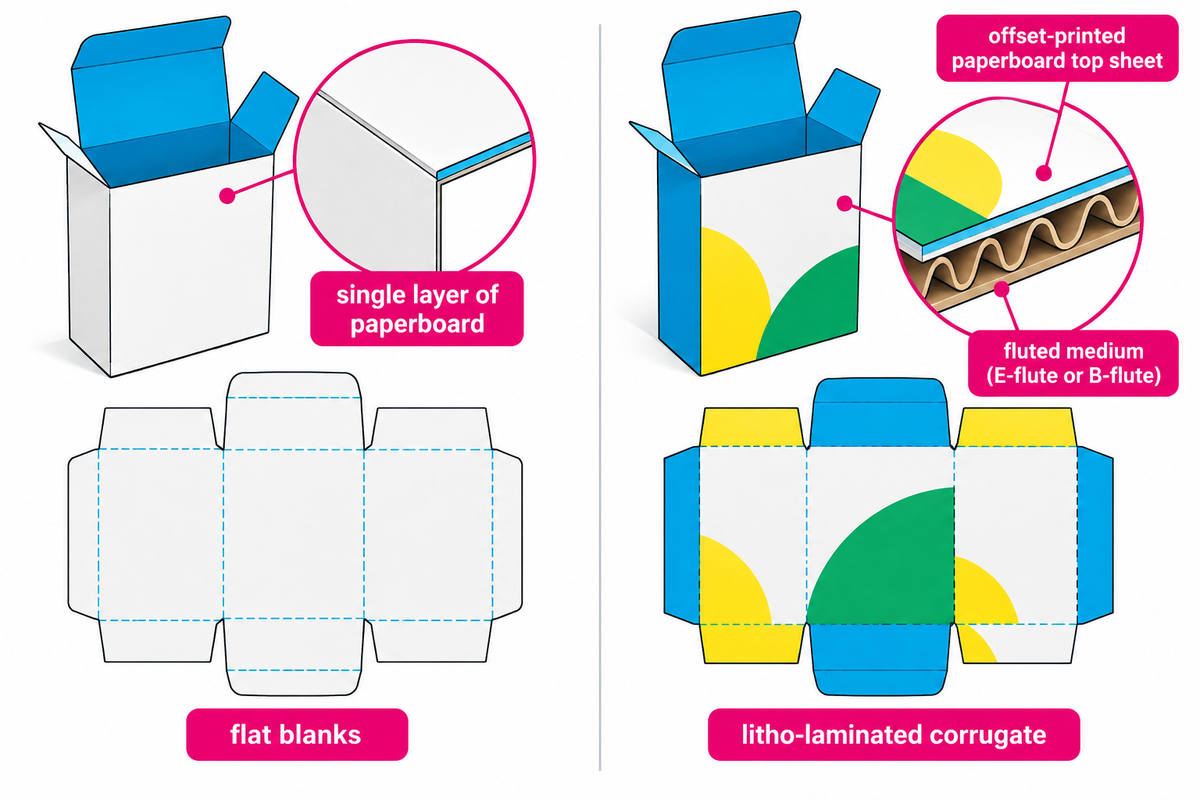
Folding carton packaging uses die-cut and creased single-layer paperboard blanks shipped flat to the filling line, while litho-laminated corrugate bonds an offset-printed paperboard top sheet to a fluted medium (E-flute or B-flute) to create a micro-flute.
According to the Paperboard Packaging Council (PPC), paperboard is a thick paper-based material that can be scored, folded and custom die-cut into different shapes. Paperboard can also be curved to deliver high-resolution retail presentation and strong brand identity. Single-ply die cut boxes fabricated from 12 pt to 24 pt (300 µm to 600 µm) virgin or recycled board dominate secondary pharmaceutical, cosmetic, dry food, and consumer electronics aisles because dozens of carton flats nest onto a single master press sheet for high-speed converting.
When a retail package holds heavy glass jars, ceramic hardware, or multi-bottle kits, the PPC notes that folding cartons can be fluted—known as mini-flute—by sandwiching a small E, F, G, or N-fluted wavy medium between liner boards. According to Xiamen Huandao Packaging Technology Co., Ltd., an in-line corrugator supplies single E-flute and single B-flute board just in time with zero stock for litho-laminated printed boxes, while A, C, F, BC, and other flute profiles are produced from sourced board. Standard corrugated flute profiles defined by the Fibre Box Association distinguish these micro-flutes by flute count per linear foot and caliper thickness, letting engineers combine 175–200 LPI offset print graphics with corrugated structural rigidity.
“While not as strong and durable as rigid boxes, folding cartons can be fluted for extra protection and cushioning. Known as ‘mini-flute,’ these cartons feature a small E, F, G, or N-fluted (wavy) substrate that is sandwiched between two liner boards.”
What is the difference between a folding carton and a corrugated box?
A folding carton is made by die-cutting a single sheet of paperboard from 12 pt to 24 pt or 250 gsm to 500 gsm for primary or secondary retail display packaging. A corrugated box, on the other hand, is made with a fluted wavy medium between liner boards to dampen shock from transportation and support heavy pallet stacking.
Follow the 5-Stage Folding Carton Specification Sequence Before Approving Artwork
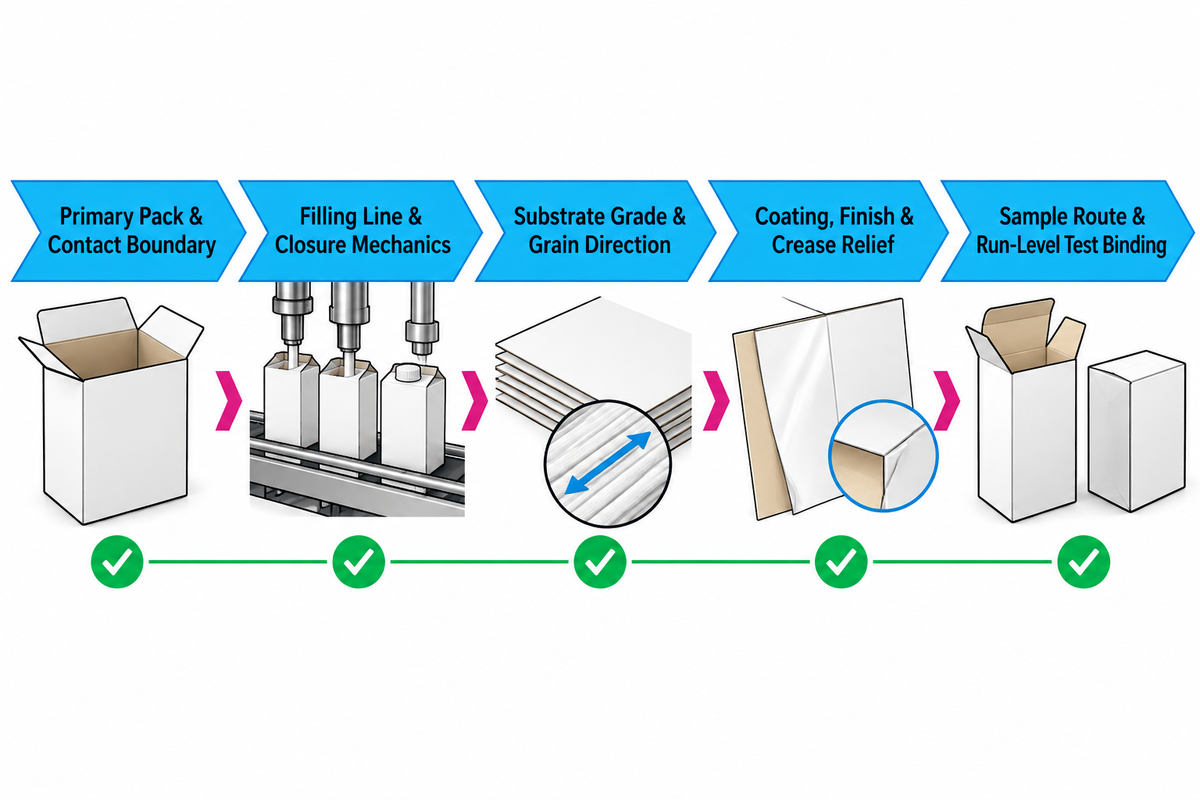
The 5-step sequence of the Folding Carton Specification ensures engineering teams eliminate dieline revisions and filling-line jams by first locking the primary pack boundary, second filling-line and bottom closure mechanics, third substrate grade and grain direction, fourth coatings and crease knockouts, and fifth sampling and binding it to production-run laboratory tests.
When marketing teams finalize custom sizes and exterior artwork before packaging engineers lock paperboard caliper, insert tolerances, and glue-seam orientation, the dieline must be rebuilt if physical samples fail on the cartoning line. Pro Carton states that multiple cartons are printed on one master sheet of cartonboard. It is the imposition on that sheet that governs the cutting and creasing forms used during the production process. Using our named engineering framework, the 5-Stage Folding Carton Specification Sequence ensures that upstream constraints are locked prior to plates or cutting-die manufacturing.
5-Stage Folding Carton Specification Sequence
- Stage 1 — Primary Pack & Contact Boundary: Define whether the carton touches food or cosmetics directly or encloses a primary bottle, blister, or pouch, and measure physical product dimensions plus insert clearance in millimeters.
- Stage 2 — Filling Line & Closure Mechanics: Choose between manual hand-packing and automatic horizontal or vertical cartoning (in cartons per minute), and match bottom closure geometry (reverse tuck, straight tuck, 1-2-3 bottom, or auto-lock bottom) to the product’s static base load.
- Stage 3 – Substrate Grade & Grain Direction: Select paperboard family (i.e. SBS, FBB, CUK, CCNB, or litho-laminated E/B-flute) and lock caliper and gsm, and align grain with the primary crease or around the perimeter based on panel bowing risk.
- Stage 4 — Coating, Finish & Crease Relief: Pair offset ink coverage with aqueous, UV, or laminated finishes while masking glue flaps and keeping embossing dies and foil stamping clear of fold scores.
- Stage 5 — Sample Route & Run-Level Test Binding: Validate an unprinted CAD white dummy on the exact production board first, approve a wet offset press proof second, and bind batch release to production-run ASTM and ISO lab reports.
Consider a practical specification case study. In a practical specification scenario , a personal-care brand launching a 120 mL glass dropper bottle approved full-bleed matte black artwork on a 16 pt reverse tuck dieline before testing the physical bottle with its corrugated flute insert. Before tooling, the art and design team tested physical bottles with a corrugated flute insert and approved the first CAD sample. When the first CAD sample was assembled, the glass base pushed the bottom tuck tab downward by 3.5 mm, preventing the carton from standing flat on the retail shelf. Re-running Stage 2 and Stage 3 of the sequence shifted the structure to an 18 pt tuck-top auto-lock bottom carton with a 2.0 mm wider side panel, resolving the base deflection before cutting production steel-rule dies.
How to Match Paperboard Grade, Caliper, and Carton Style to Product Weight and Filling Lines
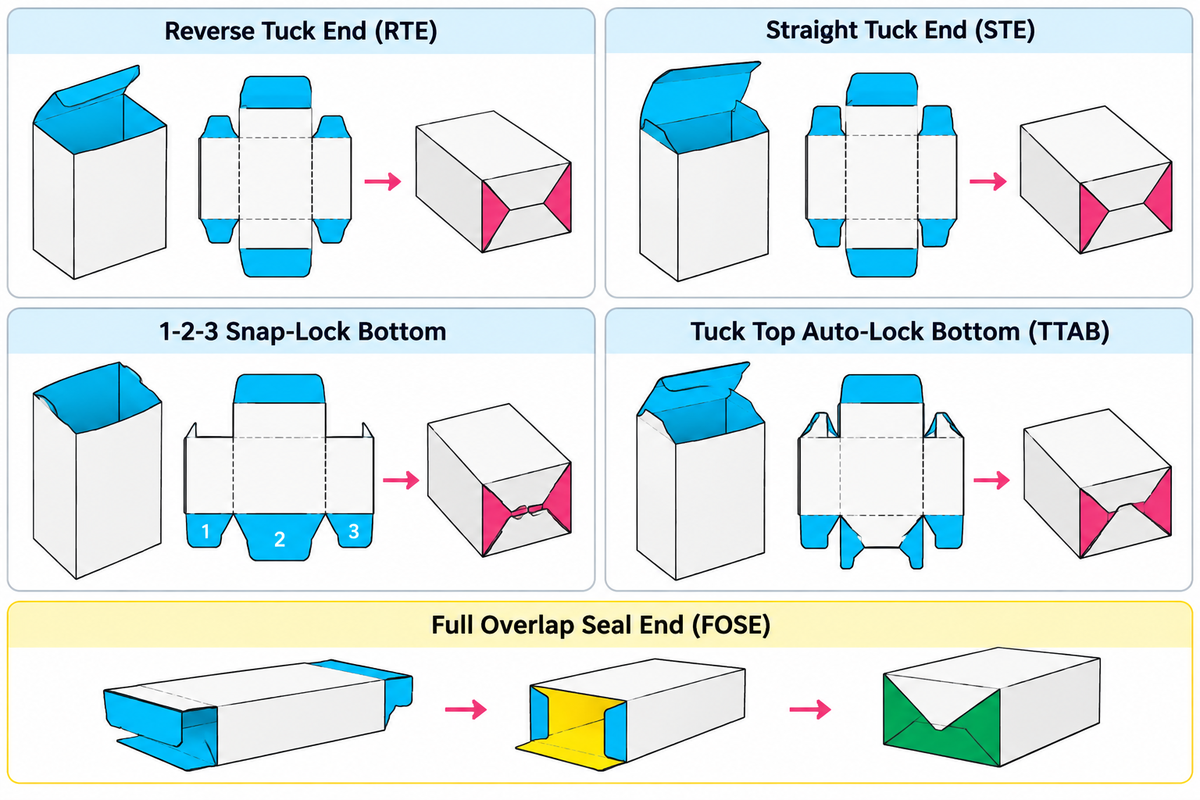
Match your filling-line method and bottom closure style to the product’s weight distribution first, then select the paperboard grade (SBS, FBB, CUK, or recycled CCNB) and caliper (12 pt to 24 pt) using two-point, three-point, or four-point bending stiffness under ISO 5628 / ISO 2493 rather than basis weight (gsm) alone.
According to the Paperboard Packaging Council’s 4 Types of Paperboard and PPC Paperboard Properties, North American basis weight is calculated in pounds per 1,000 square feet (lb/MSF) or pounds per 3,000 square feet (lb/3MSF), while optical brightness measures reflectance at a wavelength of 457 nanometers. Equal basis weights (GSM) of different fiber families, i.e. SBS, FBB, CUK, and recycled CCNB, do not correlate to equal bending stiffness, making physical sample validation (grade-specific) mandatory. Under ISO 2493 / ISO 5628, two-point and three-point bending methods measure stiffness on lower-thickness paperboard, whereas four-point bending is recommended for corrugated fibreboard and higher-thickness board. In addition, research from the USDA Forest Products Laboratory shows that cyclic relative humidity changes reduce paperboard compression strength, meaning cold-chain or sea-freight cartons require higher material quality and stiffness margins.
| Substrate Grade | Fiber Construction | Caliper & GSM Range | Surface & Stiffness Profile | Primary Packaging Applications |
|---|---|---|---|---|
| Solid Bleached Sulfate (SBS / GZ) | Bleached virgin hardwood and softwood chemical pulp throughout all plies | 12 pt to 24 pt (300–600 µm) / 250–450 gsm | Brilliant clean white surface (clay-coated C1S/C2S); high fold endurance for deep emboss and scoring | Cosmetics, fragrance, pharmaceuticals, medical devices, premium confectionery |
| Folding Boxboard (FBB / GC1 & GC2) | Bleached chemical outer plies over a mechanical pulp middle core | 12 pt to 24 pt (300–600 µm) / 230–400 gsm | High bulk and high bending stiffness per gram of fiber; white back (GC1) or cream back (GC2) | Personal care, dry food boxes, nutraceuticals, healthcare, retail electronics |
| Coated Unbleached Kraft (CUK / SUS) | Unbleached virgin kraft softwood fiber with clay-coated white print top or natural kraft | 14 pt to 24 pt (350–600 µm) / 280–480 gsm | High tear and tensile resistance; natural brown reverse side resists moisture condensation | Beverage carriers, chilled and frozen food packaging, hardware tools, heavy retail items |
| Clay Coated Newsback (CCNB / WLC / GD2) | Made from recycled paper fibers with a clay-coated white top liner and grey/cream back | 14 pt to 24 pt (350–600 µm) / 300–500 gsm | Economical cost-effective board with lower stiffness per gsm; requires wider crease channels | Dry household goods, toys, automotive replacement parts, secondary shelf cartons |
| Litho-Laminated E-Flute / B-Flute | Offset-printed paperboard face laminated to single-face corrugated medium (in-line E or B flute) | 1.5 mm (E-flute) to 3.0 mm (B-flute) composite | Combines offset print graphics with corrugated vertical compression and drop cushioning | Heavy glass bottles, small appliances, e-commerce mailer kits, multi-unit retail displays |
The chosen substrate family sets the structural carton style and bottom closure, which must be aligned with the filling line and the product base load:
| Carton Style | Bottom Closure Mechanism | Sheet Nesting Efficiency | Erecting & Packing Mode | Recommended Product Profile |
|---|---|---|---|---|
| Reverse Tuck End (RTE) | Top and bottom tuck flaps hinge from opposite main panels; slit-lock or friction tuck | High (interlocking top/bottom flaps reduce board trim waste) | High-speed automatic cartoner or fast manual packing | Lightweight retail items, vials, tubes, and blister cards |
| Straight Tuck End (STE) | Both top and bottom tuck flaps hinge from the rear panel and fold toward the front | Moderate (flaps align on the same panel edge) | Automatic cartoner or manual prestige assembly | Cosmetics and skincare where the front display panel requires clean, uninterrupted edges |
| 1-2-3 Snap-Lock Bottom | Four interlocking bottom flaps fold sequentially by hand without bottom gluing | Moderate | Low- to medium-volume manual hand assembly | Medium-weight bottles and candles where tooling budget favors 1-point side-seam gluing |
| Tuck Top Auto-Lock Bottom (TTAB) | Pre-glued diagonal bottom flaps snap into a locked flat base as corners are pushed | Lower (extended bottom lock tabs) | Fast manual packing cells (easy to assemble) and semi-auto lines | Heavier glass jars, multi-packs, and retail products needing fast manual setup and secure bottom support |
| Full Overlap Seal End (FOSE) | Top and bottom flaps overlap completely and seal with hot-melt or dispersion adhesive | Moderate | Automated cartoning with inline hot-melt glue closers | Granular foods, cereal, frozen goods, and tamper-resistant retail cartons |
What is the difference between straight tuck and reverse tuck cartons?
On straight tuck cartons, both top and bottom flaps tuck into the same back panel. As such, no raw edge of the board is visible on the face of the carton. On the other hand, a reverse tuck carton, tucks its top and bottom flaps into different panels. This allows a more compact nesting of press sheets and waste paperboard.
Compare Folding Boxes with Corrugated Cardboard Boxes, Rigid Boxes, and Flexible Pouches
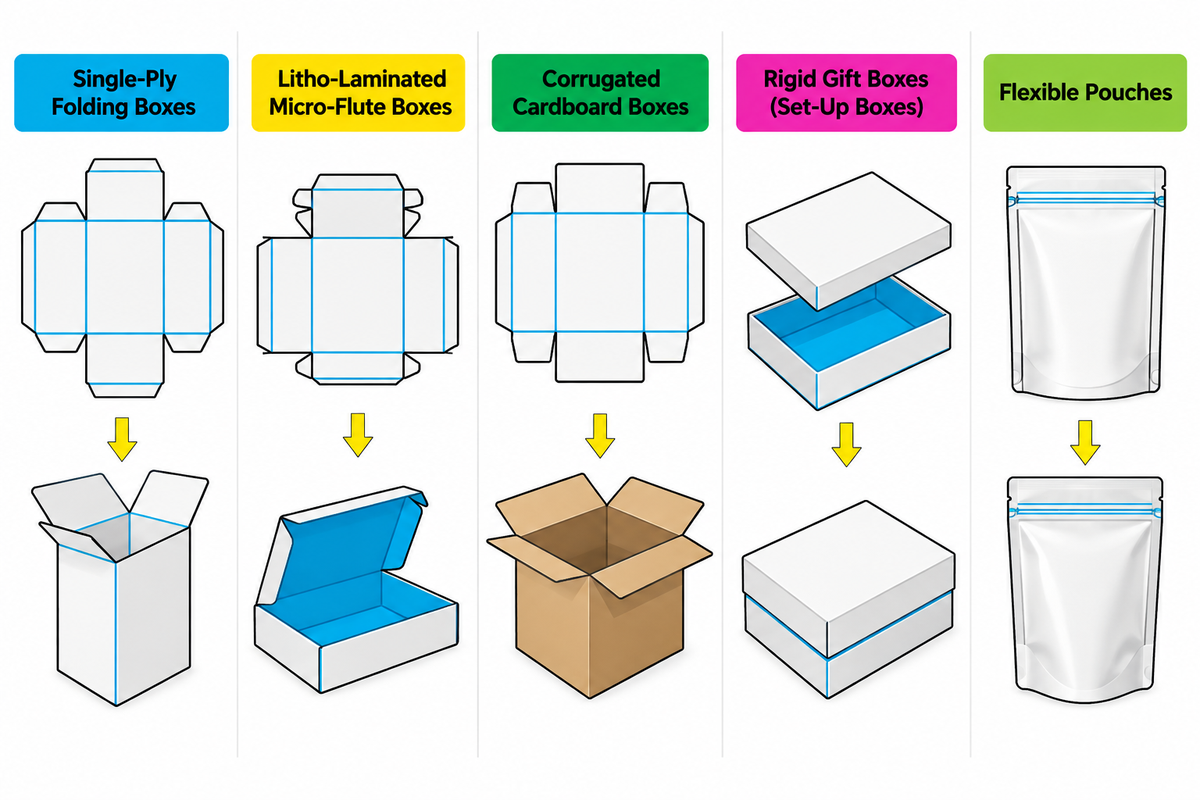
Single-ply folding boxes boast the lowest inbound storage volume and highest sheetfed offset print efficiency for lightweight retail goods.
As noted in the PPC, folding cartons folding flat leads to an efficient use of warehouse space and is therefore economical for shipping and storage and runs at high multi-up sheet speeds. However, when evaluating custom boxes across product lines, procurement teams should look at all five primary and secondary formats across six operational dimensions rather than just unit price.
| Engineering Dimension | Single-Ply Folding Boxes | Litho-Laminated Micro-Flute Boxes | Corrugated Cardboard Boxes | Rigid Gift Boxes (Set-Up Boxes) | Flexible Pouches |
|---|---|---|---|---|---|
| Structural Construction | Single layer of paperboard (12–24 pt), die-cut, creased, side-seam glued | Offset-printed paperboard face laminated to single-face E-flute or B-flute medium | Fluted corrugated medium (A, B, C, BC) bonded between inner and outer linerboards | Heavy non-bending greyboard (1.5–3.0 mm) wrapped with printed decorative paper | Multi-layer polymer, aluminum, or barrier-coated paper web heat-sealed into pouches |
| Inbound Shipping & Storage Space | Ships flat; minimal warehouse footprint | Ships flat; moderate stack height per 1,000 blanks | Ships flat in bundles; higher bundle thickness | Ships fully erected; requires significant warehouse volume | Ships on reels or flat stacks; lowest inbound storage volume |
| Vertical Stacking & Impact Protection | Low to moderate; relies on panel stiffness and inner product support | High; corrugated flutes absorb drop shock and vertical compression | Highest; engineered for pallet stacking and parcel distribution | High rigid wall crush resistance; requires outer mailer for parcel transit | None; requires secondary folding carton or corrugated shelf-ready case |
| Print Graphics & Shelf Appeal | High-precision sheetfed offset, foil stamping, emboss, and specialty coatings | Identical sheetfed offset quality on the laminated top liner | Flexographic post-print or digital print; coarser screen ruling than offset | Luxury tactile wraps, deep debossing, magnetic closures, and ribbon inserts | Rotogravure, flexo, or digital web printing; curved surface can distort flat display |
| Packing Line Speed & Assembly | Up to hundreds of cartons per minute on automatic cartoners; fast manual tuck | Manual or semi-automatic erecting; lower cpm than thin solid board | Case erectors or manual taping for master shipping cases | Manual hand-packing into pre-erected base and lid | Form-fill-seal (FFS) or rotary premade pouch filling lines |
| Fiber Recyclability (Pro Carton / 4evergreen) | Recyclable in paper streams; non-paper elements reduce pulp yield to 88%–92% | Recyclable in paper and board collection when water-based starch/PVA adhesives are used | Widely recycled in standard corrugated fiber recovery streams | Recyclable if mono-material paper wrap is used without embedded magnets or foam | Multi-layer plastic/foil laminates are difficult to recycle in standard curbside streams |
Specify Offset Printing, Coating, Emboss, and Foil Customization for Retail Brand Protection
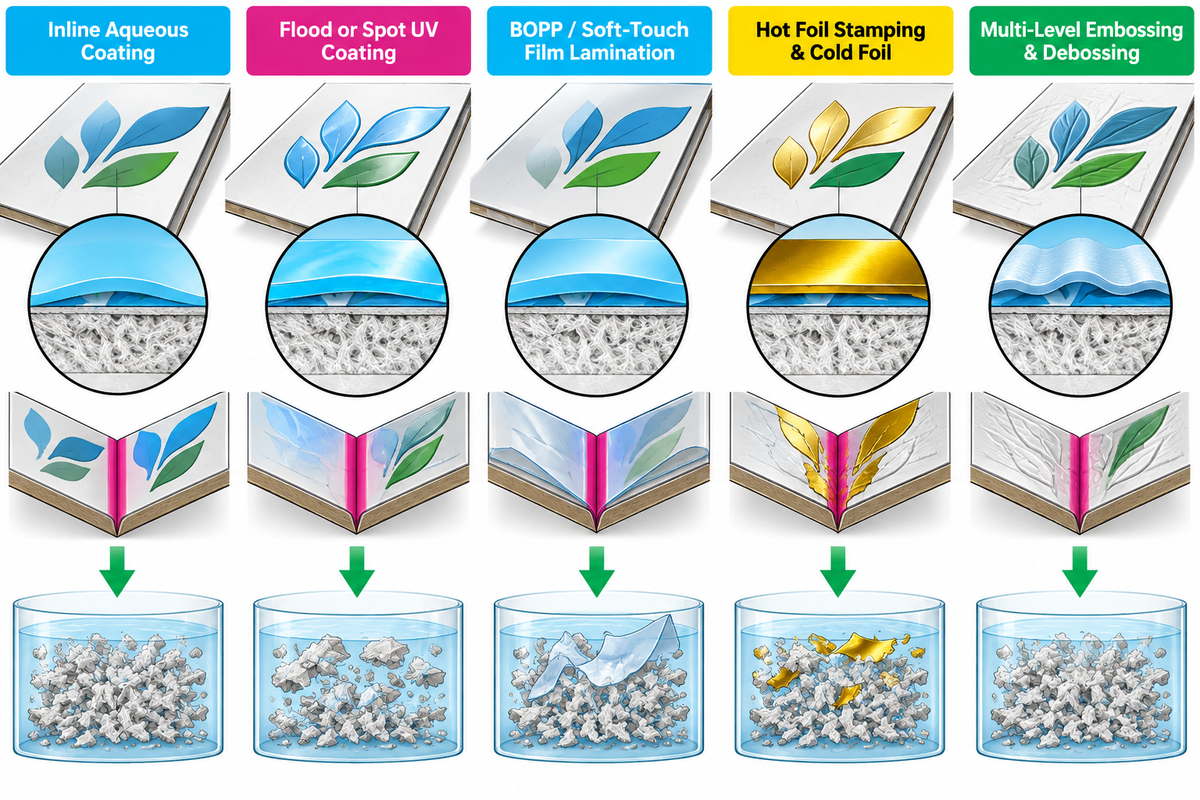
For projects requiring sheetfed offset printing, consider inline aqueous coating, UV varnish or film lamination and keep flood inks, cured UV coatings and hot foil stamping clear of first fold scores to avoid creasing. This will help maintain the cartons in their shelf appeal condition.
Visual customization drives retail conversion: Pro Carton reports that 70% of purchase decisions are made at the point of sale. Therefore, shelf appeal, unboxing, and the entire unboxing experience play a major role in perceived value and helping a product stand out on the retail shelf. When producing custom printed, cosmetic folding cartons and retail boxes, sheetfed offset presses do a four-color process (CMYK) and spot colors, and then add glossy or matte protective finishes.
However, coatings and finishes directly alter paperboard mechanics during creasing and folding. A peer-reviewed converting study in BioResources (Lev et al., 2023) found that surface coating penetrates substrate fibers and increases required folding force by 9.5% in the machine direction (MD) and 15.4% in the cross direction (CD). Full surface plastic film lamination or oversized metallic foil coverage yield a poor fiber recovery in a standard repulping mill compared to water-based coatings. According to Pro Carton’s Recyclability of Folding Cartons report, folding cartons are recyclable through separate paper and board collection, where non-paper components reduce the recyclable amount of pulp to 92% or 88% respectively.
What are the coating options available for folding carton boxes?
The four primary coating options for folding carton boxes are inline water-based aqueous coating (gloss, satin, matte, or soft-touch), ultraviolet (UV) cured flood or spot coating, press oil/varnish, and thermal or wet film lamination (gloss BOPP, matte BOPP, or anti-scratch soft-touch film).
| Finish or Embellishment | Scuff & Rub Protection (ASTM D5264) | Fold Score Cracking Behaviour | Paper Stream Recyclability | Primary Design & Engineering Use Case |
|---|---|---|---|---|
| Inline Aqueous Coating (Gloss, Matte, Satin) | Moderate to High; protects offset ink from transit rub and set-off | Low cracking risk; flexible water-based dispersion flexes with paperboard fibers | High; repulps cleanly in standard paper and board mills | Standard commercial finish for food boxes, pharmaceuticals, and high-volume retail cartons |
| Flood or Spot UV Coating | High; cross-linked UV polymer resists abrasion and chemical spills | Moderate to High on dark flood ink across 180° scores unless score-relieved | High for spot UV and standard UV varnishes within repulping guidelines | High-contrast specular highlights on logos (Spot UV) or high-gloss retail display panels |
| BOPP / Soft-Touch Film Lamination | Highest; plastic film shields deep black or navy flood ink from scuffing | Low surface cracking, but requires proper crease depth and glue-flap knockouts | Reduced pulp yield; plastic film must be separated during hydrapulping (OPRL / UK guidance) | Luxury fragrance boxes, gift boxes, and heavy-duty cartons subjected to frequent handling |
| Hot Foil Stamping & Cold Foil | Moderate; metallic foil should be paired with protective varnish if exposed to rub | High flaking risk if stamped directly across a 180° fold score line | Compatible when localized foil coverage stays within 4evergreen design guidelines | Metallic brand crests, borders, and anti-counterfeit accents on prestige retail packaging |
| Multi-Level Embossing & Debossing | Not applicable (structural relief) | Requires keeping raised/recessed die edges away from adjacent fold scores | 100% compatible; alters fiber topography without adding non-paper materials | Tactile brand typography and sculpted patterns on virgin SBS or FBB substrates |
Engineer the Dieline, Grain Direction, Die-Cutting, and Folder-Gluing for Line Reliability
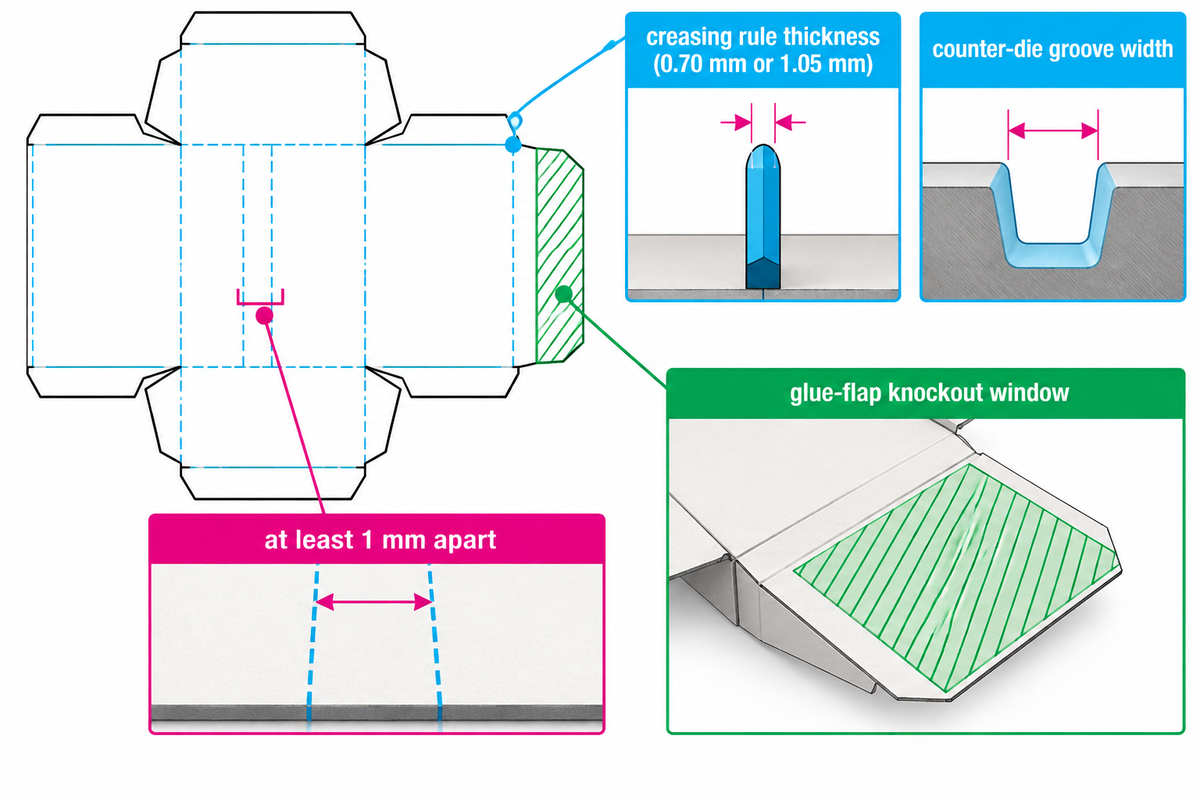
Prevent the following defects by orienting the paperboard grain according to the primary fold scores, using the appropriate creasing rule thickness (0.70 mm or 1.05 mm) and channel width in relation to board thickness, keeping adjacent creases at least 1 mm apart, and removing 100% of coatings from glue flaps.
During flatbed die-cutting and creasing, steel cutting rules and rounded creasing rules press the printed sheet into a precision-milled counter-die matrix to form a controlled hinge. According to the Iggesund Paperboard Manual on Die-Cutting and Creasing, the width of the creasing rule is 0.70 mm in the paperboard thickness range of 0.20 mm to 0.55 mm and 1.05 mm for paperboard thicknesses above 0.55 mm, while the counter-die groove width is generally 1.5 times the thickness of the paperboard plus the width of the creasing rule. In addition, as documented in the BioResources converting review, the distance between adjacent creases correlates with corner radius and its lower limit should be set to at least 1 mm so coating integrity is not compromised, while the force needed to fold the material grows linearly with bending angle and peaks at 180°. Before releasing files to prepress, teams can verify bleed, knockout masks, and crease clearances against our artwork preflight checklist.
How are folding cartons made from flat paperboard sheets?
Folding cartons are made in six consecutive steps: computer-to-plate (CTP) imposition, sheetfed offset printing, surface coating and lamination, flatbed or rotary die-cutting and creasing, waste removal and automated folder-gluing with score pre-breaking.
DO: Dieline & Converting Engineering Controls
- Use a 0.70 mm creasing rule for 0.20–0.55 mm board and a 1.05 mm rule above 0.55 mm, starting counter-groove width at 1.5 times board thickness plus rule width (Iggesund).
- Keep parallel crease lines at least 1 mm apart on double-wall trays and gussets to avoid shear of coatings (BioResources).
- Mask 100% varnish, UV and film lamination knockout on glue flaps and inner bonds to allow adhesive to bond to raw cellulose fibers.
DON’T: Common Converting Failure Modes
- Do not approve high-volume production based on a digital XY cutting table sample, as digital rolling wheels do not reproduce the behavior of flatbed steel-rule dies and counter-matrices ( practitioner consensus on r/PackagingDesign).
- Do not allow scoring lines to be set too deep or too shallow on the folder-gluer; inappropriate depth causes glue-seam pop-open (Lanco Adhesives).
- Do not place unperforated foil stamping or brittle flood UV over 180° folds without first testing the production folding process.
In a converting failure scenario, , a buyer approved a hand-folded digital cutter prototype on 400 gsm custom paperboard with heavy dark ink and flood UV coating. During the commercial folder-gluer run where folding angle peaks at 180°, the outer coated liner cracked along the spine and the UV-contaminated glue flap popped open inside master shipping cases. A glue-flap knockout window, a wider cross-direction counter-groove channel, and conditioning the board between 6.5% and 12% moisture removed both defects on rerun.
Adapt Custom Folding Carton Specifications Across Different Industries and Eco-Friendly Rules
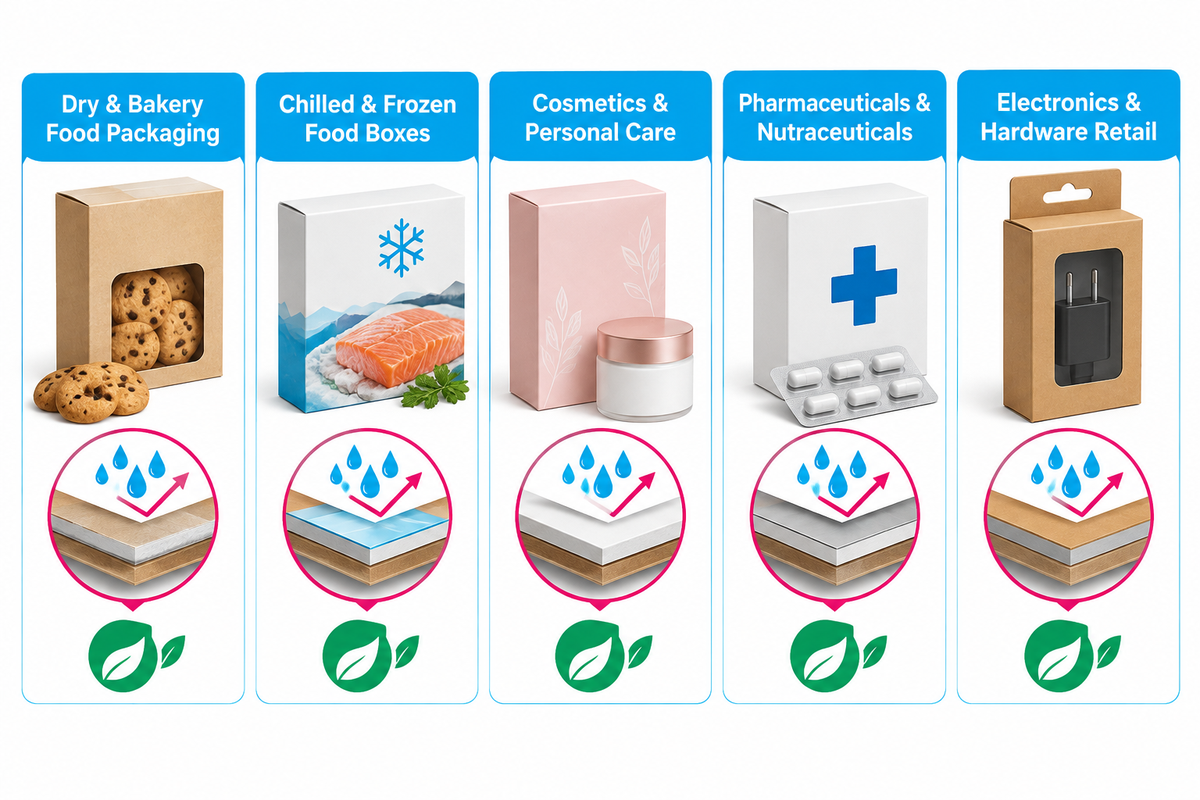
Adapt custom folding carton specifications to sector regulations by pairing EU Regulation 2023/2006 Good Manufacturing Practice and functional migration barriers for food packaging with moisture-conditioned converting (6.5% to 12% board moisture), FSC-certified fiber chain-of-custody, and 4evergreen mono-material recyclability rules.
Packaging requirements shift significantly across different industries because food contact, cold-chain condensation, pharmaceutical serialization, and European circularity rules impose distinct material boundaries. For direct food contact packaging (e.g. bakery trays, confectionery, dry food boxes, etc.), the European Commission and the May 2025 Food Contact Guideline stipulate that all food contact materials must be manufactured complying with Good Manufacturing Practices (GMP) of Commission Regulation (EC) No 2023/2006. In addition, peer-reviewed papers published in PubMed (PMID 21749235) assess recycled paperboard and found that it is not always safe for food contact and a functional barrier layer must be provided to prevent migration of mineral oil into food. Buyers specifying food folding cartons and sustainable packaging solutions may replace plastic film liners with water-based barrier liners (coatings), which, as peer-reviewed papers published in PubMed Central (PMC11269091) reported, retain repulpability, and provide grease-resistant and water repellency.
During converting of eco-friendly and FSC-certified barrier boards, moisture control is critical: as cited in BioResources (Hauptmann et al., 2017), maintaining an optimal paperboard moisture range between 6.5% and 12% visibly improves wrinkle distribution and formability, whereas raising moisture to 14% yields no further quality gain. Under the 4evergreen Circularity by Design Guideline (Version 4, February 2026), brands advancing corporate sustainability goals should favor mono-material virgin or recycled paperboard with aqueous or dispersion coatings over heavy multi-material plastic laminations.
| Industry Sector | Preferred Paperboard & Structure | Barrier & Surface Finish | Key Compliance & Quality Boundary |
|---|---|---|---|
| Dry & Bakery Food Packaging | Virgin FBB (GC1/GC2) or SBS; auto-lock bottom, seal-end, or windowed tuck cartons | Water-based grease-resistant dispersion coating or functional barrier liner | Regulation (EC) No 2023/2006 GMP; functional barrier required if recycled board is used (PMID 21749235) |
| Chilled & Frozen Food Boxes | Wet-strength CUK/SUS or virgin FBB; full overlap seal-end (FOSE) | Moisture-resistant dispersion coating; hot-melt or cold-temperature PVA adhesive | Derate compression for high-humidity cold chain (USDA FPL); verify bond tear at freezer temperatures |
| Cosmetics & Personal Care | 16–22 pt SBS or GC1 white-back FBB; Straight Tuck End (STE) or two-piece sleeve | Spot UV, hot foil stamping, multi-level emboss, or soft-touch finish | Spectrophotometric color control across runs; ASTM D5264 rub test to protect dark/metallic finishes |
| Pharmaceuticals & Nutraceuticals | 14–18 pt GC2 or SBS; Reverse Tuck End (RTE) with tamper-evident tuck or glue seal | Low-gloss aqueous coating with unvarnished inkjet/laser serialization window | High-contrast 2D DataMatrix barcode readability; strict line clearance and lot traceability |
| Electronics & Hardware Retail | 20–24 pt CUK/CCNB or litho-laminated E-flute / B-flute with custom paperboard insert | Scuff-resistant matte varnish or aqueous coating; reinforced crash-lock base | ASTM D642 compression and ISTA Procedure 1A (for packaged products up to 150 lb / 68 kg) |
What Drives Unit Price, Tooling Cost, MOQ, Lead Time, and Production-Run Lab Verification?
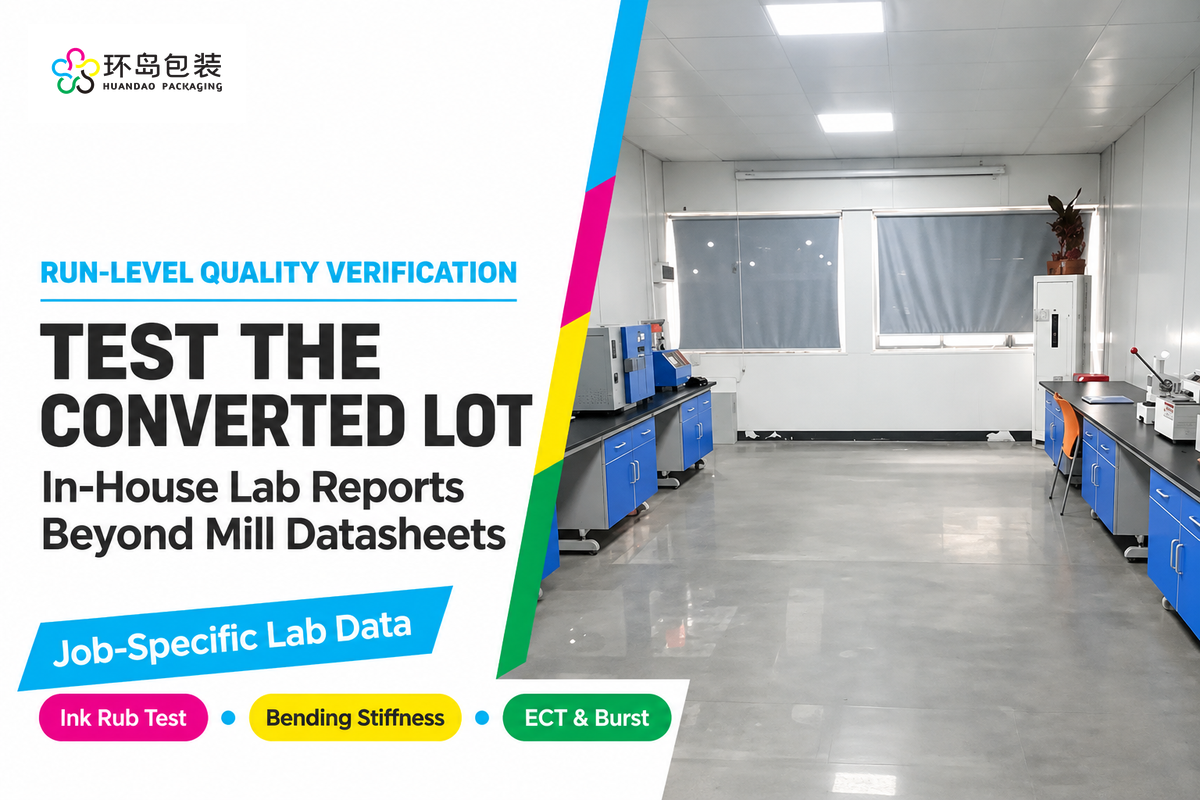
Custom folding carton unit price and minimum order quantity (MOQ) are governed by master press-sheet nesting yield, paperboard tonnage, and fixed make-ready charges (lithographic plates, steel-rule cutting dies, and folder-gluer setup), while batch quality is verified through production-run laboratory tests under ASTM D5264, ASTM D642, ISO 5628, and ISTA protocols.
When procuring custom packaging or ordering boxes wholesale, comparing raw unit price without separating fixed tooling from variable board consumption leads to unexpected surcharges. Fixed setup costs include aluminum CTP printing plates (one per process or spot color), flatbed steel-rule cutting dies and phenolic counter-matrices, embossing brass dies, and press/gluer make-ready sheets. Once those fixed costs are amortized across commercial production volumes, variable unit price is driven by how many carton blanks nest onto a press sheet and the tonnage price of the specified paperboard grade. On Huandao Packaging’s custom corrugated and litho-laminated line, the published standard MOQ is 1,000 pieces per size and style (with smaller runs quoted case by case), free structural samples are provided within 5 working days, press-run samples take about 8 days, and standard production lead time is within 15 days.
Lab testing is necessary for batch acceptance because paper mill datasheets provide information on unprinted board rolls instead of converted cartons. The International Safe Transit Association (ISTA) retesting guidance says packaged product tests must be repeated with a change in the product, package, or conversion process. Per Huandao, its in-house testing lab issues ECT/Burst, ink rub, and basis weight test reports on the customer’s production run and every process step is scanned into a real time MES Kanban.
| Laboratory Test & Property | Governing Standard | Test Method & Scope | Why Job-Run Testing Beats Mill Certificates |
|---|---|---|---|
| Printed Ink & Coating Abrasion (Scuff) | ASTM D5264-98(2019) | Sutherland Rub Tester equipped with full-width rubber pads evaluating relative abrasion resistance of printed inks, coatings, laminates, and substrates (Section 5.2) | Mill sheets are unprinted; only job-run rub testing verifies whether UV curing or aqueous drying prevented transit scuffing |
| Bending Stiffness (2-, 3-, and 4-Point) | ISO 5628 / ISO 2493 | Two-point and three-point bending for thin paperboard; four-point bending for corrugated fibreboard and higher-thickness board | Lamination tension and die-cutting impression alter board stiffness compared to raw mill rolls |
| Container Compressive Resistance | ASTM D642-25 | Determines compressive resistance of shipping containers, components, and unit loads | Validates whether the erected carton, inner insert, and master shipper withstand warehouse stacking |
| Packaged-Product Integrity Screening | ISTA Procedure 1A | Non-simulation integrity vibration and drop testing for individual packaged products weighing 150 lb (68 kg) or less | Screens the combined product, inner tray, and outer carton assembly before commercial rollout |
| ECT / Burst & Basis Weight (Job Lot) | In-House Lab Job-Run Protocol | Measures basis weight (gsm), bursting strength, and edge crush on the converted production batch | Confirms the delivered lot matches contracted board specifications and flute lamination bond quality |
How to Audit a Folding Carton Supplier for In-House Converting and Consolidated Packaging
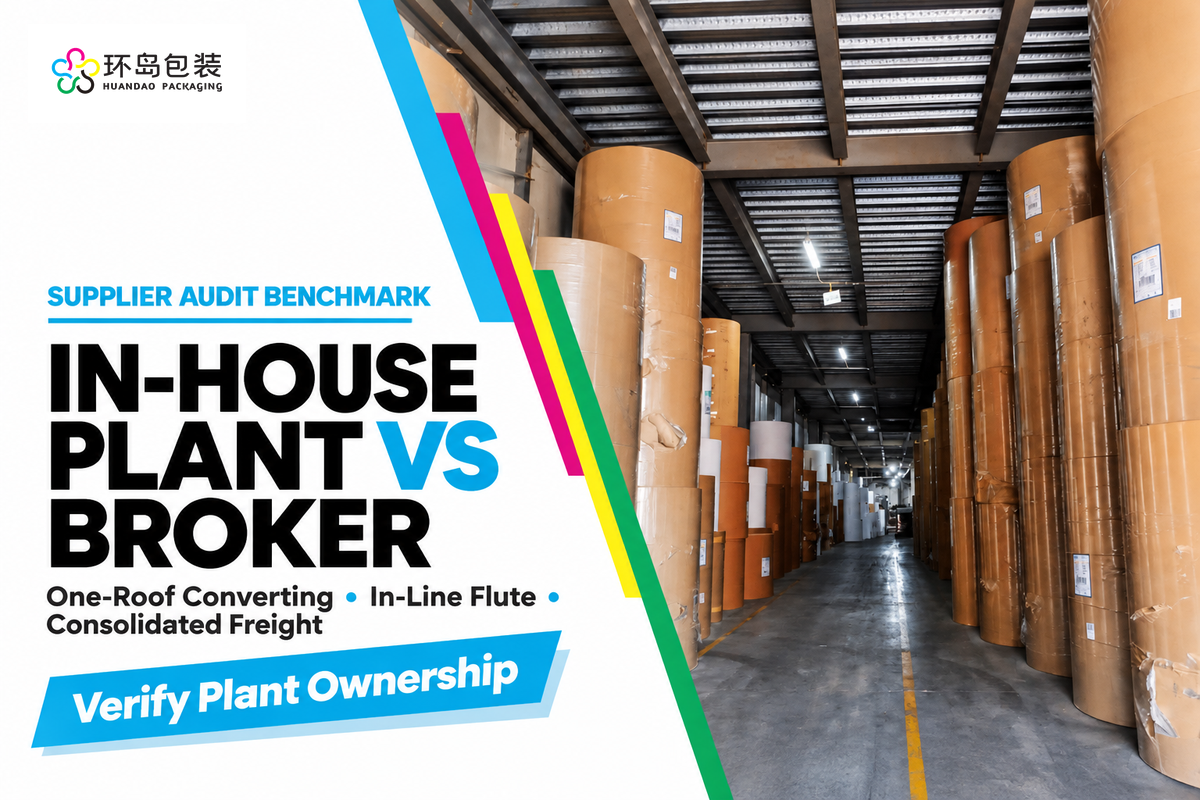
Audit a folding carton packaging manufacturer by verifying five operational proof points: in-house prepress through folder-gluing machinery, in-line E-flute and B-flute corrugation, real-time MES kanban shop-floor tracking, job-specific lab reports for your production runs, and group-level consolidation of inner trays and outer shipping cartons for shared freight.
In global paper box procurement, the largest hidden risk is contracting a trading intermediary that subcontracts offset printing to one workshop, UV coating or lamination to a second, die-cutting to a third, and corrugated outer shipping cartons to a fourth. Splitting converting steps across multiple subcontractors creates inter-building sheet moisture drift, unmanaged color variation, and fragmented LCL freight bills.
To benchmark an integrated manufacturing plant against a broker—or to request a project evaluation via our folding carton packaging commercial engineering team—compare the five operational verification pillars below, illustrated with first-party plant data provided by Xiamen Huandao Packaging Technology Co., Ltd.:
- In-house converting facility ownership: User states that Xiamen Huandao Packaging Technology Co., Ltd. (est. Xiamen Huandao Packaging Technology Co., Ltd. (founded 30 June 2003, with RMB 20M registered capital at No. 587 Tongfu Road, Tong’an District, Xiamen, and 133 staff) operates its own integrated manufacturing facility with prepress, sheetfed offset printing, UV coating, lamination, die-cutting, and folder-gluing in-house, keeping the entire converting chain under one roof and reducing inter-workshop handoff variation. Maintaining the converting chain in-house reduces variation from inter-workshop handoffs.
- In-line micro-flute vs. sourced board transparency: User states that an in-line corrugator supplies single E-flute and single B-flute board just in time with zero stock, while A, C, F, BC and other flute profiles are produced with sourced board.
- Lot-specific laboratory reports & real-time MES kanban: User states that Huandao’s in-house lab issues ECT/burst, ink-rub and basis weight test reports for the customer’s production lot, and every process step is scanned with a real-time MES kanban which is integrated with an ERP system and intelligent scheduling.
- Group-level single-shipment consolidation: User states that as the colour-printing plant of Huan Yin Packaging Group (formed in 2024, group revenue > RMB 200M), Huandao supplies inner trays, inserts, and outer shipping cartons together with the printed box in a single consolidated shipment with shared freight. Huandao is a recognised National High-Tech Enterprise and the group is the President Unit of the Xiamen Printing Industry Association.
Procurement of multiple components presented an opportunity for brand to purchase printed SBS folding carton from a print shop, mold inner trays from a second vendor, and procure B-flute master shipping cartons from a box plant. Dimensional tolerance stack-up left a 12 mm void inside the master shipper that caused corner crushing during ocean transit, while three separate domestic trucking and LCL consolidations inflated landed freight cost. Combining the printed folding carton and custom die-cut corrugated insert into the master carton and synchronizing the delivery to fill the dimensional gap eliminated the issue.
| Audit Verification Dimension | Integrated In-House Plant (e.g., Huandao Packaging) | Trading Broker / Subcontracted Workshop Chain |
|---|---|---|
| Prepress, Offset, Coating, Die-Cutting & Gluing | All steps run in-house under one roof (No. 587 Tongfu Road, Xiamen; 133 staff) | Outsourced across 3–4 separate printing, laminating, and die-cutting workshops |
| Litho-Laminated Micro-Flute Supply | In-line corrugator produces single E-flute and single B-flute just in time with zero stock; A, C, F, BC from sourced board | Buys pre-corrugated sheets on the open market with variable moisture and warp risk |
| Work-in-Progress Shop-Floor Tracking | Every process step scanned into a real-time MES kanban backed by ERP and intelligent scheduling | Manual phone/spreadsheet updates across external subcontractors |
| Quality Assurance Laboratory Evidence | In-house lab issues ECT/burst, ASTM D5264 ink-rub, and basis-weight reports on the customer’s own production run | Forwards generic upstream paper-mill datasheets that do not test converted cartons |
| Inner Trays, Inserts & Outer Shipping Cartons | Consolidated within Huan Yin Packaging Group (formed 2024, revenue > RMB 200M) into a single shipment with shared freight | Sourced from separate vendors, requiring buyer coordination and split freight billing |
Copy This Folding Carton Packaging Pre-Order Specification Checklist
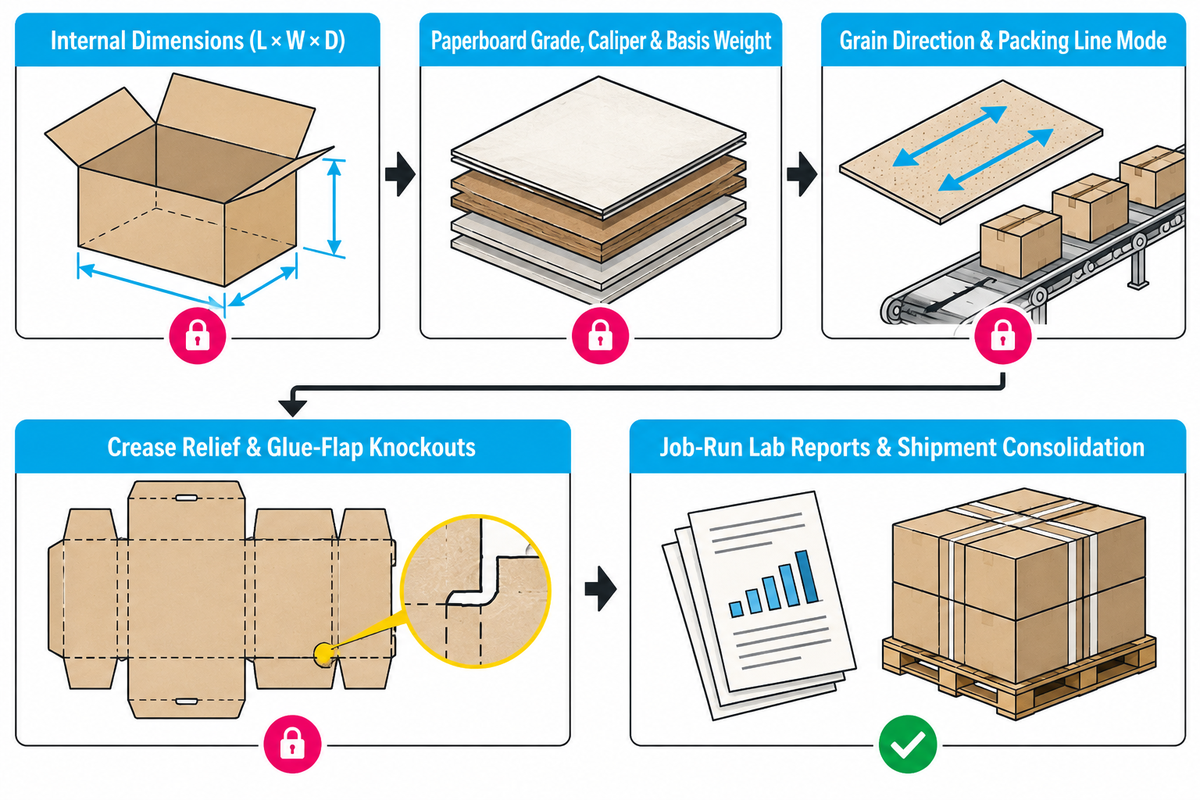
Lock all ten engineering and commercial specification fields—internal dimensions (L × W × D), product weight and contact role, paperboard grade and caliper, grain direction, ECMA style, color and coating build, knockout masks, sampling stages, production-run lab tests, and consolidated outer-carton shipping—before requesting supplier quotes.
Prior to releasing drawings to a supplier or using the interactive Carton Specification Builder, complete the 10 specification fields below so that all potential packaging manufacturer suppliers quote on an even-playing field basis:
| Field No. | Specification Field | Engineering Input to Lock in Your RFQ | Why It Prevents Cost & Quality Drift |
|---|---|---|---|
| 01 | Internal Dimensions (L × W × D) | Specify crease-center to crease-center internal dimensions in millimeters: Length (hinge panel) × Width (side panel) × Depth (height). | Prevents mixing external and internal measurements and locks press-sheet nesting yield. |
| 02 | Product Weight & Primary Contact Role | State exact product mass in grams and whether the carton is direct food contact or encloses a primary container. | Determines whether single-ply board or litho-laminated E/B-flute and functional barriers are required. |
| 03 | Paperboard Grade, Caliper & Basis Weight | Specify fiber family, caliper, and gsm together (e.g., 18 pt / 450 µm, 350 gsm virgin FBB GC1 or SBS, FSC-certified). | Stops suppliers from substituting lower-stiffness recycled board at the same gsm. |
| 04 | Grain Direction & Packing Line Mode | Define machine grain orientation and whether erecting is manual or automatic (state cartoner speed in cpm). | Locks sheet imposition direction and folder-gluer pre-breaking up to 180°. |
| 05 | Carton Style & Bottom Closure | Name the structural style (e.g., Reverse Tuck End, Straight Tuck End, 1-2-3 Bottom, or Tuck Top Auto-Lock Bottom). | Matches bottom load capacity and packing labor to product weight. |
| 06 | Offset Color Profile & Print Surfaces | Specify exterior and interior color stations (e.g., 4C CMYK + spot Pantone exterior, 1C interior) and target color tolerance. | Fixes CTP plate count, press tower allocation, and spectrophotometer verification. |
| 07 | Surface Coating, Lamination & Embellishments | Specify inline aqueous coating, spot/flood UV, BOPP/soft-touch lamination, hot foil stamping, or multi-level emboss. | Balances ASTM D5264 rub protection, score-folding flexibility, and 4evergreen recyclability. |
| 08 | Crease Relief & Glue-Flap Knockouts | Mandate 100% coating/lamination knockout masks on glue flaps and lot-coding zones, plus minimum 1 mm crease spacing. | Prevents adhesive seam pop-open and coating micro-cracks along fold hinges. |
| 09 | Sampling Route & Lead-Time Milestones | Require an unprinted CAD white dummy (5 working days) and wet press proof (about 8 days) prior to mass production (15 days). | Verifies physical fit and color on the actual board before committing full press tonnage. |
| 10 | Job-Run Lab Reports & Shipment Consolidation | Require production-run ECT/burst, ASTM D5264 ink-rub, and basis-weight lab reports, and specify inner tray + outer shipper consolidation. | Binds release to lot-specific lab data and consolidates inner and outer packaging into one shared-freight shipment. |
Frequently Asked Questions About Folding Carton Packaging
What is the minimum order quantity (MOQ) for custom folding cartons?
Minimum order quantity for custom offset-printed folding cartons is governed by fixed press make-ready, lithographic plate count, steel-rule cutting-die setup, and how many carton blanks nest on a master press sheet rather than a single universal industry threshold. Digital printing has a limit to small pilot batches, beyond which offset printing (cost-effective) is more cost-effective. Digital printing handles small pilot batches of a few hundred units, whereas commercial sheetfed offset converting becomes cost-effective once setup waste is amortized across production runs; for example, Huandao Packaging has a standard MOQ of 1,000 pieces per style with smaller trial runs quoted case by case.
Are paperboard folding cartons recyclable if they have UV coating or foil stamping?
Yes, paperboard folding cartons can be recycled in standard fiber recovery streams as long as non-paper elements are below the repulping threshold defined by Pro Carton and the 4evergreen Alliance Circularity by Design Guideline. Inline water-based aqueous coatings, spot UV varnishes, and localized hot or cold foil stamping pass standard mill repulping (where non-paper components typically adjust pulp yield to 88%–92%), whereas full-surface plastic film lamination or unperforated plastic windows can reduce fiber recovery.
Can every folding carton supplier manufacture food or pharmaceutical cartons?
No, not all commercial folding carton converters are qualified for direct food-contact packaging or pharmaceutical packaging. Food packaging requires Good Manufacturing Practice controls under frameworks such as Commission Regulation (EC) No 2023/2006, low-migration printing inks, and functional migration barriers whenever recycled paperboard is used, while pharmaceutical cartons require strict line clearance, high-contrast 2D serialization windows, and lot-level MES traceability.
Can I add custom inserts or dividers inside folding carton boxes?
Yes, engineered die-cut paperboard partitions, E-flute and B-flute cradles, and molded pulp trays can all be designed and consolidated into a single shipment with the outer carton dieline.
How should I compare unit price and lead time across competing folding carton quotes?
Verifying that identical Grade paperboard is locked, along with caliper, basis weight, grain direction, nesting count, color stations, surface coating, cutting-die ownership, sampling stages and delivery terms are critical to a fair comparison of supplier quotations. A low unit price may not include steel-rule die tooling, offline lamination, inner protective trays or outer corrugated master shippers, and buyers should confirm whether quoted production lead time starts at purchase order placement or only after physical white-dummy and printed wet-proof sign-off. Production lead time begins at the issuance of the purchase order for some suppliers; confirm this with your supplier to validate that quoted lead time is reasonable.
When marketing teams finalize custom sizes and exterior artwork before packaging engineers lock paperboard caliper, insert tolerances, and glue-seam orientation, the dieline has to be rebuilt once physical samples fail on the cartoning line.
To further evaluate the fit of the product, a sample of the production design may be requested as an unprinted CAD-cut white dummy on the same board grade, and caliper as the production design. A printed press proof may also be requested to confirm color and coating gloss.
References & Sources
- What is Paperboard Packaging? — Paperboard Packaging Council (PPC)
- 4 Types of Paperboard: SBS, CUK, CCNB, and FBB — Paperboard Packaging Council (PPC)
- The Properties of Paperboard: Basis Weight, Brightness, Caliper, and Stiffness — Paperboard Packaging Council (PPC)
- Carton Production and Cartonboard Reference — Pro Carton (European Association of Carton and Cartonboard Manufacturers)
- Recyclability of Folding Cartons Technical Report — Pro Carton
- Corrugated Flute Profiles Reference — Fibre Box Association (FBA)
- ISO 5628: Paper and board — Determination of bending stiffness — International Organization for Standardization (ISO)
- ISO 2493: Paper and board — Determination of bending resistance — International Organization for Standardization (ISO)
- ASTM D5264-98(2019): Standard Practice for Abrasion Resistance of Printed Materials by the Sutherland Rub Tester — ASTM International
- ASTM D642-25: Standard Test Method for Determining Compressive Resistance of Shipping Containers, Components, and Unit Loads — ASTM International
- ISTA Test Procedures (Procedure 1A Integrity Testing) — International Safe Transit Association (ISTA)
- When Should a Packaged-Product Be Retested? — International Safe Transit Association (ISTA)
- Converting and Its Effects on Barrier Properties of Coated Packaging Materials: A Review (BioResources 18(4), 8707–8738) — North Carolina State University (NCSU) BioResources
- Effect of Cyclic Relative Humidity on Paperboard Compression Strength — U.S. Department of Agriculture (USDA) Forest Products Laboratory
- Food Contact Materials Regulatory Framework (EC 1935/2004 & EC 2023/2006 GMP) — European Commission
- Circularity by Design Guideline for Fibre-Based Packaging (Version 4, February 2026) — 4evergreen Alliance
- Migration of Mineral Oil from Recycled Paperboard into Food and Functional Barrier Solutions (PMID 21749235) — National Library of Medicine (PubMed)
- Water-Based Dispersion Barrier Coatings on Paperboard for Sustainable Packaging (PMC11269091) — National Center for Biotechnology Information (PubMed Central)