Get in Touch with Xiamen Huandao Packaging Technology Co., Ltd.

Litho laminated boxes are high-graphic corrugated packages made by offset-printing CMYK and spot-color artwork onto a smooth clay-coated paperboard top sheet and laminating that printed sheet onto a single-face or double-wall corrugated medium before die-cutting and folding. The term defines the print-to-flute bonding process, not a single flute profile, board grade, or tested load capacity.
An effective packaging design for retail display or unboxing requires (in single-face construction) a four-element laminate, evaluation of offset litho lamination against flexo and digital print, comparison of F, E, B, C, or BC flute profiles, determination of surface coatings based on transit rub and fiber repulpability, a review of tooling and sampling, assessment of job-linked lab reports, defect diagnosis, and specification of a complete box-insert-shipper. Buyers ready to configure a production order can review custom litho laminated boxes for a defined product and pack-out.
Updated November 2026 · By Karry · Reviewed by the Xiamen Huandao Packaging Technology Co., Ltd. packaging engineering team.
Quick Engineering Summary
Litho laminated corrugated packaging bonds a sheetfed offset printed paperboard liner onto F-flute (0.8 mm, ~125 flutes/ft), E-flute (1.5 mm, ~90 flutes/ft), B-flute (3.0 mm, ~47 flutes/ft), C-flute (4.0 mm, ~39 to 42 flutes/ft), or EB/BC double-wall corrugated cardboard (6.0 to 7.0 mm for BC-flute across 125 K/T to 300 K/T linerboard grades). Published corrugated standards do not assign fixed payload weight ranges to F, E, B, C, or BC flutes alone; Board-level Edge Crush Test (TAPPI T 811) and Mullen burst (TAPPI T 810) measure flat board specimens, while finished box load capacity depends on linerboard grade, perimeter aspect ratio, die-cut geometry, and packed-box testing.
Key Engineering Takeaways for Litho Laminated Packaging
- To define a single-wall construction specify a printed top sheet, laminating adhesive, fluting medium and inner linerboard.
- Prevent washboarding ripples by scaling top-sheet basis weight and bending stiffness to the flute pitch: fine F-flute (~125 flutes/ft) and E-flute (~90 flutes/ft) provide closely spaced flute tips, whereas wider B-flute (~47 flutes/ft), C-flute (~39 to 42 flutes/ft), and BC double-wall valleys require higher-caliper paperboard liners and controlled starch adhesive solids.
- Compare protective coatings based on abrasion resistance under ASTM D5264 (Sutherland) testing and evaluate if the mill has repulpability and recyclability qualification.
- Audit production lot-linked job-order lab reports (ECT, Mullen burst, ink-rub, and basis weight) rather than paper mill generic tests.
What Are Litho Laminated Boxes and How Does the Single-Face 4-Layer Stack Work?
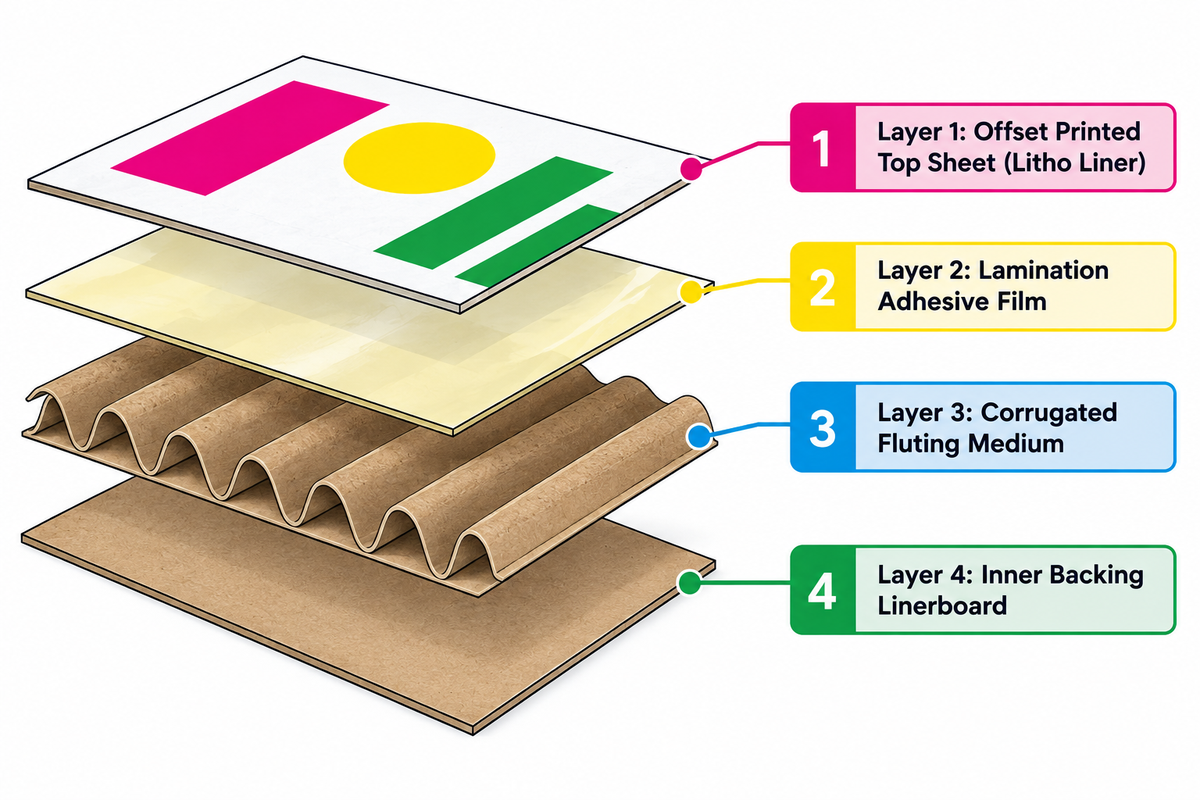
Boxes from Litho laminated are manufactured through offset lithography. First, a smooth paperboard sheet is printed with printing. Then, that sheet is laminated with layer of paper to either a single-face or double-wall fluted corrugated board, which is then flatbed die-cut to individual cartons.
Many simple summaries describe laminated boxes as “printed paper glued to cardboard,” resulting in procurement errors as quotes with mismatched liner weights or warped sheets often go unnoticed. For the single-face construction shown here, the litho-laminated carton consists of four layers: a printed sheet, an adhesive laminating layer, a fluted medium, and an inner liner. Adding paper layers in a double-face or double-wall board construction leads to extra layers. Our Single-Face 4-Layer Litho-Flute Stack Map enables engineers to stipulate the functional requirements of each layer prior to requests for dieline samples and/or unit pricing.
Why laminate a printed top sheet instead of printing directly on corrugated board?
A printing plate pressed against the crest of an uneven flute on a corrugated board leads to flute crush and mottling in the ink and enlarged halftone dots. To get a nice halftone and micro-types and a nice solid ink coverage, the printing must be printed onto a smooth paperboard with an aluminum plate for each color and then laminated to the fluted board.
In converting plants, two distinct lamination routes bond the printed sheet to the corrugated substrate. When offset artwork is printed onto the smooth clay-coated paperboard sheet first, the resulting litho print preserves fine halftones and complex designs when laminated to the exposed flute tips of a separately formed single-face web after single-facer rollers corrugate the fluting medium. In inline single-face lamination, as documented by Packaging World’s technical analysis of single-face laminated packaging, an inline single-facer unwinds roll-stock medium and inner linerboard to form a continuous single-face corrugated web, applies adhesive exclusively to the exposed flute tips, and registers the sheetfed offset printed top sheet directly onto the web before rotary knife severing. In sheet-to-sheet lamination, the laminator feeds pre-cut double-face or double-wall corrugated blanks from a bottom feeder and bonds the printed sheet onto the top liner. Single-face lamination bonds the printed sheet directly to exposed flute tips without a separate outer liner, whereas sheet-to-sheet lamination onto double-wall board provides greater strength and durability for heavy appliances.
| Stack Layer | Material & Converting Role | What Happens If Under-Specified | Required Engineering Drawing Field |
|---|---|---|---|
| Layer 1: Offset Printed Top Sheet (Litho Liner) | Clay-coated solid bleached sulfate (SBS), coated unbleached kraft (CUK/CCKB), or coated recycled paperboard (CCNB) printed via sheetfed lithography. | Low-caliper recycled sheet sags into flute valleys (washboarding) or cracks along 180-degree fold creases. | Fiber furnish, basis weight in GSM (e.g., 250 GSM in our worked appliance-box example), caliper (e.g., 12 pt), grain direction, and surface finish. |
| Layer 2: Lamination Adhesive Film | Modified corn-starch or polyvinyl acetate (PVA) water-based laminating glue metered onto flute tips. | Excess water uptake swells paper fibers and causes S-warp, downward curl, or corner delamination. | Adhesive type, target solids content, film-weight window, and post-lamination conditioning hold time. |
| Layer 3: Corrugated Fluting Medium | Semi-chemical or recycled corrugating medium formed into F, E, B or C flutes; EB and BC are double-wall combinations. | Crushed flutes during laminator nip compression or die-cutting reduce finished Edge Crush Test (ECT) capacity. | Flute profile code, medium basis weight in GSM (e.g., 120 GSM in our worked appliance-box example), flute axis orientation, and nominal caliper. |
| Layer 4: Inner Backing Linerboard | Kraft or test linerboard bonded to the inside flute tips in single-face lamination (sheet-to-sheet lamination onto double-wall board adds a center liner and second medium). | Unbalanced basis weight between outer litho sheet and inner liner induces asymmetric hygroexpansive bow. | Inner liner furnish (brown/white kraft vs test, e.g., 125 K/T to 300 K/T per GWP grades or 140 GSM in our worked example) and interior print spec. |
Worked Engineering Case (Part 1: Single-Face 4-Layer Stack Definition for a 2.4 kg Appliance Box)
To see how these four layers interact on a real bill of materials, track our recurring worked example across this guide: a retail-and-parcel appliance box engineered for a 2.4 kg countertop espresso grinder with internal cavity dimensions of 320 × 240 × 110 mm. Rather than requesting a generic “E-flute litho box,” the structural drawing locks Layer 1 as a 250 GSM clay-coated kraft-back (CCKB) printed top sheet at 12 pt caliper, Layer 2 as a high-solids modified starch laminating adhesive, Layer 3 as a 1.6 mm single-wall E-flute medium (90 flutes/ft, 120 GSM semi-chemical fluting), and Layer 4 as a 140 GSM unbleached inner kraft liner. The 32 ECT converted-board rating is established by the lot’s TAPPI T 811 edge-crush result; 6 units are packed per 600 × 500 × 350 mm BC-flute outer master shipping carton.
Litho Lamination vs Direct Flexo vs Digital Print: The 3-Process Print Crossover Matrix
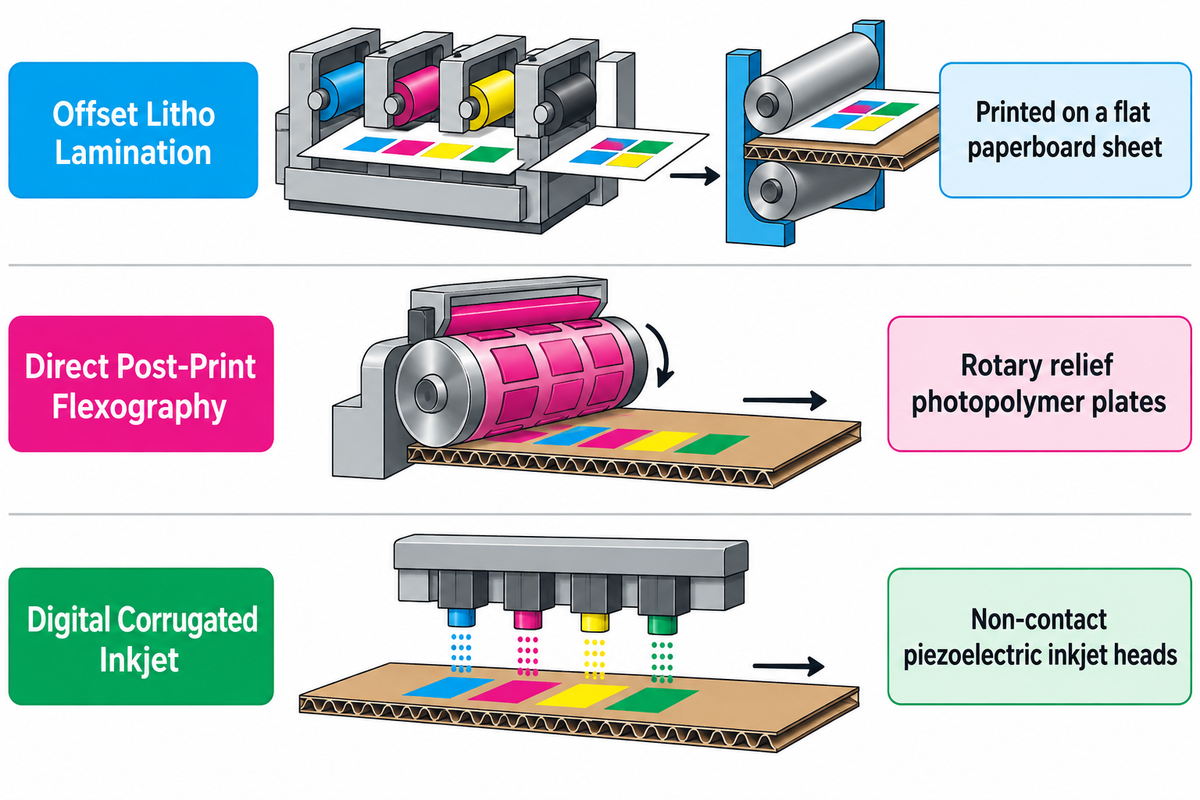
For photosensitive halftones with detail and exact Pantone spot colors, and for cost justification of lower unit cost tooling over multi-color work, choose sheetfed offset litho lamination. Choose sheetfed offset litho lamination when fine photographic halftone detail, exact Pantone spot colors, and lower unit cost at scale outweigh tooling setup; choose digital print for multi-SKU or short pilot runs without plate fees; and choose direct flexography for simple line-art shipping cartons. There are no published studies or industry accepted methods to define a unit volume crossover threshold. Therefore, the comparison should be based on total area of press sheets, plate count and die-imposition per job.
When litho lamination printing is pitted against direct flexography or single-pass digital inkjet, online posts quote an “arbitrary” 1,000-unit or 5,000-unit minimum order rule. In the world of carton manufacturing, crossover points depend on a lot of factors including the area of an unfolded blank, the number of blanks that nest on a master offset sheet, the total number of color stations, and how often the same order is repeated. In lithographic printing, color ink is conveyed to an aluminum plate using a laser, and then for each color (cyan, magenta, yellow, black, and spot channels), pressed-on onto a rubber sheet (an offset blanket), and printed on smooth paperboard. By contrast, direct flexography uses flexible photopolymer plates to directly print graphics onto pre-corrugated board, while digital print jets CMYK droplets directly onto the substrate without physical plates. If the product weighs less than a kilogram and does not require a corrugated (cushioning) flute, examine the economics of single-sheet, smooth, paperboard in our custom printed folding carton structures, or check out custom printed folding cartons.
At what order volume does offset litho lamination become more cost-effective than digital printing?
Choose digital printing for short promotional or multi-SKU runs and offset litho lamination for larger sheet runs; the crossover unit count depends on blank area, number of printing plates, die complexity and if several SKUs share the same die. Digital printing avoids plate fees for short runs and offset litho lamination distributes the cost of plates and make-ready over a large sheet to achieve a lower unit cost and faster press speeds.
Use The 3-Process Print Crossover Matrix below to evaluate all ten technical and commercial parameters before locking the printing process on your request for quotation.
| Decision Dimension | Offset Litho Lamination | Direct Post-Print Flexography | Digital Corrugated Inkjet |
|---|---|---|---|
| 1. Printing Mechanism | Sheetfed offset lithography: ink transfers from aluminum plate onto a rubber sheet blanket, then onto smooth paperboard prior to lamination. | Rotary relief photopolymer plates kiss-print water-based ink directly onto corrugated board face. | Non-contact piezoelectric inkjet heads jet aqueous or UV-curable ink droplets directly onto liner or board. |
| 2. Pre-Press Tooling | Computer-to-plate (CTP) aluminum printing plates (one plate for each colour channel); moderate plate cost per SKU. | Elastomeric photopolymer stereo plates per color; higher per-plate tooling fee than offset aluminum plates. | Zero printing plates required (RIP digital file workflow); cutting die still required unless digitally table-cut. |
| 3. Fixed Setup vs Unit Cost Curve | Press + laminator make-ready creates a fixed setup floor, then delivers a steep drop to a lower unit cost on medium-to-high sheet runs. | Highest plate setup fee, but lowest per-unit converting cost on high-volume transit shippers. | Minimal setup fee; flat per-square-meter ink and click charge makes it a cost-effective solution for small batches. |
| 4. Halftone Resolution & Gradients | Fine halftone lithographic print quality can reproduce small type and smooth photographic gradients when artwork, substrate, press setup, and viewing distance support it, though gradients may still show banding. | Coarser flexographic screening and dot gain on porous kraft liners limit photographic gradients and fine serif text. | High-resolution inkjet droplet placement supports photographic reproduction, though heavy solids can show occasional nozzle streaks. |
| 5. Brand Color & Spot Ink Matching | Full CMYK process (cyan, magenta, yellow, black) plus exact Pantone spot inks, metallic inks, and fluorescent pastels. | Spot GCMI or Pantone flexo inks; ink shade shifts noticeably between brown kraft and mottled white liners. | CMYK (or extended gamut) simulation of Pantone colors; cannot jet true metallic paste inks. |
| 6. Flute Crush & Caliper Retention | Printing occurs on flat paperboard before lamination; laminator nip settings affect flute caliper. | Over-tightened plate impression and feed-roll pressure can crush flutes. | Digital printing avoids plate impression on the corrugated face, while feed, transport, and converting settings can still affect board caliper. |
| 7. Surface Finish Compatibility | Supports inline aqueous, flood/spot UV coating, matte/glossy BOPP film lamination, hot foil stamping, and embossing. | Direct flexo boxes can receive film lamination or foil stamping in separate converting steps, with added setup and cost. | Supports inline aqueous or UV overprint varnish; offline film lamination is rarely economical at digital volumes. |
| 8. Multi-SKU Artwork Versioning | Each artwork change requires a new set of offset printing plates unless multiple SKUs are ganged on one large press sheet. | High penalty for artwork changes due to photopolymer plate cost and wash-up downtime between colors. | Zero plate-change penalty; switches between regional languages, flavours, or serial codes on the fly. |
| 9. Pre-Production Sampling Route | 3-stage verification: CAD structural white dummy, digital color mock-up, and wet offset press proof on actual linerboard. | Ink drawdown swatch + unprinted CAD sample; full press proofs on corrugated board are rarely run before mass production. | Production-identical printed prototype run directly on the digital corrugated press and cut on a CAD table. |
| 10. Best-Fit Commercial Scenario | High-graphic retail packaging, electronics boxes, club-store PDQ displays, beverage carriers, and premium e-commerce kits. | Outer master shipping cartons (FEFCO 0201 RSC), industrial parts boxes, and single-color transit mailers. | Seasonal promotional kits, crowdfunding launches, regional test-market runs, and high-SKU cosmetic mailers. |
Choosing F, E, B or BC Flutes Without Washboarding: The 5-Flute Caliper-to-Payload Selector
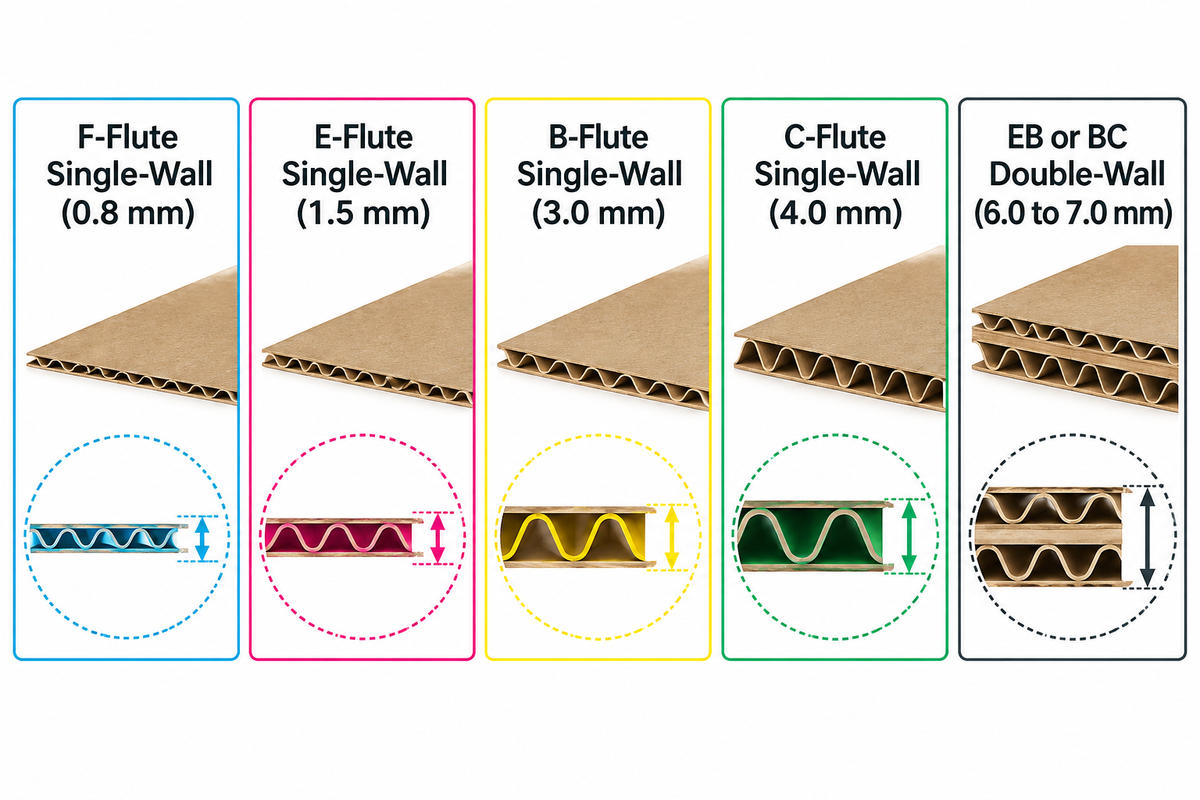
Pair fine F-flute (0.8 mm, ~125 flutes/ft) or E-flute (1.5 mm, ~90 flutes/ft) with smooth coated paperboard liners for compact retail cartons and e-commerce mailers; pair coarser B-flute (3.0 mm, ~47 flutes/ft), C-flute (4.0 mm, ~39 to 42 flutes/ft), or EB/BC double-wall board (6.0 to 7.0 mm for BC-flute across 125 K/T to 300 K/T linerboard grades) with higher-caliper, stiffer paperboard top sheets and controlled starch adhesive solids to prevent washboarding. There are no fixed payload weight ranges assigned to different flute profiles in published standards; determine the loaded-box capacity of the finished carton based on the linerboard grade, box dimensions, and stack tested samples.
Selecting the wrong flute profile or pairing a thin paperboard liner with a wide flute pitch is the number-one cause of visual rejection in printed corrugated packaging. As reference tables from GWP Group’s corrugated board grades guide show, flute profiles vary sharply in arch height and flute count per linear foot. Micro-flutes (F-flute at ~0.8 mm and ~125 flutes/ft; E-flute at ~1.5 mm and ~90 flutes/ft) place flute tips close together, creating a nearly continuous support platform under the litho sheet. Medium and coarse flutes (B-flute at ~3.0 mm and ~47 flutes/ft; C-flute at ~4.0 mm and ~39 to 42 flutes/ft) span wider valleys that demand a higher-stiffness paperboard liner to bridge the gap without sagging, while double-wall combinations such as EB-flute and BC-flute (6.0 to 7.0 mm caliper across 125 K/T to 300 K/T liner grades) combine cushioning with finer outer flute support. Because finished-box load capacity cannot be determined from flute profile alone without specifying linerboard grade, box geometry, and packed-box testing, engineers evaluate the complete composite stack together. For self-locking retail and mailer structures that combine fine flutes with tuck closures, see our custom corrugated tuck-end boxes.
What causes washboarding on litho laminated corrugated boxes?
Washboarding can be caused by a number of issues. For example, using a coarse flute pitch (i.e. B-flute or C-flute) with an overly thin top layer, applying too much water-based laminating adhesive, or using too much nip-roller pressure during lamination can all contribute to the issue. The printed top sheet sinks into the valleys between the corrugated flute tips, thereby creating visual ripples across glossy or dark printed panels.
As analyzed in Corrugated News’ technical breakdown of warp and washboarding defects, as starch-based laminating glue loses moisture and cures, adhesive shrinkage pulls the dampened top liner downward between flute tips. If the top sheet lacks cross-machine bending stiffness—or if flood-coated dark artwork with a high-gloss finish amplifies specular light reflection—every underlying flute crest telegraphs through the exterior panel. Use The 5-Flute Caliper-to-Payload Selector below to match flute profile, liner stiffness logic, and commercial application clustering across five standard board grades and five product archetypes.
| Flute Profile or Product Archetype | Nominal Board Caliper & Flute Pitch (GWP Reference) | Litho Top-Sheet Selection & Liner Grade Rule | Structural Role & Load Verification Basis | Washboarding & Converting Control Rule |
|---|---|---|---|---|
| 1. F-Flute Single-Wall (Micro-Corrugated) | ~0.8 mm; ~125 flutes/ft | Smooth clay-coated SBS or C1S paperboard top sheet matched to tight micro-flute pitch. | Compact retail cartons replacing heavy solid paperboard; finished-box load capacity depends on board grade and structural design. | F-flute’s close pitch provides a smooth printed face; folds cleanly on folding-carton gluers. |
| 2. E-Flute Single-Wall (Fine Retail & Mailer Grade) | ~1.5 mm (1.6 mm in worked example); ~90 flutes/ft | Coated SBS, CCKB, or CCNB liner (such as the 250 GSM / 12 pt CCKB sheet in our 2.4 kg appliance-box example). | Eye-catching retail boxes, subscription mailers, and small appliances; verify converted ECT (e.g., 32 ECT in our worked example). | Industry workhorse for litho laminated boxes; step up top-sheet caliper and stiffness when using dark flood ink or glossy finish. |
| 3. B-Flute Single-Wall (Structural Retail & Parcel) | ~3.0 mm; ~47 flutes/ft | Higher-caliper, stiffer CCKB or SBS top sheet paired with 125 K/T to 300 K/T inner linerboard grades. | Beverage carriers, club-store trays, and self-shipping parcel boxes; BCT varies with aspect ratio (2,078 N square vs 1,537 N at 4:1 ratio). | Wider valley spacing requires higher cross-machine liner bending stiffness and high-solids starch glue to avoid flute telegraphing. |
| 4. C-Flute Single-Wall (Heavy Transit Cushioning) | ~4.0 mm; ~39 to 42 flutes/ft | Heavy-caliper paperboard or kraft-back top sheet over 125 K/T to 300 K/T corrugated linerboard grades. | Heavy hardware shippers and warehouse-stacked display cartons; confirm stacking strength via converted ECT and packed-box testing. | Highest single-wall washboarding risk; prefer satin/matte coating or switch to EB double-wall with fine E-flute facing outside. |
| 5. EB or BC Double-Wall (5-Ply High-Load Composite) | EB: combined fine + medium flutes; BC: ~6.0 to 7.0 mm | High-stiffness paperboard liner bonded to the finer outer flute face over 125 K/T to 300 K/T double-wall board. | Multi-wall cushioning for heavy appliances, power tools, and master shippers; verify safe load with liner grade and packed-box testing. | Orient the finer flute (E in EB, B in BC) directly under the litho top sheet to preserve surface smoothness. |
| 6. Archetype A: Cosmetic & Fragrance Gift Set | F-flute (~0.8 mm) or E-flute (~1.5 mm) tuck-end or mailer | Virgin SBS top sheet with spot UV or matte BOPP lamination | Fragile glass serum bottles held inside a die-cut corrugated cradle; verify fit on CAD sample. | Requires bright white clay coating and tight score-to-score folding clearances for friction-fit inserts. |
| 7. Archetype B: Craft Beverage & Glass Bottle Carrier | In-line E-flute (~1.5 mm) or B-flute (~3.0 mm) crash-lock bottom | Unbleached kraft-back (CCKB) wet-strength paperboard liner | Multi-bottle glass carrier with interlocking cell divider; validate bottom-lock tear strength on packed samples. | Specify long-fiber virgin kraft-back top sheet to resist bottom-panel tear and chill-room condensation. |
| 8. Archetype C: Club-Store Countertop PDQ Display Tray | B-flute (~3.0 mm) or EB double-wall tear-away display tray | Stiff CCNB or SBS liner with inline satin aqueous coating | Multi-unit retail shelf-ready tray palletized for club stores; verify vertical compression with TAPPI T 811 ECT. | Orient flutes vertically along load-bearing side walls to survive pallet-tier compression without corner buckle. |
| 9. Archetype D: Countertop Kitchen Appliance Box | E-flute (1.6 mm in worked example) or B-flute (~3.0 mm) | 250 GSM (12 pt) CCKB or SBS liner with high-rub aqueous or UV varnish | Countertop appliances such as our 2.4 kg espresso-grinder example (32 ECT converted board rating). | For this appliance-box example, a 250 GSM top sheet over E-flute provides a smoother base for dark photographic artwork. |
| 10. Archetype E: Heavy Automotive / Power-Tool Kit | EB or BC double-wall (6.0 to 7.0 mm) with reinforced handholes | Heavy-caliper CCKB liner with laminated film or scuff-resistant varnish | Heavy hardware and tool kits over 125 K/T–300 K/T double-wall liner grades; verify load via packed-box compression and drop tests. | Place die-cut handholes away from vertical corner creases to preserve edge-crush load paths. |
When determining board lead times and minimum order quantities, buyers should also take into consideration how the manufacturer produces each flute profile. From the supplied manufacturing disclosures, Xiamen Huandao Packaging Technology Co., Ltd., states their Xiamen plant uses an in-line corrugator to produce single E-flute and single B-flute board just in time using a “Zero Stock” approach. A, C, F, BC and other flute profiles are produced using supplied board. For Huandao’s Xiamen plant, in-house single E-flute and B-flute production eliminates the external board-sourcing step; F-flute and BC double-wall orders include sourced-board scheduling.
Worked Engineering Case (Part 2: Flute Pitch & Anti-Washboarding Pairing for the 2.4 kg Appliance Box)
On our 320 × 240 × 110 mm espresso grinder appliance box (2.4 kg payload), the brand artwork features a deep matte-charcoal background with a glossy product silhouette on the front panel. Had the buyer paired a thin recycled top sheet with coarse B-flute (~47 flutes/ft), starch glue shrinkage could pull the liner into the wider flute valleys and create visible washboarding ridges. The single-wall E-flute board uses a 1.6 mm flute height and about 90 flutes/ft, bonded to a 250 GSM (12 pt) clay-coated kraft-back printed sheet and a 140 GSM inner kraft liner. The 32 ECT specification belongs to the converted board, while the 600 × 500 × 350 mm BC-flute outer master carton holds 6 units and carries pallet stacking loads.
Aqueous, UV Coating and Film Lamination: The 4-Finish Rub & Repulpability Map
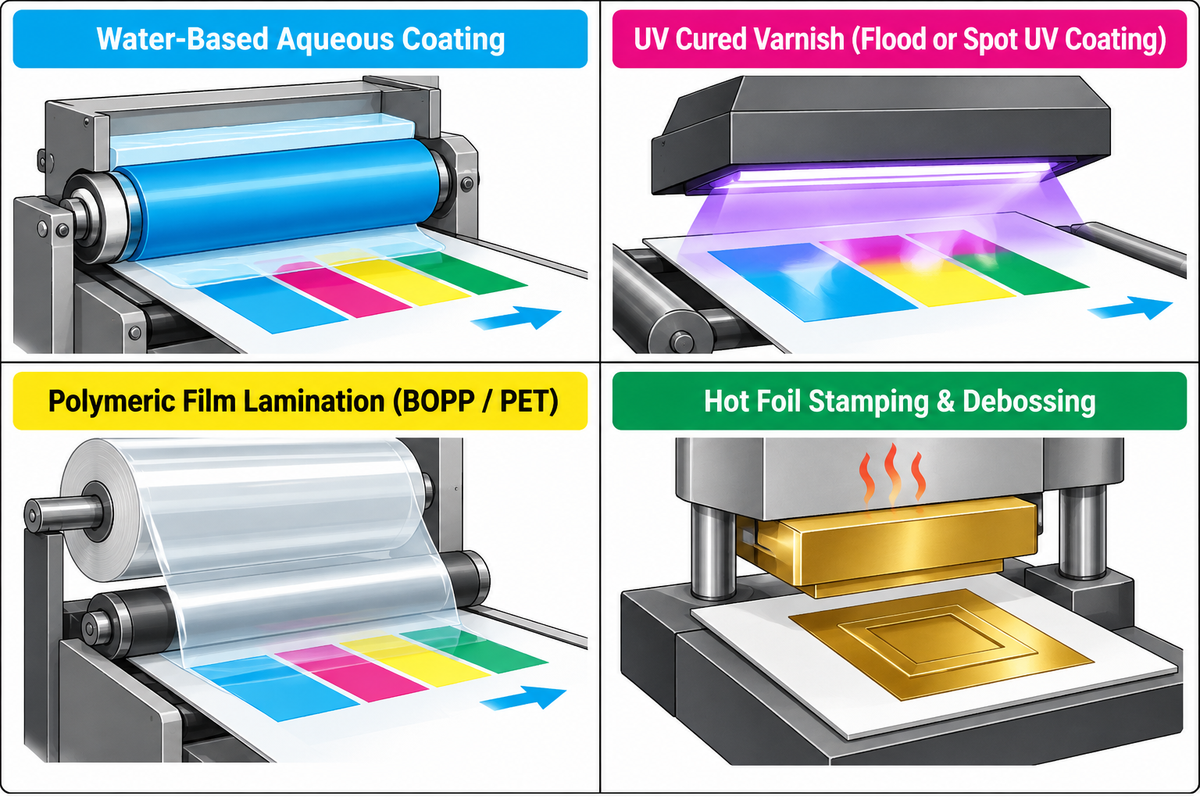
Chose inline water-based coating to prioritize paper-stream recovery, and transit rub protection. Step up to UV coating or BOPP/PET film lamination for higher scuff and moisture resistance. The ability to be repulped is dependent on the coating chemistry and the dispersibility of the adhesive, as well as mill screening and placement, and the lab’s method of testing repulpability does not align with local municipal recycling acceptance.
Because “lamination” refers both to bonding the paperboard top sheet onto the corrugated flute (board lamination) and to applying a clear plastic film over the printed ink (surface film lamination), buyers frequently confuse structural bonding with surface protection. To keep impactful retail graphics and printed packaging free from transit rub, engineers pair each top sheet with a durable finish tailored to the distribution channel, balancing cardboard packaging durability against end-of-life recycling rules. Unprotected offset ink rubs off onto adjacent boxes and corrugated dividers during truck vibration. However, adding a polymer film layer across the exterior changes how paper mills process the box after use. As peer-reviewed research in NC State University’s BioResources journal on assessing repulpability and fiber properties in recovered paper products demonstrates, fiber recovery yield in standard mill hydrapulping is governed jointly by coating chemistry, polymer film barrier layers, adhesive water-dispersibility, and mechanical coarse/fine screening rejects—not by fiber weight percentage alone. Similarly, the How2Recycle Guidelines for Use (2025) emphasize that recyclability claims on paperboard and corrugated packaging must match verified repulpability testing and municipal access thresholds.
Use The 4-Finish Rub & Repulpability Map below to balance transit scuff resistance (measured under ASTM D5264-98(2019) Sutherland Rub testing), score-line fold behavior, glue-flap masking, and paper-stream repulpability.
| Surface Finish System | Visual Effect & Application Method | ASTM D5264 Ink-Rub & Moisture Behavior | Score-Line Folding & Glue-Flap Rule | Repulpability & Recycling Stream Impact |
|---|---|---|---|---|
| 1. Water-Based Aqueous Coating (Gloss, Satin, or Matte) | Applied inline on the sheetfed offset press coater tower immediately over wet offset ink; fast drying. | Good dry-rub scuff resistance for retail cartons and master-packed boxes; breathes with paper moisture. | Flexible polymer film resists score cracking; knock out manufacturer’s glue flap and thermal label window. | Disperses cleanly in standard mill hydrapulping; preferred choice for recyclable paperboard and corrugated streams. |
| 2. UV Cured Varnish (Flood or Spot UV Coating) | Acrylate UV varnish cured under ultraviolet lamps for a high-contrast glossy finish. | High dry-rub and chemical scuff resistance; protects dark CMYK/spot solids during parcel vibration. | Cross-linked UV film is brittle on sharp 180° folds—knock out UV along crease lines and glue flaps to prevent cracking and glue failure. | Generally accepted at low coat weights, though heavy flood UV cured films break into crosslinked flakes in fine mill screens. |
| 3. Polymeric Film Lamination (BOPP / PET) | BOPP or PET film bonded over the printed sheet. | High ASTM D5264 abrasion and moisture barrier. | Film can reduce visible white cracking at tight scores when paper, film, and crease match the fold; mask glue flaps. | Adds a continuous plastic layer that reduces fiber yield during mill hydrapulping and screening, requiring destination-market repulpability qualification. |
| 4. Hot Foil Stamping & Debossing | Heated die transfers metallic foil onto the sheet. | Pair with base coat; verify rub under ASTM D5264. | Apply deep embossing to the top sheet before flute lamination to avoid crushing flutes. | Localized spot-foil accents leave most of the paper surface exposed, while full-sheet metallic PET foil creates a continuous film layer that can impede paper recycling. |
Tooling, Sampling and Run Economics: The 6-Driver Litho Order Scoping Brief
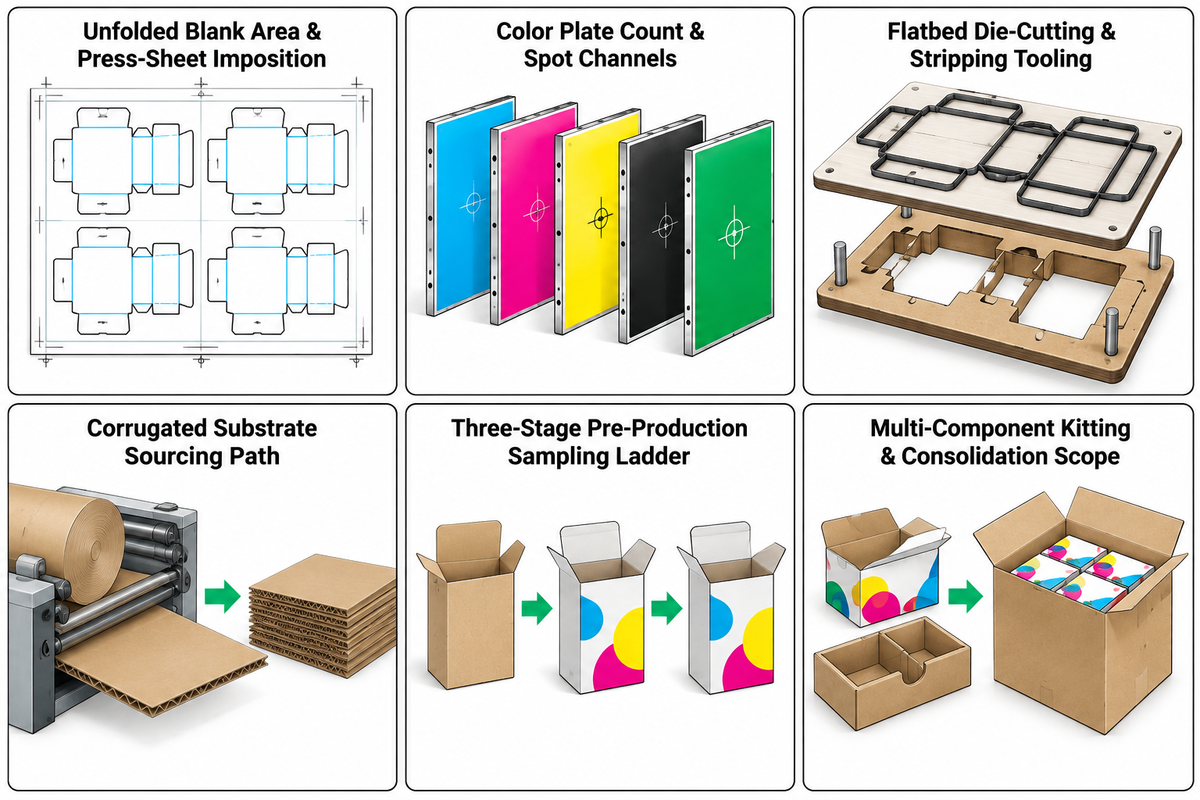
Industry standards do not set universal minimum order quantity unit floors, fixed cutting-die or printing-plate fees, or standard lead-time days because custom litho laminated box quotes are calculated per project from six physical drivers: unfolded blank nesting on the offset press sheet, color plate count, cutting-die layout, inline vs sourced flute board supply, sampling stage, and multi-component kitting scope.
When brands decide to use litho lamination for custom packaging, unit pricing and lead times cannot be read off a generic chart because published industry references do not set universal minimum order quantities, standard cutting-die or printing-plate fees, or fixed production lead-time days; instead, sheetfed offset presses and corrugated laminators price and schedule each job by master-sheet throughput, plate count, and board source. As foundational corrugated blank layout engineering—such as US Patent US4441626A on end-to-end nested corrugated box blanks—illustrates, arranging and nesting multiple box blanks across the board width saves material and multiplies how many cartons emerge from each sheet cycle. Complete The 6-Driver Litho Order Scoping Brief below before sending dielines out for quotation so every supplier bids on identical tooling and sampling assumptions.
| Order Scoping Driver | Converting & Machine Parameter | Impact on Tooling NRE & Unit Price | Buyer Scoping Action Before RFQ |
|---|---|---|---|
| 1. Unfolded Blank Area & Press-Sheet Imposition | How many flat blanks nest across a standard sheetfed offset press format (US4441626A end-to-end blank nesting). | Multi-up imposition reduces offset press impressions and laminator feeds per finished box compared with single-up layouts. | Share editable CAD dielines early and allow minor dust-flap trim adjustments if they unlock an extra blank per master sheet. |
| 2. Color Plate Count & Spot Channels | 4-color CMYK process vs multi-channel setups adding Pantone spot inks, metallic inks, and spot UV coating plates. | Each additional color requires an aluminum plate for each colour plus press wash-up and registration make-ready sheets. | Specify whether brand colors can run in 4-color CMYK process or require dedicated Pantone spot ink fountains. |
| 3. Flatbed Die-Cutting & Stripping Tooling | Birch plywood steel-rule cutting die, creasing matrix, and stripping boards. | Initial die fabrication cost (with re-tooling if dies wear or dimensions change); multi-up dies speed up mass die-cutting. | Itemized cutting-die and printing-plate fees show which existing tools can be reused on repeat orders. |
| 4. Corrugated Substrate Sourcing Path | In-house inline single-facer corrugation (such as single E-flute and single B-flute) vs externally purchased sheet board (F, C, BC). | Inline E-flute and B-flute avoid external board-mill minimum run sizes and cut raw-material lead time. | Ask the supplier which flute profiles are corrugated inline in-house versus purchased from third-party sheet feeders. |
| 5. Three-Stage Pre-Production Sampling Ladder | Stage 1: unprinted CAD structural sample; Stage 2: digital color mock-up; Stage 3: wet offset + laminated press proof. | CAD white dummies and digital proofs cost little and ship fast; wet offset press proofs require full plate and press make-ready. | Approve internal fit on an unprinted CAD sample first before ordering printing plates or wet offset proofs. |
| 6. Multi-Component Kitting & Consolidation Scope | Co-manufacturing the printed litho box alongside internal corrugated inserts/trays and outer master shipping cartons. | Consolidating box, insert, and shipper in one group facility eliminates split LCL trucking and cross-vendor dimensional mismatch. | Bundle the primary litho-laminated box, inner insert tray, and outer master shipper into a single coordinated RFQ. |
What ECT, Burst, Ink-Rub and Basis-Weight Reports Prove: The 10-Point Lab & Pack-Out Evidence Map
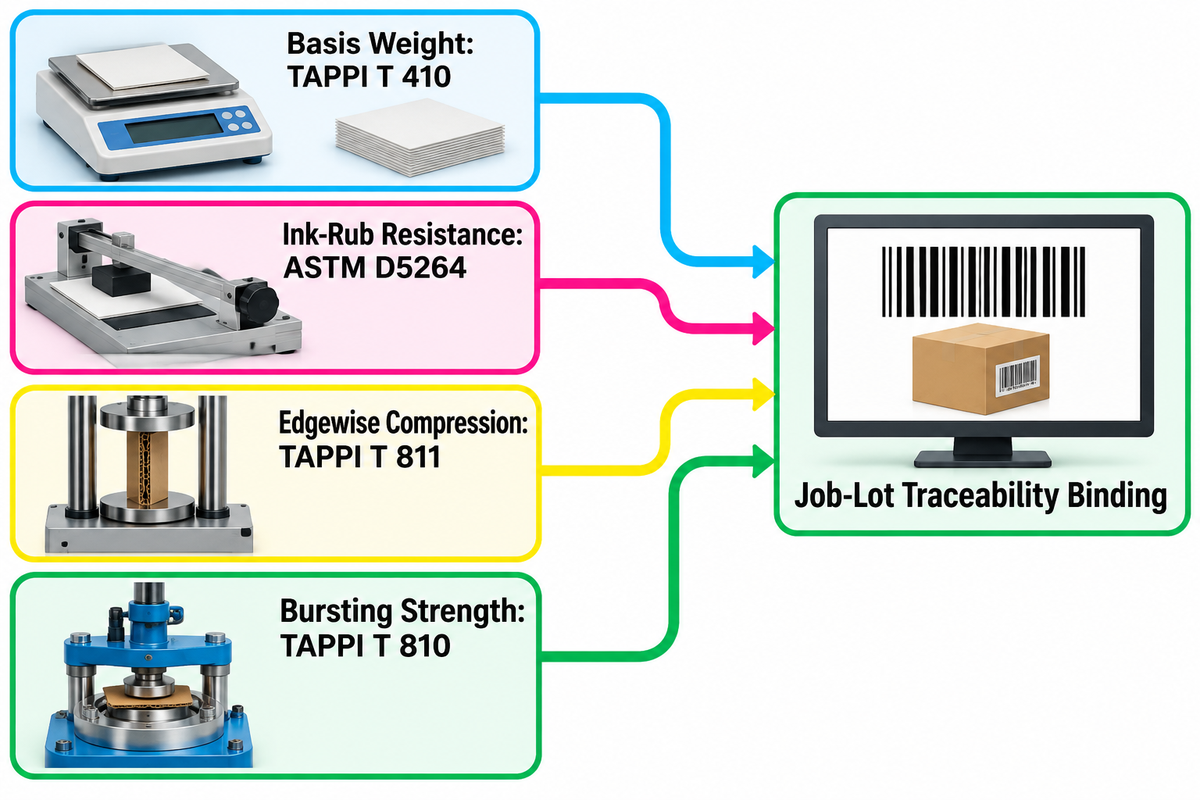
The 10-point lab and pack-out evidence map includes four job-linked laboratory reports tied to the production lot: basis weight (TAPPI T 410), Sutherland ink-rub resistance (ASTM D5264), edge crush (TAPPI T 811), and Mullen bursting strength (TAPPI T 810), tested on conditioned converted board specimens alongside six structural and lot-traceability checks. Testing was performed by (name of company) in (name of city and state) on (month day) (year).
A frequent procurement blind spot occurs when buyers accept a generic “32 ECT” or “200 lb test” line item on a supplier’s invoice—or a historical paper-mill certificate—without testing the converted board from their own production run. During the litho lamination process, excessive moisture from starched glue or over-tightened feed rollers on a laminator or die-cutter can crush flute tips, and edgewise compression can be reduced compared to raw, uncrushed roll stock. From company-supplied manufacturing disclosures from Xiamen Huandao Packaging Technology Co., Ltd., their lab issues ECT/burst and ink-rub tests on the job itself, so the numbers on the report are of the customer’s own production run. Buyers can learn more about the limits of these tests on our in-house packaging manufacturing and laboratory testing services page.
Does an ECT or burst number guarantee a litho laminated box will survive parcel shipping?
No. ECT and Mullen burst measure uncut corrugated specimens under controlled lab conditions. A finished litho laminated box includes creases, tucks, and internal spaces. Real-world compression and impact performance of a box depends on how these elements are incorporated. Survival of a parcel or pallet shipment still requires testing the system where the closed box is loaded with other shipments and subjected to standard compression, vibration, and impact test conditions.
Even when board-level Edge Crush Test (TAPPI T 811 om-17) and Mullen Bursting Strength (TAPPI T 810 om-17) meet specification, finished box compression strength (BCT) varies significantly with box geometry. As demonstrated in a peer-reviewed structural packaging study published in Materials (NIH / PMC7602429) on the influence of box geometry on corrugated board compression, changing the length-to-width aspect ratio of a B-flute box from 1.0 (250 × 250 mm) to 4.0 (100 × 400 mm) at an identical 1,000 mm perimeter and 250 mm height reduced measured Box Compression Test (BCT) load from 2,078 N down to 1,537 N without any change in board ECT or perimeter. Use The 10-Point Lab & Pack-Out Evidence Map below to audit what each laboratory test and structural check proves.
| Test / Audit Dimension | Governing Standard Method | Physical Property Measured & Units | What It Proves (and What It Leaves Unproven) | Buyer Job-Report Audit Checkpoint |
|---|---|---|---|---|
| 1. Basis Weight / Grammage Verification | TAPPI T 410 | Mass per unit area (g/m² / GSM or lb/1,000 ft²) of top sheet, medium, and inner liner. | Proves the converter used the contracted paperboard and liner weights; does not prove adhesive bond or flute height. | Confirm combined converted board GSM matches the sum of top sheet + glue + medium (with take-up factor) + inner liner. |
| 2. Ink-Rub & Scuff Resistance | ASTM D5264-98(2019) / TAPPI T 830 | Sutherland Rub Tester stroke count under a specified test block weight. | Proves whether ink and aqueous/UV coating resist dry or wet abrasion; does not measure corner impact survival. | Verify test block weight, stroke count, receptor sheet condition, and visual pass grade on dark ink panels. |
| 3. Edgewise Compressive Strength (ECT) | TAPPI T 811 om-17 / TAPPI T 839 | Peak force per unit width (lb/in or kN/m) applied parallel to the corrugated flutes until short-column buckling. | Proves laminated board column stiffness and detects flute crush; does not account for aspect ratio, handholes, or pallet overhang. | Ensure specimens are cut from laminated, converted production sheets rather than unprinted raw single-face rolls. |
| 4. Bursting Strength (Mullen Burst) | TAPPI T 810 om-17 | Hydraulic diaphragm pressure required to rupture the combined corrugated board. | Measures resistance to rupturing pressure; it does not establish puncture resistance or vertical stacking strength. | Record burst readings for the tested board specimens. |
| 5. Standard Conditioning Atmosphere | TAPPI T 402 | Standardized laboratory temperature and relative humidity conditioning prior to testing. | Prevents freshly laminated damp board or bone-dry winter board from skewing ECT and burst results. | Check that the laboratory report records lab temperature and relative humidity during test execution. |
| 6. Converted Board Caliper Check | TAPPI T 411 | Combined thickness in millimeters (mm) or thousandths of an inch (mils / pt) under standardized platen pressure. | Detects hidden flute crush caused by excessive laminator nip pressure or flatbed die-cutter impression. | Compare measured converted board caliper against the approved pre-production golden sample. |
| 7. Lamination Fiber-Tear Bond Check | Conditioned Manual Peel Audit | Fiber tear observed when peeling the litho top sheet from the corrugated substrate after conditioning. | Assesses the litho top sheet’s bond to the corrugated substrate. | Inspect sheet edges and corners for incomplete bonding. |
| 8. Box Geometry & Aspect-Ratio Effect | McKee BCT Formula & PMC7602429 Geometry Study | Whole-box top-to-bottom compression force (N or lbf) as a function of length-to-width aspect ratio. | Shows that elongated boxes (4:1 ratio) dropped from 2,078 N to 1,537 N BCT compared with square boxes of identical 1,000 mm perimeter and 250 mm height in B-flute tests. | Apply geometry safety factors when converting board ECT into pallet-stacking height limits. |
| 9. Whole-Pack Compression & Drop Validation | Packed-Carton Transit & Compression Protocols | Compression, vibration, and drop testing on packed, sealed cartons. | Results describe the tested product, insert, litho box, and outer master carton under the selected test conditions. | Run packed-box drop validation when launching fragile glass, ceramics, or heavy appliance SKUs. |
| 10. Job-Lot Traceability Binding | MES / ERP Production Order & Lab Report ID | Production lot number, date stamp, specimen count, QC signature, and specimen sampling record linking the lab sheet to shipping pallets. | The job identifiers link the report to the converted run; the sampling record identifies the lot from which the tested board was taken. | Include the supplier’s Purchase Order and MES job ID on each pre-shipment laboratory report. |
Worked Engineering Case (Part 3: Job-Linked Lab Verification Protocol for the 2.4 kg Appliance Box)
Before releasing our 320 × 240 × 110 mm espresso grinder box (2.4 kg payload), quality control audits the job-linked report on the converted lot: (1) ASTM D5264 Sutherland rub testing records no ink transfer to the test receptor from the satin aqueous coating over charcoal-black offset ink; (2) TAPPI T 410 basis-weight testing confirms the 250 GSM (12 pt) CCKB printed sheet, 1.6 mm E-flute (90 flutes/ft, 120 GSM medium), and 140 GSM inner kraft liner; (3) TAPPI T 811 short-column testing verifies converted board strength at or above 32 ECT; and (4) the 600 × 500 × 350 mm BC-flute master shipping carton (6 units per master, 14.4 kg net payload) passes top-to-bottom compression verification.
Blistering, Warp, Delamination and Cracking: The 8-Signal Lamination Defect Diagnostic
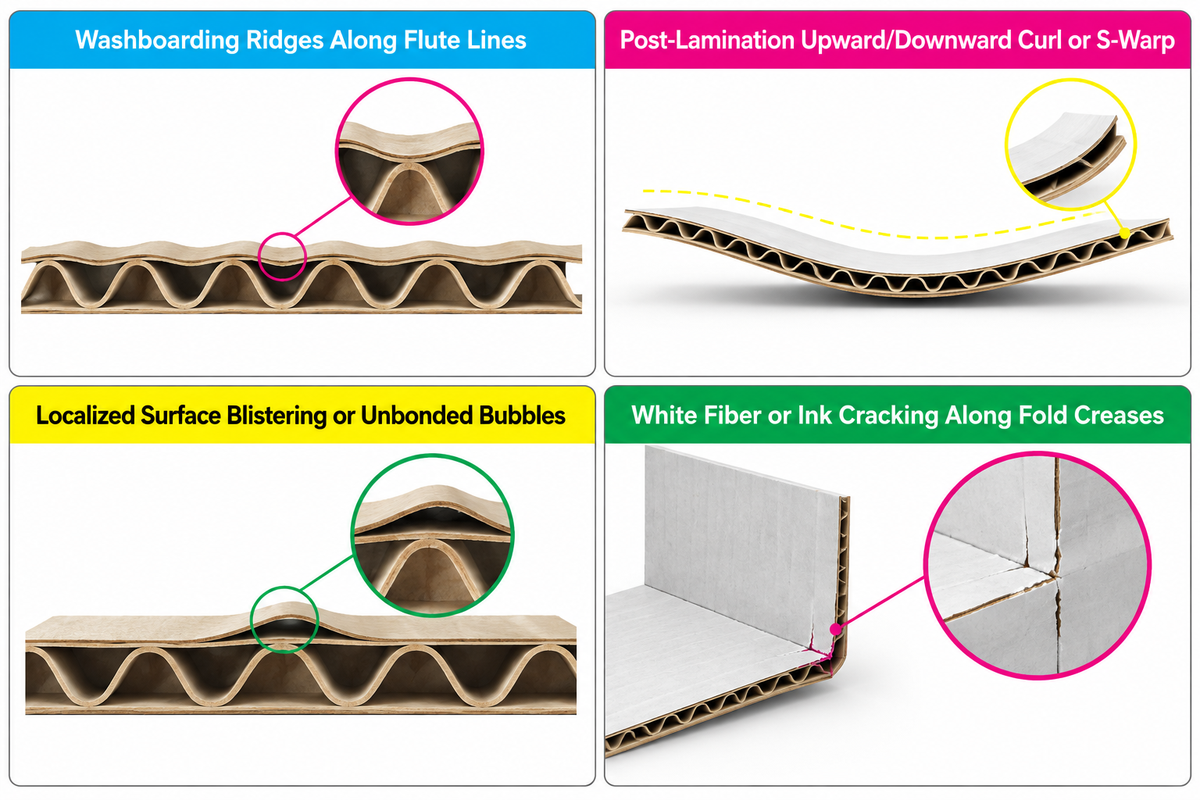
Diagnose a litho lamination defect based on the visible symptom and match to the cause as adhesive moisture imbalance, top-sheet grain or crease orientation, laminator nip pressure, etc. before board grade changes.
When a pre-production proof or incoming lot of laminated cardboard cartons exhibits curl or fold cracking, buyers often assume the corrugated flute grade itself is defective. In reality, as documented in Corrugated News’ converting defect analysis, most visual and structural flaws originate in the moisture differential between the water-glued litho sheet and the corrugated substrate, or in mismatched creasing rules during die-cutting. Use The 8-Signal Lamination Defect Diagnostic below to isolate the physical root cause and specify corrective converting controls.
| Visible Defect Symptom | Primary Converting Subsystem | Physical Root Cause | Corrective Engineering & Press/Laminator Action |
|---|---|---|---|
| 1. Washboarding Ridges Along Flute Lines | Top-Sheet GSM & Glue Metering | Top sheet too thin for coarse B/C-flute pitch; excess water in starch glue shrinks and pulls liner into flute valleys. | Step up top-sheet basis weight and stiffness (e.g., 250 GSM in our worked appliance-box example), raise starch glue solids, and reduce glue roll gap and nip pressure. |
| 2. Post-Lamination Upward/Downward Curl or S-Warp | Hygroexpansive Moisture Balance | Aqueous adhesive wets the outer litho sheet while the inner corrugated liner remains dry, causing differential expansion and cure shrinkage. | Meter minimum effective glue film weight, balance outer/inner liner GSM, and stack sheets flat under weighted press boards during curing. |
| 3. Localized Surface Blistering or Unbonded Bubbles | Laminator Glue Applicator Roll | Starved glue transfer from clogged applicator roll grooves, uneven flute-tip height (high-low flutes), or silicone/oil contamination on liner backside. | Clean glue doctor and applicator rolls, verify single-facer flute-tip uniformity, and keep offset anti-setoff spray minimal on backside. |
| 4. Edge or Corner Delamination During Erecting | Adhesive Tack & Cure Hold Time | Glue wiped back too far from sheet edges, low adhesive wet tack, or sheets sent to flatbed die-cutting before bond cure completed. | Extend glue coverage to full sheet perimeter and enforce mandatory post-lamination conditioning hold time before die-cutting. |
| 5. Litho Artwork-to-Die Registration Drift | Laminator Servo Registration & Die Side-Lay | Top sheet skewed relative to corrugated backing on the laminator, or die-cutter side-lay and front-lay guides indexed to the wrong edge. | Index flatbed die-cutter front and side lays to the same registration edge used on the sheetfed offset press and laminator. |
| 6. White Fiber or Ink Cracking Along Fold Creases | Grain Orientation, UV Cure & Creasing Rule | A short-fiber recycled top sheet folded across the grain, brittle flood UV coating, or an overly narrow creasing channel can cause cracking. | Specify virgin kraft-back (CCKB) or SBS liner, knock out UV along score lines, widen crease channel to match board caliper, or use film lamination. |
| 7. Crushed Flutes & Soft Spongy Panels | Laminator Nip & Die-Cutter Impression | Compression belt nip gap set below combined board caliper, or cork/rubber ejection rubbers on cutting die over-compressing adjacent flutes. | Set the laminator nip to bond the sheets without crushing the flutes, using measured board caliper as a setup reference. |
| 8. Transit Ink Scuffing on Dark Solid Panels | Overprint Coating & Divider Clearance | Heavy dark offset ink left uncoated or under-cured, rubbing against abrasive kraft partitions during truck vibration. | Apply high-rub satin/gloss aqueous or UV coating, verify with ASTM D5264 Sutherland rub testing, and eliminate loose pack headspace. |
DO: Litho Lamination Engineering Controls
- Before flatbed die-cutting, condition laminated sheets on a flat pallet so starch in adhesive equilibrates across the layers.
- For side-seam adhesion, leave the glue flaps uncoated or unfilm laminated.
- For creasing rules and counter-matrix channels, match the full caliper of the laminated board rather than using a folding carton crease setup.
DON’T: Common Specification & Converting Traps
- Don’t use a low-caliber top sheet with a coarse B- or C-flute under a dark high-gloss flood coat without washboarding testing. Wet adhesive shrinkage can pull the sheet into flute valleys.
- Don’t use board level ECT alone to assess stacking strength of a tall, narrow display carton. The finished carton shape affects the compression strength.
- Don’t approve large scale production from a digital mock-up if the pack-out includes a metallic spot ink, heavy flood UV, or tight friction-fit corrugated inserts.
Evaluating Integrated Manufacturers and Locking the Pack-Out: The 10-Field Litho Box Pack-Out Brief
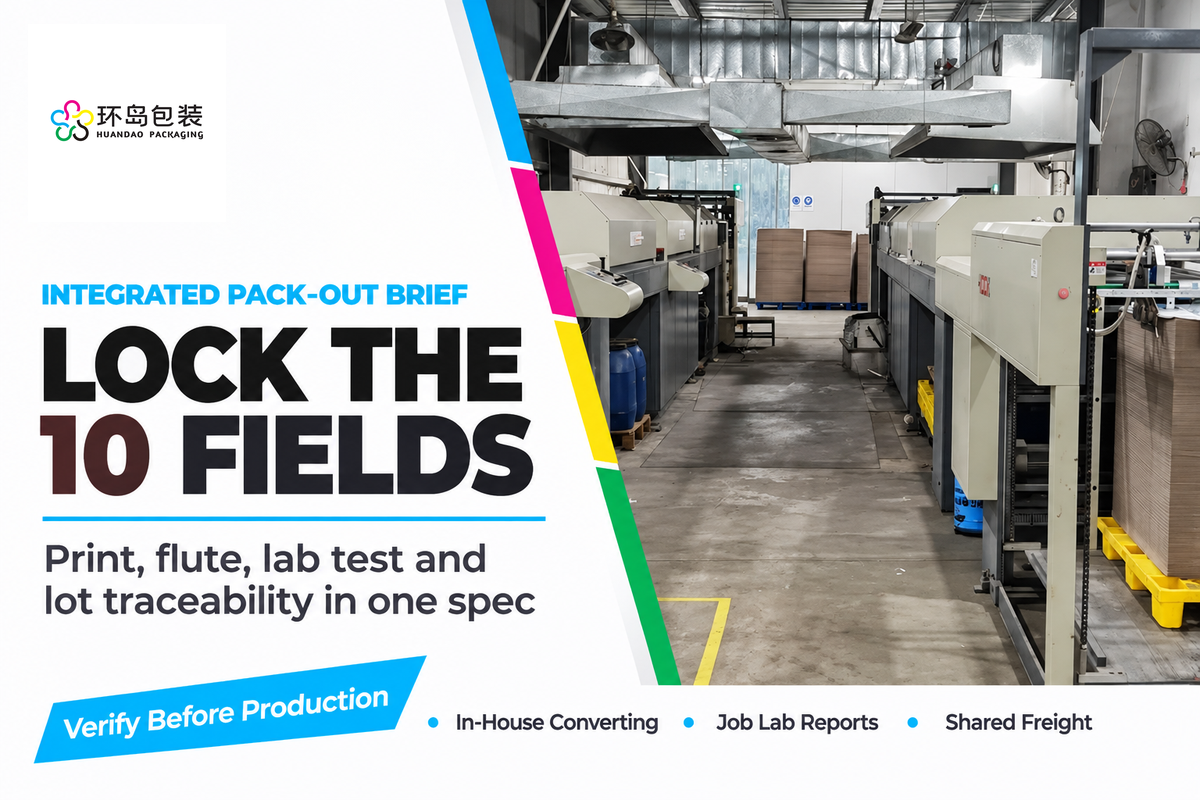
An integrated converter can reduce dimensional drift and quality discrepancies. Lock a 10-field specification and verify the converter operates a Quality System that includes offset printing, lamination, inline E/B-flute corrugation, and die-cutting.
In litho-laminated packaging, when distinct suppliers print, laminate, and make the inserts, warp, color drift, or insert buckling can take longer to trace across manufacturing handoffs. An integrated plant can lessen subcontracting handoffs, though regulated board and adhesive moisture would still be necessary to prevent mismatch. Prospective clients can see our plant history and our facility layout on our About Xiamen Huandao Packaging Technology Co., Ltd. page.
According to company-supplied manufacturing disclosures from Xiamen Huandao Packaging Technology Co., Ltd., buyers can benchmark integrated converter operations against the following declared baseline (and verify each item on a live order via factory audit, MES job tracking, and job-linked lab reports):
- Facility Ownership, Founding & Workforce: According to company-supplied manufacturing disclosures, Xiamen Huandao Packaging Technology Co., Ltd. was founded on 30 June 2003 in Xiamen, Fujian, China, with registered capital of RMB 20 million, and operates its own manufacturing facility—not a trading office—at No. 587 Tongfu Road, Tong’an District, Xiamen, Fujian, China, with 133 staff.
- Group Structure & Industry Standing: According to company-supplied disclosures, Huandao is the colour-printing plant of Huan Yin Packaging Group (brought together in 2024 after adding corrugated carton and protective packaging manufacturing, with group revenue passing RMB 200 million), the group is a President Unit of the Xiamen Printing Industry Association, and its stated values are “quality is fundamental, service is the soul”.
- In-House Offset, Lamination & Inline E/B-Flute Corrugator: Disclosures say that pre-press, sheetfed offset printing, UV coating, lamination, die-cutting and folder-gluing are all performed in-house; their Xiamen plant produces single-wall E/B-flute board inline and claims to use a ‘zero-stock’ approach for this production. For A, C, F, BC and other flute profiles, board is sourced.
- Job-Run Laboratory & Real-Time MES Kanban: Disclosures say that their on-site laboratory issues ECT/burst and ink-rub tests, as well as basis weight tests, on a job run basis, therefore, the test data is for the customer’s own production run. Every process step is scanned to a real-time MES Kanban, which is supported by an ERP and intelligent scheduling.
- Single-Shipment Group Consolidation: Huandao is part of the Huan Yin Packaging Group, therefore they say that inner trays and/or inserts and outer shipping cartons for the same product, when printed with litho boxes, can be shipped as a consolidated load with shared freight.
Verification boundary: Facts in Company profile are supplier-provided declarations from Xiamen Huandao Packaging Technology Co., Ltd. Procurement teams verify them on every purchase order by confirming the commercial contract against the registered factory address, verify retained golden samples, confirm real-time MES lot barcodes, and check the job-numbered laboratory test report prior to releasing shipment.
Use The 10-Field Litho Box Pack-Out Brief filled out with our complete, worked-out, appliance-box engineering example record, as a specification template to lock the primary litho-laminated box, internal insert, and outer master carton for repeat orders.
| Field # & Control Parameter | What Must Be Locked in the Master Specification | Worked Appliance-Box Lock Record (2.4 kg Espresso Grinder) | Verification Evidence Required |
|---|---|---|---|
| 01. Manufacturer Identity & In-House Scope | Legal entity name, physical plant address, and confirmed in-house vs outsourced process steps. | Single-plant offset printing, aqueous coating, inline E-flute lamination, die-cutting, and folder-gluing. | PO factory address match + MES routing sheet. |
| 02. Structural Dieline & Internal Cavity Dimensions | CAD revision ID, FEFCO style code, and score-to-score inside Length × Width × Depth (mm). | FEFCO 0427 primary retail-and-parcel box; inside cavity 320 × 240 × 110 mm for 2.4 kg grinder. | Signed CAD PDF/ARD file + approved white dummy. |
| 03. Litho Top-Sheet Furnish, GSM & Grain | Paperboard grade (SBS, CCKB, CCNB), basis weight (g/m²), caliper (pt), and grain axis relative to main fold. | 250 GSM clay-coated kraft-back (CCKB) top sheet at 12 pt caliper; grain perpendicular to primary lid hinge. | TAPPI T 410 basis-weight & T 411 caliper report. |
| 04. Corrugated Flute Profile & Board Source Rule | Flute code (F, E, B, C, EB, BC), medium GSM, inner liner GSM, and inline vs sourced board declaration. | In-line corrugated single-wall E-flute (1.6 mm caliper, 90 flutes/ft, 120 GSM medium) + 140 GSM inner kraft liner. | Retained board cross-section coupon + lot ticket. |
| 05. Offset Color Standard & Finish Knockout Zones | CMYK ICC profile, Pantone spot references, overprint finish, and unvarnished glue-flap / thermal-label windows. | 4-color CMYK + Pantone spot metallic accent; inline satin aqueous coating with bare glue flaps and unvarnished label zone. | Signed wet offset press proof + spectrophotometer log. |
| 06. Lamination Adhesive & Creasing Matrix Spec | Starch/PVA glue solids window, post-lamination cure hold, creasing rule width, and counter-channel depth. | High-solids modified starch adhesive; flat conditioning hold prior to flatbed die-cutting with matched channel matrix. | Conditioned fiber-tear peel check + 180° fold inspection. |
| 07. Job-Linked Laboratory Test Requirements | Minimum converted ECT, Mullen burst, ASTM D5264 rub verification, and TAPPI T 402 conditioning. | Minimum 32 ECT per TAPPI T 811; Sutherland rub verification per ASTM D5264 with no ink transfer to test receptor. | Job-numbered in-house lab test report tied to PO. |
| 08. MES / ERP Lot Traceability Key | Step-by-step barcode scan linking offset press sheet lot, laminator run, die-cutter batch, and final QC sign-off. | Real-time MES kanban work-order barcode printed on inner dust flap and master-carton pallet labels. | MES kanban timestamp log + pallet trace label. |
| 09. Matching Inner Tray / Insert Specification | Insert CAD revision, flute/material grade, cavity retention clearances, and drop-buffer air gaps. | Die-cut inline B-flute (3.0 mm) upper and lower suspension cradles locking grinder base and hopper inside the primary box. | Assembled kit fit check + packed drop test. |
| 10. Outer Master Shipping Carton & Consolidation | Master RSC dimensions, double-wall flute grade, units per master, pallet pattern, and consolidated freight rule. | 600 × 500 × 350 mm BC-flute double-wall master carton holding 6 units (14.4 kg net); shipped together with inserts & litho boxes. | Consolidated packing list + master BCT verification. |
Ready to Engineer Your Litho Laminated Box, Insert & Master Carton Pack-Out?
Send your product dimensions, payload weight, art work, or 10-field specification to our packaging engineering team to review E-flute/ B-flute vs. sourced double-wall board, request an unprinted CAD structural sample, and lock job-linked laboratory testing.
Request an Engineer-Reviewed Packaging Specification & Sample
Litho Laminated Boxes FAQs
What are litho laminated boxes?
High-graphic corrugated cartons made by bonding an offset-printed paperboard sheet onto fluted board.
They are multi-layer composite packages (four elements in single-face construction, or additional plies on double-wall board) made by printing photographic CMYK and spot-color artwork onto a smooth clay-coated paperboard top sheet using sheetfed lithography, then bonding that printed sheet onto a single-face or double-wall corrugated medium and inner linerboard before die-cutting and folding. The term identifies the print-to-flute manufacturing method rather than a fixed flute thickness, liner basis weight, or guaranteed stacking load.
How do litho laminated boxes differ from standard corrugated boxes and folding cartons?
They combine folding-carton offset print resolution with corrugated flute cushioning and stacking strength.
Single-ply folding cartons are die-cut from thin paperboard and deliver sharp offset graphics for light retail shelves, but lack fluted cushioning for heavy items or parcel drops. Standard shipping boxes print directly onto corrugated board using flexographic plates, prioritizing transit protection over fine halftones. Litho-laminated boxes bridge both categories by mounting a smooth offset-printed paperboard top sheet onto structural F, E, B, C, or double-wall corrugated flutes.
Are litho laminated boxes recyclable?
An aqueous-coated litho-laminated box can be recycled in a paper stream when its complete construction is compatible with the receiving mill’s repulping process; plastic film laminates can restrict that recovery.
Paperboard top sheets, starch-based laminating adhesives, corrugated fluting mediums, kraft inner liners, and inline water-based aqueous coatings disperse cleanly in standard paper-mill hydrapulping streams. However, adding a biaxially oriented polypropylene (BOPP), polyester (PET), or full-coverage metallic foil layer over the printed sheet introduces non-paper screen rejects that can restrict curbside recyclability depending on local mill screening rules and How2Recycle fiber-recovery thresholds.
Can a litho laminated box ship by itself without an outer master carton?
Yes, provided flute grade, scuff coating, closure security, and packed drop testing match courier hazards.
Self-shipping parcel readiness depends on specifying E-flute, B-flute, or EB/BC double-wall board, protecting exterior ink with high-rub aqueous or UV varnish, reserving an unvarnished thermal-label zone, and passing packed compression, vibration, and drop transit tests.
How do you prevent washboarding and board warp on litho laminated packaging?
Match top-sheet basis weight to flute pitch, control starch glue moisture, and condition flat stacks.
Prevent washboarding ripples by pairing fine F-flute (~125 flutes/ft) or E-flute (~90 flutes/ft) with smooth coated paperboard liners (such as the 250 GSM / 12 pt top sheet in our worked appliance-box example), and stepping up to higher-caliper, stiffer liners whenever laminating onto coarser B-flute (~47 flutes/ft), C-flute (~39 to 42 flutes/ft), or BC double-wall board. On the converting line, meter high-solids starch adhesive strictly onto the flute tips without flooding the valleys, set the laminator nip-roller gap to bond the sheets without crushing flutes, balance outer and inner liner basis weights against hygroexpansive curl, and cure laminated stacks flat before flatbed die-cutting.
Which lab test reports should I request for a litho laminated production run?
Request job-linked basis-weight, ASTM D5264 ink-rub, TAPPI T 811 ECT, and TAPPI T 810 burst reports.
Require converted-sheet test reports measured on your actual production lot after standard laboratory conditioning (TAPPI T 402): basis weight (TAPPI T 410), Sutherland ink-rub resistance (ASTM D5264), short-column Edge Crush Test (TAPPI T 811), and Mullen bursting strength (TAPPI T 810).
What details are needed to lock a litho laminated box, insert and master carton specification?
Freeze a 10-field pack-out record linking dieline, liner GSM, flute source, proofs, lab tests, and master carton.
A complete production lock record captures ten verifiable fields across the entire packaging system: (1) manufacturer legal identity, factory address, and in-house converting scope; (2) CAD dieline revision ID, FEFCO style code, and internal cavity dimensions in millimeters; (3) litho top-sheet furnish, basis weight in GSM, caliper, and grain orientation; (4) corrugated flute profile, medium/inner liner weights, and inline versus sourced board rule; (5) CMYK/Pantone color standards, surface finish, and bare glue-flap/label knockout zones; (6) starch adhesive cure hold and creasing matrix geometry; (7) job-linked ECT, Mullen burst, basis-weight, and ASTM D5264 rub report criteria; (8) real-time MES barcode lot traceability; (9) matching internal corrugated or molded insert tolerances; and (10) outer master shipping carton specification and single-shipment freight consolidation.
References & Sources
- TAPPI T 811 om-17: Edgewise Compressive Strength of Corrugated Fiberboard (Short Column Test) — Technical Association of the Pulp and Paper Industry (TAPPI)
- TAPPI T 810 om-17: Bursting Strength of Corrugated Board (Mullen Tester Method) — Technical Association of the Pulp and Paper Industry (TAPPI)
- ASTM D5264-98(2019): Standard Practice for Abrasion Resistance of Printed Materials by the Sutherland Rub Tester — ASTM International
- Garbowski, T., Gajewski, T., & Grabski, J. K. (2020) — Estimation of the Compressive Strength of Corrugated Cardboard Boxes and Effect of Aspect Ratio on B-Flute BCT (2,078 N vs 1,537 N) — Materials (NIH / PubMed Central PMC7602429)
- Assessing Repulpability and Fiber Properties in Recovered Paper Products (Coating, Barrier & Screening Rejects Analysis) — North Carolina State University (NC State) BioResources
- How2Recycle Guidelines for Use (2025): Recyclability Claims and Fiber Repulpability Qualification — GreenBlue / How2Recycle
- U.S. Patent US4441626A: Corrugated Box Blank Layout and End-to-End Nested Die-Cutting — United States Patent and Trademark Office (Google Patents)
- Single-Face Laminated Packaging: Inline Corrugation and Offset Litho Laminating — Packaging World
- Understanding Warp and Washboarding Defects in Corrugated Board Lamination and Moisture Control — Corrugated News
- Corrugated Board Grades Explained: Flute Profiles (F, E, B, C, EB, BC), Linerboard Furnish, and Caliper Reference — GWP Group