Get in Touch with Xiamen Huandao Packaging Technology Co., Ltd.

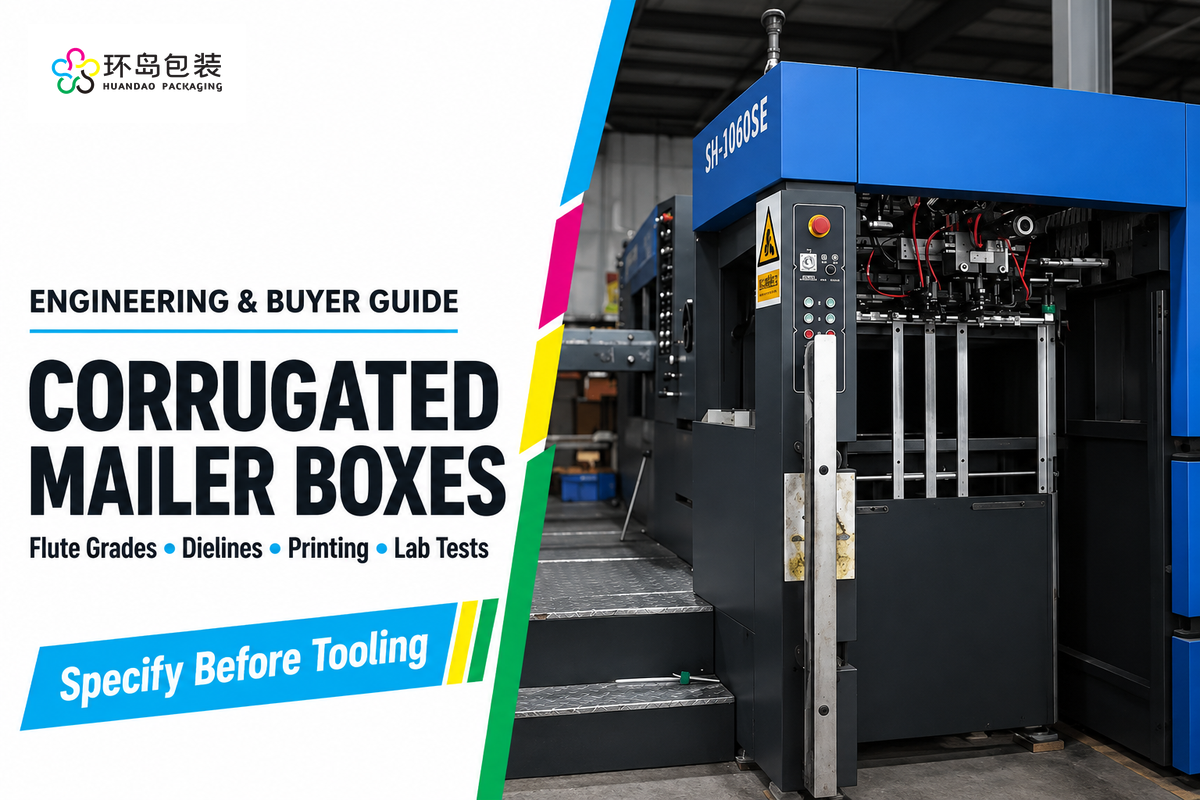
Custom corrugated mailer boxes are one-piece, die-cut corrugated fiberboard containers classified under FEFCO 04xx folder-type codes, such as FEFCO 0427, FEFCO 0426, and FEFCO 0421, which fold from a single blank to enclose the payload, with side-wall folds and lid closures that vary by design. Packaging engineers use corrugated mailer boxes for e-commerce parcels and retail kit and subscription shipments to provide edge-crush protection and two-sided graphics, when the packed product and closure are validated for the parcel route.
Brand managers and procurement personnel who order custom packaging tend to choose a mailer box by outer dimensions and surface graphics, disregarding flute caliper, double wall fold allowances and carrier dimensional weight rules. When a die-cut blank is laid out without accounting for the board thickness consumed at the roll-end, internal inserts buckle on the packing table and lids pop open on automated parcel conveyors. This engineering and buyer guide provides insight into structural FEFCO geometries, a five-gate specification sequence, flute and linerboard selection, flexographic versus litho-laminated offset and digital printing, custom inserts, laboratory verification, and factory auditing so you can create custom packaging that survives parcel transit on the first run.
Key Engineering Takeaways for Custom Corrugated Mailer Box Buyers
- Compared with single-ply paperboard boxes, corrugated mailers (FEFCO 0427, 0426 and 0421) can ship directly through parcel networks when the packed product and closure pass the applicable test.
- Always specify a custom box by internal cavity dimensions (Length × Width × Depth) and calculate axis-by-axis board thickness allowances so double side walls and dust flaps do not bind or push the outer box into a higher dimensional weight tier (FedEx DIM divisor 139).
- For shorter runs, match direct flexo, litho-laminated offset or digital printing to the intricacy of the artwork and test shipping label adhesion on laminated or UV-coated lids, including an unvarnished knockout zone where needed.
- Bind batch acceptance to agreed job-run ECT, burst or ink-rub results, use ASTM D642 for finished-box compression if specified, reference ASTM D5264 for the agreed Sutherland rub method, and verify the complete pack under ISTA Procedure 3A when it matches the distribution route.
What Are Custom Corrugated Mailer Boxes and How Do FEFCO 0427, 0426, and 0421 Structures Work?
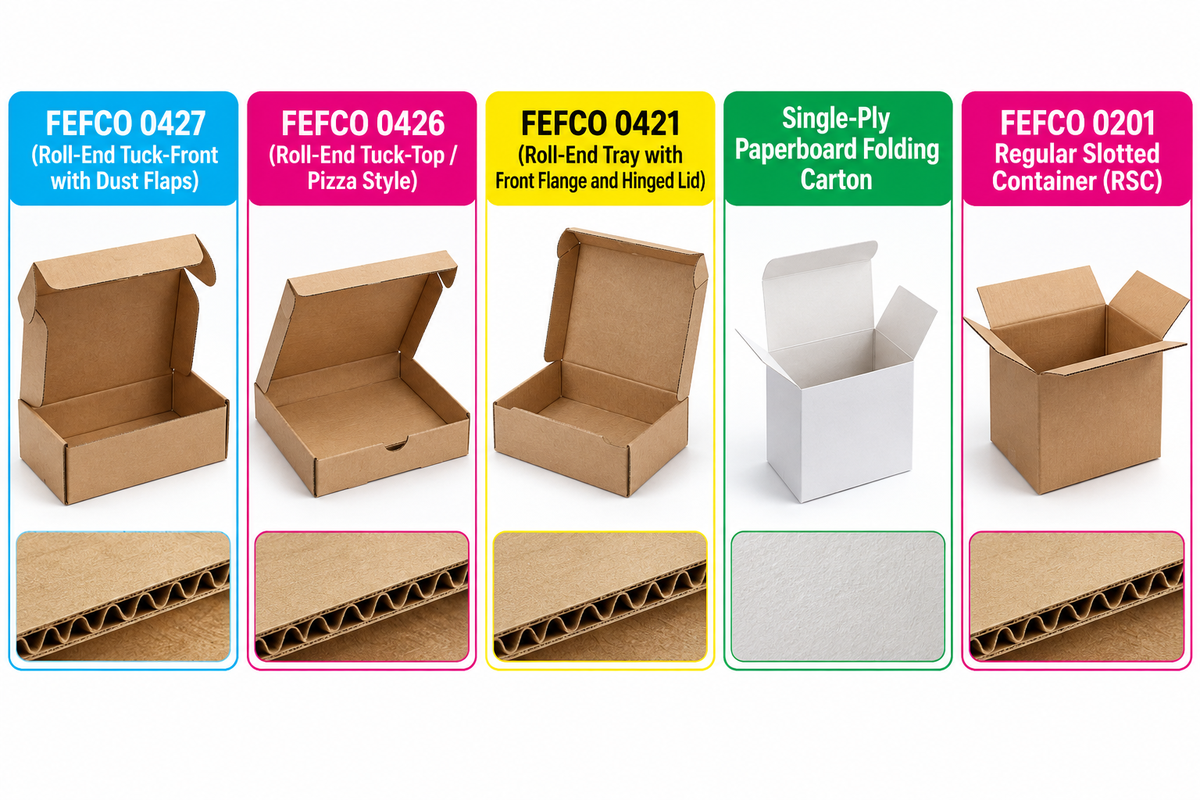
Custom corrugated mailer boxes are die-cut folder-type containers fabricated from fluted corrugated board that fold from a single flat blank into a tray with a hinged lid, with different closure details in FEFCO 0427, FEFCO 0426, and FEFCO 0421 to protect direct-to-consumer shipments when the box and closure are approved for the parcel route.
The FEFCO International Fibreboard Case Code defines folder-type boxes and trays of the 04xx series as typically having a single piece of board with the bottom hinged to form the side walls and cover, and which may have locking tabs, handles and/or display panels. Unlike a standard regular slotted container (RSC) shipping box that requires taped top and bottom flaps, or luxury rigid boxes and gift boxes that need a protective outer corrugated overbox for courier transit, a cardboard mailer acts as both the primary presentation box and the parcel shipping container. Those products that are packaged in a light-weight paperboard and sit on retail store shelves should be evaluated against our folding carton packaging guide to assess the suitability of single-ply board grades.
Single-wall corrugateds of the roll-end variety (FEFCO 0427, 0426 and 0421) should not be used in lieu of taped regular slotted containers (FEFCO 0201) or double-wall cartons when the packed sample fails the compression or transit requirements for its payload. As documented by Nuttall Packaging, to achieve a double-wall side construction of a FEFCO 0427 roll-end tuck-front box, there needs to be a precise board caliper allowance during flatbed die-cutting to provide for a side dust flap. For e-fulfillment, mailer boxes come with different locking side panels, so check how the box style and custom packaging style affect the mailer dimensions and vertical stacking.
The FEFCO International Fibreboard Case Code defines 04xx folder-type boxes and trays including 0421, 0426, and 0427 roll-end structures and inside dimension measurement conventions.
What is the difference between FEFCO 0427 and FEFCO 0426 mailer boxes?
FEFCO 0427 is a roll-end tuck-front mailer whose hinged lid has side dust flaps that fold and tuck into the side walls, and the front tuck engages the front wall, while FEFCO 0426 also has a hinged lid with side flaps, so compare the two official front-closure drawings and approve the converter’s dieline.
| Structural Format | Locking & Wall Mechanics | Side-Wall Layer Count | Unfolded Blank Consumption | Primary E-Commerce & Retail Application |
|---|---|---|---|---|
| FEFCO 0427 (Roll-End Tuck-Front with Dust Flaps) | Base side walls roll over to lock into bottom slots, and the hinged lid has side dust flaps and a front tuck | Double-folded side walls plus internal lid dust flaps (3 layers at side corners) | Higher blank area due to full roll-end side wings and lid dust flaps | Direct-to-consumer parcel mailers, subscription boxes, cosmetics, electronics, fragile kits |
| FEFCO 0426 (Roll-End Tuck-Top / Pizza Style) | Front and side tray walls fold up from base; hinged lid tucks directly into the front tray channel | Check the double-folded front wall and side flap overlap on the approved drawing | Moderate blank area; nests efficiently on master corrugated sheets | Apparel mailers, flat literature kits, shallow baked goods, low-profile e-commerce parcels |
| FEFCO 0421 (Roll-End Tray with Front Flange and Hinged Lid) | Side walls fold up from the base and the hinged top cover closes with a front flange | Verify the folded side walls and front closure on the approved sample | Moderate to high blank area depending on depth-to-width ratio | Heavy retail kits, boxed footwear, industrial spare parts, multi-item promotional boxes |
| Single-Ply Paperboard Folding Carton | Pre-glued longitudinal side seam with reverse tuck, straight tuck, or auto-lock bottom flaps | Single layer of solid paperboard (no corrugated flute medium) | Lowest blank area; multi-up nesting on sheetfed offset presses | Primary retail shelf display; check whether courier transit requires an outer shipping box |
| FEFCO 0201 Regular Slotted Container (RSC) | Factory-glued manufacturer’s joint; four top and four bottom flaps sealed with packing tape | Single wall (or double wall) on all four vertical panels | Most economical blank area per cubic liter of internal volume | Bulk wholesale master cartons, heavy freight, and warehouse pallet distribution |
Follow the 5-Gate Corrugated Mailer Engineering Sequence Before Locking Dielines
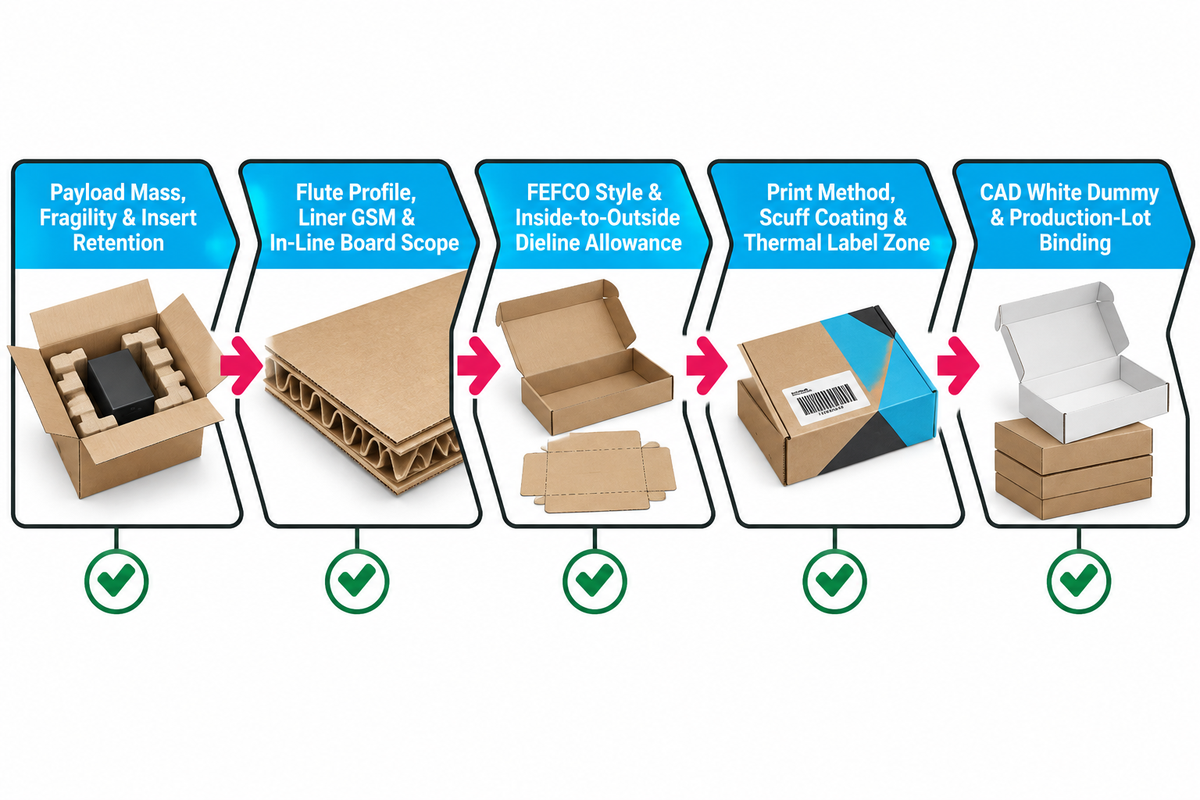
Dust-flap binding can be prevented by executing the 5-Gate Corrugated Mailer Engineering Sequence in strict order: lock payload and insert geometry first, select flute profile and linerboard second, calculate FEFCO inside-to-outside allowances third, specify print and label zones fourth, and assess CAD samples and job-run lab tests fifth.
When designing your custom mailer, confirm board caliper and insert clearances before the box is made to the custom design, or the finished side walls can pinch the insert or bow outward. The 5-Gate Corrugated Mailer Engineering Sequence allows teams to create packaging and custom-designed boxes, where every structural dependency is resolved before cutting dies or printing plates are ordered.
5-Gate Corrugated Mailer Engineering Sequence
- Gate 1 — Payload Mass, Fragility & Insert Retention: Measure your product dimensions in millimeters, weigh the full kit, and define whether a corrugated cradle, divider, or molded tray is needed to immobilize items inside the box.
- Gate 2: Flute Profile, Liner GSM & In-Line Board Scope: Determine flute profile (E-Flute, B-Flute, F-Flute, or EB double-wall) and the inner/outer liner board basis weight (gsm), and judge whether the plant corrugates the flute in-line or uses sourced board.
- Gate 3 — FEFCO Style & Inside-to-Outside Dieline Allowance: Lock the FEFCO structure (0427, 0426, or 0421) from internal cavity dimensions and add axis-specific board thickness allowances and confirm the spacing between adjacent creases with the converter on a folded sample (BioResources).
- Gate 4: Print Method, Scuff Coating & Thermal Label Zone: Match the method of print (Direct Flexo, Litho-lam Offset or Digital) to the artwork LPI and order quantity, and test a coating-free knockout zone if the shipping label needs one.
- Gate 5 – CAD White Dummy & Production-Lot Binding:
Test fit an unprinted CAD-cut sample on the actual production board and check the force needed to close the folds, approve a printed proof, and bind batch release to job-run ECT, burst, and ink-rub lab reports.
In a hypothetical specification scenario, a direct-to-consumer skincare brand used an online design tool to create a custom box design around a 200 mm × 150 mm × 60 mm cosmetic kit before choosing between E-flute and B-flute corrugated cardboard. When the converter switched the order to B-flute for extra drop cushioning without recalculating Gate 3, the double-folded FEFCO 0427 side walls consumed an assumed extra 6 mm of internal width, crushing the paperboard insert tray. Re-running the 5-Gate Corrugated Mailer Engineering Sequence from Gate 1 through Gate 3 restored proper insert clearance while keeping the outer box under the next parcel dimensional weight tier.
How to Choose Flute Profiles (E, B, F, EB) and Calculate Inside-to-Outside Dieline Tolerances
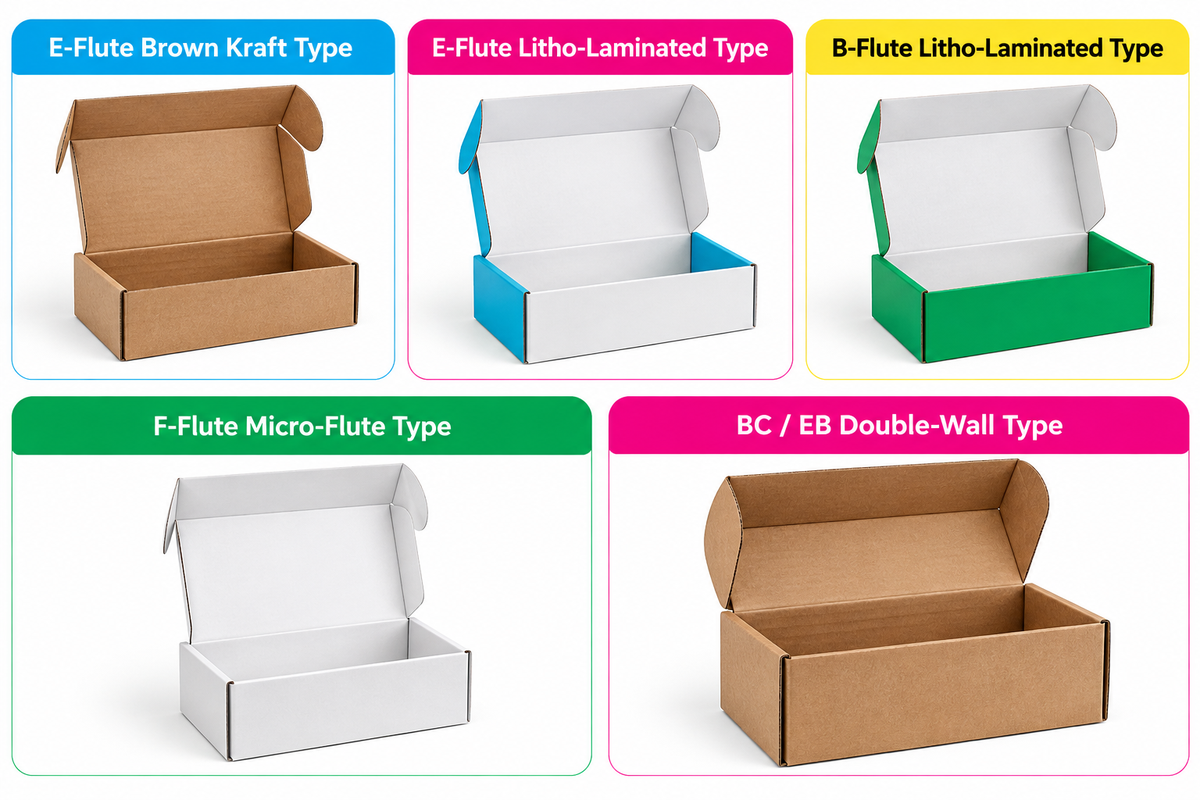
For high-resolution packages requiring sharp folds, start by sampling E-flute for e-commerce mailers. Trial B-flute for cushioning, F-flute for lighter retail-style payloads, and EB double-wall for heavier kits. Be sure to add the appropriate wall thickness in your inside dimensions when designing side walls to be double folded.
Refer to the Fibre Box Association (FBA) for information on standard corrugated flute profiles, which include A, B, C, E, and F flutes. Quoting nominal flute letters (E-flute or B-flute) doesn’t ensure equivalent edge crush strength or fold tolerances. Xiamen Huandao Packaging Technology Co., Ltd. also states an in-line corrugator at their Xiamen facility can provide single-wall E-flute and B-flute boards to the job specification, while other profiles are made from sourced board. Pairing virgin kraft, mottled white kraft, or clay-coated newsback (CCNB) top sheets with in-line E-flute or B-flute medium allows engineers to customize structural stiffness without overbuilding the package.
How do you measure inside vs outside dimensions on a roll-end corrugated mailer box?
Always measure a roll-end corrugated mailer box by its usable inside cavity dimensions in the sequence Length × Width × Depth, using the approved drawing axes and its longer and shorter opening sides, because FEFCO 0427 double-folded side walls and lid dust flaps add multiple board thicknesses to the external width and length.
When you customize the size of a FEFCO 0427 mailer, every 180° roll-end fold consumes board caliper along the width and length axes. According to the Paperboard Packaging Council (PPC), North American board basis weight is calculated in pounds per 1,000 sq ft (lb/MSF) or pounds per 3,000 sq ft (lb/3MSF), while optical brightness measures reflectance at 457 nm, and ISO 5628:2019 specifies two-point, three-point, and four-point bending stiffness test methods. As documented in the Iggesund Paperboard Manual, creasing rule width and counter-die groove width vary with solid-paperboard thickness and folding direction; in addition, BioResources discusses how coating fracture relates to folding force, so verify parallel creases on the actual double-wall tray corners at the intended fold angle. Moreover, external box dimensions directly govern parcel freight billing: FedEx calculates dimensional weight by multiplying outside package length × width × height and dividing by the carrier dimensional divisor of 139 cubic inches per pound, meaning an oversized outer box increases shipping costs even when the product is light.
| Flute Type & Category | Structural Role & Arch Geometry | Linerboard & Medium Pairing | Creasing & Folding Profile | Supply Scope & Target Mailer Application |
|---|---|---|---|---|
| E-Flute Brown Kraft Type | Fine micro-flute profile; high flute count per linear foot for flat surface crush resistance | Virgin brown kraft outer and inner liners (lb per 1,000 sq ft basis) over corrugated medium | Crisp 180° roll-end folds with crease separation matched to the selected board | Supplied just in time via Huandao in-line corrugator; standard e-commerce mailer boxes |
| E-Flute White Kraft Type | Fine micro-flute profile with bleached white kraft print face (457 nm brightness target) | Mottled or bleached white kraft outer liner over natural kraft inner liner | Clean 180° folding; supports direct flexo or digital print with minimal washboarding | Supplied just in time via Huandao in-line corrugator; skincare, wellness, and retail kits |
| E-Flute Litho-Laminated Type | Offset-printed coated paperboard top sheet laminated to single-face E-flute medium | Coated SBS/FBB/CCNB top sheet over E-flute | Coating penetration can increase folding force in MD and CD, so confirm the moisture and crease settings on the selected coated board | In-line E-flute corrugated and laminated in-house at Huandao; cosmetic and prestige D2C mailers |
| B-Flute Brown Kraft Type | Medium structural flute; thicker arch profile is a candidate for cushioning and stacking trials | Heavy virgin brown kraft outer and inner liners with rigid fluting medium | Use creasing rules and double-wall score channels matched to board caliper | Supplied just in time via Huandao in-line corrugator; heavier subscription boxes and hardware |
| B-Flute Litho-Laminated Type | High-graphic offset top sheet bonded to shock-absorbing single-face B-flute medium | Coated paperboard print sheet laminated to in-line B-flute corrugated board | Combines detailed offset graphics on B-flute board, with separate vertical edge crush and ISTA packaged-product testing | In-line B-flute corrugated and laminated in-house at Huandao; electronics and glass jar mailers |
| F-Flute Micro-Flute Type | Ultra-thin micro-flute bridging single-ply folding cartons and standard E-flute mailers | Litho-laminated coated paperboard face bonded to fine F-flute medium | Folds compactly at 180° with crease spacing matched to the selected board while adding fluted cushioning | Produced from sourced board at Huandao; compact retail product box and apparel mailers |
| A-Flute / C-Flute Cushioning Type | Tall single-wall structural flutes engineered for vertical warehouse stacking and shock absorption | Kraft linerboards paired with high-arch C-flute or A-flute corrugated medium | Match counter-die groove width to the board thickness for clean 180° hinge folding | Produced from sourced board at Huandao; protective inner pads and outer master shipping boxes |
| BC / EB Double-Wall Type | Two fluted mediums bonded between three linerboards for heavy-duty multi-tier compression | Heavy kraft liners (lb per 3,000 sq ft basis) paired with dual fluted medium layers | Compare bending stiffness under four-point bending; suited for large boxes and heavy industrial kits | Huandao lists BC as sourced board, with buyers to confirm EB availability for heavy industrial kits and consolidated master cartons. |
Prior to locking custom dimensions to a FEFCO 0427 dieline, observe how each wall moves from an internal cavity size to an external shipping size:
| Dimension Axis | Internal Cavity Definition | Structural Layers Added in FEFCO 0427 | Engineering Dieline Rule | Impact on Fit & Lower Shipping Costs |
|---|---|---|---|---|
| Length (L, Left-to-Right) | Clear internal distance between the folded double side walls | Each side wall rolls over 180° to trap the lid dust flap inside a double-wall pocket | Separate parallel double-wall score lines to suit the full compressed board caliper (confirm score line spacing on a folded sample, see BioResources) | Prevents side walls from pinching internal inserts or bowing outward during locking |
| Width (W, Front-to-Back) | Clear internal distance from inside back hinge wall to inside front wall | Back wall plus front wall and tuck-in lid lip | Trim side dust-flap length slightly short of internal width so flaps swing past the front wall without binding | Eliminates lid pop-open and speeds manual packing on high-volume fulfillment lines |
| Height / Depth (D, Top-to-Bottom) | Clear vertical cavity between inside bottom tray floor and closed inside lid panel | Bottom base panel plus top hinged lid panel and internal insert tray floor | Include insert base thickness in vertical cavity height before checking external cubic volume against the 139 DIM divisor | Right-sizing box size avoids crossing dimensional weight brackets and helps lower shipping charges |
DO: Corrugated Mailer Dieline & Flute Controls
- Give internal cavity dimensions (L x W x D) first and have a CAD dieline created with the exact flute profile (E-flute vs B-flute) before placing artwork (FEFCO).
- Clearance between adjacent score lines, creasing rules and grooves should be matched to the board caliper and verified on the approved folded sample (Iggesund).
- Orient corrugation flutes parallel to the vertical depth axis on the front and back walls whenever pallet or parcel stacking compression is the primary hazard.
DON’T: Common Mailer Dieline Mistakes
- Do not change a dieline from E-flute to B-flute without checking the rollover score channels on the thicker board, since score spacing affects liner folding and closure fit (Lanco Adhesives).
- Don’t sanction mass production from a hand-cut die until you have verified the flatbed steel-rule die compression and litho-lamination moisture balance using the proposed production board and finishing process.
- Do not leave excess headspace inside cardboard mailer boxes; as 2026 mailer packaging design analyses note, right-sizing can reduce void fill and dimensional weight, depending on the finished dimensions and applicable rate.
Compare Direct Flexo, Litho-Laminated Offset, and Digital Printing for Custom Printed Mailer Boxes
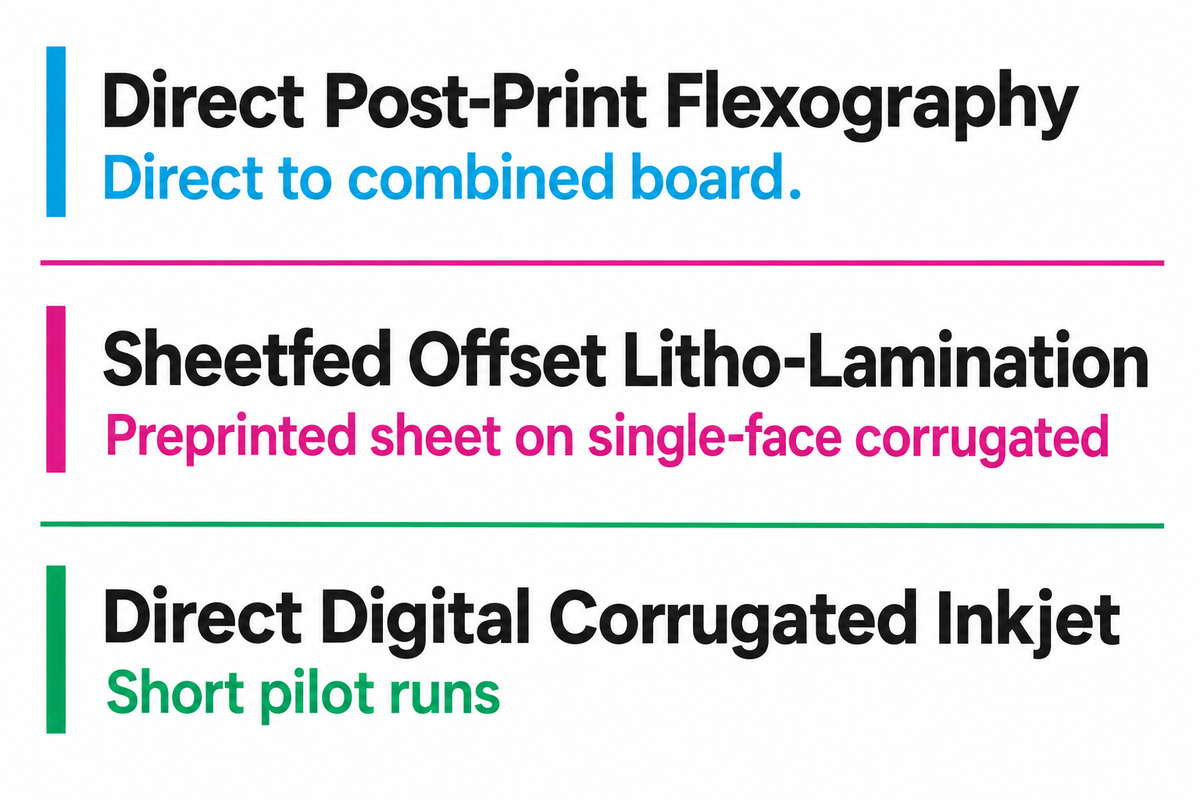
Use direct flexographic printing for high-volume 1-to-3 color kraft mailers, sheetfed offset litho-lamination for photographic CMYK and Pantone brand graphics, or digital inkjet for low-volume pilot runs, and check finished-pack recyclability and whether the selected thermal shipping label needs an unvarnished zone.
As stated by Packaging Corporation of America (PCA), direct flexo and digital printing apply ink to combined board, while offset litho-lamination applies a preprinted sheet to single-face corrugated. For brands opting for custom printed boxes and custom printed mailer boxes with two-sided graphics, such as a clean courier-ready exterior and a colorful message printed inside, on the lid, the converting process determines both unit cost and fidelity to graphics. As stated by Packaging Digest, litho-laminating an offset-printed paperboard top sheet onto corrugated flute board, sharpens graphics, and eliminates flexo flute washboarding. Xiamen Huandao Packaging Technology Co. Ltd. reports in-house pre-press, sheetfed offset, UV coating, lamination, die-cutting, and folder-gluing all under the same roof, with the artwork and finish approved for the job (see BioResources for how converting affects paperboard coatings).
According to the 4evergreen Circularity by Design Guideline for Paper-Based Packaging (Version 4, February 2026) and OPRL recyclability guidance, check how water-based aqueous coatings affect repulping and whether the local curbside paper stream accepts the finished cardboard packaging. Check full-surface plastic film laminations separately.
Should custom mailer boxes use aqueous coating, UV coating, or film lamination for shipping durability?
For custom mailer boxes, trial an inline water-based aqueous coating and test the finished box for parcel conveyor rub resistance, recyclability and thermal shipping label compatibility, and compare UV coating or film lamination when dark flood-printed artwork needs more protection, testing an unvarnished label knockout zone if needed.
| Printing & Coating Route | Screen Ruling & Graphic Fidelity (PCA) | Tooling & Setup Economics | Inside & Outside Two-Sided Printing | Scuff Protection & Recyclability (4evergreen) |
|---|---|---|---|---|
| Direct Post-Print Flexography | Often suitable for bold vector logos, line art, and 1 to 3 spot Pantone colors on brown or white kraft | Requires flexible photopolymer printing plates per color; lowest unit cost at medium-to-high volume | Economical 1 to 2 color interior logo or pattern via two-pass or inline top/bottom flexo stations | Uses water-based inks and inline aqueous varnish; check whether the finished box is curbside recyclable in local corrugated streams |
| Sheetfed Offset Litho-Lamination | Suited to photographic CMYK gradients, Pantone solids and fine typography | Uses aluminum CTP offset plates plus single-face lamination setup; ideal for high-quality custom retail mailers | Supports full-color offset exterior laminated to printed or colored inner linerboard | Pairs with inline aqueous, spot/flood UV, or matte/soft-touch lamination (knock out shipping label zone) |
| Direct Digital Corrugated Inkjet | High-resolution CMYK drop-on-demand without halftone plates; variable data and multi-SKU artwork | Zero printing plate fees; higher ink cost per square meter makes it ideal for short pilot runs and sample boxes | Can print both sides in two digital passes, though double-sided ink coverage increases per-unit price | Compatible with aqueous overprint varnish; avoids plate waste on seasonal or test campaigns |
In a hypothetical transit failure scenario, an apparel brand requested printed mailer boxes with a deep matte-black offset flood coat and full surface silicone-modified UV varnish on the top lid. When order fulfillment staff affixed direct-thermal courier labels for expedited shipping, the low surface energy of the UV varnish could cause the labels to peel off in sorting chutes, while tight 180 degree folds (where coating penetration can increase folding force in MD and CD) showed white fiber cracking. Trial an inline satin aqueous coating with a dedicated unvarnished label window, then test label adhesion and score cracking on the actual board and coating.
Engineer Custom Corrugated Inserts, Dividers, and Application-Specific Parcel Protection
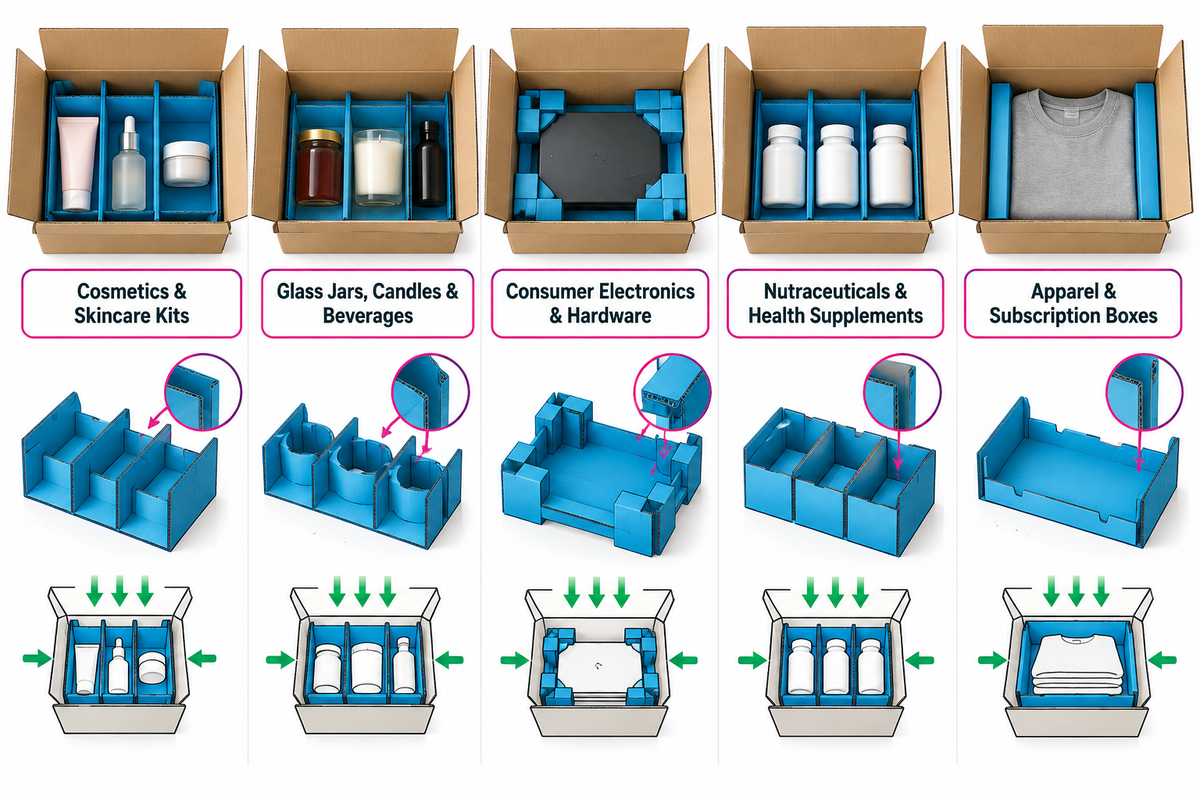
Lock internal product retention by engineering die-cut corrugated cradle inserts, interlocking cell dividers, or molded fiber trays to the exact internal cavity dimensions of the outer mailer box to limit the movement of fragile items during parcel drops (up to 150 lb. or 70 kg for eligible ISTA 3A parcels) without loose plastic void fill.
For glass dropper bottles, ceramic jars or multi-part electronics, the outer mailer wall does not prevent collisions between components inside the box. As Atlas Container indicates, custom corrugateds and dividers have to be designed to the inner-cavity of the mailer box to control movement and tolerance stack-up. If a buyer orders the outer mailer from one converter and sources custom inserts from a second workshop, dimensional drift between E-flute and B-flute caliper causes the insert tray to buckle or rattle instead of helping protect your products during shipping. If your custom product kit combines primary paperboard packaging boxes inside mailer and shipping boxes, you can align both dielines with our custom folding carton packaging engineering specifications.
According to Xiamen Huandao Packaging Technology Co., Ltd., as part of Huan Yin Packaging Group, Huandao is able to supply inner trays, inserts and outer shipping cartons along with printed boxes of the same product and consolidate them in a single shipment with shared freight subject to the project quotation. Designing the product packaging, inner insert cradle and outer master shipper on a single CAD system lets you check how each retention cell fits against the inner walls of the mailer on a folded sample.
| E-Commerce Vertical | Primary Parcel Transit Hazard | Recommended Mailer Flute & FEFCO Style | Internal Insert Architecture | Drop & Scuff Protection Principle |
|---|---|---|---|---|
| Cosmetics & Skincare Kits | Glass dropper breakage, pump actuation, and carton rub marks | Litho-laminated E-flute FEFCO 0427 with inside printing | Die-cut E-flute cradle tray with stepped neck-retention cutouts | Suspends glass base off the mailer walls while locking bottle shoulders |
| Glass Jars, Candles & Beverages | Bottom impact fracture and glass-to-glass collision in multi-packs | In-line B-flute or EB double-wall FEFCO 0427 / 0421 | Full-height interlocking B-flute cell partitions plus top/bottom buffer pads | Isolates each jar in an independent crush cell with perimeter air-gap crumple zones |
| Consumer Electronics & Hardware | Corner shock transmission to circuit boards and heavy cable abrasion | Litho-laminated B-flute FEFCO 0427 with aqueous or matte lamination | Dual-compartment folded corrugated platform separating device from charger brick | Check product movement and corner damage on the packed sample under ISTA 3A |
| Nutraceuticals & Health Supplements | Bottle cap backing off under vibration and label scuffing | E-flute or B-flute FEFCO 0427 with tamper-evident tear strip | Die-cut corrugated collar grid holding bottles upright or horizontal | Prevents axial rotation and cap contact during parcel conveyor vibration |
| Apparel & Subscription Boxes | Lid pop-open, moisture ingress, and dimensional weight creep | E-flute FEFCO 0426 or 0427 right-sized to folded garment stack | Zero insert or lightweight paperboard belly band with tissue wrap | Minimizes external cubic volume against the 139 DIM divisor while keeping unboxing crisp |
What Drives Mailer Box Cost, Tooling, MOQ, and Production-Run Lab Verification (ECT, Burst, Ink-Rub, ISTA 3A)?

Mailer box unit price is driven by unfolded flat-blank square area, master-sheet nesting yield, linerboard GSM, and print pass count, while one-time cutting dies and printing plates govern minimum order quantity; check board and print quality with agreed job-run ECT, burst or ASTM D5264 ink-rub methods, then verify the finished pack with route-specific testing such as ISTA 3A where eligible.
Differences in unit prices for custom box orders, corrugated shipping boxes, and mailer boxes wholesale often stem from the presence or absence of blank dimensions and whether tooling costs are charged separately. A FEFCO 0427 blank has double-folded side wings and a lid with dust flaps, so its unfolded flat sheet is larger than its finished internal dimensions. Data and trends from the packaging industry covered in the Packaging Dive article and market research from Mordor Intelligence (valuing the US folding carton market at USD 10.63 billion in 2026 and forecasting a growth at a 7% CAGR to reach USD 14.91 billion in 2031), show that brands are focused on optimizing the yield of nesting folding cartons and mailers, including corrugated mailers.
Paper mill certificates are used to measure the unprinted liner and medium rolls prior to corrugation, litho-lamination, and flatbed die-cutting. Acceptance of a batch requires finished box samples from the actual production run and testing. Variables beyond the control of the paper roll manufacturers such as excessive roller crush during printing or improper adhesive moisture during lamination, can affect the finished box compression. Xiamen Huandao Packaging Technology Co., Ltd. has an onsite lab that issues ECT/burst, ink-rub, and basis weight tests, and numbers in the report are specific to the customer’s own production run. According to ISTA retesting guidance , tests need to be repeated with a change in the product, package or process.
What is the difference between 32 ECT and 200 psi burst test on corrugated mailer boxes?
The Edge Crush Test (ECT) measures the amount of vertical compressive force (in pounds per linear inch) that a standing edge of corrugated board can support, parallel to the flutes, for warehouse and parcel stacking. The Mullen Burst Test measures the hydraulic pressure (in pounds per square inch) needed to burst a flat specimen of corrugated board.
| Cost or Verification Category | Standard / Governing Parameter | What It Measures or Controls | Procurement & Quality Action Item |
|---|---|---|---|
| Unfolded Blank Area & Nesting Yield | Master sheet imposition (Pro Carton layout) | Square meters of corrugated board and top liner consumed per mailer | Refine non-critical flap geometry during CAD layout if it unlocks an extra blank per master sheet |
| Cutting Die & Plate Tooling | Flatbed steel-rule cutting die + CTP offset or flexo plates | One-time setup cost amortized across your minimum order quantity | Request itemized die and plate fees so repeat box orders only pay unit board and converting cost |
| Container Compression & Edge Crush (ECT) | ASTM D642-25 / TAPPI ECT | Compressive resistance of shipping containers and components, and edgewise compressive strength of corrugated board specimens | Require separate job-run ECT reports on converted board and finished-box compression results against the agreed targets |
| Bursting Strength & Liner Grammage | Mullen Burst & Basis Weight (lb per 1,000 sq ft / GSM) | Burst resistance of the corrugated board and actual fiber basis weight | Verify job-run burst and basis-weight reports from the manufacturer’s in-house laboratory |
| Printed Scuff & Rub Resistance | ASTM D5264-98(2019) Sutherland Rub Tester | Abrasion resistance of printed inks, aqueous varnishes, UV coatings, and laminates | Agree the dry or wet Sutherland rub method and acceptance criteria for dark exterior flood coats before shipment |
| Parcel Delivery Drop & Vibration | ISTA Testing (3A for eligible parcels, up to 70 kg or 150 lb) | Integrity and general simulation performance testing for individual packaged products | Validate fragile glass, cosmetic, or electronics mailer-and-insert kits under ISTA drop sequences |
How to Audit a Custom Corrugated Mailer Box Manufacturer and Consolidate Inner Inserts with Outer Cartons
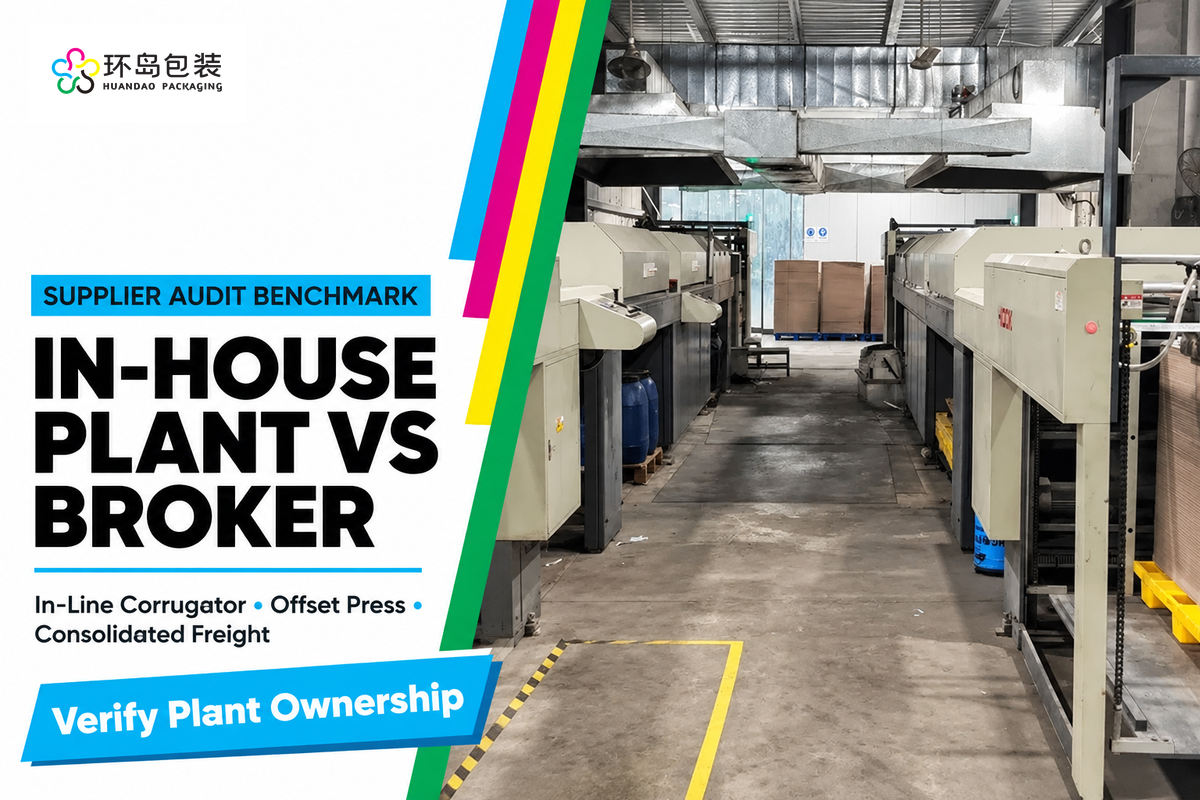
Audit potential suppliers against five operational proofs: in-line E-flute and B-flute corrugation, in-house sheetfed offset and lamination, lot-specific lab reports, real-time MES barcode tracking, and consolidation of inner printed mailers and outer shipping cartons at the group level, to eliminate broker markups and split freight.
Ask suppliers which factory corrugates the sheets, prints the graphics, and handles lamination and die-cutting for your custom corrugated boxes and packaging solutions. The Accurate Box process page describes how its own plant laminates printed sheets to corrugated board. If various workshops handle lamination and flatbed die-cutting, ask who controls board moisture, production dates and trucking for inner inserts and outer master cartons.
According to first-hand manufacturing info from Xiamen Huandao Packaging Technology Co., Ltd., potential buyers can gauge the following operational baseline:
- Reported Plant Ownership & Scale: According to Huandao, Xiamen Huandao Packaging Technology Co., Ltd. was founded in 2003 in Xiamen, Fujian, China, and operates its own manufacturing facility (not a trading office) at No. 587 Tongfu Road, Tong’an District, Xiamen, with 133 staff.
- Group Integration & Revenue Scale: According to Huandao, the company is part of Huan Yin Packaging Group, so confirm which colour-printing plant will handle your order and request evidence for any stated group revenue, National High-Tech Enterprise designation or Xiamen Printing Industry Association role.
- In-House Converting & In-Line E/B-Flute Corrugator: According to Huandao, the company has pre-press, sheetfed offset printing, UV coating, lamination, die-cutting and folder-gluing in-house, and has an in-line corrugator that provides E-flute and B-flute board to the agreed job specification. Other flute profiles are provided with sourced board.
- Job-Run Laboratory & Real-Time MES Kanban: According to Huandao, every process step is scanned in a real-time MES kanban integrated with an ERP and intelligent planning system. The company’s in-house laboratory issues ECT/burst and ink-rub test reports on the job itself, and thus the test reports belong to the customer’s production run.
- Consolidated Inner Inserts & Outer Shipping Cartons: According to Huandao, inner trays, custom inserts, printed mailers, and corrugated cardboard shipping boxes are all part of Huan Yin Packaging Group and can be supplied together in a consolidated shipment with shared freight when confirmed in the project quotation.
Engineering and procurement teams who want to place project dielines, request unprinted white dummies, or compare consolidated factory pricing with Huandao for custom corrugated mailer boxes can connect directly to the structural engineering team at Huandao on our commercial solution page.
| Audit Verification Dimension | Integrated In-House Plant (e.g., Huandao Packaging) | Sheet Plant / Trading Broker Subcontract Chain |
|---|---|---|
| Corrugation & Board Supply | In-line corrugator produces single-wall E-flute and B-flute board to the job specification; A, C, F, BC from sourced board | If it purchases corrugated sheets from external mills, ask how it controls warehouse humidity before die-cutting |
| Offset Printing, UV, Lamination & Die-Cutting | Pre-press, sheetfed offset, UV coating, lamination, die-cutting, and folder-gluing run under one roof (133 staff, Xiamen) | If it splits printing, laminating, and flatbed die-cutting among subcontractors, confirm each worksite and handoff |
| Laboratory Quality Evidence | In-house lab issues ECT/burst, job-specific ink-rub, and basis-weight reports measured on the customer’s own production run | Ask for converted box strength results as well as paper-mill reference sheets |
| Shop-Floor Traceability | Every converting step scanned into a real-time MES kanban backed by ERP and intelligent scheduling | Ask for subcontract status updates and a written approval process for board or liner substitutions |
| Inner Trays & Outer Master Cartons | Supplied across Huan Yin Packaging Group and available as one consolidated shared-freight shipment when confirmed in the project quotation | If separate vendors supply inserts and outer shipping boxes, ask who coordinates them and how freight fees are allocated |
Copy This Custom Corrugated Mailer Boxes Pre-Order Specification Checklist
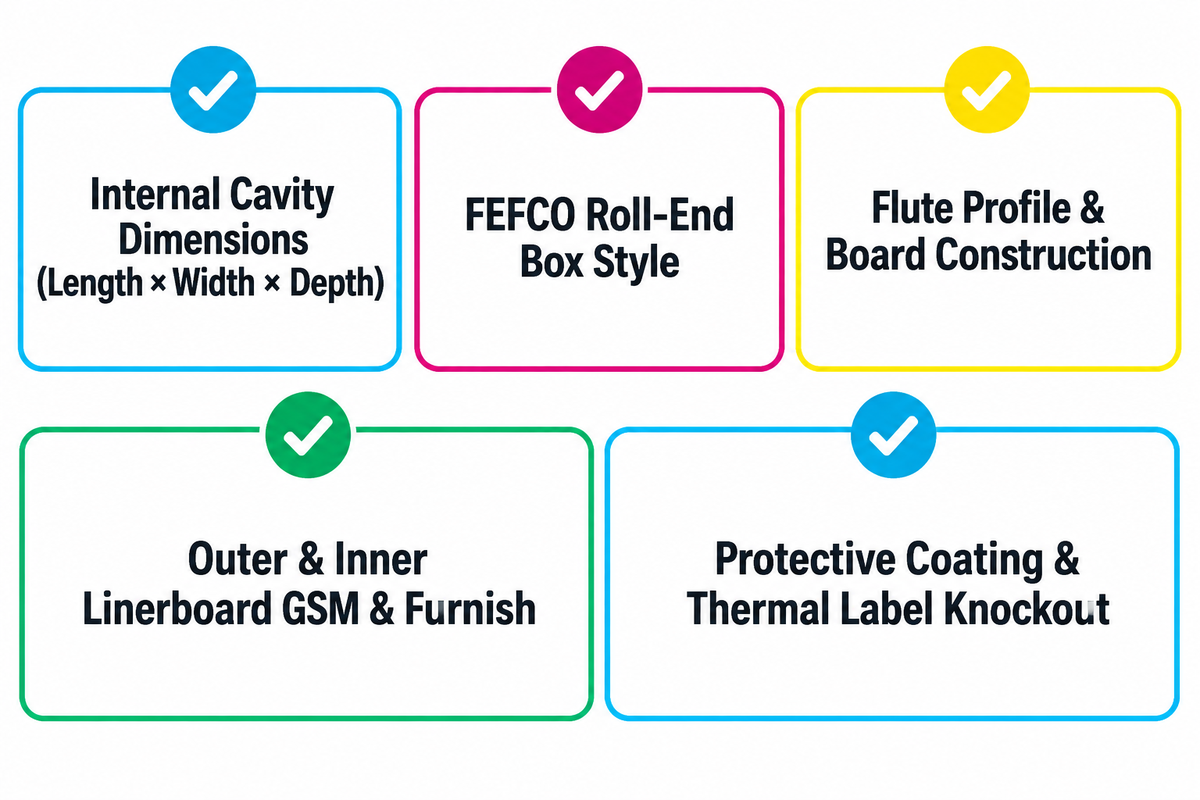
Use this 10-field engineering specification checklist to lock internal cavity dimensions, FEFCO roll-end style, flute profile, linerboard GSM, print process, coating and thermal-label knockout zones, internal insert geometry, CAD white-dummy sampling and its quoted timing, job-run lab reports, and master-carton consolidation before ordering mailer boxes.
You may be ordering mailer boxes for a new product launch, sourcing mailer packaging boxes and box products, and standardizing boxes and packaging across custom shipping boxes and retail SKUs. Sending an incomplete RFQ means suppliers have to guess board caliper and coating coverage. Copy and fill in the 10-field specification table below to align all product details and custom packaging needs before tooling begins:
| Field No. | Specification Parameter | Exact Engineering Input to Lock in Your RFQ | Why It Protects Quality & Unit Economics |
|---|---|---|---|
| 01 | Internal Cavity Dimensions (Length × Width × Depth) | Specify usable inside Length × Width × Depth in millimeters (never external nominal size). | Ensures FEFCO 0427 double side walls and dust flaps add caliper outward without pinching the payload. |
| 02 | FEFCO Roll-End Box Style | Specify exact code: FEFCO 0427 (tuck-front with side dust flaps), FEFCO 0426 (pizza-style), or FEFCO 0421, plus the closure and locking details from the approved drawing (FEFCO code). | Eliminates ambiguity around side-wall layer count, blank area, and manual assembly speed. |
| 03 | Flute Profile & Board Construction | Specify single E-flute or single B-flute (in-line corrugated) or sourced F-flute / EB double-wall, plus flute direction. | Matches vertical crush strength and fold crispness to payload mass and parcel stacking. |
| 04 | Outer & Inner Linerboard GSM & Furnish | State outer print liner (virgin brown kraft, white kraft, or litho-laminated SBS/CCNB) and inner liner basis weight in gsm. | Prevents suppliers from quoting low-grammage recycled liners that crack along 180° roll-end folds. |
| 05 | Print Method & Inside/Outside Coverage | Specify direct flexo, litho-laminated offset, or digital inkjet, and state exterior + interior color stations. | Aligns plate/laminator setup cost with order volume and two-sided unboxing graphics. |
| 06 | Protective Coating & Thermal Label Knockout | Specify inline aqueous varnish, spot/flood UV, or matte/soft-touch lamination, plus an unvarnished courier label window if the finished-surface adhesion trial calls for one. | Check scuff resistance under ASTM D5264 rub testing and check separately whether the selected thermal shipping labels stay attached on the finished surface. |
| 07 | Internal Insert & Partition Architecture | Specify die-cut E/B-flute cradle insert, interlocking divider grid, or molded pulp tray engineered on the same CAD file. | Eliminates cross-vendor tolerance stack-up and immobilizes fragile items without plastic bubble wrap. |
| 08 | Prototype & Proof Approval Sequence | Require (1) unprinted CAD white dummy at the agreed lead time on exact production flute/GSM and (2) wet offset proof at the quoted lead time prior to mass run. | Verifies cherry-lock tension, insert fit, and brand color before cutting flatbed production dies. |
| 09 | Production-Run Laboratory Test Binding | Request job-specific lab reports for the agreed ECT, burst, ink-rub or basis-weight checks, use ASTM D642 for box compression if specified, use ASTM D5264 for the agreed ink-rub method, and use separate finished-pack ISTA testing when it matches the intended parcel route. | Checks whether the actual converted production batch meets agreed test specs and tracks finished-pack transit separately. |
| 10 | Master Carton Consolidation & Pallet Spec | Specify flat-packed bundle count, moisture barrier wrap, and consolidated shipping of inner trays, mailers, and outer shipping cartons. | Cuts LCL/FCL freight cost by combining all packaging components into one scheduled shipment. |
Frequently Asked Questions About Custom Corrugated Mailer Boxes
What is the minimum order quantity (MOQ) for custom corrugated mailer boxes?
The minimum order quantity depends on the converting and printing route, and Huandao lists 1,000 pieces per size and style as its standard MOQ. For smaller pilot runs, ask the supplier to quote digital inkjet production without printing plates. Direct litho and flexo become cost effective once the amortization of the printing plates, flatbed dies and laminator are spread across the production run.
Can custom corrugated mailer boxes be printed on both the inside and outside?
Two-sided printing on roll-end corrugated mailers offers a branding advantage as an unbleached, or flood-printed exterior can be used for transit parcel, and an interior high-impact printing, or message can be used for unboxing. In production, two-sided graphics require either a second press pass or pre-printing the inner liner before corrugation and lamination, which adds plate setup and registration control steps.
Are custom printed corrugated mailer boxes curbside recyclable?
Corrugated board mailer boxes with kraft or recycled fiber liners can be printed with water-based flexo inks or vegetable-based offset inks. Check whether the local paper recovery stream accepts the finished box with its inline aqueous varnish. Full-surface plastic film laminations and metallic foil coverings, especially exceeding fiber-repulping thresholds, should be avoided in accordance with the 4evergreen and UK Recycling Assessment Methodology guidelines.
Do FEFCO 0427 mailer boxes need packing tape for parcel shipping?
FEFCO 0427 mailers assemble without tape when their folded side walls and lid closure hold the tray rigid. In a courier parcel network, using a single peel-and-tape adhesive strip, or a paper tape, can help secure the lid of the tray, preventing it from opening during sorting.
How do I prevent crease cracking on dark flood-printed corrugated mailers?
Sharp 180-degree reverse fold lines, particularly on long panel sections, can easily lead to crease cracking. Crease cracking occurs when heavy ink coverage, brittle UV varnish, or low-moisture linerboard stretches across sharp 180-degree roll-end folds. Prevent cracking by specifying virgin kraft or long-fiber bleached outer liners for dark flood coats, aligning corrugation flute direction perpendicular to the main load-bearing fold, knocking out heavy UV coating along score lines, and running pre-creasing rules matched to the exact board caliper during flatbed die-cutting.
When should I approve a CAD white dummy versus a printed production proof?
Always approve an unprinted CAD-cut white dummy on the real production flute and liner first to ensure the fit of the product, especially the clearances for inserts, and dust-flap locking. Lock the brand colors by signing off on a wet offset proof or a digital color drawdown.
References & Sources
- FEFCO International Fibreboard Case Code (04xx Folder-Type Boxes & Inside Dimension Conventions) — European Federation of Corrugated Board Manufacturers (FEFCO)
- Standard Corrugated Flute Profiles Reference (A, B, C, E, F Flutes) — Fibre Box Association (FBA)
- ASTM D642-25: Standard Test Method for Determining Compressive Resistance of Shipping Containers, Components, and Unit Loads — ASTM International
- ASTM D5264-98(2019): Standard Practice for Abrasion Resistance of Printed Materials by the Sutherland Rub Tester — ASTM International
- ISTA Procedure 3A: Packaged-Products for Parcel Delivery System Shipment 150 lb (70 kg) or Less — International Safe Transit Association (ISTA)
- When Should a Packaged-Product Be Retested? — International Safe Transit Association (ISTA)
- Converting and Its Effects on Barrier Properties of Coated Packaging Materials: A Review — North Carolina State University (NCSU) BioResources
- Paperboard Manual: Die-Cutting and Creasing Rule & Counter-Groove Geometry — Holmen Iggesund
- More Than Ink on Paper: Flexographic, Litho-Lamination, and Digital Corrugated Printing — Packaging Corporation of America (PCA)
- What Is Dimensional Weight and How to Calculate It (Divisor 139) — FedEx
- Circularity by Design Guideline for Fibre-Based Packaging (Version 4, February 2026) — 4evergreen Alliance
- Litho-Laminating Gives Corrugated Cartons an Enhanced Image — Packaging Digest
- Paperboard and Corrugated Packaging Demand Trends 2025–2026 — Packaging Dive
- US Patent US8408451B2: Reclosable folding box with tamper-evident closure without adhesive — United States Patent and Trademark Office (Google Patents)