Get in Touch with Xiamen Huandao Packaging Technology Co., Ltd.

Updated November 2026
Food packaging boxes are engineered paperboard, corrugated fiberboard, or rigid board structures designed to hold, protect, display, and transport food across takeout, cold-chain, bakery, and retail channels. Selecting the right packaging solution requires matching board grade (10 to 36 pt folding cartons or 0.8 to 4.0 mm corrugated flutes) and PFAS-free barriers to the food’s temperature and oil load. Buyers must also align every component with applicable US FDA or EU migration rules.
Purchasing food boxes and packaging solely on unit price can cause failures in the field. Takeout food becomes soggy. Grease bleeds through folds and creases, and pallets collapse in high-humidity cold storage. This guide explains packaging boxes, primary and secondary legal and regulatory barriers, and specs of folding cartons, fluted board, offset printing and test methods. This guide walks packaging buyers and brand teams through box structures, primary versus secondary regulatory boundaries, paperboard and flute specs, laboratory test standards, and wholesale offset procurement mechanics.
Quick Specs: Food Packaging Boxes Engineering Baseline
| Folding Carton Caliper | 10 to 36 pt (0.25 to 0.91 mm) full converting range (common food grades 12 to 30 pt across SBS, FBB, CUK, and CRB) |
| Corrugated Food Flutes | F-flute (~0.8 to 1.0 mm), E-flute (~1.5 to 1.6 mm), B-flute (~3.0 mm), C-flute (~4.0 mm) |
| Rigid Food Gift Board | 36 to 120 pt (0.91 to 3.05 mm) non-bending chipboard with printed wrap |
| Core US & EU Compliance | US 21 CFR 176.170 / 176.180 / 175.105, 90 FR 653 (PFAS); EU 1935/2004, 2023/2006, PPWR 2025/40 (applied Aug 12, 2026) |
| Cold-Chain Operating Band | USDA FSIS freezer guidance <= 0 °F (-18 °C); refrigerator guidance <= 40 °F (4 °C); fiber compression drops above 30% RH |
| Reference Offset MOQ (Huandao) | Standard MOQ is 1,000 pieces per size and style; smaller runs are quoted case by case |
What Are Food Packaging Boxes and Which Box Types Fit Each Use Case?
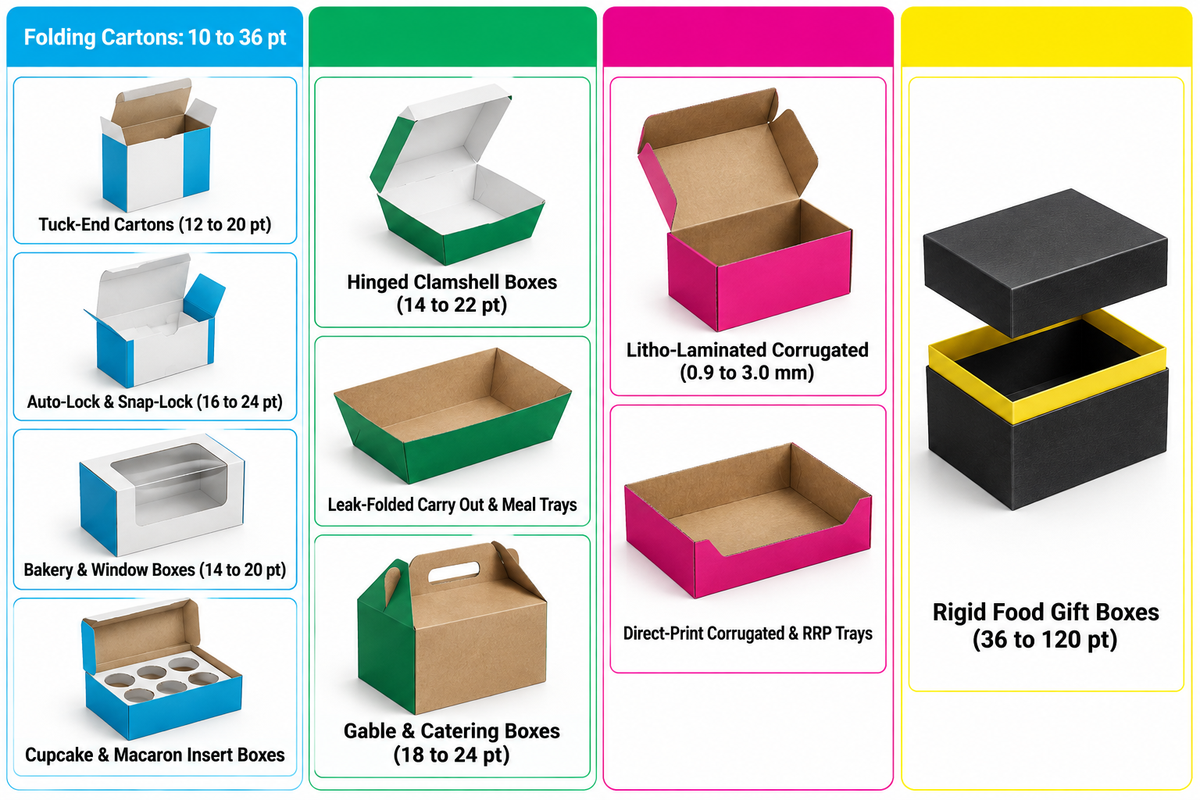
Food packaging boxes include paperboard folding cartons (10 to 36 pt), fluted corrugated and litho-laminated boxes (0.8 to 4.0 mm single-wall), and rigid set-up gift boxes (36 to 120 pt), while foodservice carryout designs include clamshell food packs and windowed bakery boxes.
Often, first-time buyers specify a general “food box,” which can yield mismatched quotes for a thin folding carton proposed for hot food delivery meals that need a leak-folded carryout tray. Matching structural class to your exact packaging needs first prevents tooling revisions and clarifies primary versus secondary contact scope. For an intersectoral overview before focusing on food, see our sector packaging specification guide.
| Box Type / Category | Typical Wall / Board | Closure & Assembly | Best Food Applications |
|---|---|---|---|
| Straight & reverse tuck-end cartons | 12 to 20 pt SBS, FBB, or CRB | Top and bottom friction tuck flaps; flat-packed | Dry snacks, tea, cereal, retail candy, bagged crackers |
| Auto-lock & snap-lock folding cartons | 16 to 24 pt SBS, FBB, or CUK | Pre-glued crash-lock or manual 1-2-3 interlocking floor | Heavier frozen entrees inside inner trays, jarred sauces, dense baking mixes |
| Hinged clamshell food boxes | 14 to 22 pt coated kraft or SBS; F-flute or E-flute | One-piece hinged lid with interlocking front tab and steam vents | Take out boxes for burgers, fried foods, sandwiches, grab-and-go |
| Leak-folded carry out boxes & meal trays | 14 to 22 pt barrier-coated kraft or SBS | Gusseted web corners with folding top flaps | Saucy rice bowls, noodles, meal prep, warm restaurant takeout |
| Gable boxes & catering boxes | 18 to 24 pt SBS/kraft or 1.5 mm E-flute corrugate | Integral top gable handle with pop-up auto-lock floor | Catering lunch boxes, stackable lunch boxes, boxed meals, bakery party favors |
| Bakery boxes & boxes with window | 14 to 20 pt white SBS or natural kraft paper | One-piece tuck lid or two-piece base and boxes with clear lids | Boxes for baked goods, layer cakes, pies, pastry assortments |
| Cupcake & macaron insert boxes | 14 to 20 pt SBS with die-cut paperboard tray inserts | Front-loading tuck flap or clear window sleeve | Cupcake boxes, macarons, decorated cookies, fragile dessert boxes |
| Litho-laminated corrugated boxes | F-flute (~0.9 mm), E-flute (~1.5 mm), or B-flute (~3.0 mm) | Roll-end front tuck (FEFCO 0427) or custom die-cut mailer | Branded meal-kit shippers, beverage multipacks, club-store food packs |
| Direct-print corrugated shippers & RRP trays | B-flute (~3.0 mm), C-flute (~4.0 mm), or double-wall BC | Regular slotted container (FEFCO 0201) or perforated retail tray | Pizza boxes, wholesale produce, food delivery master cases, grocery display |
| Rigid food gift boxes | 36 to 120 pt chipboard wrapped in 120 to 157 gsm printed paper | Two-piece telescope lid, magnetic flap, or drawer tray with paper dividers | Confectionery assortments, holiday chocolate, specialty tea and wine gift giving |
Sources: Paperboard Packaging Council (PPC) caliper definitions and FEFCO International Fibreboard Case Code.
What are the four main types of food packaging boxes?
Food brands narrow those four structural families by matching closure mechanics and load capacity to each distribution channel. Flat-shipping cartons anchor retail shelves, fluted boxes carry heavy stacking loads, rigid boxes support specialty gifting, and pre-folded carryout structures serve hot and cold foodservice.
Many bakery boxes are converted to multi-compartment carriers by die-cut dividers for macarons, cupcakes or side-dishes, for example, without the use of plastic trays. High-volume meal prep and lunch box lines prioritize stackable geometries that lock lid-to-base during courier transport.
Primary Food-Contact Cartons vs. Secondary Printed Food Boxes: US FDA and EU Rules
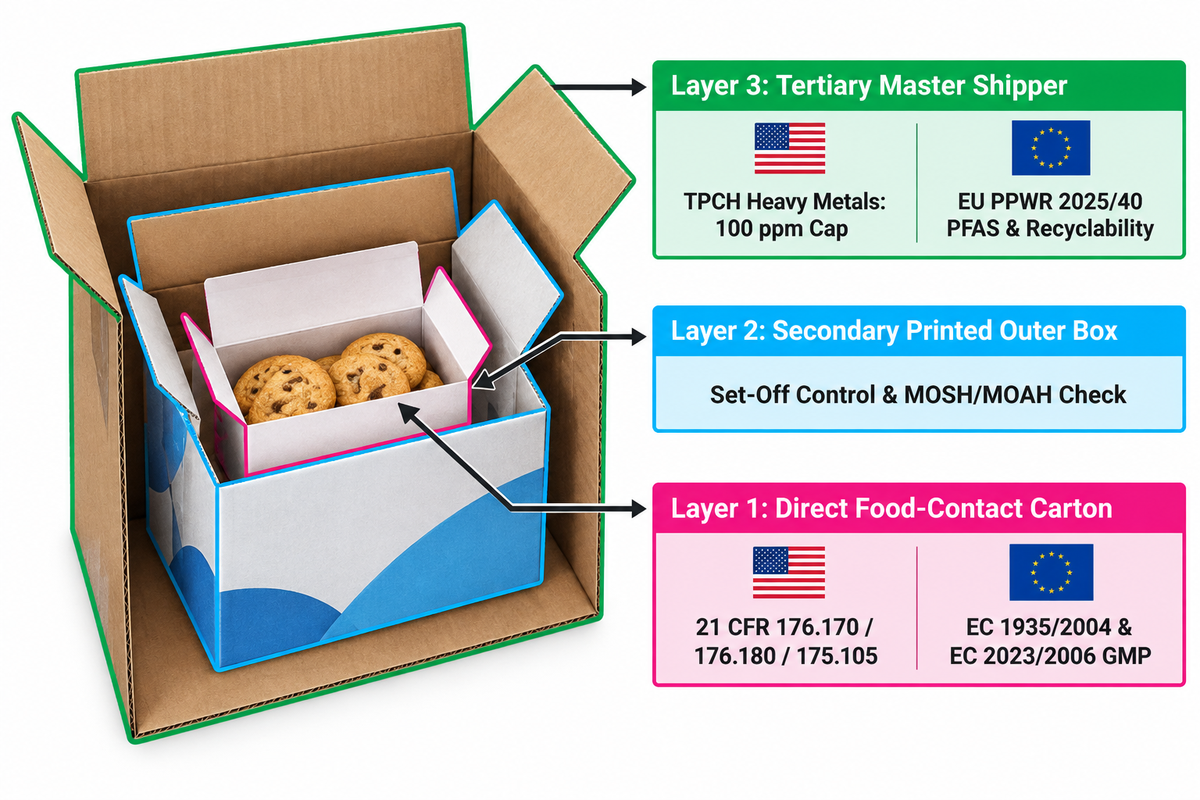
Under US 21 CFR 176.170, 21 CFR 176.180, 21 CFR 175.105, and EU Framework Regulation (EC) No 1935/2004, food safety depends on whether substances from board, ink, or glue can migrate into food under intended use. If volatile compounds can cross an inner pouch, treat the outer box as migration-relevant.
“Substances identified in this section may be safely used as components of the uncoated or coated food-contact surface of paper and paperboard intended for use in producing, manufacturing, packaging, processing, preparing, treating, packing, transporting, or holding aqueous and fatty foods, subject to the provisions of this section.”
– U.S. eCFR, 21 CFR 176.170 (Paper and Paperboard Components)
Procurement delays often start when teams request an “FDA-approved box certificate” or assume any inner plastic bag blocks outer-carton migration. US FDA regulates food-contact components and intended conditions of use under 21 CFR rather than certifying finished box shapes. Section 21 CFR 176.170 governs paperboard touching aqueous and fatty foods, while dry Type VIII foods are routed to 21 CFR 176.180. Under 21 CFR 175.105(a)(2), an adhesive may be separated from food by a functional barrier. Without a functional barrier, adhesive contact with dry food is limited by good manufacturing practice, while contact with aqueous or fatty food is limited to trace amounts at seams and laminate edges.
European compliance adds two additional checks. First, under EU food contact legislation (Regulation (EC) No 1935/2004 Article 6), there are no harmonized EU-wide specific measures for printing inks and paperboard. Buyers thus need to cross-check the national laws of EU Member States in addition to the widely referenced national guidance, e.g. the German BfR Recommendation XXXVI. Second, EU GMP Regulation (EC) No 2023/2006 Annex A requires non-food-contact printing inks to prevent migration through the board. Simultaneously, pressrooms must prevent ink set-off on the food contact surface during the process of sheet stacking, reeling, and semi-finished storage. Meanwhile, the German Federal Institute for Risk Assessment (BfR) said that C10 to C50 mineral oil hydrocarbons (MOSH & MOAH) from recycled cardboard can permeate thin inner bags and migrate to dry foods, such as rice, flour, semolina and cereals. Recently published 2026 peer-reviewed functional-barrier studies substantiate that the inner liners of food packaging should be fully tested for barrier performance.
| Packaging Layer | US FDA Regulatory Basis | EU & National Rules | Buyer vs. Converter Action |
|---|---|---|---|
| Layer 1: Direct Food-Contact Carton (Unlined pastry box, coated takeout box, bare dry cereal carton) |
21 CFR 176.170 (aqueous/fatty), 21 CFR 176.180 (dry Type VIII), effective FCNs; 21 CFR 175.105(a)(2) functional barrier or GMP dry / seam-trace aqueous-fatty limits | EC 1935/2004 general safety, EC 2023/2006 GMP Annex A, national rules and guidance (e.g., BfR XXXVI), EU PPWR 2025/40 PFAS limits | Converter supplies mill and ink component documentation; brand owner validates finished pack under intended temperature and hold time |
| Layer 2: Secondary Printed Outer Box (Outer folding carton holding sealed pouch, flow-wrap, or frozen tray) |
Not a direct contact surface if an inner barrier prevents transfer; retail labeling rules (such as 21 CFR Part 101) depend on the food product, label placement, and exemptions | EC 2023/2006 Annex A set-off control during stacking; BfR mineral-oil check if recycled board surrounds non-barrier film | Verify inner pouch permeability against MOSH/MOAH and odor transfer (smell proof barrier) rather than assuming automatic exemption |
| Layer 3: Tertiary Master Shipper (Corrugated shipping carton packing multiple retail food boxes) |
US state rules based on the TPCH model cap the combined incidental concentration of Pb, Cd, Hg, and Cr(VI) at 100 ppm per component | EU PPWR 2025/40 heavy-metal, empty-space ratio, and recyclability documentation rules | Specify clean warehouse storage and confirmed-spec ECT/BCT strength; keep secondary and primary specs distinct in purchase orders |
For teams focusing on regulatory checklists and migration tests in folding cartons, the food folding cartons engineering guide provides additional technical information. Confirm whether a box supplier’s confirmed scope covers secondary printed cartons only or includes documented food-grade direct-contact materials before signing off on a food-safe specification.
Paperboard Grades, Corrugated Flutes, and Caliper Specifications for Food Boxes
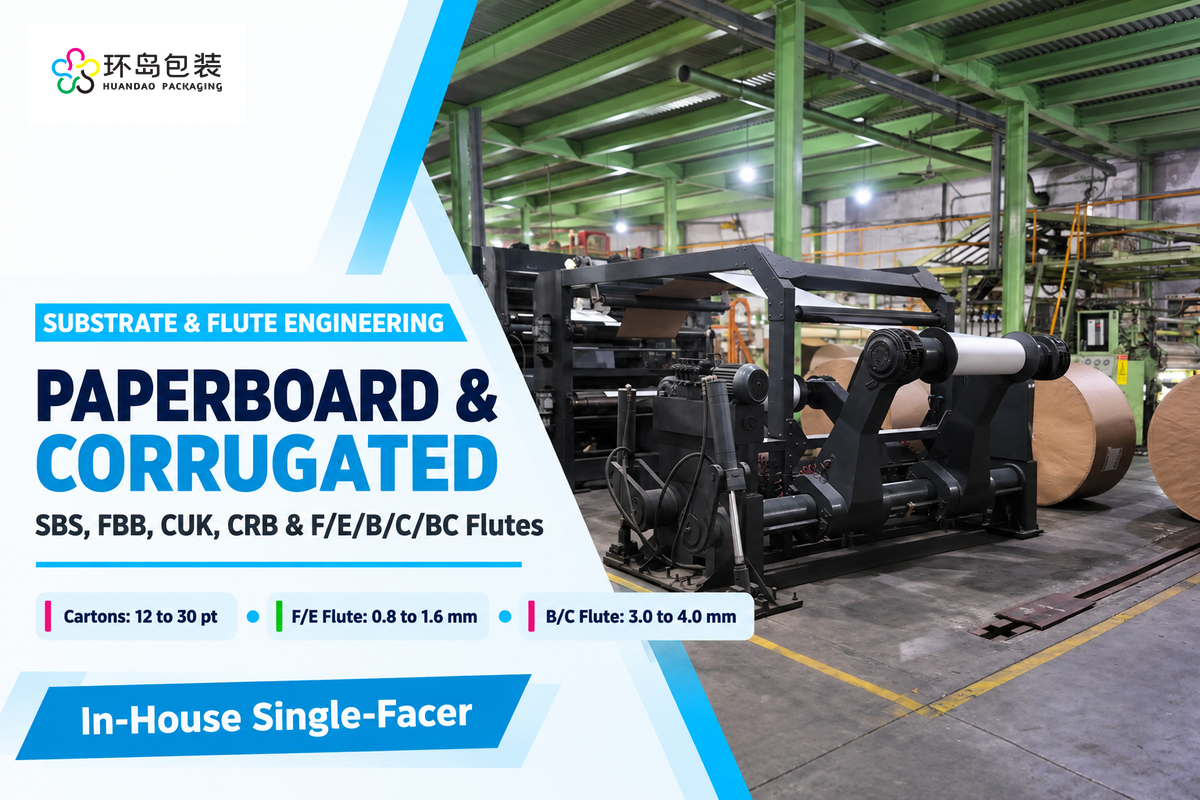
Virgin paperboard grades (SBS, FBB and CUK) outperform recycled CRB for odor neutrality and wet-tear resistance across the 10 to 36-point folding carton range (food cartons are typically 12 to 30-point). The corrugated flute extends from 0.8 mm (F-flute) to 4.0 mm (C-flute) with increasing stack loads. Use a virgin SBS, FBB, or CUK for wet, frozen or direct contact food, reserve CRB for dry bagged staples, and step up to B or C flute with increasing loads.
The Paperboard Packaging Council (PPC) defines four North American paperboard grades (SBS, CUK, CRB, and non-bending chipboard), while export food carton converting also widely uses Folding Boxboard (FBB). Solid Bleached Sulfate (SBS) cartons are made from a bright-white clay coating fused to a hardwood/softwood fiber matrix and are used for perishables and bakery boxes. Coated Unbleached Kraft (CUK, or SUS) is made from unbleached southern pine fiber mats and clay coatings, offering high tear strength for beverage and chilled multipacks. Folding Boxboard (FBB) pairs bleached outer plies with a lighter mechanical-pulp middle ply for high stiffness-to-weight ratios in export food cartons. Coated Recycled Paperboard (CRB) uses recovered fibers with a white top ply for lower-cost dry foods such as pasta, crackers, and cake mixes inside inner liners.
| Substrate / Flute | Thickness / Flute Pitch | Fiber Origin & Key Strength | Primary Food Box Fit |
|---|---|---|---|
| SBS (Solid Bleached Sulfate) | 10 to 36 pt converting range (common food cartons 12 to 28 pt; ~250 to 500 gsm) | Bleached virgin pulp; low odor, crisp graphics | Frozen cartons, dairy, bakery boxes, chocolates, premium takeout |
| FBB (Folding Boxboard) | 12 to 24 pt (0.30 to 0.61 mm; ~230 to 400 gsm) | Multi-ply virgin bleached face + mechanical core; high stiffness/gsm | Frozen meals, confectionery, export dry retail food cartons |
| CUK / SUS & Natural Kraft | 14 to 28 pt (0.36 to 0.71 mm; ~275 to 480 gsm) | Unbleached virgin pine kraft paper; highest tear and wet resilience | Beverage carriers, heavy frozen boxes, natural kraft boxes for takeout |
| CRB (Coated Recycled Board) | 14 to 30 pt (0.36 to 0.76 mm; ~280 to 520 gsm) | Recycled fibers with clay-coated top ply; lowest board cost | Secondary outer cartons for bagged cereal, pasta, cookies, cake mix |
| F-Flute & E-Flute Corrugate | F: ~0.8 to 1.0 mm (~125 flutes/ft); E: ~1.5 to 1.6 mm (~90 flutes/ft) | Tight flute pitch minimizes washboarding under litho-laminated sheets | Clamshells, burger boxes, specialty pizza, printed retail food boxes |
| B-Flute, C-Flute & Double-Wall BC | B: ~3.0 mm (~47 flutes/ft); C: ~4.0 mm (~39 flutes/ft); BC: ~6.5 to 7.0 mm | Higher flat-crush and stacking rigidity for heavy transport | Large pizza boxes, meal-kit shippers, wholesale produce and bulk master cases |
Sources: Paperboard Packaging Council and Fibre Box Association Corrugated Specifications (2025).
Choose F-flute or E-flute when fine litho-laminated retail graphics are needed on a thin wall, and step up to B-flute, C-flute, or double-wall BC as pallet stacking height and transit crush loads increase. Standard fluted food packaging options span E, B, C, F, and double-wall BC. If E-flute and B-flute board are corrugated in-house and converted fresh, without aged stock in the warehouse, sheet flatness improves register accuracy during die-cutting and folder-gluing. For details on conversions from caliper to weight, and rule of grain, see the folding carton packaging specifications.
Can recycled cardboard be used for direct-contact food packaging boxes?
Recycled cardboard (CRB) is generally restricted to secondary outer cartons or dry foods protected by a validated functional barrier, because waste-paper pulp can introduce mineral oil hydrocarbons (MOSH and MOAH) and print-ink residues. Direct contact with oily, hot, or high-surface-area dry foods depends on finished food-contact compliance and migration validation; virgin SBS, FBB, or CUK boards are commonly chosen to reduce recycled-fiber contamination risk.
The German BfR identifies dry staples with large surface area (flour, rice, semolina, breadcrumbs, and cereal) as the highest-risk category for mineral oil transfer from recycled board. Even when recycled kraft boxes carry an exterior clay coat, the interior still needs a tested functional barrier liner (such as EVOH, PET, or aluminum foil). Alternatively, specify virgin-fiber construction verified against migration over multi-month shelf life.
Grease, Moisture, and Thermal Barriers: Navigating PFAS-Free Coatings
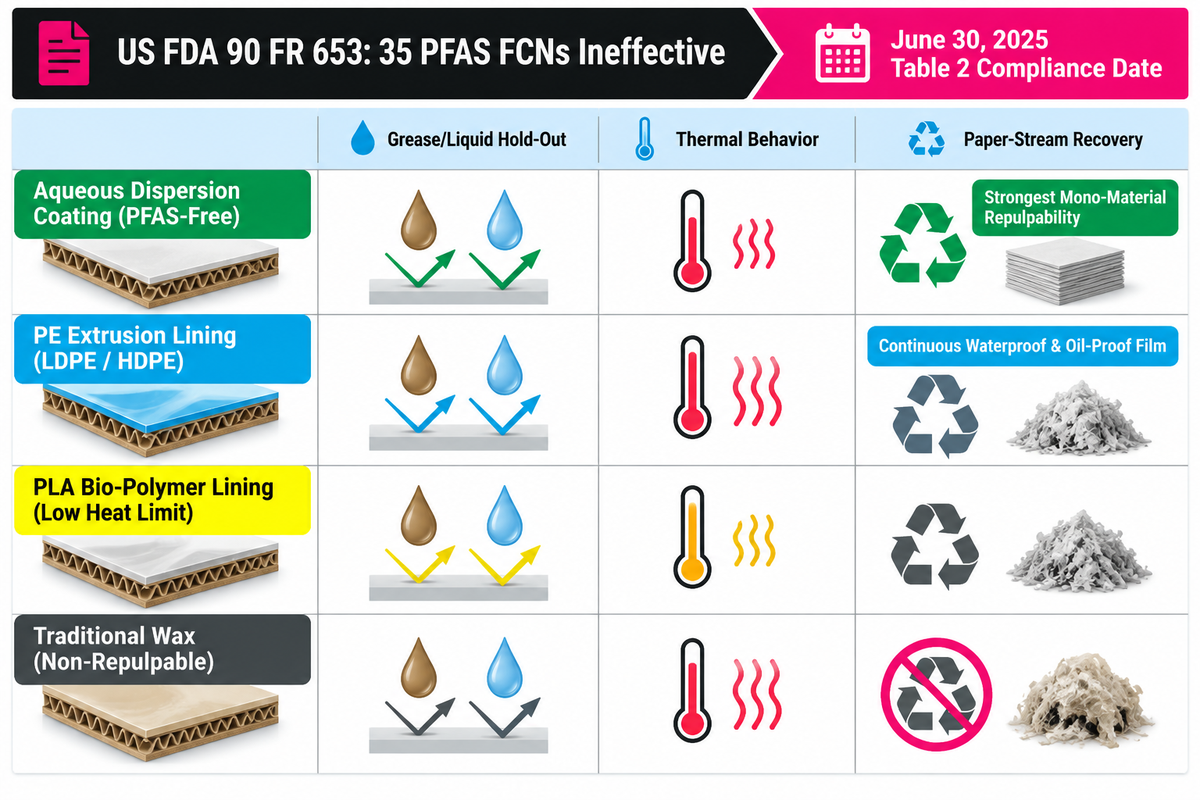
US FDA notice 90 FR 653 made 35 PFAS grease-proofing FCNs ineffective on January 6, 2025, with a June 30, 2025 compliance date for prior-production Table 2 substances. Oily and hot food packaging boxes now use PFAS-free aqueous dispersion coatings, PE linings, or PLA linings verified on creased folds and cut edges.
After the US PFAS phase-out, converters switched rapidly to PFAS-free aqueous dispersion coatings (see cellulosic barrier patent US20210292590A1). One report by the Institute of Food Technologists (IFT) describes pH-balanced oil-in-water emulsions as one of the dispersion classes, with blends of kaolin clay and/or calcium carbonate and polymer binders. IFT also notes that high dispersion moisture content can complicate inline tray forming unless applied post-forming or dried under strict thermal control.
Flat-sheet TAPPI T 559 cm-22 Kit numbers (scaled 1 to 12) measure oil repellency on smooth board and don’t guarantee hold-out across deeply creased folds or exposed die-cut edges under hot delivery loads. Converting research from North Carolina State University BioResources shows that deep creasing and folding compress paperboard and micro-crack barrier coatings along score lines. Exposed raw die-cut edges can also wick warm fryer oil by capillary action, making clean web-folded corners essential for grease-proof food containers.
| Barrier Type | Grease & Liquid Hold-Out | Thermal / Reheating Behavior | Paper-Stream Recovery & Trade-Offs |
|---|---|---|---|
| Aqueous dispersion coating (PFAS-free) | Moderate to strong flat-sheet grease repellency; test creased corners with warm oil | Handles hot takeout and short reheating per resin spec | Strongest mono-material repulpability; watch score-line cracking on tight folds |
| PE extrusion lining (LDPE / HDPE) | Continuous waterproof and oil-proof film; supports soup containers and saucy dishes | Heat-sealable seams; softens under high oven or prolonged microwave grease heat | Polymer layer limits standard paper recycling; do not label plastic-free |
| PLA bio-polymer lining | Strong cold liquid and light oil barrier for salads and cold grab-and-go | Low heat distortion threshold; deforms with boiling soup or hot oil | A PLA lining alone does not establish that the finished box is commercially compostable; verify complete-package certification |
| Traditional packaging wax coating | Effective cold-water shedding for wet produce and iced seafood shippers | Softens and transfers into hot foods; unsuitable for warm takeout or microwaving | Non-repulpable in standard paper mills; largely replaced by recyclable barrier coats |
💡 Pro Tip: Run a Hot-Oil Fold Test Before Tooling Sign-Off
Do not approve a grease-resistant takeout box from a flat-sheet Kit certificate alone. Fill a folded structural sample with your actual hot sauce or fryer oil at real serving temperature and hold time, then inspect the bottom score lines and gusseted corners for capillary wicking before releasing production plates.
Are cardboard food packaging boxes microwave safe?
Cardboard food packaging boxes are microwave safe only if the complete construction (board, barrier, adhesive, and ink) is validated for intended heating. Boxes must also omit metal foil, wire handles, metallic inks, and low-melt wax. Unrated folding cartons and standard PE-lined boxes can scorch, delaminate, or release glued seams during high-fat reheating.
Hot spots in oily or sugary foods can exceed boiling temperatures inside a microwave oven, warping standard PLA linings and softening unrated adhesives along glued flaps. Don’t assume that all paperboard is able to withstand microwaving. Check the completed finished-pack temperature rating, and leave a steam-vent gap during reheating.
Folding Cartons vs. Litho-Laminated Corrugated, Molded Fiber, and Plastic Containers
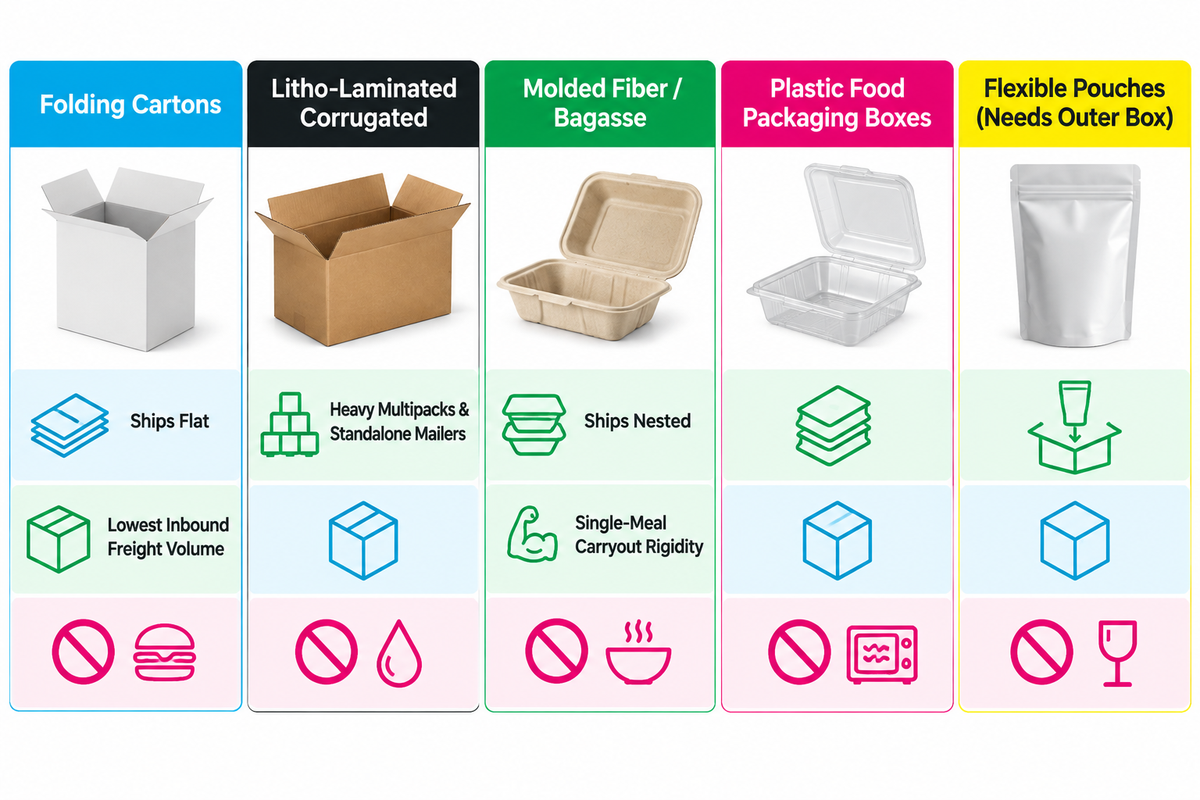
Folding cartons fit lightweight retail food shipping inside master cases on automated cartoners, while litho-laminated corrugated boxes handle heavy stacking and direct parcel impact. Switch to molded fiber for single-meal carryout rigidity, or rigid plastic for wet crush resistance and hot-liquid leak seals.
A common budgeting mistake in retail food launches is paying for litho-laminated corrugated when shoppers never see the outer shipping carton. If you have a dry snack pouch or sealed frozen meal tray that ships in a plain corrugated master case, a folding carton delivers sharp shelf graphics at a lower unit cost and with less warehouse cube. Conversely, shipping heavy meal kits or beverage multipacks without fluted corrugated support invites crushed corners during distribution.
Choose Folding Cartons (10 to 36 pt)
Folding cartons fit best when lightweight retail food ships inside an outer master shipper, automated cartoning lines run flat blanks, and fine offset typography or spot UV drives shelf pull.
Choose Litho-Laminated Corrugated (0.8 to 4.0 mm)
Litho-laminated corrugated boxes fit best when heavy multipacks or direct parcel shipments double as a mailer or club-store pallet display requiring full-color offset print on a crush-resistant fluted wall.
| Format | Load & Stacking | Graphic & Branding | Freight & Storage Cube | Limitations / Not Suitable For |
|---|---|---|---|---|
| Folding Cartons | Light retail units shipping inside a master shipping case | Highest offset detail, spot Pantone, foil, emboss | Ships flat; lowest inbound freight volume | Not for standalone heavy courier parcels or unlined liquid-heavy meals |
| Litho-Laminated Corrugated | Heavy multipacks, club-store displays, and standalone parcel mailers | Offset-printed top sheet laminated to F/E/B/C flute | Ships flat; thicker stack than solid paperboard | Not cost-effective when shoppers never see the outer shipping box |
| Molded Fiber / Bagasse | Single-meal carryout rigidity; limited multi-tier pallet stacking | Embossing or simple pad print; textured surface | Ships nested, not flat; higher warehouse cube | Not for multi-color retail branding or high-speed horizontal cartoners |
| Plastic Food Packaging Boxes | High wet crush resistance and snap-tight leak seals | Clear visibility; relies on adhesive labels or sleeves | Nested trays consume higher freight volume | Not suitable for plastic-free positioning or paper-stream recycling goals |
| Flexible Pouches (Mylar / Candy Bags) | Minimal crush protection; needs outer box for fragile food | Strong rotogravure/digital print; low shelf rigidity | Compact roll or flat-pouch storage | Not for fragile cookies, macarons, or stackable meal prep containers without an outer carton |
In many high-performing food lines, flexible packaging and paperboard boxes are used in combination rather than competition. A barrier inner pouch (such as multi-layer mylar bags for coffee or candy bags for confections) controls oxygen and moisture vapor transmission.
Matching Food Box Construction to Channel: Takeout, Frozen Cold Chain, Bakery, and Retail Display
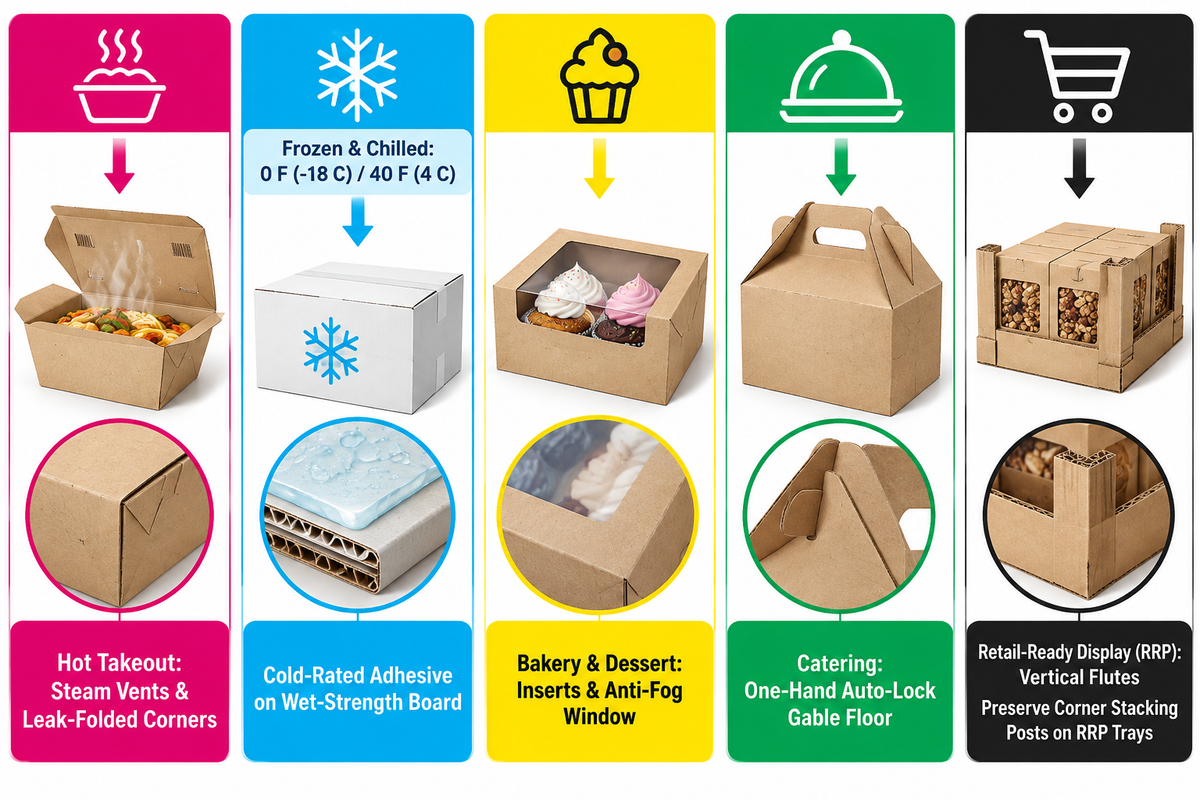
Commercial food channels impose conflicting physical stresses: hot takeout traps steam unless vented, frozen food storage follows USDA FSIS storage guidance at or below 0 °F (-18 °C), and retail display cutouts cut stacking rigidity. Specify closures, vents, and cold-resistant adhesives to prevent issues.
Takeout food operators have channel issues with food coming out limp and liquid sauces wicking through folded base corners of the takeout boxes. For catering professionals running multi-course food service drop-offs, stackable lunch boxes and gable boxes with reinforced auto-lock floors prevent collapse inside insulated catering bags, while die-cut steam vents along upper side flaps release vapor and gusseted web-corner trays eliminate raw interior glue seams.
| Distribution Channel | Primary Environmental Stress | Recommended Construction | Critical Detail to Verify |
|---|---|---|---|
| Hot takeout & food delivery | Steam condensation and pooled cooking oil | Coated kraft/SBS clamshell or E-flute carryout box | Upper steam vents for crispy foods; leak-folded corner webs for saucy take out food |
| Frozen & chilled cold chain | <= 0 °F (-18 °C) freezer or <= 40 °F (4 °C) chill + thaw condensation | Wet-strength SBS, FBB, or CUK folding carton | Cold-rated adhesive verified on coated board; outer moisture varnish |
| Bakery, dessert & confectionery | Icing smudge, butter oil spots, fragile decoration | SBS window boxes, cupcake boxes, or rigid dessert packaging | Paperboard inserts/partitions for macarons and cupcakes; clear lids or anti-fog window patch |
| Catering & grab-and-go food service | Rapid hand assembly, stacked transport, portion sorting | Pre-glued auto-lock gable boxes, portion trays, catering supplies | One-hand pop-up floor saves staff time at catering events; interlocking lid tabs |
| Retail-ready grocery display (RRP) | Balancing shelf facing count against pallet crush loads | E-flute or B-flute perforated shelf-ready tray with vertical flutes | Keep front tear-away perforation height conservative to preserve corner stacking posts |
Retail-Ready Packs (RRP) have to be structurally balanced. Material removed from the front panel to increase the merchandiser’s facing count reduces stacking capacity. Before finalizing your retail case pack-out, use our food box case-count planner to map the dimensions of the units, and see the reinforcement patterns in our retail display boxes guide.
Printing, Color Control, and Food-Safe Surface Finishes for Branded Food Boxes
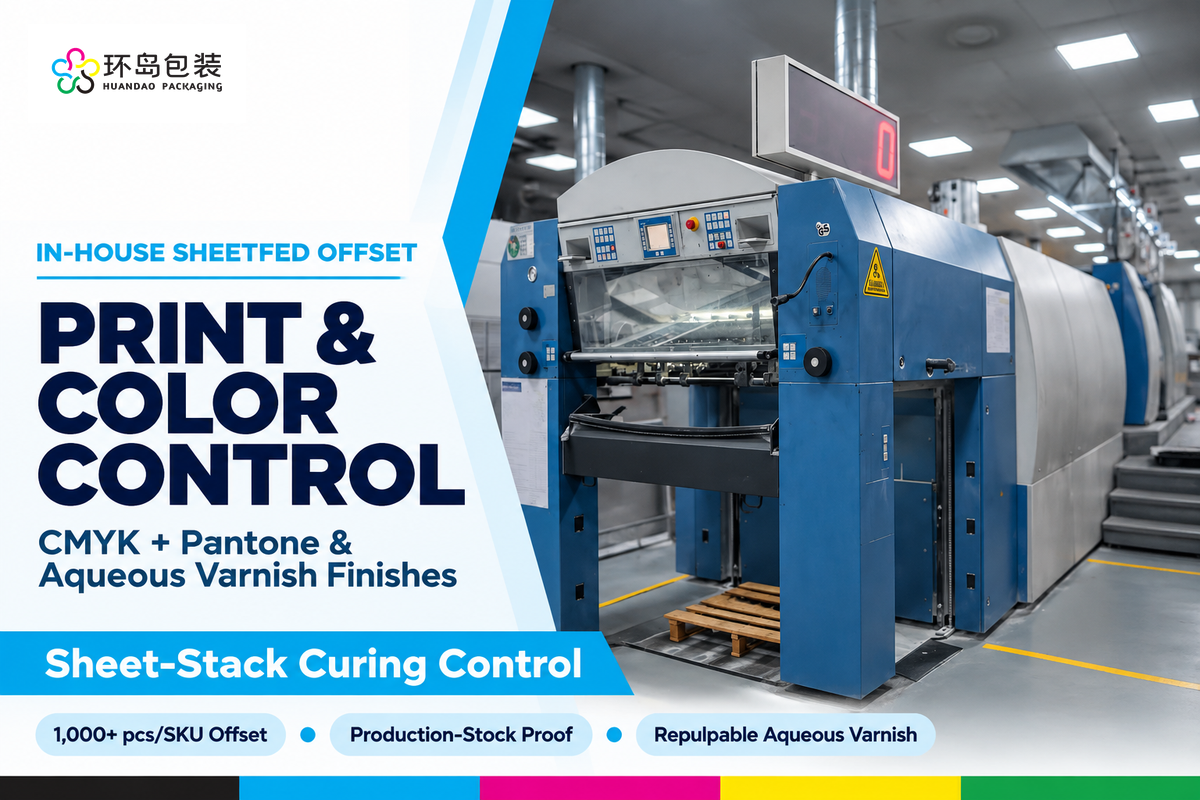
Sheetfed offset custom printing on smooth paperboard or litho-laminated top sheets delivers sharp typography and consistent color for branded food packaging, while direct flexographic printing fits high-volume 1- to 3-color corrugated shipping containers. Always approve brand colors on a physical production-stock proof rather than a backlit screen, because substrate whiteness and finish shift perceived hue.
In commercial carton converting, Pro Carton observes that printing, creasing, die-cutting and folding-gluing operate as a series of linked tolerances. Heavy ink coverage on score lines can crack during folding unless the grain direction and aqueous varnish or lamination match the board caliper. On multi-SKU food lines requiring repeat color consistency, presses calibrated to G7 and controlled with an X-Rite system hold production to an agreed ΔE tolerance against the signed proof. Pantone spot colors keep signature brand tones uniform across runs, while 4-color CMYK handles photographic artwork efficiently.
To meet the EU Annex A set-off controls, pressrooms manage sheet-pile curing, ink tack, and low-migration overprint varnishes before die-cutting. High-build finishes such as matte or gloss lamination, spot UV, foil stamping, and iridescent accents sharpen unique design impact on secondary retail dessert boxes and holiday gift boxes. However, plastic film lamination can restrict paper-mill repulping, so use water-based aqueous varnish for rub protection wherever mono-material paper recovery is a priority.
| Print / Finish Method | Best Run & Substrate | Visual & Durability Performance | Compliance & Recycling Watch-Out |
|---|---|---|---|
| Sheetfed Offset (CMYK + Pantone) | 1,000+ pcs/SKU; SBS, FBB, CUK, litho top sheets | High-quality printing for small ingredient text and food photos | Control sheet-stack curing to prevent ink set-off onto interior panels |
| Direct Flexographic Printing | High-volume kraft corrugated pizza and shipping cases | Clean 1- to 3-color logos and barcodes; slight flute-line show-through | Water-based flexo inks dry quickly and support paper-stream recovery |
| Water-Based Aqueous Varnish | Inline on offset folding cartons and foodservice boxes | Seals ink against light transit scuffing (matte or satin) | Supports mono-material paper repulping; lower gloss than film |
| UV Coating & BOPP Lamination | Secondary retail cartons, frozen outer sleeves, gift boxes | Strong scuff and condensation resistance; supports spot UV or soft-touch | Film lamination can restrict paper-mill repulping; qualify recycling claims |
Quality Testing, Stacking Strength Calculations, and Preventing Common Box Failures
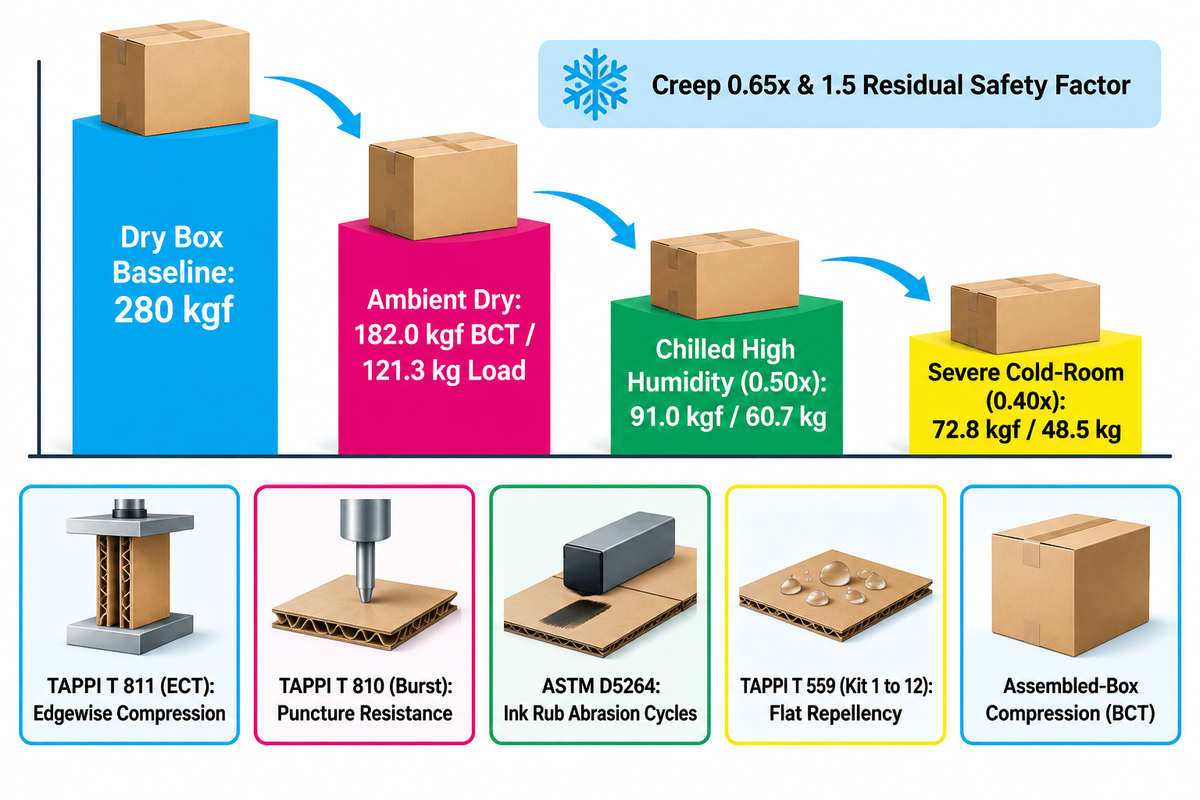
Material-level board tests (TAPPI T 811 ECT, TAPPI T 810 burst, and ASTM D5264 ink rub) establish baseline sheet strength, yet corrugated stacking drops above 30% relative humidity (ASTM Journal of Testing and Evaluation, Volume 52). Cold-room pallet design must derate dry compression strength for humidity and creep.
Baseline sheet strength is determined by board level ECT and Mullen burst tests, and cold-room pallet survival depends on the conditioned, assembled box compression strength under creep. USDA Forest Service Forest Products Laboratory research states that bottom-tier boxes under long-term creep and cyclic high humidity fail at loads well below those observed in short-duration dry lab tests. Distribute according to need. Validate distribution performance separately from board-level ECT or burst testing, including packs designed to ISTA 3A in parcel channels; buyers can use supplier board data alongside independent lab certification if their retailer requires it.
| Standard | What It Measures | Unit / Scale | What It Does Not Cover |
|---|---|---|---|
| TAPPI T 811 (ECT) | Edgewise compressive strength of corrugated board | lbf/in or kN/m | Box geometry, pallet overhang, or humid creep loss |
| TAPPI T 810 om-22 (Burst) | Mullen bursting resistance against puncture and rough handling | psi or kPa | Vertical column stacking load on tall warehouse pallets |
| ASTM D5264-98(2019) | Sutherland ink and coating rub abrasion resistance | Rub cycles (2 lb / 4 lb weight) | Chemical migration or condensation delamination |
| TAPPI T 559 cm-22 (Kit) | Flat-sheet paperboard repellency to castor-oil/solvent drops | Kit 1 to 12 | Cracked score lines, cut-edge wicking, or hot-oil hold duration |
| Assembled-Box Compression (BCT) | Top-to-bottom compression load of an assembled empty box | lbf or N | Vibration and impact during distribution |
📐 Cold-Storage Compression Derating Worked Calculation
Assumed inputs (illustrative engineering check, not a universal board standard): Suppose a corrugated shipper (400 x 300 x 250 mm) carries 10 kg gross weight stacked 6 layers high, placing a 50 kg static load on the bottom box, with a dry lab box compression strength of 280 kgf. Applying illustrative multipliers (0.50 for chilled high humidity, 0.40 for severe cold-room humidity, 0.65 for sustained creep, and a 1.5 residual safety factor, equal to an overall dry-BCT factor of roughly 4.6 at 0.50 humidity and 5.8 at 0.40 humidity) yields:
| Illustrative Condition | Assumed Humidity Multiplier | Assumed Creep Multiplier | Effective BCT (kgf) | Illustrative Load (1.5 residual SF) | 6-Tier Stack (50 kg load) |
|---|---|---|---|---|---|
| Ambient dry baseline | 1.00 | 0.65 | 182.0 kgf | 121.3 kg | PASS (2.4x residual margin) |
| Chilled high humidity | 0.50 | 0.65 | 91.0 kgf | 60.7 kg | Marginal (cut tiers or test upgraded board) |
| Severe cold-room humidity | 0.40 | 0.65 | 72.8 kgf | 48.5 kg | FAIL; any replacement grade requires its own conditioned compression result |
Under these hypothetical inputs, the same 280 kgf dry box passes dry ambient stacking yet fails under severe cold-room humidity at 6 tiers. Pallet overhang, interlocked stacking patterns, and internal partitions further shift real load capacity, so validate final board grades with conditioned box compression testing.
When addressing delivery concerns, trace each symptom to its physical source. For example, too-moist walls indicate the absence of steam vents or raw inner fibers. Corner grease rings indicate cracked fold coatings or raw, inner cut edges. Popped seams in cold rooms can be caused by adhesive formulation, bonding conditions, or coated board surfaces, and scuffed retail graphics can be caused by under-cured varnish or abrasive master-case dividers.
Wholesale Pricing, Minimum Order Quantities, Tooling Fees, and Supplier Evaluation
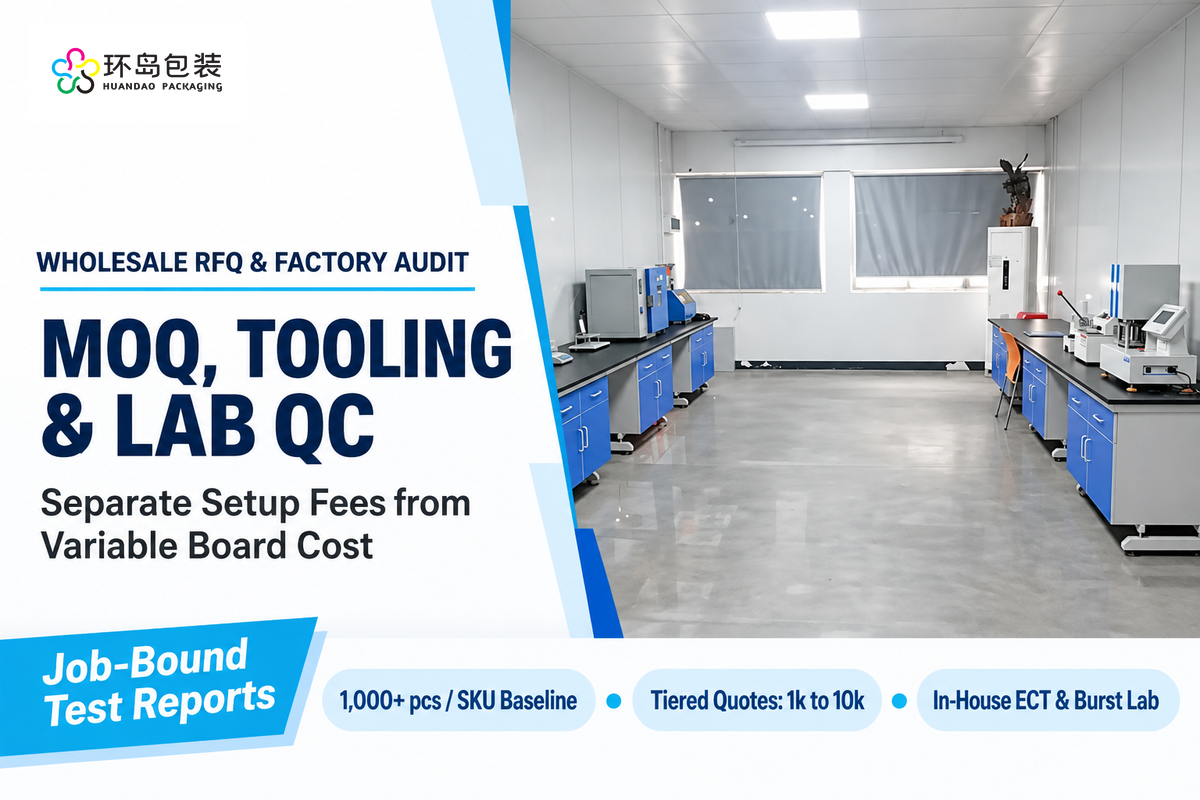
Published 2026 US supplier guides for custom packaging show wide per-box price bands driven by order quantity, board grade, and finishes. One-time tooling costs for steel cutting dies are shown as fixed setup costs in the supplier guides. Fixed costs for printing plates and dies are amortized over more units for larger wholesale orders, thereby decreasing the per-box landed cost.
Comparing quotes accurately requires separating fixed setup fees from variable board cost and checking whether a supplier runs converting in-house or brokers orders out. In published 2026 supplier guides, GMS Industries lists custom corrugated boxes at $0.40 to $3.00 per unit, while YoursPackaging cites $1.20 to $6.50 per unit depending on order volume, material selection, and printing requirements. Print247 illustrates volume elasticity dropping from $2.10 per box at 500 units to $1.10 at 1,000 units and $0.75 at 5,000 units. Use these published supplier figures, captured November 2026, for early budgeting, with landed pricing adjusted for exact board gsm, grease barrier chemistry, window patching, and export freight.
What is the minimum order quantity and typical lead time for custom food boxes?
At Xiamen Huandao Packaging Technology Co., Ltd., standard MOQ is 1,000 pieces per size and style (with smaller runs quoted case by case), and production runs within 15 days (typical, confirmed per order at quotation). Dielines and quotations are typically returned in 24 to 48 hours, with a free plain structural sample shipped within 5 working days (courier paid by the buyer) and an on-press proof in about 8 days when requested.
Specifying “per size and style” prevents miscommunications in quotations. An order of 1,000 total boxes across four dielines requires four different cutting dies and four different press setups, increasing tooling and unit costs. Repeat orders using an archived cutting die skip die fabrication, and structural re-sampling can be avoided only if the board grade, coating, and pack-out remain the same, supporting fast shipping schedules. For buyers preparing CAD dielines ahead of sampling, see our custom die-cut box dieline guide.
When requesting wholesale quotes, copy the structured table below into your inquiry, or use our pack-to-case specification brief builder to construct a brief with us, to ensure that each factory is bidding on the same board, barrier, print, and freight assumptions.
RFQ checklist – copy these parameters into your custom food packaging boxes quote request:
| Parameter | Recommended range | Why it matters | How to verify |
|---|---|---|---|
| Internal dimensions (L x W x H) | Exact mm (e.g., 180 x 120 x 60 mm) + product weight (g/kg) | Sets blank sheet yield, die cost, and master carton pack-out | Fit-test physical product inside a plain structural sample |
| Contact layer & barrier | Direct contact vs. secondary outer box; aqueous/PE/PLA barrier | Determines FDA 21 CFR 176.170 / EU 1935/2004 compliance scope | Request mill/coating compliance letters and run a hot-oil fold test |
| Board grade & flute | 12 to 30 pt SBS/FBB/CUK/CRB or F/E/B/C/BC flute | Balances stiffness, cold-room humidity survival, and unit price | Confirm caliper/gsm and ECT or burst testing for confirmed specs |
| Print & color standard | 4-color CMYK + 0 to 2 Pantone spot colors; varnish/lamination | Locks plate count, ΔE color consistency, and recyclability status | Approve physical proof on production stock calibrated to G7 / X-Rite |
| Order quantity per SKU | 1,000+ pcs per size and style (Huandao offset baseline); note versions | Amortizes cutting die and plate setup across total run volume | Request tiered quotes at 1,000 / 3,000 / 5,000 / 10,000 pcs per SKU |
| Incoterms & packing | EXW, FOB, CIF, or DDP; flat-packed export master cartons | Flat-pack volume before production is estimated until goods are packed | Verify estimated CBM per 1,000 boxes and palletization height limits |
Check four things when evaluating potential printed paperboard and litho-laminated box suppliers. Confirm that they have prepress, sheet-fed offset printing, die-cutting, and folder-gluing in-house. Second, distinguish G7 press calibration, X-Rite spectrophotometric control, and GMI certification rather than treating them as interchangeable terms. Check if they’ve ECT, burst, and ink-rub tests for confirmed specifications and if printed boxes, inserts, and outer shippers can all be consolidated under one export schedule.
At Xiamen Huandao Packaging Technology Co., Ltd. in Xiamen, China, pre-press, multi-color sheetfed offset printing, UV coating, lamination, die-cutting, folder-gluing, and inline E-flute and B-flute corrugation run in-house with MES production tracking. Quality and environmental management follow ISO 9001 and ISO 14001 systems, with FSC-certified board available on request. When you are ready to move from technical specifications to custom dielines and project quotations, visit our commercial solution page for custom food packaging boxes.
Regulatory Shifts and Recyclability Reality for Food Packaging Boxes (2025 to 2026 Outlook)
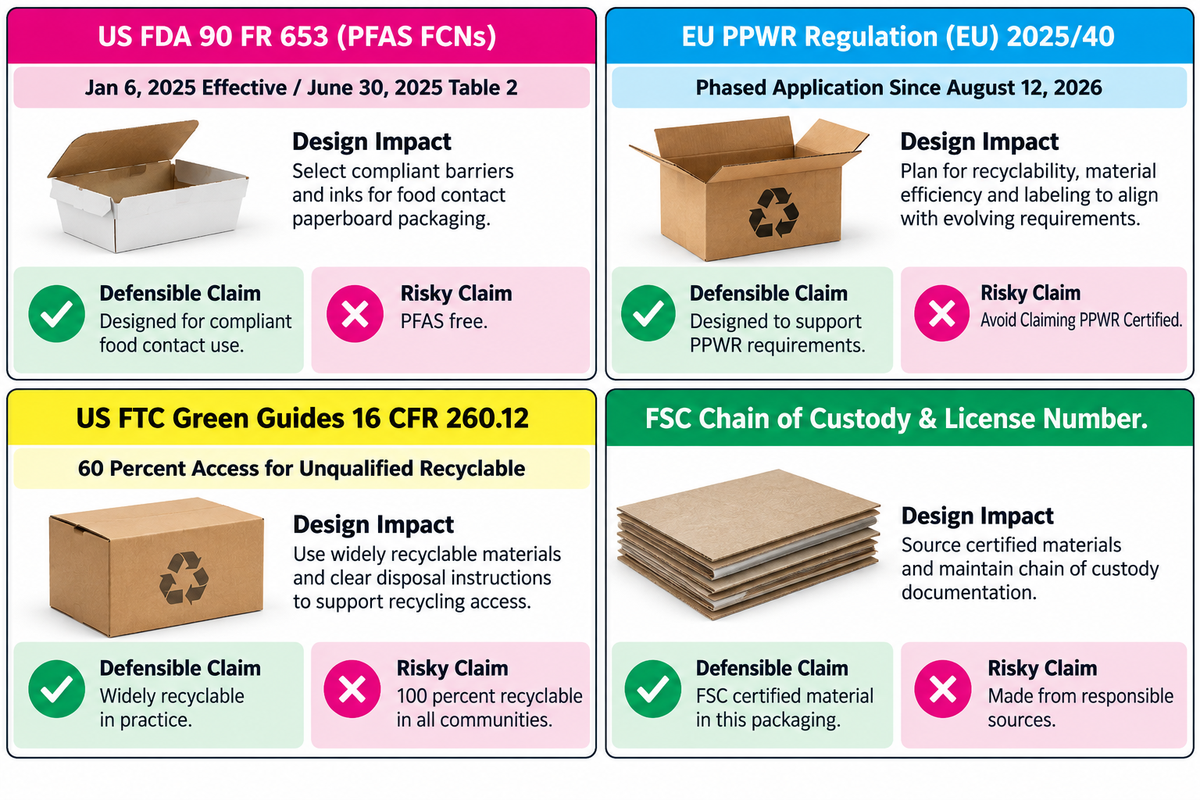
With US FDA 90 FR 653 and EU PPWR Regulation (EU) 2025/40 already in force, compliance reviews center on PFAS-free barriers, mono-material recovery files, and defensible retail recycling claims. Legacy fluorinated grease treatments covered by the FDA revocation raise food-contact compliance issues, while recycling claims for heavily plastic-laminated boxes depend on the finished package’s recovery route.
In the EU, PPWR entered into phase-specific general application on August 12, 2026, with strict limits on PFAS in takeout containers, bakery paper, fast food wrappers and pizza boxes. Obligations under the PPWR fall on various economic operators in the supply chain rather than on a single operator. Buyers should specify mono-material paper construction designed for paper recovery and request supplier material documentation rather than asking converters for a non-existent “PPWR certificate.”
On environmental marketing claims in the US, FTC Green Guides 16 CFR 260.12 lays down two specific tests. Under paragraph (b)(1), an unqualified “recyclable” claim requires that recycling facilities be available to a “substantial majority,” defined to mean at least 60 percent of the consumers or communities in which the product is offered for sale. Under paragraphs (c) and (d), plastic lamination, clear window patches, and wax barriers can limit recovery of the finished box. Any unqualified recyclable claim must reflect the complete package and local access rather than broad eco-friendly slogans. Similarly, FSC Chain of Custody rules separate requesting FSC-certified board from holding trademark license approval to print the FSC logo on finished artwork.
| Regulation / Rule | Active Milestone | Impact on Box Design | Defensible vs. Risky Claim |
|---|---|---|---|
| US FDA 90 FR 653 (PFAS FCNs) | Effective Jan 6, 2025; Table 2 compliance date June 30, 2025 | Ends 35 fluorinated grease-proofing FCNs on US food paperboard | Use “no-intentionally-added PFAS” backed by supplier testing; avoid vague safety claims |
| EU PPWR Regulation (EU) 2025/40 | Phased application active since August 12, 2026 | Restricts PFAS in EU food-contact packs; phases in recyclability documentation | Write “mono-material paper construction; supplier documentation available”; avoid “PPWR certified” |
| US FTC Green Guides 16 CFR 260.12 | Unqualified recyclable claims require access for at least 60 percent of consumers or communities and whole-package support | Plastic windows, BOPP films, and wax coatings can limit finished-box recovery | Qualify claims whenever coatings, films, or local collection limit recovery; avoid unqualified biodegradable claims |
| FSC Chain of Custody & Trademark | Ongoing audit and license requirement | Separates certified virgin/recycled board supply from on-box logo printing | Confirm converter trademark license number before placing FSC marks on artwork |
Are coated or greasy food packaging boxes recyclable or compostable?
Paperboard cartons and aqueous-coated mono-material boxes, once cleaned and separated from debris, are often recovered at the paper mill, though this is heavily dependent on local recycling collection and sortation systems. Heavy PE lamination, plastic display windows, and soaked grease can limit recovery and require qualified claims under FTC 16 CFR 260.12. Commercial compostability requires testing the complete finished package (board, coating, ink, and adhesive) under applicable regional packaging or compostable-plastic standards, and unqualified “biodegradable” labels carry strict legal risk.
On corrugated pizza boxes, the American Forest & Paper Association (AF&PA) 2025 Sustainability Progress Report confirms that US paper mills accept empty, lightly greased pizza boxes once food scraps and parchment liners are removed. Municipal curbside rules still vary, so align end-of-life labeling with verified coating chemistry rather than printing generic compostable or biodegradable badges on standard film-lined stock.
FAQ
Q: How do you seal food packaging boxes for delivery and tamper evidence?
Delivery food boxes use die-cut tear-strip locking tabs, dust flaps or tamper-evident security labels, to illustrate if a package was opened during transit.
If an adhesive label or tape can touch food directly rather than only the exterior of the lid, verify that the pressure-sensitive adhesive is compliant with US 21 CFR 175.125. In addition, test the strength of the adhesive to withstand heat or moisture to ensure it holds during transport.
Q: What food packaging box materials should buyers avoid for hot or fatty foods?
Buyers should avoid uncoated recycled CRB without a functional barrier and fluorinated PFAS grease treatments invalidated under US FDA 90 FR 653. Low-melt paraffin wax coatings that soften into hot foods and standard PLA linings that deform with hot oils also fail.
Unrated industrial glues and unvented heavy solid board also raise frequent complaints because of seams releasing or trapping steam. Pair virgin SBS, FBB, or CUK board with a tested PFAS-free aqueous or heat-rated barrier verified on folded corners.
Q: Can custom printed food boxes meet US and EU nutrition and allergen labeling rules?
Sheetfed offset printing reproduces crisp small-type nutrition facts, net-weight statements, and allergen bolding required under US FDA 21 CFR Part 101 and EU Regulation 1169/2011 minimum x-height rules on smooth coated paperboard.
To avoid ink spread on porous uncoated kraft paper, verify legibility of 6 pt to 8 pt ingredient text and barcodes on a physical press proof or production-stock digital proof before releasing bulk printing plates.
Q: How do paperboard food boxes affect product shelf life?
To extend shelf life of crisp snacks, use a sealed high barrier inner pouch, or a functional moisture barrier coating, or lidding film.
In practice, the outer printed box protects structural integrity and blocks UV light, while the inner barrier film or coating controls oxygen and moisture vapor transmission over retail shelf life.
Q: What is the difference between a structural sample, a digital proof, and a press proof?
A plain structural sample verifies box dimensions, fold tension, and product fit on unprinted production board. A digitally printed sample gives an approximation of the alignment of the artwork, and a proof gives an accurate representation of the finish before mass production.
Using a simple structural sample allows your team to pack actual containers and confirm stackability and partition clearances without absorbing the cost of press setup. Once the artwork is finalized, a proof uses actual press plates to lock the offset color fidelity before bulk production.
Q: Should wholesale food packaging boxes be shipped flat-packed or pre-glued?
Folding cartons, auto-lock gable boxes, and corrugated takeout boxes are shipped flat to reduce volume and warehousing costs.
Rigid two-piece food gift boxes ship erected unless engineered as collapsible folding-rigid structures, so confirm volumetric shipping costs before specifying erected rigid boxes on long-distance export orders.
Q: What Incoterms and freight factors affect landed cost on exported food boxes?
Export packaging factories quote EXW, and based on the terms selected by the buyer, will give a price quote for FOB, CIF, or DDP.
Quotes with freight included are an estimate based on a predicted volume. The final figure is determined once the goods are packed. Confirm HTS classification and import duties with your licensed customs broker.
Q: How do kraft food boxes compare with white SBS food cartons?
Unbleached kraft and CUK paperboard provide a more natural look and higher tear resistance than white SBS. SBS can provide a brighter palette and more legible small text.
For multi-color retail branding and dairy and bakery presentation, use coated SBS. Use coated kraft when carryout and natural styling are called for, and when there’s a worry for wet-tear.
Related Articles
- Custom Food Packaging Boxes Solutions – Commercial structural formats, printing options, and dieline quotation workflow.
- Food Folding Cartons Engineering Guide – Deep dive into folding carton board specs, food-contact boundaries, and sample checks.
References & Sources
- 21 CFR 176.170: Components of Paper and Paperboard in Contact with Aqueous and Fatty Foods – U.S. Electronic Code of Federal Regulations (FDA)
- 21 CFR 175.105: Food Packaging Adhesives – U.S. Electronic Code of Federal Regulations (FDA)
- 90 FR 653: Food Contact Notifications That Are No Longer Effective (Jan 6, 2025) – U.S. Federal Register / FDA
- New EU Packaging Rules Start to Apply, Including Restrictions on PFAS in Food-Contact Packaging (Aug 11, 2026) – European Commission DG Environment
- Regulation (EU) 2025/40 on Packaging and Packaging Waste (PPWR) – EUR-Lex, European Union
- Questions and Answers on Mineral Oil Components in Food (MOSH/MOAH) – German Federal Institute for Risk Assessment (BfR)
- 16 CFR 260.12: Recyclable Claims (FTC Green Guides) – U.S. Federal Trade Commission
- 4 Types of Paperboard (SBS, CUK, CRB, Chipboard) – Paperboard Packaging Council (PPC)
- Corrugated Board Specifications & Flute Caliper Standards (2025) – Fibre Box Association (FBA)
- TAPPI Test Methods Index (T 810 Burst, T 811 ECT, T 559 Kit) – Technical Association of the Pulp and Paper Industry
- Relative Humidity and Absolute Moisture Content Effects on Corrugated Compression Strength – ASTM Journal of Testing and Evaluation, Volume 52
- Strength and Life Criteria for Corrugated Fiberboard Under Cyclic Humidity – USDA Forest Service Forest Products Laboratory
- Converting and Its Effects on Barrier Properties of Coated Packaging Materials: A Review – North Carolina State University BioResources
- The Paperboard Coating Renaissance (Aqueous Dispersion Barriers) – Institute of Food Technologists (IFT)
- Freezing and Food Safety Storage Temperatures – USDA Food Safety and Inspection Service (FSIS)
- Carton Production: Linked Printing, Creasing, Cutting, and Gluing – Pro Carton
- 2025 Sustainability Goals Progress Report (Pizza Box Mill Recyclability) – American Forest & Paper Association (AF&PA)
About This Specification Guide
This guide compiles US FDA 21 CFR paperboard and adhesive clauses, EU PPWR 2025/40 milestones, TAPPI/ASTM test methods, and folding-carton converting rules for buyers sourcing food packaging boxes across takeout, frozen, bakery, and retail channels. Manufacturing workflow notes reflect sheetfed offset printing, inline E- and B-flute corrugating, and confirmed-specification board testing at Xiamen Huandao Packaging Technology Co., Ltd. Reviewed by the Xiamen Huandao Packaging Technology Co., Ltd. technical team.