Get in Touch with Xiamen Huandao Packaging Technology Co., Ltd.

Last updated: November 2026
Candle boxes fall into three structural grades: 10 to 36 point folding cartons for flat-packed retail lines, litho-laminated E-flute boxes for heavy glass jars, and 36 to 120 point rigid boxes for gift sets. Converters build each box around the maximum diameter, lidded height, and total weight of the filled vessel.
Selecting custom candle box packaging first requires distinguishing display presentation from shipping survival. A decorative retail carton carries brand identity along with shelf warnings. A more protective corrugated outer box and shock-absorbing fitment protect the glass during transit. This guide provides information on structures, dimensions, clearances, board thicknesses, finishes, compliance, and wholesale request for quote (RFQ) requirements.
What Are Candle Boxes and How Do Retail vs. Transit Requirements Differ?
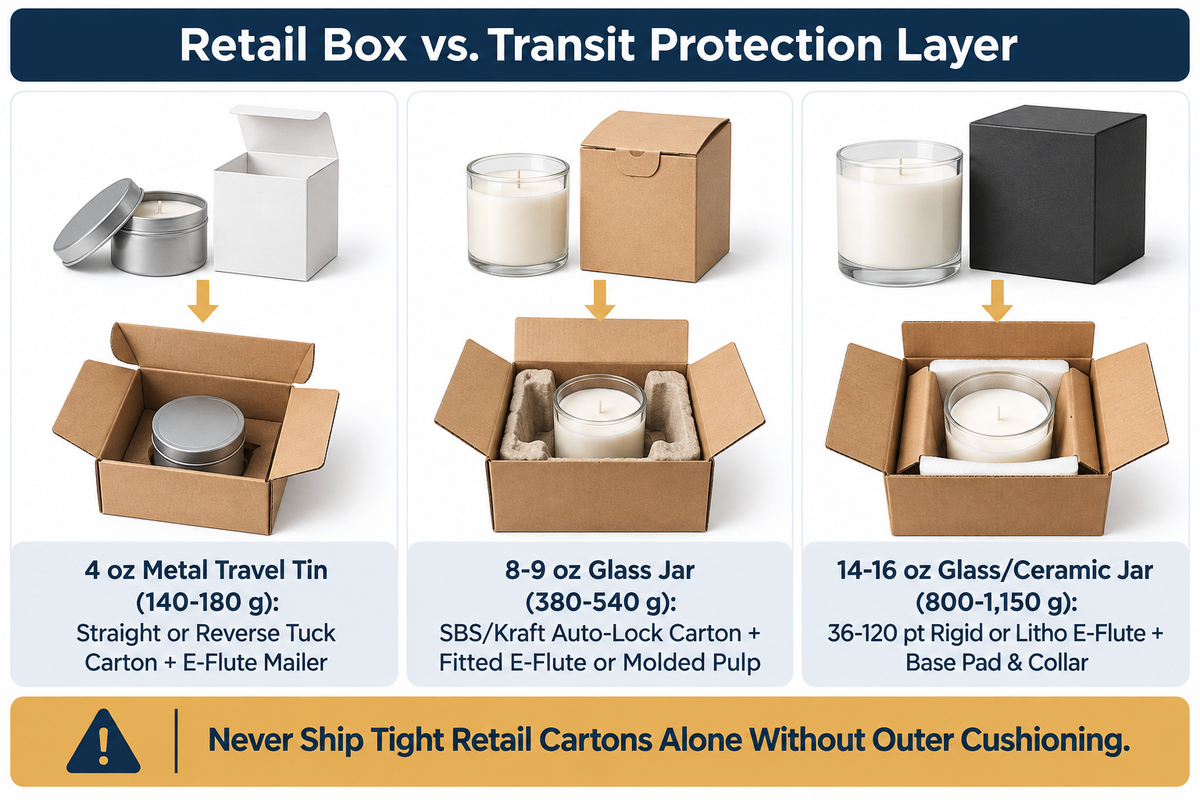
Candle boxes are secondary packaging structures built to stabilize, identify, and protect individual candles or home-fragrance sets. Retail boxes help achieve shelf branding as well as scent and warning clarity. Isolation of glass and ceramic vessels from drops, vibrations and stacking loads during transit is achieved through transit layers.
Some candle makers expect a decorative carton to perform dual functions. Glass jars weigh much more per cubic inch than cosmetics or dry goods. Ceramic rims also chip when a loose lid shifts during transportation. A tuck carton, as it’s often called, can provide a cosy fit to a boutique shelf, but can also create a stress-concentrating condition in the carton that leads to failure during parcel sorting. Separating shelf presentation from parcel protection helps reduce breakage claims and reduce tooling waste.
What Are the Best Boxes for Candle Packaging Across Vessel Types?
For lightweight travel tins and wax melt clamshells, use compact folding cartons. Choose lock-bottom cartons, litho-laminated E-flute boxes, or wrapped rigid boxes with fitted inserts for heavy glass jars and ceramic vessels. When selecting cartons for your vessels, take into account not only the total wax weight, but also the center of gravity and total mass of the filled vessel.
Home-fragrance lines use different formats for their containers. Seasonal and holiday releases, votive sets, and reed diffuser pairings each have different shape constraints. Table 1 shows the starting retail and shipping structures for eight common candle creations.
| Candle Vessel Format | Typical Filled Mass | Primary Retail Candle Box | Transit Protection Layer |
|---|---|---|---|
| 4 oz metal travel tin | 140–180 g (5–6 oz) | Straight or reverse tuck folding carton | Tape lid seam; ship in E-flute mailer with void control |
| 2–3 oz glass votive | 150–230 g (5–8 oz) | Straight tuck single carton or partitioned 3-pack box | Corrugated divider partition inside outer shipping carton |
| 8–9 oz glass candle jar | 380–540 g (13–19 oz) | SBS/kraft auto-lock carton or rigid drawer box | Fitted E-flute, molded pulp, or foam insert in outer shipper |
| 10–12 oz heavy glass jar | 550–750 g (19–26 oz) | Heavy auto-lock carton, litho E-flute, or rigid two-piece box | Full-suspension corrugated cradle or molded pulp cavity in shipper |
| 14–16 oz or multi-wick glass/ceramic jar | 800–1,150 g (28–40 oz) | Litho-laminated E-flute box or wrapped rigid box (36–120 pt) | Engineered base pad, top collar, and validated outer shipper |
| Pillar and sculpted handcraft candles | 250–650 g (9–23 oz) | Grease-resistant coated carton or window-patched rigid box | Wax-safe glassine wrap and snug collar protecting surface detail |
| Taper candle pairs and sets | 120–350 g (4–12 oz) | Long flat sleeve-and-tray carton or rigid drawer box | Stiff corrugated mailer preventing bending snaps |
| Wax melt clamshells & diffuser sets | 80–900 g (3–32 oz) | Window folding carton (melts) or partitioned rigid gift box (diffuser) | Separate bottle/reed cells inside leak-checked shipping carton |
If your vessels are already locked and you need an integrated retail-plus-transit build, take a look at our custom candle packaging solutions before finalizing your artwork panels.
Candle Box Styles Compared: Folding Cartons vs. Rigid Two-Piece, Drawer, and Window Boxes
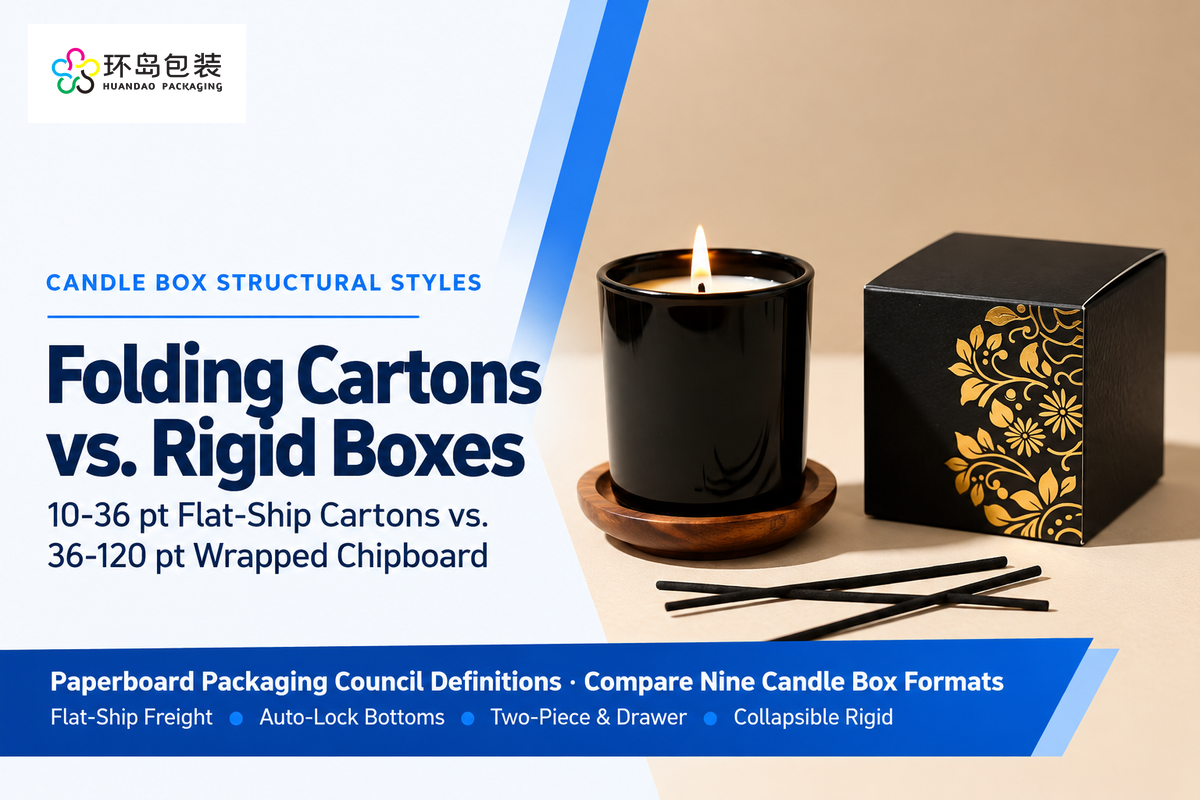
A 10 to 36 point folding carton outperforms rigid two-piece or drawer boxes for everyday retail lines, and space-limited warehouses. Folding cartons ship flat and reduce inbound freight. Rigid candle packaging (36 to 120 point wrapped board) is suitable for luxury gifting and heavy ceramic vessels.
“A type of paperboard packaging that folds flat for storage and shipping, folding cartons are made of 10 to 36 point board.” Board selection within that 10 to 36 point caliper band scales directly with jar mass.
“Rigid (set-up) boxes are made of thick 36 to 120 point board overlaid with a printed paper wrap. These boxes generally do not fold flat.”
Erected rigid boxes are popular among new brands for their visual appeal. Warehouse economics hurt because pre-assembled two-piece boxes ship mostly empty air, increasing inbound pallet volume and storage costs. On the other hand, flat-packed folding cartons, which are designed to be shipped flat, stack compactly on a single pallet. Magnetic rigid boxes, which are collapsible, let brands ship luxury packaging flat.
Check out our engineering guide for custom candle rigid boxes for a guide focused strictly on wrapped chipboard boxes. High volume shelf programs can also check out our folding carton structural specifications. Table 2 compares nine primary candle box packaging formats.
| Box Style | Board Class | Shipping Form | Multi-Scent Shared Structure | Best Fit & Structural Limit |
|---|---|---|---|---|
| Straight Tuck End (STE) | Folding carton (10–36 pt) | Flat-packed | High (same die, swap print plates) | Light tins, wax melts, small votives (<250 g); clean front edge |
| Reverse Tuck End (RTE) | Folding carton (10–36 pt) | Flat-packed | High (tight sheet nesting) | Economical light cartons; avoid for heavy glass jars |
| 1-2-3 Snap-Lock Bottom | Folding carton (10–36 pt) | Flat-packed | High (same die, swap print plates) | Mid-weight jars; slower manual folding than auto-lock |
| Pre-Glued Auto-Lock (Crash-Lock) | Heavier folding board (10–36 pt) | Flat-packed | High (same die, swap print plates) | Retail workhorse for standard glass jars; pops open fast |
| Window-Patched Carton | Folding board + PET or cutout | Flat-packed | Medium (window cutout fixed) | Colored wax or sculpted pillars; cutouts lower wall stiffness |
| Litho-Laminated E-Flute Box | E-flute + offset printed liner | Flat-packed | High (same die, swap top liner) | Heavy jars, multi-packs, and retail/DTC crossover mailers |
| Two-Piece Rigid Setup Box | Rigid board (36–120 pt) + wrap | Pre-assembled | High for same jar OD (shared core, swap wrap) | Luxury candle lines & candle gift boxes; high freight cube |
| Rigid Drawer (Matchbox) Box | Rigid board (36–120 pt) + ribbon | Pre-assembled | High for same jar OD (shared tray, swap sleeve) | Sliding unboxing for premium candle lines; tight sleeve tolerances |
| Collapsible Magnetic Rigid Box | Rigid board (36–120 pt) + magnets | Knocked-down flat | Medium-High (same core, swap wrap) | Luxury multi-jar gift sets shipping overseas; lower cube than erected rigid |
⚠️ When a Rigid Candle Box Works Against You
Skip rigid boxes in four scenarios. Always avoid them in small pilot runs under your offset converter’s minimum production batch. Avoid them when jar molds are not frozen. Rigid boxes become unnecessary when transit loads are absorbed by ecommerce outers. Lastly, rigid boxes become unnecessary when an “eco-friendly” brief does not include named fiber specifics.
How to Size Candle Boxes and Set Dieline Clearances Without Jar Rattling
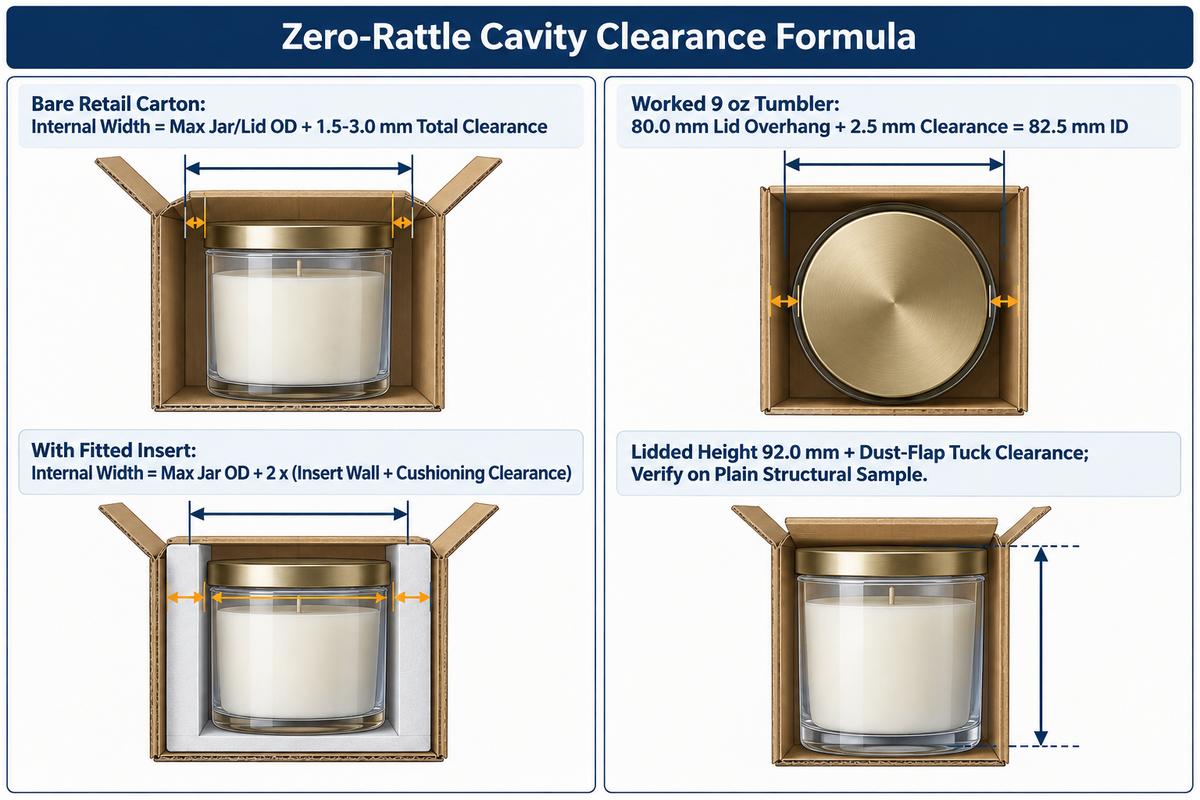
Size custom candle boxes from the widest outside diameter and lidded height measured across multiple filled jars, never from nominal wax weight. For bare retail folding cartons, add 1.5 mm to 3.0 mm (1/16 to 1/8 in.) of total width clearance. A plain structural sample must be used to demonstrate final fit.
Glass vessels vary from mold to mold in diameter, height, and verticality (often ±1.0 mm to ±1.5 mm across production lots). ASTM F2179 covers annealed glass thermal shock and stress, not jar diameter tolerances. Taking multiple measured, filled jars with lids captures true high-side diameter before dies are cut. When bare loading clearance leaves a tapered jar loose, add a folded paperboard collar or neck lock.
Use our Zero-Rattle Cavity Clearance Formula to define the internal dimensions (ID) of your prototype’s starting dimensions before requesting your CAD dieline.
- 📐Bare Retail Folding Carton (No Insert): Internal Width = Max Measured Jar or Lid OD + Total Loading Clearance (1.5–3.0 mm across full width, or 0.75–1.5 mm per side). Internal Height = Max Lidded Height + Dust-Flap Tuck Clearance.
- 📐Carton With Fitted Corrugated or Molded-Pulp Insert: Internal Width = Max Measured Jar OD + 2 × (Insert Wall Thickness + Engineered Cushioning Clearance). The Internal Height is equal to the Max Lidded Height plus Top/Bottom Cradle Depth sized to the chosen flute or pulp profile.
Worked 9 oz Glass Tumbler Example (Prototype Target): Suppose your candle business measures a batch of filled 9 oz jars with wooden lids installed. The widest lid overhang measures 80.0 mm across, and total height measures 92.0 mm. For a bare retail carton, adding 2.5 mm total width clearance gives an 82.5 mm internal width and depth. Internal height starts at 92.0 mm plus dust-flap tuck clearance checked against board thickness. With the addition of an E-flute suspension cradle, increase both the width and height to account for the wall of the folded insert and the engineered air gap. For formula outputs, treat all internal dimensions as prototypes. Final internal dimensions must be verified on a plain structural sample with filled production jars to check board thickness, flap intrusion, and lid friction.
How Can I Get Custom Sizes and Dielines for My Candle Boxes?
Send your converter five measurements for each vessel: maximum diameter of jar or lid, diameter of tapered base, total height with lid, weight when filled, and contact surfaces. Your engineer then draws a CAD dieline to enclose the ID. Specifying ID rather than OD gives the engineer the target to enclose the interior cavity for E-flute or Rigid Greyboard.
At Huandao Packaging, every structure review starts with the filled vessel rather than the artwork. Convert packaging dimensions using our Packaging Dimension Unit Converter, and enter details about vessels in the candle jar fit input planner. Keep critical logos and warnings within the safe zone, which is away from crease scores. Extend background colors to the outer bleed. For tapered tumblers, provide both rim and base diameters, so an internal collar can be placed to center the jar, and to avoid base kick-out.
Paperboard Thickness, Board Grades, and Bottom Styles for 8 oz to 16 oz Glass Jars
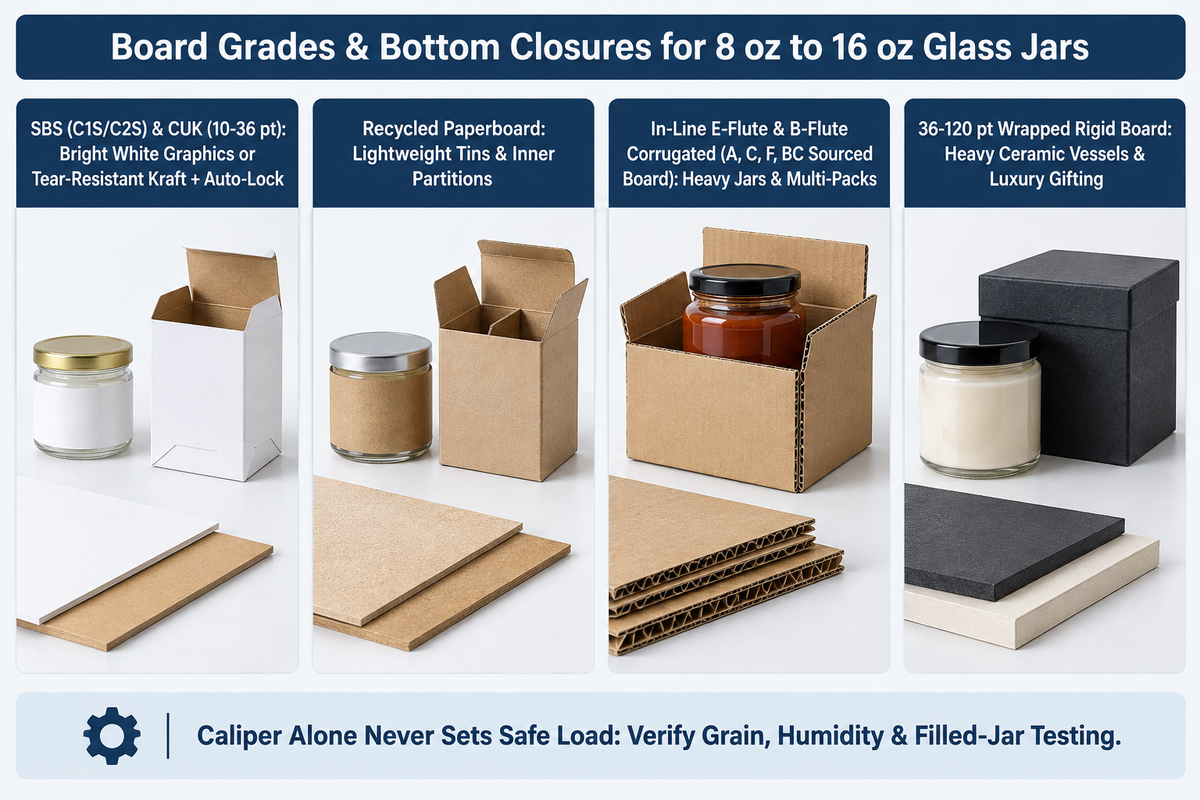
For 8 oz to 16 oz retail glass jar candles, converters test heavier 10 to 36 pt folding paperboards with pre-glued auto-lock bottoms. As the filled weight and base span increase, specifications step up to litho-laminated E-flute or 36 to 120 pt wrapped rigid boards.
The safe load capacity of a paperboard can’t be determined strictly by paperboard caliper. Factors such as grain direction, humidity, and physical tests with the filled vessel determine the strength of a board to be used. Plain reverse-tuck bottoms can flex under heavy glass loads when lifted from the upper walls, depending on jar mass, panel span, and flap engagement. An auto-lock bottom combined with stiff boards can alleviate concerns of bottom blowout. Refer to our Tuck-End Carton Closure Comparison for various flap styles.
SBS (C1S or C2S) prints exceptionally sharp graphics on bright white interiors for luxury candle packaging. Natural kraft paper and rustic brown kraft boards provide strong tear resistance from unbleached fibers, but transparent CMYK inks darken on brown stock without white ink. Recycled paperboard fits lightweight tins and inner partitions, where lower fiber stiffness suits the load. SBS, coated unbleached kraft (CUK), and recycled paperboard have varying densities; therefore, caliper (in mm or pts) and grammage (GSM) should be treated separately. Huandao Packaging runs an in-line corrugator that supplies single E-flute and single B-flute board just in time with zero board inventory, while A, C, F, and BC flute profiles come from sourced board. Use our Vessel-to-Structure Load Spec Map in Table 3 to pick prototyping baselines.
| Candle Size & Vessel | Approx. Filled Weight | Starting Board Class | Recommended Bottom Closure | Retail / Transit Insert Baseline |
|---|---|---|---|---|
| 4 oz metal tin | 140–180 g | Light folding board (C1S SBS or kraft) | Straight tuck end (STE) or RTE | Optional paperboard collar |
| 6 oz small glass votive | 250–340 g | Mid-weight folding board (SBS or kraft) | 1-2-3 snap-lock or auto-lock | Folded paperboard neck lock |
| 8–9 oz glass candle jar | 380–540 g | Medium-heavy SBS/virgin kraft or rigid drawer | Pre-glued auto-lock or rigid tray | Paperboard/E-flute cradle + outer shipper |
| 10–12 oz glass jar | 550–750 g | Heavy SBS/CUK folding board or litho E-flute | Pre-glued auto-lock bottom | Die-cut E-flute suspension insert or molded pulp |
| 14–16 oz single-wick glass jar | 800–950 g | Litho-laminated E-flute or wrapped rigid board | Corrugated auto-lock or rigid base | E/B-flute cradle or molded fiber cavity |
| 14–16 oz multi-wick wide jar | 900–1,150 g | Litho-laminated E-flute or wrapped rigid board (36–120 pt) | Reinforced corrugated or wrapped rigid base | Double-wall corrugated or molded pulp end-caps |
| Heavy ceramic / concrete vessel | 1,000–1,600 g | Heavy wrapped rigid greyboard (36–120 pt) | Fixed rigid setup base (non-tuck) | Engineered EVA/EPE foam or thick molded pulp |
| Multi-jar gift set (2–3 candles) | 800–2,000 g | Wrapped rigid box or litho B-flute | Rigid tray or interlocked corrugated base | Individual cell dividers blocking glass-to-glass contact |
Align board grain or corrugated flute vertically with the stacking load, and test loaded samples under real warehouse humidity before cutting bulk tooling.
Fitted Inserts, Dust Covers, and Ecommerce Candle Shipping Protection
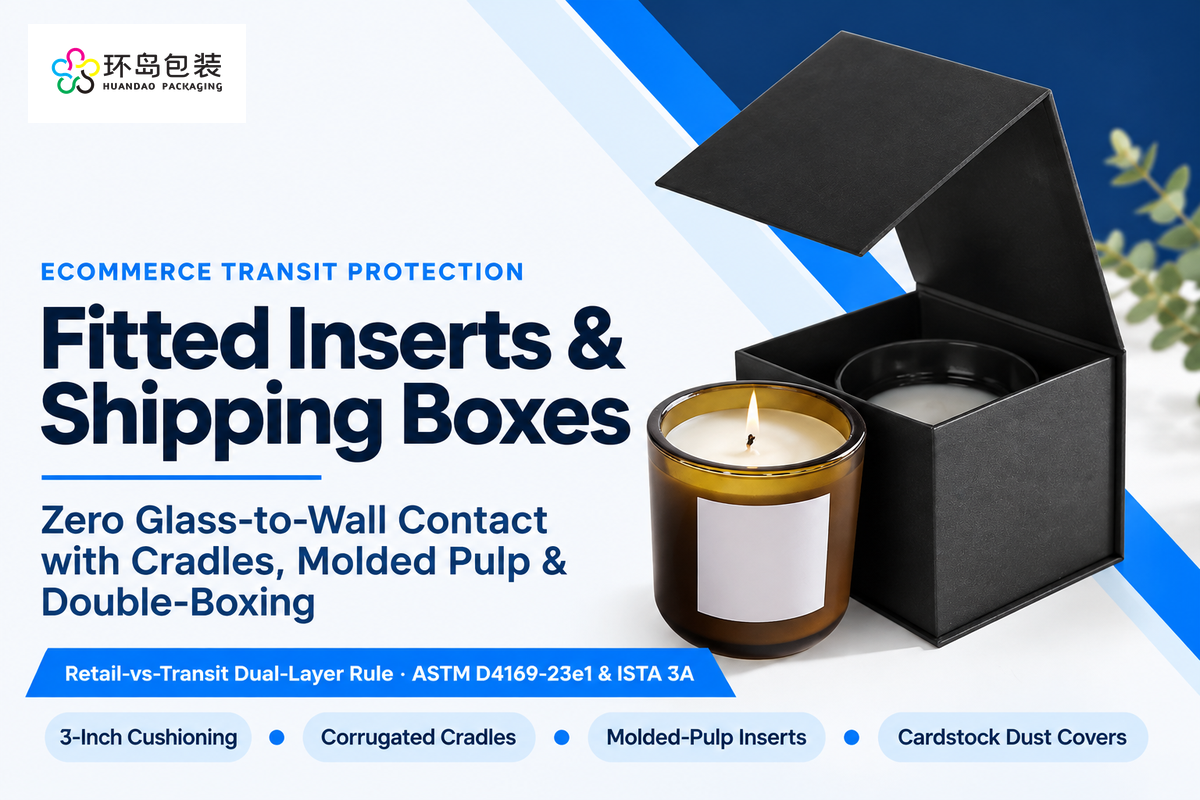
Apply our Retail-vs-Transit Dual-Layer Packaging Rule for parcel shipping: immobilize each lidded jar inside a fitted insert with zero glass-to-wall contact, then pack inside a corrugated outer shipper. Low-volume brands use double-boxing with 3 inches (76 mm) of cushioning. Production brands validate filled packs under ASTM D4169-23e1 or ISTA 3A.
“Double-box fragile items within a larger box and include 3” of cushioning in and around the interior box.”
“Wrap fragile products individually in a minimum 3″ thickness of air-cellular cushioning material, and then fill any empty spaces with loose-fill peanuts or other cushioning material.”
Candle-making forum discussions reveal two prevalent parcel mistakes. First, makers ship tight retail boxes alone with no outer cushioning. Second, buyers order wrong-sized packaging supplies because they forget to add cushioning around the decorative box. There are internal risks to glass too. Unsecured metal or wooden lids come loose during drops and chip the rim. Also, during cold, wintery transit, the wax can shrink from the glass, causing the wax plug to come loose. Loose lids should be secured with a piece of clean-peel tape or a shrink band. Seat cardstock dust covers flat over the wax to guard the candle wick and display candle care instructions.
Seal outer candle shipping boxes using FedEx’s H-tape method across the center seam and both end edges. Place carrier labels flat on the largest panel rather than across a taped seam. See our custom printed corrugated mailer boxes for more information on ecommerce mailers.
Do You Need Fitted Inserts for Glass Candle Shipping Boxes?
Glass and ceramic candles require cushioning and restraint during parcel transit. Proven options, validated on the complete filled shipping package, include fitted corrugated cradles, engineered double-box systems, molded-pulp inserts, and individual 3-inch cushioning wraps. Molded pulp designs in USPTO Patent US5335770A use suspension ribs, pods, cavities, and corner protectors to keep fragile jars away from carton walls.
Table 4 analyzes four protective packaging insert structures in terms of their engineering function, tooling profile, and recovery options.
| Insert Type | Primary Engineering Job | Tooling & Storage | Recyclability & Best Use |
|---|---|---|---|
| Folded paperboard collar / platform | Centers jar inside retail carton; limits rattle | Low steel-rule die cost; ships flat | Mono-material fiber; fits retail shelf cartons |
| Die-cut E-flute / B-flute corrugated cradle | Suspends jar away from all six walls; absorbs drops | Low-to-moderate die cost; ships flat | Curbside recyclable corrugate; workhorse for DTC candle shipping boxes |
| Molded pulp fiber tray / end-caps | Contoured 3D shock absorption around curved glass | Higher metal mold cost; nests densely | Plastic-free eco-friendly materials; scalable at mid-to-high volume |
| Die-cut EVA / EPE foam cavity | Tunable shock damping for heavy luxury ceramic/glass (depends on foam density, thickness, and bearing area) | Moderate die cost; bulky storage cube | Mixed-material (not curbside paper recyclable); high-value gift sets |
When fulfillment is through Amazon FBA, check fragile-glass drop prep rules before packing out the master carton.
Printing, Color Control, Decorative Finishes, and Preventing Scuff or Wax-Oil Failure
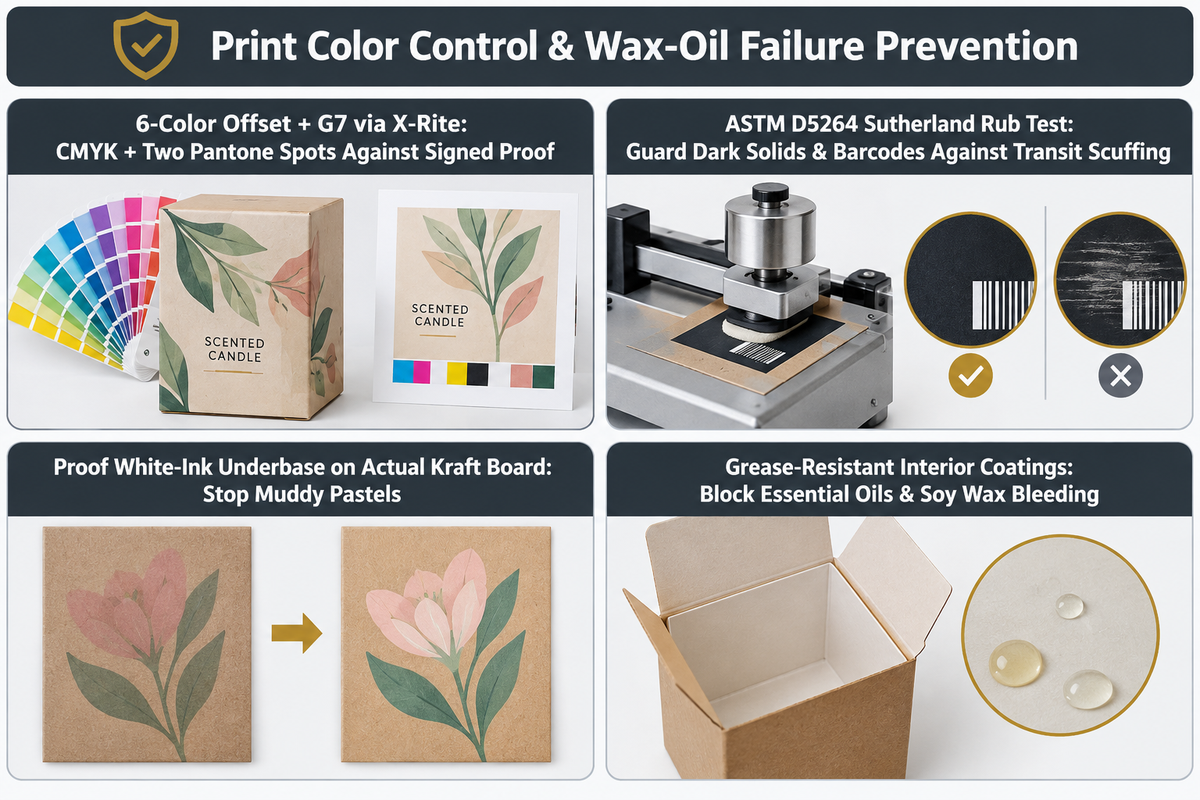
There are consistently uniform colors across scents in wholesale custom printed candle boxes through 6-color sheetfed offset printing with inline coating units. Printers run CMYK plus up to two Pantone spot colors calibrated via X-Rite to G7 against a signed proof and agreed Delta E. A rub-resistant coating is applied to dark solid areas.
Four production failures mar professional packaging artwork on candle cartons. First, transit scuffing spoils matte panel artwork. Second, transparent pastels print muddy on brown kraft paper without a white-ink underbase. Third, fragrance oils bleed into coatings. Finally, rigid lids bind when humidity changes. Offset printing offers Pantone accuracy at wholesale. Digital printing eliminates plate charges on short pilot runs. On unbleached kraft candle boxes, proof white-ink underbase opacity on actual kraft board rather than approving a digital screen. To guard dark solids and barcodes against shipping abrasion, specify an ASTM D5264 Sutherland Rub Test on printed samples.
Essential oils and soy wax residues soften standard varnishes or weaken hot-melt seams during warm storage. Specify grease-resistant interior coatings for unwrapped pillar candles or oily wax melts. Check chipboard moisture balance before sealing export containers so rigid lids don’t warp. Table 5 shows ten customization options available in sheetfed converting and the sample checks each finish requires.
| Finish / Process | Converting Route | Functional & Visual Effect | Pre-Production Sample Check |
|---|---|---|---|
| Gloss lamination | In-house film lamination | High sheen and wipe resistance against dust/oil | Check shelf glare and film recyclability impact |
| Matte lamination | In-house film lamination | Muted, refined sheen on luxury retail cartons | Check dark solids for rub marks and fingerprints |
| Soft-touch lamination | Specialty matte film | Velvet tactile grip on premium packaging solutions | Confirm ink-shift darkening and foil adhesion on film |
| Matte anti-scratch varnish | In-line press coater | Scuff resistance on dark boxes without plastic film | Verify ASTM D5264 rub cycles on printed sample |
| Spot UV coating | In-house UV coating | Gloss contrast over logos or scent names | Supply separate vector mask plate; check registration |
| Gold / silver foil stamp | Hot transfer foil stamping | Crisp metallic branding without full-sheet film | Approve brass/magnesium die and fine-line fill |
| Holographic foil stamp | Transfer foil stamping | Directional shimmer for seasonal gift launches | Check pattern seam repeat across front panel |
| Emboss | Raised relief tooling | Tactile raised logo on SBS or wrapped rigid lid | Review relief depth, board cracking, and back show-through |
| Debossing | Recessed relief tooling | Subtle pressed emblem on thick rigid wrap or kraft | Confirm chipboard compression depth without wrap tearing |
| Window patching | Die-cut + PET film or open | Displays jar label or allows retail scent sniffing | Check glue border, glass exposure, and panel rigidity |
Exact board grade, ink count, coating chemistry, tooling dies, and signed Delta E tolerances need to be written in spec sheets before plates are cut.
Candle Box Labeling Compliance, Sustainability Specs, and Packaging Test Boundaries
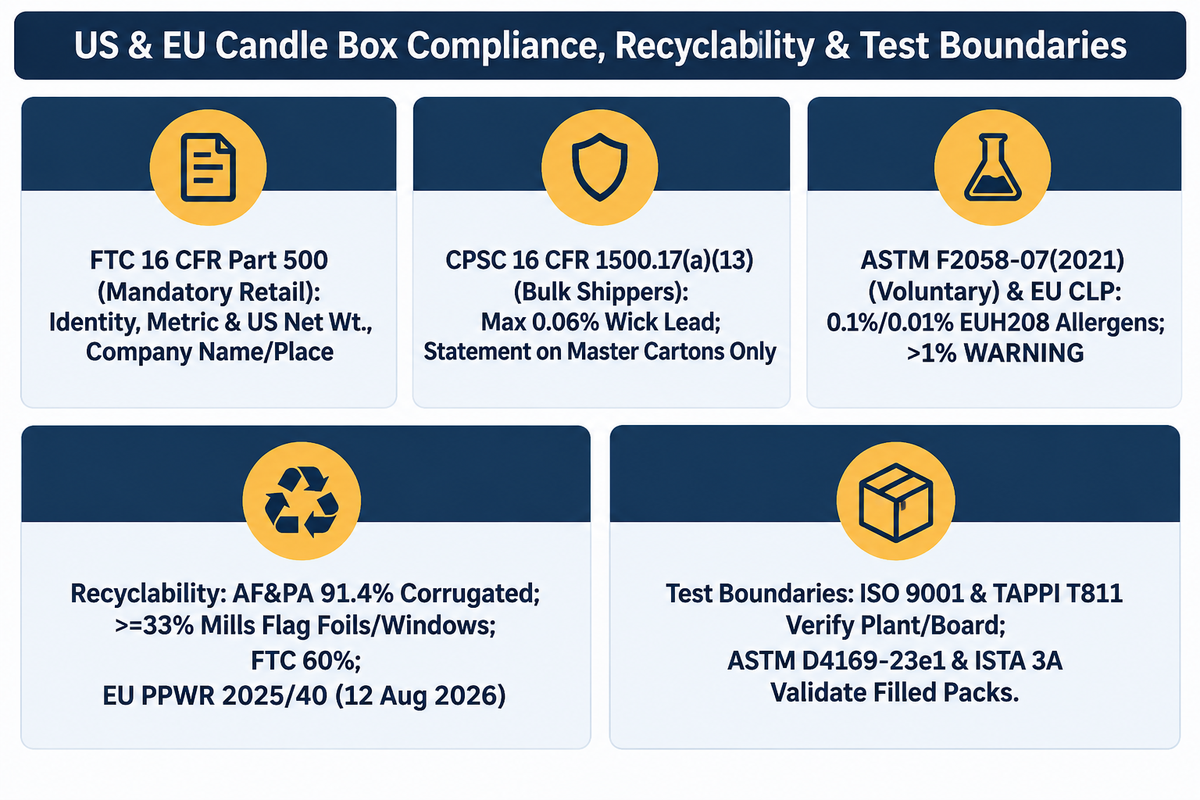
U.S. candle boxes sit under three distinct frameworks. FTC enforces mandatory Fair Packaging and Labeling Act (16 CFR Part 500) Net Weight and Identity Requirements on retail boxes. The CPSC limits lead in metal-cored wicks to 0.06% by weight (16 CFR 1500.17(a)(13), with labeling on bulk shippers only), while ASTM F2058-07(2021) addresses voluntary fire-safety warnings.
“Metal-cored candle wicks and candles that use such wicks must not contain lead in the metal core in excess of 0.06% by weight, per 16 CFR § 1500.17(a)(13).”
“Bulk shipments of metal-cored candlewicks and candles that use such wicks must have the statement ‘Conforms to 16 CFR 1500.17(a)(13)’ on the shipping package or outer wrapping as it is shipped to retailers. The label does not need to be on the retail packaging itself.”
U.S. Consumer Product Safety Commission (CPSC), Candles Business Guidance
Separating federal law from retailer-enforced voluntary standards prevents panel errors. Under 16 CFR Part 500, the retail display panel must list commodity identity (such as “Scented Candle”), net quantity in both metric and inch/pound units (“Net Wt. 9 oz / 255 g”), and the manufacturer, packer, or distributor name and place of business. CPSC has classified ASTM F2058 as a voluntary standard; however, major retailers and insurers expect unobstructed ASTM F2058 candle warning labels at the point of sale. Should an outer box cover the jar, affix a warning label on the outer box.
Scented candles, exported to the EU/Northern Ireland, require CLP Mixture Labelling. Per official HSENI CLP guidance, candles count as chemical mixtures on a wick carrier. Any sensitizing fragrance ingredient above 0.1% (subcategory 1B) or 0.01% (subcategory 1A) triggers the EUH208 allergen statement, even on unclassified candles. Total sensitizing fragrances above 1% trigger the exclamation-point pictogram, signal word WARNING, and skin-allergy statement. CLP text must stay firmly affixed and horizontally readable when the box rests normally on a shelf. Reserve clean rear-panel space in your dieline before graphic design starts.
Are Custom Candle Boxes Recyclable After Adding Lamination or Foil?
Plain paperboard cartons and cartons using hot, cold, or digital transfer foil stamping generally repulp cleanly, whereas plastic film lamination, polymer windows, and foil-laminated boards pose challenges for recycling mills. Repulpability alone doesn’t authorize the unqualified “Recyclable” claim on U.S. retail boxes.
The AF&PA Design Guidance for Recyclability reports a 91.4% U.S. recycling rate for corrugated packaging (2021). The guidance also mentions the FSEA/Georgia Tech study that demonstrated transfer foil stamping repulps cleanly in standard mills. By contrast, at least 33% of the surveyed mills flag laminated foils, polymer windows, and wet-strength resins as challenges for recycling. According to the FTC Green Guides, marketers must qualify recyclable claims when the available facilities serve fewer than 60% of the consumers or communities where the product is sold. Printing “Refillable” also requires the existence of an actual refill system. In Europe, the EU Packaging and Packaging Waste Regulation (Regulation (EU) 2025/40) repealed Directive 94/62/EC and applies from 12 August 2026, with recyclability-at-scale rules phasing in toward 2030. Instead of using vague labels, specify concrete eco-friendly packaging solutions. Consider FSC Chain of Custody fiber, aqueous matte varnish, die-cut scent openings in place of PET film, and mono-material paperboard and molded-fiber inserts.
Keep plant quality certificates, board lab sheets, and shipping-unit tests strictly separate in your RFQ. ISO 9001 certificates and material-level tests (TAPPI T811 ECT, burst, ASTM D5264 ink rub) verify process and board properties, not parcel drops. Complete filled shipping packs require ASTM D4169-23e1 or ISTA 3A validation. Table 6 defines each boundary.
| Qualification Layer | Governing Standard | What It Measures & Proves | Scope Boundary |
|---|---|---|---|
| Layer 1: Plant Process Control | ISO 9001:2015 / ISO 14001 / FSC CoC | Factory quality-management traceability, environmental controls, and fiber chain of custody | Audits plant consistency; separate from box load or parcel drop results |
| Layer 2: Run-Specific Board & Print QC | TAPPI T811 (ECT), Mullen Burst, ASTM D5264, Basis Weight | Short-column corrugated edge crush load, rupture resistance, printed rub durability, and board gsm on your production run | Verifies material and print conformance; separate from filled glass drop survival |
| Layer 3: Packaged-Unit Distribution Test | ASTM D4169-23e1 or ISTA 3A | Complete filled shipping unit tested across compression (12 lb/ft³ default unknown density; light-and-small <10 lb / 4.53 kg and <2 ft³ / 0.056 m³), drops, vibration, and climatic stress | Evaluates the complete jar + insert + shipper pack against defined acceptance criteria; reduces risk without guaranteeing zero breakage |
Custom Printed Candle Box Pricing, MOQ Tiers, Tooling Fees, and Lead Times
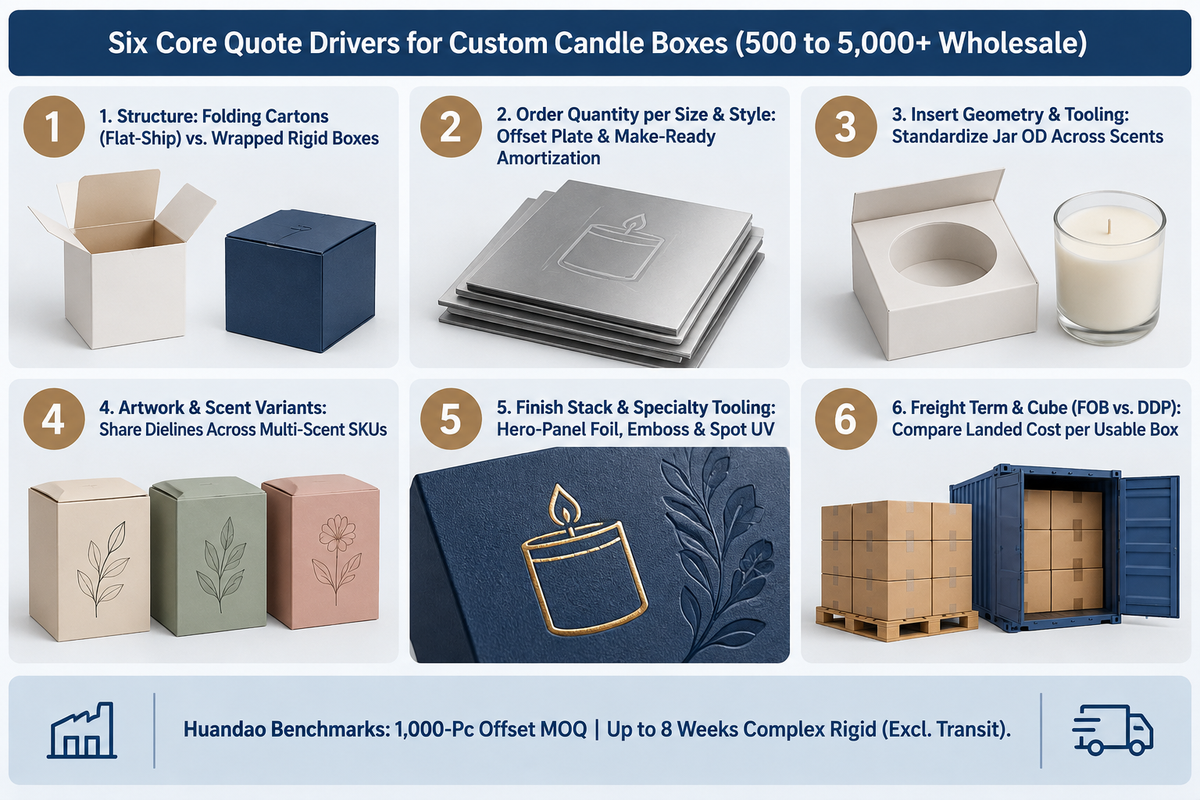
Custom candle boxes do not carry universal catalog prices or tooling charts because quotes depend on structure, board grade, SKU count, finishes, and Incoterms. Huandao Packaging sets standard offset MOQ at 1,000 pieces per size and style (smaller runs quoted case by case). Digital printers charge no plate fees for short pilot runs.
Why is there such wide variation in online quotes for 500 to 5,000 custom candle boxes wholesale? Headline per-box numbers rarely share identical scope. As Pro Carton’s carton production overview explains, offset printing requires separate plates per color, custom cutting and creasing dies, and multi-up sheet nesting. At low quantities, the costs of press make-ready and plates dominate per unit cost. At high quantities, these fixed costs are distributed over thousands of units. Digital presses fit small runs until offset unit economics take over. Compare quotes only when all line items are the same for board grade, print count, tooling for inserts and freight terms.
There’s one major cost lever for multi-scent candle lines, shared dielines. When six scents use the same glass jar, one cutting die and box dimension is shared for all six SKUs. You pay for one structural die and reuse one insert cavity. Extra costs are restricted to color plates and packing. Use our MOQ and SKU quantity calculator to see how SKU splits and order totals are impacted. Table 7 explains six major quote drivers.
| Cost Driver | Why Quotes Diverge | Practical Cost-Control Lever |
|---|---|---|
| Structure (folding vs. rigid) | Rigid boxes add wrapped greyboard, hand assembly, and larger pallet volume | Reserve rigid candle packaging for flagship gift sets; run folding cartons on core SKUs |
| Order quantity per size/style | Offset make-ready and plates amortize per unique die and artwork run | Use digital short runs for small tests; consolidate volume into offset runs at scale |
| Insert geometry & tooling | Separate die-cut cradles or molded pulp molds are often omitted from base quotes | Standardize jar OD across scents so one insert die serves multiple SKUs |
| Artwork & scent variants | Each scent colorway requires plate swaps, proofs, and segregated packing | Share common outer graphics plus scent-specific front candle labels on micro-runs |
| Finish stack & specialty tooling | Foil stamping and embossing add metal dies; spot UV adds coating plates; window patching adds die-cut and film passes | Apply foil or emboss only on hero front panels rather than all six faces |
| Freight term & cube (FOB vs. DDP) | FOB quotes cover loading at the named origin port (excluding ocean freight and duty), while DDP covers delivery to the named destination | Compare landed cost per usable box on the same delivery basis (adding freight and duty to FOB quotes) |
How Long Does Production Take for Custom Candle Boxes Wholesale?
Huandao Packaging recommends allowing up to 8 weeks after final proof approval for complex rigid candle packaging, excluding ocean or air transit. Production timing starts only after vessel dimensions, dieline, board grade, artwork, signed contract proof, packing spec and commercial terms are frozen—never on inquiry day.
Two sample gates should be incorporated in your launch schedule. First, a plain unprinted structural sample should be tested to verify clearance and drop restraint with jars fully loaded. Second, approval of a printed pre-production sample and a signed contract proof should be obtained to lock G7 and Delta E targets. Skipping the plain sample to save a week often results in multi-week rework when lids bind or base flaps bow.
How to Evaluate Custom Candle Box Manufacturers for Small-Batch vs. Wholesale B2B Programs
Ranked vendor lists shouldn’t be relied upon to determine the right converter type for order volume. Small businesses running short pilot tests can use local digital printers who charge no plate fees. Wholesale programs ordering 1,000 or more boxes bulk per size and style can get a quote from offset plants for custom structures and consolidated freight.
Many top-ranking pages for candle packaging boxes wholesale are online brokers rather than factories. Brokers simplify small digital orders, yet on complex custom runs they add margin and slow structural revisions. Audit any prospective plant with four direct questions. First, ask about the type of presses run in the plant (offset or digital), and about the corrugated flutes run in-line versus sourced board. Also verify how ISO 9001 or ISO 14001 tracking works, and whether run-specific lab reports (ECT, burst, ASTM D5264 ink rub, basis weight) come from an in-house lab or third-party facility.
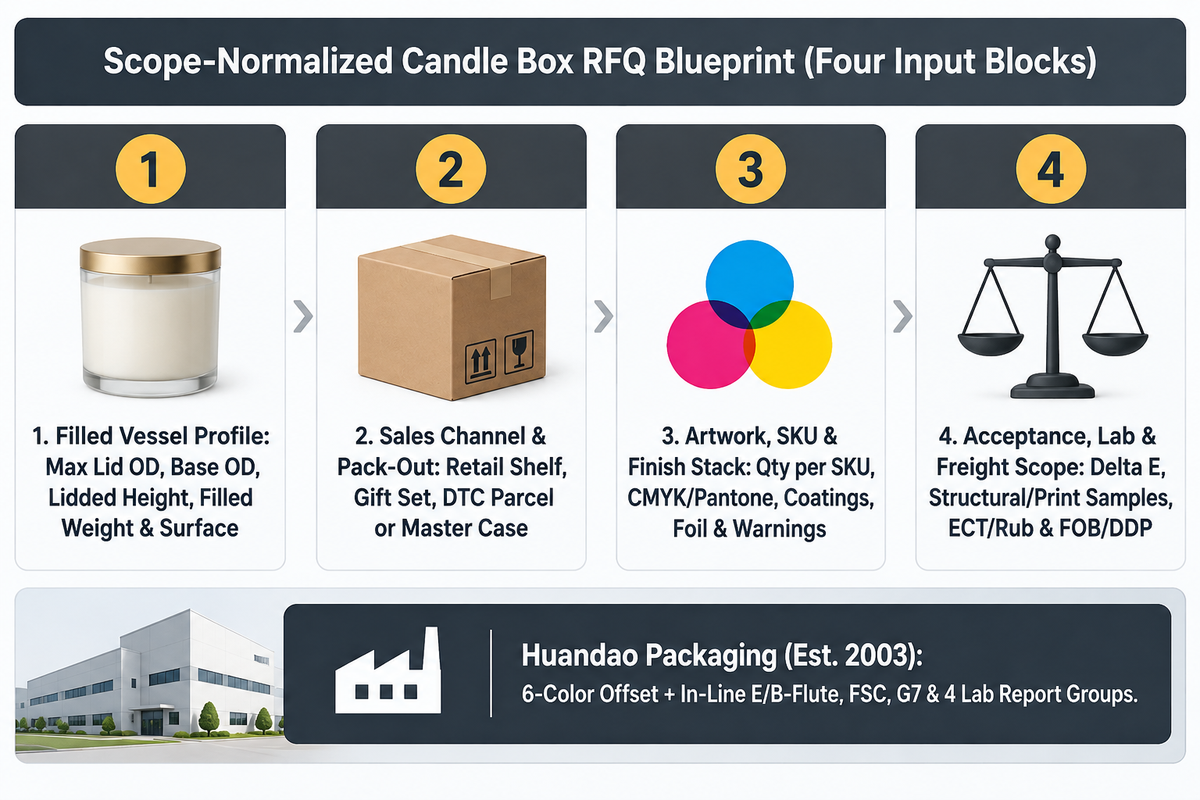
For wholesale buyers considering a direct factory partner, Xiamen Huandao Packaging Technology Co. Ltd. (established in Xiamen in 2003) runs a six-color sheetfed offset press with an in-line coating unit and in-line E/B-flute corrugating. The plant offers FSC Chain of Custody fiber, G7 color control, full customization, and 4 run-specific lab report groups. Offset print production requires a minimum of 1,000 units per unique box size and structure, and smaller trial batch orders receive custom individual quotes. Color accuracy is compared to signed proofs, and landed cost is assessed against normalized quotes.
Where Can I Source Wholesale Candle Boxes With Consolidated Inserts and Shippers?
Coordinate retail boxes, paperboard or corrugated inserts, and matched outer shipping cartons through one packaging partner. Splitting them up across three vendors can cause tolerance mismatches, resulting in delivery of parts that don’t nest. One manufacturer can lock in clearances, and ship everything in a single consolidated load.
Hone your inquiry with our Scope-Normalized Candle Box RFQ Blueprint in Table 8. Assess your intake file prior to approaching plants with the candle packaging RFQ readiness checker.
| RFQ Input Block | Exact Data to Supply | Why It Prevents Rework & Hidden Fees |
|---|---|---|
| 1. Filled Vessel Profile | Max OD (with lid overhang), base OD, total height, filled weight, glass/ceramic/tin surface | Locks cavity clearance, insert contact points, and load-bearing bottom closure |
| 2. Sales Channel & Pack-Out | Retail shelf, gift set, DTC parcel, distributor master case, or mixed route | Defines retail board class separately from outer shipper and cushioning specs |
| 3. Artwork, SKU & Finish Stack | Quantity per SKU, CMYK/Pantone count, varnish/lamination/foil/emboss, candle labels & warnings | Normalizes plate changeovers, tooling charges, and panel real estate across quotes |
| 4. Acceptance, Lab & Freight Scope | Target Delta E, structural + printed sample stages, run lab tests (ECT/burst/rub), FOB or DDP port | Turns subjective quality expectations into inspectable pass/fail release criteria |
Prepared to transition vessel measurements to structural reviews and normalized quotes? Submit your filled jar specs, channel, and SKU quantities on our custom candle packaging page. Our engineers can provide you with sample structural plans and quotes.
Frequently Asked Questions About Candle Boxes
Q: How do you make a custom candle box from vessel measurements to finished carton?
Measure filled jars with lids attached to set box internal dimensions. Also draft a CAD dieline showing fold lines, score lines, bottom locks, and glue lines.
Cut and crease the board along the score lines, fold the panels, and glue the side seam and auto-lock base. Also, make a structural sample to test before releasing mass production.
Q: How do you measure a glass candle jar for a custom box?
Measure 5 to 10 filled production jars with lids installed using digital calipers, recording the widest outside diameter (including any lid overhang), tapered base diameter, and total vertical height in millimeters.
For your box converter, use internal dimensions, and set prototype allowances using the formula above for the Zero-Rattle Cavity Clearance, and only then confirm the fit to a plain structural sample.
Q: What paperboard thickness prevents a heavy candle jar from breaking through the bottom?
Increasing weight requires stepping up to thicker grades of paperboard, such as litho-laminated E-flute or 36-120 pt wrapped rigid board. Pair heavy glass jars with pre-glued auto-lock bottoms.
With heavy glass items, avoid using plain, straight-tuck, or reverse-tuck bottoms. Be aware that strength also depends on grain direction of the material, humidity, and other factors. Confirm load behavior on a physical sample.
Q: Are custom candle boxes recyclable?
Paperboard candle boxes, when aqueous varnished or transfer foil stamped, generally allow for clean repulping, but plastic film laminations, and polymer windows can hamper the process.
FTC Green Guides, and EU PPWR boundaries, as detailed in the Sustainability section above, should be taken into consideration before unqualified ‘Recyclable’ claims are printed.
Q: Can a retail folding candle box be shipped directly through parcel carriers without an outer box?
No, a standard retail folding carton isn’t designed to absorb the impacts of an automated conveyor or a drop by a courier.
For small parcel runs, follow FedEx’s 3-inch double-boxing cushion guideline and H-tape sealing detailed in the transit section above. Larger DTC brands validate custom corrugated or molded-pulp inserts as part of a complete filled shipping pack under ASTM D4169-23e1 or ISTA 3A.
Q: What is the minimum order quantity for custom printed candle boxes?
Offset production at Huandao Packaging starts at 1,000 boxes per size and style, while smaller trial batches receive custom case-by-case quotes.
Local digital converters can run small pilot batches without printing-plate fees, while larger offset runs spread the cost of printing plates and cutting-die setup.
Q: What warning labels are required on candle boxes sold in the US and EU?
Retail boxes sold in the U.S. must feature FTC 16 CFR Part 500 commodity identity, dual metric and inch/pound net weight, and company name/location, plus voluntary ASTM F2058 fire warnings expected by retailers.
CPSC’s mandatory 16 CFR 1500.17(a)(13) wick-lead statement belongs on bulk master shipping cartons rather than retail boxes. EU and Northern Ireland exports, follow the CLP allergen and WARNING thresholds as covered in the compliance section above.
About This Candle Box Specification Guide
This technical packaging reference has been drawn up by the engineering team of Xiamen Huandao Packaging Technology Co., Ltd., using verified U.S. CPSC, FTC, ASTM, TAPPI, Paperboard Packaging Council, AF&PA, FedEx, and EU PPWR/CLP standards. Technical review by Xiamen Huandao Packaging Technology Co., Ltd.
References & Sources
- What is Paperboard Packaging? Paperboard Packaging Council
- Candles Business Guidance (16 CFR § 1500.17(a)(13) & Voluntary ASTM Standards) U.S. Consumer Product Safety Commission (CPSC)
- Fair Packaging and Labeling Act: Regulations Under Section 4 (16 CFR Part 500) U.S. Federal Trade Commission (FTC)
- Environmental Claims: Summary of the Green Guides U.S. Federal Trade Commission (FTC)
- Candles and CLP (Classification, Labelling and Packaging) Health and Safety Executive for Northern Ireland (HSENI)
- Packaging and Packaging Waste Regulation (PPWR, Regulation (EU) 2025/40) European Commission
- Design Guidance for Recyclability (with FSEA / Georgia Tech Transfer Foil Repulpability Study) American Forest & Paper Association (AF&PA)
- Packing Breakables 101 FedEx
- Changes to ASTM D4169: A Brief Guide (ASTM D4169-23e1) Smithers
- TAPPI T811 Edge Crush Test (ECT) Gaynes Labs
- The Sutherland Rub Test: ASTM D5264 Package Compliance Labs
- Molded Pulp Fiber Interior Package Cushioning Structures (USPTO US5335770A) United States Patent and Trademark Office
- Carton Production Overview Pro Carton (European Association of Carton and Cartonboard Manufacturers)