Get in Touch with Xiamen Huandao Packaging Technology Co., Ltd.

Updated November 2026 | Technical Engineering & Procurement Guide
Ecommerce packaging is a transit-engineered packaging method made to deliver each order smoothly through high-speed parcel automation, from warehouses to buyer doorsteps. Effective e-commerce packaging pairs right-sized corrugated fiberboard or flexible mailers with internal restraint. This setup helps orders survive conveyor drops, mixed-load stacking, and dimensional weight billing without unnecessary shipping costs.
Selecting the wrong shipping box creates hidden margin leaks across fulfillment centers and ecommerce fulfillment teams. All ecommerce business teams balance unit cost, freight, and breakage. Even 0.25 inches past a carrier rounding threshold can bump billable weight up by one or more pounds.
Poorly matched packaging boxes also invite crushed-corner returns that wipe out small unit savings.
To keep products in transit intact and deliver a clean first impression, buyers need e-commerce boxes engineered around real courier forces. This guide breaks down FEFCO constructions, corrugated packaging versus flexible mailers, flute and ECT grades, dimensional weight math, internal cushioning, transit validation, print durability, 2026 to 2030 regulations, and how to create packaging specs for bulk sourcing.
Key Takeaways for Ecommerce Packaging Engineers and Buyers
- Separate structure from strength: FEFCO 0427 mailers and FEFCO 0201 regular slotted cartons define blank folding geometry, while board grade (32 ECT, 44 ECT, or 200# Mullen) and warehouse humidity govern stacking survival.
- Right-size exterior dimensions first: parcel carriers round fractional outside box measurements upward to the next whole inch, making tight box sizing the fastest lever for lower freight bills.
- Match testing to your fulfillment route: use TAPPI board tests for raw sheet specs, ISTA Procedure 3A for general parcel carriers, and Amazon SIPP (ISTA 6-Amazon) for overbox-free FBA shipping.
- Prepare for binding 2026 to 2030 rules: upcoming EU Packaging and Packaging Waste Regulation empty-space limits, US state producer-responsibility reporting, and FTC recyclability thresholds directly affect oversized and mixed-material boxes.
Quick Specs: Ecommerce Packaging Engineering Benchmarks
| Primary Outer Corrugated Standards | FEFCO 0427 (self-locking mailer), FEFCO 0201 (RSC), 12th edition FEFCO Code |
| Inner Retail Paperboard Grades | Solid paperboard folding cartons and thick chipboard rigid boxes (packed inside shipping outers) |
| UPS US DIM Weight Rules | Upward whole-inch rounding; Daily and Retail rate divisors; max 150 lb and 108 in length |
| Parcel Transit Validation Scope | ISTA Procedure 3A (individual parcel limit) and Amazon SIPP / ISTA 6-Amazon |
| EU PPWR Empty-Space Rule | Article 24 maximum empty-space cap under Regulation (EU) 2025/40 (details in compliance section) |
What Is Ecommerce Packaging and How Does Parcel Transit Differ From Retail?
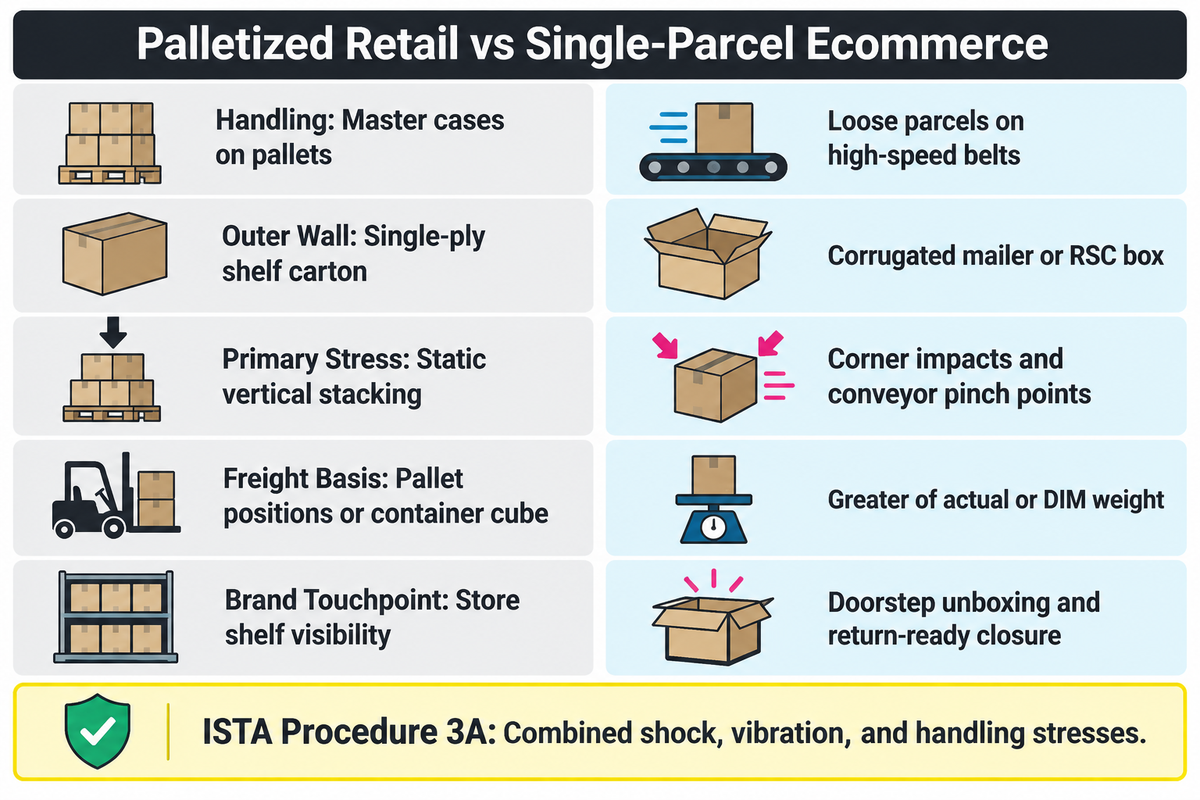
Ecommerce packaging supports single-order shipments within high-touch parcel networks that move each box loose on automated sorters, compared to retail packaging that moves unitized in stretch-wrapped pallets. Shipping a thin single-ply retail folding carton on its own through parcel carriers increases the risk of corner crush, seam splits, and breakage for fragile items without a protective shipping outer.
Understanding this physical gap prevents a costly launch mistake. Don’t use a retail shelf carton as a courier shipping carton. Your ecommerce box packaging must protect your product when an ecommerce product is shipped through automated belt transfers, chute drops, uneven van stacking, sustained vibration, and humid storage.
Within retail distribution, the same interior folding cartons are transported within master corrugated containers secured onto forklift-handled pallets. For DTC fulfillment, the outer shipping container delivers both structural integrity and your brand name at each transfer location in the entire network. Your shipping container also acts as your first physical brand identity touchpoint at the end consumer’s door. According to ISTA Procedure 3A guidelines, individual parcel shipments face combined shock, vibration, and handling stresses that differ fundamentally from unitized pallet freight.
| Distribution Factor | Palletized Retail Packaging | Single-Parcel Ecommerce Packaging |
|---|---|---|
| Handling Unit | Uniform master cases locked on pallets | Individual parcels sorted loose on high-speed belts |
| Typical Outer Wall | Single-ply paperboard shelf carton inside master case | Corrugated mailer, RSC shipping box, or reinforced flexible mailer |
| Primary Stress Mode | Static vertical pallet stacking in storage | Corner impacts, conveyor pinch points, uneven top loads, scuffing |
| Freight Billing Basis | Pallet positions, LTL class, or container cube | Greater of actual weight or carrier dimensional weight |
| Brand Touchpoint | Store shelf visibility alongside competitors | Doorstep unboxing experience and return-ready closure |
What is the difference between packaging and packing?
Packaging is an engineered package system (boards, inserts, printed matter, etc.) that surrounds a product. Packing is the warehouse workflow of putting items into containers, adding cushioning, sealing the seams, and labeling cartons for couriers.
Separating the two issues puts more diagnostic power into the decision. A packaging defect implies a board grade that is underspecified, fragile flap geometry, or inadequate dieline tolerances. A packing defect reveals an incorrect carton selection at the bench, faulty tape job, or inadequate protective packout around glass.
Ecommerce Packaging Types: Corrugated Mailers, RSC Cartons, Folding Cartons, and Rigid Boxes
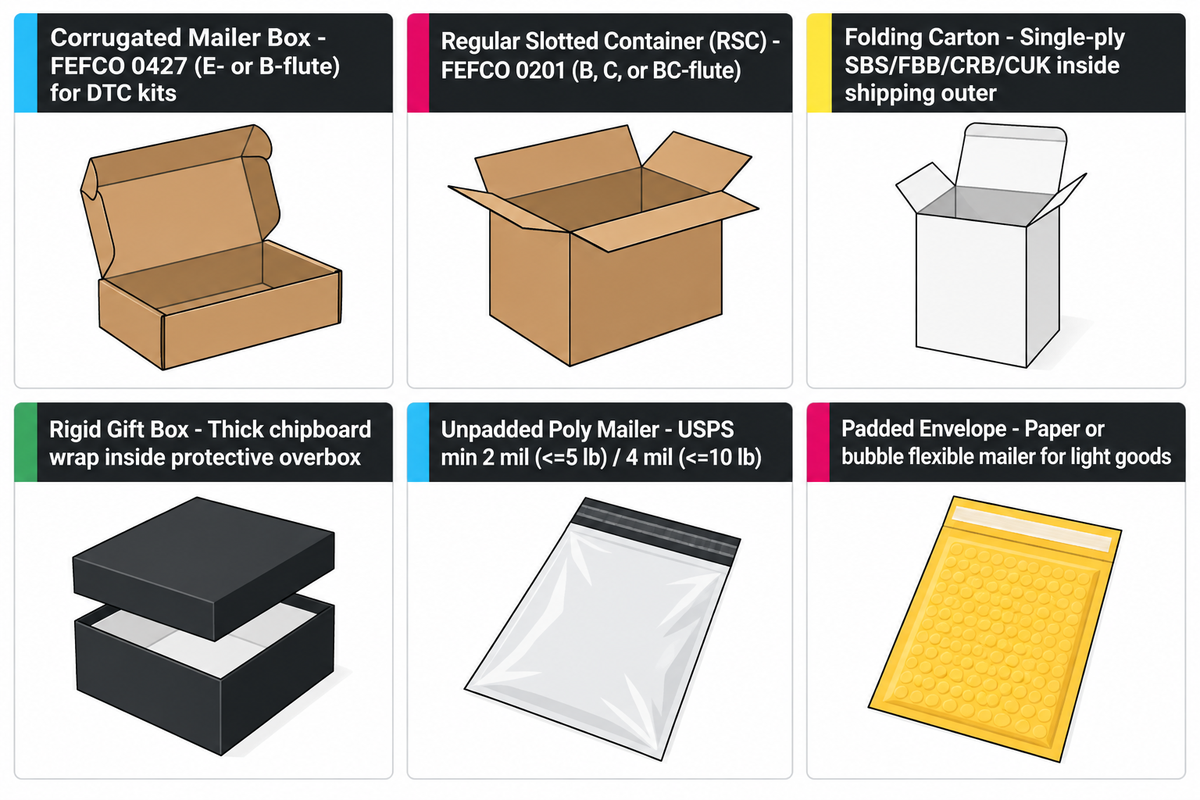
Ecommerce parcel styles are based on four varieties of regular paperboard boxes and a flexible mix of poly and padded mailers. Corrugated mailers (FEFCO 0427) are suitable for neat DTC kits, standard slotted containers (FEFCO 0201) for bulkier multi-piece loads. Folding cartons and rigid gift boxes are usually inner containers inside shipping outers unless the full pack passes transit validation.
Adopted globally by the International Corrugated Case Association (ICCA), the FEFCO International Fibreboard Case Code replaces ambiguous verbal descriptions with standardized four-digit structural codes across factories worldwide.
“The 12th version of the FEFCO code reflects the developments in the corrugated industry, new technologies, market changes and more than a hundred new designs, including a new series related to retail and e-commerce.”
– FEFCO (European Federation of Corrugated Board Manufacturers), Official FEFCO Code Overview
Buyers comparing self-locking DTC styles can check our custom corrugated mailer box engineering guide for FEFCO 0427 roll-end fold allowances. Many e-commerce brands order custom ecommerce boxes or dual-purpose corrugated mailers that act as both presentation box and shipping outer. Teams pairing an inner retail carton with an outer case can review solid paperboard grades in our folding carton packaging guide.
Use the following ecommerce packaging spec matrix to compare the four corrugated and paperboard box families and flexible mailers by payload weight, fragility, and branding objectives before choosing ecommerce packaging boxes for your packaging solution.
| Packaging Format | Reference Code / Structure | Best-Fit Ecommerce Application | Limitations / Not Suitable For |
|---|---|---|---|
| Corrugated Mailer Box | FEFCO 0427; E- or B-flute | Subscription kits, cosmetics, electronics, branded DTC unboxing | Heavy bulk loads above single-wall ECT limits; custom sizes may need a cutting die unless using stock tooling or digital cutting |
| Regular Slotted Container (RSC) | FEFCO 0201; B-, C-, or BC-flute | Multi-SKU warehouse fulfillment, heavy goods, deep cushioning space | Needs tape on top and bottom flaps; plainer unboxing without custom inserts |
| Folding Carton (Inner Primary) | Single-ply solid paperboard (SBS, FBB, CRB, CUK) | Primary retail carton packed inside a corrugated outer shipping box | High crush and tear risk if shipped solo through automated parcel sorters |
| Rigid Gift Box (Inner Premium) | Thick greyboard / chipboard + printed paper wrap | High-margin luxury, jewelry, and gift kits inside a protective overbox | High inbound storage cube (unless collapsible) and scuff-prone without an overbox |
| Unpadded Poly Mailer | USPS min 2 mil (≤5 lb) / 4 mil (≤10 lb) | Apparel, soft textiles, and compressible non-breakable goods | Zero crush or stacking protection for glass, rigid cartons, or sharp items |
| Kraft or Bubble Padded Envelope | Paper-cushioned or bubble-lined flexible mailer | Lightweight accessories, books, and low-fragility small parts | Light scuff cushioning only; bends under heavy stacks and lacks rigid wall protection |
What are the four types of packaging used in parcel fulfillment?
Parcel fulfillment organizes packaging into four functional layers: primary product packaging touching the item, secondary inner presentation packaging, tertiary outer shipping containers built for carrier handling, and ancillary sealing or cushioning components such as inserts and tape.
By mapping every SKU through all four layers of pack design, you can visualize where any two layers could be assembled together without creating friction. A fitted FEFCO 0427 corrugated mailer routinely combines outer shipping and secondary presentation for space-efficient DTC kits. Fragile glass bottles still need a primary container, an internal cradle, and a cushioned outer RSC.
Corrugated Mailer Boxes vs Poly Mailers and Padded Envelopes: Protection, Cost, and Recyclability
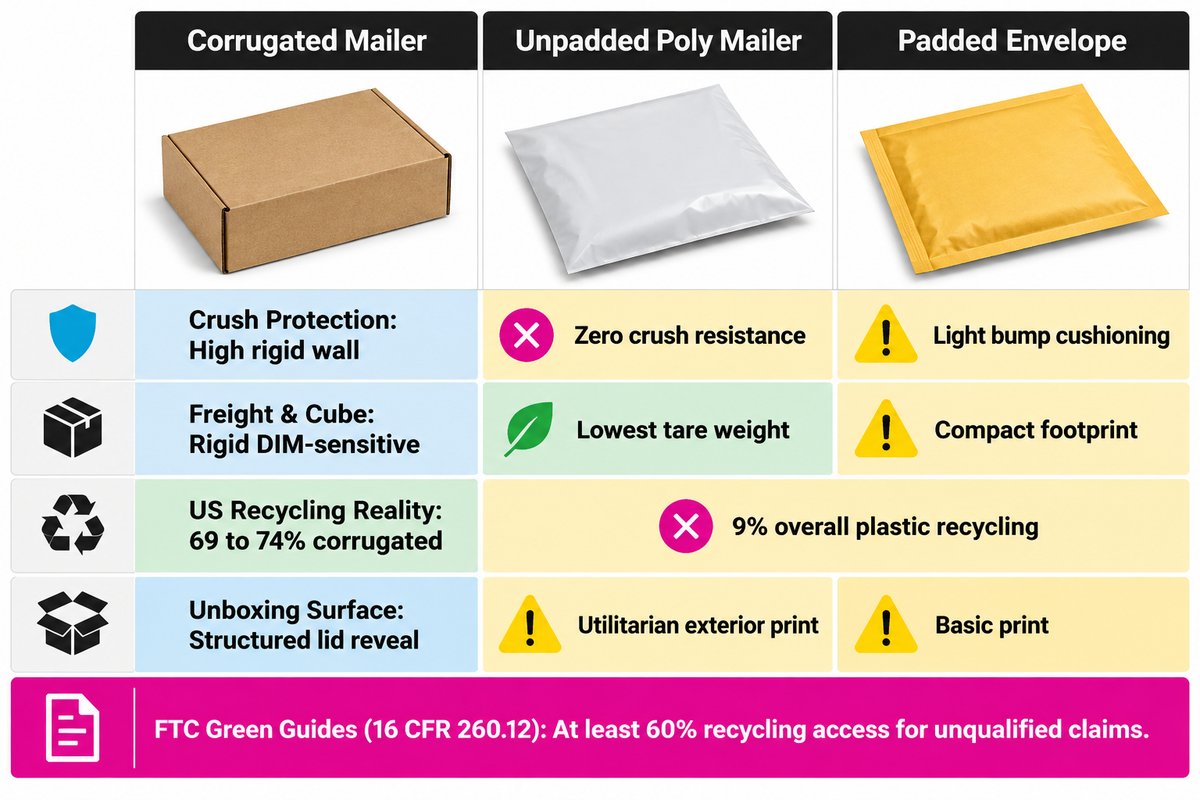
Corrugated mailer boxes protect rigid or fragile goods in perfect condition and support customer satisfaction, while poly mailers remain the most cost-effective choice for compressible apparel. Under US FTC Green Guides (16 CFR 260.12), unqualified recyclable claims require recycling access for at least 60 percent of consumers, and limiting components must be qualified.
Across US distributor catalogs, stock unpadded poly mailers occupy the lowest unit-cost tier, padded envelopes sit in the middle, and custom corrugated mailers cost more upfront depending on size, board grade, and print volume. For USPS parcel shipments, EcoEnclose’s USPS packaging requirements summary specifies that poly mailers must be at least 2 mils thick for orders up to 5 pounds and 4 mils thick up to 10 pounds.
A single industry damage-rate standard isn’t valid for all SKUs in transit, since breakage is based on product fragility, drop height, void fill, and mail center sorting. Still, buyers can test unit economics with one simple formula: divide the added box-and-insert cost per shipment by your full replacement cost per damaged order (product cost plus reshipment postage and handling). As long as a stiff, corrugated mailer prevents damage at a rate greater than that breakeven point, the more expensive box makes good economic sense.
| Evaluation Dimension | Corrugated Mailer Box | Unpadded Poly Mailer | Padded Envelope (Paper / Bubble) |
|---|---|---|---|
| Crush & Puncture Protection | High rigid wall protection against stacking and conveyor impacts | Moisture and tear barrier only; zero crush resistance | Light scuff and bump cushioning; bends under heavy parcels |
| Freight & Cube Profile | Rigid dimensions subject to carrier DIM weight if oversized | Lowest tare weight and minimal cube for soft textiles | Compact footprint; slightly heavier than unpadded poly |
| Recycling Stream Reality | Uncoated or aqueous-coated corrugated enters paper streams where accepted (Packaging World reports 69 to 74% US corrugated recycling); plastic film lamination restricts repulping | Excluded from most residential curbside bins; clean PE film relies on retail drop-off programs where available (separate from overall 9% US plastic recycling) | All-paper padded mailers enter paper streams where accepted; glued paper-plus-plastic bubble mailers are rarely recyclable together |
| Unboxing & Brand Surface | Structured lid reveal, interior print, fitted paper inserts | Utilitarian exterior print only; creases in transit | Basic exterior print; limited presentation structure |
⚠️ Recyclability Qualification Boundary (16 CFR 260.12)
Do not treat every corrugated box as automatically recyclable in every market. As per US FTC Green Guides (16 CFR 260.12), unqualified recyclable claims are only permissible when consumer or community access to recycling facilities is at least 60 percent in their retail markets. Any component that hinders repulping, such as heavy plastic film lamination or glued mixed-material windows, requires clear qualification.
Corrugated Flute Profiles and Board Strength: E-Flute vs B-Flute and 32 ECT vs 44 ECT
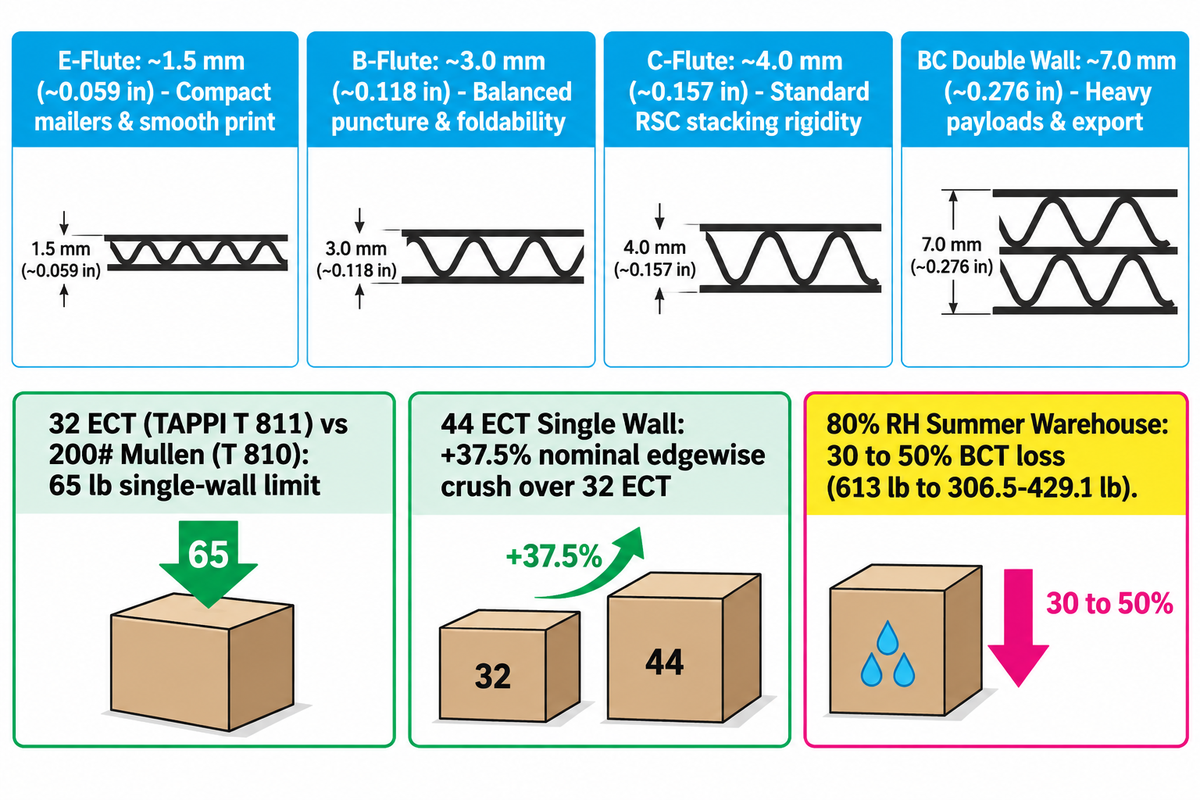
Corrugated specs distinguish vertical stacking strength (ECT) from wall-breakage resistance (Mullen) and wall thickness (flute profile). E-flute keeps mailers slim and smooth for printing, B-flute fits general parcels, and C-flute cushions heavier RSCs. Going from 32 ECT to 44 ECT boosts nominal edgewise crush resistance by 37.5%, and helps compensate for 30-50% humid-warehouse strength loss.
Buyers often confuse three distinct board test methods. Under TAPPI standard test guidelines, TAPPI T 811 measures Edgewise Compressive Strength (ECT) on a short column of combined board to predict vertical stacking strength. TAPPI T 810 measures Bursting Strength (Mullen test, such as 200#) to evaluate wall rupture resistance. FEFCO Methods 2, 4, 8, and 50 measure basis weight, burst, edgewise crush, and full Box Compression Testing (BCT), respectively.
| Flute / Board Spec | Approximate Wall Caliper | Mechanical Strength Focus | Typical Parcel Application |
|---|---|---|---|
| E-Flute (Single Wall) | ~1.5 mm (~0.059 in) | High flat-crush and smooth print surface; minimal wall space | Compact FEFCO 0427 mailers, cosmetics, light consumer goods |
| B-Flute (Single Wall) | ~3.0 mm (~0.118 in) | Balanced puncture resistance, foldability, and crush protection | General DTC mailers, canned or jarred goods, subscription boxes |
| C-Flute (Single Wall) | ~4.0 mm (~0.157 in) | Higher cushioning arch and vertical stacking rigidity | Standard RSC shipping boxes (FEFCO 0201) for medium loads |
| BC Double Wall | ~7.0 mm (~0.276 in) | Dual fluted layers for heavy payloads and long export transit | Dense hardware, heavy glassware kits, multi-tier warehouse stacks |
| 32 ECT vs 200# Mullen | Same nominal flute class | Both list 65 lb single-wall content limit; ECT targets stacking, 200# targets burst | Use 32 ECT for stacked cartons; consider burst spec for sharp or rough parcel loads |
| 44 ECT Single Wall | Same nominal flute class (verify liner caliper) | Higher nominal edgewise crush rating than 32 ECT without double-wall cube | Dense items, tall stacks, or humid routes where 32 ECT buckles |
Why Nominal ECT Stamps Fail in Real Warehouses: As documented in StarBoxes’ corrugated strength analysis, a 200# Mullen box and a 32 ECT box share a 65 lb single-wall content limit yet behave differently under puncture versus stacking. Note also that 32 ECT is a board-edge rating (32 lb/in), not a universal whole-box compression number. Whole-box compression strength (BCT) depends on box perimeter and flute caliper via the McKee formula.
But real warehouses are rarely laboratory conditioned. Peer-reviewed experiments in MDPI Applied Sciences (2024) across six board types confirm that edgewise crush resistance shifts sharply with temperature and humidity. StarBoxes notes that at 80% relative humidity in non-climate-controlled summer warehouses, corrugated boxes can lose 30 to 50% of their compression strength depending on board structure, humidity level, and exposure time. On their worked 16 x 12 x 10 inch C-flute 32 ECT sample box (estimated at 613 lb lab BCT), a 30 to 50% loss reduces effective stacking capacity to 306.5 to 429.1 lb (rounded to 300 to 430 lb in StarBoxes’ guide).
Flute thickness also affects carrier dimensional weight. Switching from E-flute (~1.5 mm) to C-flute (~4.0 mm) adds roughly 5 mm across opposite walls, and more across double-folded mailer sides. When an interior dimension sits near a whole-inch boundary, thicker board can push the exterior across the next inch line. Specify board and flute to match packed weight, stack height, and climate across E, B, C, F, or BC double-wall profiles. At Huandao Packaging, we corrugate E-flute and B-flute board in-house and convert it fresh with no warehouse-aged stock, while C, F, and double-wall BC profiles are converted from sourced board.
Carrier Dimensional Weight and Right-Sized Packaging: Cutting Parcel Freight Costs
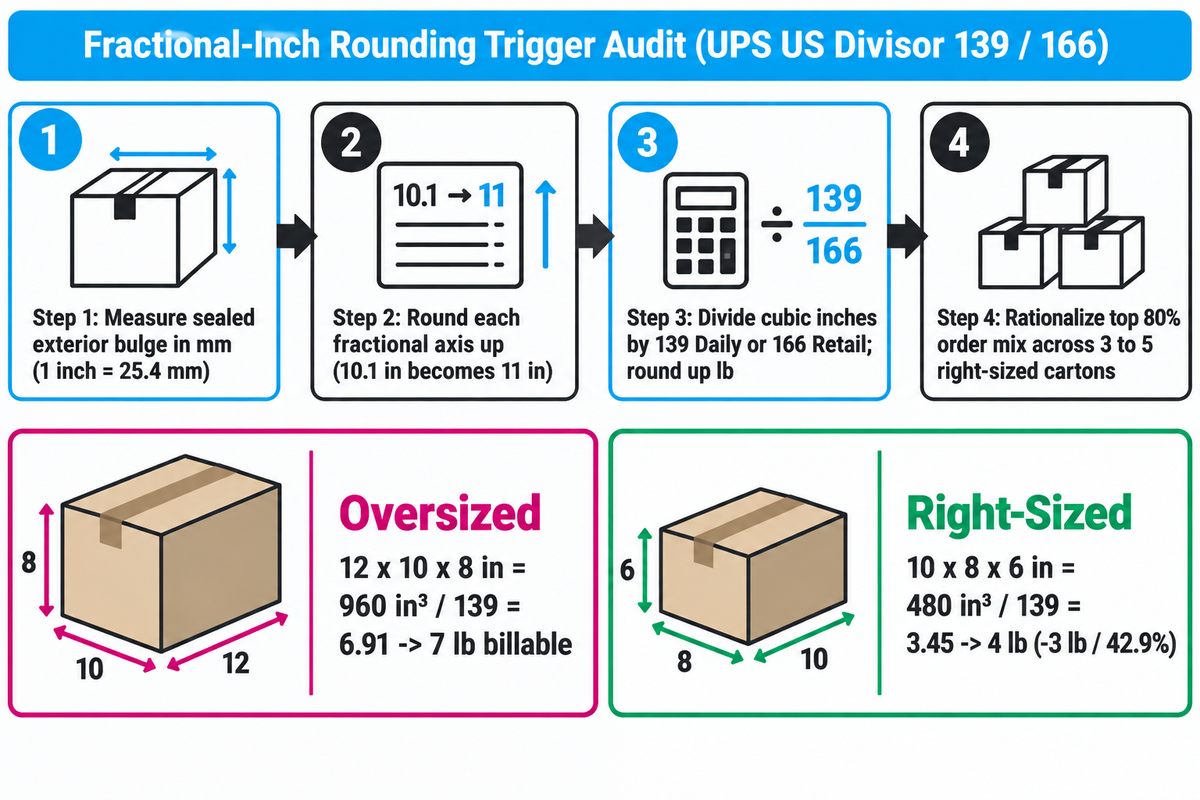
Parcel carriers charge the higher of actual scale weight and outer volume-based dimensional (DIM) weight. Under UPS US guidelines, fractional exterior measurements round upward to the next whole inch, cubic volume divides by 139 (Daily) or 166 (Retail), and any fractional pound rounds up to the next whole pound.
Per UPS official US package measurement guidelines, small-parcel shipments top out at 150 lb (with heavy-package procedures above 70 lb) and 108 inches in maximum length. UPS explicitly instructs shippers to round fractional dimensions up to the next whole number, showing that 1.01 to 1.99 inches rounds up to 2 inches. Automated carrier dimensioners scan the widest bulge of a packed carton. Even a slight flap bulge or 0.1-inch board-caliper oversight triggers an immediate whole-inch jump.
Fractional-Inch Rounding Trigger Audit (4-Step Freight Reduction Method)
- Audit packed exterior dimensions: measure finished, sealed boxes (not flat dielines) at their widest bulge in millimeters, then convert using 1 inch = 25.4 mm.
- Apply upward whole-inch rounding: round each exterior axis up to the next integer inch (for example, 10.1 in becomes 11 in) before computing cubic volume.
- Test against your contract rate divisor: divide rounded cubic inches by the divisor for your shipment’s rate (UPS lists 139 for Daily Rates and 166 for Retail Rates), then round dimensional weight up to the next whole pound.
- Rationalize your box suite: map top 80% order combinations across 3 to 5 right-sized cartons so small dimensional trims drop high-volume SKUs into lower billable pound tiers.
Worked UPS US Daily Rate Calculation (Assumed Dimensions): Consider a 4 lb actual-weight parcel shipped under UPS US Daily Rates (divisor 139). An oversized 12 x 10 x 8 in carton measures 960 cubic inches. Dividing 960 by 139 gives 6.91 lb, which rounds up to a 7 lb billable weight. Trimming 2 inches per axis to a fitted 10 x 8 x 6 in box cuts volume to 480 cubic inches. Dividing 480 by 139 gives 3.45 lb, rounding up to 4 lb billable weight, cutting billable weight by 3 lb (42.9%).
Compare your own SKU measurements with carrier divisors and dimensional weight charges by opening our dimensional weight comparator. Or, explore multi-item carton splits using our order-mix parcel review worksheet. Be aware of carrier divisors and other handling thresholds according to your signed account tariff.
| Box Sizing Scenario | Exterior Dimensions (L x W x H) | Cubic Volume | DIM Weight (Divisor 139) | Billable Weight (Actual 4 lb) |
|---|---|---|---|---|
| Oversized Stock RSC | 12 x 10 x 8 in (304.8 x 254.0 x 203.2 mm) | 960 in³ | 960 / 139 = 6.91 → 7 lb | 7 lb (paying for 3 lb of air) |
| Right-Sized Corrugated Box | 10 x 8 x 6 in (254.0 x 203.2 x 152.4 mm) | 480 in³ | 480 / 139 = 3.45 → 4 lb | 4 lb (3 lb lower billable weight) |
How do you measure a box accurately for carrier dimensional weight?
Measure the sealed outer carton along its longest side first for Length, rotate 90 degrees for Width, and measure the remaining axis for Height, rounding each fractional axis up to the next whole inch before multiplying.
Separate factory and carrier sizes. Factories build from inside cavity dimensions so products and inserts fit well. Parcel carriers bill from outside assembled dimensions.
On roll-end corrugated mailers, double-folded side walls increase outside width and length by multiple board calipers, so always check outside dimensions on an assembled physical sample.
Internal Restraint, Paper Inserts, Closures, and Reverse Logistics Design
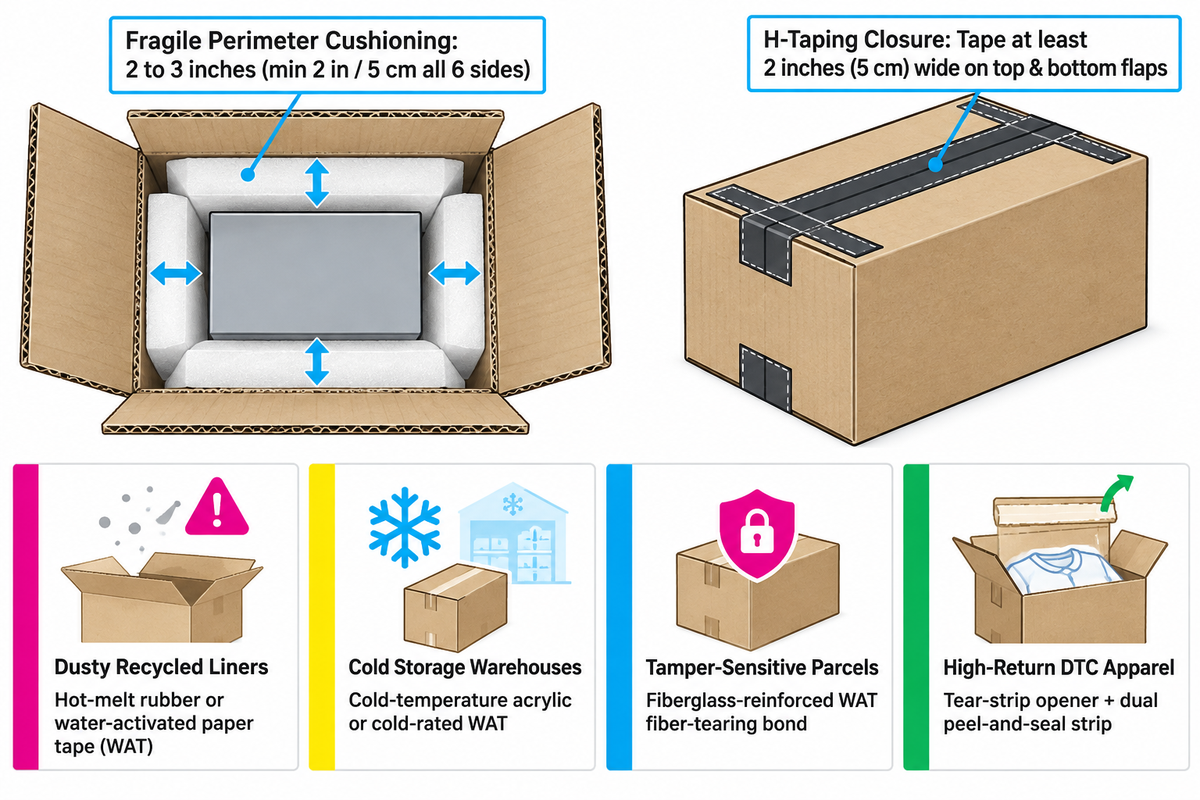
Effective parcel protection separates structural restraint (holding items stationary away from box walls) from impact cushioning (absorbing drop shock). Immobilize products with die-cut corrugated inserts, add 2 to 3 inches of perimeter cushioning around fragile glass, and seal flaps with H-taped closures matched to warehouse temperature and recycled liner dust.
Per FedEx official packing guidelines, fragile items should be wrapped individually, centered away from carton corners, and surrounded by 2 to 3 inches (minimum 2 inches / 5 cm in box-in-box packing) of cushioning on all six sides. FedEx packing advice recommends sealing top and bottom outer flaps using the H-taping method with pressure-sensitive plastic tape, water-activated paper tape, or reinforced water-activated tape at least 2 inches (5 cm) wide (its FAQ suggests 3-inch tape). FedEx advises against cellophane, duct, or masking tape and recommends avoiding outer shrink-wrap.
Counter-Intuitive Tape Adhesive Physics: When seams split in transit, warehouse supervisors often tell packers to add more tape layers. As documented in PackageMore’s industrial carton sealing guide, seam failure usually stems from adhesive chemistry mismatch. Standard hot-melt synthetic rubber tape grabs dusty surfaces fast, yet it turns brittle and releases in freezing storage, where cold-temperature acrylic tape or cold-rated water-activated paper tape holds reliably.
Standard utility acrylic tape struggles to grip the short, dusty recycled fibers of high-recycled-content corrugated liners. On dusty recycled board, hot-melt rubber or starch-based water-activated gummed paper tape (WAT) adheres much more effectively. Since wet starch-based adhesive can wet out, penetrate and mechanically bond with kraft linerboard fibers, reinforced WAT leaves a trace of fiber tear if someone tampers with the seal.
| Fulfillment Environment | Recommended Closure System | Failure Mode Avoided |
|---|---|---|
| High-Recycled / Dusty Corrugated Liners | Hot-melt rubber tape or water-activated paper tape (WAT) | Prevents utility acrylic tape from slipping off short surface fibers |
| Cold Storage / Winter Unheated Warehouses | Cold-temperature acrylic tape or cold-rated WAT | Prevents standard hot-melt adhesive from embrittling and popping open |
| High-Value / Tamper-Sensitive Parcels | Fiberglass-reinforced water-activated tape (H-taping) | Creates fiber-tearing bond that exposes unauthorized resealing |
| High-Return Apparel / Footwear DTC | Tear-strip opener plus dual-adhesive peel-and-seal strip | Eliminates box-cutter product damage and lets buyers reuse the original box |
For high-return categories, patented closure features like easy-open tear strips and dual peel-and-seal adhesives (such as US7374048B2 and US20140217163A1) let shoppers open cartons without blades and reseal returns cleanly. Moving from loose plastic void fill to paper-based corrugated dividers and gummed tape also lowers environmental impact while supporting safe delivery.
How can brands protect fragile orders without plastic bubble wrap?
Replace plastic bubble wrap with custom die-cut corrugated inserts that suspend fragile items away from box walls, paired with heavy kraft paper cushioning or honeycomb paper sleeves. Together with paper tape and uncoated or aqueous-coated board, this packaging solution stays fiber-based, subject to local recycling acceptance.
A ceramic mug company replaced the large stock RSC boxes, filled with air pillows, with a custom B-flute corrugated mailer that had a die-cut corrugated partition locking away each handle from outer panels. Die-cut corrugated cradles create predictable crush zones that stay locked under truck vibration. Packers also stop cutting loose plastic wrap by hand.
Parcel Transit Testing: ISTA 3A, Amazon SIPP/SIOC, and Change-Control Retesting
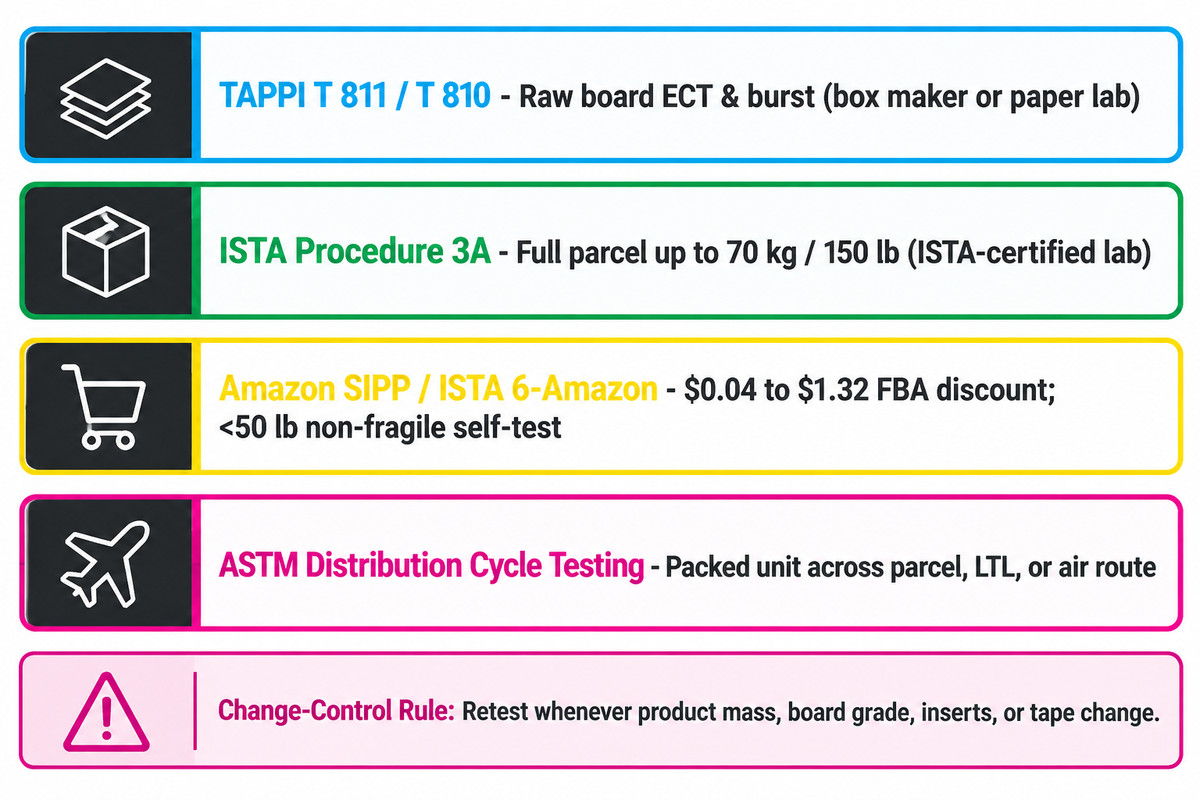
To validate assembled parcels, match the test protocol to your specific delivery route, such as ISTA Procedure 3A for parcel-delivery simulation or Amazon SIPP (ISTA 6-Amazon) for overbox-free FBA shipping. Both procedures apply shock, vibration, and conditioning to full, packed units rather than flat board sheets.
According to the ISTA Procedure 3A official overview, Test Procedure 3A covers individual packaged products up to ISTA’s stated ceiling of 70 kg (listed alongside 150 lb in ISTA’s overview, which converts to ~68 kg) across small, standard, flat, and elongated parcels. Tests combine atmospheric conditioning, shock, and random vibration with and without top loads. Per ISTA’s test selection guidance, match the procedure to your exact distribution route.
For Amazon FBA sellers, Amazon’s 2026 Ships in Product Packaging (SIPP) program publishes an Amazon platform FBA fulfillment fee discount between $0.04 and $1.32 per certified item when goods ship in their own container without an Amazon overbox.
Sellers can self-test eligible non-fragile products under 50 lb without liquids or sharp items. Fragile, liquid, or sharp SKUs require third-party testing at an ISTA-certified lab for an ISTA 6-Amazon report.
| Test / Protocol | What It Evaluates | Scope / Key Threshold | Testing Body & Certification Scope |
|---|---|---|---|
| TAPPI T 811 / T 810 (ECT & Burst) | Corrugated sheet edgewise crush (T 811) or bursting strength (T 810 Mullen) | Board material only (e.g., 32 ECT, 44 ECT, 200# Mullen) | Box manufacturer or paper lab (board-level confirmation) |
| ISTA Procedure 3A | Full packed parcel under conditioning, shock, and random vibration | Individual parcel delivery shipments within ISTA 3A weight cap | Independent ISTA-certified testing laboratory |
| ISTA 6-Amazon (SIPP / SIOC) | Overbox-free survival through Amazon fulfillment and parcel delivery | Qualifies eligible SKUs for Amazon’s published per-unit FBA fee discount | Independent ISTA-certified lab report submitted to Amazon (or self-test if <50 lb non-fragile) |
| Distribution Cycle Testing (ASTM) | Performance of a packed shipping unit across selected distribution cycles and assurance levels | Cycle selected for the specific parcel, LTL, or air route | Testing laboratory or qualified in-house lab (test practice, not a certification body) |
Change-Control Retesting: ISTA guidelines require test units to represent production packages and call for retesting whenever product mass, board grade, inserts, or tape change. Custom packaging factories build cartons designed to ISTA 3A or ISTA 6-Amazon targets and run board-level ECT or burst testing for confirmed specifications, while accredited laboratories handle channel certification on production samples.
Print Methods, Coatings, and Unboxing Design: Direct Flexo vs Litho-Laminated Offset vs Digital
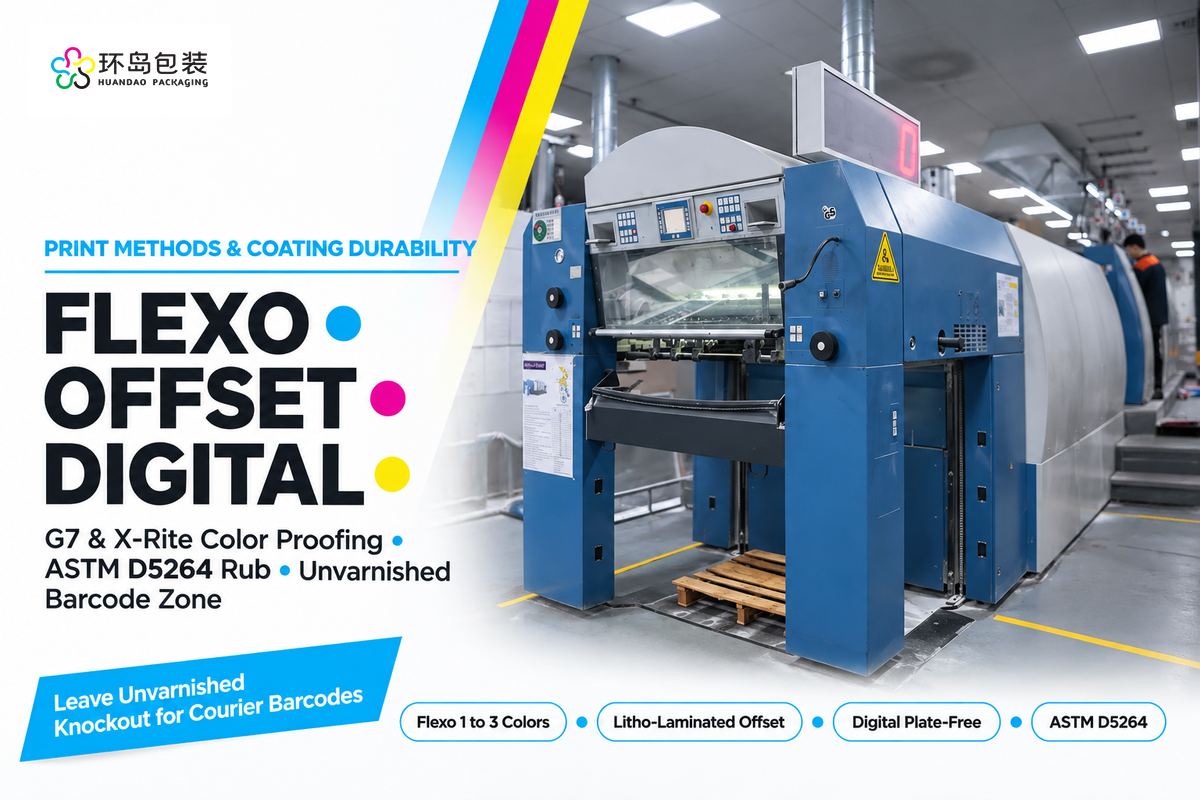
Direct flexographic printing suits high-volume 1 to 3 color logos on kraft or white liners, litho-laminated offset delivers photographic retail graphics on corrugated mailers, and digital inkjet covers plate-free prototyping or short runs. ASTM D5264 enables printed rub testing for scuff resistance, while an uncoated shipping-label panel enhances thermal barcode adhesion.
As detailed in Unicorr’s corrugated specification guide and our printed corrugated box finishing and print methods reference, each print process carries distinct setup mechanics. Direct flexography transfers fast-drying water-based inks from photopolymer plates straight onto combined board, keeping unit cost low on clean vector logos.
Litho-lamination prints high-resolution custom artwork onto a smooth coated paperboard top sheet (such as SBS or CCNB) before laminating it onto E-flute or B-flute corrugated medium. This smooth laminated liner prevents flute washboarding and creates a memorable unboxing experience on DTC mailers. When you customize interior lid panels, your brand story greets the consumer the moment the box opens.
Thoughtful structural design and exterior customization reinforce your brand and strengthen your brand without relying on excess filler. Digital inkjet skips the need for print plates entirely on pilots and short runs, though the unit cost on this process typically leans toward offset or flexo for repeat scale.
| Print Method | Graphic Capability | Tooling / Plate Structure | Best Ecommerce Use Case |
|---|---|---|---|
| Direct Flexographic (Flexo) | Bold vector logos, icons, shipping marks (1 to 3 spot colors) | Photopolymer print plates + cutting die | Medium-to-high volume kraft or white corrugated shipping boxes |
| Litho-Laminated Offset | Photographic CMYK, fine typography, Pantone spot colors, emboss or foil | Offset plates + cutting die + lamination setup | Branded DTC mailers, cosmetics, electronics, subscription unboxing |
| Digital Inkjet | Full color and variable SKU artwork without plates | Zero print plates (cutting die still needed for custom sizes) | Pre-production sampling, market pilots, multi-version short batches |
Color Consistency, Ink Rub, and Thermal Label Zones: Approving packaging artwork on an illuminated RGB screen creates avoidable surprises on kraft or coated board. Compare the finish ink color with a signed off physical proof within a set delta E tolerance. G7 calibrated presses monitored by an X-Rite color management system deliver consistent runs on reorders, with solid Pantone spot inks to safeguard brand colors.
For printed exteriors exposed to conveyor scuffing, ASTM D5264-98(2019) defines Sutherland rub resistance testing across cartons and inserts. Leaving an unvarnished knockout rectangle (without coating) for the courier barcode reduces peel-off risk across different label adhesives and temperature ranges.
Sustainability Compliance and 2026 to 2030 Regulations: EU PPWR 2025/40, EPR, and FTC Green Guides
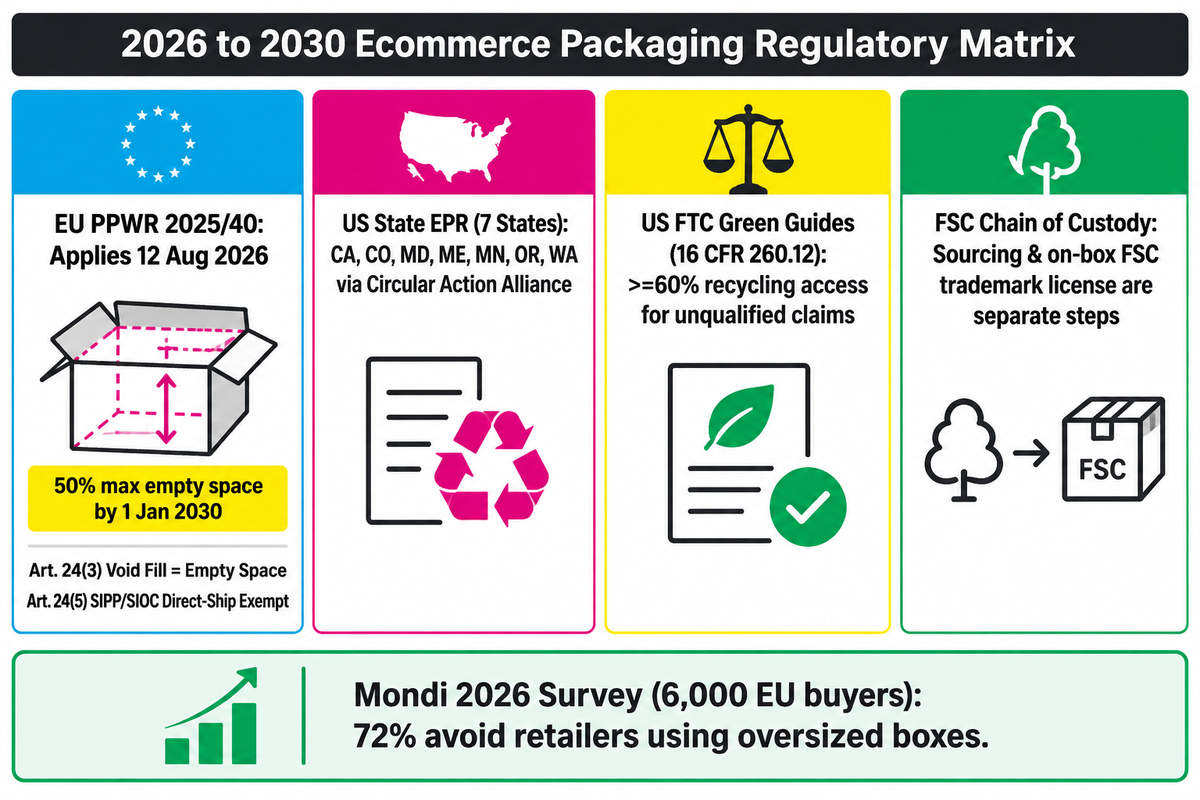
Mandatory EU and US packaging standards in force from 2026-2030 now directly influence box dimensions, materials used and sustainability claims. EU Regulation (EU) 2025/40 limits empty space in filled ecommerce cartons, while seven enacted US state EPR laws introduce producer reporting and eco-modulated fee structures that vary by state.
According to the European Commission Environment portal and EUR-Lex official summary of Regulation (EU) 2025/40, the EU Packaging and Packaging Waste Regulation (PPWR) entered into force on 11 February 2025. It repeals Directive 94/62/EC and applies directly across all Member States from 12 August 2026. Under Article 24(1), operators filling grouped, transport, or e-commerce packaging must cap the empty-space ratio at 50% maximum by 1 January 2030 or 3 years after the implementing acts take effect, whichever is latest. Two adjacent clauses drive structural engineering:
- Void fill counts as empty space (Article 24(3)): for packaging subject to the 50% cap, stuffing air pillows, crinkled kraft paper, or foam chips into an oversized box does not satisfy the rule. Shippers must right-size the carton, adjust product layout, or confirm whether an Article 24(5) exemption applies.
- Direct-ship sales packaging exemption (Article 24(5)): sales packaging used directly for e-commerce delivery (such as SIPP/SIOC cartons) and reusable packaging inside a reuse system are exempt from the empty-space cap of Article 24(1), though sales packaging still follows the minimization rules of Article 10.
Commercial and consumer pressure mirrors these statutory dates. Packaging World’s Parcel Forum 2025 report cites US corrugated recycling rates of 69 to 74% versus 9% for plastics and roughly 50% average recycled content in corrugated boxes. Tighter cartons also allow more parcels per truckload, helping reduce your carbon footprint.
Shoppers notice waste directly. Mondi’s 2026 eCommerce Trend Report surveyed 6,000 online buyers across Germany, Poland, France, Sweden, the UK, and Turkey (reported by PaperAdvance). In that European sample, 72% said they would avoid online retailers using oversized boxes. That pressure is accelerating warehouse automation, including on-demand right-sizing machines like CMC Supervertical (up to 400 boxes/hour on E- and B-flute) and Packsize X6 (up to 1,300 boxes/hour) for brands deciding what is genuinely good for the environment.
| Framework / Law | Verified Threshold & Effective Timeline | Obligated Party & Packaging Action |
|---|---|---|
| EU PPWR Regulation (EU) 2025/40 | In force 11 Feb 2025; general application 12 Aug 2026; 50% empty-space cap (Art. 24) by 1 Jan 2030 or 3 yrs post-implementing acts; recyclability grades from 2030 | EU producers and importers hold legal compliance duty; gather supplier files for PPWR conformity assessment and specify mono-material paper designs |
| US State Packaging EPR (7 States) | Enacted in CA, CO, MD, ME, MN, OR, WA; Oregon billing active since July 2025; 2026 producer reporting via Circular Action Alliance | Log exact packaging material weights by SKU (paper vs film coatings) to support state-specific EPR reporting |
| US FTC Green Guides (16 CFR 260.12) | At least 60% consumer/community recycling access required for unqualified recyclable claims | Qualify or omit recyclable claims on laminated, windowed, or mixed-material packs; verify local stream acceptance |
| FSC Chain of Custody | Material sourcing and on-product FSC trademark use are separate steps | Specify FSC-certified board on request and confirm trademark license approval before printing an FSC logo on boxes |
In the United States, seven states (California, Colorado, Maryland, Maine, Minnesota, Oregon, and Washington) have enacted packaging Extended Producer Responsibility (EPR) laws, with Circular Action Alliance (CAA) administering 2026 producer reporting schedules across Oregon, Colorado, and California. Keep legal roles accurate. Factories supply mono-material paper constructions designed for the EU paper recycling stream and provide supplier documentation for PPWR conformity assessment on request. Legal registration and EPR filing remain with the brand owner or importer placing goods on the market.
Ecommerce Packaging Cost, MOQ, and Tooling Break-Even: Flexo vs Litho-Laminated vs Digital
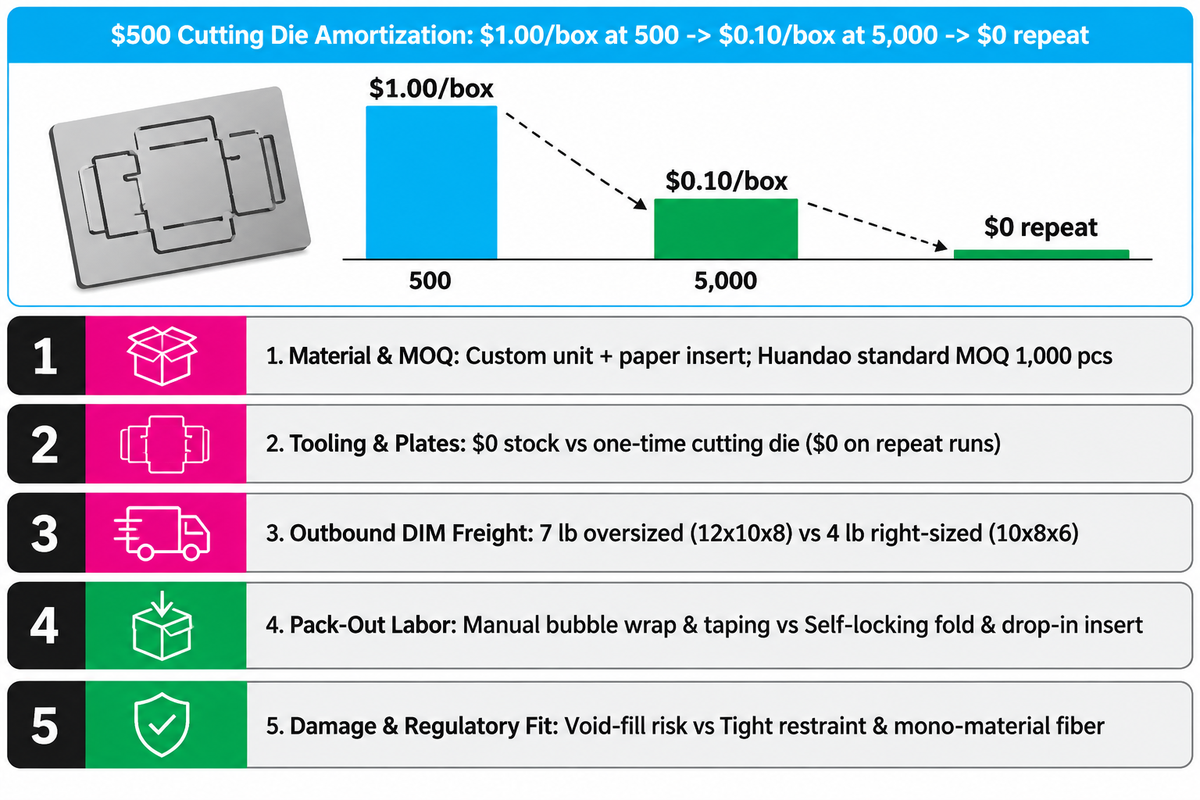
Cost of custom ecommerce packaging includes one-time cutting-die and print-plate tooling plus variable board area, finishing, and flat-packed shipping volume. Starter brands avoid upfront tooling with stock boxes and branded tape or stickers, then compare digital, flexo, and litho-laminated offset quotes per order batch to find their real unit-cost break-even.
Each print method scales differently across run sizes. Digital inkjet charges zero print plates, making it practical for short test runs and online low-MOQ shops such as EcoEnclose (which lists minimums starting at 100 custom shipping boxes and 500 custom mailers). Direct flexography adds photopolymer plates but delivers the lowest unit box cost at volume for 1 to 3 color graphics. Litho-laminated offset carries plate and lamination setup, yet amortizes efficiently across mid-to-large batches requiring photographic detail.
Tooling amortization drives per-box economics on custom boxes. As President Container Group explains, spreading a one-time $500 cutting die across 500 boxes adds $1.00 per box. Spreading that same $500 die across 5,000 boxes drops tooling to $0.10 per box. On repeat runs, the cutting-die fee drops to $0 because the factory keeps your die on file.
Factories set minimums by size and style because each box size needs a new die setup and a new press makeready. At Huandao Packaging, our standard MOQ is 1,000 pieces per size and style, and smaller runs are quoted case by case. Repeat runs do not require new dies or sampling; therefore they cost less and ship faster.
In comparing delivered quotes, flat-pack freight estimates use projected bundle dimensions and carton counts, and the final packed shipping volume is measured and confirmed once the goods are packed.
Ecommerce Packaging Total Cost of Ownership (TCO) Framework (Stock Oversized vs Custom Right-Sized):
| TCO Cost Component | Oversized Stock RSC + Bubble Wrap | Right-Sized Custom Corrugated Mailer + Paper Insert |
|---|---|---|
| Box & Inner Material Cost | Lower raw carton price + recurring loose void fill | Custom unit price + integrated corrugated insert; MOQ quoted per size/style |
| Cutting Die & Print Tooling | $0 upfront (stock size + sticker/tape branding) | One-time cutting die (e.g., $500 / 5,000 = $0.10/box Year 1; $0 on repeat runs per President Container Group) plus print plates by method |
| Outbound Carrier DIM Freight | 7 lb billable weight at 12 x 10 x 8 in (UPS Daily divisor 139) | 4 lb billable weight at 10 x 8 x 6 in (3 lb lower billable weight) |
| Pack-Out Labor & Tape | Slower bottom taping + manual bubble-wrap measuring | Faster self-locking fold and pre-cut insert drop-in |
| Damage, Return & Regulatory Fit | Higher migration risk + exposed to EU empty-space rules | Tighter product restraint + mono-material fiber design |
Tooling Payback Formula: Divide your one-time cutting-die and plate total by your net per-order savings (carrier DIM-weight freight drop minus any unit box-price increase). Plugging in your exact carrier zone tariff and factory quote immediately shows how many shipped orders pay back custom tooling before counting reduced breakage or eligible Amazon SIPP savings.
How to Source Bulk Custom Corrugated Ecommerce Packaging and Build an RFQ Spec Sheet
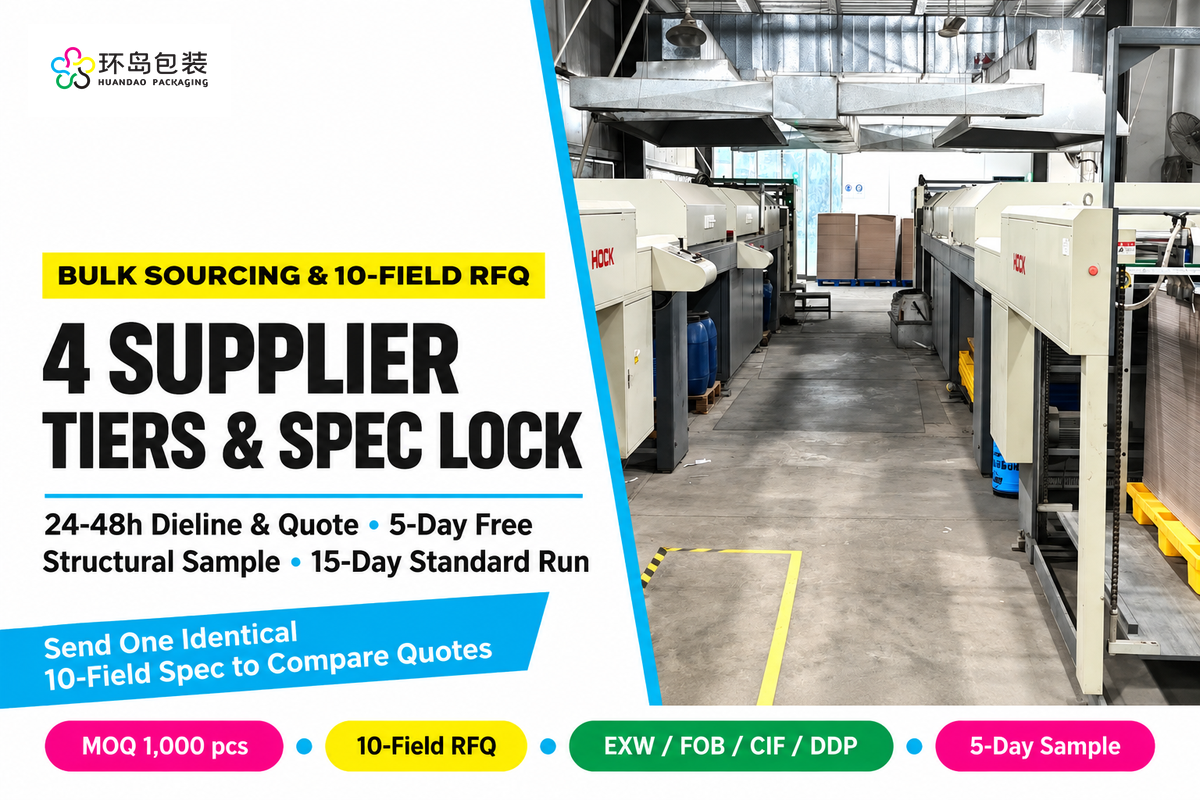
To source bulk custom ecommerce packaging, send an identical 10-field technical spec sheet covering inside dimensions, FEFCO style, flute/ECT, print method, batch quantity, and Incoterms to shortlisted suppliers. Compare quotes across four supplier tiers: mill-integrated producers, regional sheet plants, direct color-printing export factories, and web-to-print platforms.
Empty corrugated cartons for transit ship flat on pallets, so geography, print complexity, design options, and batch size determine the best tier. Public US supplier rankings vary based on the metric used (tons, box-plant count, or custom print volume), so supplier capability tier rankings are more useful than an arbitrary top-5 list. Large US mill-integrated corrugated producers such as Packaging Corporation of America (PCA) can produce high volumes, while web-to-print specialists such as EcoEnclose enable small launches.
To compare corrugated suppliers across volume tiers, review our corrugated box manufacturer comparison directory. When specifying packaging solutions for ecommerce across branded folding cartons, litho-laminated boxes, and corrugated mailers, review our custom ecommerce packaging production workflow or build your project brief in our ecommerce pack-out brief builder.
| Supplier Tier | Typical Fit & Run Profile | Strengths | Key Trade-Offs to Verify |
|---|---|---|---|
| Mill-Integrated Enterprise Producers | High-volume regional or national truckload programs | Direct paper mill integration, automated line support, national plant networks | High minimums; longer onboarding for mid-sized custom graphic runs |
| Regional Sheet-Plant Converters | Mid-volume regional pallet replenishment | Short local truck freight, quick repeat replenishment, flexo/digital mix | Often limited in-house offset litho-lamination or specialty rigid finishing |
| Direct Color-Printing Export Factories | Standard MOQ 1,000+ units per size and style (e.g., Huandao Packaging) | In-house sheetfed offset, litho-lamination, UV/lamination, die-cutting, strong unit value on complex graphics | Plan ocean/air transit lead time; verify exact EXW/FOB/CIF/DDP freight volume |
| Web-to-Print Online Platforms | Low-MOQ launch runs (e.g., EcoEnclose starting at 100 boxes / 500 mailers) | No cutting dies on stock sizes, instant online quoting, low launch risk | Higher per-unit box price at scale; narrower custom structural insert options |
Remote order and sample workflow from Huandao Packaging: Overseas buyers don’t need to ship any physical products to begin the quoting process. Submit measurements along with dieline references or artwork to get a dieline and quote within 24 to 48 hours. Then confirm a free structural sample that ships within 5 working days (courier paid by buyer) to test the fit.
Once structure is locked, Huandao Packaging moves through artwork proof sign-off and an optional press proof in about 8 days for complex graphics. Standard production runs within 15 days (typical, confirmed per order at quotation), followed by quality inspection and dispatch under EXW, FOB Xiamen, CIF, or DDP terms. Copy this 10-field checklist into your RFQ so that all factories price the same specification exactly.
RFQ checklist: copy these 10 specification fields into your ecommerce packaging quote request:
| Parameter | Recommended Specification | Why It Matters | How to Verify |
|---|---|---|---|
| 1. Inside Dimensions | L x W x H in mm (or inches) | Prevents product bind and carrier DIM-weight surprises | Measure assembled structural sample |
| 2. Box Style Code | FEFCO 0427, 0201, or custom CAD | Locks flap folding geometry before cutting die work | Sign off PDF dieline drawing |
| 3. Flute & Board Grade | E, B, C, or BC flute; 32 ECT, 44 ECT, or 200# burst | Matches wall thickness and stacking strength to route | Request ECT/burst testing for confirmed spec |
| 4. Liner & Print Method | Kraft vs white; flexo, litho-laminated offset, or digital | Sets plate fees, graphic resolution, and unit cost | Confirm print method and signed press proof |
| 5. Color & Coating | CMYK + optional Pantone; aqueous varnish vs UV; unvarnished label zone | Controls scuff resistance and thermal shipping label grip | G7/X-Rite proof tolerance + ASTM D5264 rub check |
| 6. Internal Inserts | Die-cut corrugated tray or paperboard divider | Immobilizes fragile SKUs without plastic void fill | Fit-test insert inside structural sample |
| 7. Order Quantity | Qty per size and style (e.g., 1,000 / 3,000 / 5,000) | Amortizes die and plate fees accurately per SKU | Request tiered unit plus tooling breakdown |
| 8. Sustainability & Docs | FSC board on request; mono-material paper spec | Supports EU PPWR conformity files and US EPR reporting | Verify FSC Chain of Custody scope & material weights |
| 9. Transit Protocol Target | Designed to ISTA 3A or ISTA 6-Amazon if required | Aligns structural design before lab submission | Submit production samples to accredited lab |
| 10. Delivery Terms | EXW, FOB, CIF, or DDP + destination postal code | Clarifies flat-pack freight volume and customs duty role | Confirm final packed carton volume before dispatch |
FAQ
Q: What is the best type of packaging for ecommerce shipping?
Corrugated mailer boxes (FEFCO 0427) are ideal for small, rigid or branded DTC orders and standard slotted cartons (FEFCO 0201) are best for heavier multi-piece shipments and unpadded poly mailers are best for soft apparel.
Align the outside format with product fragility, stack load, and packed weight first, and check inside clearance and outside dimensional weight before choosing coatings or print finishes.
Q: How can better ecommerce packaging reduce parcel shipping costs?
Right-sizing exterior carton dimensions reduces unused cubic inches and avoids expensive whole-inch rounding jumps in dimensional weight calculation for everyday parcel shipments.
In our worked UPS Daily example above, trimming 2 inches per axis cut billable parcel weight from 7 lb to 4 lb, while fitted corrugated inserts also curb damaged-return reshipment expenses.
Q: What is the cheapest packing material for starting an ecommerce store?
Stock kraft corrugated boxes or unpadded poly mailers with stickers, rubber stamps, or printed paper tape minimize up-front startup spend in the initial demand test.
Huandao Packaging’s minimum batch starts at 1,000 units per SKU size and style (smaller runs quoted case by case), so stock cartons keep tooling at zero until custom flexo or offset quotes justify die setup.
Q: What is Amazon Frustration-Free Packaging and SIPP certification?
Frustration-Free Packaging (FFP) is Amazon’s broader easy-open, reduced-waste tier, while Ships in Product Packaging (SIPP) certifies that an item ships safely in its own container without an extra Amazon overbox.
Certified SIPP items qualify for Amazon’s published per-unit FBA fee discount (detailed in our testing section above), with fragile or liquid SKUs requiring an ISTA 6-Amazon lab report.
Q: How much more expensive is sustainable ecommerce packaging than standard corrugated?
There is no blanket percentage premium for all boxes as the price varies with board grade, certification, print type, and batch size.
Uncoated mono-material kraft corrugated boxes with water based inks will be comparable to regular kraft cartons. FSC-certified boards, paper padded mailers, or custom die-cut inserts add material cost that should be compared against freight savings and state EPR rules on your own shipping lanes.
Q: What are the 7 basic steps to ecommerce packaging design?
The parcel team uses seven pragmatic engineering steps. First, measure product size, mass and fragility; second, select the outer format and FEFCO style; third, select flute and ECT or burst grade.
Fourth, check carrier dimensional weight breakpoints. Fifth, engineer internal restraint and closure tape. Sixth, fit-test a physical structural sample and validate transit survivability.
Seventh, sign-off print proofs and production specifications.
Q: When should a brand upgrade from 32 ECT single-wall board to 44 ECT or double-wall corrugated?
Increase from 32 ECT to 44 ECT single wall for dense products stacked multiple tiers high or stored in humid, non-climate-controlled warehouses where moisture can lower stacking strength.
Verify assembled outer caliper on a sample because heavier liners can shift wall thickness slightly. Proceed to double-wall BC flute after heavy payloads or export transit exceed single-wall performance in trial shipments or ISTA 3A testing.
Q: How do EU PPWR 2025/40 empty-space limits affect ecommerce box sizing?
Article 24 of Regulation (EU) 2025/40 caps empty space in filled ecommerce and transport packaging once the statutory compliance date takes effect.
Since loose void fill counts as empty space under Article 24(3), packers will have to make outer cases in the correct size or alter the layout of the product unless you’re relying on an exemption under Article 24(5).
References & Sources
- FEFCO Code (12th Edition Adopted by ICCA) – European Federation of Corrugated Board Manufacturers
- Shipping Package Dimensions and Weight Limits (Divisors 139 / 166) – UPS US Support
- FedEx Packing Tips and General Packaging Guidelines – FedEx
- Overview of ISTA Test Procedure 3A (Parcel Delivery System Shipments 70 kg / 150 lb or Less) – International Safe Transit Association
- Guidelines for Selecting ISTA Test Procedures by Distribution Route – International Safe Transit Association
- Ships in Product Packaging (SIPP) Program and FBA Fee Discounts – Amazon Seller Central (2026)
- Regulation (EU) 2025/40 on Packaging and Packaging Waste (PPWR) Summary – EUR-Lex / European Union
- Packaging Waste Policy and Regulation (EU) 2025/40 Application Dates – European Commission
- 16 CFR 260.12 Recyclable Claims (Green Guides) – Electronic Code of Federal Regulations (FTC)
- 2026 US Packaging EPR Producer Reporting Schedules – Circular Action Alliance
- TAPPI Standards T 810 (Bursting Strength) and T 811 (Edgewise Compressive Strength) – TAPPI
- ASTM D5264-98(2019) Standard Practice for Abrasion Resistance of Printed Materials – ASTM / iTeh Standards
- Influence of Environmental Conditioning on Corrugated Board Edge Crush Resistance (2024) – MDPI Applied Sciences
- Benefits of Right-Sizing and Recyclability of Corrugated Material at Parcel Forum 2025 – Packaging World
- Industrial Carton Sealing Guide: Acrylic vs Hot Melt vs Water-Activated Tape – Packaging & More
- Tooling and Die Charges for Custom Corrugated Boxes Explained – President Container Group
- Corrugated Box ECT Ratings, Stacking Strength, and Humidity Loss – StarBoxes
- EcoEnclose Custom Shipping Packaging Minimums – EcoEnclose
About This Ecommerce Packaging Analysis
This reference assembles verified carrier measurement guidelines, FEFCO and TAPPI structural standards, ASTM abrasion methods, and 2026 EU PPWR and US FTC compliance thresholds so ecommerce buyers can specify corrugated mailers, folding cartons, and shipping boxes accurately. Reviewed by the technical team at Xiamen Huandao Packaging Technology Co., Ltd.
Need a Dieline and Quote for Custom Ecommerce Packaging?
Send your inside dimensions, FEFCO style, board preference, and order quantity per size and style to get a dieline and quote in 24 to 48 hours. Standard MOQ is 1,000 pieces per size and style, with smaller runs quoted case by case and free structural samples dispatched within 5 working days (courier paid by buyer).
Request a Dieline & Quote →
Explore Ecommerce Packaging Solutions