Get in Touch with Xiamen Huandao Packaging Technology Co., Ltd.

Apparel packaging is the three layers of inner wraps, retail or shipping cases, and outer master cartons that protect garments from moisture, crushing, and scuffing the length of the journey from factory to front door. Soft, compressible single garments like tees ship in tear-resistant poly mailers or kraft paper mailers that minimize billing weight. Structured outerwear, heavy fleece, multi-item bundles, and gift sets need either E-flute or B-flute corrugated mailer boxes or rigid assemblies to maintain their shape.
Getting clothing packaging right is an engineering trade-off rather than a graphic-design afterthought. A 1-inch jump in box height can push a 0.5 lb T-shirt from 1 lb to 2 lb billed weight under the UPS Retail divisor. Similarly, double-sided plastic film lamination can flip a paperboard carton into a non-recyclable red classification under UK rules. This guide covers packaging for fashion brands across retail packaging and e-commerce channels, detailing formats designed to protect garments, freight math, board grades, print proofing, ISTA 3A testing, 2026 compliance, and a factory RFQ checklist.
What Are the 7 Main Types of Apparel Packaging Formats and Layers?
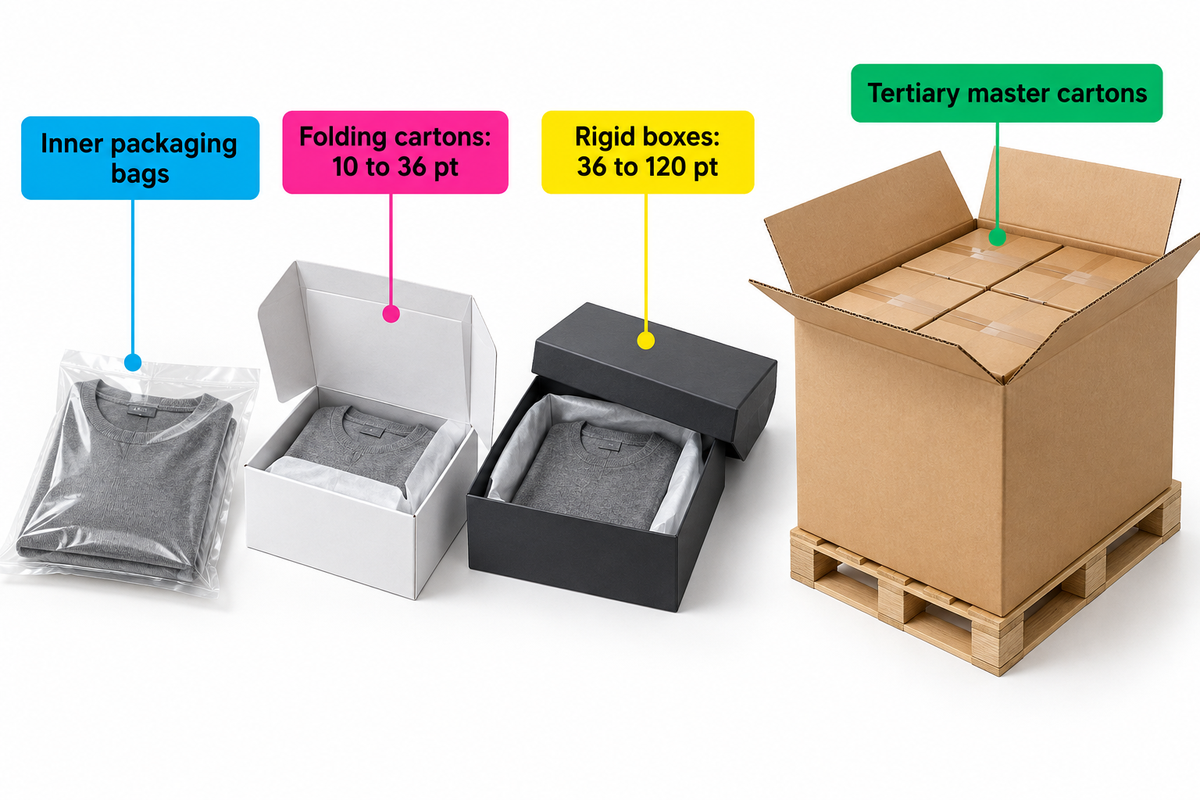
Seven core apparel packaging configurations include: poly mailers, kraft paper mailers, inner garment bags, paperboard folding cartons, corrugated mailer boxes, rigid gift boxes, and retail paper shopping bags with master shipping cartons. Fashion supply chains divide them into three layers: inner packaging bags touching fabric directly, secondary retail cartons or shipping mailers, and tertiary master cartons for wholesale pallets.
Material standards in the box industry categorize paperboard cartons by board caliper rather than marketing labels. The Paperboard Packaging Council reports flat-shipping folding cartons use 10 to 36 point paperboard (0.25 to 0.91 mm). Wrapped rigid set-up boxes employ 36 to 120 point (0.91 to 3.05 mm) board that stands up unless constructed with collapsible hinges.
Knowing where your fashion products sit prevents buying a secondary retail carton inside an outer shipper when a single printed mailer solves the job.
What are the 7 types of apparel packaging with examples?
The seven apparel packaging styles each serve a distinct layer role, substrate spec, and garment configuration for both retail store and e-commerce channel fulfillment – balancing moisture barrier protection, compression strength, unit costs, and retail presentation appeal differently across apparel packaging materials.
Selecting the right structure from these seven packaging styles protects your products without adding redundant layers or warehouse packing time:
| # & Format | Layer Role | Typical Material & Spec | Best Apparel Examples | Primary Limitation |
|---|---|---|---|---|
| 1. Poly Mailers | Secondary (e-commerce) | LDPE / PCR film, 2.0–3.0 mil, self-seal | Single T-shirts, leggings, soft basics | Zero crush resistance; low flexible-film recycling collection |
| 2. Kraft Paper Mailers | Secondary (e-commerce) | Uncoated kraft paper, flat or gusseted shipping envelope | Plastic-free tees, soft accessories, lightweight knits | Lower rain resistance and puncture strength than poly film |
| 3. Inner Garment Bags | Primary (inner protection) | Clear plastic bags (≥1.5 mil for FBA), glassine paper, or cotton dust bag | All warehouse-stored or transit-boxed apparel products | Adds material cost; poly bags ≥5 in opening require suffocation warning |
| 4. Folding Cartons & Sleeves | Secondary (retail) | 10–36 pt paperboard (SBS, CUK, CRB, FBB), ships flat | Underwear, socks, hosiery, dress shirts, belly-banded tees | Not built for standalone parcel shipping without an outer shipper |
| 5. Corrugated Mailer Boxes | Secondary (e-commerce) | E-flute (~1.5 mm) or B-flute (~3 mm) roll-end tuck front | Hoodies, denim, structured hats, multi-item DTC bundles | Higher unit cost and dimensional weight exposure than bags |
| 6. Rigid & Collapsible Gift Boxes | Secondary (luxury/gift) | 36–120 pt greyboard with printed wrap, lid-and-base or magnetic | Luxury apparel, cashmere, tailored outerwear, silk dresses | High unit cost; non-collapsible builds consume heavy freight volume |
| 7. Retail Shopping Bags & Master Cartons | Retail carry / Tertiary transit | Printed kraft/art paper bags; single- or double-wall RSC outer cartons | Boutique point-of-sale carry; B2B wholesale pallet shipping | Requires matched dimensional tolerance across inner boxes and master case |
When brands map packaging options across retail and online channels, duplicating structure is the most common cost leak. Placing a retail folding carton inside an unpadded shipping bag leads to crushed corners. Similarly, putting a heavy rigid gift box inside an oversized outer shipper multiplies both unit price and parcel volume.
Defining each SKU as direct-to-consumer parcel, retail shelf display, or omnichannel keeps packaging for fashion lean.
Poly Mailers vs. Corrugated Mailer Boxes: Which Format Fits Your Garments?
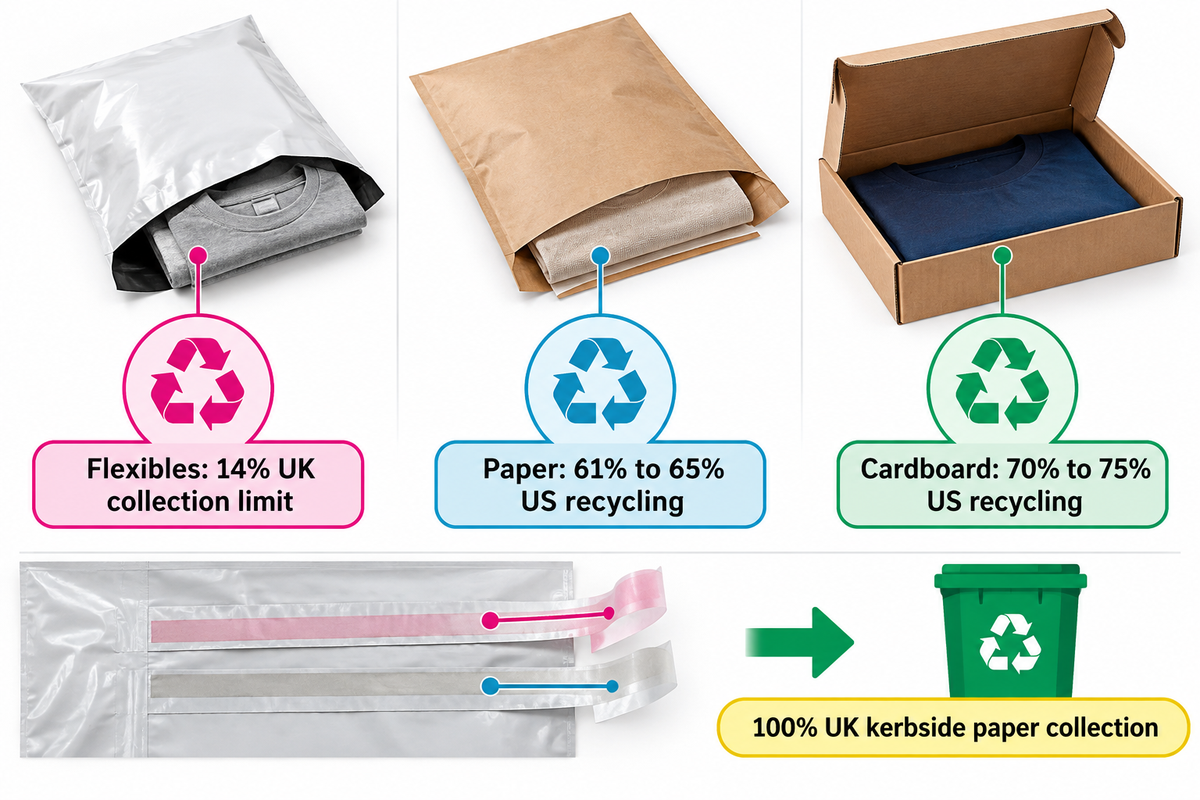
Corrugated mailer boxes justify their higher purchase and freight cost when garments carry rigid trim, structured collars, delicate embellishments, multi-item weight, or gift expectations. Flexible poly mailers are the cost-effective standby for single, soft basics capable of standing stacking compression. Kraft paper mailers sit between the two when curbside recycling matters and an inner wrap handles rain.
End-of-life recovery data exposes a wide gap between fibre and plastic shippers. In the United States, the American Forest & Paper Association (AF&PA) reports a 2025 cardboard recycling rate of 70% to 75% (over 33 million tons recovered) and an overall paper recycling rate of 61% to 65%. In the United Kingdom, official guidance under the UK Government Recycling Assessment Methodology (RAM) states the exact collection limit facing flexible plastic bags:
“At present, no plastic (flexibles) exceeds a 14% collection rate and therefore fail to meet this criterion, or the criteria for the limited collection route.”
UK Government DEFRA, Recyclability Assessment Methodology: Assessing Materials
By contrast, the same UK DEFRA methodology confirms paper and board are collected at kerbside by 100% of local authorities. If you want to make this rule repeatable for SKU use, apply the 6-Point Garment Format Selector to crush protection, moisture barrier, returnability, dimensional-weight exposure, recovery benchmarks, and Limitations / Not Recommended:
| Decision Criterion (6-Point Garment Format Selector) | Poly Mailers (LDPE / PCR) | Kraft Paper Mailers | Corrugated Mailer Boxes (E/B-Flute) |
|---|---|---|---|
| Crush & Shape Protection | None; conforms to external load | Minimal; resists light abrasion only | Rigid fluted walls protect shape and trims |
| Moisture Barrier | Waterproof outer film when sealed | Low; requires inner moisture barrier in wet lanes | Porous kraft liner; requires inner bag or tissue wrap |
| Returnability & Sealing | Dual self-sealing strip + tear perforation supports resealable returns | Dual self-seal tear strips available on gusseted builds | Tuck-front tab or tear strip; customer re-tapes for return |
| DIM-Weight Exposure | Minimal; compresses around folded garment | Low; flat envelope profile stays compact | High if box height exceeds folded stack by >0.5 in |
| Recovery Benchmark | ≤14% UK flexible collection (DEFRA); store drop-off in US | 61%–65% US paper (AF&PA); 100% UK kerbside (DEFRA) | 70%–75% US 2025 cardboard recycling rate (AF&PA) |
| Limitations / Not Recommended | Not recommended for structured hats, blazers, heavy metal hardware, or luxury gifting | Not recommended for bulky overstuffed bundles that split paper gussets | Not recommended for single low-margin basics where box + DIM freight erodes margin |
Online apparel shipping’s higher return rates make a resealable closure essential across every format. A second adhesive strip and tear strip added to either mailer bags or corrugated shipping solutions stops the customer from ripping open the entire package when it arrives. That one added feature, in turn, reduces the damage caused by return repacking, and retains the tear resistant barrier.
Are apparel boxes suitable for e-commerce shipping?
E-flute or B-flute corrugated apparel boxes are designed to be shipped direct-to-consumer, not thin paperboard folding cartons or uncovered rigid gift boxes. Packing a 16 pt to 24 pt retail folding carton loose in parcel networks allows corners and glued seams to get caught in conveyor jams, crushed, and wet.
For other brands requiring a high-end retail display inside the box that travels through the shipping process, there are two tested builds to select from. Replace the shipper with a custom printed corrugated mailer box with interior-lid graphics. Alternatively, pack the folding carton or rigid gift box inside a snug corrugated outer shipping box with an inner poly bag or glassine wrap to block doorstep rain.
How to Match Packaging Styles to Specific Garment Categories
Match packaging styles to garment weight, bulk, and surface fragility. Use poly or kraft paper mailers for soft single basics, E-flute or B-flute corrugated mailers for heavy fleece and hardware-trimmed denim, and compact retail sleeves or folding cartons for socks and intimates. Standardizing around garment behavior stops brands from ordering six custom box sizes when three footprints cover the catalog.
Each garment category creates distinct mechanical stress during warehousing and transit. Heavy zippers, snap buttons, and metal drawcord aglets on hoodies and outerwear can snag adjacent knitwear or puncture thin clothing bags if folded facing outward. Lightweight basics like socks, intimates, and swimwear rely on compact retail sleeves or hang-tab cartons that fit store pegs cleanly. When supplying retail chains with pegboard or shelf-ready cartons, reviewing folding carton engineering specifications helps align board weight and tuck closures to garment mass.
| Garment Category | Recommended Inner Layer | Recommended Outer Format | Key Engineering Watchout |
|---|---|---|---|
| T-Shirts, Activewear & Sportswear | Clear poly bag (1.5–2.0 mil) or translucent glassine bag | Poly mailer, kraft mailer, or 1.5–2 in shallow E-flute box | Keep box height ≤2 in; a 10 × 8 × 2 in mailer bills at 1 lb under the UPS Retail divisor (166) but already bills at 2 lb under the Daily divisor (139) |
| Hoodies & Heavy Fleece | 2.0–2.5 mil gusseted poly bag or acid-free tissue wrap | E-flute (midweight) or B-flute (~3 mm) corrugated mailer box | Fold hood flat and tuck zippers inward to prevent fabric marks and lid bowing |
| Knitwear, Sweaters & Cashmere | Smooth tissue paper between folds + breathable garment bags or dust bags | Corrugated mailer box or collapsible rigid gift box + outer shipper | Avoid aggressive vacuum compression that sets permanent crease lines in wool |
| Dress Shirts, Suits & Tailored Wear | Collar stay, paperboard backer, and tissue wrap | Two-piece shirt box, folding carton, or rigid box inside corrugated outer | Zero-crush clearance above structured collars and shoulder pads |
| Denim & Heavy Outerwear | Tear-resistant 2.5 mil poly bag or kraft belly band | B-flute corrugated shipping box or litho-laminated carton | Rivet and buckle abrasion requires sturdy inner wall resistance |
| Socks, Swimwear & Intimates | Paperboard sleeve, header card, or small glassine pouch | 14–20 pt retail folding carton (tuck-end or hang-tab) | Consolidate multipacks inside one carton to cut retail fixture clutter |
To keep die-cutting tooling fees from multiplying across seasonal drops, standardize your folded garment footprint first. Most DTC clothing and apparel brands run an entire catalog on three outer sizes: one flat single-item mailer, one mid-depth bundle box, and one large multi-item shipper. Internal fold boards or tissue change fit without having to commission unique custom clothing boxes for each SKU.
Apparel Box Sizing, Fold Clearances, and Dimensional Weight Math
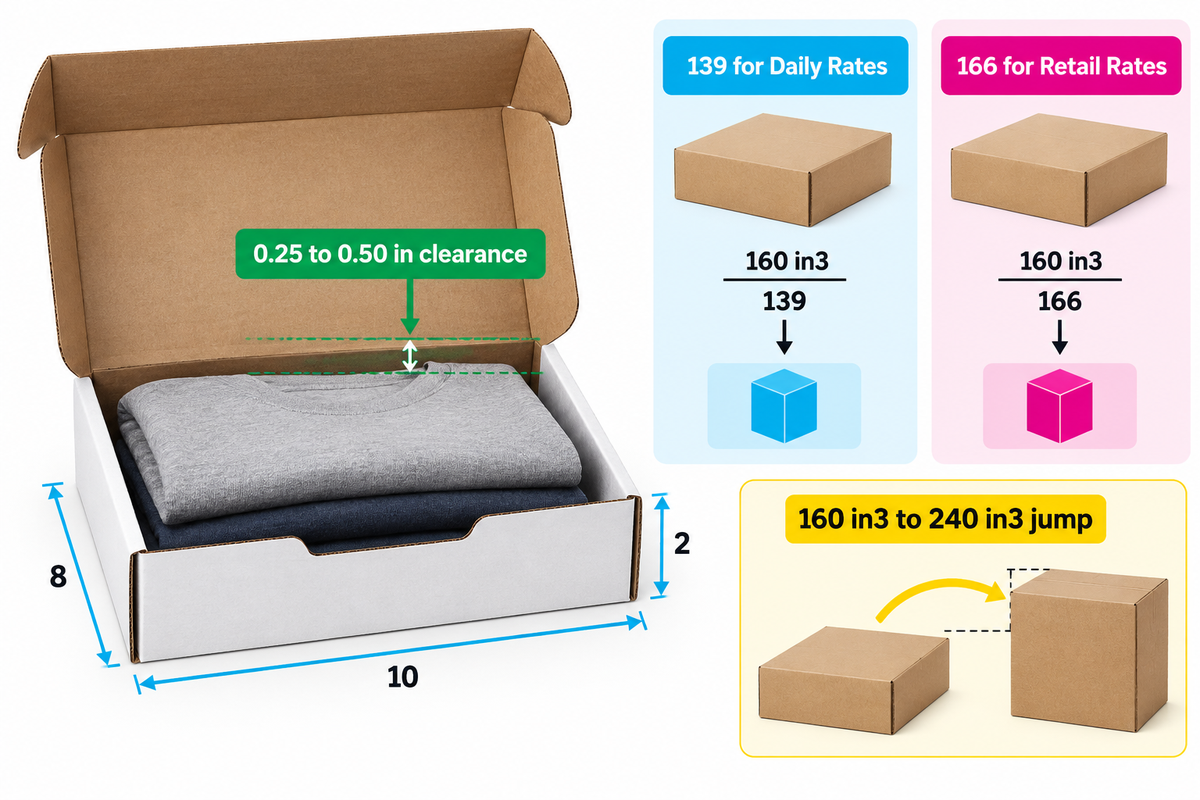
US domestic parcel carriers bill whichever is greater between actual package weight and dimensional (DIM) weight. According to UPS official shipping dimension and weight guidance, DIM weight equals external length times width times height (rounded to whole inches) divided by 139 for Daily Rates or 166 for Retail Rates, rounded up to the next pound.
With apparel so lightweight compared to its size, the number one driver of phantom freight fees is excessive vertical headroom. Leaving 0.25 to 0.50 in (6 to 13 mm) of internal clearance above the relaxed folded garment keeps the lid flat without letting fabric slide and wrinkle. Always validate box dimensions using your largest core size (usually XL or XXL) rather than a Medium sample; undersizing makes warehouse staff crush lids or burst tuck flaps during peak season.
Assumed inputs for the worked DIM-Weight Threshold Table for Apparel Boxes below: External box sizes in whole inches reflect common roll-end tuck-front apparel packaging boxes, including corrugated wall thickness. Illustrative actual weights (0.5 lb for one folded T-shirt, 1.4 lb for a heavyweight fleece hoodie, and 2.0 lb for a two-piece knitwear bundle) are compared against the verified UPS Daily (139) and Retail (166) divisors. Negotiated UPS contract rates differ from these published-divisor figures by carrier agreement, fuel surcharges, and zone.
| Apparel Shipment Example (DIM-Weight Threshold Table for Apparel Boxes) | Assumed External Size (L × W × H) | Cubic Volume | Actual Weight (Assumed) | UPS Daily DIM (/139, rounded up) | UPS Retail DIM (/166, rounded up) |
|---|---|---|---|---|---|
| Single T-Shirt Mailer Box | 10 × 8 × 2 in | 160 in³ | 0.5 lb | 1.15 → 2 lb billed | 0.96 → 1 lb billed |
| Heavyweight Hoodie Box | 12 × 10 × 3 in | 360 in³ | 1.4 lb | 2.59 → 3 lb billed | 2.17 → 3 lb billed |
| 2-Pack / Bulky Knitwear Box | 14 × 11 × 4 in | 616 in³ | 2.0 lb | 4.43 → 5 lb billed | 3.71 → 4 lb billed |
Empty air inflates parcel spend fast. Expanding that mailer depth from 2 in to 3 in raises cubic volume from 160 in³ to 240 in³ (240 ÷ 166 = 1.45), showing how just an extra inch of headspace drives dimensional-weight bracket creep. Raising a 14 × 11 × 4 in box to 5 in tall adds 154 in³ and pushes Daily billed weight to 6 lb. Review parcel-level modeling in our e-commerce parcel box and freight math guide or test dimensions with our dimensional weight comparator.
How do you package clothes for shipping without wrinkling or dimensional weight penalties?
Fold each garment to match the exact interior length and width of a shallow box or snug mailer rather than adding extra cross-folds to cram it smaller. Match your fold template to the box footprint first, then interleave acid-free tissue paper between layers of heavy fabric so collars, pleats and screen prints don’t rub during transport.
Place a lightweight recycled paperboard backer inside a folded garment when shipping structured shirts, knitwear, and multi-piece bundles in corrugated clothing boxes. Wrap the stack in tissue or a sealed inner bag before closing the outer shipper to stop lateral shift during conveyor drops without adding wasted cubic height.
Paperboard Grades, Corrugated Flutes, and Inner Bag Materials Explained
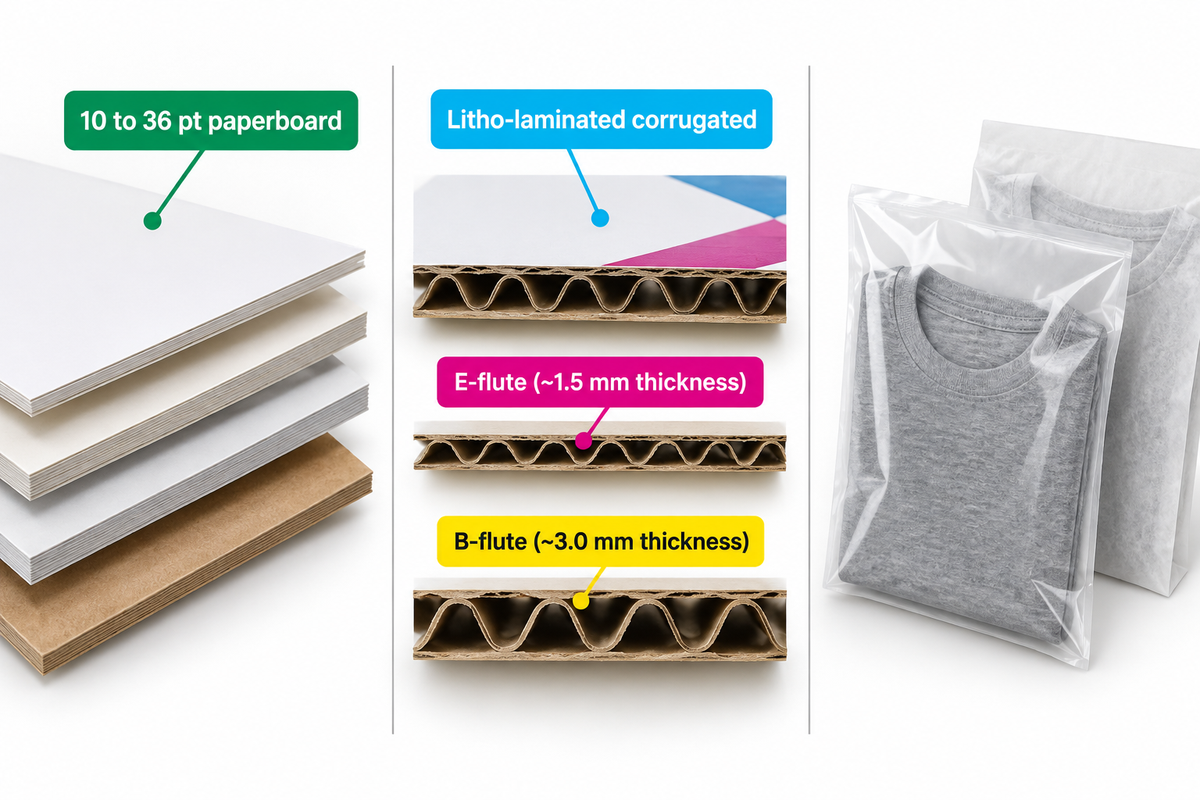
State the precise grades of substrates rather than requesting ‘thick cardboard’ from a mill, and this prevents sellers from providing soft greyback board which will crack along scoring or crush in moisture-bearing storage. Three substrate families serve apparel converters: solid paperboards for folding cartons, fluted corrugated boards for shipping mailers and litho-laminated boxes, and flexible inner barrier wraps. For folding cartons, four core grades dominate apparel converting: SBS (Solid Bleached Sulfate) provides bright white virgin fibre for crisp fashion graphics and embossing, FBB (Folding Boxboard) pairs a bleached print face with stiff mechanical pulp center plies, CUK (Coated Unbleached Kraft) adds natural brown tear strength under a printable clay top coat for heavier denim, and CRB (Coated Recycled Board) cuts material cost on multipacks where minor greyback flecking is acceptable.
Retail folding cartons use 10 to 36 pt paperboard per the Paperboard Packaging Council, spanning four core grades. See board combinations in our custom printed folding cartons guide.
When specifying corrugated mailer boxes and heavy apparel shippers, flute profile governs both crush resistance and print smoothness:
- E-flute (~1.5 mm thickness): Compact micro-flute profile with flat print face for single T-shirts, light knitwear, swimwear sets, and light weight shallow subscription boxes.
- B-flute (~3.0 mm thickness) builds a stronger arch structure with higher puncture and stacking resistance for heavyweight hoodies, denim, footwear, and multi-garment bundles.
- Litho-laminated corrugated bonds an offset-printed paperboard top sheet directly onto single-face E- or B-flute board, combining photo-sharp brand graphics with corrugated strength and no surface “washboarding.”
In factory converting, board supply architecture plays a role in how the work is scheduled and the ability to keep the sheets flat. Providing single E-flute and single B-flute board from the corrugator on a just-in-time basis with zero stock ensures the die-cut sheet and folder-glued sheet are flat when needed. Less frequently used profiles like A, C, F, and double-wall BC are also available when flute is selected to the application.
Inside the box, brands pair clear LDPE poly bags designed for moisture control (≥1.5 mil for Amazon FBA) or translucent glassine bags made from paper with acid-free tissue paper or cotton dust bags for luxury apparel.
Printing Methods, Color Control, and Scuff-Resistant Finishes for Fashion Brands
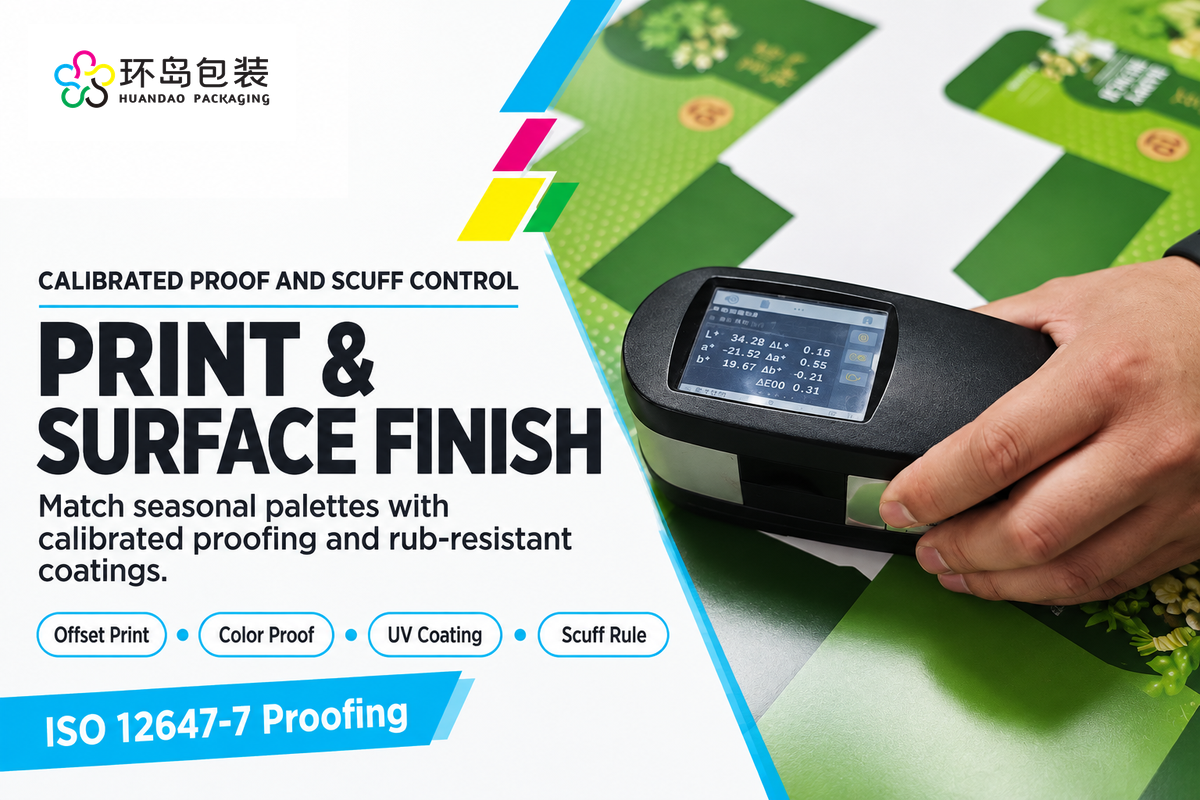
Sheetfed offset printing delivers sharp fine type, consistent color, and lower unit cost at bulk volumes, while digital printing handles short runs without plate fees and direct flexography suits simple 1- to 2-color bulk cartons. To match seasonal fabric palettes across boxes, inserts, and retail bags, specify a calibrated ISO 12647-7:2016 proof and a scuff-resistant coating.
| Print Process | Typical Run Profile | Image & Color Fidelity | Best Apparel Packaging Use |
|---|---|---|---|
| Digital Inkjet | Short runs & multi-SKU drops (no plates) | Clean CMYK; limited metallic/spot Pantone | Startup launches, seasonal capsule runs, market tests |
| Sheetfed Offset | Medium to high bulk volumes | Sharp photographic detail, tight registration, spot Pantone | Folding cartons, rigid box wraps, retail paper bags |
| Litho-Laminated Offset | Bulk branded parcel volumes | Offset graphic sharpness bonded onto E/B corrugated board | Premium DTC mailer boxes, heavy outerwear & shoe boxes |
| Direct Flexography | High-volume repeating runs | Solid spot colors on kraft/white liners; lower fine detail | High-volume e-commerce mailers & master outer cartons |
Never accept packaging design colors from a computer screen or an uncalibrated office printer. Ink-absorbing, uncoated kraft imparts a warmer, darker hue to most ink colors than does ink-reflecting clay-coated SBS, and matte coatings desaturate vivid colors. ISO 12647-7:2016defines the requirements for calibrated hard-copy digital proofs that simulate a defined production printing condition. Sheetfed offset presses deliver high-quality printing that reflects your brand across matched retail suites, aligning your brand identity across custom paper shopping bag specifications and our die-cut box dieline and tooling guide.
Special finishes—especially matte black and soft-touch surfaces—often cause unboxing complaints across the fashion industry when rub testing is skipped. In an October 2026 Packaging Digest finishing guide, practitioners note that soft-touch finishes scuff more easily than high-gloss UV coatings, with marks showing worst over heavy dark ink coverage on both film and coating. On-press UV or water-based coatings also cost less than post-press film lamination and stay recyclable in standard paper mills, while blind embossing or cold foil supports a memorable unboxing experience without plastic film.
The best cartons will be the ones where finishing was decided at the start, not added at the end.
Walter Shiels, Chief Operating Officer, Arkay Packaging, via Packaging Digest (October 2026)
⚠️ Dark-Ink Scuff Rule
Before locking a dark matte or soft-touch finish for direct parcel mailers, ship filled production-stock samples through your real carrier network. If rub marks appear on outer dark panels, move heavy dark flood ink to the interior lid for a premium unboxing experience and keep the exterior in kraft, light print, or abrasion-resistant UV varnish.
Transit Protection, Moisture Control, and Lab Testing Protocols
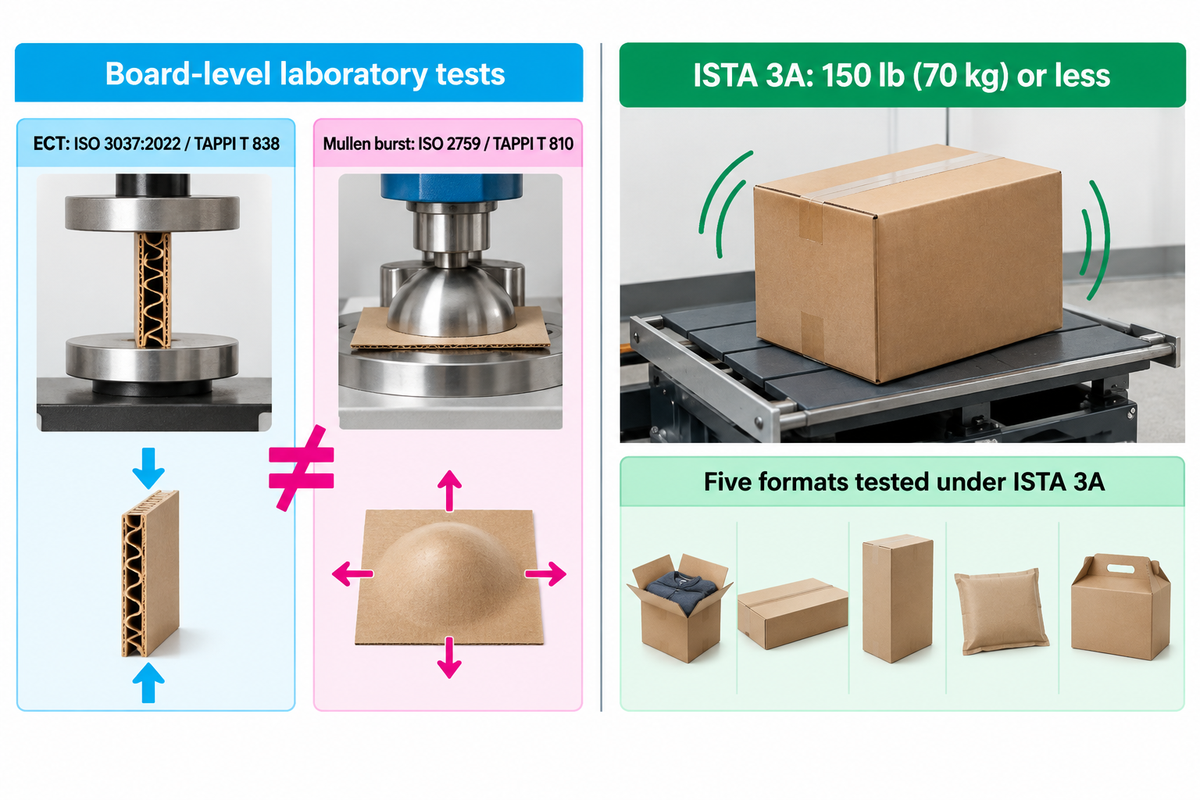
Two verification levels ensure standard quality control. During manufacturing, batch lab checks verify Edge Crush Test, burst strength, ink-rub resistance, and basis weight. At the full-pack level, ISTA Procedure 3A simulates parcel delivery for individual packages weighing 150 lb (70 kg) or less.
Buyers often confuse board strength ratings when comparing quotes. Edge Crush Test (ECT, tested under ISO 3037:2022 or TAPPI T 838) measures edgewise stacking compression strength. Mullen bursting strength (ISO 2759 or TAPPI/ANSI T 810) measures resistance to puncture and rupture under pressure. The two properties are not equivalent and cannot be converted directly into each other. Since corrugated fiberboard loses stacking strength as it adapts to ambient moisture, combine desiccant control for export master cartons with sealed inner garment bags for overseas apparel shipments.
Full-system testing matters because garments, accessories, and outer containers interact under drop and vibration forces. In a European retailer-sponsored trial at the Virginia Tech Center for Packaging and Unit Load Design (CPULD), researchers tested five formats under ISTA 3A: a polybag, paper bag, corrugated box, Orbis box, and RePack pouch. All five formats passed without failure holding two T-shirts, one pair of shoes, and lip gloss, yet that specific four-item combination does not pit the bag against the box for any particular SKU.
On the factory floor, asking whether lab numbers come from a generic mill sheet or your actual production lot separates rigorous converters from resellers. In an integrated plant with an in-house laboratory, ECT / burst testing, ink-rub checks, and basis-weight verification are available for confirmed specifications rather than relying solely on generic mill sheets. Real-time MES kanban scanning links those test results immediately to the shipped order.
Sustainable Apparel Packaging and 2026 Regulatory Compliance (EU PPWR, UK RAM & FBA)
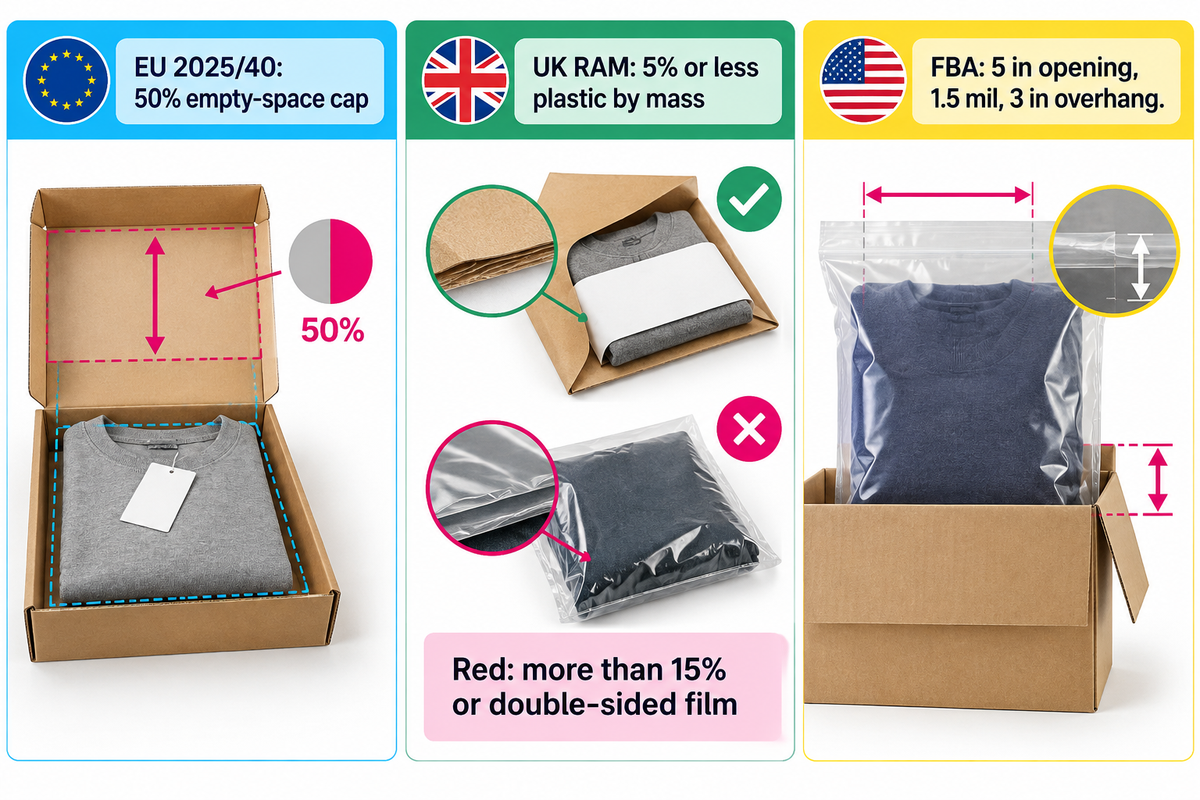
Binding packaging rules in the EU and UK have made sustainable apparel packaging an auditable engineering requirement. EU Regulation (EU) 2025/40 applies from 12 August 2026, with its 50% empty-space cap phasing in by 2030. Apparel brands selling into the EU, UK, or US Amazon FBA should now plan board coatings, empty box volume, plastic warning labels, and chain-of-custody documentation before cutting production dies, even where specific limits such as the 50% empty-space cap phase in by 2030.
EU Regulation (EU) 2025/40 (PPWR), Correcting the Empty-Space Myth: Several secondary e-commerce blogs still cite an earlier 40% draft threshold, yet the enacted law sets a 50% cap. As confirmed by the official EUR-Lex summary of Regulation (EU) 2025/40 (repealing Directive 94/62/EC), the law entered into force on 11 February 2025 and applies from 12 August 2026. Operators must keep conformity files, remove deceptive double walls or false bottoms, and meet recyclability grades starting in 2030 (with recycled-at-scale rules in 2035 and stricter exclusions in 2038). Grouped, transport, and e-commerce packaging can’t exceed 50% empty space by 2030.
UK RAM Recyclability Thresholds for Coated Cartons: Under the UK Government Recyclability Assessment Methodology (RAM), fibre-based composites with 5% or less plastic by mass are assessed in the paper and board stream. Paper packaging with more than 15% non-paper content by weight (outside fibre-composite scope) or double-sided plastic lamination is flagged red (non-recyclable), triggering higher UK Extended Producer Responsibility fees. Switching from double-sided BOPP film to single-side water-based or UV varnish keeps cartons recyclable and supports real sustainability goals.
US Amazon FBA Bagging, Suffocation Warnings, SIPP & FSC Rules:
- Amazon US FBA poly bags: Official Amazon Seller Central bagging requirements require poly bags with a flat opening of 5 inches or larger to carry a printed or labeled suffocation warning. Bags must measure at least 1.5 mil thick, seal completely, and protrude no more than 3 inches past the garment.
- Amazon SIPP (Ships in Product Packaging): Amazon offers lower FBA fulfillment fees for certified items weighing 20 lb or less shipped in their own durable container, while unenrolled bulky items can incur added packaging fees, so upgrading a standard poly bag to a rigid carton rarely pays back on ultra-light apparel SKUs.
- Purchasing FSC-certified board isn’t the same as obtaining FSC approval to print an FSC logo on your garment box. Only FSC-certified companies are entitled to print FSC logos after certification artwork approval. See the Forest Stewardship Council on-product label rules.
Compostable Poly Bags vs. Recycled Paper: Compostable poly bags or a sustainable poly bag certified only for industrial compostability require commercial high-heat plants most residential buyers lack. Bio-based films can also degrade early in warm, humid storage. To compare eco-friendly materials and vet supply partners, read our guide to sustainable packaging manufacturers.
For many major regions, uncoated kraft paper, glassine inner bags, and recycled content corrugated boxes achieve much better real-world recovery than specialty bio-films.
How much more expensive is sustainable apparel packaging compared to standard options?
Uncoated recycled kraft cartons, water-based varnished folding boxes, and FSC-certified corrugated mailers typically price close to conventional paperboard at bulk factory volumes because they run on standard offset and corrugating lines without extra plastic-film passes. Home-compostable bio-films, glassine inner bags, and custom paperboard dividers carry steeper unit premiums due to specialty feedstock costs and slower run speeds.
In terms of the complete landed price, judging eco-friendly packaging for clothing simply reduces that gap. Removing double-sided plastic lamination and double outer wrap offsets the material surcharges for eco-friendly clothing packaging and sustainable packaging options, and reduces shipment weight and UK EPR fees.
Custom Apparel Packaging Costs, MOQs, and Production Lead Times
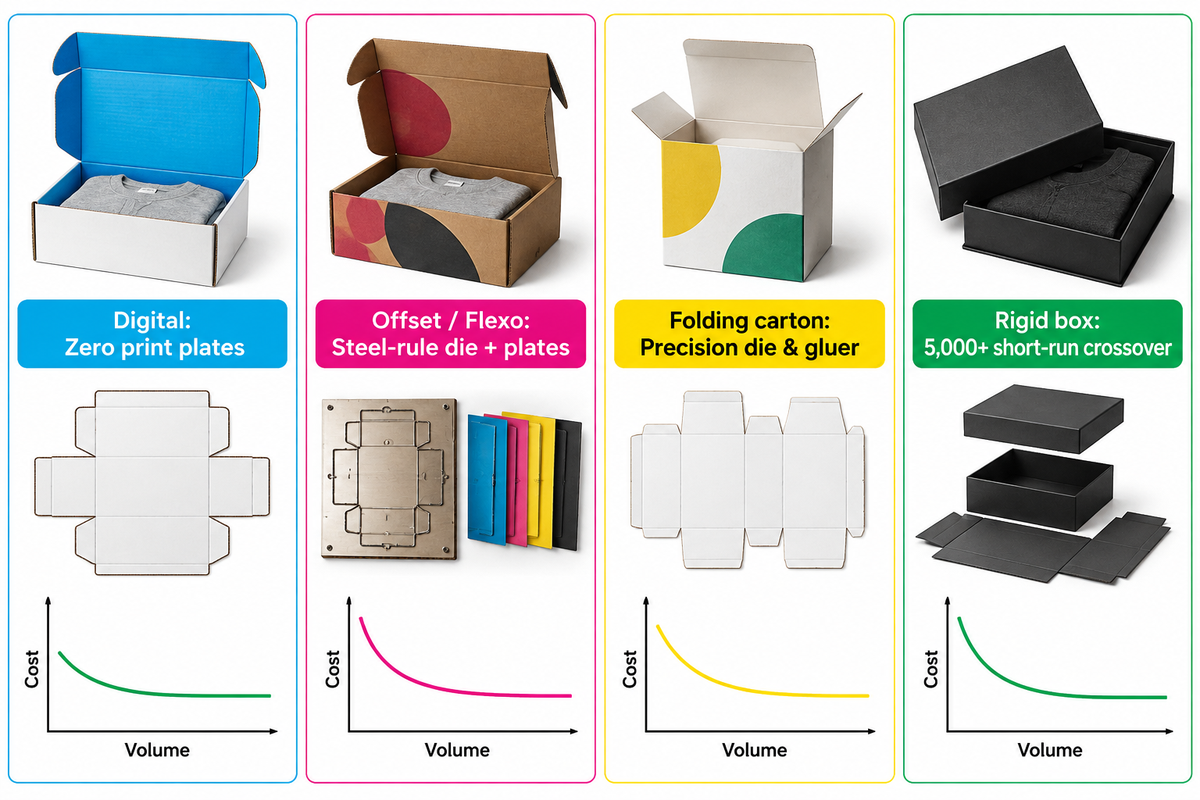
Unit pricing, minimum order quantities, and turnaround schedules in custom apparel packaging follow setup amortization rather than simple box size. Digital printing removes steel plates to produce limited test drops at a higher unit price, while sheetfed offset and flexographic converting amortize one-time plate and cutting-die fees in bulk runs to lower per-unit prices. Board caliper, inside-out ink coverage, special finishes, and freight cube define the spread from indicative price levels to actual landed cost.
| Format & Print Route | Tooling & Setup Profile | Cost & Volume Behavior | Primary Schedule & Freight Driver |
|---|---|---|---|
| Digital Corrugated Mailer | Zero print plates; digital knife or stock die | Lowest entry MOQ; highest unit ink cost (quote by size) | Fastest domestic turnaround; ships flat in bundles |
| Bulk Offset / Flexo Mailer | One-time steel-rule cutting die + print plates | Steep unit price drop once setup amortizes across bulk tiers | Proof sign-off, die fabrication, converting + freight lane |
| Printed Folding Carton | Higher precision cutting die & folder-gluer setup (per PPC) | Highly economical at medium-to-high retail order quantities | Extra finishing passes (foil, emboss, window) extend lead time |
| Luxury Rigid Gift Box | Lower simple-box tooling cost than folding cartons (PPC notes 5,000+ short-run fit) | Highest labor and greyboard material cost per unit | Erect rigid boxes ship empty air; collapsible builds cut ocean cube |
That Paperboard Packaging Council 5,000+ unit short-run benchmark is just that: a cost crossover where basic rigid boxes avoid paying up front for folding-gluer tooling, but folding cartons recoup their higher tooling fee through flat-pack freight savings and automated gluing at higher volumes. When buying luxury apparel gift boxes overseas, converting from an erect lid-and-base box to a collapsible flat-pack box can often save far more ocean container cube than minor factory unit reductions can. Use our packaging order cost comparison calculator to compare setup amortization to quantity discounts for your catalog.
How to Evaluate Apparel Packaging Manufacturers and Write a Production-Ready RFQ
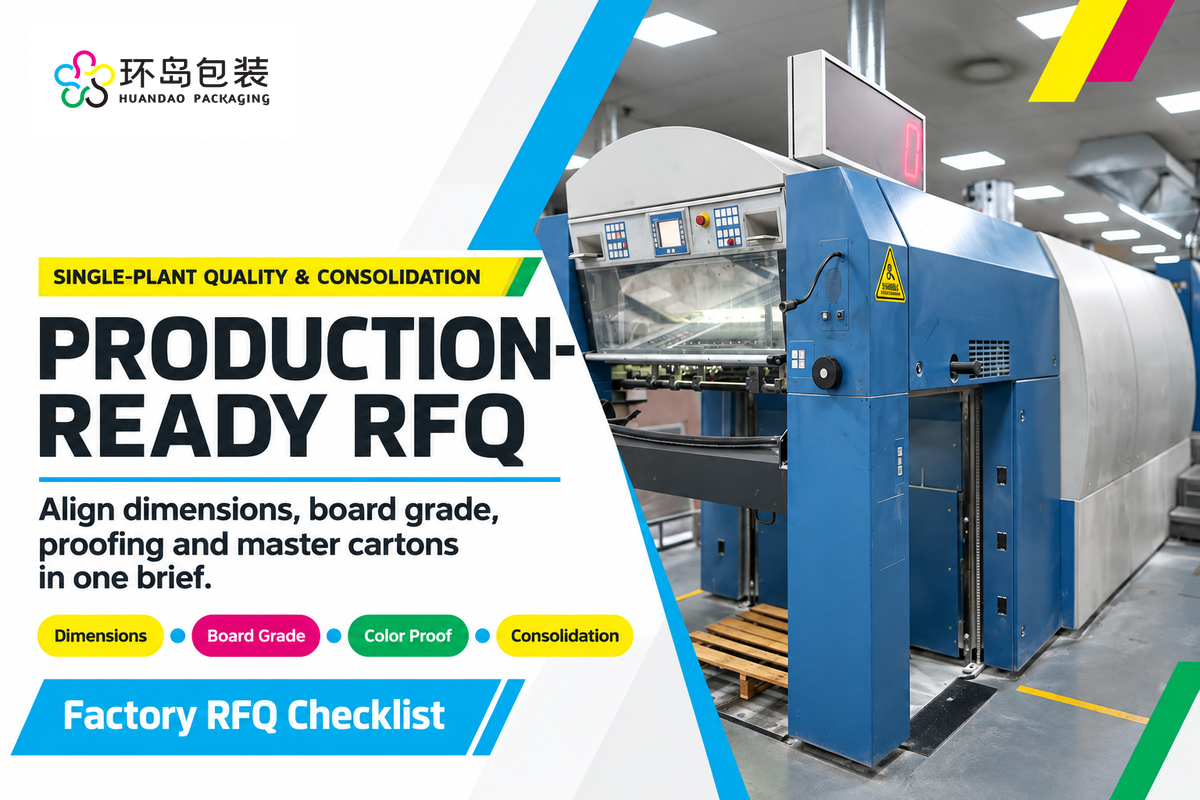
Apparel brands sourcing custom clothing packaging face a structural choice between online brokers and owned manufacturing plants. Brokers simplify small mixed test orders. When the volumes for wholesale packaging grow, directly sourcing from an integrated converter eliminates broker markup, provides better color control, and supplies batch lab reports across pre-press, offset printing, coating, lamination, die-cutting, and folder-gluing.
You also run the risk of a traditional supply-chain failure: a brand sourcing printed garment boxes from Factory A, inner trays or inserts from Vendor B, and corrugated outer shipping boxes from Factory C. Minor die-cut tolerance drift across separate plants makes inserts rattle or stops retail boxes from nesting inside master cartons—while tripling freight coordination. Working with an integrated manufacturing partner that coordinates inner trays, inserts, printed boxes, and outer shipping cartons together into a single consolidated shipment eliminates cross-vendor fit disputes and shared-freight waste.
Use the 8-Point Apparel Packaging RFQ Checklist below so packaging experts can return accurate, apples-to-apples factory quotes on the first round:
| # | RFQ Specification Item (8-Point Apparel Packaging RFQ Checklist) | Exact Data to Include in Your Brief |
|---|---|---|
| 1 | Internal Dimensions & Garment Size Basis | L × W × H in mm or inches measured around your largest folded SKU (e.g., XL/XXL) plus 0.25–0.50 in vertical clearance |
| 2 | Box Style & Structural Drawing | Exact style (RETF mailer, reverse tuck folding carton, 2-piece rigid, collapsible rigid) + whether supplier creates dieline |
| 3 | Substrate Grade, Caliper & Flute | Board type (SBS, CUK, FBB, CRB, kraft) in pt or gsm; single E-flute (~1.5 mm) or B-flute (~3 mm) + target ECT/burst rating |
| 4 | Print Coverage & Color Proofing | Outside-only vs inside-and-outside print, CMYK + Pantone spot count, ISO 12647-7 hard-copy proof requirement |
| 5 | Surface Finish & Recyclability Target | Aqueous/UV varnish vs single-side film, foil/emboss areas, and whether EU PPWR / UK RAM curbside recyclability is mandatory |
| 6 | Inner Accessories & Safety Warnings | Inner tray/divider, tissue paper, glassine or poly bag (≥1.5 mil for US Amazon FBA; suffocation warning required on poly bags with a 5-in or larger opening under both Amazon FBA rules and applicable US state statutes) |
| 7 | Order Quantities & SKU Version Split | Total volume across quantity breaks and number of artwork versions sharing the same cutting die |
| 8 | Quality Reports & Master Carton Consolidation | Job-run lab reports (ECT/burst, ink-rub, basis weight), MES tracking visibility, Incoterms, and whether outer shippers ship consolidated |
When your specification brief is ready for sampling and quoting, review direct manufacturing capabilities on our custom apparel packaging solutions page. Founded in 2003 in Xiamen, China, Xiamen Huandao Packaging Technology Co., Ltd. operates an owned colour-printing and paper packaging plant.
Pre-press, sheetfed offset printing, UV coating, lamination, die-cutting, folder-gluing, in-house E- and B-flute corrugation (with flute selected to the application), and MES kanban tracking all operate in-house, with ECT / burst testing available for confirmed specifications. Printed packs, inner inserts, and outer cartons share freight consolidation in one shipment. Think you’ll lock your carton parameters first?
Visit our carton specification builder.
Frequently Asked Questions About Apparel Packaging
Q: What is the best packaging for selling clothes online?
Tear-resistant poly mailers or gusseted kraft paper mailers are the most cost-effective packaging solution for single soft basics like T-shirts and leggings. E-flute or B-flute corrugated mailer boxes fit structured, heavy, or multi-item orders.
Pair any mailer with a dual self-sealing strip for clean customer returns, and add an inner moisture barrier when shipping porous paper or corrugated packaging through wet transit lanes.
Q: Where can I get custom packaging for a clothing brand?
Clothing brands launching small seasonal drops start with digital print suppliers offering low minimums and zero plate setup fees. Expanding brands scaling bulk production have lower unit costs working with direct offset and corrugated producers.
Before giving a bulk order, get a combined structural sample set and recent job run lab reports to ensure the factory has board caliper and color registration under their control.
Q: What determines turnaround time for custom apparel packaging?
Lead time varies by print route, tooling, and finishing passes. Digital mailers move fastest because they skip plate making, while offset folding cartons, litho-laminated boxes, and rigid gift boxes need die fabrication and multi-stage converting.
Always budget separate calendar blocks for plain structural sampling, physical color proofing, bulk production, and domestic or international ocean/air freight before seasonal launch dates.
Q: Can I order a physical sample before placing a bulk apparel box order?
Yes. Direct manufacturers supply plain structural samples so you can test folded garment fit and lid clearance before cutting production dies.
Request a calibrated hard-copy print proof on actual production board whenever seasonal color accuracy or scuff resistance is critical.
Q: Do apparel poly bags require a suffocation warning label?
Yes. Check the Amazon US FBA and state suffocation-warning opening threshold (≥5-inch opening) alongside Amazon US FBA’s separate ≥1.5 mil gauge and ≤3-inch overhang rules detailed in the regulatory compliance section above, and specify pre-printed warning text on your bag dieline so warehouse teams do not have to apply manual stickers.
Specify pre-printed warning text directly on your bag dieline alongside minimum 1.5 mil film gauge, full sealing, scannable barcodes, and at most 3 inches of loose overhang. Switching inner wraps to translucent glassine paper removes plastic suffocation warning requirements altogether while keeping folded clothing dust-free.
Q: What is the difference between folding cartons and rigid boxes for clothing?
Beyond the Paperboard Packaging Council’s 10–36 pt versus 36–120 pt board caliper boundary defined earlier, the practical commercial difference lies in logistics and line automation: folding cartons ship flat to feed high-speed gluing and erecting lines, whereas wrapped rigid boxes stay erect for luxury presentation and keepsake durability.
Folding cartons cut unit and freight costs; rigid boxes deliver heavy gift stiffness.
Q: Are compostable poly mailers always better than recycled paper or kraft mailers?
No. Unless your customers have verified access to municipal or mail-back composting programs, industrial-only bio-films often end up in landfill or contaminate standard polyethylene film recycling streams.
So, with the existing industry infrastructure in the US and UK that specifically can provide curbside paper and cardboard recovery, uncoated mono-material kraft mailers and corrugated boxes will offer fashion brands a more sustainable end-of-life than industrial-only bio-films.
Our Editorial Approach to Apparel Packaging Specs
This guide synthesizes primary packaging standards, including PPC board calipers, UPS dimensional weight divisors, ISO 12647-7:2016 proofing, ISTA 3A parcel simulation, EU Regulation (EU) 2025/40, and UK RAM recyclability rules. Production tolerances reflect real converting practices across folding cartons, litho-laminated boxes, and ECT / burst testing available for confirmed specifications. Reviewed by the Xiamen Huandao Packaging Technology Co., Ltd. technical team.
References & Sources
- What Is Paperboard Packaging? (Folding Cartons & Rigid Boxes) Paperboard Packaging Council (PPC)
- Paper & Cardboard Recycling Facts (2025 US Rates) American Forest & Paper Association (AF&PA)
- Recyclability Assessment Methodology: Assessing Materials (RAM) UK Government DEFRA
- Packaging and Packaging Waste (from 2026), Summary of Regulation (EU) 2025/40 EUR-Lex
- Shipping Dimensions and Weight (Domestic DIM Divisors 139 / 166) UPS
- ISO 12647-7:2016, Graphic Technology Proofing Processes Working Directly from Digital Data International Organization for Standardization (ISO)
- Research Highlight: Reusable Apparel Packaging in E-Commerce (ISTA 3A Trial) Virginia Tech Center for Packaging and Unit Load Design
- Test Procedures, General Simulation Procedure 3A International Safe Transit Association (ISTA)
- FSC On-Product Labels and Authorization Rules Forest Stewardship Council (FSC)
- US FBA Poly Bagging & Suffocation Warning Requirements Amazon Seller Central
- How to Choose the Right Finish for Your Carton (October 2026) Packaging Digest