Get in Touch with Xiamen Huandao Packaging Technology Co., Ltd.

Custom Product Packaging by Industry: Specification Guide

PRODUCT PACKAGING BY INDUSTRY
We match five physical and commercial variables to develop custom product packaging: payload weight, product fragility, chemical or regulatory barriers, distribution channel hazards, and order-volume tooling economics, to the right paperboard, corrugated, or rigid box architecture. Buyers don’t pick a box style by industry label alone. They specify board caliper, flute profile, internal inserts, printing method, and tolerances for laboratory tests for their exact supply chain.
When brands assess custom packaging companies or compare custom boxes and packaging from catalog photos without checking the distribution route, failures occur. Matte cosmetic cartons arrive scuffed, bakery box packaging suffers grease or ink set-off, perforated retail display boxes burst in automated warehouses, and oversized e-commerce mailers incur heavy dimensional-weight freight penalties. The packaging specification guide offers information on structure and format of packaging, substrate and flute selection, adherence to industry specific regulations and guidelines, trade-offs in press and coating, job linked laboratory testing, and multi-component kitting and consolidation.
How Product Weight, Fragility, and Distribution Route Dictate Packaging Architecture Across Industries
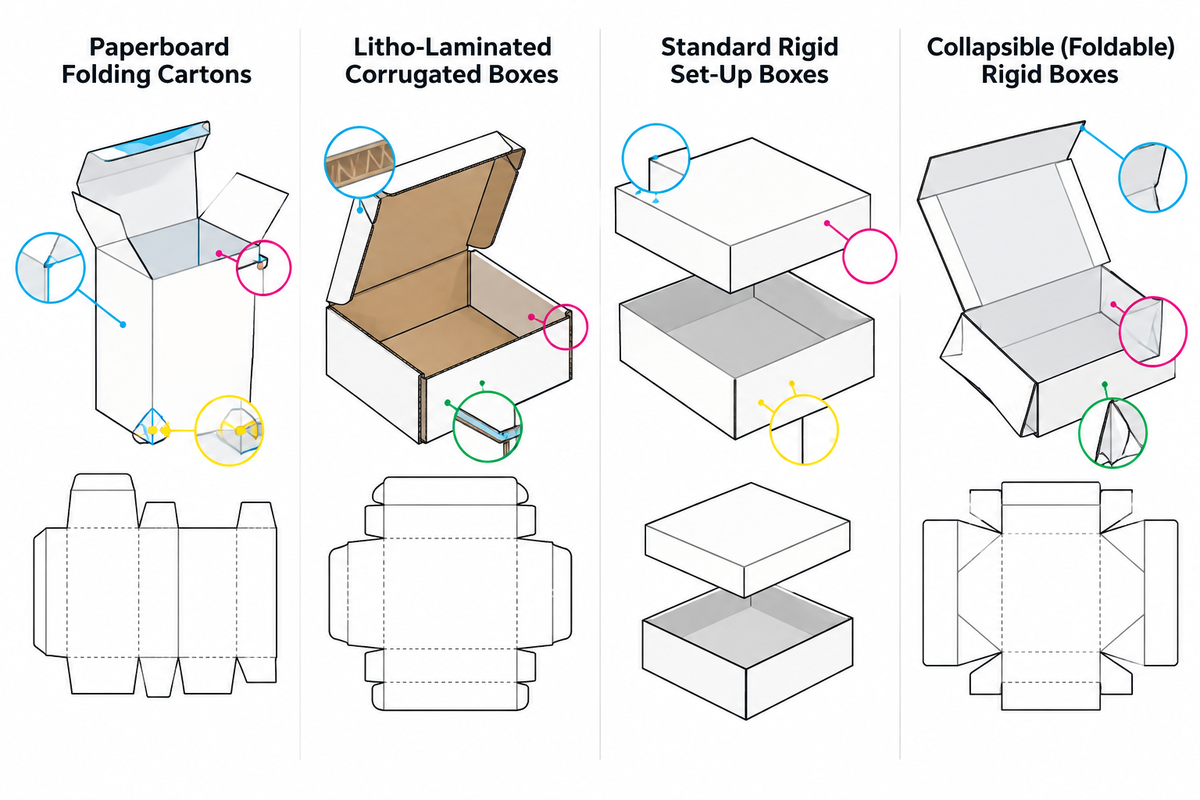
The physical nature of a product and its distribution route determines which custom packaging framework is appropriate to survive the modern packaging industry. A product packed in a glass dropper bottle in a custom retail packaging that reaches the store on a palletized master case will encounter different drop, compression and transportation hazards compared to the same bottle shipped by itself via parcel sorting centers. Analyzing retail packaging, in combination with the packaging needs and structured packaging design methodology, helps brands create custom packaging to not over-engineer the product protection and not under-engineer the protection of fragile shipments.
As defined technically by the Paperboard Packaging Council (PPC) on paperboard packaging, folding cartons are made from 10 to 36 point (pt) paperboard, and are made to fold flat to enable economical storage and high speed filling. Common folding board grades include: solid bleached sulfate (SBS), coated unbleached kraft (SUS/CUK), folding boxboard (FBB), and coated recycled board (CRB). When a product requires greater puncture or stacking protection while retaining shelf graphics on custom printed boxes, mini-flute cartons sandwich an E, F, G, or N corrugated medium between two linerboards. By contrast, rigid set-up boxes use thick 36 pt to 120 pt chipboard overlaid with a printed paper wrap. Set-up boxes generally ship in the erect position, and are better suited for luxury packaging presentation and shorter production runs where low tooling setup outweighs warehouse volume.
The 5-Variable Industry Packaging Matrix
- Variable 1: Payload Mass and Point-Load Concentration: Keep single-layer 10 to 36 point folding cartons and reverse tuck boxes for compact retail items under approximately 0.75-1.5 kg. Transition to E-flute, B-flute, or double-wall BC-flute corrugated structures when concentrated payload mass exceeds 0.75–1.5 kg or stacking loads exceed solid paperboard bending limits.
- Variable 2 — Fragility and Internal Restraint: Separate outer container compression from internal shock absorption by pairing glass, ceramic, or electronic assemblies with die-cut paperboard cradles, fluted partitions, molded fiber trays, or closed-cell foam inserts.
- Variable 3 — Barrier and Regulatory Class: Define whether the package contacts aqueous or fatty food (21 CFR 176.170) or dry food (21 CFR 176.180). For healthcare or electronics, verify serialization, child-resistant locks, or electrostatic protection before choosing board furnish and ink chemistry.
- Variable 4 — Distribution Channel Hazards: Distinguish palletized retail shelf distribution (where a master shipping case carries stacking loads) from individual parcel delivery. Parcel mailers are tested under ISTA Procedure 3A for single parcels up to 70 kg (150 lb).
- Variable 5 — Tooling Amortization and Kitting Economics: Balance digital, flexographic, and sheetfed offset plate setup against unit run length. Evaluate consolidated kitting early—international freight and customs can add $6.67 to a $25 unit price, while spending $1.80 on engineered kitting can save $4.20 per kit in avoided returns and reshipments.
Notice the structural limitation here: Paperboard point caliper (10-36pt) or corrugated flute selection alone, doesn’t set a universal payload limit, and would require testing of the complete, assembled package, and the geometry of the internal inserts. A thick 36pt. Even a thick 36 point carton can pop open at the bottom panel if a dense bottle concentrates load on an unglued tuck flap instead of an auto-lock bottom. Seasoned buyers therefore use custom packaging prototypes to test the strength of the bottom-lock, before committing to boxes custom-sized to their product.
| Structural Packaging Format | Board Caliper / Wall Construction | Shipping & Storage State | Primary Protection Strength | Typical Industry Verticals |
|---|---|---|---|---|
| Paperboard Folding Cartons | 10 to 36 point (10–36 pt) paperboard (SBS, FBB/C1S, SUS/CUK, CRB/CCNB per PPC) | Shipped flat; erected on manual or automated cartoning lines | High-resolution retail graphics, light containment, and fast line machinability inside master cases | Cosmetics, pharmaceuticals, dry food, supplements, confectionery, and small retail hardware |
| Litho-Laminated Corrugated Boxes | Offset-printed top sheet laminated onto single-face or sheet-to-sheet E, B, C, F, or BC fluted medium | Shipped flat; die-cut mailers or crash-lock bottoms fold at 90° and 180° into structural boxes | Combines photographic offset print with fluted cushioning and vertical stacking compression (e.g., 32 ECT / 65 lb) | Consumer electronics, wine and spirits, e-commerce subscription kits, small appliances, and retail PDQ displays |
| Standard Rigid Set-Up Boxes | 36 to 120 point (36–120 pt) greyboard/chipboard overlaid with printed wrap paper (per PPC) | Shipped pre-erected; requires zero assembly on the brand’s packing line | Maximum wall stiffness, non-deforming luxury presentation, and reusable keepsake structure | Luxury fragrances, fine watches and jewelry, premium gift sets, and flagship consumer tech |
| Collapsible (Foldable) Rigid Boxes | 36–120 pt die-cut and scored greyboard subassemblies with triangular corner connectors and concealed magnets | Shipped flat in stacks; pulls upright into a locked 3D box (e.g., 150×150×25 mm) via magnetic flaps | Delivers rigid luxury unboxing while cutting inbound sea-freight and warehouse cube compared to erect setup boxes | Apparel gift boxes, luxury footwear, seasonal retail hampers, and export-shipped gift packaging |
Paperboard Grades, Corrugated Flute Profiles, and Greyboard Calipers by Industry Load Class
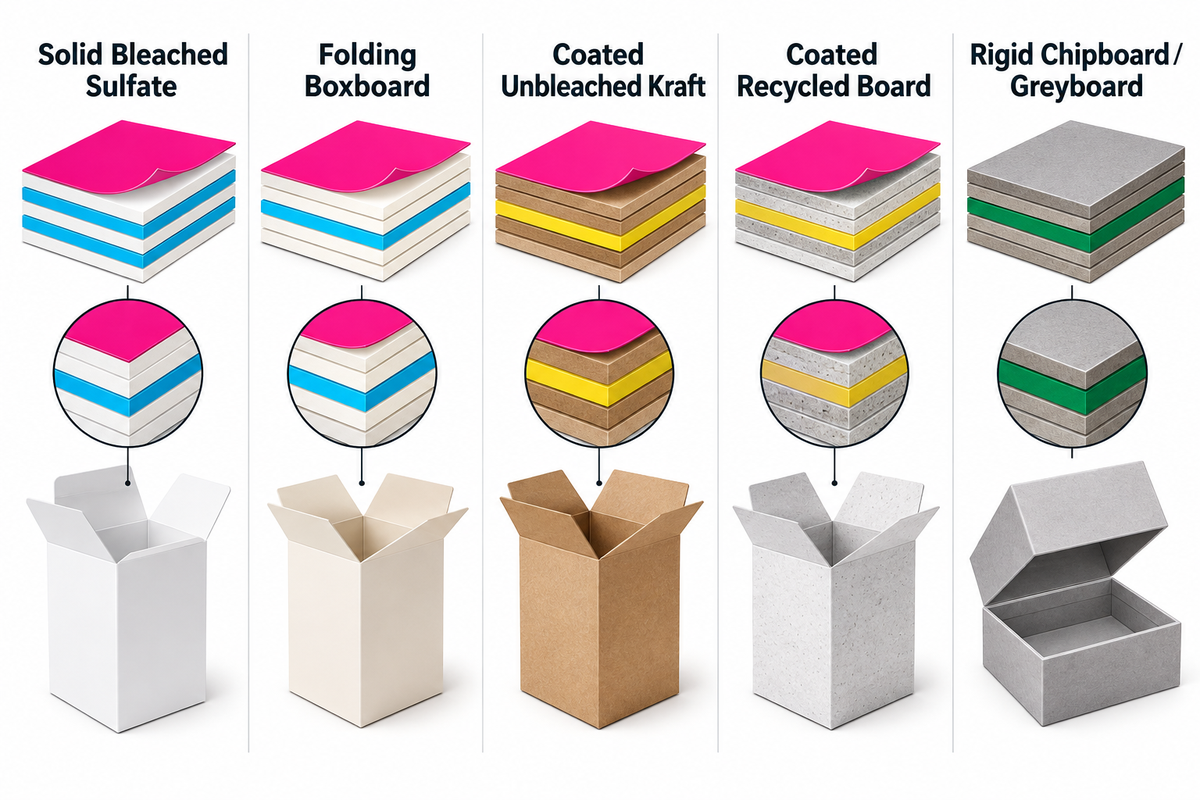
Once the structural format is selected through the 5-Variable Industry Packaging Matrix, engineers must lock in the exact substrate furnish and flute geometry on the CAD drawing for their packaging boxes. Specifying “cardboard” or a nominal weight, without calling out the fiber grade, allows for batch-to-batch stiffness drift. As outlined in the Paperboard Packaging Council guide to 4 types of paperboard, four core grades dominate commercial folding cartons: Solid Bleached Sulfate (SBS), Coated Unbleached Kraft (CUK/SUS), Folding Boxboard (FBB), and Coated Recycled Board (CRB/CCNB). Teams sourcing custom folding cartons from the best custom packaging companies match each grade’s pulp architecture to their print and moisture environment.
SBS uses virgin hardwood and softwood fibers that are bleached and coated with clay to create a white printing surface. Because of this, it is considered the industry standard for cosmetics applications like dry, frozen, or wet food cartons. CUK uses unbleached virgin fiber (kraft) to make a natural brown backer to increase tearing resistance and achieve higher wet-strength performance for beverage and hardware cartons. FBB (commonly supplied as C1S ivory board) sandwiches a mechanical pulp middle layer between chemical pulp outer layers to achieve high bending stiffness per gram of fiber for customized packaging boxes. This structure is used for customized packaging boxes. CRB/CCNB uses recovered paperboard fiber with a clay-coated top surface for dry retail goods where maximum bending stiffness or direct wet food-contact purity is not required.
When product weight and parcel drop concerns demand fluted cushioning, converters laminate an offset-printed sheet to corrugated board. As described in technical converting notes from PackRite on single-face laminated corrugated, a single-face lamination bonds a top printed sheet to a fluted corrugated sheet in a 3-layer construction (C, B, E, or F profiles). By comparison, sheet-to-sheet lamination mounts a printed litho sheet to double-face (single- or double-wall) board. Huandao’s Xiamen plant has an in-line corrugator that produces single E-flute or single B-flute board. They maintain zero stock. Meanwhile, A, C, F, BC, and other flute profiles are produced from sourced board, allowing a full-service packaging partner to match micro-flutes to retail graphics or heavy double-wall profiles to industrial export loads.
Rigid Boxes vs. Folding Cartons: Which Is Right for You?
Choose folding cartons (10 to 36 point SBS, FBB, CUK, or CRB) to get a low manufacturing cost per unit, flat-packed shipping efficiency, and high-speed automated filling for light to moderate retail products. Choose rigid set-up boxes (36 to 120 point greyboard wrapped in printed paper) to get luxury tactile stiffness, convenience of a pre-assembled box, and magnetic keepsake presentation.
| Paperboard or Flute Category & Grade Type | Typical Caliper / Construction | Fiber & Structural Behavior | Print Surface Characteristics | Best-Fit Industry Applications |
|---|---|---|---|---|
| Solid Bleached Sulfate (SBS) | 10 to 36 point (10–36 pt) virgin bleached chemical pulp board (per PPC) | Solid white through-sheet; hygienic, odor-neutral, high crease fidelity at 90° and 180° score folds | Clay-coated C1S or C2S surface supports fine offset halftones, hot foil, embossing, and Spot UV | Cosmetics, fragrances, pharmaceuticals, medical devices, frozen foods, and bakery cartons (per PPC) |
| Folding Boxboard (FBB / C1S Ivory Board) | 10 to 36 point (10–36 pt) multi-ply virgin mechanical and chemical pulp board | High bulk and bending stiffness-to-weight ratio; resists panel bulging on upright retail shelves | Smooth coated white top surface with cream/manila reverse side | Skincare cartons, nutraceutical bottle boxes, confectionery, and personal care retail boxes |
| Coated Unbleached Kraft (CUK / SUS) | 10 to 36 point (10–36 pt) unbleached virgin softwood kraft board | Long virgin softwood fibers deliver high tear resistance and wet-strength load retention up to 65 lb | Clay-coated white top for retail graphics over a strong natural brown kraft back | Beverage multipack carriers, frozen food cartons, heavy hand tools, and auto aftermarket parts |
| Coated Recycled Board (CRB / CCNB) | 10 to 36 point (10–36 pt) clay-coated recycled paperboard | Lower bending stiffness and tear strength than virgin board; requires wider score channels at 90° folds | Clay-coated white top over grey newsprint back; economical for dry non-fatty items | Dry household goods, shoe inner boxes, paper stationery, and budget retail cartons |
| F-Flute & E-Flute Micro-Corrugated | Fine micro-flute corrugated medium (F-flute and E-flute profiles) | High flat-crush resistance and smooth surface; bridges 10–36 pt folding cartons and parcel shipping boxes | Accepts direct flexo or litho-laminated C1S top sheets with minimal flute washboarding | DTC e-commerce mailers, cosmetic subscription boxes, small electronics, and counter PDQ displays |
| B-Flute & C-Flute Single-Wall Corrugated | Standard single-wall fluted medium (B-flute and C-flute profiles, e.g., 32 ECT / 65 lb limit) | B-flute resists die-cut crushing and puncture; C-flute offers thicker cushioning and vertical stacking column strength | Litho-laminated for retail boxes or flexo-printed for master shipping cartons up to 75 in outside dimensions | Small kitchen appliances, wine/spirits carriers, retail shelf-ready cases (SRP), and master shippers |
| BC-Flute Double-Wall Corrugated | Combined B + C fluted double-wall corrugated board for parcels up to 70 kg (150 lb) | High edgewise compression (ECT) and Mullen burst resistance for heavy pallet stacking | Heavy litho-laminated retail packs or kraft export master cases | Industrial hardware, power tools, automotive assemblies, and heavy export pallet loads |
| Rigid Chipboard / Greyboard | 36 to 120 point (36–120 pt) high-density board overlaid with printed paper wrap (per PPC) | Non-bending structural core V-grooved or die-cut and wrapped with printed art or specialty paper | Supports C2S art paper, textured specialty paper, soft-touch film, hot foil, and debossing | Luxury perfume, jewelry, watches, premium spirits, and flagship smartphone packaging |
Cosmetics, Fragrance, and Luxury Retail: Specifying High-Graphics Cartons, Rigid Boxes, and Fragile Glass Restraint
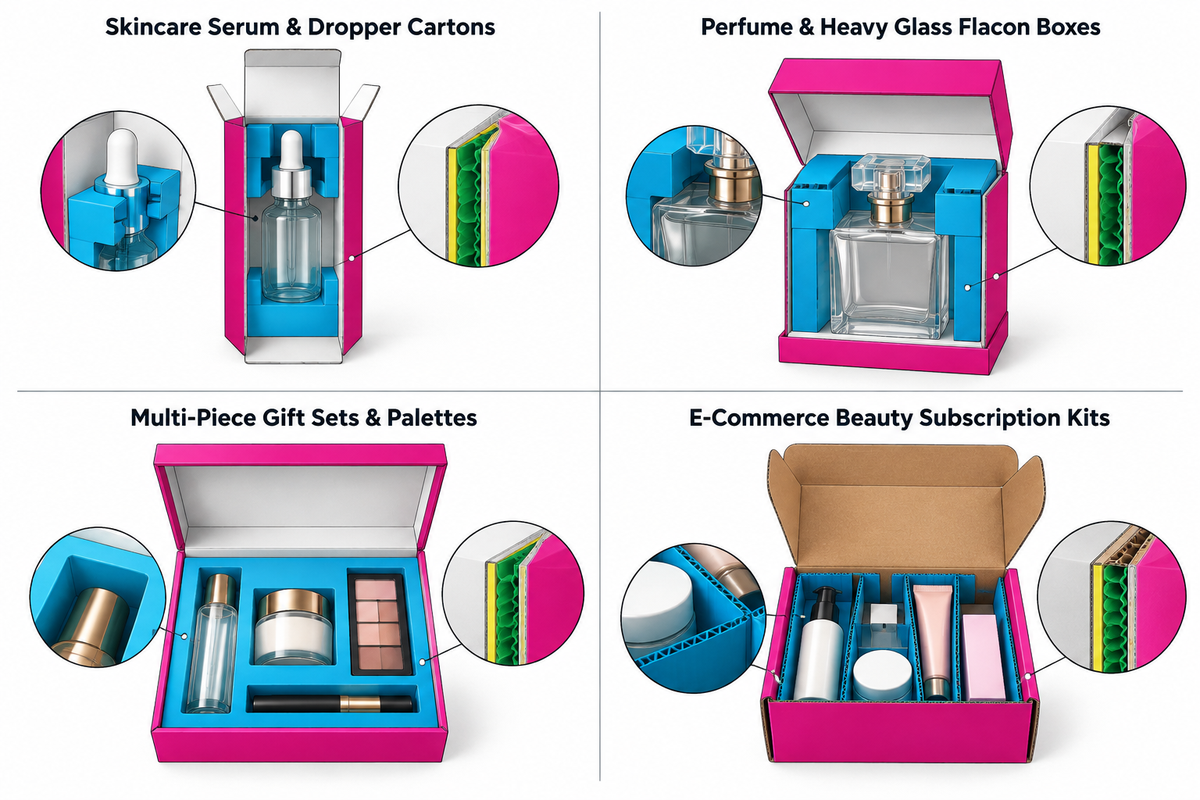
In the cosmetics, skincare, and fragrance sector, personalized packaging must protect heavy, fragile glass dropper or atomizer bottles and keep flawless visual brand identity under retail store lighting. A scuffed matte panel or a shifted Pantone color compromises product presentation on the shelf. For brands ordering custom rigid boxes and primary cosmetic cartons, protection science and interior geometry must work together to achieve premium packaging solutions.
First, control color evaluation across substrates and finishes. When ordering packaging online, a PDF proof approved on an office monitor does not predict how an ink formula will look once coated with matte BOPP lamination, gloss UV varnish, or soft-touch film. As documented by X-Rite on ISO D50 illumination and M-standards, visual color evaluation and spectrophotometric measurement for packaging substrates and printing colorants rely on D50 daylight illumination conditions under ISO 3664. For paperboards containing optical brightening agents, pressrooms also apply ISO 13655 M1/M2 measurement modes. Buyers should require physical wet press drawdowns on the actual SBS or C2S wrap stock and specify whether color tolerances are measured before or after lamination.
Second, balance luxury gift boxes against inbound freight volume. Traditional 36 to 120 point rigid set-up boxes ship fully erected, meaning ocean containers carry mostly air. For larger beauty gift sets or apparel boxes, engineers increasingly specify foldable rigid constructions. U.S. Patent US8573471B2 (Foldable box) discloses a reusable foldable rigid box with a flat configuration for stacked storage. It pops into a three-dimensional upright box locked by concealed magnets and triangular corner connectors (illustrated at 150×150×25(h) mm). Because the magnetic locking elements are flush to the surface of the laminated panels, rigid boxes can be collapsed flat, and locked in the shipping position, for export. On the fulfillment line, they are popped upright, in seconds, to become three dimensional.
Third, immobilize glass containers. Fragrance bottles and glass serum jars should not rattle against the walls of the carton. A custom die-cut paperboard cradle or fluted partition should be specified, as well as a wet-pressed molded fiber tray. An EVA foam insert should be specified to cradle the bottle and provide an interference fit, leaving a shock zone within the outer carton wall.
| Cosmetic & Luxury Component | Recommended Substrate & Caliper | Surface Finish & Embellishments | Internal Restraint Engineering | Key Quality & Failure Control |
|---|---|---|---|---|
| Skincare Serum & Dropper Cartons | 10 to 36 point (10–36 pt) SBS or FBB/C1S ivory board | Anti-scratch matte BOPP lamination + Spot UV or cold/hot metallic foil stamping | Integrated folded paperboard neck lock and raised bottom platform cradle | Verify ASTM D5264 ink-rub resistance on dark matte panels; test 90° score folds parallel to grain |
| Perfume & Heavy Glass Flacon Boxes | Heavy-caliper 10–36 pt SBS or F-flute litho-laminated micro-corrugated | Soft-touch film lamination + multi-level blind embossing and hot foil | Corrugated E-flute liner sleeve or die-cut EVA/molded-pulp cavity holding bottle shoulders | Prevent heavy glass base from punching through bottom tuck by specifying auto-lock or snap-lock bottom |
| Multi-Piece Gift Sets & Palettes | 36 to 120 point (36–120 pt) rigid greyboard wrapped in coated C2S art paper | Linen/textured specialty paper wrap or matte lamination with magnetic closure (e.g., 150×150×25 mm format) | Custom die-cut EVA foam, thermoformed RPET blister, or smooth wet-pressed molded pulp tray | Check lid-to-base telescopy clearance and magnet pull strength across humidity cycles |
| E-Commerce Beauty Subscription Kits | E-flute litho-laminated FEFCO 0427 mailer (e.g., 290 × 220 × 95 mm / 11.42 × 8.66 × 3.74 in) | Exterior aqueous varnish for parcel scuff resistance; interior CMYK unboxing graphics | Die-cut paperboard divider grid separating glass jars from flexible tubes | Verify ISTA 3A parcel drop survival (≤70 kg / 150 lb class) and unvarnished glue reserve strips |
Food, Beverage, and Bakery Packaging: Barrier Coatings, Migration Boundaries, and Wet-Strength Board
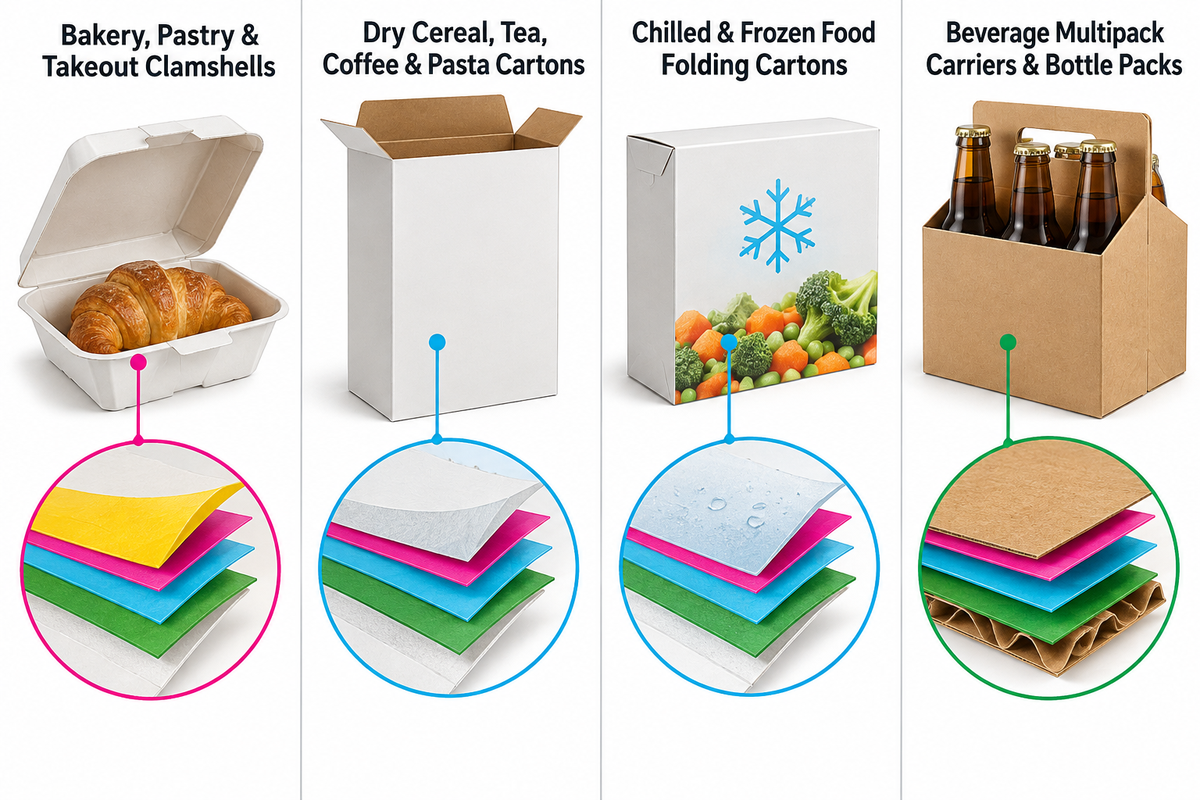
Specifying custom packaging solutions for food, beverage, and bakery products, requires separating three functional layers to protect product safety. Simply writing “food-grade box” when evaluating options for custom packaging leaves the converter guessing if the paperboard is in contact with unwrapped fatty or oily pastry, dry tea bags, or sealed glass jars.
In the U.S., paper and paperboard components that come in direct contact with food are covered by Title 21 of the Code of Federal Regulations. Under 21 CFR 176.170 (aqueous and fatty foods), permitted substances and extraction limits depend on the type of food (Types I-IX) and temperature conditions of use (Conditions A-H). Prior to the sheet forming operation in paperboard manufacture, certain water-repellent resins are restricted to not more than 1.6 percent by weight of the finished dry paper and paperboard fibers. On the other hand, dry food solids of the type defined under Type VIII are governed by the provisions of 21 CFR 176.180. In the European Union, Commission Regulation (EC) No 2023/2006 on Good Manufacturing Practice (GMP) Annex A, governs non-food contact printing. As specified therein, the inks should be formulated and printed so that no substances transfer to the food-contact side through the substrate, or by set-off in the stack or reel.
What relevance does printing-ink set-off have when food is within a secondary carton or inner wrapper? When custom-made boxes are printed on paperboard sheets and stacked on press pallets or wound into reels, the wet ink on the outside of one sheet comes in contact with the unprinted inside of the next. Peer-reviewed food safety literature on food packaging and chemical migration documents chemical migrants from printed carton packaging in milk at concentrations of 2.84 to 18.35 µg/kg. In addition, 2025 packaging migration research highlights set-off migration from external printed components to inner food-contact layers. Keep this engineering limitation in mind: complying with US FDA 21 CFR 176.170/176.180 for paperboard components or EU Regulation 2023/2006 for printing-ink set-off does not replace finished-package migration testing for the specific food type and storage temperature.
Are Product Boxes Compostable?
Yes, unlaminated paperboard product boxes made from virgin or recycled cellulose fibers and printed with low migration vegetable or water based inks and sealed with water based adhesives, are both curbside recyclable and biodegradable/compostable if coated with aqueous dispersion barriers. Boxes laminated with conventional polyethylene (PE), polypropylene (BOPP), or metallized polyester films are not compostable and require qualified recycling claims.
| Food & Beverage Packaging Application | Contact & Environmental Exposure | Recommended Board Furnish | Barrier & Ink Specification | Regulatory & Structural Focus |
|---|---|---|---|---|
| Bakery, Pastry & Takeout Clamshells | Direct contact with warm, moist, or greasy food (Food Types III–V, VII) | 10–36 pt virgin bleached SBS or unbleached virgin kraft (no recycled de-inked fiber) | Water-based dispersion grease/moisture barrier or PLA/PE lining; low-migration food-compliant inks | 21 CFR 176.170 extraction compliance; steam vents to prevent condensation softening |
| Dry Cereal, Tea, Coffee & Pasta Cartons | Direct dry food contact (Type VIII) or secondary carton around inner pouch | 10–36 pt virgin FBB/C1S ivory board or SBS; CRB/CCNB only when isolated by a functional barrier | Low-odor, low-migration vegetable/water-based offset inks; aqueous overcoat to block set-off | 21 CFR 176.180 (dry food) and EU 2023/2006 Annex A stack set-off control |
| Chilled & Frozen Food Folding Cartons | Freeze-thaw condensation and high-humidity cold storage (Conditions F–G) | Wet-strength 10–36 pt virgin SBS or CUK/SUS board | Moisture-vapor barrier dispersion or film coating; cold-temperature hot-melt glue, with skive-and-hem edge protection | Prevent carton panel bowing and glue open-flaps during freezer-to-ambient transitions |
| Beverage Multipack Carriers & Bottle Packs | Heavy glass bottles or aluminum cans under wet cooler/condensation loads | Heavy-caliper 10–36 pt Coated Unbleached Kraft (CUK/SUS) with long virgin softwood fibers | Wet-strength resin furnish + water-resistant aqueous varnish | High tear resistance at finger-grip holes and bottom locking tabs under dynamic carry jolts |
E-Commerce, Subscription, and Apparel Packaging: Corrugated Mailer Flutes, DIM Weight, and ISTA 3A Parcel Survival
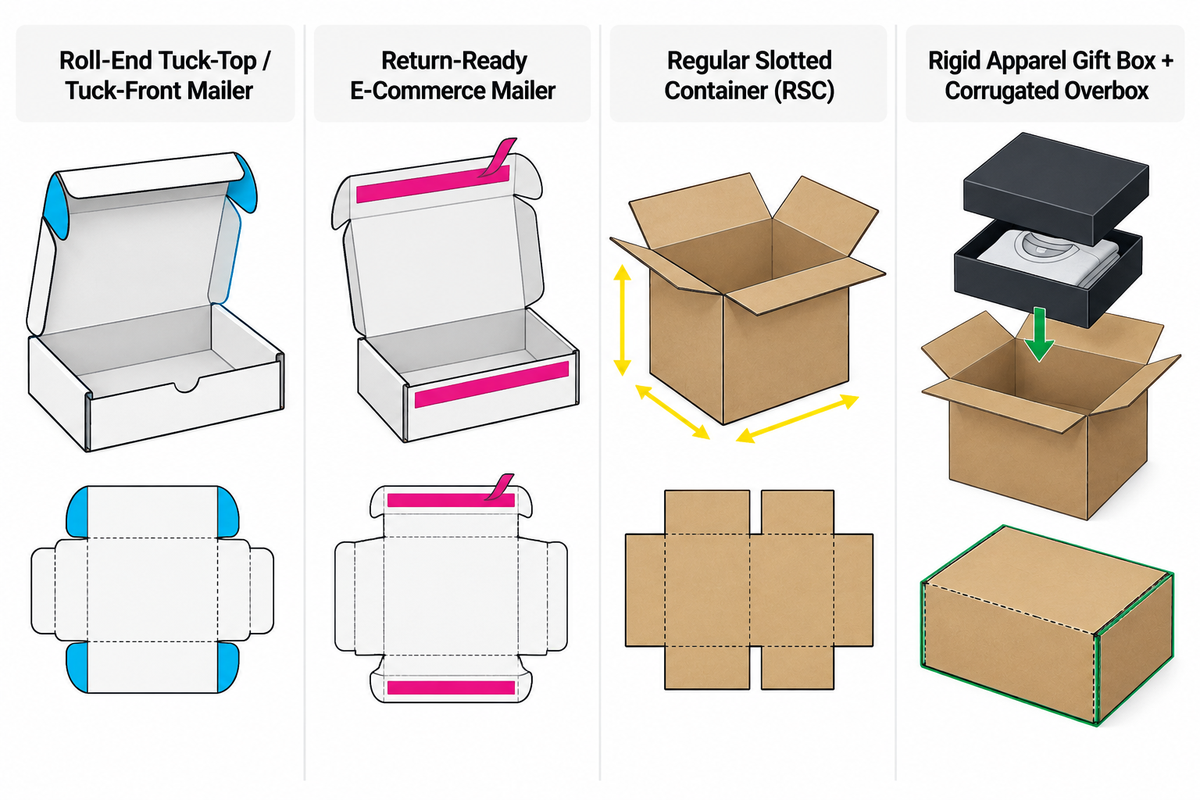
Subscription box and apparel brands are facing a two-part engineering problem as a result of their direct-to-consumer (DTC) e-commerce models. Branded packaging serves as the primary unboxing touchpoint for the customer, yet custom shipping boxes travel unpalletized through automated parcel conveyors, drop chutes, and delivery vans. Parcel carriers bill by either the actual scale weight or the volumetric dimensional (DIM) weight, and whichever is greater is charged to the customer. Brands configuring their custom corrugated boxes and custom mailer boxes must consider both structural survival and cubic volume, and unbreakable soft garments may ship in custom poly mailers or kraft mailers if box rigidity is not necessary.
Academic distribution testing shows why the complete pack must be validated as a unit. In a study conducted at the Virginia Tech Center for Packaging and Unit Load Design (CPULD), researchers evaluated five e-commerce apparel packaging solutions across an ISTA 3A testing sequence. Each test pack contained two T-shirts, one pair of shoes, and a container of lip gloss. As documented in ISTA procedure specifications, 3-series parcel delivery procedures simulate vibration, drop, and compression hazards for individual packaged products weighing 70 kg or less. When a mixed subscription kit combines soft apparel with a rigid shoe box and a fragile cosmetic jar, internal paperboard dividers must prevent the heavier item from crushing the cosmetic container during corner and flat drops.
At the same time, right-sizing the flute thickness and external dimensions of branded boxes with logo directly protects profit margins by lowering billable dimensional weight. Commercial parcel carriers calculate dimensional weight in pounds by multiplying exterior Length × Width × Height (in inches) and dividing by 139. Consider a worked engineering example for a 1.2 kg (2.65 lb) subscription apparel and skincare kit:
- Baseline Oversized Stock B-Flute Box: Using a generic stock box measuring 14.17 × 11.02 × 5.91 in (360 × 280 × 150 mm) yields an exterior volume of 923 in³. Dividing 923 in³ by the 139 DIM divisor produces a 6.64 lb dimensional weight (7 lb billing tier), billing for over 4 lb of air.
- Right-Sized E-Flute FEFCO 0427 Custom Mailer: Switching to a custom die-cut FEFCO 0427 mailer in E-flute with a paperboard insert trims dimensions to 11.42 × 8.66 × 3.74 in (290 × 220 × 95 mm), or 370 in³. Dimensional weight drops to 370 / 139 = 2.66 lb (matching the 3 lb actual weight tier) while double-thickness side walls formed by the FEFCO 0427 roll-over ears protect corners during ISTA 3A drops.
| E-Commerce & Apparel Box Style | FEFCO Structural Code & Flute | Structural & Unboxing Features | DIM Weight & Packing Efficiency | Best-Fit E-Commerce Use Case |
|---|---|---|---|---|
| Roll-End Tuck-Top / Tuck-Front Mailer | FEFCO 0427 in E-flute or B-flute corrugated | Double-thickness side walls; dust flaps block dirt; supports full inside-and-outside printing | Eliminates outer tape when locked; tight depth control minimizes carrier DIM weight | Subscription boxes, DTC cosmetics, apparel kits, and direct-mail PR Influencer boxes |
| Return-Ready E-Commerce Mailer | Modified FEFCO 0422 / 0427 in E-flute or B-flute (≤70 kg / 150 lb ISTA 3A class) | Integrated zipper tear-strip for frustration-free opening + dual peel-and-seal adhesive strips | Allows the customer to return or exchange garments in the exact same right-sized box | Fashion apparel, footwear, eyewear, and try-at-home retail programs |
| Regular Slotted Container (RSC) | FEFCO 0201 in B-flute, C-flute, or BC double-wall (e.g., 32 ECT / 65 lb / 75 in limit) | All flaps equal length, with outer flaps meeting at center; highest material yield from parent corrugated sheet | Lowest board cost per liter of packed volume; requires water-activated or branded packing tape | Multi-item wholesale orders, heavy home goods, and outer master shipping cartons |
| Rigid Apparel Gift Box + Corrugated Overbox | 36 to 120 point (36–120 pt) collapsible rigid box inside E/B-flute shipper | Preserves pristine luxury gift box corners by isolating parcel conveyor scuffs on the outer mailer | Collapsible rigid construction saves substantial warehouse storage space prior to fulfillment | Luxury outerwear, designer handbags, bridal accessories, and premium footwear |
Electronics, Consumer Tech, and Industrial Hardware: Litho-Laminated Corrugated, Cushioning Inserts, and ECT/Burst Limits
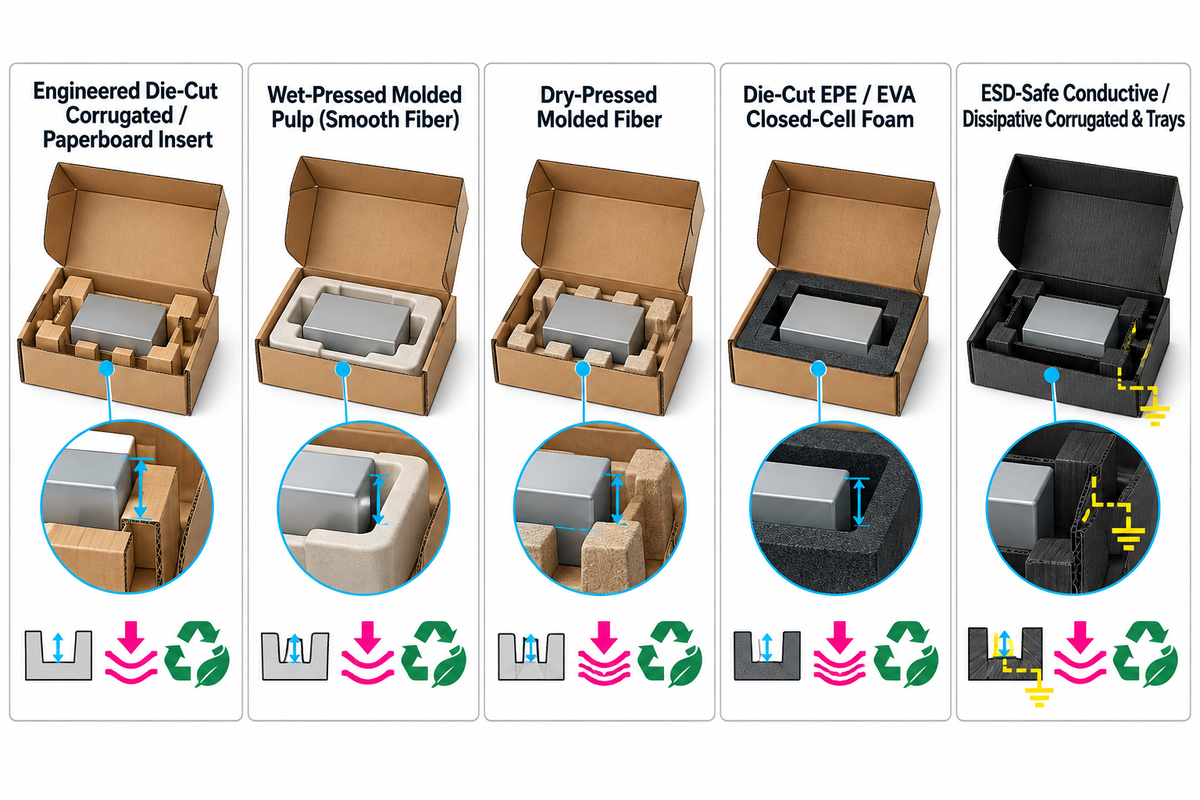
Products that use consumer electronics, smart home devices, power tools, and automotive aftermarket parts incorporate mass into small packages, and can contain sensitive circuit boards, displays, and/or machined metal components. Delivering professional packaging for these products requires using the right corrugated strength metric (Edge Crush Test (ECT) vs. Mullen Bursting Strength) and engineering an energy absorbing cushioning insert to protect high gloss surfaces from marring.
A common procurement error is treating ECT and Mullen burst ratings as interchangeable numbers. In FEFCO’s Testing Methods and Recommendations, both Bursting Strength (Method 4) and Edgewise Crush Resistance (Method 8) evaluate different types of mechanical stress, and therefore cannot be converted to each other with a linear multiplier. Edge Crush Test (ECT) is a measure of the vertical compressive force (in pounds per linear inch or kilo-Newtons per meter) that a board edge can withstand before buckling, and is used to determine the stacking height of warehouse pallets. Mullen burst measures the hydraulic pressure (in pounds per square inch or kPa) required to rupture the face of the board, governing diaphragm rupture resistance under rough parcel handling.
Published corrugated engineering tables from Crown Packaging’s Mullen vs. ECT technical specification show standard single wall box ratings align as follows: a single wall box with a 65 lb. maximum load and 75 in. maximum outside dimensions correlates to either a 200# Mullen Burst or a 32 ECT rating.
Inside the box, brand owners pursuing sustainable and innovative packaging are rapidly replacing expanded polystyrene (EPS) and virgin plastic foams with fiber-based cushioning across the global boxes market. According to Grand View Research’s Low-Carbon Footprint Packaging Market analysis, paper and paperboard held the largest revenue share of 36.6% in 2025. Meanwhile, the molded fiber segment is projected to grow at the fastest compound annual rate of 9.4% from 2026 to 2033 as consumer electronics and industrial brands adopt recyclable trays and inserts.
| Internal Cushioning & Insert Type | Material & Manufacturing Process | Shock & Surface Protection Profile | Tooling Cost & Minimum Run Fit | Curbside Recyclability Impact |
|---|---|---|---|---|
| Engineered Die-Cut Corrugated / Paperboard Insert | E-flute, B-flute, or 10–36 pt folding paperboard folded into multi-cell suspension cradles | Excellent crush and suspension clearance; low tooling cost (flatbed steel-rule cutting die) | Low cutting-die setup; ideal for short to high-volume runs and rapid CAD adjustments | Mono-material curbside recyclable in the same paper stream as the outer box |
| Wet-Pressed Molded Pulp (Smooth Fiber) | Virgin bleached kraft or bamboo pulp molded and hot-pressed between matched metal dies | Smooth, lint-free surface finish suitable for flagship smartphones, earbuds, and luxury cosmetics | Higher CNC aluminum mold tooling investment; best for stable high-volume SKUs | Fully repulpable in standard municipal paper and cardboard recycling streams |
| Dry-Pressed Molded Fiber | Recycled newsprint and corrugated fiber vacuum-formed and oven-dried | Thick, ribbed shock-absorbing walls for heavy routers, power tools, and industrial valves | Moderate mold tooling cost; economical unit price for heavy protective cushioning | Curbside recyclable with corrugated board |
| Die-Cut EPE / EVA Closed-Cell Foam | Polyethylene (EPE) or Ethylene-Vinyl Acetate (EVA) foam, optionally laminated with velvet/paper | Repeatable multi-drop elastic recovery for delicate optical instruments and heavy glass | Low die-cutting setup cost; higher unit material cost and storage volume | Not recyclable in paper streams; user must separate foam insert before recycling the box |
| ESD-Safe Conductive / Dissipative Corrugated & Trays | Carbon-loaded or electrostatic-dissipative coated paperboard and corrugated | Limits triboelectric charging and provides a controlled discharge path for bare PCBs, sensors, and control modules when paired with shielding packaging | Specialized ESD coating/board specification; low die tooling | Depends on carbon/polymer coating load; verify mill repulpability per specification |
Pharmaceuticals, Supplements, and Retail Shelf-Ready Packaging (SRP): Line Machinability, Tamper Evidence, and Display Perforation
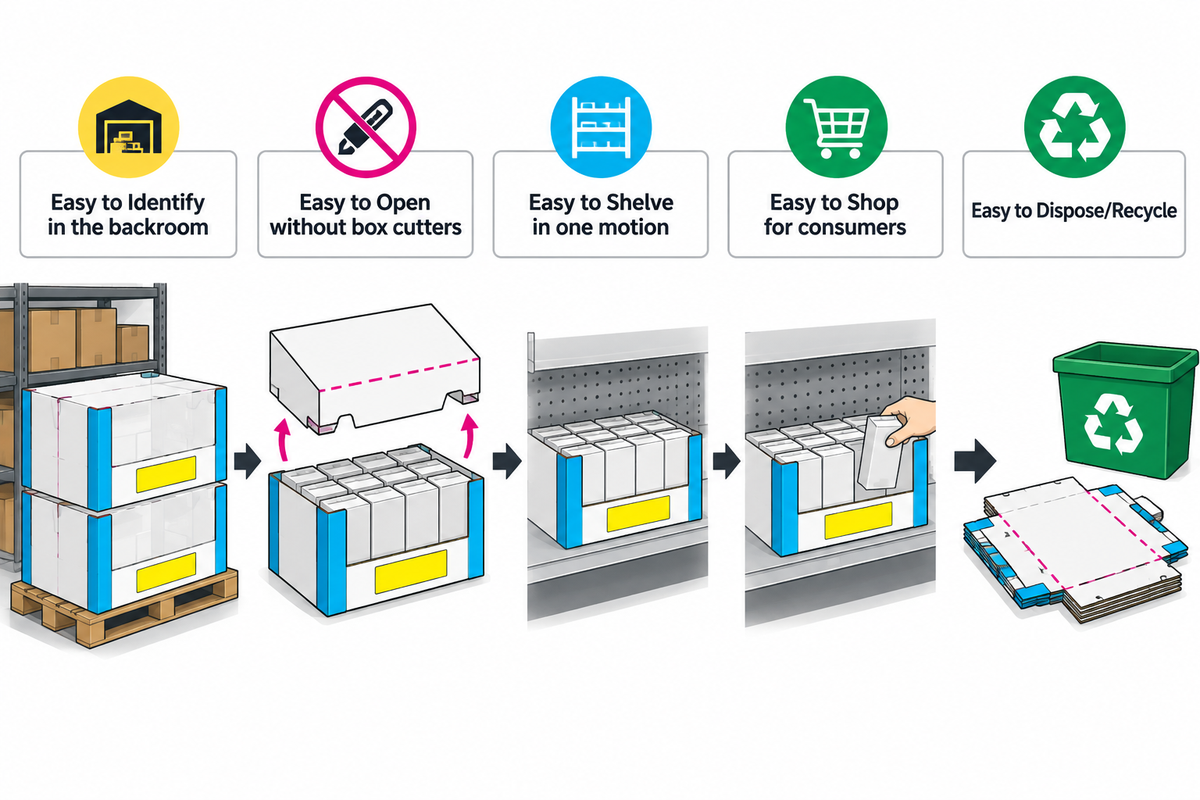
In the pharmaceutical, OTC, dietary supplement, and FMCG sectors, customized packaging has to execute on two high-speed mechanical stages. Initially, it has to work smoothly on cartoning machines at the filling plant; later, it has to withstand warehouse conveyors and store shelf environments. For more on crease-to-board stiffness ratios and carton style, check out our folding carton packaging guide.
On high-speed pharmaceutical and nutraceutical cartoning lines, flat pre-glued cartons are pulled from a magazine by vacuum cups and erected open along pre-broken score lines. They are then filled with blister packs or glass bottles along with a folded leaflet, closed by tuck flaps or hot-melt glue. If paperboard moisture or crease depth drifts outside tight tolerances during the packaging process, the carton resists opening and jams the line. Healthcare cartons also require smart packaging and serialization details, including unvarnished, high-contrast white zones for inline laser or inkjet 2D DataMatrix codes (GTIN, serial number, lot number, and expiry date). Depending on the class of the pharmaceutical product, rotary Braille embossing on SBS or FBB without breaking fibers, as well as other security features (tamper-evident glued ends or CR locks) may be required.
Once individual cartons are packed into secondary cases for club stores or supermarkets, retail chains increasingly mandate Shelf-Ready Packaging (SRP), also called Retail-Ready Packaging (RRP), a category that includes counter PDQ display boxes. Industry design guidelines structure SRP around five functional store tasks: Easy to Identify in the backroom, Easy to Open without box cutters, Easy to Shelve in one motion, Easy to Shop for consumers, and Easy to Dispose/Recycle. However, adding tear-open perforations creates a critical structural trade-off. As reported by Packaging World on automated distribution center forces, perforated shelf-ready packaging is particularly vulnerable because tear-open weak points can fail prematurely under mechanized depalletizers, clamp trucks, and high-speed conveyors. Engineers solve this by keeping perforation lines out of the primary vertical load-bearing corner posts and using a two-piece tray-and-hood construction or calibrated bridge-to-cut ratios. Under GS1 GTIN management rules, brands also issue a new GTIN barcode on the outer case whenever case pack quantities change or dimensional changes exceed standard thresholds.
Printing Methods and Surface Finishes: Matching Offset, Flexo, Digital, and Coatings to Industry Volumes
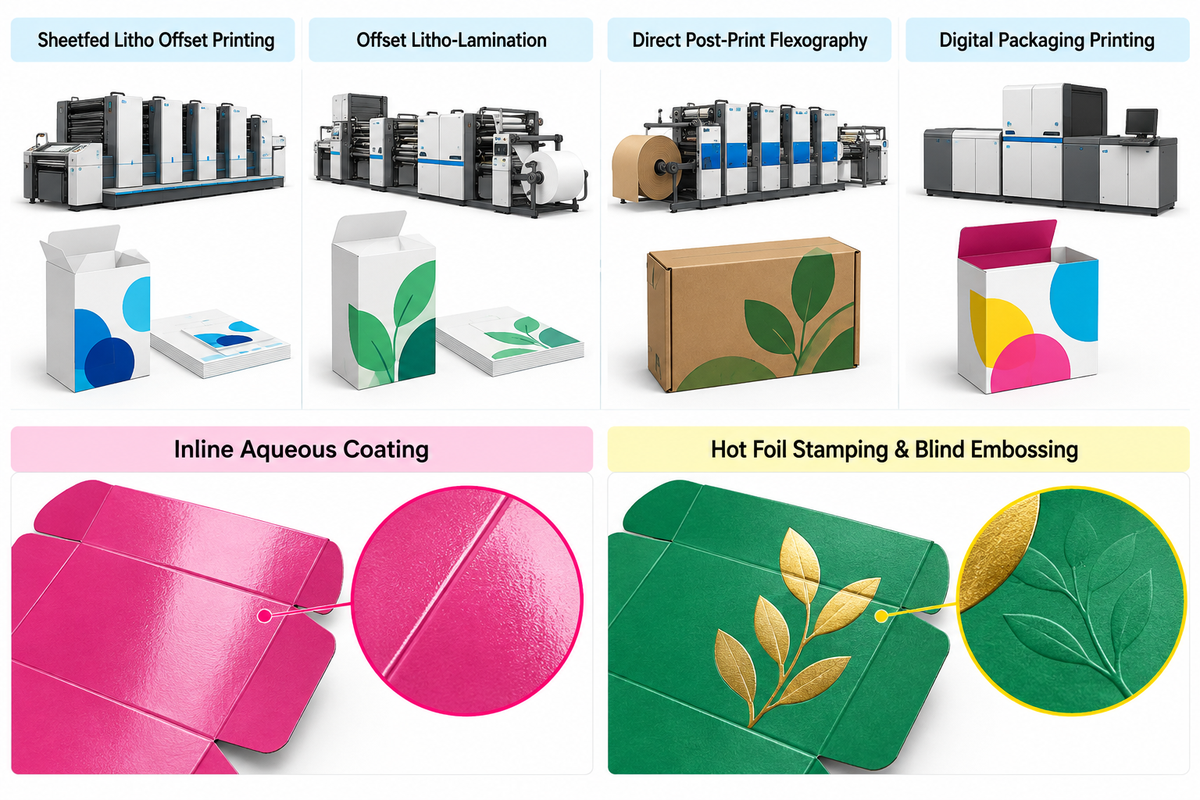
Mistaking the correct printing and packaging process or surface coating can also cause a well-designed dieline to fail. This can also result in visible flute washboarding and fold-line cracking on dark brand colors. Brands that coordinate primary packaging with retail shopping bags (see our printed paper bags guide) need consistent ink and finish behavior across formats.
First, balance advanced printing technology against artwork complexity and run volume. The efficiency of sheetfed lithographic offset makes it ideal for photographic gradation, crisp regulatory typography, and exact Pantone spot-color matching for folding cartons, rigid box wraps and litho-lamination top sheets. Direct flexographic printing uses a flexible photopolymer plate to print directly on corrugated board or kraft webs and is economical for large volume transit cartons with line art, though halftone dots are limited by flute pressure. Digital printing presses eliminate printing plates, making them ideal for small batch, seasonal promotional sleeves, and multi SKU flavor and fragrance variants.
Second, prevent score cracking and flute washboarding during finishing. Engineers testing solid ink and UV coating at the pressroom found that scoring and folding a printed sheet at 90 degrees will immediately show if a heavy ink build with brittle UV varnish will crack. Industry corrugated guides also warn that when liner moisture drops below 5–6%, cellulose fiber bonds become brittle and fracture along fold lines. Flute washboarding on litho-laminated corrugated boxes occurs when the top laminate is either too thin or too much laminating moisture is used. This causes the paper to sink into the valleys between flute tips, making it look “wavy.” Huandao’s in-house integration of pre-press, sheetfed offset printing, UV coating, film lamination, and die-cutting and folder-gluing allows them to engineer packages where the grains of paper are aligned with the primary fold. They also pair heavy C1S top liners over in-line E-flute or B-flute board and keep glue flaps free of varnish or film so side seams bond permanently.
Do I need to provide my own packaging design?
You don’t need to create structural CAD dielines from scratch. Certain manufacturers that provide free design dielines and structural design support will design a die-cut layout for you around your physical sample.
| Printing or Surface Finish Option | Process Mechanics | Visual & Protective Performance | Economic Volume Fit | Recyclability & Prepress Rule |
|---|---|---|---|---|
| Sheetfed Litho Offset Printing | 4-color CMYK + Pantone spot inks transferred via rubber blanket onto flat 10–36 pt paperboard sheets | High-resolution photographic detail, smooth solid flood coats, tight multi-color registration | Medium to long commercial production runs across folding cartons and 36–120 pt rigid wraps | Compatible with curbside paper recycling; requires aluminum litho plates per color |
| Offset Litho-Lamination | Offset-printed C1S top sheet laminated onto single-face or double-wall corrugated board | Combines folding-carton print quality with E, B, C, or BC corrugated structural strength (e.g., 32 ECT / 65 lb) | Medium to high runs for electronics, retail displays, subscription kits, and heavy gifts | Control glue moisture and liner basis weight to prevent flute washboarding and board warp |
| Direct Post-Print Flexography | Flexible photopolymer plates print water-based inks directly onto corrugated board | Clean line art, barcodes, and 1–3 color branding for transit and master cartons up to 75 in | High-volume shipping cartons and industrial outer cases (≤70 kg / 150 lb parcel class) | Fully repulpable with water-based inks; avoid excessive squeeze pressure that crushes flutes |
| Digital Packaging Printing | Plate-free piezo inkjet or toner printing directly onto 10–36 pt paperboard or corrugated sheets | Zero plate setup cost; enables variable data, QR serialization, and multi-SKU gang runs | Prototypes, pilot launches, and short multi-flavor or multi-SKU runs | Verify ink de-inkability and rub resistance with protective overcoat |
| Inline Aqueous Coating | Water-based clear protective varnish applied inline on the offset press | Fast drying, prevents stack ink set-off, and provides moderate scuff protection at 90° folds | Lowest-cost protective finish for folding cartons and litho-laminated top sheets | Does not impede standard municipal paper repulping; knock out glue flaps |
| UV Varnish & Spot UV | Ultraviolet-cured high-gloss polymer coating applied flood or via spot screen/flexo plate | High visual contrast and chemical/rub resistance; flood UV can crack on 90° scores if brittle | Cosmetics, retail display cartons, and luxury rigid box wraps (spot highlight) | Keep flood UV off score lines and glue flaps; test 90° fold cracking before mass run |
| BOPP Film Lamination (Gloss / Matte / Soft-Touch) | Thermal bonding of thin polypropylene film over the printed sheet prior to die-cutting | Bridges paper fibers across sharp 90° and 180° creases to eliminate score cracking (even near 5–6% liner moisture) | Luxury rigid boxes, dark matte cosmetic cartons, and heavy retail carriers | Plastic film layer limits standard curbside paper repulpability; qualify claims per FTC § 260.12 |
| Hot Foil Stamping & Blind Embossing | Heated brass or magnesium die presses metallic foil or 3D relief into 10–36 pt board or wrap stock | Delivers metallic reflectivity and tactile bevels that ink alone cannot replicate | Cosmetic cartons, spirits gift boxes, and 36–120 pt luxury rigid set-up boxes | Foil coverage generally remains compatible with repulping when kept to accent logos and borders |
Quality Control Testing and Sustainability Compliance: ECT, Burst, Ink-Rub, and Verifiable Recyclability Claims
Only verified engineering specifications on your production run provide brand protection. Federal truth-in-advertising guidance from the FTC’s Green Guides and the voluntary FSC chain-of-custody and trademark requirements also apply to environmental claims on sustainable custom packaging. Relying on a supplier’s mill certificate leaves the buyer vulnerable to humid-transit box crushing and enforcement by regulatory agencies.
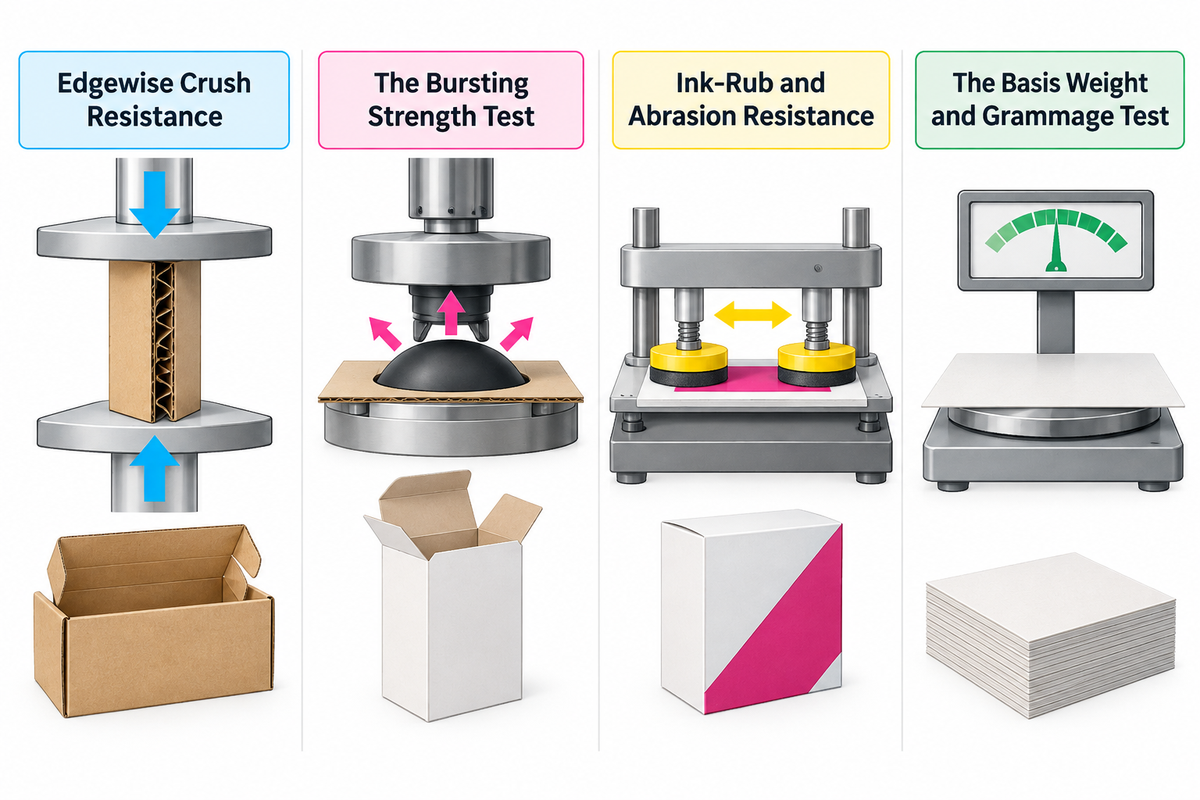
To test physical properties of corrugated and paperboard packaging, four standard laboratory tests form the core of incoming and pre-shipment verification protocols:
- Edgewise Crush Resistance (ECT — FEFCO Method 8 / TAPPI T811): Measures the vertical stacking load a fluted corrugated specimen sustains parallel to the flutes, predicting whether bottom-layer pallet cases will buckle in humid ocean containers.
- The Bursting Strength Test (FEFCO Method 4/ TAPPI T810) measures the hydraulic diaphragm rupture pressure across the walls of paperboard and corrugated and determines the resistance to mishandling and bursting forces.
- Ink-Rub and Abrasion Resistance (ASTM D5264-98(2019) Sutherland Rub Tester): Oscillates a weighted receptor pad across printed and coated specimens. It verifies that dark matte inks, metallic foils, and barcodes will not scuff during parcel vibration.
- The Basis Weight and Grammage Test (TAPPI T410) determines if the paperboard liner, medium, or folding carton stock meets the agreed GSM tolerance. As ISTA retesting guidance notes, packaged products should also be retested if there is a change to the product, internal cushioning, board specification or closure process, since these may affect the distribution performance of the packaged product.
Huandao claims that its in-house lab issues ECT/burst, ink-rub, and basis-weight tests on-site, so the reported numbers pertain to the customer’s production run, as opposed to an off-the-shelf sample. Additionally, Huandao indicates that every process step in its Xiamen plant is scanned into a MES (Manufacturing Execution System) kanban and reported in real-time, backed by intelligent scheduling and ERP.
On the environmental compliance side, two distinct sets of rules govern what brands may print on their boxes: federal regulatory guidance and voluntary certification standards. First, under the U.S. FTC Green Guides at 16 CFR 260.12 (Recyclable claims), unqualified recyclable claims are permitted only when recycling facilities serve a substantial majority (at least 60 percent) of communities where the item is sold. If any component—such as a plastic film lamination or non-paper foam insert—limits recyclability, the claim must be qualified. While U.S. EPA recycling data shows that paper makes up 23 percent of municipal solid waste and Americans recycled about 68 percent of the paper they used in 2018, laminated or grease-contaminated packaging requires qualified labelling. Second, under Forest Stewardship Council (FSC) Chain of Custody rules (FSC-STD-40-004 and FSC-STD-50-001), asking a printer to buy FSC-certified paperboard does not by itself authorize printing an on-product FSC logo on the finished carton. Unbroken Chain of Custody certification and trademark approval covering the converting plant are required.
How do I choose the right custom packaging company?
When comparing top custom packaging companies, choose a manufacturer that specializes in custom in-house production across pre-press, offset printing, coating, lamination, die-cutting, and folder-gluing lines. The plant must have an in-house lab which issues ECT, Burst, ink-rub, and basis weight test reports for lot-specific samples, as well as a Manufacturing Execution System (MES) to track and integrate multi-component kitting.
Do Specify Lot-Linked Lab Reports & Qualified Claims
- Require job-specific laboratory test reports for ECT, Burst, ink-rub (ASTM D5264), and TAPPI T410 basis weight. The tests must be performed on samples pulled from actual production.
- Qualify recyclability claims under 16 CFR 260.12 whenever boxes include BOPP film lamination, plastic windows, or non-paper foam inserts, and verify converter FSC Chain of Custody before printing on-pack FSC labels.
- Mandate unvarnished glue reserve strips on dielines and test 90-degree score folding on dark solid inks before approving mass production.
Don’t Rely on Broker Promises or Unverified Certificates
- Do not accept a trading company’s generic mill datasheet as proof that corrugated or folding cartons will survive sea freight and DC conveyors for mass production.
- Never skip retesting your assembled package after changing board grade, flute profile, or insert geometry when distribution hazards remain severe.
- Do not take for granted that an inner plastic pouch eliminates printing ink set off from an outer food carton for EU Regulation 2023/2006.
Total Landed Cost, MOQ Economics, and Consolidated Kitting: Specifying Primary Boxes, Inserts, and Outer Cartons Together
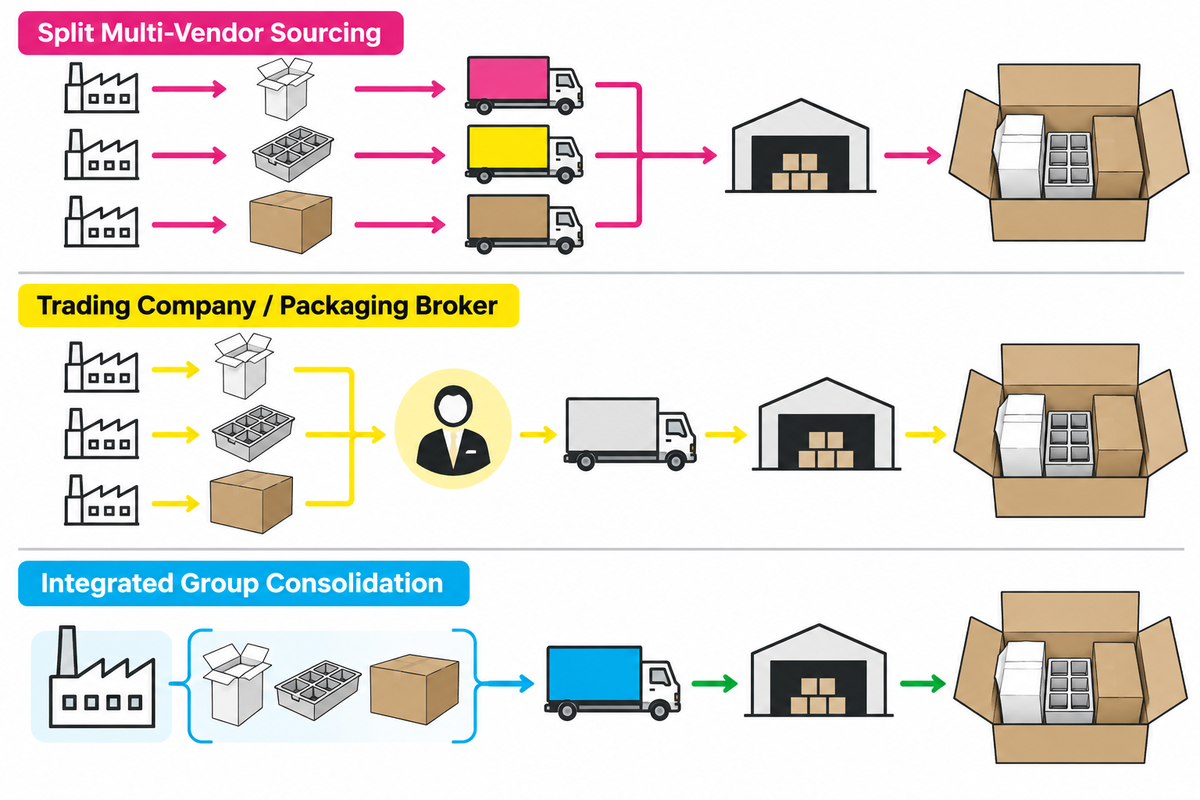
What impacts unit cost, tooling setup amortization, minimum order quantities and freight when working with custom folding cartons, corrugated mailers and rigid boxes in the global packaging market? In B2B procurement, headline FOB unit price is only one fraction of total packaging costs. As documented in worked international shipping calculations from iContainers on calculating landed cost, when a supplier charged $25 per unit, transportation, customs, and related expenses added approximately $6.67 per unit to total landed cost. In case data from AWI Logistics on kitting and fulfillment costs, even though engineered kitting increased per unit cost by $1.80, elimination of returns and reshipments saved $4.20 per kit. Remember unit cost of packaging, setup tooling, and freight varies by sheet nesting and order quantity and container cube utilization.
As per the cost-accounting principles in UF/IFAS Extension Publication FE1103, looking for custom boxes should consider direct variable costs (paperboard sheets, flute, lamination film, and inserts) separate from their allocated indirect costs (setup costs) for aluminum offset plates, flexo photopolymer plates, steel-rule cutting dies, brass hot-foil dies, and press makeready waste. It costs the same amount to prepare a sheetfed offset press and an automated folder-gluer for makeready, whether running a short pilot batch or a larger commercial production run. As such, fixed costs get amortized quickly over larger volumes.
A further substantial hidden cost occurs when brands break a product’s packaging across multiple packaging manufacturers. Sourcing the printed folding carton or rigid gift box from a color printer, the molded-pulp insert from a tray supplier, and the outer corrugated shipping carton from a box plant multiplies coordination overhead. But these split the shipper into three pieces and increase coordination cost. Multi-vendor splitting makes three separate domestic trucking bills, increases the risk of dimensional tolerance issues where an insert or inner box does not fit snugly within the outer shipper, and complicates LCL/FCL container consolidation.
Working with a vertically integrated manufacturing group that provides custom packaging services—custom packaging printing and inner cushioning trays and master shipping cases—eliminates multiple vendor problems. According to the company information provided by Huandao, Xiamen Huandao Packaging Technology Co., Ltd. was founded on 30 June 2003 in Xiamen, Fujian, China, with registered capital of RMB 20 million (RMB 20M). It offers custom packaging and makes custom packaging across a full range of custom printed paper packaging formats, including folding cartons (10 pt to 36 pt), litho-laminated printed boxes, and rigid gift boxes (36 pt to 120 pt). Huandao is the color-printing plant of Huan Yin Packaging Group, which was built around it and later added corrugated carton and protective packaging manufacturing. Brought together as Huan Yin Packaging Group in 2024, the group has passed RMB 200 million (RMB 200M) in revenue. Huandao is a recognized National High-Tech Enterprise, and the group is a President Unit of the Xiamen Printing Industry Association, guided by the values: Quality is Fundamental, Service is the Soul.
Huandao states its plant at No. 587 Tongfu Road, Tong’an District, Xiamen, Fujian, China operates as a manufacturing facility with 133 staff and is not a trading office. Pre-press, sheet fed offset printing, UV coating, lamination, die cutting, folder gluing, and in-line single E-flute and single B-flute corrugation (plus A, C, F and BC profiles) are all done in house. Because Huandao is part of Huan Yin Packaging Group, inner trays and protective inserts, and outer cartons for the same product, can also be supplied along with the printed box in a shared-freight shipment.
Ready to translate your technical specifications into structural dielines and production quotes from a factory that can offer custom kitting? Check out our Customized Product Packaging solutions by Industry to identify your vertical and connect with our Xiamen Engineering Team directly.
| Packaging Procurement Model | Tooling & Setup Structure | Dimensional & Color Coordination | Inbound Freight & Container Cube | Quality Accountability |
|---|---|---|---|---|
| Split Multi-Vendor Sourcing (Separate Box, Insert, and Shipper Vendors) | Separate dieline engineering and setup fees across uncoordinated suppliers | High risk of cavity tolerance mismatch and shade drift between primary box and carrier | Triple domestic drayage fees and fragmented LCL ocean freight billing | Disputed responsibility between carton printer, insert molder, and master-carton plant when transit damage occurs |
| Trading Company / Packaging Broker | Opaque bundled unit pricing that hides subcontracted plate and die markups | Subcontracted across shifting workshops; inconsistent board furnish between reorders | Consolidates paperwork but adds broker margin on both product and logistics | No direct MES shop-floor visibility; relies on third-party spot checks rather than in-house job lab reports |
| Integrated Group Consolidation (Printed Box + Inner Tray/Insert + Outer Carton) | Single CAD engineering team designs the primary carton, insert cavity, and master shipper simultaneously | Exact stack-up fit tested prior to die fabrication; calibrated D50 color control across components | Flat-packed cartons, nested inserts, and master shippers consolidated into one shared-freight container | Unified group quality workflow backed by job-specific lab reports (ECT/burst, ink-rub, GSM) and real-time MES tracking |
Key Engineering Takeaways for Cross-Industry Packaging Buyers
- Use the 5-Variable Industry Packaging Matrix to balance payload weight, fragility, barrier class, transit route, and run economics to your format, either 10-36 pt folding cartons, E/B/BC-flute litho-laminated boxes, or 36-120 pt rigid boxes.
- Match Standards to Sector Risks: Specify 21 CFR 176.170/176.180 compliance for food-contact paperboard and EU 2023/2006 set-off controls for food packaging inks. Pair ISO 3664 D50 viewing for cosmetics, ISTA 3A and DIM-weight calibration for e-commerce mailers, and FEFCO ECT vs. Mullen burst ratings for electronics.
- Verify Lot-Specific Lab Proof and Compliant Claims: Request ECT, burst, ASTM D5264 ink-rub, and TAPPI T410 basis weight test reports for production runs, and validate recyclability or FSC claims in accordance with 16 CFR 260.12 and FSC Chain of Custody.
- Consolidate the Complete Kit: Reduce tolerance errors and lower landed cost of freight by having primary shipping containers, including boxes, trays, and inserts, shipped together as a single group.
Copyable 10-Field Cross-Industry Packaging RFQ Specification Checklist
Copy and fill in the ten engineering fields below when requesting equivalent factory quotes for branded custom product packaging, especially when making multi-vendor requests:
- Industry Vertical and Product Profile: State product category (cosmetics, food/beverage, e-commerce apparel, electronics, pharma/supplements, or industrial hardware), net product weight (g or kg), and external product dimensions (L × W × H in mm).
- Packaging Architecture and Style Code: Specify folding carton (reverse tuck, auto-lock bottom, snap-lock), litho-laminated corrugated (FEFCO 0427 mailer, 0201 RSC, PDQ tray), standard rigid box, or collapsible rigid box.
- Substrate Grade and Caliper or Flute Profile: Indicate type of paperboard (i.e., SBS, FBB/C1S, CUK/SUS, CRB/CCNB) along with GSM and point caliper. For corrugated or rigid styles, indicate flute profile (E, B, C, F, BC) along with ECT/burst rating or greyboard thickness (mm).
- Internal Restraint and Insert Specification: Folded paperboard cradle, corrugated partition, wet- or dry-pressed molded fiber tray, die-cut EPE/EVA foam, or electrostatic-dissipative insert.
- Barrier and Regulatory Requirements: State direct vs. indirect food contact (21 CFR 176.170/176.180 paperboard compliance and EU 2023/2006 low-migration set-off control), child-resistant closure, or 2D barcode serialization zone.
- Printing Process and Color Standard: Specify sheetfed offset, direct flexo, or digital print; state CMYK + Pantone spot color count (exterior and interior), and require color approval under ISO 3664 D50 viewing conditions.
- Surface Protection and Decorative Finishes: Specify inline aqueous varnish, UV coating, Spot UV, Matte/gloss/soft-touch BOPP film lamination, hot foil stamping, and embossing, plus unvarnished glue-flap knockouts.
- Distribution Route and Transit Test Target: Indicate whether boxes ship palletized in master cases or individual parcels (ISTA 3A drop/vibration target, carrier DIM weight cap).
- Mandatory Lot-Specific Lab Reports and Certifications: Require ECT, Mullen burst, ASTM D5264 ink-rub, TAPPI T410 basis weight, and FSC Chain of Custody certificate number (if on-pack FSC is required).
- Order Volume, Sampling and Consolidated Kitting: State target quantity per SKU, white CAD sample + wet press proof requirement, and whether primary printed boxes, inner inserts, and outer master shipping cartons should be quoted as one consolidated shipment.
Frequently Asked Questions
What is custom packaging, and why does it matter for my brand?
Custom packaging relies on a specific product’s dimensions, weight, fragility, regulatory considerations, and distribution to determine carton design instead of using standard stock cartons. This results in more effective use of board grades and internal inserts, and reduces damage during shipment and dimensional-weight shipping. It can also satisfy the requirements of food and pharmaceuticals. In addition, structural dielines and calibrated D50 color control deliver consistent shelf and unboxing recognition across retail and e-commerce channels.
Is custom packaging worth it for small businesses?
Yes, provided the structural format and printing method match order quantity and unit economics of the business. Emerging brands can pair low tooling dielines structures, such as E-Flute mailers and reverse-tuck folding cartons with digital printing to eliminate multi-plate offset charges. As order volume grows, brands can then transition to high-speed sheetfed offset or litho-lamination.
How long does custom packaging take to produce?
CAD dieline engineering and unprinted white structural samples typically take a few days; total turnaround to finished boxes then adds printed press proofs or wet samples plus mass production through printing, coating, die-cutting, and folder-gluing. Precise timing of the above steps is impacted by the approval cycle for cutting-dies or tooling, and by pre-production consolidation of multi-component packaging kits.
Which packaging company has the lowest minimum order?
Digital corrugated and carton presses have the lowest minimum order quantities, as the absence of plates in the digital process allows short run lengths without the cost of offset plates.
What is the cheapest custom packaging company?
An integrated manufacturing plant that produces primary printed boxes, inner trays and outer shipping cases and consolidates them into one shared-freight shipment, lowers the total landed cost. In contrast, assessing suppliers based on the headline unit cost doesn’t account for various broker commissions, independent tooling charges, uncalibrated board grades, and split domestic and ocean shipping costs.
Want interactive packaging?
Interactive packaging uses structural mechanics (i.e. slide-out drawers, tear strips, and multi-compartment trays) in combination with high-contrast GS1 QR Codes to support traceability, dosing, and reorders.
Not ready to commit to custom boxes?
When the final dimensions of a new product are still being validated, you can source CAD-cut unprinted white samples in your target paperboard caliper and corrugated flute profile, for physical samples. White samples can be used for drop tests, vibration tests and pallet stacking tests. You can also source a single unprinted integrated corrugated or folding mailer to create a master carton and subsequently vary internal dividers to realize economies of scale.
References & Sources
- Paperboard Packaging Council (PPC) — What is Paperboard Packaging? (10 to 36 point folding cartons in SUS, SBS, CUK, CRB, and FBB shipped flat; E, F, G, and N mini-flute; 36 to 120 point rigid set-up boxes overlaid with printed wrap).
- Paperboard Packaging Council (PPC) — 4 Types of Paperboard (Solid Bleached Sulfate SBS, Coated Unbleached Kraft CUK, Folding Boxboard FBB, and Coated Recycled Board CRB end-use industry classifications).
- U.S. Code of Federal Regulations — 21 CFR 176.170: Paper and Paperboard in Contact with Aqueous and Fatty Foods (Food Types I–IX, Conditions A–H, 1.6 percent resin limit, and 21 CFR 176.180 reference).
- European Union EUR-Lex — Commission Regulation (EC) No 2023/2006 on Good Manufacturing Practice (Annex A rules preventing printing-ink transfer through substrates or by stack set-off).
- National Institutes of Health (NIH) PubMed Central — Food Packaging and Chemical Migration: A Food Safety Perspective and ScienceDirect — Chemical Migration from External Printed Components
- Virginia Tech Center for Packaging and Unit Load Design (CPULD) — Reusable Apparel Packaging in E-Commerce (ISTA 3A distribution testing across five e-commerce apparel packaging solutions).
- International Safe Transit Association (ISTA) — Procedure Changes & Development and When Should a Packaged-Product Be Retested? (ISTA 3-series parcel delivery procedures and retesting guidance upon product or material changes).
- European Federation of Corrugated Board Manufacturers (FEFCO) — FEFCO Testing Methods & Recommendations (Method 4 Bursting strength and Method 8 Edgewise crush resistance ECT) and Crown Packaging Mullen vs. ECT Specification Table.
- ASTM International — ASTM D5264-98(2019): Standard Practice for Abrasion Resistance of Printed Materials by the Sutherland Rub Tester (Laboratory evaluation of ink and coating rub resistance on flat printed packaging).
- U.S. Federal Trade Commission (FTC) — 16 CFR 260.12: Guides for the Use of Environmental Marketing Claims (Recyclable Claims) and U.S. EPA — How Do I Recycle Common Recyclables.
- Forest Stewardship Council (FSC) — Chain of Custody Certification (FSC-STD-40-004 & FSC-STD-50-001) (Requirements for applying on-product FSC labels to finished packaging).
- X-Rite — ISO D50 Illumination and M-Standards for Packaging Color Evaluation and USPTO Patent US8573471B2 — Foldable Box.
- Packaging World — As Walmart DCs Automate, Pack Developers Face New Forces, New Standards and Grand View Research — Low-Carbon Footprint Packaging Market Report.
- University of Florida IFAS Extension — Publication FE1103: Product Costing, AWI Logistics — Kitting Services Fulfillment Costs, and iContainers — Landed Cost Calculation Guide.
HUANDAO PACKAGING INSIGHTS
About Huandao Packaging Insights
Huandao Packaging manufactures folding cartons, litho-laminated printed boxes and rigid gift boxes, and also supplies paper bags, retail displays and protective inserts.
Our guides help buyers compare packaging options and prepare a clearer brief before requesting a quote.
Packaging families
Board, print and finish
Artwork, dieline and sample review
Delivery planning
PROJECT DISCUSSION
Talk with the Huandao Team
- Company
- Xiamen Huandao Packaging Technology Co., Ltd.
- Quote input
- Dimensions, filled weight, quantity, artwork or dieline, finish and destination.
- Review scope
- Box, insert and delivery requirements.
- Next step
- Bring the available details to a packaging conversation.